Design Rules for Discovering 2D Materials from 3D Crystals
by
Eleanor Lyons Brightbill
Collaborators: Tyler W. Farnsworth, Adam H. Woomer, Patrick C. O'Brien, Kaci L. Kuntz
Senior Honors Thesis Chemistry
University of North Carolina at Chapel Hill
April 7th, 2016
Approved:
Abstract
Two-dimensional (2D) materials are championed as potential components for novel technologies due to the extreme change in properties that often accompanies a transition from the bulk to a quantum-confined state. While the incredible properties of existing 2D materials have been investigated for numerous applications, the current library of stable 2D materials is limited to a relatively small number of material systems, and attempts to identify novel 2D materials have found only a small subset of potential 2D material precursors. Here I present a rigorous, yet simple, set of criteria to identify 3D crystals that may be exfoliated into stable 2D sheets and apply these criteria to a database of naturally occurring layered minerals. These design rules harness two fundamental properties of crystals—Mohs hardness and melting point—to enable a rapid and effective approach to identify candidates for exfoliation. It is shown that, in layered systems, Mohs hardness is a predictor of inter-layer (out-of-plane) bond strength while melting point is a measure of intra-layer (in-plane) bond strength. This concept is demonstrated by using liquid exfoliation to produce novel 2D materials from layered minerals that have a Mohs hardness less than 3, with relative success of exfoliation (such as yield and flake size) dependent on melting point.
Introduction
of stable 2D materials is limited to a relatively small number of material systems and structure types. In order to continue expanding the field of 2D materials, a clear set of criteria for exploring other 2D material candidates is needed.
While much progress has been made in exploring 2D systems, only a few crystal types are represented.3 Previous efforts to expand the library of 2D material systems have relied on computer-based techniques. For example, Revard and Collegues created a grand-canonical evolutionary algorithm to determine the structure of novel 2D materials. The algorithm used first-principles total-energy methods to identify new low-energy (i.e. stable) 2D structures and they showed that their method worked to reproduce known 2D structures of Sn-S and C-Si.4 However, the algorithm relies on inputs of a specific composition space. While useful, this algorithm can only find a potential structure if the atomic composition is searched, and therefore ignores the wealth of information available from naturally occurring layered minerals. Lebegue and colleagues addressed this issue by applying a filtering algorithm to the International Crystallographic Structural Database (ICSD), identifying 92 possible 2D structures from 3D precursors and verified their technique by “predicting” the known 3D layered systems of graphene and hexagonal boron
nitride.5 However, any structure that was not high-symmetry with square or hexagonal in-plane structures was automatically excluded, which eliminated a large portion of the structures within the ICSD. Since this limitation prevented a full exploration of layered minerals as potential candidates, an overall simpler, more inclusive, and generally applicable set of design rules for identifying potential 2D materials is needed.
is an indication of the strength of inter-layer interactions, suggesting that an ideal precursor for exfoliation is a material with a high melting point and low Mohs hardness value. We propose that Mohs hardness is a valid indicator of the exfoliation potential of a layered mineral, with softer minerals corresponding to weaker interlayer interactions (and higher potential of exfoliation) and harder minerals to stronger interactions. Furthermore, the high in-plane bonding strength of minerals characterized by a high melting point will likely produce large, stable 2D flakes whereas lower melting point minerals will produce flakes with smaller lateral dimensions. We validated these hypotheses by first applying a data mining approach to a set of layered minerals and separating candidates based on their Mohs hardness. With this list of candidates in hand, we then designed three key experiments to test our predictions in the laboratory. Our results indicate that, unlike previous claims, melting point is not a good predictor of exfoliation potential, but rather Mohs hardness provides a better indication as to whether a material may be exfoliated into stable 2D form.6
Methods
Data Mining
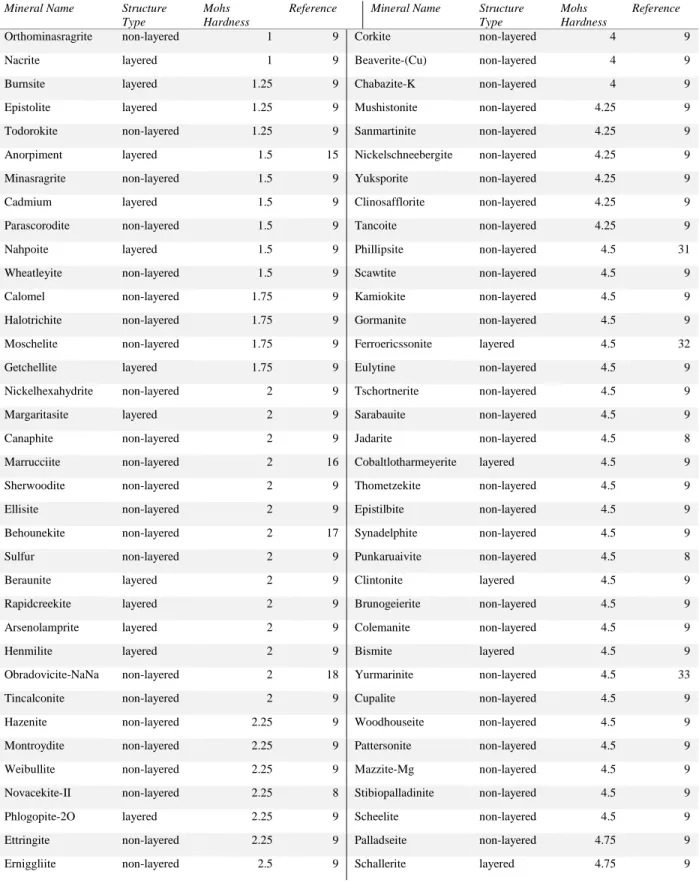
Table A1 in the Appendix. Of the 400 minerals, 47 were excluded because hardness data was not available. The crystal structure of each remaining mineral was constructed in Accelrys’ Materials Studio from the most recent unit cell data available in the AMCSD. A mineral was designated as layered if there existed stacks of continuous, nonintersecting surfaces across which no covalent bonds are formed.
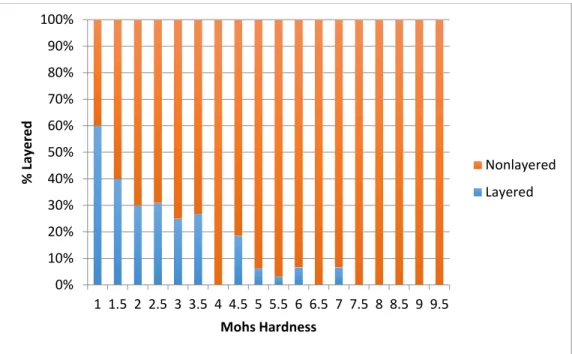
Analysis of the 400 mineral subset served to approximate the prevalence of layered systems across the full spectrum of the Mohs hardness scale and showed that the majority of layered minerals are technically classified as softer materials (Mohs = 1 to 3). This realization helped establish a “cutoff value” of Mohs hardness that we then used to focus our search and
characterization of probable layered structures (Figure 1). Once this cutoff was known, we used webmineral.com to provide an initial list of minerals with Mohs hardness less than or equal to
three.9 The structural parameters of these minerals were determined from the literature. Once the layered minerals were identified, hardness values were verified with secondary sources and melting points were found, if available.
Materials Studio was used to build the crystal structures of layered minerals for which unit cell information and hardness values were available. Interlayer bonding between layers was classified as either van der Waals (vdW), hydrogen (H-bond), or ionic bonding and was determined from an analysis of the chemical structure. In cases of ambiguity, the bonding type was confirmed from other sources. The Materials Studio close contacts tool was also used to determine the shortest distance between atoms on adjacent layers.
Mineral and Solvent Selection
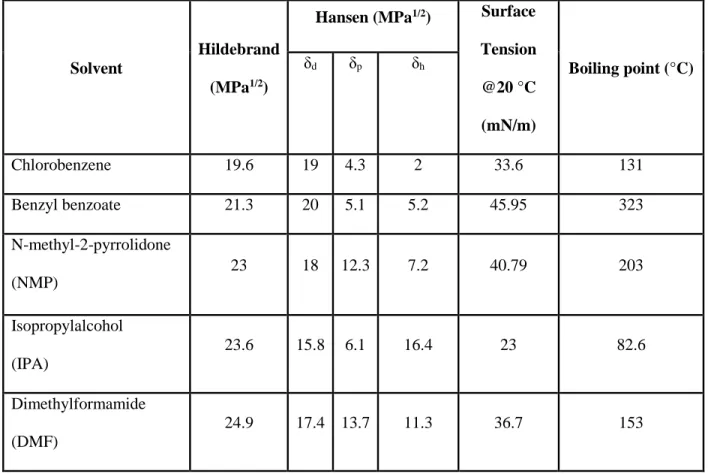
exfoliation of hydrogen-bonded minerals were additionally dried with molecular sieves. Since exfoliation success is largely dependent on the interaction between the mineral and the solvent, five solvents with a wide range of Hildebrand and Hansen solubility parameters were selected for the study. Each vdW mineral investigated was exfoliated in each of the 5 solvents.
Table 1. Parameters of solvents for vdW mineral exfoliations.
Solvent
Hildebrand (MPa1/2)
Hansen (MPa1/2) Surface Tension @20 °C (mN/m)
Boiling point (°C)
δd δp δh
Chlorobenzene 19.6 19 4.3 2 33.6 131
Benzyl benzoate 21.3 20 5.1 5.2 45.95 323
N-methyl-2-pyrrolidone
(NMP)
23 18 12.3 7.2 40.79 203
Isopropylalcohol
(IPA)
23.6 15.8 6.1 16.4 23 82.6
Dimethylformamide
(DMF)
24.9 17.4 13.7 11.3 36.7 153
2D Material Preparation
temperature between 22 and 30 °C. The resulting solutions were analyzed by TEM to identify which solvents led to exfoliation, if any. The identity of thin sheets was verified by electron diffraction. Solutions of 2 mg/mL were made in the successful solvents and sonicated for 10 hours. The resulting solutions were transferred to Nalgene Oak Ridge FEP 10-mL centrifuge tubes and centrifuged at 15,000 rpm in a Sorvall RC-5B superspeed refrigerated centrifuge (rotor radius 10.7 cm). The supernatant was subsequently removed and replaced with IPA. The solvent transfer process was repeated three times to completely remove the starting solvent, and the final solutions were analyzed via TEM. The solvent transfer step was completed to reduce the presence of organics on the TEM grid and allow for shorter grid drying time. If large aggregates were observed on the TEM grid, the solutions were diluted to allow individual flakes to be imaged.
Transmission Electron Microscopy (TEM)
For imaging, 0.8-1.0 μL of solution was drop-cast onto a 300 mesh lacy carbon grid (Ted Pella) in the glovebox and allowed to dry. A JEOL 100CX II TEM was used for low resolution imaging. The TEM was operated at 100 kV accelerating voltage and had a resolution of 2 Å (lattice) and 3 Å (point to point). A charge-coupled device (CCD) camera was used to acquire all TEM images.
TEM Image Analysis
In order to improve image quality for analysis, an image averaging and background subtraction procedure was developed. Each final image used for contrast analysis is the average of 6 background-subtracted images. Background images were collected from the vacuum between the carbon grid at an intensity similar to the images.
approximating the flakes as simple rectangles and triangles. Contrast analysis was accomplished by computing the difference between the average of 300 pixels from both the flake surface and representative background.
Results
Figure 1. Prevalence of layered structures across the Mohs hardness scale from AMCSD subset.
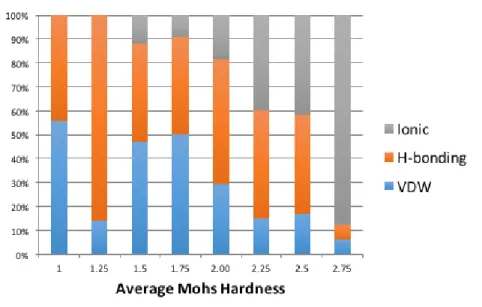
Furthermore, the Mohs hardness of a layered structure can be used to estimate the strength of interlayer binding. Data from the layered minerals discovered from the webmineral.com list was used to create Figure 2 below. As shown in Figure 2 (top), the prevalence of weak interlayer bonding (vdW) decreases with higher Mohs hardness values: vdW-bonded systems comprise more than 50% of minerals with Mohs = 1 but drops to less than 10% when Mohs = 2.75. To further probe the relationship between hardness and interlayer binding strength, the interlayer distance is plotted versus Mohs hardness in Figure 2 (bottom), separated by bonding type. Here, the distance is determined as the shortest atom-to-atom contact distance between layers and is generally shorter for stronger bonding. It is clearly shown that minerals with vdW bonding are associated with larger interlayer distances than minerals with stronger interlayer bonding.
0% 10% 20% 30% 40% 50% 60% 70% 80% 90% 100%
1 1.5 2 2.5 3 3.5 4 4.5 5 5.5 6 6.5 7 7.5 8 8.5 9 9.5
%
Layer
e
d
Mohs Hardness
Figure 2. Top: Prevalence of interlayer bonding type by Mohs Hardness. Bottom: 3D histogram showing prevalence of hardness and layer separation by bonding type.
high melting points, the layers are held together by weak vdW forces, allowing them to slide easily relative to one another. Of the layered minerals we have identified, we find no direct correlation between hardness and melting point.
Figure 3. Mohs hardness generally correlates with melting point, but the trend does not hold for layered minerals.
From the data above, it is a reasonable hypothesis that Mohs hardness will determine how easily a layered mineral can be exfoliated due to a relationship with interlayer bonding strength. Similarly, melting point will determine the ultimate lateral size of an exfoliated flake since minerals with stronger in plane bonds should break into fewer pieces during the physical stress of liquid exfoliation. These hypotheses are confirmed with both experimental and literature data by comparing the exfoliation minerals with the same Mohs hardness but different melting points, and minerals with the same melting point but different Mohs hardness. Furthermore, it is shown that H-bond minerals without interlayer water can be exfoliated given a properly low Mohs hardness.
R² = 0.73499
R² = 0.00145
0 1 2 3 4 5 6 7 8 9 10
0 1000 2000 3000 4000 5000
M
o
h
s
H
ar
d
n
e
ss
Melting Point (0C)
Non-layered Minerals Graphite
MoS2 hBN
Experiment 1: Same Mohs hardness, different melting point
We predict that Mohs hardness is a good indicator of the ability to exfoliate stable monolayers from a bulk material. Moreover, the ability to exfoliate a layered mineral to a stable monolayer does not depend strictly on melting point. However, lower melting point minerals should yield flakes with smaller lateral dimensions than flakes exfoliated from higher melting point materials.
Two minerals that have not been previously exfoliatiated, Orpiment and Pyrophyllite, were selected to further support this claim. Both minerals have a Mohs hardness of 1.75, but melting points of 320 °C and 800 °C, respectively, and were exfoliated in the five solvents as described above. From this preliminary study, Orpiment was found to exfoliate best in dimethyl formamide and Pyrophyllite was found to exfoliate best in chlorobenzene. All data presented is from these two solvents. While I do show that both materials may be exfoliated in these solvents, it may be important to note that Pyrophyllite does not remain suspended in chlorobenzene while some of the Orpiment will remain in the dimethyl formamide, suggesting that the disparities in exfoliation success are even greater than presented here.
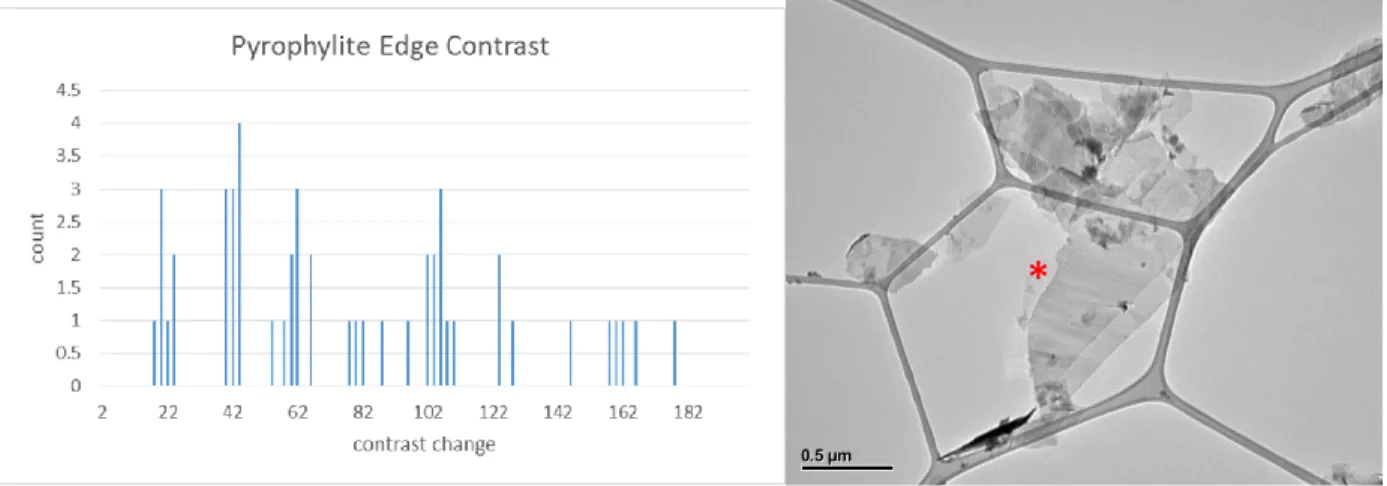
Figure 4. Left: Contrast change histogram for Pyrophyllite. Right: Red star marks a monolayer region of the flake.
Representative thin flakes of Pyrophyllite and Orpiment are shown below. Electron diffraction was used to confirm the atomic structure of the thin flakes. Qualitatively, the exfoliation of Pyrophyllite resulted in a significantly higher yield of thin flakes, while the exfoliation of Orpiment left many small, thick pieces.
Figure 5. Thin flakes of Pyrophyllite (left) and Orpiment (right).
In order to describe the differences in flake distributions, twenty flakes of each mineral were randomly selected, excluding bulk pieces and particulate matter (smaller than 0.01 μm2 in
0.5 µm 0.5 µm
*
1 µm
layers, the thickness that represented the largest area of the flake was used. The results of this analysis is shown in Table 2 below. In agreement with the hypothesis that melting point will predict lateral size, the typical area for an Orpiment flake is significantly smaller than that of Pyrophyllite while the thickness is noticeably larger. However, Orpiment was still successfully exfoliated to stable few-layer sheets despite its low melting point, just with a much lower yield.
Table 2. Thickness and surface areas of Pyrophyllite and Orpiment flakes.
Pyrophyllite Orpiment
# Layers Area (μm2) # Layers Area (μm2)
4 2.75 7 9
2 0.23 5 0.16
4 3.30 27 0.80
7 0.72 10 0.85
10 7.60 11 0.27
3 1.20 12 0.07
6 12.60 16 0.18
6 34.60 21 0.18
6 2.90 10 4.80
5 1.30 12 2.00
5 0.18 10 9.00
8 0.19 10 1.60
5 8.10 11 1.20
4 1.50 10 1.30
8 0.17 11 5.00
2 0.20 11 7.80
13 0.15 4 0.04
1 0.03 6 1.50
2 0.01 18 0.25
6 5.60 25 0.03
Average 4.17 Average 2.30
was still successfully exfoliated to stable few-layer sheets despite its low melting point, just with a much lower yield.
Figure 6. Thickness of Pyrophyllite and Orpiment flakes.
Experiment 2: Same melting point, but different Mohs hardness
If Mohs hardness is a measure of interlayer binding strength in layered systems, there should be a cut-off point above which minerals may no longer be exfoliated. To investigate this claim, two minerals with similar melting points (within 30 °C) but different Mohs hardness were selected. Berndtite (SnS2) and Antimony have melting points of 600 °C and 630 °C,
respectively, but Mohs hardness values of 1.5 and 3.25. Based on our predictions, we would expect Berndtite to produce stable 2D flakes while exfoliation of Antimony would result in bulk-like flakes with small lateral dimension. We found that Berndtite has previously been
successfully exfoliated in a 1:4 IPA/water mixture.13 Our own experiments demonstrated that Antimony was not able to exfoliated into 2D form, despite using solvents covering a wide range
0 1 2 3 4 5 6
1 2 3 4 5 6 7 8 9 10 11 12 13 14 15 16 17 18 19 20 21 22 23 24 25 26 27
Cou
n
ts
# Layers
Orpiment
of Hansen solubility parameters, suggesting that the interlayer interactions in Antimony are too great to be overcome by a simple liquid exfoliation protocol (Table 1).
Figure 7. TEM images of Antimony from each selected solvent.
Experiment 3: Exfoliation of Hydrogen-bonded material
Although liquid exfoliation of vdW and several ionic systems has been previously demonstrated, exfoliation of minerals with interlayer hydrogen bonding (non water-based) has not been demonstrated to the best of my knowledge.14 Several of our candidates include some degree of hydrogen bonding between the layers, often without interlayer water present in the crystal structure. Hydrogen bonds are a particularly strong dipole interaction, and therefore H-bond minerals fall higher on the Mohs scale than most vdW solids (Figure 2). However, these
1 µm
1 µm
0.5 µm
0.5 µm
0.2 µm
0.2 µm
0.2 µm
0.2 µm 0.5 µm0.5 µm
A
B
C
E
D
A:
N-methyl-2-pyrrolidone
B:
Isopropyl alcohol
C:
Chlorobenzene
D:
Benzyl Benzoate
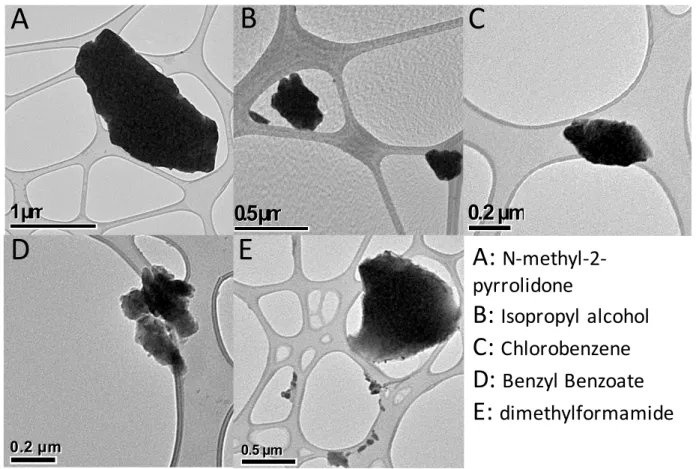
minerals can, in fact, be exfoliated. We show in Figure 7 that Brucite, [Mg(OH)2] (Mohs 2.75, MP=350 °C), may be successfully exfoliated in dried acetone. It is important to note that Brucite is another material with a low melting point that can be successfully exfoliated.
Figure 7. TEM images of Brucite exfoliated in acetone
While we successfully demonstrate that Brucite, a hydrogen bonded mineral, can be exfoliated, there are several challenges to overcome. Hydrogen bonded minerals typically have a non-negligible degree of solubility in water, and most solvents with a large hydrogen bonding Hansen parameter—and therefore most ideal for exfoliating hydrogen bonded systems—are difficult to thoroughly dry. Exfoliation of Gibbsite [Al(OH)3] (Mohs 2.75, MP=2035 °C) was also attempted but was unsuccessful in acetone, methanol, ethanol, and 1-propanal, most likely due to the high solubility of the mineral in these particular solvents.
Based on our design rules, we have identified over 400 minerals that are likely candidates for being exfoliated into stable 2D flakes. A full list of identified layered candidates with appropriate Mohs hardness values is included as Table A2 in the Appendix.
0.5 µm
Conclusions
In this work, we have demonstrated the effectiveness of using the Mohs hardness scale as
References
1. Novoselov, K. S.; Geim1, A. K. Morozov, S. V.; Jiang, D.; Zhang, Y.; Dubonos, S. V.; Grigorieva1, I. V.; Firsov, A. A. Electric Field Effect in Atomically Thin Carbon Films. Science 2004, 306, 666-669
2. Guptaa, A.; Sakthivela, T.; Seala, S. Recent development in 2D materials beyond graphene. Progress in Materials Science 2015, 73, 44-126
3. Mas-Balleste, R.; Gomez-Navarro, C.; Gomez-Herrero, J.; Zamora, F. 2D materials: to graphene and beyond. Nanoscale 2011, 3, 20-30.
4. Revard, B. C.; Tipton, W. W.; Yesypenko, A.; Hennig, R. G. Grand-canonical
evolutionary algorithm for the prediction of two-dimensional materials. Physical Review B 2016, 93, 054117.
5. Lebègue, S.; Björkman, T.; Klintenberg, M.; Nieminen, R. M.; Eriksson, O. Two-Dimensional Materials from Data Filtering and Ab Initio Calculations. Phys. Rev. X
2013, 3, 031002
6. Geim, A. K.; Grigorieva, I. V. Van der Waals heterostructures. Nature 2013, 499, 419-425.
7. Downs, R.T; Hall-Wallace, M. The American Mineralogist Crystal Structure Database. American Mineralogist 2003, 88, 247-250.
8. Anthony, J. W.; Bideaux, R. A.; Bladh, K. W.; Nichols, M. C. Handbook of Mineralogy, Mineralogical Society of America, Chantilly, VA 20151-1110, USA 2011.
9. Barthelmy, D. Webmineral Mineralogy Database. http://webmineral.com/ 2015. 10.Woomer, A. H.; Farnsworth, T. W.; Hu, J.; Wells, R. A.; Donley, C. L.; Warren, S. C.
Phosphorene: Synthesis, Scale-Up, and Quantitative Optical Spectroscopy. ACS Nano
2015, 9, 8869–8884
11.Tabor, D. Mohs's hardness scale-a physical interpretation. Proceedings of the Physical Society.Section B 1954, 67, 249.
12.Railsback, L. B. Some fundamentals of mineralogy and geochemistry. www.gly.uga.edu/railsback 2006.
13.Shen, J.; He, Y.; Wu, J.; Gao, C.; Keyshar, K.; Zhang, X.; Yang, Y.; Ye, M.; Vajtai, R.; Lou, J.; Ajayan, P. M. Liquid Phase Exfoliation of Two-Dimensional Materials by Directly Probing and Matching Surface Tension Components Nano Letters 2015, 15, 5449–5454, DOI: 10.1021/acs.nanolett.5b01842
14.Nicolosi, V.; Chhowalla, M.; Kanatzidis, M. G.; Strano, M. S.; Coleman, J. N. Liquid Exfoliation of Layered Materials. Science 2013, 340, 1226419 DOI:
10.1126/science.1226419.
15.Kampf, A.; Downs, R.; Housley, R.; Jenkins, R.; Hyršl, J. Anorpiment, As2S3, the triclinic dimorph of orpiment. Mineralogical Magazine 2011, 75, 2857-2867.
16.Sejkora, J.; Ozdin, D.; Laufek, F.; Plasil, J.; Litochleb, J. Marrucciite, a rare Hg-sulfosalt from the Gelnica ore deposit (Slovak Republic), and its comparison with the type
occurrence at Buca della Vena mine (Italy). Journal of Geosciences 2011, 56, 399-408. 17.Plášil, J.; Fejfarová, K.; Novák, M.; Dušek, M.; Škoda, R.; Hloušek, J.; Čejka, J.;
Majzlan, J.; Sejkora, J.; Machovič, V. Běhounekite, U (SO4) 2 (H2O) 4, from Jáchymov (St Joachimsthal), Czech Republic: the first natural U4 sulphate. Mineralogical Magazine
18.Kampf, A.; Mills, S.; Rumsey, M.; Dini, M.; Birch, W.; Spratt, J.; Pluth, J.; Steele, I.; Jenkins, R.; Pinch, W. The heteropolymolybdate family: structural relations,
nomenclature scheme and new species. Mineralogical Magazine 2012, 76, 1175-1207. 19.Rumsey, M.; Mills, S.; Spratt, J. Natropharmacoalumite, NaAl4 [(OH) 4 (AsO4) 3].
4H2O, a new mineral of the pharmacosiderite supergroup and the renaming of
aluminopharmacosiderite to pharmacoalumite. Mineralogical Magazine 2010, 74, 929-936.
20.Jolyon, R.; Ida, C. Mindat Minerology Database; Hudson Institute of Mineralogy. http://www.mindat.org 2015.
21.Pekov, I. V.; Zelenski, M. E.; Zubkova, N. V.; Ksenofontov, D. A.; Kabalov, Y. K.; Chukanov, N. V.; Yapaskurt, V. O.; Zadov, A. E.; Pushcharovsky, D. Y.
Krasheninnikovite, KNa2CaMg (SO4) 3F, a new mineral from the Tolbachik volcano, Kamchatka, Russia. Am. Mineral. 2012, 97, 1788-1795.
22.Cooper, M. A.; Ball, N. A.; Hawthorne, F. C.; Paar, W. H.; Roberts, A. C.; Moffatt, E. Georgerobinsonite, Pb4 (CrO4) 2 (OH) 2FCl, a new chromate mineral from the Mammoth–St. Anthony mine, Tiger, Pinal County, Arizona: Description and crystal structure. The Canadian Mineralogist 2011, 49, 865-876.
23.Elliott, P.; Kolitsch, U.; Willis, A.; Libowitzky, E. Description and crystal structure of domerockite, Cu4 (AsO4)(AsO3OH)(OH) 3· H2O, a new mineral from the Dome Rock Mine, South Australia. Mineralogical Magazine 2013, 77, 509-522.
24.Nagashima, M.; Akasaka, M.; Minakawa, T.; Libowitzky, E.; Armbruster, T. Sursassite: Hydrogen bonding, cation order, and pumpellyite intergrowth. Am. Mineral. 2009, 94, 1440-1449.
25.Railsback, L. B. Patterns in the compositions, properties, and geochemistry of carbonate minerals. Carbonates and Evaporites 1999, 14, 1-20.
26.Makovicky, E.; Paar, W. H.; Putz, H.; Zagler, G. Dantopaite, Ag5Bi13S22, the 6P natural member of the pavonite homologous series, from Erzwies, Austria. The Canadian
Mineralogist 2010, 48, 467-481.
27.Mills, S. J.; Kartashov, P. M.; Gamyanin, G. N.; Whitfield, P. S.; Kern, A.; Guerault, H.; Kampf, A. R.; Raudsepp, M. Fluorocronite, the natural analogue of β-PbF2, from the Sakha Republic, Russian Federation. European Journal of Mineralogy 2011, 23, 695-700.
28.Brugger, J.; Elliott, P.; Meisser, N.; Ansermet, S. Argandite, Mn7 (VO4) 2 (OH) 8, the V analogue of allactite from the metamorphosed Mn ores at Pipji, Turtmann Valley,
Switzerland. Am. Mineral. 2011, 96, 1894-1900.
29.Brugger, J.; Meisser, N.; Ansermet, S.; Krivovichev, S. V.; Kahlenberg, V.; Belton, D.; Ryan, C. G. Leucostaurite, Pb2 [B5O9] Cl· 0.5 H2O, from the Atacama Desert: The first Pb-dominant member of the hilgardite group, and micro-determination of boron in minerals by PIGE. Am. Mineral. 2012, 97, 1206-1212.
30.Kampf, A. R. Miguelromeroite, the Mn analogue of sainfeldite, and redefinition of villyaellenite as an ordered intermediate in the sainfeldite-miguelromeroite series. Am. Mineral. 2009, 94, 1535-1540.
32.Kampf, A. R.; Roberts, A. C.; Venance, K. E.; Dunning, G. E.; Walstrom, R. E.
Ferroericssonite, the Fe2 analogue of Ericssonite, from eastern fresno county, California, USA. The Canadian Mineralogist 2011, 49, 587-594.
33.Pekov, I.; Zubkova, N.; Yapaskurt, V.; Belakovskiy, D.; Lykova, I.; Vigasina, M.; Sidorov, E.; Pushcharovsky, D. Y. New arsenate minerals from the Arsenatnaya
fumarole, Tolbachik volcano, Kamchatka, Russia. I. Yurmarinite, Na7 (Fe3 , Mg, Cu) 4 (AsO4) 6. Mineralogical Magazine 2014, 78, 905-917.
34.Blaschko, S. D.; Chi, T.; Miller, J.; Flechner, L.; Fakra, S.; Kapahi, P.; Kahn, A.; Stoller, M. Strontium substitution for calcium in lithogenesis. J. Urol. 2012, 189.
35.Nomura, S.; Atencio, D.; Chukanov, N.; Rastsvetaeva, R.; Coutinho, J.; Karipidis, T. Manganoeudialyte, a new mineral from Poços de Caldas, Minas Gerais, Brazil. Zapiski Vserossiiskogo Mineralogicheskogo Obshestva (Proceedings of the Russian
Mineralogical Society) 2010, 139, 35-47.
36.Galuskin, E. V.; Lazic, B.; Armbruster, T.; Galuskina, I. O.; Pertsev, N. N.; Gazeev, V. M.; Włodyka, R.; Dulski, M.; Dzierżanowski, P.; Zadov, A. E. Edgrewite Ca9 (SiO4) 4F2-hydroxyledgrewite Ca9 (SiO4) 4 (OH) 2, a new series of calcium humite-group minerals from altered xenoliths in the ignimbrite of Upper Chegem caldera, Northern Caucasus, Kabardino-Balkaria, Russia. Am. Mineral. 2012, 97, 1998-2006.
37.Larsen, A. O.; Kolitsch, U.; Gault, R. A.; Giester, G. Eirikite, a new mineral species of the leifite group from the Langesundsfjord district, Norway. European Journal of Mineralogy 2010, 22, 875-880.
38.Bonazzi, P.; Lepore, G. O.; Bindi, L.; Chopin, C.; Husdal, T. A.; Medenbach, O. Perbøeite-(Ce) and alnaperbøeite-(Ce), two new members of the epidote-törnebohmite polysomatic series: Chemistry, structure, dehydrogenation, and clue for a sodian epidote end-member. Am. Mineral. 2014, 99, 157-169.
39.Ockenga, E.; Yalcin, U.; Medenbach, O.; Schreyer, W. Zincohögbomite, a new mineral from eastern Aegean metabauxites. European journal of mineralogy 1998, 10, 1361-1366.
40.Tabor, D. The hardness of metals; Oxford university press: 2000.
41.Yusupov, R.; Stanley, C.; Welch, M.; Spratt, J.; Cressey, G.; Rumsey, M.; Seltmann, R.; Igamberdiev, E. Mavlyanovite, Mn5Si3: a new mineral species from a lamproite
diatreme, Chatkal Ridge, Uzbekistan. Mineralogical Magazine 2009, 73, 43-50.
42.Novák, M.; Povondra, P.; Julie, B. Schorl-oxy-schorl to dravite-oxy-dravite tourmaline from granitic pegmatites; examples from the Moldanubicum, Czech Republic. European Journal of Mineralogy 2004, 16, 323-333.
43.Götze, J. Chemistry, textures and physical properties of quartz-geological interpretation and technical application. Mineralogical Magazine 2009, 73, 645-671.
Appendix
Table A1. 349 Mineral AMCSD Subset
Mineral Name Structure Type
Mohs Hardness
Reference Mineral Name Structure Type
Mohs Hardness
Reference
Orthominasragrite non-layered 1 9 Corkite non-layered 4 9
Nacrite layered 1 9 Beaverite-(Cu) non-layered 4 9
Burnsite layered 1.25 9 Chabazite-K non-layered 4 9
Epistolite layered 1.25 9 Mushistonite non-layered 4.25 9
Todorokite non-layered 1.25 9 Sanmartinite non-layered 4.25 9 Anorpiment layered 1.5 15 Nickelschneebergite non-layered 4.25 9 Minasragrite non-layered 1.5 9 Yuksporite non-layered 4.25 9
Cadmium layered 1.5 9 Clinosafflorite non-layered 4.25 9
Parascorodite non-layered 1.5 9 Tancoite non-layered 4.25 9
Nahpoite layered 1.5 9 Phillipsite non-layered 4.5 31
Wheatleyite non-layered 1.5 9 Scawtite non-layered 4.5 9
Calomel non-layered 1.75 9 Kamiokite non-layered 4.5 9
Halotrichite non-layered 1.75 9 Gormanite non-layered 4.5 9 Moschelite non-layered 1.75 9 Ferroericssonite layered 4.5 32
Getchellite layered 1.75 9 Eulytine non-layered 4.5 9
Nickelhexahydrite non-layered 2 9 Tschortnerite non-layered 4.5 9
Margaritasite layered 2 9 Sarabauite non-layered 4.5 9
Canaphite non-layered 2 9 Jadarite non-layered 4.5 8
Marrucciite non-layered 2 16 Cobaltlotharmeyerite layered 4.5 9 Sherwoodite non-layered 2 9 Thometzekite non-layered 4.5 9
Ellisite non-layered 2 9 Epistilbite non-layered 4.5 9
Behounekite non-layered 2 17 Synadelphite non-layered 4.5 9
Sulfur non-layered 2 9 Punkaruaivite non-layered 4.5 8
Beraunite layered 2 9 Clintonite layered 4.5 9
Rapidcreekite layered 2 9 Brunogeierite non-layered 4.5 9
Arsenolamprite layered 2 9 Colemanite non-layered 4.5 9
Henmilite layered 2 9 Bismite layered 4.5 9
Obradovicite-NaNa non-layered 2 18 Yurmarinite non-layered 4.5 33
Tincalconite non-layered 2 9 Cupalite non-layered 4.5 9
Hazenite non-layered 2.25 9 Woodhouseite non-layered 4.5 9 Montroydite non-layered 2.25 9 Pattersonite non-layered 4.5 9 Weibullite non-layered 2.25 9 Mazzite-Mg non-layered 4.5 9 Novacekite-II non-layered 2.25 8 Stibiopalladinite non-layered 4.5 9
Phlogopite-2O layered 2.25 9 Scheelite non-layered 4.5 9
Ettringite non-layered 2.25 9 Palladseite non-layered 4.75 9
Neyite non-layered 2.5 9 Davanite non-layered 5 9
Fluorophlogopite-1M
layered 2.5 9 Gupeite non-layered 5 9
Jouravskite non-layered 2.5 9 Tsepinite-Na layered 5 9
Riomarinaite non-layered 2.5 9 Aluminocerite-(Ce) non-layered 5 9
Aksaite non-layered 2.5 9 Linnaeite non-layered 5 9
Masutomilite layered 2.5 9 Grischunite non-layered 5 9
Natropharmacoalum ite
non-layered 2.5 19 Triplite non-layered 5 9
Rucklidgeite layered 2.5 9 Malinkoite non-layered 5 9
Eucairite non-layered 2.5 9 Kostylevite non-layered 5 9
Bamfordite layered 2.5 9 Thomsonite-Sr non-layered 5 9
Ulexite layered 2.5 9 Fluorstrophite non-layered 5 34
Tedhadleyite layered 2.5 9 Kalininite non-layered 5 9
Galgenbergite-(Ce) non-layered 2.5 20 Raslakite non-layered 5 9
Shafranovskite non-layered 2.5 9 Poudretteite layered 5 9
Phoenicochroite non-layered 2.5 9 Bystrite non-layered 5 9 Auricupride non-layered 2.5 9 Tetranatrolite non-layered 5 9
Lanthanite-(Ce) layered 2.5 9 Alloclasite non-layered 5 9
Lisiguangite non-layered 2.5 9 Zanazziite non-layered 5 9
Picromerite non-layered 2.5 9 Gaitite non-layered 5 9
Oxammite non-layered 2.5 9 Analcime non-layered 5 9
Cumengeite non-layered 2.5 9 Wickenburgite layered 5 9
Wilkmanite non-layered 2.5 9 Brenkite non-layered 5 8
Tungstite layered 2.5 9 Maucherite non-layered 5 9
Ilesite non-layered 2.5 9 Natanite non-layered 5 9
Lizardite-2H1 layered 2.5 9 Mesolite non-layered 5 9
Metaswitzerite non-layered 2.5 9 Iridarsenite non-layered 5.25 9
Becquerelite layered 2.5 9 Microlite non-layered 5.25 9
Pyroaurite layered 2.5 9 Hydroxyl-herderite non-layered 5.25 9
Radtkeite non-layered 2.5 9 Ilmenite non-layered 5.25 9
Wegscheiderite non-layered 2.75 9 Cuprorhodsite non-layered 5.25 9 Krasheninnikovite non-layered 2.75 21 Magnesiozippeite non-layered 5.25 9 Fuenzalidaite non-layered 2.75 9 Odintsovite non-layered 5.25 9 Leonite non-layered 2.75 9 Allabogdanite non-layered 5.5 9 Georgerobinsonite non-layered 2.75 22 Litidionite non-layered 5.5 9 Roxbyite non-layered 2.75 9
Protoferro-anthophyllite
non-layered 5.5 9
Krohnkite layered 2.75 9 Bismutocolumbite non-layered 5.5 9 Barysilite non-layered 3 9 Clinohypersthene non-layered 5.5 9
Nordstrandite layered 3 9 Senegalite non-layered 5.5 9
Domerockite non-layered 3 23 Tivanite non-layered 5.5 9
Nevskite layered 3 9 Pararammelsbergite non-layered 5.5 9
Rhodochrosite non-layered 3 9 Zirkelite non-layered 5.5 9
Sursassite non-layered 3 24 Loparite non-layered 5.5 9
Natrojarosite non-layered 3 9 Kentbrooksite non-layered 5.5 9 Lakebogaite non-layered 3 9 Ferri-ottoliniite non-layered 5.5 9
Britvinite layered 3 9 Latrappite non-layered 5.5 9
Connellite non-layered 3 9 Allanite-(Ce) non-layered 5.5 9
Agardite-(Ce) non-layered 3 9 Grunerite non-layered 5.5 9
Marecottite non-layered 3 9 Marinellite non-layered 5.5 9
Buttgenbachite non-layered 3 9 Alluaivite non-layered 5.5 9 Bariopharmacosideri
te
non-layered 3 9 Senkevichite non-layered 5.75 9 Chivruaiite non-layered 3 9 Tantalaeschynite-(La) non-layered 5.75 9 Dymkovite layered 3 8 Hydroxyledgrewite non-layered 5.75 36
Kambaldaite non-layered 3 9 Zenzenite layered 5.75 9
Paravauxite non-layered 3 9 Wairakite non-layered 5.75 9
Dawsonite non-layered 3 9 Miserite non-layered 5.75 9
Alum-(Na) non-layered 3 9 Kristiansenite non-layered 5.75 9 Betekhtinite non-layered 3 9 Vicanite-(Ce) non-layered 5.75 9
Mammothite non-layered 3 9 Kukisvumite non-layered 5.75 9
Thorikosite layered 3 9 Ixiolite non-layered 5.75 9
Chamosite layered 3 9 Nagashimalite non-layered 6 9
Paraershovite non-layered 3 8 Blatterite non-layered 6 9
Gowerite non-layered 3 9 Fergusonite-beta-(Ce) non-layered 6 9 Rinneite non-layered 3 9 Ferriallanite-(Ce) non-layered 6 9
Bobkingite non-layered 3 9 Sarcolite non-layered 6 9
Raite non-layered 3 9 Eirikite non-layered 6 37
Spencerite layered 3 9 Periclase non-layered 6 9
Arsenohopeite non-layered 3 8 Fluoro-nyboite non-layered 6 9
Ansermetite non-layered 3 9 Niocalite non-layered 6 9
Laurionite non-layered 3.25 9 Fredrikssonite non-layered 6 9 Atacamite non-layered 3.25 9 Scandiobabingtonite non-layered 6 9 Lindstromite non-layered 3.25 9 Marsturite non-layered 6 9
Astrophyllite layered 3.25 9 Marianoite non-layered 6 9
Reederite-(Y) non-layered 3.25 9 Zektzerite layered 6 9
Priceite layered 3.25 9 Columbite-(Fe) non-layered 6 9
Geminite layered 3.25 9 Roaldite non-layered 6 9 Arisite-(Ce) non-layered 3.25 8 Cancrinite non-layered 6 9
Rutherfordine layered 3.25 25 Inesite non-layered 6 9
Poitevinite non-layered 3.3 9 Takeuchiite non-layered 6 9
Zincolibethenite non-layered 3.5 9 Fluoro-leakeite non-layered 6 8
Twinnite non-layered 3.5 9 Bikitaite non-layered 6 9
Descloizite non-layered 3.5 9 Epidote-(Sr) non-layered 6.5 8
Niobophyllite layered 3.5 9 Milarite non-layered 6 9
Bruggenite layered 3.5 9 Hollingworthite non-layered 6.25 9 Catamarcaite non-layered 3.5 9 Yuanfuliite non-layered 6.25 9
Monetite non-layered 3.5 9 Bazirite non-layered 6.25 9
Hydrodresserite non-layered 3.5 9 Magnesiocoulsonite non-layered 6.25 9
Jonesite non-layered 3.5 9 Glaucophane non-layered 6.25 9
Minyulite layered 3.5 9 Tienshanite layered 6.25 9
Dixenite non-layered 3.5 9 Hematite non-layered 6.5 9
Jacutingaite layered 3.5 8 Euxenite-(Y) non-layered 6.5 9
Rhodesite non-layered 3.5 9 Alnaperboeite-(Ce) non-layered 6.5 38
Chursinite layered 3.5 9 Berlinite non-layered 6.5 9
Tsumebite layered 3.5 9 Vuorelainenite non-layered 6.5 9
Dantopaite non-layered 3.5 26 Zincohogbomite-2N6S
non-layered 6.5 39 Calcioburbankite non-layered 3.5 9 Belkovite non-layered 6.5 9
Stutzite layered 3.5 9 Jervisite non-layered 6.5 9
Burbankite non-layered 3.5 9 Cristobalite non-layered 6.5 9 Akrochordite non-layered 3.5 9 Saneroite non-layered 6.5 9
Jensenite non-layered 3.5 9 Zoisite non-layered 6.5 9
Fiedlerite non-layered 3.5 9 Tantalum non-layered 7 40
Chalcocyanite non-layered 3.5 9 Piemontite non-layered 6.5 9 Fluorocronite non-layered 3.5 27 Axinite-(Mn) non-layered 6.75 9 Argandite layered 3.75 28 Calcio-olivine non-layered 6.75 9 Clinoptilolite-Na non-layered 3.75 9 Dissakisite-(Ce) non-layered 6.75 9
Boltwoodite layered 3.75 9 Liberite non-layered 7 9
Katayamalite layered 3.75 9 Mavlyanovite non-layered 7 41
Euchroite non-layered 3.75 9 Paracostibite non-layered 7 9 Pyromorphite non-layered 3.75 9 Carbobystrite non-layered 7 8
Wavellite non-layered 3.75 9 Natalyite non-layered 7 9
Cuprite non-layered 3.75 9 Oxy-schorl non-layered 7 42
Wurtzite non-layered 3.75 9 Silicon non-layered 7 9
Mckelveyite-(Y) layered 3.75 9 Epidote non-layered 7 9
Troilite non-layered 3.75 9 Ominelite non-layered 7 9
Semenovite-(Ce) non-layered 3.75 9 Carlsbergite non-layered 7 9 Freibergite non-layered 3.75 9 Fluor-buergerite non-layered 7 9
Emilite non-layered 3.75 9 Schreyerite non-layered 7 9
Phosphosiderite non-layered 3.75 9 Magnesiostaurolite layered 7.25 9
Queitite non-layered 4 9 Fluor-elbaite non-layered 7.5 9
Vismirnovite non-layered 4 9 Tazheranite non-layered 7.5 9 Okanoganite-(Y) non-layered 4 9 Stoppaniite non-layered 7.5 9
Leucostaurite non-layered 4 29 Euclase non-layered 7.5 9
Lithiophosphate non-layered 4 9 Landauite non-layered 7.5 9 Ammoniojarosite non-layered 4 9 Loveringite non-layered 7.5 9
Kazakovite non-layered 4 9 Hambergite non-layered 7.5 9
Garavellite non-layered 4 9 Stishovite non-layered 7.75 9
Franciscanite non-layered 4 9 Beryl non-layered 7.75 9
Miguelromeroite non-layered 4 30 Gahnite non-layered 8 9
Gatehouseite non-layered 4 8 Seifertite non-layered 8.5 43
Tunisite non-layered 4 9 Bahianite non-layered 9 9
Algodonite non-layered 4 9 Qingsongite non-layered 9.5 44
Arsendescloizite non-layered 4 9 Qusongite non-layered 9.5 9
Bernalite non-layered 4 9
Table A2. Identified candidates for liquid exfoliation
Mohs Hardness
Mineral Name chemical composition Mohs Hardness
Mineral Name chemical composition
1 Evenkite (CH3)2(CH2)22 2.25 Haidingerite Ca(AsO3OH)•(H2O)
1 Juanitaite Ca10Mg4Al2Si11O39•4(H2O) 2.25 Ktenasite (Cu,Zn)5(SO4)2(OH)6•6(H2O)
1 Molybdenite MoS2 2.25 Pharmacolite CaHAsO4•2(H2O)
1 Schmitterite (UO2)TeO3 2.25 Uramphite (NH4)(UO2)(PO4)•3(H2O) 1 Talc Mg3Si4O10(OH)2 2.25 Muscovite KAl2(Si3Al)O10(OH,F)2 1 Sassolite H3BO3 2.25 Ferrisurite (Pb,Cu)2-3(CO3)1.5-2(OH,F)
0.5-1[(Fe,Al)2Si4O10(OH)2] •n(H2O)
1 Glaucocerinite (Zn,Cu)5Al3(SO4)1.5(OH)16•9(H 2O)
2.25 Chalcothallite (Cu,Fe)6Tl2SbS4
1 Hornesite Mg3(AsO4)2•8(H2O) 2.25 Bismoclite BiOCl
1 Meta-autunite Ca(UO2)2(PO4)2•2-6(H2O) 2.25 Metazeunerite Cu(UO2)2(AsO4)2•8(H2O) 1.25 Melonite NiTe2 2.25 Phlogopite KMg3(Si3Al)O10(F,OH)2 1.25 Droninoite Ni3Fe+++Cl(OH)8•2H2O 2.25 Zavaritskite BiOF
1.25 Honessite Ni6Fe+++2(SO4)(OH)16•4(H2O) 2.25 Hydrozincite Zn5(CO3)2(OH)6 1.25 Epistolite (Na)2{(Na,Ti)4[Nb2(O,H2O)4Si4
O14](OH,F)2}•2H2O
2.5 Vulcanite CuTe
1.25 Tochilinite 6Fe0.9S•5(Mg,Fe++)(OH)2 2.5 Merenskyite (Pd,Pt)(Te,Bi)2 1.25 Tochilinite 6Fe0.9S•5(Mg,Fe++)(OH)2 2.5 Moncheite (Pt,Pd)(Te,Bi)2 1.25 Valleriite 4(Fe,Cu)S•3(Mg,Al)(OH)2 2.5 Cadmium Cd
1.5 Rectorite (Na,Ca)Al4(Si,Al)8O20(OH)4•2(H 2O)
2.5 Urvantsevite Pd(Bi,Pb)2
1.5 Weissbergite TlSbS2 2.5 Mackinawite (Fe,Ni)S0.9
1.5 Kawazulite Bi2(Te,Se,S)3 2.5 Froodite PdBi2
1.5 Belloite Cu(OH)Cl 2.5 Rucklidgeite (Bi,Pb)3Te4
1.5 Berndtite SnS2 2.5 Chapmanite Sb+++Fe+++2(SiO4)2(OH)
1.5 Christite TlHgAsS3 2.5 Claudetite As2O3
1.5 Laphamite As2(Se,S)3 2.5 Dozyite (Mg7Al2)(Si4Al2)O15(OH)12 1.5 Sidpietersite Pb++4(S++++++O3S--)O2(OH)2 2.5 Tungstenite WS2
1.5 Sinjarite CaCl2•2(H2O) 2.5 Bamfordite Fe+++Mo2O6(OH)3•(H2O) 1.5 Coalingite Mg10Fe+++2(CO3)(OH)24•2(H2O
)
2.5 Humberstonite K3Na7Mg2(SO4)6(NO3)2•6(H2 O)
1.5 Iriginite (UO2)(Mo++++++2O7)•3(H2O) 2.5 Uranophane Ca(UO2)2SiO3(OH)2•5(H2O) 1.5 Kalicinite KHCO3 2.5 Abernathyite K(UO2)(AsO4)•4(H2O) 1.5 Iowaite Mg4Fe+++(OH)8OCl•2-4(H2O) 2.5 Clinobehoite Be(OH)2
1.5 Simonkolleite Zn5(OH)8Cl2•(H2O) 2.5 Cobaltkoritnigite (Co,Zn)(AsO3OH)•(H2O) 1.5 Birnessite (Na,Ca,K)x(Mn++++,Mn+++)2O4•
1.5(H2O)
2.5 Alpersite (Mg,Cu)SO4•7H2O
1.5 Koenenite Na4Mg4Cl12•Mg5Al4(OH)22 2.5 Brushite CaHPO4•2(H2O) 1.5 Illite * (K,H3O)(Al,Mg,Fe)2(Si,Al)4O10[(
OH)2,(H2O)]
2.5 Chalcanthite CuSO4•5(H2O)
1.5 Straczekite (Ca,K,Ba)(V5+,V4+)8O20•3H2O 2.5 Chesnokovite Na2[SiO2(OH)2]•8H2O 1.75 Teallite PbSnS2 2.5 Greenalite (Fe++,Fe+++)2-3Si2O5(OH)4 1.75 Teallite PbSnS2 2.5 Lanthanite-(Ce) (Ce,La)2(CO3)3•8(H2O)
1.75 Tetradymite Bi2Te2S 2.5 Novacekite Mg(UO2)2(AsO4)2•12(H2O) 1.75 Sylvanite (Au,Ag)2Te4 2.5 Pentahydroborite CaB2O(OH)6•2(H2O) 1.75 Kermesite Sb2S2O 2.5 Poughite Fe+++2(TeO3)2(SO4)•3(H2O) 1.75 Leiteite ZnAs+++2O4 2.5 Pyroaurite Mg6Fe+++2(CO3)(OH)16•4(H2
O)
1.75 Ludlockite PbFe+++4As+++10O22 2.5 Schrockingerite NaCa3(UO2)(CO3)3(SO4)F•10( H2O)
1.75 Orpiment As2S3 2.5 Sengierite Cu2(UO2)2V2O8•6(H2O)
1.75 Pyrophyllite Al2Si4O10(OH)2 2.5 Sidwillite MoO3•2(H2O) 1.75 Vermiculite (Mg,Fe++,Al)3(Al,Si)4O10(OH)2•
4(H2O)
2.5 Sjogrenite Mg6Fe+++2(CO3)(OH)16•4(H2 O)
1.75 Vivianite Fe++3(PO4)2•8(H2O) 2.5 Trona Na3(CO3)(HCO3)•2(H2O) 1.75 Kuzelite Ca4Al2.4(OH)12.8(SO4)•6(H2O) 2.5 Tungstite WO3•(H2O)
1.75 Stichtite Mg6Cr2(CO3)(OH)16•4(H2O) 2.5 Uramarsite (NH4,H3O)2(UO2)2(AsO4,PO4 )2•6H2O
1.75 Woodallite Mg6Cr2(OH)16Cl2•4(H2O) 2.5 Wroewolfeite Cu4(SO4)(OH)6•2(H2O) 1.75 Metavivianite
(Fe++3-x,Fe+++x)(PO4)2(OH)x•8-x(H2O), x=0.5
2.5 Cookeite LiAl4(Si3Al)O10(OH)8
1.75 Dickite Al2Si2O5(OH)4 2.5 Ungemachite K3Na8Fe+++(SO4)6(NO3)2•6( H2O)
1.75 Kaolinite Al2Si2O5(OH)4 2.5 Rodalquilarite H3Fe+++2(Te++++O3)4Cl 1.75 Zdenekite NaPbCu++5(AsO4)4Cl•5(H2O) 2.5 Schoepite (UO2)8O2(OH)12•12(H2O) 1.75 Montmorillonit
e
(Na,Ca)0,3(Al,Mg)2Si4O10(OH)2• n(H2O)
2.5 Schultenite PbHAsO4
1.75 Nontronite Na0.3Fe+++2(Si,Al)4O10(OH)2•n( H2O)
2.5 Darapskite Na3(SO4)(NO3)•(H2O)
1.75 Gabrielite Tl2AgCu2As3S7 2.5 Lengenbachite Pb6(Ag,Cu)2As4S13 2 Caresite Fe++4Al2(OH)12CO3•3(H2O) 2.5 Franckeite (Pb,Sn)6Fe++Sn2Sb2S14 2 Ramdohrite Ag3Pb6Sb11S24 2.5 Hematophanite Pb4Fe+++3O8(OH,Cl)
2 Emplectite CuBiS2 2.5 Norrishite K(Mn+++2Li)Si4O10(O)2
2 Arsenolamprite (arsenic)
As 2.5 Cymrite BaAl2Si2O8•(H2O)
2 Herzenbergite SnS 2.5 Fluorophlogopite KMg3(AlSi3)O10F2
2 Vavrinite Ni2SbTe2 2.5 Kombatite Pb14(VO4)2O9Cl4
2 Livingstonite HgSb4S8 2.5 Nafertisite Na3(Fe++,Fe+++)6(Ti2Si12O34 )(O,OH)7•2(H2O)
2 Cianciulliite Mn++++(Mg,Mn++)2Zn2(OH)10• 2-4(H2O)
2.5 Polylithionite KLi2AlSi4O10(F,OH)2
2 Haydeeite Cu3Mg(OH)6Cl2 2.5 Rossite CaV2O6•4(H2O) 2 Koritnigite ZnHAsO4•(H2O) 2.5 Sahlinite Pb14(AsO4)2O9Cl4
2 Litharge PbO 2.5 Artroeite PbAlF3(OH)2
2 Massicot PbO 2.5 Diaboleite Pb2CuCl2(OH)4
2 Palmierite (K,Na)2Pb(SO4)2 2.5 Hugelite Pb2(UO2)3(AsO4)2(OH)4•3(H2 O)
2 Tellurite TeO2 2.5 Krausite KFe+++(SO4)2•(H2O)
2 Erdite NaFeS2•2(H2O) 2.5 Lamprophyllite Na2(Sr,Ba)2Ti3(SiO4)4(OH,F)2 2 Halloysite Al2Si2O5(OH)4 2.5 Linarite PbCu(SO4)(OH)2
2 Namuwite (Zn,Cu)4(SO4)(OH)6•4(H2O) 2.5 Masutomilite K(Li,Al,Mn++)3[(Si,Al)4O10]( F,OH)2
2 Chlormagalumi nite
(Mg,Fe++)4Al2(OH)12(Cl2,CO3)• 2(H2O)
2.5 Oxykinoshitalite (Ba,K)(Mg,Fe++,Ti)3(Si,Al)4O 10O2
2 Brugnatellite Mg6Fe+++(CO3)(OH)13•4(H2O) 2.5 Paragonite NaAl2(Si3Al)O10(OH)2 2 Comblainite Ni++6Co+++2(CO3)(OH)16•4(H2
O)
2.5 Preiswerkite NaMg2Al3Si2O10(OH)2
2 Desautelsite Mg6Mn+++2(CO3)(OH)16•4(H2O )
2.5 Schwartzembergit e
Pb++6(IO3)2O3Cl4
2 Takovite Ni6Al2(OH)16(CO3,OH)•4(H2O) 2.5 Shirokshinite K(NaMg2)Si4O10F2 2 Karchevskyite [Mg18Al9(OH)54][Sr2(CO3,PO4)
9(H2O,H3O)11]
2.5 Siderophyllite KFe++2Al(Al2Si2)O10(F,OH)2
2 Meixnerite Mg6Al2(OH)18•4(H2O) 2.5 Volkovskite KCa4[B5O8(OH)4][B(OH)3]Cl• 4(H2O)
2 Mountkeithite (Mg,Ni)11(Fe+++,Cr)3(SO4,CO3) 3.5(OH)24•11(H2O)
2.5 Devilline CaCu4(SO4)2(OH)6•3(H2O)
2 Reevesite Ni6Fe+++2(CO3)(OH)16•4(H2O) 2.5 Sazhinite-(Ce) Na2Ce[Si6O14(OH)]•n(H2O), (n >= 1.5)
2 Umohoite [(UO2)MoO4]•H2O 2.75 Hydrobiotite [K(Mg,Fe)3(Al,Fe)Si3O10(OH, F)2]•[(Mg,Fe++,Al)3(Si,Al)4O1 0(OH)2•4(H2O)]
2 Annabergite Ni3(AsO4)2•8(H2O) 2.75 Poubaite PbBi2Se2(Te,S)2 2 Aurichalcite (Zn,Cu)5(CO3)2(OH)6 2.75 Susannite Pb4(SO4)(CO3)2(OH)2 2 Bazhenovite CaS5•CaS2O3•6Ca(OH)2•20(H2O
)
2.75 Kernite Na2B4O6(OH)2•3(H2O)
2 Carboborite Ca2Mg(CO3)2B2(OH)8•4(H2O) 2.75 Ianthinite (UO2)•5(UO3)•10(H2O) 2 Chalcophyllite Cu++18Al2(AsO4)3(SO4)3(OH)27
•33(H2O)
2.75 Amesite Mg2Al(SiAl)O5(OH)4
2 Gerhardtite Cu2(NO3)(OH)3 2.75 Ankinovichite (Ni,Zn)Al4(VO3)2(OH)12(H2O )2.5
2 Gypsum CaSO4•2(H2O) 2.75 Bechererite (Zn,Cu)6Zn2(OH)13[(S,Si)(O,O H)4]2
2 Hydrotalcite Mg6Al2(CO3)(OH)16•4(H2O) 2.75 Doyleite Al(OH)3 2 Meyerhofferite Ca2B6O6(OH)10•2(H2O) 2.75 Gibbsite Al(OH)3 2 Nikischerite NaFe++6Al3(SO4)2(OH)18(H2O)
12
2.75 Kottigite Zn3(AsO4)2•8(H2O)
2 Rapidcreekite Ca2(SO4)(CO3)•4(H2O) 2.75 Langite Cu4(SO4)(OH)6•2(H2O) 2 Rhomboclase (H5O2)+Fe+++(SO4)2•2(H2O) 2.75 Lithiophorite (Al,Li)Mn++++O2(OH)2 2 Stercorite H(NH4)Na(PO4)•4(H2O) 2.75 Murmanite (Na)2{(Na,Ti)4[Ti2(O,H2O)4Si
4O14](OH,F)2}•2H2O 2 Hummerite KMgV+++++5O14•8(H2O) 2.75 Portlandite Ca(OH)2
2 Inyoite Ca2B6O6(OH)10•8(H2O) 2.75 Posnjakite Cu4(SO4)(OH)6•(H2O) 2 Veatchite-A Sr2B11O16(OH)5•(H2O) 2.75 Spangolite Cu6Al(SO4)(OH)12Cl•3(H2O) 2 Glauconite (K,Na)(Fe+++,Al,Mg)2(Si,Al)4O1
0(OH)2
2.75 Brucite Mg(OH)2
2 Tobelite (NH4,K)Al2(Si3Al)O10(OH)2 2.75 Pyrochroite Mn(OH)2
2 Beraunite Fe++Fe+++5(PO4)4(OH)5•4(H2O) 2.75 Gyrolite NaCa16Si23AlO60(OH)8•64(H 2O)
2 Carnotite K2(UO2)2V2O8•3(H2O) 2.75 Thalcusite TlCu3FeS4 2 Celadonite K(Mg,Fe++)(Fe+++,Al)[Si4O10](
OH)2
2 Scotlandite PbSO3 2.75 Biotite * K(Mg,Fe++)3[AlSi3O10(OH,F) 2
2 Peprossiite-(Ce) (Ce,La)(Al3O)2/3B4O10 2.75 Ershovite Na4K3(Fe++,Mn++,Ti)2Si8O20 (OH)4•5(H2O)
2 Jankovicite Tl5Sb9(As,Sb)4S22 2.75 Kinoshitalite (Ba,K)(Mg,Mn,Al)3Si2Al2O10( OH)2
2 Chloromenite Cu9O2(SeO3)4Cl6 2.75 Krohnkite Na2Cu(SO4)2•2(H2O) 2 Pyrostilpnite Ag3SbS3 2.75 Lepidolite K(Li,Al)3(Si,Al)4O10(F,OH)2
2 Rorisite (Ca,Mg)FCl 2.75 Matlockite PbFCl
2.25 Donbassite Al2[Al2.33][Si3AlO10](OH)8 2.75 Nanpingite Cs(Al,Mg,Fe++,Li)2(Si3Al)O10 (OH,F)2
2.25 Sudovikovite PtSe2 2.75 Phosgenite Pb2(CO3)Cl2
2.25 Lorandite TlAsS2 2.75 Rancieite (Ca,Mn++)Mn++++4O9•3(H2O )
2.25 Klockmannite CuSe 2.75 Tainiolite KLiMg2Si4O10F2
2.25 Bobierrite Mg3(PO4)2•8(H2O) 2.75 Tetraferriannite K(Fe++,Mg)3(Fe+++,Al)Si3O1 0(OH)2
2.25 Autunite Ca(UO2)2(PO4)2•10-12(H2O) 2.75 Wonesite (Na,K).5(Mg,Fe,Al)3(Si,Al)4O1 0(OH,F)2
2.25 Borax Na2B4O5(OH)4•8(H2O) 3 Manandonite Li2Al4[(Si2AlB)O10](OH)8 2.25 Clinochlore (Mg,Fe++)5Al(Si3Al)O10(OH)8 3 Sudoite Mg2(Al,Fe+++)3Si3AlO10(OH)