V Masaki Nakajima V Nobumasu Kobayashi
(Manuscript received December 24, 2003)
The ubiquitous network society in which anyone can connect to the Internet and enjoy services anytime, anywhere, and with any type of terminal is evolving at an increasing tempo. This evolution is proceeding together with the progress being made in high-speed broadband networks and the introduction of various types of information equipment such as mobile computers and electrical information appliances. The ubiq-uitous network society requires that the IPv6 network (or next-generation Internet Protocol), with its vast address space, be adapted as part of the infrastructure, because the IPv4 network currently used by the Internet cannot provide sufficient sup-port. However, it is not practical to reconstruct the huge user properties built into the IPv4 network for migration to the IPv6 network. Migration to IPv6 involves two techni-cal subjects: IPv4/IPv6 translation technology and gateway construction technology. IPv4/IPv6 translation technology involves address mapping between IPv4 and IPv6, and the methods used to translate protocols. Gateway construction technology in-volves reserving the necessary scalability and ensuring the required reliability. This paper describes an IPv4/IPv6 translation technology that fully utilizes the user proper-ties built into the existing IPv4 network without any changes and standardizes new services on the IPv6 network that are compatible with the next-generation Internet. This paper also describes our newly developed IPv4/IPv6 address translator, applica-tion level gateway, and high-reliability technologies.
1. Introduction
The rapid diffusion of the Internet and development of high-speed broadband networks have posed the problem of inadequate IPv4 address space on the Internet. Moreover, this lack of address space has been made worse by the progress made toward the ubiquitous network society, in which various types of information equipment, mobile computers, and electrical information appliances communicate on the Internet. IPv6 was developed as a solution to this problem. The IPv4 address structure is based on a 32-bit address length. It can manage about 4 billion addresses, but cannot be assigned to everyone living in the world, which contains about 6.3 billion people. However, the IPv6 address structure is based on a 128-bit address length and
therefore can be used to assign more than 5×1028 addresses to every person in the world, thus offering an almost infinite address space. In addition to extending the address space, IPv6 can be enhanced to, for example, concentrate routing information in the layering address structure, automatically set addresses, add the security fea-ture offered by IPsec (IP Security), and add a QoS (Quality of Service) feature.
This background has already promoted IPv6 compatibility in various fields, with full-scale com-mercial use about to begin. In order to migrate the huge user properties (e.g., applications, net-work environments) built into IPv4 to IPv6, operating systems (OSs), middleware, and appli-cations adapted for address length and IPv6 must be upgraded. These major changes pose a high
risk, and many subjects remain to be resolved before a smooth migration from existing IPv4 properties to IPv6 can be achieved. Consequent-ly, the authors have developed a reliable, large-scale IPv4/IPv6 translator that seamlessly enables new communication with the IPv6 net-work and devices for commercial use, without changing existing IPv4 user properties. This paper mainly introduces IPv4/IPv6 translation technology and gateway construction technology. IPv4/IPv6 translation technology involves address mapping, protocol translation, and cooperation between services. The gateway construction tech-nology involves scalability and high reliability.
2. Development concept
The translator is a piece of equipment used to mutually translate IPv4 and IPv6 at the bound-ary between an IPv4 network and an IPv6 network. It can translate multimedia communi-cations such as Internet/intranet communicommuni-cations involving the WWW, e-mail, and File Transfer Protocol (FTP) and mobile communications via Mobile-IP1), note) and IP telephone (VoIP) via
Ses-sion Initiation Protocol (SIP).
The translator makes it possible to quickly and inexpensively achieve communication be-tween IPv4 and IPv6 simply by installing a gateway (even when a part of a system, e.g., a serv-er, client, or network, is replaced).
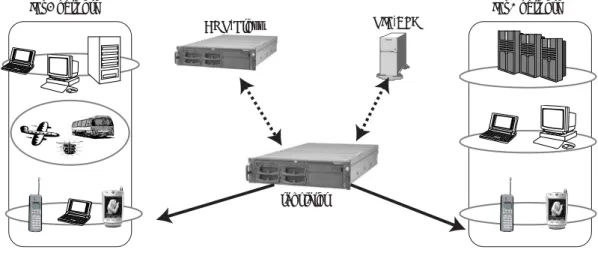
Figure 1 shows the positioning of the
trans-lator.
2.1 Basic concept
The translator was developed based on the concept of TRIOLE.2)
1) Virtualization
A system achieves translation in not only the IP layer, but also total mutual translation in high-er layhigh-ers. Seamless communication is realized by data-level translation and guaranteeing the trans-parency between IPv4 and IPv6 in services of a higher level (multi-layer translation).
Multi-layer translation achieves seamless communication independent of location and the connected network.
2) Automation
Automation autonomously adapts the system to changes in the communication load, failures, and other changes with scalability and high
IPv6 network IPv4 network
DNS-Proxy SIP-ALG
Translator
SIP: Session Initiation Protocol
SIP-ALG: Gateway server that performs the interconnection of IPv4/IPv6 networks by SIP (GeoServe)
Figure 1
Positioning of translator.
note) Mobile-IP is the protocol of mobile
reliability. 3) Integration
Various types of communication functions are unified to handle various services of the ubiqui-tous age.
2.2 Requirements
The following four points are considered requirements for translation between an IPv4 network and an IPv6 network:
1) To perform seamless communication between an IPv4 network and an IPv6 network, com-munication must be conducted according to the differences between the IP headers and address space structures of IPv4 and IPv6. This is because the translator acts as a host node for each protocol.
2) When address information is handled in a higher-level protocol that is directly controlled by an application that makes a layer violation or the protocol specifications of a higher-level protocol differ between IPv4 and IPv6, address and protocol translation must be performed by complying with the higher-level protocol. For example, FTP3) sets an IP address and port number as the pay-load part of TCP. Moreover, IPv6 extends the FTP protocol command and compatibility with lower parts is lost to IPv4.
3) Since a translator is installed between an IPv4 network and an IPv6 network, packets may be concentrated and the communication load increased. For this reason, we require a structure that can sufficiently support a system according to increases in the commu-nication load without needing to stop the network.
4) Because the translator serves as a relay between an IPv4 network and IPv6 network, traffic may be concentrated on the transla-tor. As a result, communication may be stopped, making services unavailable to users. Therefore, network devices must be highly reliable, especially in a network that
provides real-time communication via VoIP.
3. IPv4/IPv6 translation
technology
3.1 Address mapping
The 128-bit address space of IPv6 is much larger than the 32-bit address space of IPv4. It is characterized by the following:
• It is not possible to map all of the IPv6 ad-dresses to IPv4 adad-dresses on a one-to-one basis.
• An IPv4 address is written in the 32 low-order bits and combined with a prefix consisting of the 96 high-order bits to form a 128-bit IPv6 address.
Given these characteristics, IPv6 and IPv4 addresses are mapped in the translator as follows: • The designated subnetworks for translation are assigned from inside the IPv4 network and managed as a pool of addresses included in subnetworks for the translator. Then, an IP address in the pool of IPv4 addresses (hereinafter called the pool addresses) is mapped to a designated IPv6 address and regarded as the IPv4 address of the IPv6 host node connecting to the IPv4 host node through the translator.
• The designated subnetworks for translation are assigned from inside the IPv6 network and managed using a 96-bit prefix assigned to the translator. The 128-bit IPv6 address (96-high-order-bits prefix and 32-low-order-bits IP address) of the connecting IPv4 host node is reported to the IPv6 host node.
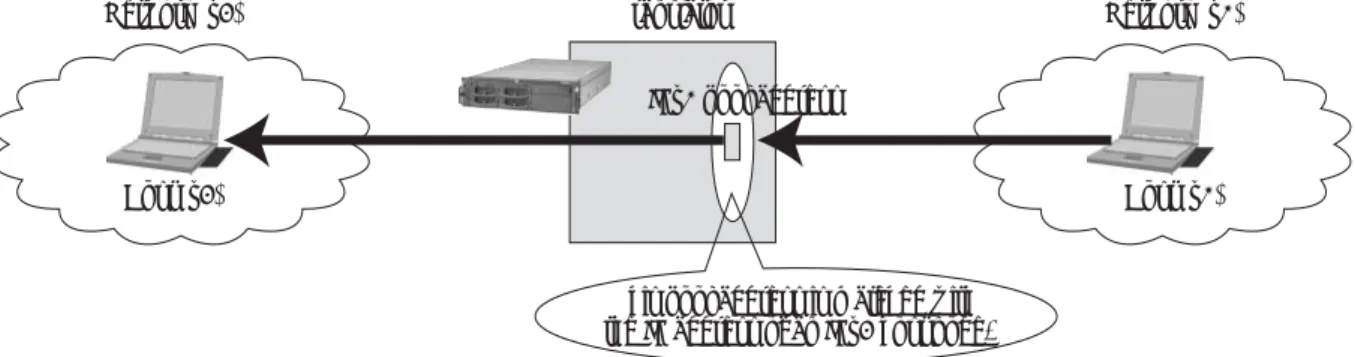
Figure 2 shows the address mapping.
There are two methods of address mapping: static mapping and dynamic mapping. The meth-od of address mapping must be selected according to the purpose of introducing the translator. Therefore, we implemented both methods of ad-dress mapping.
3.1.1 Static mapping
one-to-one to an IP address of the IPv6 host node, and the translator is statically defined by these rela-tionships. This is effective for a company intranet when sufficient private IP addresses can be as-signed or an IP address can be fully secured or fixed based on the communication characteristics (e.g., the security and the direct address specifi-cation by IP address checking), because a pool address of IPv4 must match that of the IPv6 host node to be connected.
3.1.2 Dynamic mapping
When a client communicates with a connec-tion partner by acquiring the connecconnec-tion partner’s IP address via name resolution in DNS and by signaling control of SIP communication, and the versions of both IPs differ, the pool address of IPv4 and the IP address of the IPv6 host node are mapped dynamically. This mapping is released at the end of communication during a timeout.
This mapping is effective when an IP address
must be used efficiently in large-scale networks (e.g., carrier networks) and Internet Database Connectors (IDCs) and when there are few IP ad-dresses like global IP adad-dresses that can be assigned. This is because IP addresses can be effectively used through dynamic mapping.
The following outlines name resolution by DNS that cooperates with DNS-Proxy.4),5) DNS-Proxy operates as the DNS server of a host node in name resolution by Fully Qualified Domain Name (FQDN). DNS-Proxy returns an IP address suitable for the demand type (a record indicating an IPv4 address or an AAAA record indicating an IPv6 address) of name resolution of a host node.
Figure 3 outlines the processing of name
recog-nition by DNS-Proxy.
When an IPv4 host node requests the name resolution of, for example, “www.fujitsu.com” to DNS-Proxy at the start of communication with a Web server from an IPv4 host node (q), DNS-Proxy asks DNS for the applicable domain (w).
Figure 2
Address mapping.
Translator
Translator
IPv4 pool address
IPv6 prefix address Network (v6) Host (v6) Network (v6) Host (v6) Network (v4) Host (v4) Network (v4) Host (v4) This pool address is matched with
the IP address of an IPv6 host node.
IPv4 network is mapped.
(a) The IPv6 address is matched in the pool address of IPv4.
DNS returns the IP address of IPv6 as the name resolution result of “www.fujitsu.com” (e). DNS-Proxy requests mapping generation to the translator (r). After creating the translation ta-ble for the IP address of IPv6, the translator assigns the pool address of IPv4 to the IPv6 ad-dress reported by DNS-Proxy and sends the pool address to DNS-Proxy in response (t and y). DNS-Proxy returns a response for the pool address of IPv4 to the IPv4 host node as the name resolu-tion result of “www.fujitsu.com” (u). The IPv4 host node initiates Web access using the pool ad-dress of IPv4, which is changed by the translator for translation (i).
No mapping generation request is sent to the translator from DNS-Proxy for name resolution from IPv6 to IPv4. This is because the result of name resolution (reported to the host node of IPv6) is generated by adding the IPv6 prefix of the trans-lator to the IP address of IPv4 reported from the DNS IP address without completely corrupting the IPv4 address information. The translator can also perform translation of an IPv4 address by simply deleting the IPv6 prefix in the translation
pro-cessing. Moreover, the source IPv4 address of the packet sent by the translator is dynamically as-signed a vacant pool address when the translator receives a packet from the IPv6 host node.
3.2 Translation method
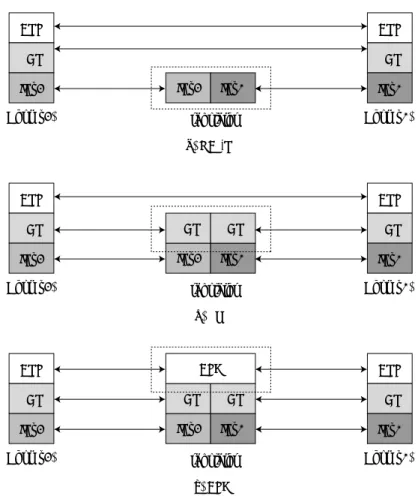
The translation technologies used to mutu-ally connect the host node between IPv4 and IPv6 are listed below. Based on the applications and protocols to be relayed and the network composi-tion, we considered it necessary to select a translation system and incorporate all three trans-lation technologies.
1) Network Address Translation-Protocol
Translation (NAT-PT)6)
According to the translation table in which the IP address of the IPv6 host node and the pool address in the translator match, the translation of an IP address and the IP header part was changed for both IPv4 and IPv6, along with the IP level relays. Moreover, to reserve a pool ad-dress for connection initiated in the IPv4 direction from IPv6, it is possible to use Network Address Port Translation (NAPT) that shares one source
Figure 3
Name resolution by DNS-Proxy (IPv4→IPv6).
tIPv4 address capture XYZv4⇔XYZv6 Translation table generation
qAddress reference [www.fujitsu.com] wAddress reference [www.fujitsu.com] eReference result [XYZv6] uReference result [XYZv4] rMapping generation [XYZv6] yMapping response [XYZv4] iWeb access Translator DNS-Proxy
IPv4 host node DNS
Web server (v6) www.fujitsu.com
address between two or more IPv6 host nodes by changing the port number of each Transmission Control Protocol/User Datagram Protocol (TCP/ UDP) connection.
When a host node transmits a large volume of data to another host node, the data is sent con-tiguously in the form of IP packets. For these IP packets, data should not be fragmented while it is sent from the source node to the destination node. However, the difference in IP header length of both protocols may exceed the Maximum Trans-mission Unit (MTU) of the translator due to the link on the boundary of an IPv4 network and IPv6 network. Therefore, although a relay node does not usually fragment IP packets in IPv6, the trans-lator performs fragmentation instead of the source node.
Moreover, when the source node performs Path MTU Discovery,7) exceeds MTU on the trans-lator, and cannot transmit a packet to the following link, the translator returns Too Big mes-sages of Internet Control Message Protocol (ICMP) Packet to the source node.
2) Transport Relay Translator (TRT)8)
TRT establishes TCP connections with the client and host node on both sides (IPv4 and IPv6) and then serves as the termination of transport connection for each node. Unlike in the NAT-PT system, communication is managed according to the state of each transport connection.
TRT is required for the following reasons in a ubiquitous network that freely employs mobile communications, wireless LAN, and other radio-wave communication devices:
• TRT is not influenced by MTU.
• Communication parameters that suit the quality and performance of a given network can be selected.
3) Application Level Gateway (ALG)
For ALG, the specialized application process in the translator (gateway program) connects IPv4 with the host node of IPv6 in a higher level proto-col. It also performs translation specific to the application.
In communications such as FTP communi-cation and streaming, the IP address and port number information of the transport layer of a data session in the payload of a control session is conveyed. Since the translator must guarantee the permeability of an application level, it ana-lyzes the data format of a payload and prepares an ALG that converts the IP address and port number information for all protocols.
Figure 4 shows the layers in which each
translation method operates.
3.3 ICMP translation
To use network tools that use ICMP (e.g., Ping), protocol translation of IPv4 and IPv6 is also required. Although the same header format is used for ICMPv4 and ICMPv6,9) the type and code information in the header that shows the packet classification are completely different. For this reason, this information is changed into values corresponding to the packet classification when each packet is translated. The Stateless IP/ICMP Translation Algorithm (SIIT)10) prescribes the correspondence of values for type and code information.
3.4 VoIP translation coordinated with
SIP-ALG
SIP11) is the signaling control protocol used by Internet telephone (VoIP) types of communi-cation that perform call control. The signaling control protocol is used (e.g., to call a partner and perform certification and codec negotiation for voice quality) as part of telephone call manage-ment, with voice data carried by data transmission protocols (e.g., RTP) for peer-to-peer communica-tion between end nodes. In a telephone call via SIP, as in the case of calling connection from the calling side (UAC: User Agent Client) through an SIP server, the translator and nearby SIP-ALG (UAS: User Agent Server) cooperate to find a matching address. Consequently, it is possible to perform peer-to-peer communication between UAC and UAS when a voice telephone call is made.
Figure 5 outlines the processing of VoIP
trans-lation cooperation with SIP-ALG (GeoServe).12) GeoServe is a Fujitsu server software for pro-viding an IP telephone service in an SIP base and represents the core of network communication services.
4. Scalability
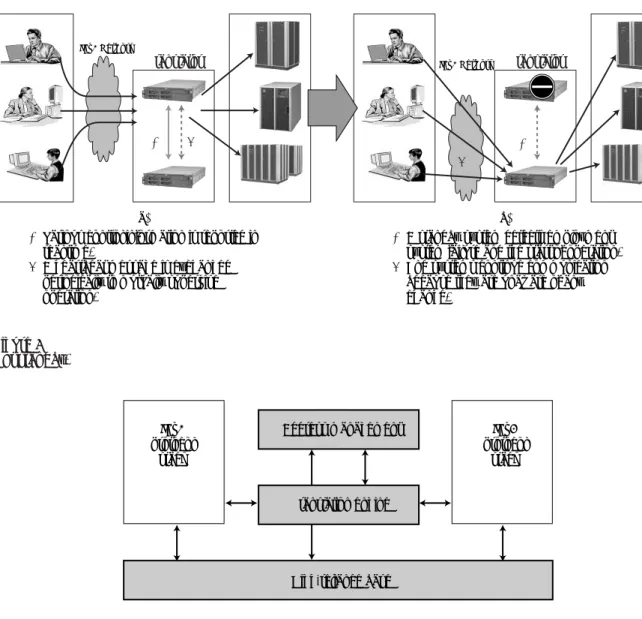
If a bottleneck occurs at the translator due to an increase in network traffic, the translator is extended and its load distributed. Because trans-lators can be added to the network environment without stopping cooperation with DNS-Proxy and SIP-ALG, there is a high degree of extendibility. After being incorporated, a translator becomes a candidate for cooperation, with DNS-Proxy and SIP-ALG periodically monitoring for translator failures. If a translator failure is detected, the
translator that failed is separated, thereby avoid-ing a failure in communication. Moreover, a malfunctioning translator is automatically re-turned to the network after being restored.
In addition, translators cooperate with DNS-Proxy or SIP-ALG to distribute their load. Load information such as the rate of CPU usage by each translator and the number of connections is peri-odically reported to DNS-Proxy or SIP-ALG. A DNS-Proxy or SIP-ALG selects translators for cooperation based on this load information to bal-ance the translators’ load. The pool address and IPv6 prefix (assigned at signaling control by SIP) and name resolution of DNS-Proxy are selected for a translator with a low load. In this way, the packet-passing load is equalized.
Figure 6 outlines the processing of the load
balancing function. Figure 4 Translation methods. APL TCP IPv6 APL TCP IPv4 IPv4 IPv6
Host (v6) Translator Host (v4) (a) NAT-PT APL TCP IPv6 APL TCP IPv4 IPv4 IPv6 TCP TCP
Host (v6) Translator Host (v4) (b) TRT APL TCP IPv6 APL TCP IPv4 IPv4 IPv6 TCP TCP ALG
Host (v6) Translator Host (v4) (c) ALG
Address mapping INVITE / OK SIP-ALG (GeoServe) SIP-ALG (GeoServe) INVITE / OK INVITE / OK Translator VoIP IPv4 UAS IPv6 UAC RTP SIP
Coordinating to SIP-ALG (GeoServe)
Figure 5
VoIP translation coordination with SIP-ALG.
Load balancing of translators DNS-Proxy A B C IPv4 Network IPv6 Network Translators Translator A Translator B Translator C Figure 6
Figure 7 Hot standby.
Translator Translator
q w q
w
q Various control information is reported in real time.
w A heartbeat message is exchanged periodically to mutually supervise operation.
(a)
q A standby system detects employment system failure and the start of operation.
w End systems continue communication because they are unaware of any change. (b) IPv4 Network IPv4 Network IPv4 protocol stack IPv6 protocol stack Address management Translation engine High-reliance base Figure 8 Components of translator.
5. High reliability
When mutual surveillance performed with heartbeat messages between translators or self-surveillance detects a translation engine malfunction, the translator concerned is quickly switched to the standby system of the translator pair to allow processing to continue.
Figure 7 outlines hot-standby processing.
Thanks to the redundancy afforded by the Network Interface Card (NIC), if an NIC failure is detected, the NIC function is immediately switched to the standby system to allow commu-nication to continue.
When the translation definition of a
transla-tor must be changed due to a system reconfigura-tion, it is unnecessary to stop the service, because the translators can be switched dynamically.
6. Translator components
The main components of a translator are the address management, translation engine, and high-reliance base (Figure 8).
1) Address management
This component matches the IPv6 address and IPv4 address and performs unitary manage-ment of the translation policy of various translation engines.
2) Translation engine
This component performs translation control of various network protocols such as the IP head-er, transport header (UDP, TCP), and address information about a payload part.
3) High-reliance base
This component ensures the failure-proof nature of a translator and guarantees the conti-nuity of service by hot standby and the NIC alternation function. The highly reliable engine of the IPCOM13) series is used as the common base engine.
IPCOM provides various network functions (e.g., load balancing, bandwidth control, SSL) in cooperation with IP systems and points of contact between the Internet and intranets.
The translator implements the technology and functions described above, and also provides the fundamental translation function for corre-spondence between a low-level protocol and a higher level protocol, highly reliable functions, and employment/operation functions (Table 1).
7. Conclusion
The expected effects of introducing a trans-lator are as follows:
1) The user can connect to an IPv4 network to
use new services without being isolated from the ubiquitous world realized by IPv6. 2) Moreover, ubiquitous users can use the IPv6
network to access the abundant information accumulated in the IPv4 network and related services.
This paper described the technology for translating between an IPv4 network and an IPv6 network and the gateway construction involved in reserving scalability and reliability. The tech-nology makes it possible to quickly provide compatibility with the next-generation network at low cost and low risk without needing to change the users’ existing IPv4 properties, resulting in upgraded (modernized) user properties.
We took up the challenge of establishing a convergence technology for guaranteeing existing user assets and new services that are compatible with the key technologies and functions of a ubiq-uitous network.
The technology described in this paper in-corporates some of the results from a sponsored research entitled “Research and Development of Large-Scale IPv4/IPv6 Mixture Network System Construction Technology” of the National Insti-tute of Information and Communications Technology (NICT).
Table 1
Translator functions.
Translation system Translation direction
Standard protocol for translation Optional function
Cooperation with other equipment Communication course change Hot standby Load distribution Definition Operation Maintenance Translation functions High-reliability functions/ scalability Employment operations NAT, TRT, ALG IPv6→IPv4, IPv4→IPv6
TCP, UDP, ICMP, http, ftp, telnet, etc. VoIP, Streaming, Mobile-IP (Reverse tunnel) DNS-Proxy, SIP-ALG
NIC change
Translator, DNS-Proxy
DNS-Proxy cooperation, SIP-ALG cooperation Dynamic change
Command Line Interface (CLI)
Log, Cooperation with network surveillance equipment
Masaki Nakajima received the B.E.
degree in Mechanical Engineering and M.E. degree in Information Engineering from Nagoya University, Nagoya, Japan in 1987 and 1989, respectively. He joined Fujitsu Ltd., Kawasaki, Japan in 1989, where he has been engaged in development of network software for mainframe computers and network servers. He is also a member of the Information Processing Society of Japan (IPSJ).
References
1) D. Johnson et al.: Mobility Support in IPv6.
<draft-ietf-mobileip-ipv6-24.txt>, July 2003.
2) TRIOLE White Paper.
http://www.fujitsu.com/services/solutions/ triole/whitepaper/index.html
3) M. Allman et al.: FTP Extensions for IPv6 and
NATs. RFC 2428, September 1998.
4) S. Thomson et al.: DNS Extensions to Support IP
Version6. RFC3596, October 2003.
5) P. Srisuresh et al.: DNS extensions to Network
Address Translators (DNS_ALG). RFC 2694, Sep-tember 1999.
6) G. Tsirtsis et al.: Network Address Translation
-Protocol Translation (NAT-PT). RFC 2766, Feb-ruary 2000.
7) J. Mogul et al.: Path MTU Discovery. RFC 1191,
November 1990.
8) J. Hagino et al.: An IPv6-to-IPv4 Transport
Re-lay Translator. RFC 3142, June 2001.
9) A. Conta et al.: Internet Control Message
Proto-col (ICMPv6) for Internet ProtoProto-col Version 6 (IPv6). RFC2463, December 1998.
10) E. Nordmark: Stateless IP/ICMP Translator
(SIIT). February 2000.
11) J. Resenberg et al.: SIP: Session Initiation Proto-col. RFC 3261, June 2002.
12) Network application server “GeoServe series”. (in
Japanese).
http://telecom.fujitsu.com/jp/products/ geoserve/
13) The lineup guide of IPCOM.
http://primeserver.fujitsu.com/ipcom/catalog/ ipcom_6p.pdf
Nobumasu Kobayashi received the
B.E. degree in Information Engineering from Okayama University of Science, Okayama, Japan in 1990. He joined Fujitsu Ltd., Kawasaki, Japan in 1990, where he has been engaged in development of network software for mainframe computers and network servers.