Nang Yan Business Journal (v.3 no. 1 - 2014) Page 41
Fire Risk Analysis and Optimization of Fire Prevention
Management for Green Building Design and High Rise
Buildings: Hong Kong Experience
Albert Yau1
Fire Safety Consultants Ltd., Hong Kong
Samuel K. M. Ho2
Asia Pacific Business Excellence Standard Academy, Hong Kong
Published online: 18 November 2014 © Nang Yan Business Journal 2014
ABSTRACT: There are many iconic high rise buildings in Hong Kong, for example,
International Commercial Centre, International Financial Centre, etc. Fire safety issue in high rise buildings has been raised by local fire professionals in terms of occupant evacuation, means of fire-fighting by fire fighters, sprinkler systems to automatically put off fires in buildings, etc. Fire risk becomes an important issue in building fire safety because it relates to life safety of building occupants where they live and work in high rise buildings in Hong Kong. The aim of this research is to identify the fire risk for different types of high rise buildings in Hong Kong and to optimise the fire prevention management for those high rise buildings with higher level of fire risk and to validate the model and also to carry out the study of the conflict between the current fire safety building code and the current trend of green building design. Survey via the 7-point scale questionnaire was conducted through 50 participants and their responses were received and analysed via the statistical tool SPSS software computer program. A number of statistical methods of testing for significantly difference in samples were adopted to carry out the analysis of the data received. When the statistical analysis was completed, the results of the data analysis were validated by two Fire Safety Experts in this area of specialisation and also by quantitative fire risk analysis.
Keywords:High rise buildings, fire risk, fire safety, fire prevention management, green building design
JEL code: Q5
1
Director, Fire Safety Consultants Ltd., Hong Kong. Email: [email protected] 2
Nang Yan Business Journal (v.3 no. 1 - 2014) Page 42
1. Introduction
Hong Kong (HK) becomes one of the highly densely populated cities in the world. In reality, most people in Hong Kong live, work or even spend their leisure time in high rise buildings. Thus, a relatively higher population density within a high rise building is a very common phenomenon in Hong Kong, entailing critical concerns on building fire safety in terms of risks to life and fire. Once a fire occurs in these buildings, it would create big losses to human life and property.
Our lives are surrounded by activities associated with risks that have the potential to derive in unwanted consequences, resulting in economic losses or, what is worse, physical harm or death (Wilson, 1990).
At present, there are many iconic high rise buildings higher than 300-metre high in Hong Kong, for example, 484-metre tall International Commercial Centre (ICC) in Kowloon side and 415-metre tall International Financial Centre (IFC) in Hong Kong side, etc. Fire safety issue has been raised by local fire professionals in terms of occupant evacuation, means of fire-fighting by fire fighters, sprinkler systems to automatically put off fires in buildings, etc.
As there are many people living, working, staying in high rise buildings in Hong Kong, their life safety becomes an important issue concerned by the general public. Fire risk becomes an important issue in building fire safety because it relates to life safety of building occupants where they live and work in high rise buildings in Hong Kong.
Therefore, based on the background information mentioned above, the research questions (RQs) are provided below:-
RQ-1: Which type of buildings are having higher fire risk among the most common types of high rise buildings in Hong Kong?
RQ-2: Are the current fire safety provisions able to sufficiently protect the life safety of occupants staying in high rise buildings where the fire risk is relatively higher?
RQ-3: Is green building design (GBD) compatible with the current building fire safety regulations?
Fire risk is an important consideration in the building fire safety and how to protect the life safety of occupants within a building will highly depend on the functional elements of fire prevention measures, whereas the GBD has significant impact onto the fire safety measures. As a result, the relationship between fire risk, fire prevention and GBD is graphically presented in Figure 1.
Nang Yan Business Journal (v.3 no. 1 - 2014) Page 43 Figure 1: Overall view of the relationship between Fire Risk, Fire Prevention & Green Building
Design (GBD) for a high rise building: Hong Kong experience
Objectives of the study
In order to achieve the above aim, the objectives of this research are to review the increasingly importance of fire safety in high rise buildings in Hong Kong. It is also set out to investigate whether the active fire safety/prevention systems currently provided are considered sufficient to cope with the associated fire risk. Specifically, the objectives are set in the following tasks:
To determine fire risk associated with the most common types of high rise buildings in Hong Kong;
To review the current active fire safety/prevention systems whether they are able to protect the life safety of occupants in a high rise building where the fire risk is relatively higher;
To make recommendations to optimise fire prevention management for those buildings with higher ranking of fire risk;
To study GBD which may conflict with the current fire safety building code for high rise buildings.
Importance of the study
The importance of the study is that it will reveal which type of high rise buildings has relatively higher fire risk in Hong Kong. This study will help the local Government and fire authorities review the current fire safety systems so that appropriate fire prevention measures can be optimised for high rise buildings. Recommendations from this study are to help owners of high
GBD Fire Prevention Fire Risk H IG H RI SE B U IL D IN G in H K H IG H RI SE B U IL D IN G in H K
Nang Yan Business Journal (v.3 no. 1 - 2014) Page 44 rise buildings to pay attention to the main concerns of the life safety of occupants so that they can take consideration of occupants’ needs in order to meet the desired requirements.
This research study will contribute to the following related fields:-
Contribution to the fire industry for those high rise buildings associated with higher fire risk using appropriate fire prevention measures
Contribution to the local fire authorities to review the current fire safety systems to catch up with the latest trend
Contribution to fire professionals to pay attention to the life safety issue when carrying out the design
Contribution to insurance companies to review the current fire insurance policy for high rise buildings
2. Literature Review
Review of the following web sites relevant to the research study.
Search from Google Website and Hong Kong Nang Yan College of Higher Education (NYC) e-Library:-
SUBJECT GOOGLE GOOGLE
SCHOLAR
NYC E-LIBRARY
A = “Fire risk analysis (FRA)” 765,000 1,310 295
B = “Optimization of fire prevention management (FPM)”
1,510,000 0 363
C = “Green building design (GBD) and high rise buildings”
3,800,000 0 2,089
D = “Hong Kong (HK) experience” 805,000 5,470 3
1 = “A” & ”B” 13,500,000 0 610
2 = “A” & “B” & “C” 659,000 0 3,345
3 = “A” & “B” & “C” & “D” 6,200 0 0
‘4’ Related 1,000 0 0
Academically related 4 0 0
Unfortunately, there are no sites available either in Google Scholar or College Library addressing all 4 keywords: FRA, FPM, GBD, HK
Nang Yan Business Journal (v.3 no. 1 - 2014) Page 45
Review of papers with reference to the current version Excellence in Research for Australia, Journal Ranked List and almost 80% B grade above papers/journals were reviewed from this List, i.e. 50 papers.
Review of local building code requirements for current fire safety systems in buildings.
Review of the purpose of fire safety management plan.
Review of the GBD vs fire safety with some examples.
Local building code requirements for fire prevention measures
A fire prevention measures for a building consists of the following essential elements:
Passive fire safety systems
Active fire safety systems
Each of these elements must be adequately provided for a building in order to function safely. Passive fire safety systems
As defined previously, passive fire safety systems are built into the building structure and are part of the physical building features. These include the Means of escape (MoE), Fire resistance construction (FRC), Means of access to the building by fire fighters (MoA).
The details of such provisions are referred to the Code of Practice for Fire Safety in Buildings (Building Department, 2011) and are summarized in Table 1.
Table 1: A summary of passive fire protection systems by Buildings Department (BD)
HIGH RISE BUILDINGS REQUIRED
MoE (e.g. travel distances, etc.) √
FRC (e.g. compartments, etc.) √
MoA (e.g. fireman’s lift, etc.) √
It is evident from the above table that MoE, FRC and MoA are all required to be provided for high rise buildings.
Nang Yan Business Journal (v.3 no. 1 - 2014) Page 46
Active fire safety systems
As defined previously, active fire safety systems are required to be activated in case of an outbreak of fire.
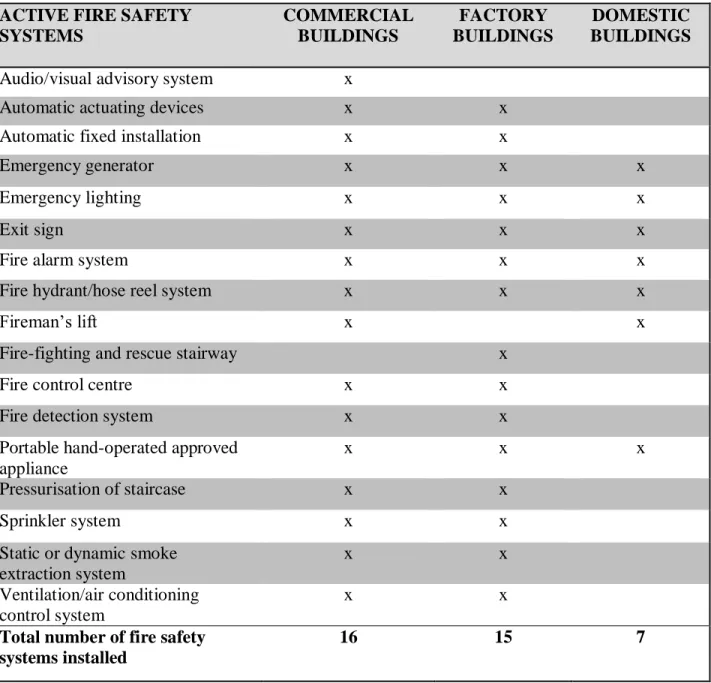
The active fire protection systems for high rise buildings are provided in Table 2 in accordance with the Code of Practice for Minimum Fire Services Installations and Equipment in Hong Kong (Fire Services Department, 2012).
Table 2: A summary of active fire protection systems by Fire Services Department (FSD)
ACTIVE FIRE SAFETY SYSTEMS COMMERCIAL BUILDINGS FACTORY BUILDINGS DOMESTIC BUILDINGS
Audio/visual advisory system x
Automatic actuating devices x x
Automatic fixed installation x x
Emergency generator x x x
Emergency lighting x x x
Exit sign x x x
Fire alarm system x x x
Fire hydrant/hose reel system x x x
Fireman’s lift x x
Fire-fighting and rescue stairway x
Fire control centre x x
Fire detection system x x
Portable hand-operated approved appliance
x x x
Pressurisation of staircase x x
Sprinkler system x x
Static or dynamic smoke extraction system
x x
Ventilation/air conditioning control system
x x
Total number of fire safety systems installed
Nang Yan Business Journal (v.3 no. 1 - 2014) Page 47 Generally, if fire protection systems are significantly installed in a building which means that the fire risk is considered higher in that building. It is evident from Table 2 that more active fire protection systems are installed in commercial buildings (16 systems) and then followed by factory buildings (15 systems) and domestic buildings (7 systems). This means that commercial buildings are relatively associated with higher fire risk than factory and domestic buildings. The conclusion is therefore simply presented below:-
Commercial buildings > Factory buildings > Domestic buildings
Green building design vs fire safety
Fire safety in green building design has not been considered carefully in Hong Kong. It is to ensure that the building is designed to the green and sustainable requirements in order to protect the environment with fewer amounts of greenhouse gases discharged and energy consumption reduced, while the building is adequately protected against fire in terms of life safety and property protection.
Design of new buildings or upgrade of existing buildings with construction elements and environmental control systems is aimed at improving their sustainability. However, some problems which are conflicting with the criteria of green building design have arisen when designing the fire safety provisions. Examples of green architectural features requiring more in-depth investigations on fire safety are (Chow, 2004):
Internal building voids
Double-skin facades
Natural ventilation design with airflow induced by wind
Materials with better thermal insulation to reduce Overall Thermal Transfer Values of building envelope
Glass contribution with steel framework
3. Research Design
The research design consists of the methodology to conduct scientific research for this study. The process of research design is summarised below:
Quantitative analysis
Questionnaire survey (Close-ended questions using a 7-point Likert Scale)
Valid sample size: 50 respondents
Nang Yan Business Journal (v.3 no. 1 - 2014) Page 48
Total questions: 15 Qualitative analysis
Questionnaire survey (Open-ended)
Valid sample size: 50 respondents
Total questions: 3
Implementing the research design
Collect and process data
Analyse data
Transform data collected into usable data format
Using SPSS to analyse data collected Validation of the research model
Through (1) interview questions based on the summary of the research findings by 2 Fire Safety Experts
Through (2) secondary data using quantitative fire risk analysis based on the fire statistical data available in Hong Kong
Presenting the results
Prepare and present the final results, make conclusion and recommendations as well as its implication to the industry
The group of individuals selected included the following population of study:-
Architects
Fire Services Engineers
Building Services Engineers
Other related professionals e.g. Structural Engineers
Their work experience are related to the fire safety issues in their design works on their building projects and they can contribute their professional experience and views to this study in more accurate than other non-related professional persons.
The sample size was determined by the following equation:- W = ± 2 x SQRT[ p* (1-p)/N]
W2 = 4 * p (1-p) / N N = 4 * p (1-p) / W2
Nang Yan Business Journal (v.3 no. 1 - 2014) Page 49 Therefore, for our case, N = 4 * 0.5 (1-0.5) / 0.142 = ~50 which is considered sufficient to generate a normal distribution curve to fit for the purpose.
15 close-ended and 3 open-ended questions were set in the questionnaire survey, including building profile and respondent’s profile. 15 questions in the questionnaire were arranged under 3 different groups, including fire risk analysis, fire prevention management optimisation and GBD vs. fire risk. 5 questions were set for each group.
60 questionnaires were randomly distributed to the group of professionals identified and 50 questionnaires were received from them after follow-up calls. The outcomes are considered reasonable.
Statistical treatment
In order to carry out the quantitative analysis of the data collected from the questionnaires, the SPSS software program was adopted for this analysis and various methods of testing for significant difference in samples were used. The statistical methods adopted in SPSS included data reliability test, one-sample T-Test, correlation, independent sample T-Test, one-way ANOVA and multiple regressions.
Multiple Regressions
The purpose of this study is to investigate whether there are any relationships between floor levels and the existing policy of fire insurance premium, i.e. the higher the floor levels, the higher is the fire insurance premium. It is shown that the number of floors ≥ 10 (by definition of high rise buildings) is considered to be the commencement of high fire risk to occur in buildings. However, as advised by insurance agents/brokers in Hong Kong, fire insurance premium in HK$ for high rise buildings is the flat rate system according to the generally accepted insurance policy i.e. the premium paid not related to floor levels. The insurance agents/brokers also said that higher fire insurance premium would be paid for a building located at some risky areas, like nearby the petrol station or risky factory and 3 elements including insured amount/location/age/size of the buildings plus the conditions of the fire protection systems are the determination factors for the evaluation of fire insurance premium for a building. Therefore, it can be concluded that there is no difference in floor levels for the existing policy of fire insurance premium.
Nang Yan Business Journal (v.3 no. 1 - 2014) Page 50
Validation via experts’ opinion
A validation process is an important step in the research study and therefore expert opinion on the research findings should be sought. It is necessary to pay more attention to the choice of experts who should be knowledgeable and experience in the area of research study.
Validation via quantitative fire risk analysis
This fire risk analysis is to further supplement the findings of the statistical analysis conducted. The validation is based on the analytical analysis on the available statistical data obtained from Hong Kong Department of Statistics, Fire Services Department, etc.
Quantitative fire risk assessment is based on an assessment which involves numerical evaluations not only of the probability of a fire hazard occurring in a building, but also the consequences of that fire hazard. By multiplying the numerical values of probability and consequence, a numerical fire risk value can be estimated (Yung, 2008).
In conclusion in terms of quantitative fire risks:-
Commercial buildings > Factory buildings > Domestic buildings
It should be noted that it is confident in the above data analysis as the similar outcomes of fire risk data for the above analysis are also supported by similar studies carried out in Taiwan (Chi et al., 2012) and the mainland China (Xin et al., 2013).
4. Summary of Findings
According to the outcomes of the various scientific research methods of analysis, the overall results of statistical tools and fire risk analysis are summarised below for ease of reference. RQ-1: Which type of buildings are having higher fire risk among the most common types of
high rise buildings in Hong Kong?
Survey study using statistical tools:-
In brief, fire risk is an important consideration for the most common types of buildings in Hong Kong including commercial and industry and residential buildings. The higher the fire risk in a building, the more professional fire risk assessment is required. Previous fire safety training is required when carrying out professional fire risk assessment for such high rise buildings. The
Nang Yan Business Journal (v.3 no. 1 - 2014) Page 51 taller and/or the older the building, the higher is fire risk. Furthermore, an appropriate fire risk ranking (HI/MED/LOW) should be assigned to the common types of high rise buildings for optimising the fire prevention management which should need further research work on this particular issue.
Secondary data of analysis using fire risk assessment:-
In addition to the above study, secondary data of analysis was adopted in the research study to validate the research question RQ-1. This was conducted by using the available fire statistical data in Hong Kong via the quantitative and qualitative risk analysis on the level of fire risk for the most common types of buildings in Hong Kong.
From quantitative fire risk analysis:-
Commercial buildings > Factory buildings > Domestic buildings
It can be seen from above results that commercial buildings (e.g. office buildings, restaurants, shopping centre, etc.) are relatively higher fire risk than factory buildings (e.g. warehouse, storage, etc.) and domestic buildings (e.g. residential) based on the quantitative fire risk assessment.
Provision of active fire protection systems in a building:-
Based on the level of fire risk and by local building fire codes, more active fire protection systems are installed in commercial buildings (16 systems) and then followed by factory buildings (15 systems) and domestic buildings (7 systems). It is concluded that based on the total number of fire protection systems provided, commercial buildings are relatively more risky than factory buildings and followed by domestic buildings, the outcome of which are the same as the quantitative fire risk analysis. It is therefore simply presented below:-
Commercial buildings > Factory buildings > Domestic buildings
RQ-2: Are the current fire safety provisions able to sufficiently protect the life safety of occupants staying in high rise buildings where the fire risk is relatively higher?
In brief, the current fire safety systems are sufficient for the preparation of fire risk ranking of high rise buildings and the higher the fire risk, the more stringent fire prevention measures are required in order to mitigate fire risk. Whilst it is important to optimise fire prevention management, it is equally important to give due consideration to the life safety of occupants.
Nang Yan Business Journal (v.3 no. 1 - 2014) Page 52 Furthermore, a fire safety management plan or fire safety audit checklist should be required for a building in order to effectively manage the installed fire systems and to enhance the reliability of the fire systems.
RQ-3: Is green building design compatible with the current building fire safety regulations? In brief, GBD has no impact on fire risk in a high rise building and a balance of GBD and statutory fire legislation can be achieved. However, neutral opinions were sought on the following 2 items which my need further research work:
“The current fire safety building code should be reviewed in order to cope with green building design.” They had neutral opinion on this issue, probably because the current fire safety building code is not necessary to be reviewed for GBD and is considered sufficient at this stage.
“GBD will enhance fire safety in high rise buildings and also is in conflict with fire safety building code.” They had neutral opinion on this issue, probably because the current fire safety building codes are sufficient for GBD at this stage.
Specific research on the investigation of any difference in floor levels for the existing policy of insurance premium:-
According to the outcomes of the various scientific research methods of analysis, it is shown that the lower floors have lower fire risk, while the higher floor levels have higher fire risk. However, based on the information provided by the insurance agents/brokers, there is no difference in floor levels for the existing policy of fire insurance premium. If insurance agents/brokers currently have no insurance policy to cater for this particular finding, they should suffer from the situation where under-paid premium should occur in the high rise buildings associated with higher fire risk. This should need further detailed analysis on this particular issue in the future research work.
5. Conclusion
Fire risk becomes an important issue in building fire safety because it relates to life safety of building occupants where they live and work in high rise buildings in Hong Kong. This research is to study 3 research questions relating to fire risk analysis, fire prevention management optimization and green building design vs fire risk for high rise buildings. These 3 elements form the important aspects in building fire safety as it closely relates to the evaluation of fire risk in a building and the impact on to life safety of building occupants.
Nang Yan Business Journal (v.3 no. 1 - 2014) Page 53 In brief, fire risk is a function of the following combination factors for high rise buildings:-
Building height + Building usage + Training of fire professionals + Fire prevention measures + Fire legislation
Furthermore, secondary data of analysis was adopted in the research study to validate the research question. This was conducted by using the available fire statistical data in Hong Kong via the quantitative risk analysis on the level of fire risk for the most common types of buildings in Hong Kong.
From quantitative fire risk analysis, the building usage is in the following order:- Commercial buildings > Factory buildings > Domestic buildings
In addition, specific research on the investigation of any difference in floor levels for the existing policy of insurance premium should need the future research work.
Nang Yan Business Journal (v.3 no. 1 - 2014) Page 54
References
Buildings Department. (2011). Code of practice for fire safety in buildings. Hong Kong: Author. Chi, J. H., Wu, S. H., & Shu, C. M. (2012). Constructing an anticipation formula for fire loss in factory-type. Journal of the Chinese Institute of Engineers, 25 (7), 803-814.
Chow, W. K. (2004). A short note on fire safety for new architectural features. International Journal on Architectural Science, 5 (1), 1-4.
Fire Services Department. (2012). Codes of practice for minimum fire service installations and equipment and inspection, testing and maintenance of installations and equipment. Hong Kong: Author.
Wilson, R. (1990). Analysing the daily risks of life. In Glickman, T. S., & Gough, M. (Eds.), Readings in Risk, 55-59. New York: Resources for the Future.
Xin, J., & Huang, C. F. (2013). Fire risk analysis of residential buildings based on scenario clusters and its application in fire risk management. Fire Safety Journal, 62, 72-78.
Yung, D. (2008). Principles of fire risk assessment in buildings. Chichester: John Wiley & Sons Ltd.