THE RHETORIC OF PARTICIPATION:
GENDER AND REPRESENTATION IN ANCIENT SYNAGOGUES
Carrie Elaine Duncan
A dissertation submitted to the faculty of the University of North Carolina at Chapel Hill in partial fulfillment of the requirements for the degree of Doctor of Philosophy in the Department of Religious Studies
Chapel Hill 2012
ii
©2012
iii
ABSTRACT
CARRIE ELAINE DUNCAN: The Rhetoric of Participation: Gender and Representation in ancient synagogues
(Under the direction of Jodi Magness)
iv
ACKNOWLEDGEMENTS
My gratitude towards those who have helped this project reach this point cannot be adequately expressed on paper. I am grateful for financial support from the University of North Carolina Graduate School in the forms of a Dissertation Research Fellowship in the fall of 2010 and a Paul C. Hardin Royster Society Fellowship in 2011-2012, as well as the many teaching opportunities, travel fellowships, and other forms of support offered to me. The Charlotte Newcombe Foundation awarded me a dissertation completion fellowship in 2011-2012, which I was greatly honored to receive.
I am grateful to Amy Hirschfeld of the International Catacomb Society, Hannah Kendall of the Ashmolean Museum, and Andrew Reinhard of the American School of Classical Studies for their assistance with many of the images that appear in this dissertation.
v
of graduate studies for most of my time at UNC and have helped me in many ways, some of which I am likely not even aware.
My brilliant and dedicated colleagues at UNC have provided seven years’ worth of support and camaraderie. In particular, I would like to thank the members of Team JOB, everyone from various writing and reading groups, and the women of my cohort: Jill Peterfeso, Cynthia Hogan, and Brandi Denison. Non-Carolina people nonetheless deserving of recognition are Ely Levine and Maria Doerfler.
Finally, I am grateful to friends and family who have taken this circuitous journey with me. To Cori for all the care packages and phone calls, my brother Andrew for all the pep talks and encouragement, and my husband Peter for tech and design support,
photographic assistance, and unstinting confidence in me – thank you. Above all, to my
vi
TABLE OF CONTENTS
LIST OF FIGURES...viii
Chapter I. INTRODUCTION TO SYNAGOGUES, TITLES, AND INSCRIPTIONS...1
Introduction...1
The early history of the synagogue...4
Title Bearer Inscriptions...15
Theoretical Considerations...27
Organization of the Study...31
II. CHRONOLOGY AND GEOGRAPHY...43
Introduction...43
Religion, Gender, and Title...45
Chronology...52
Geography...66
Conclusions...98
III. ON THE USE AND ABUSE OF EPIGRAPHY...99
Introduction...99
Textuality and the Linguistic Turn...105
Ancient Literacy...111
Epigraphy as a Genre...121 1
15 27 31 43 43 45 52
99
105 111 ...
...
... . ...
vii
Synagogues and Catacombs...136
Conclusions...155
IV. MATERIALITY AND THE VISUAL RECEPTION OF INSCRIPTIONS...156
Introduction...156
Where art and text collide: Reception Theory and Visual Culture...167
Materiality: Medium, Execution, Decoration...176
Sophia of Gortyn and Marcella of Rome...211
Conclusions...216
V. WOMEN LEADERS...219
Introduction...219
Objectivism, Presentism, Feminism...221
Power, Prestige, Leadership...232
Financial Leadership in Synagogues...245
Inscribing Identity...265
Conclusions...278
VI. CONCLUSION...281
BIBLIOGRAPHY...286 156 156
157 176
viii
LIST OF FIGURES
Figure
1. Chronological Chart of Female Title Bearer Inscriptions...55-56
2. Chronological Chart of Average Dates...57
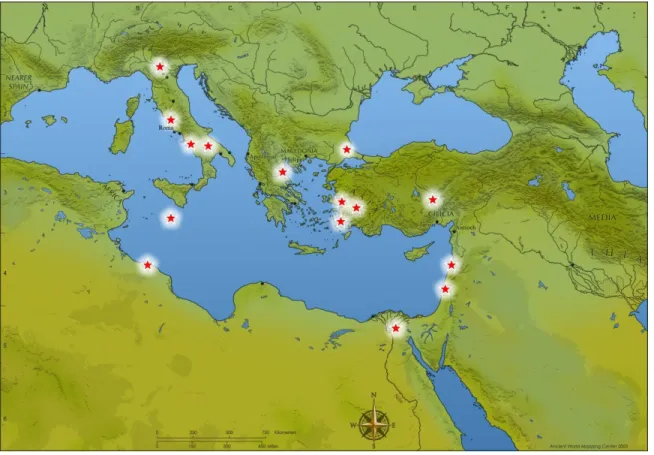
3. Map of Geographical Distribution of Inscriptions...67
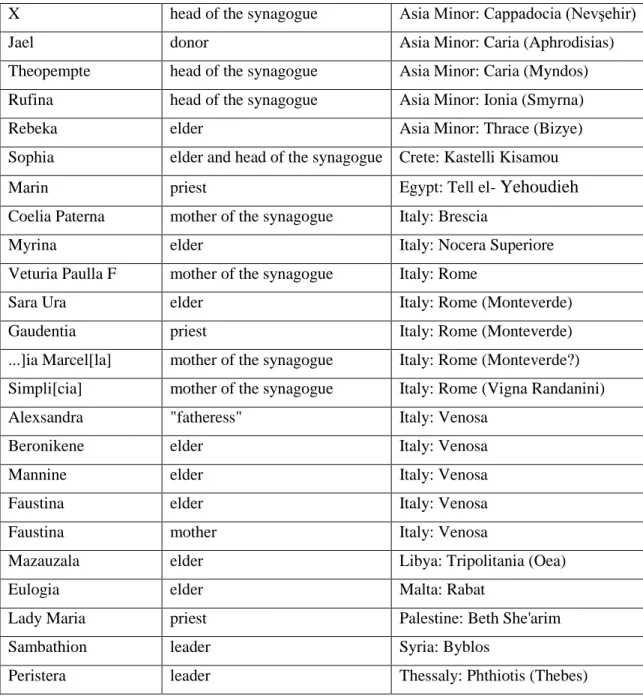
4. Geographical Chart of Inscriptions...70
5. Faustinus Family Tree...131
6. Typical entry in Jewish Inscriptions of Western Europe...158
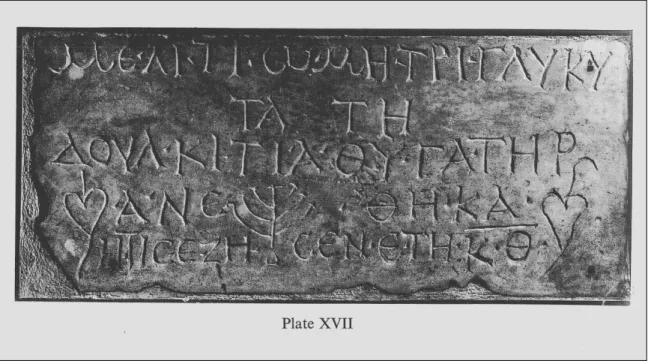
7. Typical plate in Jewish Inscriptions of Western Europe...160
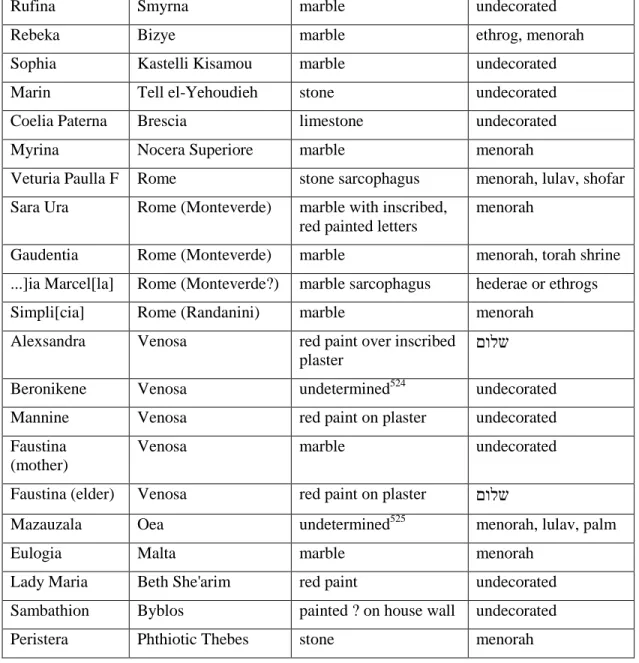
8. Chart of Inscriptions’ Decoration...176-177 9. Example of Inscription of average quality...183
10.Example of Inscription of high quality...184
11.Transcription of Rufina of Smyrna’s inscription...186
12.Image of Gaudentia’s inscription...191
13.Image of Sophia of Gortyn’s inscription...212
14.Image of Marcella of Rome’s inscription...214 158 160 176-177 183 184 186 191 212 55-56
. . .
Chapter One: Introduction to Synagogues, Titles, and Inscriptions 1.1: Introduction
Did women act as leaders in the synagogues of Late Antiquity? For those familiar with early Judaism, the instinctual answer is no. Judaism has historically been
overwhelmingly male oriented in its authority structures: male deity, male priests, male rabbis. Yet, a small number of inscriptions have been taken as evidence for exceptions to this general understanding of exclusively male leadership among ancient Jews. These inscriptions have led some scholars to answer yes to the question posed above. This study does not answer the question of whether women were leaders of synagogues: at least, not in the way it was meant. Instead, the question will itself be questioned, its assumptions illuminated, its terms unpacked. The evidence cited in support its affirmative answer will be analyzed, its utility queried, its interpretation challenged. My goal is to broaden the question of women’s leadership in synagogues from yes or no to when and where/how and why.
The evidence in question is a corpus of what I am calling title bearer inscriptions: Late Antique dedicatory and funerary inscriptions labeling individual Jews, men and women, with a variety of titles – head of the synagogue, mother or father of the
2
17th century, although they were not taken as a serious subject of inquiry until the 19th century.1
Title bearer inscriptions hold great potential to illuminate the inner workings of the early synagogue institution as well as the options and opportunities available to women within early Jewish communities. This potential has resulted in consistent and continued engagement by scholars with these inscriptions for over 150 years.2 This project engages and builds upon the work of these scholars. While I will question and assess critically the assumptions, theoretical stances, and conclusions of those whose work precedes my own, I neither minimize nor marginalize their contributions to the subject.
At the same time, however, title bearer inscriptions are a type of historical data susceptible to cooption in modern disputes. For some, these inscriptions constitute evidence for a more egalitarian original version of Judaism subsequently routinized into an androcentric hierarchy.3 Appeals are made to ancient precedent to justify calls for women’s more active involvement in Jewish leadership roles. Further, the mutually reactionary and contested relationship between Judaism and Christianity in their early development has led to a modern controversy over which religion offered women more
1
The Monteverde catacomb was discovered by Antonio Bosio in 1602 and described briefly in his publication of the Christian catacombs of Rome, Roma sotterranea (Rome: Facciotti, 1632). See Leonard Rutgers, The Jews in Late Ancient Rome (Leiden: Brill, 1995), 1-49, for a history of the excavations of and scholarship on the Jewish catacombs of Rome. See also Amy Hirschfeld, “An Overview of the Intellectual History of Catacomb Archaeology,” in Deborah Green and Laurie Brink (eds.), Commemorating the Dead: Texts and Artifacts in Context (Berlin: de Gruyter, 2008), 11-38.
2For example, Ross Shepard Kraemer, Unreliable Witnesses: Religion, Gender, and History in the
Greco-Roman Mediterranean (New York: Oxford University Press, 2011), 179-242. 3
For various articulations of Max Weber’s theory of routinization, see The Sociology of Religion 4th ed. (Boston: Beacon Press 1963), esp. 60-79 and The Theory of Social and Economic Organization (New York: Oxford University Press, 1947), 358-386. On the history of women’s ordination to the rabbinate, see Pamela Nadell, Women who would be Rabbis: a History of Women’s Ordination 1889-1985 (Boston: Beacon Press, 1998). See also Sarah Grossman and Rivka Haut, “Introduction: Women and the
Synagogue,” in Sarah Grossman and Rivka Haut (eds.), Daughters of the King: Women and the Synagogue
3
equitable status.4 Thus, advocates for women’s leadership and ordination in conservative Christian denominations likewise justify their case, at least in part, on ancient evidence.5
Whether ancient precedent should be used to validate modern decisions regarding gender and religious leadership is not for me to say.6 The fact is that synagogue
inscriptions and comparable material are used by all sides in current debates over issues of justice, gender equity, and leadership in modern religious institutions. Therefore, scholars’ work on this subject has real-world ramifications rather than remaining within a strictly academic context. The timely dissemination of conclusions based on careful evaluation of evidence to a non-academic audience is increasingly seen as the
responsibility of every scholar, regardless of subject.7 If historical data are to be used to authorize modern ethical decisions, however, historians’ responsibility to evaluate continually the validity of those data and their interpretation carries even greater weight.
The main premise of this study is that female title bearer inscriptions were created, signified, and read by ancient Jewish communities, and therefore cannot be understood properly when examined in isolation. Consequently, the subject is not so much the women who feature in these inscriptions, but rather the inscriptions themselves and the communities that produced them. These inscriptions are one body of evidence which
4Amy-Jill Levine, “Second Temple Judaism, Jesus, and Women,” Biblical Interpretation 2.1 (1994), 8-33 provides a summary of the debate, which will be discussed in more detail below.
5See, for example, Karen Torjesen, When Women were Priests (San Francisco: HarperSanFrancisco, 1993) and Dorothy Irvin, “The Ministry of Women in the Early Church: The Archaeological Evidence,” The Duke Divinity School Review 45 (1980), 76-86. Irvin in particular is a key advocate for women’s ordination in the Roman Catholic Church based on her interpretation of ancient evidence for women in early Christian sacramental roles.
4
informs our understanding about these communities, specifically how and, perhaps, why certain individuals are represented in particular ways.
Since the larger discussion will take place in the context of synagogues, I begin not with inscriptions, but with a brief overview of the history of the earliest synagogues and the questions of origins, purposes, extant remains, and literary references. An
introduction to the earliest scholarship on Jewish titles in inscriptions follows, along with the challenges title bearing women held for early scholars. Feminist scholars’ interest in and influence upon the discussion of women’s title bearer inscriptions, and the insights, challenges, and responses presented by their influence, provide a context for
understanding the current state of the question. Finally, I introduce the theoretical underpinnings and methodological approaches that will be used in this study to explore how title bearer inscriptions served as representations of women in early synagogue communities.
1.2: The early history of the synagogue
Origins and purposes
The date and origins of the early synagogue as an institution are hotly contested.8 The earliest suggested period of synagogue origin is the pre-exilic period. Von Waldow, following Finkelstein, suggests that the 7th century reforms of Josiah were only feasible if local worship facilities were already in existence.9 Weingreen agrees with Finkelstein’s
8This conversation is complicated by the fact that συναγωγή can refer to a community or gathering of people as well as a structure, as in 1st century C.E. manumission inscriptions from the Bosphorus region. See, for example, IJO I BS5 and IJO I BS4, which clearly use synagoge to refer to the community and
proseuche to refer to the community’s physical meeting place. For additional examples see Lee Levine, The Ancient Synagogue: The First Thousand Years (New Haven: Yale University Press, 2005), 122-123. 9H. Eberhard von Waldow, “The Origin of the Synagogue Reconsidered,” in Dikran Hadidian, ed., From
5
dating, but not with his explanation.10 Morgenstern, following Lods, suggest that the synagogue originated as a response to Josiah’s reforms.11
Some scholars advocate a date in the 6th century BCE, reasoning that the development of non-sacrificial religious observations by the displaced Judahite population during the Babylonian Exile would have required a new type of facility.12 While these suggestions are all reasonable, each is based solely on reason; there are neither extant remains from the region nor textual references to synagogues in pre-exilic, exilic, or post-exilic literature to support an origin prior to or in the Babylonian Exile.
Levine has suggested that the synagogue institution resulted not from a religious crisis, but from a change in city wall construction. Bronze and Iron Age city walls contained monumental gate complexes in which civic business was conducted.13
Hellenistic period walls had no such accommodation. Separate structures were therefore required to replace the city gate as the location for social and civic business.14 The functional connections Levine draws between city-gate and synagogue are striking. A specific connection between city-gate and synagogue is difficult to see, however,
10Jacob Weingreen, “The Origin of the Synagogue,” Hermathena 98 (1964), 68-84.
11Julian Morgenstern, “The Origin of the Synagogue,” Studi Orientalistici II (1956), 192-201; Adolphe Lods, The Prophets and the Rise of Judaism, trans. S. Hooke (London: Routledge & K. Paul, 1937). 12
Salo Wittmayer Baron, The Jewish Community: Its History and Structure to the American Revolution, v.1-3 (Philadelphia: Jewish Publication Society of America, 1942), I.59-63; Samuel Krauss, Synagogale Altertümer (Berlin: Benjamin Harz, 1922), 52-66; George Foot Moore, Judaism in the first centuries of the Christian era, v.1-3 (Cambridge: Harvard University Press, 1958-1959), I.283.
13For example, in the post-exilic book of Ruth 4:1-12, Boaz conducts the transaction with the next-of-kin at the city gate under the auspices of the elders.
6
particularly given the break in time between the change in gate structure and the earliest evidence for synagogue structures.15
Richardson sees the development of the synagogue as a Diaspora invention of the Hellenistic period. Diasporic communities in need of a center for religious life built synagogues, known by a variety of names from inscriptions, but most famously in Egypt as proseuche, or house of prayer.16 This new structure was imported to Palestine, where the term synagoge became prevalent. The difficulty with this suggestion is the
terminology’s implications. Richardson sees minimal importance in what he considers regional differences of language: a gathering place for Jews is a synagogue, regardless of whether the structure is called a synagoge or a proseuche. Equating these terms, however, presumes that specifically religious activities occurred in the earliest synagogue
structures.17 The debate over the synagogue’s origins is, therefore, enmeshed in the equally contested debate over the early synagogue’s purpose.
Theories which advocate a primarily religious original purpose for the synagogue typically locate its origins in the Diaspora. Thus, positing the origin of the synagogue in the Babylonian Exile helps to explain how the exiles retained their identity as God’s
15Levine, The Ancient Synagogue, 41-42 notes that those who advocate an early date for synagogues in Palestine cannot explain why they are not mentioned in Hellenistic Jewish literature such as Ben Sira, 1-2 Maccabees, Tobit, Jubilees, the Letter of Aristeas, the Testament of the 12 Patriarchs, and Enoch. He contrasts the Hellenistic texts with the 1st century CE writings of Philo and Josephus, in which synagogues as buildings do appear. As an argument from silence, the lack of synagogue buildings in Hellenistic literature does not carry significant weight, but the chronological uniformity of the texts is striking. 16Peter Richardson, “Early Synagogues as Collegia in the Diaspora and Palestine,” in John Kloppenborg and Stephen Wilson (eds.), Voluntary Associations in the Graeco-Roman World (London: Routledge, 1996), 90-109, but argued earlier by Martin Hengel, “Proseuche und Synagoge: Jüdische Gemeinde, Gotteshaus, und Gottesdienst in der Diaspora und in Palästina,” in Joseph Gutmann (ed.), The Synagogue: Studies in Origins, Archaeology and Architecture (New York: KTAV, 1975), 27-54.
7
chosen people. Similarly, for Richardson the synagogue is readily understandable as a house of prayer because the Jewish population of Egypt did not have access to the Jerusalem Temple and needed alternative religious centers.18
In contrast, theories of Levantine synagogue origins usually suggest that synagogues primarily served civic or social roles.19 Levine’s suggestion that the synagogue replaced the city gate as a location for community business is one example.20 While the connection between city gate and synagogue is tenuous, the concept of a communal space in which a wide variety of activities occurred is plausible. Moreover, a primarily civic or social purpose for synagogues seems also to fit the earliest extant evidence, both archaeological and textual, of synagogue activity.
Second Temple period Judaism’s religious focal point was the Jerusalem Temple.21 As in the pre-exilic period, religious observance was manifested principally in the
18
Josephus, in Antiquities 13.62-73, records Onias IV petitioning Ptolemy VI for permission to build a temple at Leontopolis, which is described in greater detail in War 7:420-436. Victor Tcherikover in Corpus Papyrorum Judaicarum v.1-3 (Cambridge: Harvard University Press, 1957-1964), I.44-46 questions the degree to which Onias could have been a Torah observant Jew and expressed doubt that his temple was ever accepted by the Jewish population of Egypt. Erich Gruen argues that the temple at Leontopolis was not a rival of the Jerusalem Temple in “Origins and Objectives of Onias’ Temple,” Scripta Classica Israelica 16 (1997), 45-70. The biggest problem with establishing the relationship between Palestinian synagogues and Egyptian proseuchai is that no archaeological remains of the latter have been found and excavated. Without any actual material to compare, we are left with supposition and logic.
19I would characterize Runesson’s suggestion of a Persian influenced Levantine fourth century BCE synagogue origin similarly, in its focus on reading the law as recorded in the book of Ezra, see “Persian Imperial Politics: The Beginnings of Public Torah Reading, and the Origins of the Synagogue,’ in Birger Olsson and Magnus Zetterholm (eds.), The Ancient Synagogue: From its Origins until 200 C.E.
(Stockholm: Almqvist & Wiksell International, 2003), 63-89.
20Although Levine, The Ancient Synagogue, 29, notes that religious activities sometimes occurred at the city gate as part of Jewish life, and would likewise have occurred at the synagogue, he distinguishes his theory specifically from those that see the synagogue primarily as a religious institution, arguing instead that as communal buildings, synagogues would have seen the full gamut of functions and activities. 21We enter difficult territory when trying to parse what constitutes “religious” behavior within early Judaism. See Brent Nongbri, “Dislodging ‘Embedded’ Religion: A Brief Note on a Scholarly
8
performance of sacrifices by priests at the Temple. Laypersons participated in these observations primarily by bringing sacrificial offerings on specific pilgrimage holidays and for other specific reasons and occasions. It is possible that additional forms of devotion were practiced at the Temple; for example, Luke 18:9-14 tells a parable of two men who went to the Temple to pray. In any case, while it stood, the Temple was the ideological and practical center of Jewish religious observance in Palestine.
Reasonable proximity to the Temple would seem to negate the need for alternative structures dedicated to religious observances. Moreover, even for diasporic communities, synagogues did not and could not have served as a rivals or replacements for the Temple. The Temple was God’s house where sacrifices were offered; synagogues were where Jews gathered for a multiplicity of purposes. Over time, and with the sacralization of the Torah, the synagogue became a repository for the sacred and a location for the
specifically religious expressions that came to constitute post-Temple Judaism.22
appropriate to term “religious” behaviors in Second Temple period Judaism. In the post-Temple period, a different set of religious behaviors develops with the transfer of the sacred to the Torah scrolls themselves. 22On the increasing sanctity of synagogues in Late Antiquity, see Steven Fine, This Holy Place (Notre Dame: University of Notre Dame Press, 1997), although he sees a sacred character to synagogues earlier than I would. Jodi Magness, “Heaven on Earth: Helios and the Zodiac Cycle in Ancient Palestinian Synagogues,” Dumbarton Oaks Papers 59 (2007), 1-52 follows Seth Schwartz, Imperialism and Jewish Society: 200 B.C.E. to 640 C.E. (Princeton: Princeton University Press, 2001), in seeing many of the liturgical, architectural and theological aspects of Late Antique Judaism developing in the 4th century in response to the rise of Christianity.
9
Extant archaeological evidence
The earliest preserved synagogue structures known to have been used as synagogues in Palestine include those at Gamla, Masada, Herodium, and Migdal, and date to the first century CE.23 In the Diaspora, the earliest extant synagogue is at Dura Europos and dates to the mid-third century CE.24 Most early synagogues appear to reuse existing buildings, to exhibit indifference regarding orientation, to lack permanent furnishings and to eschew
Review Article, The American Historical Review 108.4 (2003), 1255; Lester Grabbe, Review Article,
Journal for the Study of the Old Testament 27.5 (2003), 188; Yaron Eliav, “The Matrix of Ancient
Judaism,” Prooftexts 24 (2004), 116-128. The bulk of objections to Imperialism seem to rest on Schwartz’s Part II, in which the Jews of Palestine are thought mostly to assimilate to Greco-Roman culture, foregoing any distinctively Jewish religious affiliation or expression. I agree that for this period Schwartz overstates his case and gives insufficient credence to the evidence from Beth She‘arim, Christian sources, and the Mishnah. Nonetheless, I agree with Michael Satlow (155) that Schwartz provides a framework uniting the increasingly agreed upon views that Jewish-Roman/Christian relations were not universally negative, that Jews shared cultural space with non-Jewish neighbors, and that rabbis and patriarchs exerted less universal and/or powerful influence over the majority of Late Antique Jews. Schwartz focuses primarily on Jewish society in Palestine while this study engages Diaspora Jewish populations. Thus, although Schwartz has provided substantial influence on my scholarly outlook in general, his particular argument, and any associated difficulties, are only tangentially relevant to my work. For a review of Were the Jews a Mediterranean Society?, see Judith Lieu, Review Article, The American Historical Review 118.4 (2011), 1177-1178.
23
On the Gamla synagogue, see Bezalel Bar-Kochva, “Gamla in Gaulanitis,” Zeitschriftdes Deutschen Palästina-Vereins 92 (1976), 54-71; on Masada, see Yigael Yadin, “The Synagogue at Masada,” in Lee Levine (ed.), Ancient Synagogues Revealed (Jerusalem: Israel Exploration Society, 1981), 19-23 and Ehud Netzer, Masada III, The Yigael Yadin Excavations 1963-1965, Final Reports: The Buildings, Stratigraphy and Architecture (Jerusalem: Israel Exploration Society, 1991), 420-413; for Herodium, see Gideon Foerster, “The Synagogues at Masada and Herodium,” in Levine, Ancient Synagogues Revealed, 24-29; Migdal has yet to be published and has only appeared in popular news releases. For other proposed first century CE Judean synagogues and associated bibliography, see Levine, The Ancient Synagogue, 45-80. 24
Carl Kraeling, The Excavations at Dura-Europos, VIII, Part I: The Synagogue (New Haven: Yale University Press, 1956; reprinted, New York: KTAV, 1979). The Ostia synagogue is often cited as one of the earliest Diaspora synagogues, but there is no clear evidence that the building was used as a synagogue before the 4th century, and given the proclivity of Diaspora synagogues to reuse existing buildings, there is no reason to assume that it was a synagogue in its earlier phases just because it was used as one at a later date. See Anders Runesson, “A Monumental Synagogue from the First Century: the Case of Ostia,”
10
decoration.25 Early synagogues are often indistinguishable in many ways from other types of meeting places: all typically have one or more levels of benches around the edges of the room. In several of the aforementioned cases, identification of a structure as a synagogue depends entirely on an exclusively Jewish population at that time and location.26
The Masada synagogue preserves the only distinguishably Jewish find among these early synagogues published to date. Two scraps of scrolls from the Torah were found in a small, subsidiary room next to the synagogue’s meeting room.27
The discovery of Torah remains in one of the earliest synagogue buildings is significant in that it corroborates part of the earliest extant description of a synagogue’s purpose: the Theodotus
inscription.
The Theodotus inscription was found in excavations of the City of David in
Jerusalem and has been dated to the first century CE.28 The inscription is written in Greek on limestone and reads:
Theodotus, son of Vettenos, priest and archisynagogos, son of an archisynagogos,
grandson of an archisynagogos, built the synagogue for reading the law and teaching
the commandments, and the guest chamber, the rooms, the water installations as an inn for those in need from foreign lands, which his fathers founded together with the elders and the Simonides.29
25Migdal is an exception in that it is decorated; its publication remains forthcoming. The Dura Europos synagogue is exceptional in many ways: it is the only synagogue building in the eastern Diaspora; it is the earliest extant synagogue building outside of Palestine; its decoration is unique among all extant synagogue buildings; it contains the earliest known example of a Torah niche.
26For a survey of pre-70 Diaspora synagogues, see Levine, The Ancient Synagogue, 81-134.
27The scraps found were from Ezekiel and Deuteronomy, according to Yadin, “The Synagogue at Masada,” 21-22.
11
Several features stand out. First is the person of Theodotus himself: a synagogue builder, a priest, and third generation archisynagogos. He will be dealt with below. Second, the purpose of the synagogue, according to the inscription, is for the reading of law and instruction of commandments. Depending on one’s perspective, these could constitute religious or civic activities.30 In the context of first century Palestine, the latter would seem closer to how the members of Theodotus’ synagogue would have viewed their activities. Third, the earliest synagogue buildings have no features comparable to the sort of hostel arrangement the Theodotus inscription describes as one of the primary features of his synagogue. Perhaps accommodations for visitors were features of Jerusalem synagogues specifically, and were intended for visitors to the city during the pilgrimage holidays. It is possible that, like other early synagogue buildings, the
Theodotus synagogue renovated and reused an existing domestic space and retained some of the domestic features as lodgings for travelers.
While part of the Theodotus inscription fits well with the archaeological evidence and part does not, it is nonetheless significant that the inscription describes the synagogue as having social and civic functions. Theodotus does not record having built the synagogue as a house of prayer or as a repository for the Torah scrolls. The synagogue as a place for reading of Torah and instruction of Law fits well with the archaeological remains of the earliest synagogues in Palestine and the Diaspora. Although their functions expand with
30The status of the Torah as scripture or law relates in many ways to the discussion of “religious” above. James VanderKam, An Introduction to Early Judaism (Grand Rapids: Eerdmans, 2001), 14, approaching the subject from a Catholic perspective, notes that the second century translation of the Bible into Greek constitutes the first known time of scripture being translated. Elias Bickerman The Jews in the Greek Age
12
the changing needs of Jewish communities in the post-Temple period, the earliest
synagogues are best understood as locations for Jewish communities to conduct a variety of communal civil and social activities.
Literary references
There are a variety of references to early synagogues in Jewish, Christian, and Roman literature.31 These sources include Philo, Josephus, the New Testament, rabbinic writings, patristic literature, and Roman legislation. 32While each source mentions the synagogue in some capacity, these references, particularly the later ones, offer more insight into the writer’s relationship to the synagogue and its Jewish community than historically useful information about the synagogue itself.
Earlier and, arguably, more insider literary sources, such as Philo, Josephus, and the New Testament, depict the synagogue primarily as a place of assembly and location for reading and teaching Torah.33 In the New Testament, these activities are supplemented by
31For example, Runesson et al., A Sourcebook, where literary references are organized geographically by town. Levine, The Ancient Synagogue, divides the literary evidence chronologically (pre-70 and post-70) and geographically (Palestine and Diaspora), although it is used throughout as relevant, e.g. rabbinic material to discuss the pre-70 Diaspora (91-96).
32See also Juvenal, Satires III. 296.
13
a few others. In Matthew 6:2 and 6:5, Jesus warns against giving charity and praying in public places like the synagogue and the street corner. While the latter example might be cited as evidence for prayer as a regular facet of first century synagogue activity, its pairing with the street corner argues against the synagogue being more than an example of a public location in these passages. Concern with the synagogue as a public place is also evinced by references to those who desire the “chief seats” therein.34
In contrast to Philo, Josephus, and, to a lesser extent, the New Testament authors, later literary sources like rabbinic writings, patristic literature and Roman legislation can be seen as having more of an outsiders’ view of synagogue activities. As many have observed, the most notable feature of the early sages’ attitudes towards the synagogue is their seeming lack of involvement.35 These observations run counter to earlier
assumptions that the post-70 CE Yavneh circle arranged and ran the synagogue under their purview as part of an organized and deliberate religious retrofitting of post-Temple Judaism.36 The heterogeneity and geographical spread of synagogues as well as the disparate attitudes towards synagogues evinced among the rabbis argues for caution in taking their comments as uniformly descriptive of synagogue practice.37 Only in the
interestingly the references in Acts 16:13-16:16 of Paul expecting to find a place of prayer by the riverside in Philippi.
34See Mark 12.39; Matthew 23:6; Luke 11:43, 26.46. The other most frequent activities the New Testament purports to occur in synagogues are judgment, imprisonment, and beatings, see Mark 13:9; Matthew 10:17, 23:34; Luke 12:11, 21:12; Acts 22:19, 26:11. Paul’s reference in Acts 22.19 to imprisoning Christians in synagogues, if accurate, is very interesting.
35Erwin Goodenough’s study Jewish Symbols in the Greco-Roman Period, 13 vols. (New York: Pantheon, 1953-1968) launched this theory, which has been articulated most forcefully by Seth Schwartz,
Imperialism. As noted above, n. 22, Michael Satlow has characterized this position as one which has achieved scholarly consensus.
36
See, for example, Gedalia Alon, Jews, Judaism, and the Classical World (Jerusalem: Magnes Press, 1977).
14
fourth century CE does the preponderance of evidence suggest that any significant number of rabbis were involved in synagogue activities and it is not until the medieval period that the relationship between sages and synagogue administration becomes axiomatic.
If the rabbis are considered synagogue outsiders, the comments in patristic writings and Christian imperial legislation regarding synagogue activities are at least another large step away. The church fathers engage synagogues most often in the performance of anti-Jewish polemic.38 In this context, synagogues stand as architectural representations of anti-churches, where Jews sought to entice Christians away from true faith, as
represented spiritually by the Church and physically by churches.39 The Theodosian Code gives provisions for protection of synagogue buildings and freedom of worship, so long as that worship does not include sacrifice or affronts to Christianity.40 In doing so, those aspects of Judaism recognized as significant by Christians are codified: buildings, worship, clergy. In this way, the Theodosian Code constructs the synagogue as a Jewish religious institution modeled upon the church and, consequently, defined by and
controllable by Christians. The Theodosian Code thus offers a clearer picture of the
York: Jewish Theological Seminary, 1956), 67-81; Lee Levine, The Rabbinic Class of Roman Palestine in Late Antiquity (Jerusalem & New York: Yad Izhak Ben-Zvi & Jewish Theological Seminary, 1989); Stuart Cohen, The Three Crowns: Structures of Communal Politics in Early Rabbinic Judaism (Cambridge: Cambridge University Press, 1990); Catherine Hezser, The Social Structure of the Rabbinic Movement in Roman Palestine (Tubingen, J..B. Mohr, 1997); Alexei Sivertsev, Households, sects and the origins of rabbinic Judaism (Leiden: Brill, 2005); Hagith Sivan, Palestine in Late Antiquity (Oxford: Oxford University Press, 2008).
38
See Robert Wilken, John Chrysostom and the Jews: Rhetoric and Reality in the Late Fourth Century
(Berkeley: University of California Press, 1983). For analysis of and extensive bibliography on conversion, proselytes, and god-fearers, see Kraemer, Unreliable Witnesses, 179-242.
39Chrysostom’s
Adversus Iudaeos is the best example, and demonstrates as well the continuing attraction of Christians to synagogues.
15
Church’s perception of synagogues (and Judaism) than of synagogues themselves. As a whole, the later Christian sources offer little reliable information on synagogue activities.
This brief overview of the history of the early synagogue, debates regarding its origin and purpose, and the extant archaeological and literary evidence brought to bear in these debates highlights the highly contested nature of almost all aspects of early synagogue history. It is this complicated context in which title bearer inscriptions appear and in which they must be interpreted.
1.3: Title Bearer Inscriptions
Early interpretations
“Theodotus… priest and archisynagogos, son of an archisynagogos, grandson of an
archisynagogos, built the synagogue…” Theodotus’ designation in this inscription is
interesting for several reasons. First, the fact that Theodotus was both a priest and a head of the synagogue indicates that these offices were at the least mutually compatible.41 Second, Theodotus is the third of three men in his family to hold the position of head of the synagogue. This does not necessarily indicate an automatic heredity of office, but is noteworthy nonetheless. Third, if Theodotus was both a priest and a head of the
synagogue, it is mostly likely his father and grandfather were also priests in addition to being heads of the synagogue, given the hereditary nature of Jewish priestly lines. Therefore, although the date of the Theodotus inscription does not inform on whether Theodotus built this particular synagogue before or after the destruction of the Temple, it is likely that his father and grandfather both served simultaneously as priests and heads of
41
16
the synagogue while the Temple was in operation. Last, to say that Theodotus built the synagogue is to say that he financed the synagogue. Did he do so in his capacity as priest? As head of the synagogue? Or simply as a wealthy Jewish individual in a capacity unrelated to either official role?
Nineteenth and early twentieth century studies of ancient Judaism interpreted
Theodotus’ title, head of the synagogue, and other title bearer inscriptions as evidence for the officers responsible for running the synagogue. Their various explications of the responsibilities incumbent upon officers are based primarily on interpretations of
references to synagogue officials in rabbinic and Christian texts, as noted above.42 Thus, Baron understands the synagogue to have been governed by the head of the synagogue, his assistant, the ḥazzan, the group secretary, or grammateus, and a council of elders, the
gerousia, under their leader, the gerousiarch. Fathers of the synagogue and, sometimes, archons, are understood by Baron to be honorary officials.43 Krauss sees the offices of head of the synagogue, archon, and secretary as wielding substantial powers; the head of the synagogue in particular chooses the person to read and lecture on the Torah text and to oversee the building.44 Moore sees the head of synagogue as elected from among the elders and working with a salaried attendant to execute the necessary tasks.45 Schürer sees the elders as chiefly in charge of synagogue affairs, with officers delegated for
42 Brooten addresses the various literary exemplars of each title bearer in Women Leaders in the Ancient
Synagogue (Chico: Scholars Press, 1982). 43
Baron, Jewish Community, I.95-107. Heads of the synagogue are understood by Baron to have
“maintained order, assigned seats, distributed honors, invited guest preachers, and, when necessary, cared for the building” (I.103).
44
Krauss, Synagogale Altertümer, 112-137. Krauss separates synagogue officials, including the head of synagogue, ḥazzan, and cantor from synagogue counselors, such as the archon, gerousia, secretary, and
17
specific tasks.46 He views the head of the synagogue’s office, for example, as one restricted to supervision of worship activities and not indicative of authority over the synagogue as a whole.47 Juster emphasizes the regional variations in title usage, but generally divides offices into administrative and religious categories. To the former belong the elders, gerousiarch, and archons, along with the scribes, while the latter include the head of the synagogue, priests, the ḥazzan, readers, translators, and exegetes.48 Thus, although early scholars disagreed about the particulars, they are generally in agreement that title bearers functioned in a variety of leadership capacities within the early synagogue, albeit with little evidence to support their conclusions. The titles’ ambiguities lent themselves to broad spectrums of possibility, which include, but were not limited to administrative, logistical, liturgical, financial, spiritual, and social roles.
The “problem” of female title bearers
The general consensus regarding title bearers was challenged upon the realization that some titles were associated with women as well as men. For example, a fourth century CE marble mortuary plaque from Crete reads, “Sophia of Gortyn, elder and head of the synagogue of Kisamos, lies here. The memory of the righteous one forever. Amen.”49 Some early scholars were not able to maintain their clear understanding of the
46Emil Schürer, History of the Jewish People in the Age of Jesus Christ, rev. ed. Geza Vermes, Fergus Millar, Matthew Black and Pamela Vermes (eds.), (Edinburgh: T&T Clark, 1973-1979), II.431-433. 47Schürer, History, II.435. Frey appears to agree with this assessment in CIJ I. xcvii-xcix.
18
responsibilities and duties of title bearers when those bearers happened to be women. A variety of methods were engaged to explain this phenomenon.50
One explanation for female title bearers was that women held titles as a consequence of their marriages. Drawing parallels to contemporary Jewish traditions of calling a rabbi’s wife rebbetzin, some early scholars understood the titles bestowed upon women to reflect the offices held by their husbands. Thus Krauss said of female heads of synagogue in general that their titles “…can certainly not mean that they were clad with the dignity of a head of the synagogue… it is rather the wives of heads of the synagogue who are meant.”51
A problem with this explanation is that only four of the extant female title inscriptions include the woman’s husband. In two cases husband and wife have the same title, but in two other examples they bear different titles.52 One of the latter comes from Malta, where a catacomb inscription commemorates “[X], gerousiarch, lover of the commandments and Eulogia, the elder, his wife”.53
The second comes from Nocera Superiore in southern Italy and records the funerary inscriptions of “Pedoneious, the scribe” and “Myrina, the
50Moore deals with the issue by ignoring it. Despite devoting several pages to women in his section on The Family and defending vigorously the legitimacy of his “digression,” Moore discusses title bearers only in their literary appearances and thus does not engage the question of female title bearers (Judaism, II.1218-131).
51Krauss, Synagogale Altertümer, 118. Baron echoes this thought in Jewish Community, I.97.
52The two cases in which husband and wife seem to have the same title include JIWE I 166 from Venosa: “Here likes Faustina, mother, wife of Auxanios, father and patron of the city,” and JIWE II 251, which is very poorly preserved, and is reconstructed to reflect a married mother and father of the synagogue in Rome.
19
elder, wife of Pedoneious.” 54 The case of a possible infant head of the synagogue from Cappadocia also argues against the suggestion that women’s title bearers were derived from their husbands.55 Moreover, there are numerous examples of male title holders named in inscriptions alongside untitled wives.56 The explanation that female title bearers received their titles by virtue of marriage to a functional office holder does not seem to fit the evidence.
A second, less specific, explanation for the presence of female title bearers is that their titles were honorary, in contrast to those of men, which were functional. As noted above, early scholars filled the void created by the paucity of information on the
organization and administration of Late Antique synagogues with (male) title bearers. At the same time, their understanding of a uniform male-dominated rabbinic Judaism, established in the first century CE and continuing virtually unchanged to modern times, precluded any possibility that the titles bestowed upon women could be of the same quality as those bestowed upon men.57 For example, Schürer, after discussing the important responsibilities required of (male) heads of the synagogue, notes that
archisynagogos “…seems also to have been applied just as a title, even to children and women.”58
54Bernadette Brooten, “Female leadership in the ancient synagogue,” in Lee Levine and Ze’ev Weiss (eds.),
From Dura to Sepphoris: studies in Jewish art and society in Late Antiquity (Portsmith: Journal of Roman Archaeology, 2000), 215-223.
55IJO II 255; Brooten, “Female leadership,” 216. Walter Ameling, Inscriptiones Judaicae Orientis II:
Kleinasien (Tübingen: Mohr Siebeck, 2004), does not agree that the inscription refers to an infant, noting that Brooten’s reconstruction of the broken text of IJO II 255 relies upon its relationship with IJO II 257. The Nevşehir inscriptions are soon to be republished by Christine Thomas in Harvard Theological Review, which should clarify the status of this inscription.
56See, for example, JIWE I 351, JIWE I 266, IJO I Moes1, among many others. 57As noted by Kraemer, Unreliable Witnesses, 233.
20
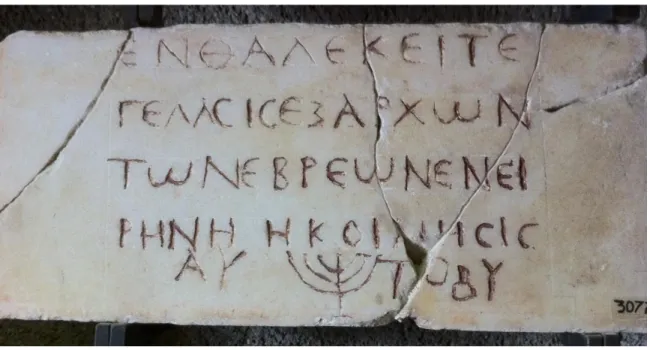
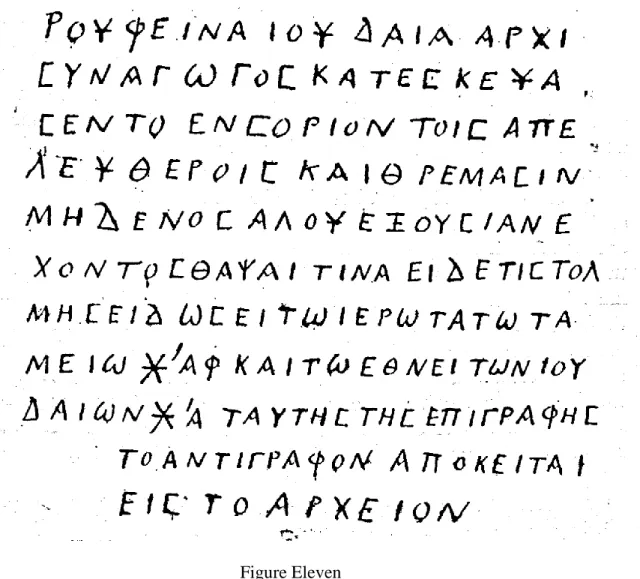
A gender-based dichotomy of meaning for title bearers held sway through the middle of the 20th century.59 Practical responsibilities and obligations were incumbent upon male title bearers, but the same could not be said for women. Regarding a third century CE mortuary inscription from Smyrna that names a woman, Rufina, as head of the synagogue, Frey observes, “It seems difficult to admit that she [Rufina] actually exercised the functions of a head of the synagogue.”60
The dichotomy of meaning predominated until developments in feminist scholarship led to a reconsideration of female title bearers and their role in the early synagogue.
Feminist Scholarship and the Rise of Women Leaders
Studies of women in antiquity appeared as early as the turn of the 20th century.61 Derived from Enlightenment ideals, “first-wave” feminist scholarship sought to
demonstrate women’s social status by recovering women’s historical presence in public roles and demonstrating the significance of women’s domestic roles.62 The popularity of research on women increased during the 1960s and 70s, perhaps in response to the publications of Friedan’s Feminine Mystique and de Beauvoir’s The Second Sex.63 A
59Louis Robert, in Hellenica 1 (1940), 26-27, does not elaborate on his observation that Jewish women occasionally bore titles.
60IJO II 43; Frey, CIJ II, 11.
61See, for example, John Edgar, Noble dames of ancient story (Edinburgh: Gall & Inglis, 1870) and Knud Wieth-Knudsen, Understanding Women: a popular study of the question from ancient times to the present day (New York: E. Hold, 1929). Joseph McCabe, The Religion of Woman: an Historical Study (London: Watts, 1905) focuses primarily on women and Christianity. For studies on women in Classical Greece and Rome, see Frank Abbot’s essays, “Women and Public Affairs under the Roman Republic,” Scribner's Magazine 46.3 (1909), 357-366 and “Roman Women in the Trades and Professions,” Society and Politics in Ancient Rome: Essays and Sketches (New York: Scribner’s, 1909), 77-99; Helen Clees, A Study of Women in Attic Inscriptions (New York: Columbia University Press, 1920).
62Suzanne Spencer-Wood, “Feminist Gender Research in Classical Archaeology,” in Sarah Nelson (ed.),
Women in Antiquity: Theoretical Approaches to Gender and Archaeology (Lanham: Altamira Press, 2007), 265-299.
21
“second wave” of feminist scholarship joined the first at this point, exploring the influence of patriarchy and emphasizing gender ideology and women’s resistance.64
Both waves of feminist theory have been and continue to be influential in the study of
women’s title bearers, which are seen as representative of the broader question of women’s status in earliest Judaism and, by extension, Christianity.65
Questions about women’s status in first century CE Judaism and early Christianity have at times become competitive and controversial. In the 1970s and 80s, Christian and Christian feminist theologians made efforts to reclaim for contemporary Christianity the perceived egalitarian basis of Jesus’ original movement. Although many of these scholars appropriately contextualized the Jesus movement within its Jewish setting, an inevitable dichotomy arose between a woman-friendly Jesus movement and a woman-restrictive Judaism.66 Jewish feminist scholars were quick to respond to these characterizations: in their most extreme, responses included accusations of anti-Semitism, but more moderate voices answered with comparable studies of women’s status in early Judaism.67 These
64
Suzanne Spencer-Wood, “Feminist theory and Gender research in Historical Archaeology,” in Nelson,
Women in Antiquity, 29-74.
65See Alison Wylie, “Why is there no Archaeology of Gender?” in Joan Gero and Margaret Conkey (eds.),
Engendering Archaeology (Oxford: Basil Blackwell, 1991), 31-56 on the non-evolutionary nature and interrelatedness of these “waves.”
66Elisabeth Schüssler Fiorenza’s In Memory of Her: A Feminist Theological Reconstruction of Christian
Origins (New York: Crossroads, 1984) is the classic articulation of the Christian feminist position, and although it does situate the Jesus movement’s perceived feminist impulse within a Jewish context, the proposed radical break with Judaism that Jesus is thought to have effected diminishes the force of this acknowledgement. Schüssler Fiorenza subsequently clarified her position and its implications for early Judaism in But She Said: Feminist Practices of Biblical Interpretation (Boston: Beacon Press, 1992). On the other hand, Leonard Swidler, Women in Judaism: the status of women in Formative Judaism
(Metuchen: Scarecrow Press, 1976); Biblical Affirmations of Women (Philadelphia: Fortress Press, 1979) and Ben Witherington III, Women in the Earliest Churches (Cambridge: Cambridge University Press, 1988) draw stark comparisons between the freedom offered by Jesus and the restrictiveness of Judaism. 67Judith Plaskow, “Blaming the Jews for Inventing Patriarchy,”
22
studies questioned the prevailing certainty of Judaism’s unilaterally restrictive treatment of women by reexamining non-canonical and other “unofficial” Jewish literature.68 The question of leadership, in particular, became a litmus test by which a religion’s original woman friendliness could be judged. A tentative truce appears to have been drawn, which recognizes the utility of each side for the other: women in both second/post-Temple Judaism and early Christianity possessed a degree of freedom, status, and leadership potential during the formative years of their respective religions. These potentials were gradually eliminated by an increasingly rigid, androcentric, and even misogynist hierarchy and eventually forgotten or actively denied.
As mentioned above, part of the process to establish women’s status in Judaism and Christianity involved investigation of alternative ancient sources which might preserve a more authentic, unaltered record of women’s place in history. Inscriptions fit the bill nicely. Bernadette Brooten’s 1982 monograph Women Leaders in the Ancient Synagogue
redeemed Sophia of Gortyn, Rufina of Smyrna, and other female title bearers from being part of the problem to being part of the solution: Judaism allowed women to be leaders of the synagogue.
Brooten challenges the gender-based dichotomy of meaning ubiquitous in previous scholarship on title bearers. She argues that different meanings are ascribed to the same
see Léonie Archer, Her Price is beyond Rubies: the Jewish Woman in Graeco-Roman Palestine (Sheffield: JSOT Press, 1990).
68As discussed in Levine, “Second Temple Judaism,” 13-20, including Cheryl Anne Brown, No Longer Be
23
title based on the sex of its bearer due to preconceived and unwarranted assumptions about women’s roles within early Jewish communities. If these assumptions are discarded, no reason remains to postulate one meaning for a title when given to a man and another for the same title when given to a woman. Read in this light, the inscriptions testify to the fact that women could stand as equals with men in the realm of synagogue leadership. Brooten’s study thus falls primarily within the paradigm of first-wave feminist theory, insomuch as it focuses on highlighting the heretofore neglected or discounted evidence for Jewish women in public, authoritative roles.69 Second-wave feminist thought is engaged only to the degree that Brooten sees subsequently developed gender ideologies and the increasingly patriarchal structure of Judaism serving to obscure women’s early positions of prominence in early Jewish communities, in collusion with traditional scholarship on the subject.70
In addition to disputing the basis upon which women’s titles were thought to derive from husbands, Brooten disputes the idea that a functional title could be used for honorary purposes.71 Following Preisigke, she claims that truly honorary titles, such as
clarissimus (most distinguished) and spectabilitas (notable one) always had an honorary meaning whether applied to men or to women.72 Since Brooten agrees with earlier scholars that titles such as archon or archisynagogos are functional titles for their male bearers, she argues that they cannot be honorary when applied to women. Instead, they
69
Preoccupation with women in positions of authority is characteristic of first-wave feminist theory as described by Spencer-Wood, “Feminist theory,” 36-37.
70Bernadette Brooten, “Early Christian Women and their Cultural Context: Issues of Method in Historical Reconstruction,” in Adela Collins (ed.), Feminist Perspectives on Biblical Scholarship (Atlanta: Scholars Press, 1985), 65-91.
71Brooten, Women Officeholders, 7-8.
24
imply the same degree of authority and practical responsibility when applied to both men and women. Brooten concludes that all title bearers should be viewed as functional without reference to the biological sex of the bearer. Following her history of scholarship and articulation of theoretical stance, the bulk of Brooten’s monograph is devoted to a catalogue of extant female title inscriptions organized according to title, with a discussion of complementary titles among men as well as the corresponding literary evidence for the use of each title. In each case, both male and female title bearers are credited with
functional responsibilities for the organization and administration of synagogues, based on the understanding that what is functional in one place cannot be honorary in another.
Brooten’s adaptation of the earlier model, wherein functionality implies leadership and honor something less, continues to be the paradigm by which new inscriptions are evaluated, albeit with a new default conclusion: women (somehow) acted in a leadership capacity within the synagogue. The most recent example is a 2009 publication by Daniel Stökl Ben Ezra of a funerary epitaph from Byblos.73 The inscription is only partially preserved, and reads, “May the pity of Adonai, my God, be on Sambathion, archontesse. Year 416, Mars 30.” Having concluded that Sambathion was most likely a woman due to the yod-tav ending on the word archon, Stökl Ben Ezra comments that the next point to consider is whether she was an archon in her own right, or whether the title was honorific and derived from her husband.74 He concludes that there is insufficient evidence to make this determination, but leans towards the former possibility, given that, as he says, “…in
73
Daniel Stökl Ben Ezra, “A Jewish ‘Archontesse’. Remarks on an Epitaph from Byblos,” Zeitschrift für Papyrologie und Epigraphik 169 (2009), 287-293. Earlier examples that follow the same paradigm include Kraemer, “A New Inscription from Malta,” and Bernadette Brooten, “Jael προστάτης in the Jewish Donative Inscription from Aphrodisias,” in Birger Person (ed.), The Future of Early Christianity
(Minneapolis: Fortress Press, 1991), 149-162.
25
some instances at least, women seem to have actually performed some leading functions.”75
Stökl Ben Ezra’s ambiguous conclusions regarding Sambathion are characteristic of the current state of research on women’s title bearers. Most scholars are willing to say that title inscriptions indicate women were doing something within the early synagogue, while several insist that these women were doing a very important something.76 As new inscriptions have added to the corpus of female title bearers over the past thirty years, each publication presents its inscription as further confirmation that earlier assumptions of women’s subordinate place in Judaism and Jewish society have been overturned.
State of the Question
Tessa Rajak and David Noy note that Brooten’s otherwise revolutionary study neither questions the basis upon which the functional responsibilities of title bearers had been established, nor challenges the binary functional/honorary terminology of the debate.77 Brooten’s assertion that both men’s and women’s titles were functional has no more solid basis or supporting evidence than did earlier scholars’ assumptions that women’s titles
75Stökl Ben Ezra, “A Jewish ‘Archontesse’,” 291.
76Tessa Rajak, “The Jewish Community and its Boundaries,” in Judith Lieu, John North, and Tessa Rajak (eds.), The Jews among Pagans and Christians (London: Routledge, 1992), 9-28 and James Burtchaell,
From Synagogue to Church (Cambridge: Cambridge University Press, 1992), 244-246 reject women leaders in Brooten’s sense, although not for the same reasons. Levine, TheAncient Synagogue, 509-511 is tentative in his conclusions, while Matthew Collins, “Money, Sex, and Power,” in Peter Haas (ed.),
Recovering the Role of Women (Atlanta: Scholars Press, 1992), 7-22 sidesteps the issue by discussing patronage without reference to titles. Paul Trebilco, Jewish Communities in Asia Minor (Cambridge: Cambridge University Press, 1991) and Hannah Safrai, “Women and the Ancient Synagogue,” in Grossman and Haut, Daughters of the King, 39-50 support Brooten’s conclusions.
77
Tessa Rajak and David Noy, “Archisynagogoi: office, title and social status in the Greco-Jewish
synagogue,” Journal of Roman Studies 83 (1993), 75-93. William Horbury, “Women in the Synagogue,” in William Horbury, William Davies, and John Sturdy (eds.), The Cambridge History of Judaism v. 3
26
were honorary while men’s were functional.78 The argument that women’s titles must be functional since men’s were rests upon the unsubstantiated assumption that men’s titles were functional. As it is, there is simply too little information available to know what, if any, practical responsibilities or obligations were associated with the titles in question, regardless of the title bearer’s gender.
Given the absence of progress interpreting these inscriptions over the past thirty years, a re-conceptualized approach to the corpus as a whole is warranted. The continued enumeration of female title bearers brings us no closer to understanding how these and other title bearers functioned in early Jewish communities.79 Without disputing the importance of publishing newly discovered women’s title inscriptions, scholarship on title bearers in general and female title bearers specifically is trapped in a pattern in which, to quote feminist historian Elizabeth Clark, “…we retrieve another forgotten woman and throw her into the historical mix.”80
78Kraemer, Unreliable Witnesses, 237-238 observes that functionality might not have been as highly valued in antiquity as it is in modern times, and that honor derived from benefaction might have more effectively garnered the social cachet Brooten sought to obtain for ancient Jewish women by seeing them as
administrative leaders. Many of the observations made by Kramer in Unreliable Witnesses, 232-241 correspond to my own, presented in the following conference papers: “Women leaders in the ancient synagogue: a reevaluation of the archaeological evidence,” Annual Meeting of the American Schools of Oriental Research (session: World of Women), November 2009; “What’s in a Title? Rethinking women’s leadership in the ancient synagogue,” Society of Biblical Literature Annual Meeting (session:
Archaeological Excavations and Discoveries: Illuminating the Biblical World), November 2010; “If it’s good for the gander is it good for the goose? Gender and Representation in Title bearer Inscriptions,” Southeastern Conference for the Study of Religion (session: Women and gender in conjunction with material culture), March 2011; “‘Honor’ vs. ‘Function’: Challenging the terms of the debate on title bearers,” Philadelphia Seminar on Christian Origins. University of Pennsylvania, April 2011. 79
This point is made eloquently in Riet van Bremen, The Limits of Participation: Women and civic life in the Greek East in the Hellenistic and Roman periods (Amsterdam: J.C. Gieben, 1996), 43, who notes that the enumeration of women with titles is offered frequently as evidence for significance: “that by showing
quantity… we are somehow able to make a positive qualitative point: ‘therefore women must have been prominent’, or some such statement.” Italics in original.
80Elizabeth Clark, “The Lady Vanishes: Dilemmas of a Feminist Historian after the ‘Linguistic Turn’,”
27
The pattern can be broken and progress renewed by establishing a new approach to analyzing title bearers, which incorporates both theoretical and methodological advances. I will argue that title bearer inscriptions are not examples of women in leadership
positions, but representations of women in leadership positions. Following this post-structuralist suspicion/dissolution of the subject, I rethink how, methodologically, to engage these inscriptions as textual, visual, and gendered representations of Jewish women by Jewish communities. Finally, I will discuss whether and how these
representations of women can inform our understanding of Jewish women’s reality in early synagogues.
1.4: Theoretical Considerations
Examining historians’ theoretical responses to post-structuralist critical theory’s rejection of subject and history is one place to start developing a new theoretical
approach to women’s title bearers. Studies on women in ancient Judaism are not always uniform or explicit in articulating their assumptions or outlook.81 I offer the following two examples to orient myself and the reader to the theoretical positions from which this book has been researched and written as well as the types of questions this project will ask and answer.
Elizabeth Clark has reflected on the effects of literary criticism’s linguistic turn on historians and their work on female subjects in particular.82 She notes that whereas the initial “discovery” of respected, authoritative female figures in male-dominated religious
81An excellent exception to this generalizing statement is Cynthia Baker, Rebuilding the House of Israel:
Architectures of Gender in Jewish Antiquity (Stanford: Stanford University Press, 2002), which has been very influential in the conceptualization of this project.
28
roles was cause for celebration, the gradual realization of the representational nature of such figures has tempered expectations about their proving the empowerment of “real” women.83 Clark illustrates this point using the depiction of St. Macrina in the writings of her brother, Gregory of Nyssa. Gregory’s prominent, positive depiction of Macrina initially was lauded by feminist historians. Scholars have become increasingly aware, however, of the distinction between the historical Macrina and the textual Macrina. The former was a real woman whose reality is lost to modern scholars, whereas the latter is a representational character created by Gregory for specific uses in his text.84 This
realization leads to more sobering conclusions regarding Macrina’s presence and prominence in the text, but also to more credible understandings of women’s roles in early Christianity. Clark’s critique of Macrina scholarship in light of post-structuralism’s desired elimination of the subject offers a way to rethink female title bearers, such as Rufina of Smyrna and Sophia of Gortyn. Like Macrina, Rufina and Sophia are not the subjects they were once thought, but neither are they fictitious. As representational subjects, female title bearers can illuminate the ways in which ancient synagogues conceived and used gender in their public presentations of leadership.
In response to post-structuralism’s attempted dissolution of history into textuality, Gabrielle Spiegel has formulated a stance by which literary text and historical context remain distinct but work in conjunction to create meaning.85 She argues that by heeding a text’s “social logic,” due diligence is given both to its contextual and discursive
83Clark, “The Lady Vanishes,” 30-31. 84
29
dimensions as simultaneous product and agent of social construction.86 Moreover, if the discursive power of a text is to be understood, it should be examined within a historical context which, though distinct from the text itself, simultaneously establishes its
significance: “Historians must insist… on the importance of history itself as an active constituent of the elements which themselves constitute the text.”87
The theoretical relationship between history and text articulated by Spiegel offers a corrective to the current practice of reading title bearer inscriptions as neutral records of historical fact. Indeed, a robust skepticism toward archaeological and epigraphic sources is particularly important, as these sources are often heralded as straightforward and unequivocal in their depiction of “real” women in contrast to more bias-prone literary sources.88
Determining the “social logic” of title bearer inscriptions will involve renewed emphasis on the
historical context of Jewish communities as the social location reflected in and generative of these titles.
Repositioning the theoretical stance from which to view title bearer inscriptions is the first step in moving the conversation in a productive direction. The insights developed by Clark and Spiegel in response to post-structuralist challenges to subject and history offer three new positions from which to think about title bearers. First, the subjects of inquiry are, of necessity, representations rather than real people. This is not to say that Sophia of Gortyn, for example, did not exist, but rather that the title inscription from which we
86Spiegel, “History,” 77-78.
87Spiegel, “History,” 83-84.
88Historians working with literature have been quicker to recognize the constructed nature of their source material compared to those working with documentary evidence, but recognition is growing that
30
know her is a contextually specific representation of Sophia as head of the synagogue at Kisamos. Second, title inscriptions participate in the construction of social meanings at the same time they purport to reflect those meanings. Again using Sophia as an example, her title inscription contributes to what it means to be a head of synagogue even as it describes Sophia. Third, the meaning of a title bearer is not fixed, but fluid and signified through the discursive exchange between text and historical context. For example,
Theodotus, Sophia, and the anonymous female infant from Cappadocia bear the title head of synagogue.89 The social logic of these texts would suggest that the title’s meaning is sufficiently fluid to allow all three individuals to be heads of the synagogue without necessarily implying that they were heads of the synagogue in exactly the same way. The significance of the term is mediated by each context in which it is invoked.
As an analysis of representation, this study inevitably distances and, perhaps, excises Jewish women from its pages. Shaye Cohen has addressed a similar phenomenon in his work:
This book is about Jewish women, but is not about Jewish women. Jewish women are everywhere but nowhere in this book. The Jewish women who figure on every page are women as imagined, constructed, and classified by Jewish men… This book is not a history of women’s Judaism; it is at best a small contribution to the history of
women in men’s Judaism.90
By applying to my own project Cohen’s observation that his study of Jewish women does not actually engage with Jewish women, I am, from the outset, inexorably
delimiting the parameters of my conclusions. I cannot offer encouragement about how many Jewish women you will meet in this study or how much you will learn about them.
89Originally published in G. Mavridis, The scientific, literary, and technical illustrated almanac of 1913,
especially for Anatolian Greeks, published by the ‘Papa Giorgios’ Association of the inhabitants of Nevşehir (1913), as referenced in Brooten, “Female leadership,” 216.