INFORMATION NEEDS AND USE OF ONLINE VIDEO BY EDUCATORS: IMPLICATIONS FOR THE DESIGN OF WEB RESOURCES
Ron T. Brown
A dissertation submitted to the faculty of the University of North Carolina at Chapel Hill in partial fulfillment of the requirements for the degree of Doctor of Philosophy, in the School of Information and Library Science.
Chapel Hill 2007
ABSTRACT
RON T. BROWN: Information Needs and Use of Online Video by Educators: Implications for the Design of Web Resources
(Under the direction of Professor Stephanie W. Haas)
A case study of the nasa.ibiblio.org Web site was undertaken to deepen the current understanding we have of how educators search for and use online video information in classroom settings. Three methods were used to conduct a user needs assessment: transaction log analysis, online survey, and cognitive walkthrough interviews. The findings support previous research which found educators used videos with difficult topics and they used them to help students visualize concepts. In the study, visual surrogates of video were evaluated and educators suggested a series of revisions which would make them more interactive. Some educators were able to compensate for the system’s lack of educational standards metadata by applying their personal knowledge to the system.
The major contributions of this dissertation are the introduction of the Web of
Criteria, the recommendations for educational digital libraries and implications for the design of storyboard and posterframe visual surrogates. Findings from the current study and from previous research suggested social interactions educators have are important and need to be facilitated in digital environments. Digital library providers might view the interface as the point where they can intervene and lessen the barriers educators have to retrieving
ACKNOWLEDGMENTS
I thank God for providing me with the strength, support and determination to achieve this wonderful dream.
I appreciate the feedback provided by my dissertation committee which greatly shaped this work, Stephanie W. Haas, Samantha K. Hastings, Gary Marchionini, Jeffrey Pomerantz and Barbara M. Wildemuth.
TABLE OF CONTENTS
LIST OF TABLES x
LIST OF FIGURES xii
CHAPTER I. INTRODUCTION 1
Rationale 2
A Study Of An Online Media Archive 5
II. BACKGROUND 8
One Educator’s Search For Online Video 8
Impact of Educational Philosophy 18
Teaching Process 22
Information Seeking And Use Of Online Video By Educators 41
Relevance Criteria For Educational Materials And Online Video 54
Digital Library Interface Design 63
Research Questions 79
III. METHODS 81
Research Bias and Validity 101
Credibility 102
Dependability 104
Confirmability 105
Conclusion 106
IV. RESULTS 107
Transaction Log Analysis 107
Online Survey 135
Demographic Information 135
Information Needs and Use of Educational Material by Educators 136
Design Expectations of Educators 141
Design Decisions and Functional Requirements 150
Data Cleaning For Queries 151
Truncated Queries 152
Plural Queries 152
Visual Aspect of Video 153
GEM Criteria for Design: Organization 157
Investigate Other Types of Educational Metadata 160
Add Related Content 161
Add Full Text Transcripts 161
Implement Captioning 162
Integrate Search Engines and Customized Search 162
Miscellaneous Design Decisions 170
Interviews and Cognitive Walkthrough Analysis 172
Interview and Cognitive Walkthrough Demographic Information 176
Revising Science Category 180
Revising the Images and Text 183
Revising the presentation of video segmentation 185
Relevance of Standards 186
Importance of Grade Level 187
Preferred Seeking Style 189
Posterframe and Storyboard Surrogates 190
Use of Video 193
New Interface Features 195
Summary of Cognitive Walkthrough and Interview Results 199
Summary of Research Findings 201
V. DISCUSSION 205
Information Seeking and Motivation Node 206
Technical Skill Node 212
Technology Node 213
Current Lesson and Curriculum Node 213
Interface Node 216
Limitations 221
VI. CONCLUSION 223
APPENDICES 226
LIST OF TABLES
Table Page
2.1 Range and Formality: Two dimensions of information
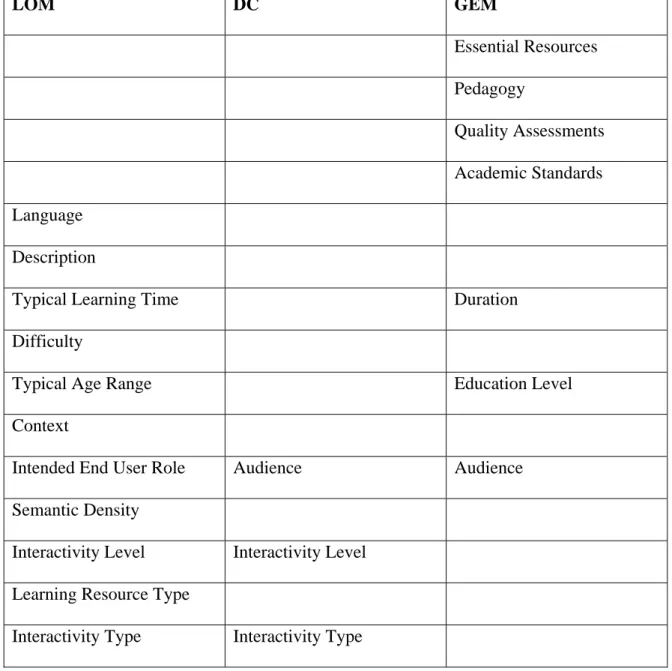
gathering used by Hart 29 2.2 Comparison of educational metadata elements 56 2.3 Some metadata elements used by Open Video to
describe digital video 60 4.1 Top downloaded video titles by NASA program 113 4.2 Top viewed video title pages by NASA program 120 4.3 Top viewed video metadata by NASA program
and video title 124 4.4 Adjusted activities by NASA program from July
2006 to May 2007 128 4.5 Adjusted activities by month from July 2006
to May 2007 128 4.6 Monthly summary statistics for each activity 128 4.7 Classification of Referrer traffic into broad categories 133 4.8 Resources used by educators to find Web based
educational resources 138 4.9 Needs which inspired the educators to do a Web search 139 4.10 Ranking of resources educators used in planning
for the previous month 140 4.11 Features respondents valued in their favorite
search engine or Web site 142 4.12 Frequency of Web based video use in the past month 143 4.13 Actions taken if videos were not available from
find on a Web site which provided online video 144
4.15 Ranking of instructional tools educators would most like to accompany Web based video 145
4.16 Educators' ranking of the importance of each design feature 146
4.17 Challenges to the use of Web based video 147
4.18 Reasons for not using Web based video 148
LIST OF FIGURES
Figure Page
1.1 Screenshot of nasa.ibiblio.org index page 6 2.1 The Web of Criteria: Factors which impact an educator's
successful interaction with online video 11 2.2 Wilson’s 1981 model of information behavior 16 2.3 Wilson’s 1996 model of information behavior 17 2.4 Selected faceted categories from the Gateway to Educational
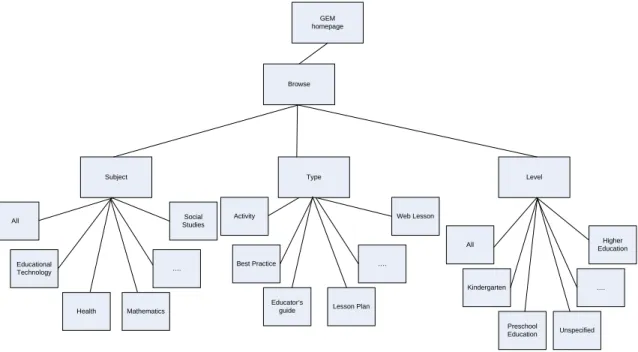
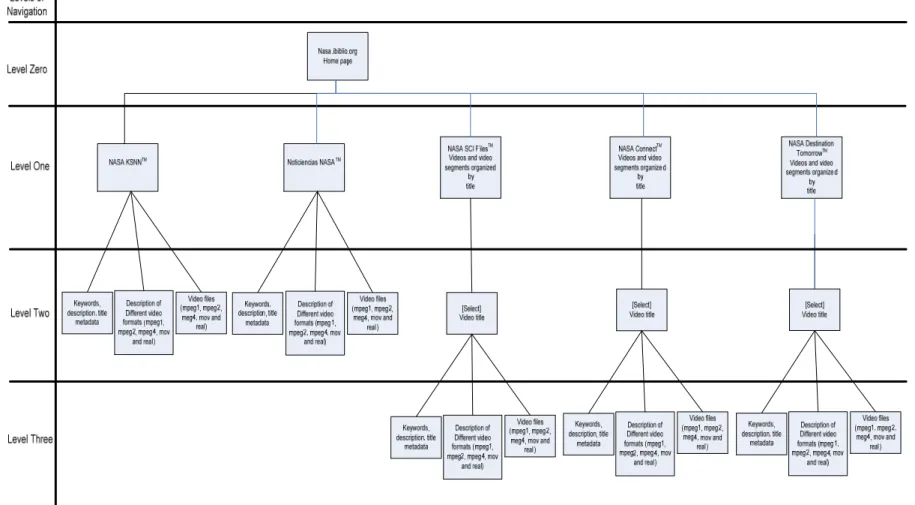
Materials 67 2.5 Navigation paths for nasa.ibiblio.org 70 2.6 Screenshot of duplicate link structure for nasa.ibiblio.org 72 3.1 Comparison of systems development life cycle
to NASA Ibiblio research project 92 3.2 Screenshot of NASA SCI Files™ listing 95 3.3 Screenshot of video keyword and description information 95 4.1 Video downloads for nasa.ibiblio.org from
July 2006 – May 2007 109 4.2 Adjusted downloads by video format for nasa.ibiblio.org
from July 2006 – May 2007 111 4.3 Adjusted views of NASA program index pages on
nasa.ibiblio.org from July 2006 – May 2007 116 4.4 Video title views for nasa.ibiblio.org from
July 2006 – May 2007 118 4.5 Views of video metadata for nasa.ibiblio.org from
July 2006 – May 2007 122 4.6 User searches on nasa.ibiblio.org from
4.7 Categories of queries performed on nasa.ibiblio.org from
July 2006 – May 2007 130
4.8 Top Referrers to nasa.ibiblio.org from July 2006 to April 2007 132
4.9 Screenshot of text view 155
4.10 Screenshot of small thumbnail and text view 156
4.11 Screenshot of reduced text and large thumbnail view 156
4.12 Screenshot of detailed video view 157
4.13 Screenshot of nasa.ibiblio.org main page 159
4.14 Screenshot of first level of science category 159
4.15 Screenshot of the Embedded Viewer 165
4.16 Screenshot of a video playing in the video display 166
4.17 Screenshot of the search results for the Embedded Viewer 166
4.18 Screenshot of the initial Google Video Search page 168
4.19 Screenshot of the expanded results for the Google Video Search page 168
4.20 Screenshot of the Google Video display shown after performing a search 169
4.21 Overview of tasks and questions for cognitive walkthrough 172
4.22 Mathematics category and subtopics 182
4.23 Science category and subtopics 183
CHAPTER I INTRODUCTION
Since the introduction of the World Wide Web, educators and researchers have struggled with the question of how best to introduce Web based educational materials into the classroom. Educators attempting to use Web resources face a variety of problems when it comes to implementing those resources in the classroom, such as how to efficiently find information on the Web, lack of technology to fully use Web based resources in the classroom, and lack of time to align Web based resources to their course of study and/or develop related lesson plans. Although the previous list is not an exhaustive list of problems educators face when attempting to use Web materials, this list that suggests educators who do use these materials might have advantages which minimize some of these problems or these educators may see the benefit of using these materials as outweighing the problems related to their use. From the perspectives of information systems design and research on information seeking and use of Web materials, these "advantages" are the exact details which, if better understood, could lead to increased use of Web resources by educators.
technology and funding between schools affects student learning, and the importance of continuing education in sharpening educators’ classroom practices.
The previous branches generally emphasize access to resources and how access to more of those resources might influence the overall outcome of learning in the various institutions. For example, a common belief is that educators who have access to continuing education resources are generally more up-to-date in their field and better prepared to teach in the classroom. Although these types of research are important, they may not examine all of the variables related to how educators use the Web in relation to their teaching tasks. In particular, research could focus on how well current Web systems and Web resources satisfy the needs of educators. For this, more research needs to be done that evaluates educators’ information seeking and use of Web material.
To understand how the larger process operates as researchers we may need to understand which variables are most important and how these variables interact. More specifically we might need to evaluate how the Web material is advertised or made available to an educational audience, an educator's overall experience with use of the Web material, the role technology plays in educators' use of the Web material and how applicable the Web material is to their teaching tasks. In order to study this larger problem, this work focuses on evaluating educators’ information seeking in relation to the use of one specific type of Web material, Web based digital video.
Rationale
Web based or online video refers to video that has either been digitized by
widespread use of online video has recently increased at an exponential rate with the advent of sites such as youtube.com and google.video.com and their increased visibility and appeal in the past few years. Whereas youtube.com and google.video.com are Web based video repositories which focus on all genres of video created from the contributions of their users, educational Web based video repositories exist in a more library-type environment. In the library-type environment contributions are generally catalogued by information professionals and included in Web repositories based on some acquisition process. Despite the differences in how videos are contributed in educational and commercial Web based video repositories, both institutions know relatively little about the user behavior and information seeking habits of their respective populations. With that being said, the need for efficient Web based video retrieval systems and well designed interfaces will sharply increase as the number of users grows.
One important reason to investigate the use of these digital resources is the need to understand user behavior as it relates to Web based video repositories. In some respects the commercial sector will be less concerned with developing models of online video use because their primary efforts will be spent in developing ways to monetize and create economic models surrounding online video resources. This leaves the research sector to investigate why people use Web based video repositories and to explore how the use of the free online video resources might be improved.
channels and have more privacy when using these new media. As this trend continues educators may need to adapt to this evolving learning style of their students and
proportionately increase their use of video and visual materials to stimulate the minds of their students. This adaptation will only increase the need for educators to find a variety of
teaching materials in the most efficient manner possible, thus reiterating the importance of research to study how to improve access and dissemination of web video resources for use by educators.
Another motivation for the selection of online video over other educational materials is that Web based video has a distinct combination of textual, aural and visual components as compared to other Web resources. Web based video differs from text based resources
because video description, search and retrieval are largely limited to the textual domain, with researchers still working on ways to leverage the audio and the video to improve
performance of information systems. This more complex composition requires users to interact with Web based video differently. Until recently most Web based video required specialized players or additional plug-ins to be installed before the video could be displayed on users’ computers. Not only is the viewing interaction of Web based video different compared to text based resources but so are the storage requirements. The higher the quality at which the video is stored, the more storage space is required. The more storage space required for the video, the more difficult it is to transmit the video files across the variety of bandwidths used by the general population. These characteristics distinguish Web based video from other Web based resources and suggest we need to study how these
study of these materials will address the need to improve the description, search and retrieval of Web based video.
Additionally this topic deserves our attention because it can advance our understanding of pedagogies for, and preservation of, online educational materials. As suggested by Hatch, Bass , Iiyoshi, and Pointer (2004), instead of developing teaching materials for individual use, educators should make these materials available in the form of digital repositories to wider audiences. By publishing these materials in repositories, Hatch et al. suggest the scholarship of teaching would benefit from the feedback and use of the
materials from the expanded global educational audience.
Given the unique problems presented to both the providers of online video resources as well as the users in the educational domain, more research is needed to propose solutions to the problem of how to best present, search for and retrieve Web based educational videos. We propose to evaluate a specific Web based educational video repository, nasa.ibiblio.org, in relation to educators’ information seeking and use of online video in order to gain a deeper understanding of some of the issues involved.
A Study Of An Online Media Archive
Nasa.ibiblio.org is a digital library which provides Web based access to NASA
video programs; and ibiblio provides the web space for the video archive to be stored. The target populations for the digitized video are mathematics, science, and technology educators in grades K-16, home schoolers, libraries, after-school clubs, and a variety of informal education outlets such as 4-H clubs, Boys and Girls Clubs, Boy Scouts, Girl Scouts, YMCA, science centers, and planetariums.
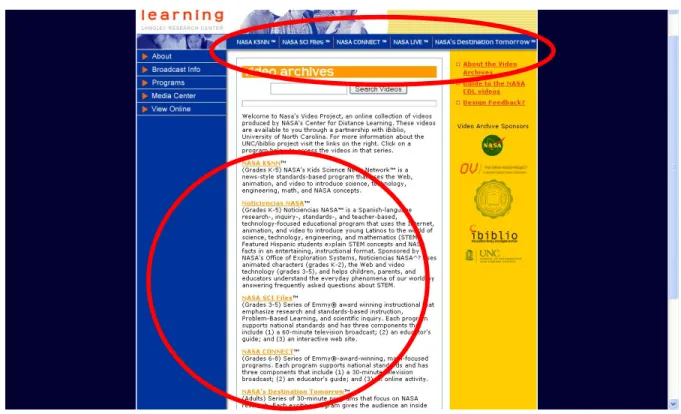
Figure 1.1 Screenshot of nasa.ibiblio.org index page.
Many questions exist about how to best design Web based video library systems for educators. The current research aims to explore the types of information educators require when searching for and retrieving online video. In particular this research will attempt to address the following broad research questions:
• How congruent is online video with educators' current work processes?
• Do the current ways in which online video is provided facilitate educator use of online video for instruction?
The first step was to conduct a user needs assessment that focused on how educators would like to access and use video in their teaching. This research attempts to expand our
understanding of educators' information seeking behavior and use of online video. With the knowledge of educators' needs we will be then able to improve our systems and empower educators to focus more on the task of teaching rather than technical issues of using video retrieval interfaces. Furthermore this user assessment provides further context for
representing and identifying semantic relationships from raw video footage; this problem is commonly referred to as the semantic gap.
CHAPTER II BACKGROUND
One Educator’s Search For Online Video
Imagine an eighth grade algebra educator is looking for an online video to include in next week’s class. The educator wants her lesson to reinforce the definitions of transversals, parallel lines, and alternate interior angles that the students learned the other day. The
educator also wants the Web based video to have a good real life example of how to calculate the circumference of a circle. She begins to plan for next week’s class at home by outlining the objectives, materials, prerequisites, and outcomes of the lesson plan that she would like to cover.
There are many things that we don’t know about the current use of online video in K-12 classes including what motivates educators to search for online video to use in the
digital library interface and a retrieval system. The digital library interface displays
information to the user that allows him to interact with the digital library. The digital library retrieval system processes user queries by searching through records in the collection. Web based video libraries also establish a community of users focused on the research and use of online video materials in a variety of ways.
After going to the online video library and typing in “Interior Angles” the educator begins to search for online videos that might help her teach a lesson on parallel lines. Several questions become relevant to the interaction the educator has with the Web interface and the online video library retrieval system. How do educators phrase their search queries? What information do educators find useful for evaluating an online video’s content? What criteria do educators use to judge the appropriateness of the online video they find to the lesson they wish to teach? How user friendly is the online video library? These questions are important because everything from how online video is indexed, to how the interface for the online video library is designed, impacts the effectiveness of Web based video retrieval and the digital library.
The educator eventually finds several online videos on the subject of parallel lines, interior angles, and circumference. She chooses the video on Eratosthenes as a possibility. But because she wants to know if parts of the video will apply to tomorrow’s lesson, she must review the entire video – there’s no other way to know for certain.
shows the video to the class. Another question the educator has is whether this site will even be available at school. The firewall prevents sites that have not had their content verified from being displayed on school computers. Randomly clicking on the MPEG-4 format she downloads the online video, the Real Player window opens up and a song begins to play. What an unexpected outcome! The educator guesses the song must be the last one she played with Real Player, and assumes that the attempt to play the video was unsuccessful. Trying again she clicks on MPEG-2 format. A progress window pops up and the video begins to download. After the download completes, a broken image of a film strip stares back at her on the computer screen indicating another unsuccessful attempt to play the online video. The educator is disappointed the Web based video library gives no indication of how long downloads will take or which videos are compatible with her computer. She decides to try one more time and clicks on the QuickTime link. The educator waits patiently as the progress window appears and the video downloads to her machine. After two unsuccessful attempts, the online video is downloaded to her machine and plays successfully. The educator reviews the video and decides it is appropriate for next week’s class. However, based on her
frustrating and unsatisfactory experience with using this particular resource she is certain she will not use it again.
struggle between in-depth inquiry and curriculum breadth" (p. 1). These problems suggest there are criteria that must be met to successfully search, retrieve, and use online video in the classroom. Collectively these criteria will be referred to as “the Web model” or the “Web of Criteria” (see Figure 2.1).
Figure 2.1. The Web of Criteria: Factors which impact an educator's successful interaction with online video
Speed of Internet Connection
Compatibility of Video Formats
Technology
Technical Skill
Mouse Functions Knowledge of Digital Video Formats
Fit within current lesson and curriculum
Fit within class period Technology Available? Aligned with Standards?
Download Digital Video
Keyboard functions
Educator’s Information Seeking and Motivation
Awareness of Digital Libraries Knowledge of Search Process
Engage students? Experience with non-text materials
The Web of Criteria is based on reflections on the research literature and from observations made during a focus group of educators conducted on January 11th, 2006 (Brown, 2006a; Brown, 2006b; Brown & Bowers, 2006). Overall this Web of Criteria
not intended to be an exhaustive representation of the described phenomenon. The four subsections are each composed of one larger node and a constellation of smaller
interconnected nodes. Nodes in the model represent different criteria related to the retrieval and use of Web based video; if any one criterion cannot be met then the web is weaker and the chance of an educator being successful in that particular interaction is diminished.
One node in the Web of Criteria represents an educator’s information seeking and motivation. In order for educators to retrieve online video they need knowledge of the search process. Knowledge of the search process implies educators have an awareness of the variety of digital libraries and search engines available along with a willingness to use them. If educators are not aware of the digital libraries or are not willing to use digital library content in the class then those resources are useless. Awareness of digital libraries and the collections each digital library contains will determine which resources are searched. Not only do
educators need to be aware of digital library resources and collections, they also need to be aware of other services where online video can be accessed. Online video can also be accessed from on-demand and streaming services, however, the cost of these services might prohibit educators from continuous use of these resources. The focus of this research is on digital libraries which provide their online videos at no monetary cost to their user.
Another node in the web is technical skill: does the educator have the technical skill necessary to use a computer? This requires the educator to have a general knowledge of how to use a computer from basic skills such as how a keyboard and mouse function, to how to select between different digital video formats and download a digital video. Educators who have the technical skill needed to display digital video will be able to download and display video from a variety of Web resources and troubleshoot problems they encounter with Web based video use.
The next node in the web is technology: is the technology available to display online video in the classroom? To use online video in their classroom the minimum technology that educators need is an Internet connection and a computer. The computer allows the educator to search for, preview, display, and download or stream Web based video to use as part of a lesson. The speed of the Internet connection affects the length of the download time for the online video, as well as the interaction educators have with various components of the digital library, such as the interface and retrieval systems. Educators with slower connections will spend more time browsing and could possibly stop searching due to frustration developed from experience with previous web interactions. The display capabilities of educators in classroom are also an issue with technology. To effectively use online video the display size of the video needs to be large and educators need access to projections and / or large
monitors.The issue of technology is also complicated by the variety of digital video formats available and the rapid changes that can occur with proprietary packages.
current lesson. Relevant videos will reinforce curriculum standards, engage students, and fit into class period time constraints. In general, educators might use a variety of sources to judge the usefulness of particular resources such as search engines, recommendations from other educators, or references from textbooks and other print materials. In addition to external sources for judging resource relevance, the digital library system must provide summaries or surrogates of their digital resources. Surrogates are the visual, textual, and aural representations of digital video in the digital library. These representations of the video must correspond to how the educator conceptualizes the digital video he needs in order to find a successful match between the system and user views of the information need.
Otherwise educators will present queries to the digital video retrieval system that continue to return unsatisfactory results.
clips and unlike key frames and storyboards, excerpts can contain audio (Marchionini et al., 2000).
Given the way in which the web was created, we need to confirm the descriptive power of the model by comparing it to more general models of information seeking behavior and by testing it with research. One model which is a good candidate to use for such purposes is Wilson’s model of information behavior. This model was chosen because of its popularity and its ability to describe a wide variety of information behaviors.
If we compare the Web of Criteria to Wilson's (1999) model of information behavior (Figure 2.2 & Figure 2.3) we can begin to see how an educator's successful interaction with Web based video fits into a more general information seeking process. The technical skill node in the Web of Criteria relates to the information user or the person-in-context in
Wilson's model also suggests that an educator's self efficacy will be motivated by the risk and rewards associated with social learning theory variables. Wilson (1999) goes further than the Web of Criteria and categorizes each information behavior as passive attention, passive search, active search and ongoing search. The technology node of the Web of Criteria resides within the demands placed on the information systems section for the 1981 model (Figure 2.2) and the intervening variables section for the 1996 model (Figure 2.3). The technology node was placed in intervening variables section of the model because technology can be viewed as a barrier to the successful retrieval of information if the correct conditions are not present. The fit within current lesson node relates to the satisfaction and non-satisfaction sections of the 1981 model (Figure 2.2) and the information processing and use section of the 1996 model (Figure 2.3). In the last node users are judging the relevance of the retrieved document by processing it through a series of criteria, if the document meets the criteria the user is either satisfied or not satisfied with the overall result.
Figure 2.2. Wilson's 1981 model of information behavior
missing from the Web of Criteria. This suggests the focus of the Web of Criteria is on the very specific experience a educator has searching for online video and not on the initial motivating factor for educators' to search for online video. Another difference between the Web of Criteria model and the 1996 Wilson model is that the Web of Criteria model does not include variables such as satisfaction or non-satisfaction with the result. This further
highlights the focus of the Web of Criteria model on the continuum of criteria need for a successful interaction with Web based video, keeping in mind that as nodes in the Web of Criteria are not present the model weakens and the chance for success decreases. Given that Wilson's model describes the aspects of activating mechanisms and satisfaction with results in overall information behavior in more detail, his model will be accepted as the default description of how these aspects of information behavior are processed within users.
Figure 2.3. Wilson's 1996 model of information behavior
retrieval of online video by educators, I will focus on the following general question: in what ways can digital library collections better meet the needs of K-12 educators in their retrieval and use of online video material? The next section explores the impact educational
philosophy may have on the use of online video. Impact of Educational Philosophy
Educational philosophy is a field of research devoted to the study of teaching and
t-hat "knowledge is emerging and not static, tt-hat the
lp
pt to establish an
ducators learning. More specifically, educational philosophy can be thought of as the set of theories that motivate instruction, the tools used for instruction, and the beliefs educators have about student learning. The educational community is currently a mix of constructivist practices (open ended, process-based instruction) and instructivist practices (standards-based, conten centered instruction) (Fitzgerald, 2001).
Constructivist philosophies hold t
inevitable task of learning is to seek meaning within one's expanding frame of reference, and that a major part of the process of education is building knowledge and checking it against the concepts of others" (Joyce & Weil, 1996), whereas instructivist philosophies believe "reality exists independent of what we may think of it" and it is the job of educators to he students obtain this knowledge (Kozioff, LaNunziata, Cowardin, & Bessellieu, 2000). These two philosophies have different implications for educators, the instructional tools used, as well as how information should be designed for educator consumption.
Educators who accept a constructivist theory of learning will attem
may use Inquiry Based Learning (Crawford, 1999) or Problem Based Learning techniques (Capon & Kuhn, 2004) to guide and motivate student behavior. Practitioners of this approac believe that student learning works best in an environment where they discover rules, principles and theories, having minimal interaction with the instructor.
From the constructivist point of view video might be used as an
h
instructional tool to
tes student inquiry in one
se
nt
d, educators who accept the instructivist theory of learning will focus n a m
s
pt, motivate student inquiry. The NASA KSNN™, NASA Connect™, and NASA SCI Files™, educational videos have been developed within the constructivist paradigm. For example, the NASA Connect video The Path of Totality: Angular Distance©
(http://www.knowitall.org/nasa/asx/angular_distance.asx) motiva
segment by asking the following questions: Why do eclipses occur? What is angular size? What is the path of totality? Why don't we see a solar eclipse every moon cycle? The purpo of these questions is to get students to think about the relationships among the sun, moon and Earth and their connection to eclipses. Similar guides for other videos have been prepared, highlighting the fact that videos whose philosophy are congruent to those of the educator should be easier to incorporate into the educator's work flow and actually reduce the amou of preparation needed.
On the other han
lead the students in use of the concept, test the students by providing structured and guided practice and finally follow up with subsequent tests to ensure that students have mastered th concept. Instructivist philosophies have developed based on Behaviorism (e.g. B.F. Skinner): in this philosophy educators may use Direct Instruction, Precision Teaching or applied behavior analysis techniques to guide instructional activities. Educators within the instructivist paradigm might use step-by-step guided instructions as a means of stru their own knowledge and facilitating educator-student communication (Fitzgerald, 2001; Kozioff, LaNunziata, Cowardin, & Bessellieu, 2000).
Educators who accept the instructivist point of
e
cturing
view may be less likely to accept ever,
e may
ols such as video, or lesson plans may have been designed
ar video as a "substitute for teacher instruction" in the early stages of student learning; how as students gain mastery of concepts educators with instructivist philosophies may use videos as introduction to tests or projects which cover using a variety of concepts and skills students have learned. On the other hand, educators with instructivist viewpoints may believe that video is a good instructional tool for reinforcing how concepts are used, such as showing students a brief video of acceleration before the educator leads the class in use of the force=mass*acceleration (f=m*a) equation. From the instructivist viewpoint, video us
have advantages over other ways of presenting classroom topics because it engages students' visual and auditory learning.
Although instructional to
2 of the Gateway to Educational Materials1 (GEM) study, one subject found it ironic that GEM provided lesson plans. The subject suggested that educators seeking lesson plans were not congruent with the constructivist philosophy, educators who used lesson plans were less likely to achieve educational objectives, and lesson plans were not conducive to educator collaboration (Fitzgerald, 2001). Another consideration is the practical constraints that strongly affect teaching practices. Lack of time, access to resources, the need to teach to the curriculum standards and other constraints may take priority over organizing instruction according to one educational philosophy. If educators operate in this environment then what will be the determining factor for an educator's adoption and use of online video?
systems. In this final question we see how richer knowledge of an educator tasks and mental models will enable us to better design systems that educators use in their everyday lives.
The previous review of educational philosophies acknowledges the importance of educational philosophy to the teaching task; however, including educational philosophy in the Web of Criteria will be left to future work and is not in the scope of this research. The next section will explore how the teaching process and the everyday information needs of educators are related to the search and use of online video.
The Teaching Process
For the purposes of this paper, the teaching process can be defined as the daily activities of teaching. The process involves decision making and the constraints of the
teaching environment. During an average day educators have many concerns such as meeting instructional objectives, covering curriculum content, monitoring student progress, keeping students motivated, disciplining students, administrative tasks and managing time. Given the variety of tasks that educators must perform on any given day, their primary concern is not with the information seeking process itself but how their work gets accomplished. One model that takes into account the importance of work that must be done by professionals is the model of information seeking for professionals created by Leckie, Pettigrew, and Sylvain (1996).
seeking was largely influenced by work roles, tasks, and setting, along with a variety of other factors.
The first major influences on the information seeking process were work roles and associated tasks. Work roles were a distinct group of job functions related to a specific profession. Associated tasks were the specific tasks required of each individual work role. For example, the researchers identified consulting as a work role of engineers. Tasks associated with the consulting role were presentations, interviews and client meetings. For this work role and task combination, engineers required information sources that were current and highly accurate. These requirements caused consultants to rely on market information from vendors. In the health care setting, an example of a work role often assumed by nurses was the role of patient care. The role of patient care was associated with administrative tasks of finding hospital equipment, and locating patient records. Patient care was also associated with the task of consultation with colleagues regarding the proper care for specific patients. Finally, in the legal setting an example of a work role of lawyers was counseling. In the work role of counseling lawyers performed the following tasks: client interviews, responding to telephone calls and client representation.
Given what we know of work roles and tasks from Leckie, Pettigrew, and Sylvain's (1996) model, we can extend the model to describe the teaching profession. With respect to the teaching profession, K-12 educators’ work will largely be governed by administrative and teaching work roles. The administrative work role of the educator is characterized by
constrained educator time is. Educators in Hanson and Carlson’s (2005) study described lack of time as: online resources that are not readily available and take too long to locate,
resources that had long download times, or resources that took too long to adapt to their needs. Given educator work constraints, issues like time, covering curriculum material, resources used and relation to subject material are likely to be important factors that affect how educators search for information.
Leckie, Pettigrew, and Sylvain (1996) found a variety of other factors that determined either what information was sought or the format in which the information was desired. In the case of engineers’ information use, the other factors that affected the information seeking process were accessibility, information system design, stage of research and stage of
engineer’s career. In the legal setting, the researchers found variables such as experience, highest level of education attained, information system design, and attitude toward research had a great influence on the information seeking process.
According to the Leckie, Pettigrew, and Sylvain (1996) model other factors will likely play a role in educators’ information seeking and use of online video. These factors may include accessibility of online video, quality of online video, level of education, design of digital library information systems, experience teaching, attitudes toward video and perceived ease of digital library use.
outcomes. Also included in their model are feedback loops so that outcomes, sources of information, awareness of information and information seeking can occur at the same time and be influenced by other parts of the model. Now that we have discussed the overall model, the specific parts of the model will be discussed in detail.
The first part of the general model of professionals’ information seeking was work roles and associated tasks. According to Leckie et al.’s (1996) model, professionals
performed a discrete number of work roles, and associated with each work role were work tasks. Leckie, Pettigrew, and Sylvain, (1996) identified five basic roles that professionals perform: educator, service provider, administrator/manager, researcher, and student. The teaching process includes all five roles; however, the most relevant role to this literature review is the role of the educator. According to the researchers, the educator role has two main subroles of community outreach and teaching. The tasks associated with the educator role include planning and curriculum development. They described the service provider role as a creator and provider of a variety of services to the client. In the service provider role, professionals assessed client needs or handled various technical and nontechnical tasks. The administrator/manager role handled a variety of tasks related to meeting the specific
requirements of business operations. For example, administrative and managerial work is usually associated with forms and paper work required for specific tasks such as, hiring a new employee or tracking specific data. Leckie et al. (1996) identified a distinction between the professional researcher and the academic researcher indicating that academic researchers may work closely with academic institutions and publish in scholarly journals but
the setting in which they work. The tasks of the researcher were writing publications,
attending conferences, and finding research-related information. The last role was the role of the student. This role had an emphasis on staying current in the field and primarily was concerned with tasks of professional development.
The second part of the general model of information seeking for professionals was the factors that affected information seeking. Leckie, Pettigrew, and Sylvain (1996) describe three factors that influence information seeking.
The first factor that affected information seeking was the characteristics of the information need. This part of the model includes a variety of variables that interact with each other such as frequency of information need, or the complexity of information need.
The second factor that affected information seeking was the source of the information. Sources of information were characterized along four dimensions:
formal/informal, internal/external, oral/written and personal (Leckie, Pettigrew, & Sylvain, 1996). Examples of formal sources of information were books, journals, and libraries. A conversation was an example of an informal source of information. The internal/external distinction clarifies the source of information’s location with respect to the organization. Personal sources of information were characterized as sources of information belonging to the individual.
The third factor that affected the information seeking was overall awareness of information. Overall awareness of information was further defined by the following
The final part of the general model of information seeking for professionals was the outcomes of the information seeking process. Leckie et al. (1996) discussed two possibilities for the outcome of the information search process, either the information need is met and the task is completed, or the need is not met and more information seeking is necessary. If the search process begins again, ideally professionals will use the experience from previous searches to learn more about the information need, this is represented by feedback loops in the model.
The work of Leckie et al. (1996) suggests that when educators search for online video they may have certain tasks they are trying to perform. The educator in our opening scenario could be looking for online video in order to find class material that meets the variety of learning styles her students possess, or Web based video that illustrates a specific part of the curriculum. Of the variables that Leckie et al. (1996) discussed, attitude may be an important factor in an educator’s interaction with online video. Educators will have to have high
internal motivation to work through initial interactions with technology, such as learning the digital library retrieval system or navigating technical problems with their computer.
to invest time into search or learning how different digital library interfaces function. Accessibility is also likely to be important to educators’ use of Web based video due to limitations of technology access in the classroom. If Web based video is not accessible for presentation, storage and manipulation then it has no potential to be adopted in the
classroom. Additionally, overall awareness of information may be an issue for how educators access digital libraries. In an online survey and interview study, Perrault (2006) found that educators cited three significant factors which influenced their online information seeking: lack of time, unsuccessful or frustrating information searches and challenges with managing resources (p.136). Perrault (2006) believes this is a problem because the majority of the educators studied did not take advantage of resources personalized to their needs such as online databases, and digital libraries, and because there is a lack of professional
development devoted to these resources.
Perhaps the most significant factor on an educator’s use of Web based video will be work setting, which has the potential to determine what class materials educators have available. Work environment may also play a role in establishing creative environments, or pressures to conform to some standard. Given these different pressures educators are likely to experience, educators will be more or less likely to try new things as opposed to using the same materials and formats as their colleagues.
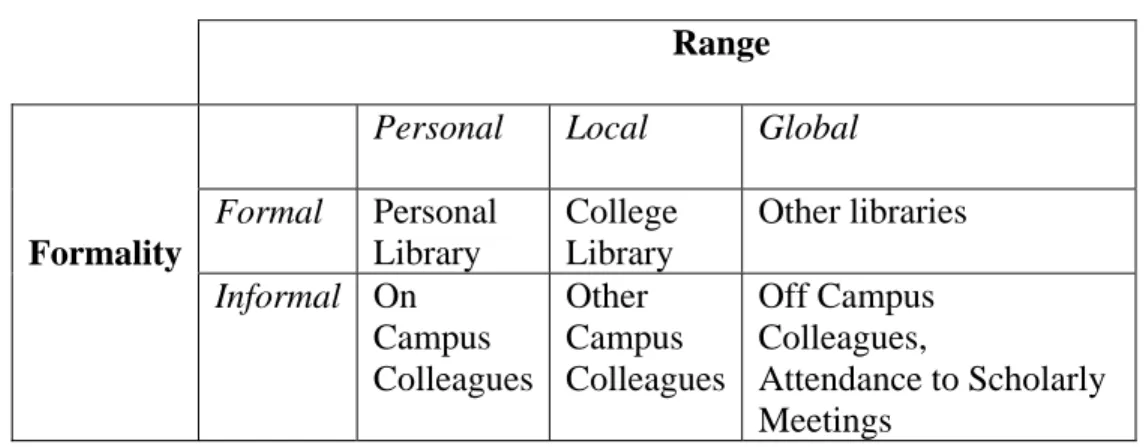
was divided into informal sources of information, and formal sources of information. The second dimension, range, was divided into local sources, global sources, and personal sources. For example, the personal library is the formal/personal information source of faculty, the college library is the formal/local information source and other libraries are the formal/global information source. Departmental colleagues were the informal/personal information source, other campus colleagues were the informal/local information source and off-campus colleagues were the informal/global information source. Hart (1998) does not mention faculty use of web sources of information. This is probably due to the fact that the survey was administered in 1990 when Internet access was not as common as it is today.
Table 2.1 Range and Formality: Two dimensions of information gathering used by Hart
Range
Formality
Personal Local Global
Formal Personal Library
College Library
Other libraries
Informal On Campus Colleagues Other Campus Colleagues Off Campus Colleagues,
Attendance to Scholarly Meetings
These categories are similar to the categories used to identify sources of information in Leckie et al. (1996). Informal and formal sources of information both refer to the
The survey in Hart’s study (1998) measured faculty’s use of the following six sources of information: personal library, college library, departmental colleagues, other on-campus colleagues, off campus colleagues and attendance at scholarly meetings. Separate indexes were created from each source of information based on questions from the survey. The four independent variables were commitments to research, teaching, service and level of courses taught. Commitment was measured by gathering self reported levels of importance and number of hours spent each month on research, teaching and service. Level of courses taught was a measure of whether the faculty taught more undergraduate courses or graduate courses. Other variables such as age, possession of doctoral degree, and quality of graduate school were used in addition to the other independent variables to calculate a faculty's commitment to research.
Hart (1998) found faculty’s information seeking and use of information sources varied by commitment to the three main roles: teaching, research and service. The majority of faculty in Hart’s survey were committed to teaching. On average, faculty in the survey spent the majority of their time on these three tasks: preparing for class (54 hours), grading papers (28 hours), and advising students (16 hours). These findings were in line with the university’s primary focus on teaching undergraduate students.
Hart’s findings overall indicate that faculty use a variety of resources and have a variety of roles when searching for information. Contrary to Hart’s (1998) hypothesis, the level of courses a professor taught (undergraduate, graduate) had no relationship with any of the information gathering measures. Although the roles of research and service are not likely to be as important for K-12 educators, the hypotheses relating information sources to
Hart (1998) initially hypothesized that commitment to teaching would be positively related to personal and local sources of information. Instead the researcher found that local
and global resources were positively related to commitment to teaching. This could imply that educators with a strong commitment to teaching will use whatever sources of
information that will help them to complete their task regardless of whether it is personal, local or global. If true it suggests it is not the range of the source used that is important to educator task but importance of the information source in relation to the teaching task. This might indicate that K-12 educators will use global and local sources of information as long as they are important enough to the teaching task. Based on use of college libraries and off campus libraries by faculty in Hart's study one might expect K-12 educators to rely on libraries and other formal school resources as significant sources of information. Future studies should add newer sources of information such as the Web and see how educator use of the Web varies according to educator work roles and tasks.
range would be classified as local. How range is viewed might also depend on the speed of the user’s Internet connection. Low speeds would increase the time needed to acquire materials and high speeds would reduce the time needed to acquire materials. In either scenario the time it takes to acquire resources might result in those resources being classified as personal, local, or global depending on the perspective of the user. This implies that range of sources of information will depend on the setting in which the resource is used and how close that setting is perceived to be to a person's place of work.
Another question that could be raised is: are digital libraries and other Web resources formal or informal sources of information? In the case of formality, how digital libraries and other Internet resources are classified will depend on the nature of the resource. Is the digital library associated with someone's blog or personal Web space? In this case the digital library might be considered informal. The same will be true for Web resources, how they are
classified will depend on the type of communication it is, as well as if the source of information goes through some type of peer reviewed process.
Hart's (1998) research also does not address how teaching, research and service are interrelated activities. Hart (1998) views information gathering factors as predictive of teaching, research, and service commitment. This research question could be reversed so that the teaching, research and service behavior predict the information gathering. One study that does address this is the work of Borgman, Smart, Millwood, Finley, Champney, Gilliland and Leazer (2005). Borgman et al. (2005) investigated how the teaching and research of
able to describe instances in which they had done research for grants or sought information for their research projects than they were able to describe instances in which they sought information for teaching. In the study, teaching and research were mutually reinforcing activities; geography faculty were able to identify useful research material while conducting information seeking for teaching and useful teaching material while conducting information seeking for research. Many geography faculty tried to maximize use of research data by also using it for teaching purposes. Borgman et al. (2005) recommended that a digital library of geography resources should contain teaching resources organized by teaching concepts and the digital library needed to provide resources and materials that could be used for both teaching and research.
Borgman et al.'s (2005) work suggests K-12 educators may also like content organized by factors most important to their teaching task. This would mean that digital libraries organized by facets such as teaching content, age of audience, state curricula addressed and duration of lesson / material will be more appealing to educators because it helps them to focus more on the task of preparation rather than the task of information seeking.
The work of Summers, Matheson, and Conry (1983) focused on the information needs of primary and secondary school educators. Summers, Matheson, and Conry (1983) surveyed the information needs and attitudes toward information of educators in British Columbia, Canada. The representative sample included the following positions: elementary educators, secondary educators, principals, vice-principals, support personnel and department heads. Respondents were asked to rate their frequency of use of 13 sources of information on a four point scale. Factor analysis of the 13 sources clustered into 3 orthogonal factors: close at hand traditional sources, less accessible print resources and organized intrapersonal resources. Examples of sources were conversations with colleagues, textbooks, and school libraries. Summers et al. (1983) found that position, dissemination and attitude were strong predictors of information use. Dissemination was a self-reported measure of how well the person transferred information from person to person. Attitude toward information was assessed using a 15 item measure of how people responded to information. The scale was based on Krathwohl, Bloom, and Masia’s Taxonmony of Educational Objectives: Affective Domain (Krathwohl, Bloom, & Masia, 1964).
Summers et al. (1983) also support the findings of Leckie et al. (1996) that discuss the importance of attitude to the process of information seeking. If attitude is a strong predictor of information use, then perceptions of computer technology, design of the Web based video library interface and metadata for search will be important components that will affect educators’ perceptions about the ease of use of Web based video library systems. Another factor that will likely play into educator’s use of online video will be their
experience with use of technology. Experience can come in the form of formal training while pursuing their degree, on the job training from a colleague or from being self-taught.
Educators who have more successful experience with the use of the Web will feel more comfortable about monitoring student progress and behavior while conducting a lesson involving online video. Another important factor in the use of online video will be forms of support. Educators who have colleagues who also use Web based video will have a support system for integrating Web based videos into the classroom smoothly and informal contacts for discussing various uses of Web based video in the class. Educators who have technology support may be more inclined to take the risk of using computer technology in the classroom.
educators, and educators who are not comfortable with technology will be less likely to adopt newer practices unless forced to do so.
More recently than the Morris (2002) and the Summers et al. work, Normore (2005a; 2005b; 2005c; 2006) conducted a series of focus groups with educators and administrators from the K-12 setting. The focus groups were divided into two parts. During the first part of the focus group participants were asked to list types of information which they need to help them complete their work. After the list was complied, the participants were then asked to evaluate the importance of the items on the list and the top three information needs were identified. In the second part of the focus group, participants discussed ways to implement or fill the top three information needs.
In Normore’s (2005a) first focus group, thirteen reading recovery educators from the National Conference of The Reading Recovery Council of North America discussed their information needs. Educator responses were divided into three content groupings: need for communication support, need to support specific instruction related skills, tools, and techniques and support for continued professional development.
The first content grouping, the need for communication support, consisted of needs in which educators expressed the desire to communicate or share their experiences with policy makers, administrators, parents, and other educators. Overall, reading recovery educators suggested they would benefit from communication tools such as discussion forums and wanted tools which would allow them to ask experts in the field questions (Normore, 2005a).
for thematic units, enrichment activities, book recommendations, web site recommendations, and video clips. The need for recommendations was reiterated in the second focus group Normore (2005b) conducted. In the second focus group thirteen reading recovery educator leaders attending the 2005 North American Leadership Academy & Educator Leader Institute suggested that resources include recommendation information drawn from the broader educator and school community.
Of specific interest to this study are the ways in which reading recovery educators and other educators felt they might use video clips in their classroom settings. In the focus group conducted by Normore (2005a) educators suggested they might use video clips in three different ways. First, video clips of classroom activities might be used to help struggling students. Next, educators felt video clips could be used as resources for educators to view “master teachers” and improve their own classroom practices. Lastly, educators felt that videos might be able to convey to parents how the lessons were conducted. There was a trend in the need for video clips to be used in ways to improve educator classroom practices. This need was expressed in the focus group Normore (2005c) conducted with thirteen literacy coordinators and the focus group Normore (2006) conducted with three school principals. In the focus group with literacy coordinators, video clips were rated as the number one resource literacy coordinators needed to support their continuing education (Normore, 2005c).
Similarly, principals in the fourth focus group suggested that video clips be used to provide guidance on specific problems such as finding ways to deal with the challenge of
In the third content grouping, support for continued professional development, educators expressed their need to stay current with the field, and to support their own work. Specifically educators were concerned with finding information related to grants and also information which would help them in their own data collection, analysis and reporting activities (Normore, 2005a).
Normore’s (2005a; 2005b; 2005c; 2006) focus group findings are important for two main reasons. It outlines some potential uses of Web based video repositories with respect to the teaching task. Educators in Normore’s (2005a) study suggested additional uses of video beyond the traditional use of video to introduce classroom activities; in particular educators desired to use video as a continuing education tool and as a way to communicate classroom practices to parents. These varied needs with respect to video suggest that repositories find ways to somehow highlight segments which correspond to part or all of these documented uses. In addition to these documented uses of video there may be other uses which may also serve as broad views to online video collections.
In the case of textual recommendations educators may be attempting to elicit the same information from the description of how the support material was used by other educators.
Perhaps the most striking finding from Normore’s (2005a; 2005b; 2005c; 2006) work is that each content group stresses the importance of the work roles and tasks educators must complete. The first content grouping, communication support, suggests that communication between educators is an important work task which had not been considered previously in Leckie et al.’s tasks. In the second content grouping Normore’s (2005a; 2005b; 2005c; 2006) work goes further than the work of Leckie et al. to suggest educators need specific types of materials to help them during the planning and curriculum development phase of their work; these materials were lesson plans, enrichment activities and various recommendations from colleagues. The last content grouping, support for continued professional development, confirms that in order to complete their work educators must assume various roles which are beyond how Leckie et al. classified the work roles and tasks of educators. Specifically, the educators in Normore’s focus groups suggest that professional development and conducting research are two roles which are highly important to the completion of their work. In the Leckie et al. work these roles were related to the student role and the professional researcher role respectively.
video collections by the uses of video found in Normore’s (2005a) focus groups such as videos which contain classroom activities, videos which contain professional development, and videos which demonstrate classroom practices to broader audiences like parents and policy makers. Additional research will need to be conducted to explore if there might be other uses of video than the ones listed by educators in Normore’s (2005a) focus group and if video use varies by the subject matter of the educator searching for video. Video repositories may also need to seek out video with the categories of use in mind, if their current collections do not contain sufficient examples of videos from each category. More broadly, video
repositories need to consider the importance educators place on communication and consider ways to design communication tools into their current structures. This research specifically suggests that video repositories might focus on developing ways in which educators can gain access to experts in their field.
consideration must be given to other variables such as attitude toward information, attitude toward technology, accessibility, and familiarity with the resource because these variables are likely to play a significant part in the information search process of informal and formal educators as well.
Information Seeking and Use of Online Video by Educators
Information seeking and use studies can be broadly divided into studies that focus on the materials and sources used and studies that focus on specific populations of users.
Studies that focus on materials and sources generally divide information gathering categories into the two dimensions of formal sources and informal sources. Formal sources of information are books, journals, and encyclopedias while informal sources of information are colleagues and scholarly meetings (Hart 1998).
It is important to study the information seeking of educators because understanding how educators view the process of information seeking and frame their information needs will help information professionals design more effective retrieval systems more effectively. These tailored systems will more accurately address educators’ specific needs. There are numerous research projects and studies designed to help educators with access to educational content, e.g., GEM, Apple Learning Interchange2, and National Science Digital Library3. The focus of these projects is on bringing together materials and creating environments in which educators can collaborate. Although these projects make digital materials availabl the majority provide materials in print or image format and do not provide online vid materials. Some progress has been made with use of non-textual indexing and materials to represent online video for search and retrieval (Marchionini & Giesler 2002; Watclar, Christel, Gong & Hauptmann, 1999) however, we have far more experience with the use of text in representing digital objects. With respect to video we still have the following
questions: what part of the online video can best summarize the video as a whole? What criteria should we use for indexing given the high cost of indexing every word or every camera shot? Should indexing take into account the broadest user group possible or focus specifically on one particular user group? Should indexing focus on identifying the exact content or focus on providing a summary? and how can indexing of online video be automated given current technology works best on processing text not digital media files?
e, eo
Before Web based video is finally incorporated into the classroom, educators must go through a process of finding the video and preparing the lesson plan for the class. As
illustrated in the opening scenario, the usual steps in this process are: recognition of
2
information need, formulation of search strategy, search, retrieval of the video, evaluation of the online video’s appropriateness, customization of the online video to the specific lesson, and lastly, presentation of the online video in class. During the process of evaluation
educators must take into consideration factors such as student attention, student motivation, and assessing how well the video conveys the material.
Although there is no literature that specifically focuses on the retrieving of online video by educators there are several studies that highlight related areas. This section will review the following topics: educators’ use of online learning materials, instruction of education students on the methods of search, information needs of K-12 educators, and access to technology.
Recker, Dorward, and Nelson (2004) assessed the use of the Instructional Architect tool by conducting a case study with eight middle and high school science and mathematics educators from the state of Utah. The purpose of the study was to assess how educators search for online learning resources. As suggested by Normore’s focus groups, the educators studied in Recker, Dorward, and Nelson (2004) also desired recommendations and filtering tools which were generated by other educators. Additionally educators suggested that items be available in a common format, where common format was defined as a format compatible with available word processors and other technology. Perhaps most importantly Recker, Dorward, and Nelson (2004) found that educators stressed finding content which was age appropriate, current, accurate, aligned with topic and also relevant to the curriculum standards.
In general the educators in the study used broad search strategies, which were
strategies, in which educators used facets like age level and topic to refine their search (Recker, Dorward, & Nelson, 2004). The importance of Recker, Dorward and Nelson’s (2004) work is that it supports other research on the specific features educators’ desire of online resources. This work also lays the groundwork for discussing educators search strategies and search processes in relation to online resources. In order to examine these strategies more closely the next research will compare what pre-service educators are taught to current information seeking models and processes.
library resources they encounter. At the locating stage they also identify which formats of digital video are best given their particular storage capacity and Internet connections.
In contrast with more general models of information seeking, Gratch et al.'s process is closely tied with information retrieval tools. General methods of information seeking (Ellis, 1989; Marchionini, 1995; Bates, 1989; Dervin, 1983; and Kuhlthau, 1991) allow searchers to rely on other sources of information such as colleagues and are more general than the process presented in the lesson plan by Gratch et al. (1992). In order to fully describe the overall information behavior of educators both process models as well as general models are needed. In addition to these models, a catalog of the resources educators use will provide the most complete picture of the information seeking task. The work of Small, Sutton, Eisenberg, Miwa and Urfels (1998) provides such a catalog.
Small, Sutton, Eisenberg, Miwa and Urfels (1998) conducted an in-depth information needs assessment of K-12 educators. The purpose of the assessment was to find out what information was available on the Web for educators, what information educators preferred to use and how they used that information. The results of the study were used to design GEM. Small et al. (1998) used content analysis of Web based resources, a content analysis of questions submitted to AskERIC (http://www.eduref.org/Eric/) and an electronic
questionnaire to collect data. AskERIC was the first Web interface to the Education Resource Information Center. They found that lesson plans were the most common type of