The Term Structure and Cost Channel Effect of
Monetary Policy
by Myung-Soo Yie
A dissertation submitted to the faculty of the University of North Carolina at Chapel Hill in partial fulfillment of the requirements for the degree of Doctor of Philosophy in the Department of Economics.
Chapel Hill 2007
Approved by:
Dr. Richard Froyen, Advisor
Dr. Stanley W. Black, Committee Member
Dr. Michael K. Salemi, Committee Member
c
2007
ABSTRACT
MYUNG-SOO YIE: The Term Structure and Cost Channel
Effect of Monetary Policy.
(Under the direction of Dr. Richard Froyen.)
Sims (1992) first recognized a puzzling protracted rise in the price level following
a contractionary monetary policy shock. Two groups of studies have addressed this
“price puzzle”. The first group suggests that the price anomaly can be resolved by
adding future inflation information to the policy rule, because they believe that this
undesirable result comes from the omission of important information available to the
monetary authority. The second group regards this price response as normal because
of the cost channel effect of monetary policy.
Since the effectiveness of monetary policy depends critically on the correct
identi-fication of the policy transmission mechanism, the recognition of the existence of the
cost channel is important for the policy makers. This paper provides evidence of the
cost channel effect through a structural VAR analysis. Based on empirical evidence,
I construct a dynamic stochastic general equilibrium model, which addresses the cost
channel effect.
My model focuses on two related features by which monetary policy affects real
variables. (1) The model derives the term structure of interest rates, which states that
the monetary policy action changes the market’s expectations on the current and future
short rate path that, in turn, determine the long rates. Despite the closer relationship
of macro variables to long rates than to short rates, the monetary authority adopts
studies fail to take into account the direct impact of long rates on the economy. In
contrast, (2) my model highlights the role of long rates. I find that time lags in the
capital formation and long-term financing contracts by firms enhance the cost channel
effect, and generate the variables’ staggered responses. The monetary policy action
changes the short and long rates through the term structure of interest rates. Also the
firms’ borrowing pattern for both labor costs with short-term contracts and investment
projects with long-term contracts link the nominal short- and long-term interest rates
directly to firms’ marginal costs.
This paper incorporates a simple cash in advance feature, sticky prices and wages,
and habit formation. My model indicates that the price stickiness makes a limited
contribution to generate persistent responses, but the sticky wage amplifies the inertial
behavior of variables and ensures that the real wage responds in the direction that
the cost channel effect of monetary policy predicts. Contrary to the studies by Fuhrer
(2000) and Amato and Laubach (2004), in which they showed that habit formation
helps to explain the gradual response of macro variables such as output and inflation
to monetary policy shocks, habit formation in this paper only smoothes the response
To my wife, Hyunju Oh, for dedicating her time and effort to taking care of me and
ACKNOWLEDGMENTS
First and foremost, I am grateful and would like to thank professor Richard Froyen,
who is my advisor, for innumerable, thoughtful discussions on my thesis topics. Many
of important features in my model came from these discussions. Without Dr. Froyen,
this paper would not be what it is today. I would like to thank professor Michael K.
Salemi for allowing me the time to learn various techniques on policy analysis. I also
thank Hamilton Fout for many discussions and feedback. Finally, I thank my parents
TABLE OF CONTENTS
LIST OF FIGURES x
LIST OF TABLES xiii
CHAPTER
1 Introduction 1
2 Preliminary Data Analysis of the US Economy 9
2.1 Identification . . . 9
2.2 Preliminary Analysis of the Data . . . 13
2.3 Model Specification Test . . . 14
2.4 Impulse Response Functions . . . 16
2.4.1 Full Sample Period . . . 16
2.4.2 Sub-Sample Periods . . . 21
3.2 The Term Premium Response to the Monetary
Policy Shock . . . 37
3.3 The Term Premium Response to Two Macroeconomic Shocks . . . 42
3.4 Response of Three Factors of Yield Curve to Macroeconomic Shocks . . . 44
3.5 Summary of Results . . . 47
4 The Model Economy and Policy Simulation 60 4.1 The Model Economy . . . 61
4.1.1 Households . . . 61
4.1.2 A Final Good Producing Firm . . . 71
4.1.3 Intermediate Good Producing Firms . . . 72
4.1.4 Financial Intermediaries . . . 80
4.1.5 Monetary Authority . . . 83
4.1.6 Aggregate Resource Constraint and Mar-ket Clearing Conditions . . . 87
4.2 Solving the Model . . . 88
4.2.1 Model Equations . . . 89
4.2.3 Linearization of the Model . . . 91
4.2.4 The Solution Algorithm . . . 93
4.3 Policy Simulation . . . 94
4.3.1 Calibration . . . 94
4.3.2 Impulse Responses to a Monetary Policy Shock in the Baseline Model . . . 96
4.3.3 Role of Loan Markets . . . 101
4.3.4 Sticky Prices and Wages . . . 102
4.3.5 Technology Shock and Preference Shock . . . 104
4.3.6 Response of the Yield Curve . . . 107
5 Conclusion 118
LIST OF FIGURES
2.1 Autocorrelation functions of VAR residuals I . . . 26
2.2 Impulse response functions to the federal funds rate shock . . . 27
2.3 Impulse response functions to the federal funds rate shock with commodity price . . . 28
2.4 Impulse response functions of yields to the federal funds rate shock . . . 29
2.5 Impulse responses to a term premium shock . . . 30
2.6 Impulse responses to the federal funds rate shock: pre-Volcker period, 1965:Q2-1979:Q3. . . 31
2.7 Impulse responses to the federal funds rate shock: Volcker-Greenspan period, 1979:Q4-2005:Q4. . . 32
2.8 Impulse responses of yields to the federal funds rate shock: pre-Volcker period, 1965:Q2-1979:Q3. . . 33
2.9 Impulse responses of yields to the federal funds rate shock: Volcker-Greenspan period, 1979:Q4-2005:Q4. . . 34
3.1 Slope of yields over the business cycle . . . 50
3.2 Autocorrelation functions of VAR residuals II . . . 51
3.4 The first-step term premium responses for all maturity
yields to the contractionary monetary policy shock . . . 53
3.5 Term premium response to the federal funds rate shock for each maturity yield. . . 54
3.6 The first-step responses of the term premium for different maturity bonds to the negative output shock . . . 55
3.7 Term premium response to the negative output shock for each maturity yield. . . 56
3.8 The first-step responses of the term premium for different maturity bonds to the negative inflation shock . . . 57
3.9 Term premium response to the negative inflation shock for each maturity yield. . . 58
3.10 Effects of the macroeconomic shocks on the yield curve . . . 59
4.1 Impulse responses to monetary policy shock: Baseline model . . . 110
4.2 Two different inflation performances . . . 111
4.3 Limiting case of habit formation: ζ = 0 vs. ζ = 1 . . . 112
4.4 Without loan markets . . . 113
4.5 Without nominal rigidities . . . 114
4.6 Technology shock: ˆξt=ρξξˆt−1 +ξ,t . . . 115
LIST OF TABLES
2.1 Summary statistics of level data . . . 23
2.2 Summary statistics of filtered data . . . 24
2.3 Autocorrelation test result: H0 :ρ1 = 0 . . . 25
3.1 Autocorrelation test result . . . 48
Chapter 1
Introduction
Sims (1992) first recognized a puzzling protracted rise in the price level following a
contractionary monetary policy shock. Two groups of studies have addressed this
“price puzzle.” The first group, which includes works such as Sims (1992) and Leeper,
Sims, and Zha (1996), suggests that the price anomaly can be resolved by adding future
inflation information in the policy rule, because they believe that this undesirable result
comes from the omission of important information available to the monetary authority.
According to Hanson’s (2004) study, however, there is little correlation between an
ability to forecast inflation and an ability to resolve the puzzle. The second group,
such as Barth and Ramey (2001), regards this price response as normal because of
the cost channel effect of monetary policy. Following the second group, this paper
provides evidence of the cost channel effect of the monetary policy transmission through
a structural vector autoregression (VAR) analysis. Based on empirical evidence, I
construct a dynamic stochastic general equilibrium (DSGE) model which addresses the
prolonged co-movement of price responses with short rates.
Since the effectiveness of monetary policy depends critically on the correct
identi-fication of the policy transmission mechanism, the recognition of the existence of the
cost channel and the term structure channel is important for policymakers. As Ravenna
of nominal interest rates to the firms’ marginal costs.1 Christiano and Eichenbaum
(1992a) and Christiano, Eichenbaum, and Evans (2005, hereafter CEE) link a firm’s
financing cost of labor to the nominal short-rate. Li and Chang (2004) connect the
nominal interest rate to the production cost of capital by assuming that firms finance
business investment. Even though these studies successfully generate a cost channel
effect in the general equilibrium framework, they focus only on the short-term financing
cost.
Contrary to previous cost channel models, this paper emphasizes the role of long
rates for generating the cost channel effect and the persistent responses of the
econ-omy. This is based on the argument by Woodford (1999) and Kozicki and Tinsley
(2002) that macro variables are more closely related to long rates than short rates.
Therefore the term structure of interest rates is considered as an important monetary
policy transmission channel which connects the policy action to long rates. But
previ-ous macroeconomic models regarding a term structure relationship have mainly focused
on finding determinants of long rates and have paid less attention to the role of long
rates in the economy. The most well-known theory about the term structure of interest
rates is the expectations hypothesis, which states that the policy affects long rates by
changing the average of current and future short-rate expectations. But, as Ellingsen
and S¨oderstr¨om (2001, 2004) noticed, some puzzling results observed in the term
struc-ture data cannot be explained by the expectations theory. First, long-term interest
rates respond more strongly to monetary policy innovation than the expected path of
short rates does. Second, since an exogenous increase in short rates should lower
infla-tion in the long run, a positive relainfla-tionship between long and short rates is puzzling.
Third, even though the average relationship is positive, the relationship between long
and short rates varies over time. To resolve these puzzling results, recent studies such
as Ellingsen and S¨oderstr¨om (2001, 2004) and Beechey (2004) rely on the
asymmet-ric information between private agents and the monetary authority. This asymmetasymmet-ric
information creates an inference problem for private agents, and the private agents’
inference on unobserved shocks affects the expectation path of short rates, hence the
behavior of long-term interest rates.
On the other hand, Kozicki and Tinsley (2001) and G¨urkaynak et al. (2005)
em-phasize the shift in private agents’ views of long-run inflation to explain the observed
violations of the expectations hypothesis. They argued that long-term interest rates
are more closely related to the market’s expectations on long-run inflation, which is
one of the goals for the monetary authority to stabilize. From their view, the Fisherian
relationship between nominal interest rates and anticipated changes in prices is more
important in determining the long-term interest rates.
Even though the empirical evidence is mixed, Cook and Hahn (1989) show that, on
the average, the overall term structure of interest rates increases, but declines with
ma-turity when the monetary authority raises short rates, which supports the expectations
hypothesis of the term structure of interest rates. Their findings can be supported by
Edelberg and Marshall (1996), and Evans and Marshall (2002), who argued that the
long-rate responses following monetary policy shocks move in the direction that the
expectations hypothesis implies. Favero (2005) also showed that the combination of a
Taylor rule and the expectations theory provide considerable support for the
expecta-tions hypothesis of the term structure.
But these efforts to resolve the behavior of long rates are not fully based on the
micro foundation. Moreover, they are all silent about the long rate’s effect on the
economy. Evans and Marshall’s (1998) study successfully introduces the term structure
of interest rates into the general equilibrium framework. But, by assuming that there is
become redundant assets. Fuhrer and Moore (1995) analyze the role of wage contracts
with a term structure relationship. The aggregate demand equation in their model
links the output gap and the ex ante long-term interest rate which is calculated from
the term structure equation. Their analysis, however, is not fully based on the micro
founded model, and fails to explain how the long rate affects output and inflation.
The DSGE model developed here, on the other hand, focuses on two related channels
through which monetary policy affects the economy. First, the model utilizes the term
structure of interest rates as a monetary policy transmission channel. Monetary policy
actions in the model change the market’s expectations of the current and future short
rate paths, which consequently determine long rates. The model states that the
long-term interest rates are the sum of two parts: the average of expectations of current and
future short rates and the term premium. The term premium is assumed to follow an
exogenousi.i.d.stochastic process with no relation to a monetary policy shock or other
macroeconomic shocks. This assumption implies that short-term interest rate policy
affects long rates through the expectations hypothesis of the term structure. Some
empirical evidence about this assumption will be presented by examining the impulse
response functions of the term premium implied by the impulse responses of different
maturity yields to macro-economic shocks. Second, as a cost channel of monetary
policy, the change of both short and long rates affects macro variables such as output
and inflation. The direct impact of long rates on the economy is considered one of
the sources of staggered responses of macro-variables because the change of long rates
alters the firm’s long-run ability to produce output by investing in long-term investment
projects.
Time lags in the formation of capital stock and long-term financing contracts of
firms distinguish my model from previous cost channel models. They enhance the
time-to-build feature that my paper adopts is introduced by Kydland and Prescott (1982) to
explain aggregate investment behavior as an alternative model to a capital adjustment
cost model. A capital adjustment cost model is intensively studied by Lucas (1967),
Gould (1968), and Hayashi (1982), among others. While they fail both to separate
the long- and short-run supply elasticities of capital and to recognize time lags in
completion of investment projects, Kydland and Prescott (1982) argue that the
multi-period formation of capital stock is a crucial factor for explaining aggregate fluctuations.
Financial intermediaries in my model are assumed to facilitate economic activity by
providing interest-bearing assets to households and financing contracts to firms. Some
behavioral assumptions on the financial market participants are made in order to avoid
an identification problem while connecting the nominal short- and long-term interest
rates directly to firms’ marginal costs. These assumptions are based on the matching
principle, which states that the maturity structure of debt matches the maturity of
projects or assets held by profit-seeking economic agents. First, firms use both
short-term loan contracts, for financing the cost of labor used in the production process every
period, and long-term loan contracts for financing the whole cost of investment projects
that take multiple periods to be used in the production process. Second, financial
intermediaries allocate resources by matching maturities between the source of funds
and the use of funds. Third, the loan markets are perfectly competitive markets. As a
result, nominal returns on short- and term bonds are equal to the short- and
long-term borrowing costs to firms, respectively. Hence, long-long-term bonds are not redundant
assets.
There are many studies that try to explain why firms use different maturity
finan-cial contracts in their production process. These studies can be categorized into three
groups: an agent or contracting cost hypothesis, a signal or liquidity risk
debt maturity is used to control the conflict of interest between equity-holders
(stock-holders) and debt-holders (bond-(stock-holders). It predicts the inverse relationship between
the debt maturity and growth opportunities, i.e., investment. Firms with risky debt
(risky bond, hence vulnerability to default) have an incentive on behalf of
equity-holders to reject projects with positive but low present value. This happens because
even if equity-holders, the investment decision makers, undertake the entire cost of the
projects including the risk of bankruptcy, they receive only a fraction of the returns by
sharing it with debt-holders. In the view of equity-holders, debt-holders appropriate
parts of their benefit created from bearing default risk. Therefore equity-holders will
have an incentive not to undertake projects with positive present value whenever the
value is lower than the amount of debt issued. This under-investment incentive can
be reduced by issuing short-term debt, which matures before investment decisions are
made. Therefore, firms prefer short-term debt to long-term debt. Debt-holders also will
try to avoid such a suboptimal investment being realized by reducing the stated period
of loan (Barclay and Smith 1995, Stohs and Mauer 1996, and Morgado and Pindado
2003).
Second, a signal or liquidity risk hypothesis states that, with positive transaction
cost, lower-quality firms self-select into long-term debt if they cannot afford the cost of
rolling over term debt, and high-quality firms signal their type by issuing
short-term debt to minimize adverse selection cost (Barclay and Smith 1995, Stohs and Mauer
1996)). Firms with the highest and lowest credit risk issue short-term debt because
firms with the highest credit ratings have small refinancing risk, and firms with very
poor credit ratings are unable to borrow long-term because of the extreme
adverse-selection costs. On the other hand, firms with intermediate credit risk issue long-term
debt. Since lenders are reluctant to refinance the debt if bad news arrives, the firms
(Barclay and Smith 1995).
Third, the tax-based model predicts that the interaction of borrowers’ preferences
for accelerating interest tax shields and lenders’ preferences for delaying the recognition
of interest income can cause borrowers to prefer long-term debt when the yield curve is
upward sloping. Hence, companies will use more long-term debt when the yield curve
is upward sloping (Barclay and Smith 1995).
Without theoretical background, we can also find some evidence that firms use
long-and short-term debt in the production process in Demirg¨u¸c-Kunt and Maksimovic’s
(1999) study. They found by examining debt maturities of firms in 30 countries during
1980 and 1991 that large firms in developed countries have more long-term debt than
short-term debt. Moreover, small firms in countries with a large banking sector have
less short-term debt and their debt is of longer maturity. The authors conjecture
that the economies of scale of financial intermediaries in obtaining information and
in monitoring debtors would facilitate access to external finance, particularly among
smaller firms. They also find that the high ratio of net fixed assets to total assets is
positively correlated to the use of long-term debt, which implies that firms use their
fixed assets (as collateral) to obtain long-term debt.
The model incorporates a simple cash-in-advance (CIA) feature, sticky prices and
wages, and habit formation. In general, price and wage stickiness are thought to
gen-erate the persistent response of variables. But sticky wages turn out to be a more
important factor than sticky prices in deepening the inertial behavior and the cost
channel effect. Contrary to CEE (2005), who emphasize the role of variable capital
utilization to generate persistence in output and inflation, the time-to-build technology
and long-term loan contracts are crucial in my model. The studies by Fuhrer (2000)
and Amato and Laubach (2004) show that habit formation helps to explain the gradual
But habit formation in this paper only smoothes the response of consumption across
time.
The rest of the paper is organized as follows. In Chapters 2 and 3, the preliminary
data analysis of the US economy will be carried out using a structural VAR analysis.
The evidence of a cost channel effect for monetary policy transmission and the role
of the term premium in the term structure of interest rates shown in the US data
will be discussed in these chapters. Chapter 4 presents the dynamic stochastic general
equilibrium model, which addresses the prolonged co-movement of price responses with
nominal interest rates. This chapter also includes the policy simulation exercises based
on the model economy. The impulse responses of the model economy to monetary
Chapter 2
Preliminary Data Analysis of the
US Economy
In this chapter, the impulse responses of the US economy following a monetary policy
shock will be examined with a structural VAR method. The identification scheme and
the well known puzzle concerning price movements will be discussed. This chapter also
analyzes the direction of long-rate responses on different maturity bonds and examines
what generates these long-rate responses to monetary policy shocks.
2.1
Identification
Two points must be checked in analyzing the effect of monetary policy shock with a
VAR. The first is related to the stability of structural models. In general, the model
estimated under a specific regime cannot be used in different monetary policy regimes.
To avoid this problem, I re-do the impulse response analysis with two different
sub-sample periods: the Pre-Volcker period and the Volcker-Greenspan period.
The second point is related to the identification problem of the policy instrument.
The policy instrument consists of two parts: an endogenous or systematic relationship
exoge-nous policy shock. Correct identification of the systematic part is required because
the misspecification of the systematic part of the policy instrument produces puzzling
anomalies (Hanson 2004). Since the dynamic analysis of a VAR system may yield
reli-able information on the monetary transmission mechanism only after exogenous policy
actions are identified (Bagliano and Favero 1998), we also need to separate an
unfore-castable exogenous policy shock from the systematic part of the policy instrument.
Two different schemes for identifying the effect of policy innovation on the
non-policy variables can be considered. First, the central bank is assumed to observe only
past values of state variables when formulating the policy. That is, there is no feedback
from the economy to the central bank’s policy action within the period. We can achieve
this type of identification by ordering the policy variables first in the state vector. The
other identification method assumes that the central bank can observe current variables
as well as a history of the entire economy when it formulates the policy rule. Therefore
the central bank can react systematically to the change of current state variables.
This identification scheme can be achieved by placing policy variables after the current
observed state variables.
The model that I use for exploring the effect of the monetary policy shock adopts
the second identification scheme, which is employed by Christiano, Eichenbaum, and
Evans (1996, 1999). A VAR for ak×1 state vector of variables, Xt, is given by
Xt= Φ(L)Xt−1+ut, Eutu0t=V (2.1)
where L denotes a lag operator and ut is a vector of residual shocks whose
variance-covariance matrix is V. By pre-multiplying A0 on both sides of (2.1), the structural
where the structural shock vector et has a covariance matrix Eete0t = I. After
esti-mating (2.1) via ordinary least squares regressions, we can obtainA0 matrix using the
relationship between the covariance matrices ut and et, V = A−01A
−10
0 . That is, A0 is
the inverse of the lower triangular Cholesky factor of V.1
All variables that I use in this chapter are quarterly data from the FRED database
provided by the Federal Reserve Bank of St. Louise for macro-variables and from the
CRSP database for yields data. The state vector includes four types of variables: the
monetary policy instrument, contemporaneous inputs to the feedback rule, the yield
on a zero-coupon bond, and an additional explanatory variable. For the monetary
policy instrument, the federal funds rate (F Ft) is used. I assume that the feedback
rule incorporates contemporaneous values of the log of real gross domestic product
(RGDPt), the annualized inflation rate (P CEt) measured as the difference in logs of
the personal consumption expenditure deflator at time t and t−4, and the log of real
wages (RWt) measured by real compensation per hour in the business sector.
Long-rates (Y Tt) are used in a VAR one at a time with the 1- to 6-month, 1- to 5-year
and 10-year maturity yields.2 The quarterly financial data, the federal funds rate, and
yields, are obtained by calculating 3-month averages of monthly data. Finally, the log of
non-borrowed reserves (N BRt) is used as an additional explanatory variable to measure
the demand for credit in the economy. This variable measures the implementation of
the federal funds rate target through open market operations (Edelberg and Marshall
1996). In summary, the state vector includes six individual variables and the ordering
is given by Xt = [RGDPt, P CEt, RWt, F Ft, N BRt, Y Tt]. All variables are de-trended 1This normalization onA
0satisfies the assumption that the monetary policy shock is orthogonal to
the information set of the monetary authority. Moreover, it ensures that the dynamic responses of the variables inXtare invariant to the ordering of variables in contemporaneous variables and additional explanatory variables (CEE 1999).
2A 10-year constant maturity yield is used for the 10-year yield from the Federal Reserve Bank of
with the Hodrick-Prescott filter with a smoothing parameter of 1600 in order to see
the responses of deviations from the steady state values. The data go from 1965:Q2 to
2005:Q4 and 6 lags are included in each equation.3
The policy instrument F Ft, which is one element of Xt, can be decomposed into a
systematic component (the reaction function) and unforecastable policy shock. That
is,
F Ft=f(Ωt) +eg,t (2.3)
where eg,t denotes exogenous policy shock, and Ωt is a set of information available to
the monetary authority at time t that consists of two parts: contemporaneous values
of output, inflation, and real wage, and the entire history of the economy.
According to the theory of the term structure of the interest rates, market
expecta-tions about the future path of short rates induced by policy acexpecta-tions play a central role
in determining long rates. After observing the policy action, the market participants
form expectations about the future path of the short rates and formulate long-term
rates. For this reason, the long-term bond yields come after the policy instrument.
Since the feedback rule is a linear function of contemporaneous variables and lagged
values of all variables in the economy, the policy decision affects reserves and bond
yields contemporaneously and has an effect on the future realizations of all variables.
3I use data from 1965 because the policy instrument that I used here is the federal funds rate and
2.2
Preliminary Analysis of the Data
In this section, I compute the first and the second moments of level data for two sample
periods to obtain preliminary information. The results are summarized in Table 2.1.
Panel A displays those with full sample data range, 1965:Q2-2005:Q4, and panel B
summarizes the moment properties within the Volcker-Greenspan period.
The average yield curve is upward sloping in both sample periods, and the standard
deviations of yields generally decrease as maturity increases. When we look up the
correlation coefficients between inflation and financial data including the federal funds
rate, we can see that the full sample period and the Volcker-Greenspan period are not
much different. The correlation coefficients between inflation and the federal funds rate
are similar across the two sample periods, with 61% in the full sample period and 69%
in the post-Volcker period. The amount of correlation between inflation and short-term
yields is similar, too, and decreases as maturity increases, even though the strength of
correlation between inflation and long yields in the full sample period is much smaller
than in the Volcker-Greenspan period. Specifically, the correlation between inflation
and longest-term yields (10-year) is -62% in the Volcker-Greenspan period, compared
to -45% in the full sample period.
The negative relationship between output and the financial data implies that when
the interest rates increase, output falls. It suggests that the interest rates can be
thought of as investment costs or production costs. The positive relationship between
inflation and the financial data confirms this interpretation that when interest rates
increase, the cost of production increases, hence the price goes up.
The correlations between output and financial data in the full sample period are
smaller than the correlations between inflation and financial data. But in the
Volcker-Greenspan period, the correlations between output and financial data are greater than
be-tween output and longest yield is -92% in the Volcker-Greenspan period and -19% in
the full sample period. From these results, we can conjecture that output and financial
data, including the federal funds rate, are highly positively correlated in the pre-Volcker
period, which is contradictory to the traditional belief that there is a negative
relation-ship between output and interest rate.
Table 2.2 shows the first and the second moment properties of de-trended data. Most
patterns resemble those from the level data. But the correlation coefficient between
output and financial data has a positive sign, which means that if the output gap
increases, then the deviations of yields from their trends also move in the same direction
as the output gap. The correlation of output or inflation with the yields decreases with
maturity in both sample periods. From this table, we can conjecture that the feedback
rule has positive signs for output and inflation gap because of the positive correlation of
the federal funds rate with output and inflation gap, 35% and 47%, respectively in the
full sample period; 46% and 27% in the post-Volcker period. The correlations between
financial data including the federal funds rate remain high relative to other variables.
Specifically, the correlations between the federal funds rate and 1-month yields are 92%
in both periods, but those correlations drop below 70% at 10-year yield in both periods.
2.3
Model Specification Test
In this section, I test the model specification by checking the autocorrelations in the
VAR residuals. Autocorrelation is frequently encountered in models estimated with
time-series data. Since error terms pick up the influences of variables affecting the
dependent variables that have not been included in the model, the persistent effect of
excluded variables causes the OLS estimation to be unbiased but inefficient. Moreover
section checks the model specification by testing serial correlation of VAR residuals
using the Lagrange multiplier test explained in Davidson and MacKinnon (1993).
We wish to test the null hypothesis that the errors ut in the model equation (2.1)
are serially independent against the alternative that they follow AR(p) process. The
test regression can be expressed as follows
ˆ
ut= ˜Φ(L)Xt−1+ p
X
j=1
ρjuˆt−j+u,t (2.4)
where ˆut is the vector of estimated errors from VAR. The matrix of regressors in the
original VAR equation is added because the lagged dependent variables in the regression
function (2.1) are included in Xt−1. It is known that when the original model includes
lagged dependent variables, the Lagrangian multiplier test should be applied based on
equation (2.4) (Verbeek 2000). A test statistic can be computed asT R2 whereR2is the
uncentered R2 from the OLS regression of ˆut upon their lags ˆut−1 and all explanatory
variables. T denotes the effective number of observations. It has aχ2 distribution with
pdegree of freedom under the null hypothesis. That is, if R2 is close to zero, it means
that the lagged residuals are not explaining current residuals.
Figure 2.1 depicts autocorrelation functions for each variable’s residuals from the
VAR estimation over 30 lags. Dotted lines represent±√T1.96. As shown in the figure,
the autocorrelation functions move within 95% confidence intervals, which implies no
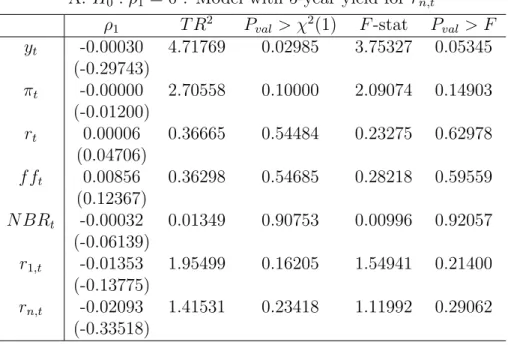
serial correlation could be detected. Table 2.3 shows the serial correlation test results
for each residual when p = 1. The table also reports F-test statistics in comparison
with theχ2 results. F-test statistics for ρ
1 =ρ2...=ρp = 0 will have pand T −k−p
degrees of freedom where k is the order of VAR regression. Test results indicate that
when VAR(6) is applied, then there is no first-order serial correlation for all variables.
hypothesis of ρ1 =ρ2...=ρp = 0, in particular, for inflation. When I apply the χ2 test
usingT R2 for test statistics, the null hypothesis of inflation is frequently rejected after
p≥2. On the other hand, F-test states that inflation does not have serial correlation
when the residual equation has less than 5 lags. Overall, we can conclude that the VAR
specification with the 6th order does not bear the autocorrelation.
2.4
Impulse Response Functions
This section discusses the results of impulse responses to a monetary policy shock based
on the identification scheme explained in the previous section. The positive relationship
between interest rates and inflation will be discussed with the full sample period and
two sub-sample periods for concerning the stability of the empirical model.
2.4.1
Full Sample Period
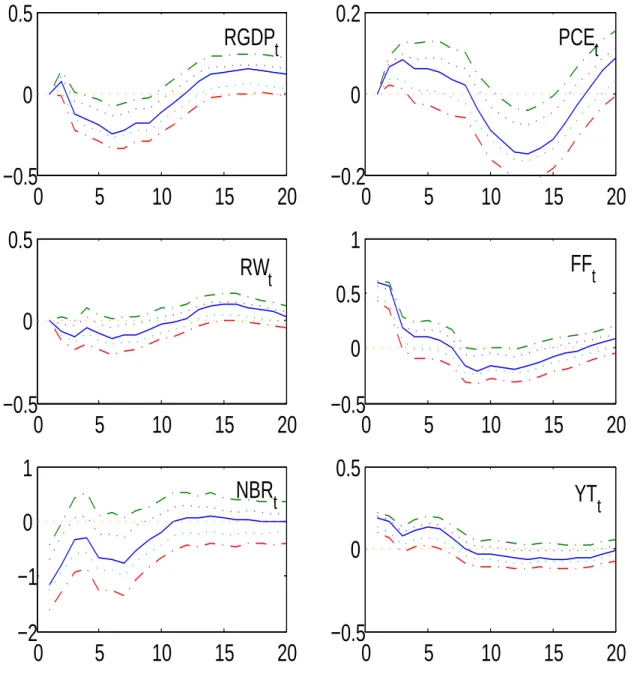
In Figure 2.2, the solid line denotes the impulse responses of state variables to
one-standard deviation exogenous monetary policy shocks for 20 quarters. The dash-dot
lines delineate 95% confidence intervals and the dotted lines depict 68% confidence
intervals. These were computed using a bootstrap Monte Carlo procedure outlined in
CEE (1999) with 1,000 bootstrap Monte Carlo draws. Five-year zero-coupon yields are
used to estimate impulse response functions to the contractionary federal funds rate
shock in Figure 2.2. The responses of variables with different yields are not different
from Figure 2.2.
The upper left panel depicts the output response to a contractionary federal funds
rate shock, and clearly shows the hump-shaped response. Output declines for
approx-imately six quarters with a maximum drop by 0.25%, then tends to rise. The federal
out before a year and a half. There is a persistent drop in non-borrowed reserves
(N BR). Together with the upward response of the federal funds rate, this result
im-plies that there is a significant liquidity effect in the economy. Real wages show an
insignificant but pro-cyclical response to the monetary policy shock. Its maximum
re-sponse is -0.11% six quarters after the shock, and it recovers the pre-shock level 13
quarters after the shock.
The upper right panel of Figure 1 represents the inflation response to a
contrac-tionary monetary policy shock. Inflation initially rises by 0.06% and tends to go down
six quarters after the shock. When we analyze the monetary policy impact in VARs,
many of these VAR specifications, particularly the ones without a commodity price,
frequently generate the price puzzle which states that the contractionary monetary
policy shock produces a substantial positive response of the aggregate price level for
many periods. The conventional wisdom predicts that the reduction of the volume of
non-borrowed reserves in the bank reduces the spending relying on bank credit. Hence,
aggregate demand and price also must fall.
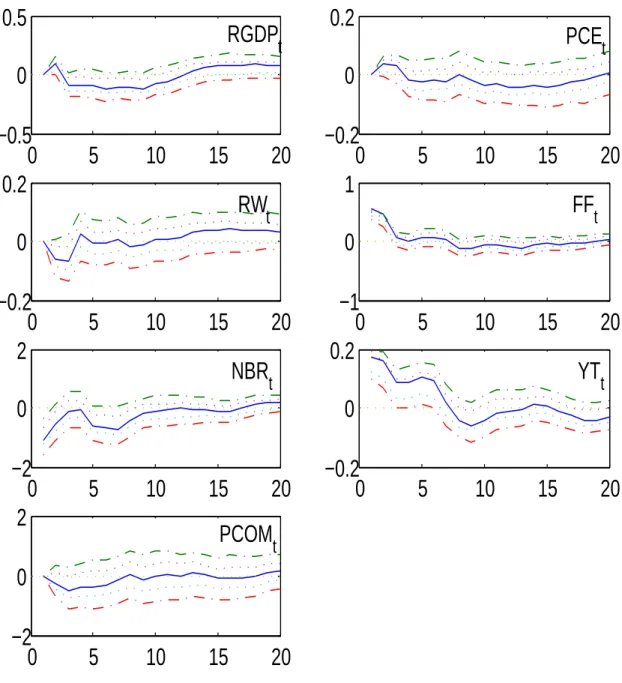
Figure 2.3 shows the impulse response functions to a contractionary monetary policy
shock when the state vector includes the commodity price index.4 According to Sims
(1992) and Leeper, Sims, and Zha (1996), the exclusion of a commodity price can
result in a critical mis-specification of the model because it is important information
to policymakers when policy decisions are made. But, as indicated by the impulse
responses, even though the commodity price index is included in order to catch the
future inflation information of the monetary authority, its statistical performance is
only slightly improved, and the directional change is not observed. Hence, the claim by
Sims (1992), that the mis-specification of the policy rule5 induces the price anomaly, is
4The spot market price index from BEA is used to measure the commodity price index.
5Some studies, such as Hanson (2004), found that the policymaker’s information omitted in the
hard to replicate.
Moreover, there are alternative explanations of the counter-cyclical movement of
prices such as that made by Chevalier and Scharfstein (1996). They focus on the test
of the null hypothesis that a firm’s markup is counter-cyclical when it is more financially
constrained with firm level data. They emphasize the role of capital market
imperfec-tions so that tighter liquidity constraints may generate counter-cyclical movement of
prices through markups. That is, the standard model predicts the lower marginal
prod-ucts in the boom implying lower marginal costs and factor prices. Hence the real factor
prices become lower in the boom. On the other hand, capital market imperfections and
a market share model can generate counter-cyclical movement of output prices relative
to factor prices. In periods of lower demand, firms tend to rely more heavily on external
financing as cash flow tends to fall faster than investment needs. Even if firms can raise
future profit by increasing market share as they reduce output price, external financing
firms are less inclined to reduce output price during economic downturns because the
increased probability of liquidation makes them care less about the future. Hence, they
have higher markups in recessions. Because of higher markups of externally financed
firms, an increase in the number of externally financed firms in recessions will make
markups even more counter-cyclical.
Another explanation of the price puzzle is the cost channel theory. When we
rec-ognize the cost channel effect of monetary policy, the co-movements of price and the
federal funds rate are not puzzling. As Barth and Ramey (2001) noticed, the
pro-cyclical response of real wages (RW) in Figure 2.2 is also the evidence of the
dom-inance of cost channel effect over the demand channel effect. A negative monetary
policy shock leads interest rates to increase. The increased interest rates, in turn, push
up the production cost by raising borrowing costs. The initial rise of price response to
the contractionary monetary policy shock reflects the dominance of the cost channel
effect relative to the demand channel effect. If a contractionary monetary policy has an
effect on the economy mainly through a demand channel, output and real wages move
in opposite directions because the decreased aggregate demand reduces output prices.
On the other hand, if a cost channel is dominant, both output and real wages should
fall because the decreased aggregate supply raises output prices. If both channels are
strong enough, the response of the relative price would not move unambiguously in one
direction.
The decrease of credit caused by the contractionary monetary policy shock reduces
the private sector’s demand for goods. The contractionary monetary policy shock also
raises the cost of current and future production because firms need to finance labor
and investments which will be used in the current and future production process with
higher interest costs. Hence, the upward movements of the price and the downward
movements of the output persist for some time. Therefore, the rise in inflation and the
fall in real wages may indicate that the cost channel of monetary policy transmission
dominates the demand channel in the economy.
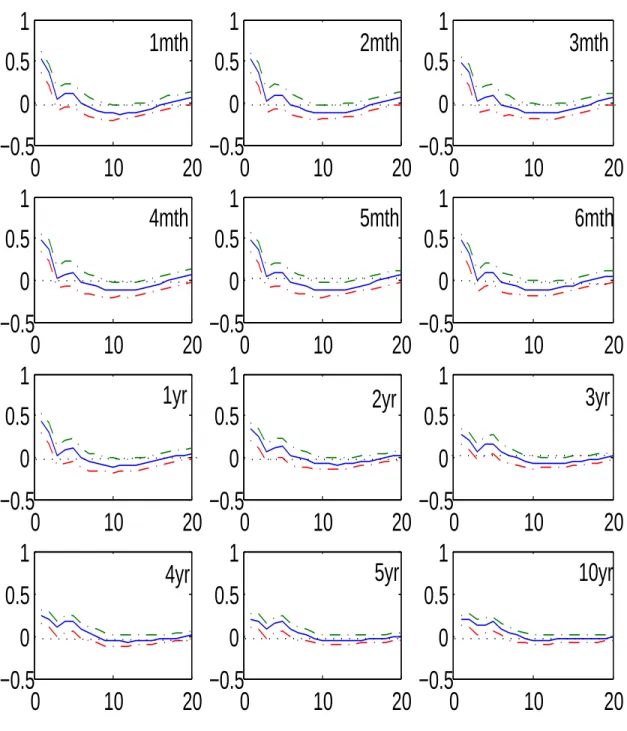
The direction of long-term yield response in Figure 2.2 is the same as the response
of the federal funds rates F Ft, but its effect is weaker than F Ft. Figure 2.4 shows the
impulse response functions (IRFs) of all bond yields to monetary policy shocks. Each
window represents a different yield (1- to 6-month, 1- to 5-year, and 10-year) starting
from the upper left corner and proceeding to the bottom right. Each impulse response
function is estimated by replacing Y Tt in the state vector with a different maturity
yield one at a time. The dashed lines delineate 95% confidence intervals. According
to the point estimates, the initial responses of all bond yields are significantly greater
These results are similar to those of Edelberg and Marshall’s (1996) study in that the
magnitude of the effect declines at longer maturities.
The initial responses of 4-year and longer-term rates persist for approximately six
quarters, which is slightly longer than the shorter-term bond yields. For example, the
impacts on 1-year bond yield and shorter yields disappear within three quarters at the
5% significance level. This can be interpreted in two ways. One is the asset market
imperfection from Andr´es, L´opez-Salido, and Nelson (ALN 2004). Since the asset
markets could have some frictions, investors tend to pay more money for purchasing
longer-term bonds. ALN considered the existence of transaction cost as an important
factor for the market friction. The other interpretation can be found in the studies
by Kozicki and Tinsley (2001) and G¨urkaynak et.al. (2005). They argued that the
change of long-term expectations on the inflation target by the central bank could
affect the movements of long-term interest rates via the Fisher equation. That is, the
movements of longer-term rates depend more on inflation expectations than on the
short rate expectations. Hence both studies assert that the effect on long rates could
remain over a longer horizon.
I will discuss the term structure of interest rates in a separate chapter by examining
the term premium responses implied by long-rate responses to macroeconomic shocks.
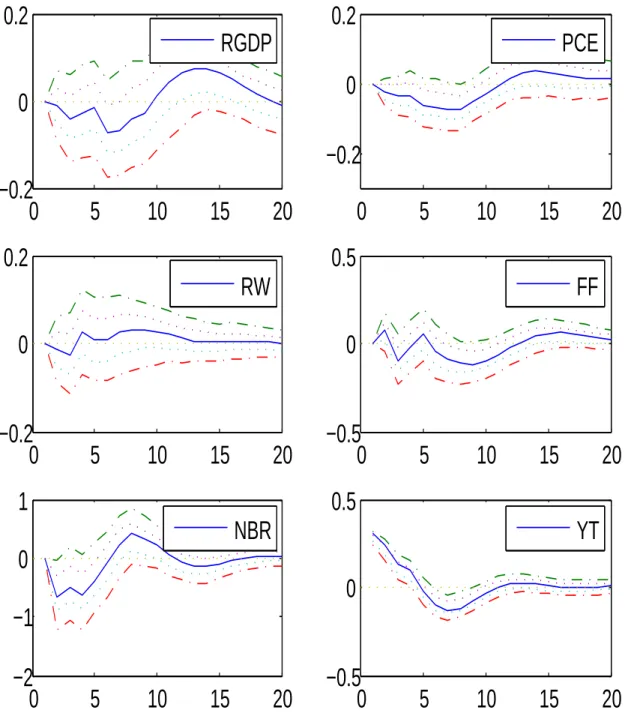
Here I examine the impulse responses to an asset market shock which can be thought
of as risk premium shock. Figure 2.5 shows the impulse responses of macro variables
to the longest-term (10-year) bond market shock. The risk premium shock does not
significantly affect output and inflation at the 5% significance level. The results are no
different when the long-term yield is ordered before the federal funds rate where the
central bank can be thought to have the asset market information when the policy is
formulated. This simply implies that the market participant fully absorbs the asset
assets.
The co-movements of interest rates and price indicate that the cost channel effect
dominates the credit channel effect, which suggests that the decrease of credit by the
contractionary monetary policy shock reduces the private sector’s demand for goods and
hence price level. The contractionary monetary policy shock causes the federal funds
rate and long-term interest rates to rise in the way that the expectations hypothesis
predicts. The increased short- and long-term interest rates raise the cost of future
production because firms need to finance investments which will be used in the future
production process. Hence the upward movements of the price level persists for some
time and the output decreases.
2.4.2
Sub-Sample Periods
Next, I examine the extent to which the impulse responses may change over the sample
period. To this end, I split the full sample into the period 1965:Q2 to 1979:Q3 (the
pre-Volcker period) and 1979:Q4 to 2005:Q4 (the Volcker-Greenspan period).
Figures 2.6 and 2.7 show the impulse responses of six variables to the contractionary
monetary policy shock in the pre-Volcker period and the Volcker-Greenspan period,
respectively. Again, the dashed line intervals and the dotted lines represent 95% and
68% confidence bands with the bootstrap Monte-Carlo procedure, respectively.
The results from the Volcker-Greenspan period are very similar to those from the
full sample period and initial inflation response remains positive four quarters after
the shock, which is shorter than the eight quarters in the full sample period. On the
other hand, the inflation response to the exogenous policy shock with the pre-Volcker
data fluctuates more across the entire forecast horizon than does that of the
Volcker-Greenspan period or the full sample period. Moreover, even if its initial response is
and cost channel effects are mixed; neither one appears dominant in the pre-Volcker
period. According to Hanson’s (2004) study, a price puzzle is related primarily to the
pre-Volcker sub-sample period and most indicator variables about the future inflation
information cannot resolve the price puzzle for this period. But my preliminary impulse
response analysis finds that, contrary to Hanson’s (2004) results, the demand and
cost channel effect are both strong enough in the pre-Volcker period, and the inflation
response during the Volcker-Greenspan period resembles the full sample response, which
implies that the cost channel effect is dominant in this period.
Figures 2.8 and 2.9 show the responses of yields to the contractionary monetary
policy shock in different sub-sample periods. Those results are very similar to the
full sample responses but the magnitude of the responses become smaller across all
maturities and the persistence of the effects is also shorter than that of the full sample
period. We can even see that the 5-year yields are significant only for the two-quarter
Table 2.1: Summary statistics of level data A. Full sample period, 1965:Q2-2005:Q4.
mean std corrl
πt f ft nbrt 1mth 1yr 5yr 10yr
yt 8.6932 0.3517 -.4484 -.3227 .9265 -.3276 -.3374 -.2420 -.1900
πt 4.0660 2.6647 .6114 -.4932 .6043 .5711 .4755 .4519
f ft 6.6082 3.3079 -.3246 .9779 .9671 .8864 .8525
nbrt 3.2885 0.5279 -.3276 -.3138 -.1906 -.1375
1mth 5.6412 2.6358 .9757 .8958 .8600
1yr 6.4810 2.7731 .9513 .9186
5yr 7.1266 2.4459 .9922
10yr 7.4735 2.4385
B. Volcker-Greenspan period, 1979:Q4-2005:Q4.
mean std corrl
πt f ft nbrt 1mth 1yr 5yr 10yr
yt 8.9114 0.2307 -.6182 -.8236 .7324 -.8062 -.8536 -.9105 -.9167
πt 3.2792 2.3396 .6883 -.6556 .6783 .6651 .6238 .6224
f ft 6.6837 3.8008 -.8068 .9847 .9798 .9258 .9091
nbrt 3.6252 0.3324 -.7888 -.7963 -.8140 -.8204
1mth 5.6735 3.0824 .9782 .9242 .9027
1yr 6.5662 3.2912 .9692 .9502
5yr 7.4499 2.8784 .9948
10yr 7.8872 2.8208
yt,πt,f ft, nbrt, 1mth, 1yr, 5yr, and 10yr represent real output, rate of inflation, federal
Table 2.2: Summary statistics of filtered data A. Full sample period, 1965:Q2-2005:Q4.
mean std corrl
10−12× π
t f ft nbrt 1mth 1yr 5yr 10yr
yt .115 0.0156 .2909 .3523 -.2000 .3828 .3554 .1044 .0118
πt .121 1.5409 .4670 -.2728 .4630 .4143 .2625 .1921
f ft -.001 1.6841 -.4233 .9257 .8993 .7065 .6362
nbrt -.047 0.0596 -.4519 -.4534 -.4392 -.4183
1mth .049 1.2922 .9170 .7257 .6456
1yr .141 1.1997 .8861 .8090
5yr .125 0.8481 .9693
10yr .211 0.8080
B. Volcker-Greenspan period, 1979:Q4-2005:Q4.
mean std corrl
πt f ft nbrt 1mth 1yr 5yr 10yr
yt -0.0008 0.0135 .3252 .4616 -.1554 .4441 .4571 .3000 .2251
πt 0.0370 1.3570 .2689 -.1655 .3140 .3052 .2313 .1789
f ft 0.1402 1.5633 -.3242 .9236 .9066 .7294 .6921
nbrt -0.0009 0.0696 -.3848 -.3952 -.4317 -.4370
1mth 0.0850 1.3420 .9048 .7371 .6733
1yr 0.0881 1.2684 .9037 .8441
5yr 0.0760 0.9307 .9743
10yr 0.0766 0.9065
Table 2.3: Autocorrelation test result: H0 :ρ1 = 0
ρ1 t-stat P rob >|t| T R2 P val > χ2(1) F-stat P val > F
yt -0.40762 -1.07138 0.28617 1.49061 0.22212 1.14786 0.28617
πt -0.23201 -0.74327 0.45878 0.74675 0.38751 0.55245 0.45878
wt -0.20131 -0.33436 0.73870 0.24652 0.61954 0.11180 0.73870
f ft 0.38106 1.57984 0.11680 3.23812 0.07194 2.49590 0.11680
N BRt 0.65434 1.37346 0.17219 2.49258 0.11438 1.88640 0.17219
rn,t 0.02832 0.09293 0.92611 0.20576 0.65011 0.00864 0.92611
yt,πt,wt,f ft,N BRt, andrn,trepresent real output, rate of inflation, real wage, federal
funds rate, non-borrowed reserves, and long-term interest rate. 5-year yield series are used for rn,t. The first to third columns present AR(1) coefficients of residuals, their
t-statistics, and theirp-values, respectively. The fourth and fifth columns report theχ2
Figure 2.1: Autocorrelation functions of VAR residuals I
0
10
20
30
−0.2
0
0.2
y
t
0
10
20
30
−0.2
0
0.2
π
t
0
10
20
30
−0.2
0
0.2
w
t
0
10
20
30
−0.2
0
0.2
ff
t
0
10
20
30
−0.2
0
0.2
NBR
t
0
10
20
30
−0.2
0
0.2
r
n,t
Autocorrelation functions of VAR(K) residual in which quarterly series are used. K = 6 is adopted. yt, πt, wt, f ft, N BRt, and rn,t represent real output, rate of inflation,
Figure 2.2: Impulse response functions to the federal funds rate shock
0
5
10
15
20
−0.5
0
0.5
RGDP
t
0
5
10
15
20
−0.2
0
0.2
PCE
t
0
5
10
15
20
−0.5
0
0.5
RW
t
0
5
10
15
20
−0.5
0
0.5
1
FF
t
0
5
10
15
20
−2
−1
0
1
NBR
t
0
5
10
15
20
−0.5
0
0.5
YT
t
RGDPt, P CEt, RWt, F Ft, N BRt, and Y Tt stand for real output, rate of inflation, real
wages, federal funds rate, non-borrowed reserves, and 5-year yield as a long rate, respectively. The dash-dot lines represent 95% confidence intervals, and the dotted lines are 68%
confidence intervals using bootstrap Monte-Carlo draws. The sample period is between
Figure 2.3: Impulse response functions to the federal funds rate shock with commodity price
0
5
10
15
20
−0.5
0
0.5
RGDP
t
0
5
10
15
20
−0.2
0
0.2
PCE
t
0
5
10
15
20
−1
0
1
FF
t
0
5
10
15
20
−2
0
2
NBR
t
0
5
10
15
20
−0.2
0
0.2
RW
t
0
5
10
15
20
−0.2
0
0.2
YT
t
0
5
10
15
20
−2
0
2
PCOM
t
RGDPt, P CEt, RWt, F Ft, N BRt, Y Tt, and P COMt stand for real output, rate of
Figure 2.4: Impulse response functions of yields to the federal funds rate shock
0
10
20
−0.5
0
0.5
1
1mth
0
10
20
−0.5
0
0.5
1
2mth
0
10
20
−0.5
0
0.5
1
3mth
0
10
20
−0.5
0
0.5
1
4mth
0
10
20
−0.5
0
0.5
1
5mth
0
10
20
−0.5
0
0.5
1
6mth
0
10
20
−0.5
0
0.5
1
1yr
0
10
20
−0.5
0
0.5
1
2yr
0
10
20
−0.5
0
0.5
1
3yr
0
10
20
−0.5
0
0.5
1
4yr
0
10
20
−0.5
0
0.5
1
5yr
0
10
20
−0.5
0
0.5
1
10yr
From the upper left corner to the bottom right, each window represents the impulse response functions of 1- to 6-month and 1- to 10-year maturity yields, respectively. The IRFs are
obtained by switching the long-term bond yield, Y Tt, in the state vector with different
Figure 2.5: Impulse responses to a term premium shock
0
5
10
15
20
−0.2
0
0.2
RGDP
0
5
10
15
20
−0.2
0
0.2
PCE
0
5
10
15
20
−0.2
0
0.2
RW
0
5
10
15
20
−0.5
0
0.5
FF
0
5
10
15
20
−2
−1
0
1
NBR
0
5
10
15
20
−0.5
0
0.5
YT
A one standard deviation long-term asset market shock is given. RGDPt, P CEt, RWt,
F Ft, N BRt, and Y Tt stand for real output, rate of inflation, real wages, federal funds rate,
non-borrowed reserves, and 5-year yield as a long rate, respectively. The dash-dot lines
Figure 2.6: Impulse responses to the federal funds rate shock: pre-Volcker period, 1965:Q2-1979:Q3.
0
5
10
15
20
−0.5
0
0.5
RGDP
t
0
5
10
15
20
−0.5
0
0.5
PCE
t
0
5
10
15
20
−0.2
0
0.2
RW
t
0
5
10
15
20
−0.5
0
0.5
FF
t
0
5
10
15
20
−1
0
1
NBR
t
0
5
10
15
20
−0.2
0
0.2
YT
t
RGDPt,P CEt,RWt,F Ft,N BRt, andY Ttstand for real output, rate of inflation, real wages,
Figure 2.7: Impulse responses to the federal funds rate shock: Volcker-Greenspan pe-riod, 1979:Q4-2005:Q4.
0
5
10
15
20
−0.2
0
0.2
RGDP
t
0
5
10
15
20
−0.1
0
0.1
PCE
t
0
5
10
15
20
−0.5
0
0.5
RW
t
0
5
10
15
20
−0.5
0
0.5
FF
t
0
5
10
15
20
−2
−1
0
1
NBR
t
0
5
10
15
20
−0.2
0
0.2
YT
t
RGDPt,P CEt,RWt,F Ft,N BRt, andY Ttstand for real output, rate of inflation, real wages,
Figure 2.8: Impulse responses of yields to the federal funds rate shock: pre-Volcker period, 1965:Q2-1979:Q3.
0
10
20
−0.5
0
0.5
1mth
0
10
20
−0.5
0
0.5
2mth
0
10
20
−0.5
0
0.5
3mth
0
10
20
−0.5
0
0.5
4mth
0
10
20
−0.5
0
0.5
5mth
0
10
20
−0.5
0
0.5
6mth
0
10
20
−0.5
0
0.5
1yr
0
10
20
−0.5
0
0.5
2yr
0
10
20
−0.5
0
0.5
3yr
0
10
20
−0.5
0
0.5
4yr
0
10
20
−0.5
0
0.5
5yr
0
10
20
−0.2
0
0.2
10yr
From the upper left corner to the bottom right, each window represents the impulse responses of 1- to 6-month and 1- to 10-year maturity yields, respectively. The IRFs are obtained by
switching the long-term bond yield,Y Tt, in the state vector with different maturity yields one
Figure 2.9: Impulse responses of yields to the federal funds rate shock: Volcker-Greenspan period, 1979:Q4-2005:Q4.
0
10
20
−0.5
0
0.5
1
1mth
0
10
20
−0.5
0
0.5
1
2mth
0
10
20
−0.5
0
0.5
1
3mth
0
10
20
−0.5
0
0.5
1
4mth
0
10
20
−0.5
0
0.5
1
5mth
0
10
20
−0.5
0
0.5
1
6mth
0
10
20
−0.5
0
0.5
1
1yr
0
10
20
−0.5
0
0.5
1
2yr
0
10
20
−0.5
0
0.5
1
3yr
0
10
20
−0.5
0
0.5
1
4yr
0
10
20
−0.5
0
0.5
1
5yr
0
10
20
−0.5
0
0.5
1
10yr
From the upper left corner to the bottom right, each window represents the impulse responses of 1- to 6-month and 1- to 10-year maturity yields, respectively. The IRFs are obtained
by switching the long-term bond yield, Y Tt, in the state vector with different maturity
Chapter 3
The Term Premium Response to
Macroeconomic Shocks
My dynamic stochastic general equilibrium (DSGE) model, which will be developed in
the next chapter, incorporates the direct effect of short- and long-term interest rates on
the current and future marginal cost of firms. Since the policy instrument in my model
is a nominal short-term interest rate and the long-term bonds are not redundant assets,
the term structure of interest rates becomes an important monetary policy transmission
channel through which the short-rate monetary policy action has an effect on long rates.
The linearized version of the term structure of interest rates derived in my DSGE model
assumes that the term premium follows an exogenous stochastic white noise process
which implies that the macroeconomic shocks do not affect the term premium, and
the monetary policy shock changes long rates in the direction that the expectations
hypothesis predicts.
The natural question would then be whether the real world data can support
the above relationship between the term premium and the macroeconomic shocks, or
whether the term premium movement with respect to other macroeconomic shocks is
term premium response implied by the impulse response functions of different maturity
yields to the macroeconomic shocks including the monetary policy shock.
In the next section, I will briefly explain the preliminary information on the yield
curve over the business cycle. In sections 2 and 3, with the method used by Edelberg and
Marshall (1996), I show that the expectations hypothesis does a good job of explaining
the impulse response of different maturity yields to macroeconomic shocks. In section
4, the effects of macro variables on the three factors of the yield curve and on the term
premium will be examined.
3.1
Behavior of the Yield Curve over the Business
Cycle
Figure 3.1 displays the yield curve over the business cycle. For yields data, I used the
CRSP data set from 1965:03 to 2005:12. The yields are 1- to 6-month and 1- to 5-year
maturity yields. The 10-year Treasury constant maturity rate is used for 10-year yield.
The slope is calculated as a difference between 5-year and 1-month zero-coupon bond
yields. The solid line represents the 3-month average slope of yields and the dash-dot
line plots the detrended log real GDP using the HP filter with the quarterly frequency
smoothing parameter of 1600. The vertical dotted lines represent peaks and troughs
announced by NBER.
As Figure 3.1 shows, there exists a negative relationship between the slope of the
yield curve and the output. The correlation coefficient is -0.4347. In particular, the
slope of the yield curve is strictly positive at the bottom of the business cycle. We also
observe a strictly smaller slope at the peak than at the very next trough. According
cyclical behavior of short-term bond yields due to the Fed’s effort to stimulate the
economy.
3.2
The Term Premium Response to the Monetary
Policy Shock
By changing the short rate, the monetary policy authority affects the long rates through
the policy transmission path known as the term structure of interest rates. I start with
the following well-known term structure equation, which is also derived in my DSGE
model:
rn,t =
1 n
n−1
X
i=0
Etr1,t+i+T Ptn (3.1)
whereT Pn
t denotes the time-varying term premium forn-period bond yield. Equation
(3.1) states that then-period bond yield, rn,t, is determined as the sum of the average
of expected current and future one-period yields up to n-periods and the time-varying
term premium for the n-period bond. Hence, if a policy shock is transmitted through
changing market expectations on future short rates, then the term premium on
long-term bond yields should not be affected by the policy shock.
We can rewrite (3.1) with respect to the term premium for the n-period maturity
bond as the difference between n-period maturity yield and the average of current and
expected one-period maturity yields up to (n−1)-periods given by:
T Ptn=rn,t−
1 n
n−1
X
i=0
Etr1,t+i (3.2)
After taking one-period lead and timetexpectation on both sides of (3.2), the expected
by the difference between the expected value for timet+ 1n-period maturity yield and
the average of the expected values for one-period maturity yields fromt+ 1 tot+n as
follows
EtT Ptn+1 =Etrn,t+1−
1 n
n
X
i=1
Etr1,t+i (3.3)
The above equation implies that when the state vector in an empirical VAR model
includes one- andn-period maturity yields, we can compute the timet+1 term premium
response for then-period maturity bond to the monetary policy shock as the difference
between the time t+ 1 impulse response function of n-period maturity yield and the
average of impulse response functions of one-period maturity yield from t+ 1 to t+n.
So the state vector in this section includes two different maturity yields together,
one-and n-period maturity yields, in order to calculate the impulse response of the term
premium for the n-period maturity bond.
The state vector is given by
Xt= (IPt, πt, rwt, F Ft, N BRt, r1,t, rn,t)0
In order to take a closer look into the dynamics of yields, monthly series are used to
examine the behavior of the yield curve. Also, the impulse response analysis is
per-formed with variables in levels and the VAR includes a constant vector. By estimating
the system on the original data, without transforming the data into stationary form,1
we can avoid a possible distortion about the long-run property in the system (Sims et
al. 1990, Bagliano and Favero 1998), which could result in a faulty estimation of the
term premium because of the contaminated long-horizon information on the short rate.
1Standard ADF tests of a unit root against the alternative of a linear trend and intercept suggest