PESTICIDE EXPOSURE AND END-STAGE RENAL DISEASE AMONG PESTICIDE
APPLICATORS AND THEIR SPOUSES IN THE AGRICULTURAL HEALTH STUDY
Jill Farnell Lebov
A dissertation submitted to the faculty at the University of North Carolina at Chapel Hill in
partial fulfillment of the requirements for the degree of Doctor of Philosophy in the Department
of Epidemiology in the Gillings School of Global Public Health.
Chapel Hill
2014
Approved by:
Lawrence S. Engel
David Richardson
Jane Hoppin
Dale Sandler
ii
iii
ABSTRACT
Jill Lebov: Pesticide Exposure and End-Stage Renal Disease among Pesticide Applicators and
their Spouses in the Agricultural Health Study
Under the direction of Lawrence S. Engel
Experimental studies suggest a relationship between pesticide exposure and renal impairment, but epidemiological research on the long-term effects of chronic low-level and acute pesticide exposure on renal disease risk is limited.
This study investigated the relationship between end-stage renal disease (ESRD) risk and 1) long-term use of and exposure to specific pesticides; 2) short-long-term high-level pesticide exposures; and 3) farming and household factors that may increase exposure to pesticides, among male licensed pesticide applicators (N=55,580) and their wives (N=32,099) in the Agricultural Health Study (AHS).
AHS participants reported pesticide use and exposure via self-administered questionnaires at enrollment (1993-1997). Associations between ESRD and pesticide exposures were estimated with Cox proportional hazard regression models controlling for age at enrollment, state of enrollment (applicator analyses only), and personal use of any pesticide (wives analyses only). ESRD cases were identified via linkage to the United States Renal Data System (USRDS). Standardized incidence ratios (SIRs) were calculated to compare ESRD incidence rates in the AHS cohort to the general population.
iv
Among wives who never applied pesticides, ESRD risk was significantly associated with husbands’ ever use of paraquat and butylate, with a positive exposure-response trend observed for husband’s cumulative use of these pesticides. Positive associations were observed with private well proximity to pesticide mixing areas, washing pesticide-exposed clothing with the family wash, and spending >10 hours in the sun during the growing season, though estimates were imprecise. ESRD incidence rates were lower among applicators and wives compared to the general population.
v
TABLE OF CONTENTS
LIST OF TABLES ... vii
LIST OF FIGURES ... ix
LIST OF EQUATIONS ... x
LIST OF ABBREVIATIONS ... xi
CHAPTER 1: INTRODUCTION AND BACKGROUND ... 1
Introduction ... 1
SPECIFIC AIMS ... 3
Background ... 5
Pesticide use and associated disease ... 5
Kidney disease – definition, risk factors and outcomes ... 7
Evidence for a relationship between pesticide exposure and ESRD... 9
Innovation and Significance ... 16
CHAPTER 2: RESEARCH DESIGN AND METHODS ... 19
Human Subjects ... 19
Approach ... 19
Study Population ... 19
Inclusion/ Exclusion criteria: ... 22
Outcome ascertainment ... 23
Exposure ascertainment ... 25
Covariate Assessment ... 28
Analytical Plan ... 28
Use of Cox proportional hazards models (Aims 1 and 2) ... 28
Model Building Strategy ... 29
Standardized Incidence Ratios (Aim 3) ... 36
Results Interpretation ... 37
Power ... 38
vi
CHAPTER 3: Pesticide use and risk of end-stage renal disease among licensed
pesticide applicators in the Agricultural Health Study. ... 40
Introduction ... 40
Methods ... 41
Results ... 44
Discussion ... 47
Conclusions ... 50
CHAPTER 4: Environmental and Occupational Pesticide Exposure and End Stage Renal Disease Risk among Farmers’ Wives in the Agricultural Health Study ... 68
Introduction ... 68
Methods ... 69
Results ... 73
Discussion ... 75
Conclusions ... 80
CHAPTER 5: Standardized Incidence Ratio Analysis ... 96
Introduction ... 96
Methods ... 97
Results ... 101
Discussion ... 101
Summary ... 104
CHAPTER 6: Summary and directions for future research ... 107
Summary of findings and interpretation ... 107
Additional interpretation issues to consider ... 111
Directions for future research ... 113
Public health significance ... 115
APPENDICES ... 117
vii
LIST OF TABLES
Tables
Table 1.1: Evidence of change in kidney pathology due to pesticide exposure in human and animal studies ... 13 Table 2.1: Characteristics of Agricultural Health Study Participants ... 21 Table 2.2: Examples of calculations of wives’ cumulative exposure to husband’s use of specific pesticides ... 32 Table 3.1: Association between ESRD and demographic and medical conditions among private and commercial applicators, adjusted for age and state, Agricultural Health Study (1993-1997) ... 52 Table 3.2 Association between ESRD risk and pesticide poisoning, unusually high
viii
Table 4.5: Associations between the husbands’ cumulative lifetime use of specific chemicals and ESRD risk, among wives who reported no prior pesticide use, Agricultural Health Study, 1993–1997 through December 31, 2011 ... 90 Table 4.6 Associations between selected measures of potential non-application farming and residential pesticide exposure and risk of ESRD among wives who reported no prior pesticide use, Agricultural Health Study, 1993–1997 through December 31, 2011. ... 93 Table 5.1: ESRD risk proportions and crude standardized incidence ratios, comparing licensed private male pesticide applicators and their wives in the
ix
LIST OF FIGURES
Figures
x
LIST OF EQUATIONS Equations
xi
LIST OF ABBREVIATIONS 2,4,5-T 2,4,5-Trichlorophenoxyacetic acid
2,4,5-TP 2,4,5-Trichlorophenoxyacetic Propanoic acid 2,4-D 2,4-Dichlorophenoxyacetic acid
AHS Agricultural Health Study AIC Akaike Information Criteria
ARIC Atherosclerosis Risk In Communities
BMI Body Mass Index
BRFSS Behavioral Risk Factor Surveillance System CI Confidence Interval
CKD Chronic Kidney Disease
CMS Centers for Medicare and Medicaid Services DAG Directed Acyclic Graph
DB Diabetes
DDT Dichlorodiphenyltrichloroethane eGFR Estimated Glomerular Filtration Rate ESRD End-Stage Renal Disease
FSD First ESRD service date
HPEE High pesticide exposure experience
HR Hazard Ratio
IA Iowa
MSAS Minimally sufficient adjustment set
NC North Carolina
xii NSAIDS Non-steroidal anti-inflammatory drugs OC Organochlorine insecticides
OP Organophosphate insecticides
RENDER Renal Data Extraction and Referencing ROS Reactive Oxygen Species
RR Risk Ratio
SIR Standardized Incidence Ratio TH Take-home questionnaire
1
CHAPTER 1: INTRODUCTION AND BACKGROUND
Introduction
Pesticide exposure has been linked to a variety of adverse chronic health outcomes, including diabetes mellitus (1-3), gestational diabetes (4), obesity (5), and cancer (6, 7). While pesticides are associated with diseases that may contribute to end-stage renal disease (ESRD), little is known about the potential association between pesticide use and kidney disease. A broad range of pesticides, including organophosphates (8), organochlorines (9), carbamates (10), pyrethroids (11) and triazine herbicides (12) have been shown to cause renal damage and dysfunction in animal toxicity studies. Case reports of both fatal and non-fatal pesticide poisoning have described nephrotoxic effects of insecticides, herbicides, fungicides, and fumigants (13-17). Yet, the impact of long-term pesticide exposure on the human kidney remains unknown. Studies conducted in El Salvador, Nicaragua, and Sri Lanka indicate an elevated prevalence of chronic kidney disease among agricultural workers (18-21); pesticide exposure is postulated to be a contributor to kidney disease in these regions, but existing evidence has not confirmed this
hypothesis (18-20). The only study to assess agrochemical exposure and ESRD found frequent exposure to insect or plant spray to be associated with increased ESRD risk (22). These studies lack specificity with regard to chemical type and have not been able to adequately assess the long-term effects of chronic or acute pesticide exposure on ESRD risk.
2
documented and quantified residential pesticide exposure from carry-home contamination by agricultural workers and spray drift from nearby fields (23-25), but research is lacking on the impact of these
exposure opportunities on renal disease risk. A second aim of this dissertation was to evaluate the role of husbands’ pesticide use and household and farming factors associated with pesticide exposure in ESRD risk among farm wives, an understudied population.
Analyses conducted within a cohort of pesticide applicators and their spouses facilitated understanding of the relationship between use of specific pesticides and ESRD. It is also important to compare the incidence of ESRD among an occupational cohort with relatively high lifetime pesticide exposure to disease incidence in the general population. Because occupational cohorts are often healthier than the general population, comparisons of disease incidence between these two populations are likely to be biased. Methods to account for differential risk factor distributions are necessary to address this healthy worker effect. Thus, an additional objective of this dissertation was to compare incidence rates of ESRD in the AHS population to rates in the general population using standardized incidence ratios, adjusted for the strongest known ESRD risk factor, diabetes mellitus.
The Agricultural Health Study (AHS), a large prospective cohort study of pesticide applicators and their spouses in North Carolina and Iowa, was established to assess the role of pesticide use and other environmental factors in relation to morbidity and mortality among pesticide applicators and their
3
SPECIFIC AIMS
Aim 1: Evaluate the relationship between pesticide use, short-term high level pesticide exposure, and ESRD among pesticide applicators.
Sub-aims:
A. Determine the magnitude of association between ESRD risk and 1) ever use and 2) cumulative pesticide use and incident ESRD for specific pesticides.
Hypothesis: Risk of ESRD increases with increasing cumulative pesticide use in an exposure-response
manner, and is associated with use of pesticides that have a clear nephrotoxic effect in humans as
described in the literature (e.g. paraquat).
B. Determine the magnitude of association between short-term high level pesticide exposure events and incident ESRD among pesticide applicators.
Hypotheses:
i. Risk of ESRD is increased among those who report visiting a medical professional due to
pesticide use compared to those who do not.
ii. Risk of ESRD is increased among those who report a diagnosis of pesticide poisoning compared
to those who do not.
iii. Risk of ESRD is increased among those who report an incident of unusually high personal
exposure to pesticides compared to those who do not.
Aim 2: Evaluate the relationship between pesticide use, indirect pesticide exposures, and ESRD among spouses of pesticide applicators. Note: we restricted these analyses to female spouses; therefore, spouses will be referred to as wives throughout the remainder of this chapter.
Sub-aims:
4
Hypothesis: This is an exploratory analysis that facilitates comparison of pesticide risk patterns
between the spouse and applicator sub-cohorts. The literature indicates that renal damage is a common
result of high level exposure to several individual pesticides. We expect that certain pesticides with
known nephrotoxic effects (e.g. paraquat) will have stronger associations with ESRD.
B. Determine the magnitude of association between ESRD risk and indirect exposure to the applicator husbands’ ever and cumulative use of specific chemicals, among wives who do not apply pesticides themselves.
Hypotheses:
i. The risk of ESRD increases with increasing cumulative use of specific pesticides by the husbands, in an exposure-response manner. The scientific literature does provide some
evidence that direct exposure to certain pesticides may lead to renal damage, but research is
lacking on the renal effects of indirect or ‘bystander’ exposure to specific chemicals. We
hypothesize that the pesticides associated with ESRD in Aim 1 may be associated with ESRD
among spouses in Aim 2.
C. Determine the magnitude of association between ESRD risk and other pesticide exposure routes, such as those incurred through household hygiene practices and farming activities, among all wives
i. Risk of ESRD is increased among wives indirectly exposed to pesticides through household hygiene practices that increase residential pesticide contamination, those who live in close
proximity of the home to area where pesticides are mixed and applied, and those who worked
more days in the field in the last growing season
Aim 3: Compare the incidence of ESRD in the Agricultural Health Study cohort to that of the general populations of Iowa and North Carolina
Hypothesis: After adjustment for important demographic factors and for diabetes, estimated ESRD
5
Background
In 2010, more than half a million Americans were receiving treatment for ESRD. Mortality among people with ESRD is ten times greater than among Medicare patients of similar age (27). Though ESRD cases make up only 1.3% of Medicare patients, ESRD care accounts for 7.5% of Medicare
spending, amounting to $47.5 billion per year. Whereas clinical pathology of ESRD is relatively well-understood and commonly studied, little is known about the impact of environmental and occupational factors on risk of ESRD. Laboratory studies and case reports suggest that pesticides are nephrotoxic at high doses, but the long-term effects of chronic low-level and acute non-fatal pesticide exposures on human renal outcomes have not been studied.
Pesticide use and associated disease
Widespread use of pesticides in the United States results in frequent human exposure; biological monitoring studies have shown that low-level exposures to pesticides and pesticide residues are
ubiquitous in the adult general population in the United States (28). Farmers and farmworkers are exposed to pesticides through mixing, loading and applying pesticides, or while performing duties related to harvesting and planting crops (29). Pesticides were developed to increase crop production by
exterminating or repelling insects, weeds, and fungi; however, pesticides have been found to adversely affect many non-target species, including humans. Pesticide exposure has been linked to a variety of adverse chronic health outcomes among agricultural workers, including diabetes mellitus (1-3),
gestational diabetes (4), cancer (7), pregnancy-induced hypertension (30), respiratory diseases (31, 32), and certain neurologic outcomes (33, 34).
6
widespread contamination of community water systems and domestic wells by pesticides and pesticide degradates (36-39). Chlorophenoxy herbicides, and carbamate, pyrethroid, and organophosphate
insecticides are common in home and lawn care (40), several of which are considered to be moderately to highly toxic depending on the formulation (41). Diet may also be an important exposure route for the general population (42). Farm families’ exposures are higher and more varied than the general population, and may include ‘take-home’ exposures, by which pesticide residues are tracked into the home on work boots and clothing. Observed levels of urinary pesticide metabolites were higher among young children of pesticide applicators compared to children in non-agricultural families (23, 24), and among families living in farming households vs. non-farming households (43). Though the United States E.P.A. has developed criteria for the allowable levels for many pesticides in foods, drinking water, and
environmental resources, the human health effects of prolonged low-dose exposure to pesticides are unknown for many of the pesticides currently on the market.
Pesticide poisoning is also a significant public health concern. Though the actual number of annual pesticide poisoning incidents in the United States is unknown, approximately 90,000 pesticide exposures were reported to the American Association of Poison Control Centers in 2010 (44). An
7
Kidney disease – definition, risk factors and outcomes
Kidney disease is characterized by kidney dysfunction, kidney damage, or both. Kidney dysfunction is defined based on the excretory capacity of the kidney. Healthy kidneys filter blood for waste products, which are excreted in the urine. Thus, kidney dysfunction is assessed through
measurement of metabolic by-products, including creatinine, in blood and urine. Serum creatinine is used to estimate glomerular filtration rate (eGFR), which is the best indicator of overall renal function (47). Kidney damage is defined by structural abnormalities or functional abnormalities other than decreased GFR. Kidney damage is evidenced by one or all of the following: increased glomerular permeability measured by urine albumin to creatinine ratio; abnormalities in urinary sediment such as the presence of red or white blood cell casts, oval fat bodies, or renal tubular epithelial cells; imaging abnormalities, such as renal cysts, small or enlarged kidneys, scarring, etc.; and evidence of renal tubular syndromes, such as renal tubular acidosis and nephrogenic diabetes insipidus (48).
Chronic kidney disease (CKD) is defined as an eGFR<60 mL/min per 1.73 m2 and/or evidence of
kidney damage for 3 or more months (49). ‘Per 1.73 m2’ refers to body surface area, and 1.73 m2 is the
8
nephrotoxic agents may eventually lead to permanent changes in the tubulointerstitium, such as tubular atrophy and interstitial fibrosis (55).
The final stage of chronic kidney disease is kidney failure, defined as either 1) eGFR less than 15 mL/min per 1.73 m2, which is accompanied in most cases by signs and symptoms of uremia, or 2) a need
to start renal replacement therapy (dialysis or transplantation) (49). Kidney failure treated by renal replacement therapy is known as end stage renal disease (ESRD), which is the operational definition used to define the population base in the USRDS. In 2010, there were 116,946 incident cases of ESRD in the U.S., with an age-, gender-, and race-adjusted annual rate of 350 cases per million population. In that same year, there were approximately 91,000 ESRD deaths and 600,000 prevalent cases. ESRD is characterized by high rates of mortality and morbidity. Complications of reduced GFR include an increased risk of acute kidney injury, infection, cognitive impairment, impaired physical function, and cardiovascular disease (48). The cardiovascular death rate in the dialysis population is almost 40 times greater than in the general population (56).Only 51 percent of dialysis patients, and 82 percent of those who receive a preemptive transplant, are still alive three years after the start of ESRD therapy (27).
9
in CKD. Additionally, the use of non-steroidal anti-inflammatory drugs and acetaminophen (52, 58-61) has been associated with CKD and ESRD risk.
The literature on occupational risk factors for ESRD is limited. Hsu et al (2009) identified significant univariate associations with ESRD and various broad categories of occupational exposures, including: lead or other metal fumes; asbestos, cement, or grain dust; ammonia, chlorine, ozone, or nitrous gas; chemicals, cleaning fluids, or solvents; engine exhaust fumes; extreme heat; and silica, sandblasting, grinding, or rock dust. In case-control studies of ESRD, the association with fumes and solvents has been inconsistent (62-65), although different definitions of the exposures and the outcome make it difficult to compare the results of these studies. However, cohort studies do suggest solvent exposure as a potential risk factor for the development of ESRD (66, 67) and more rapid progression to ESRD among those with CKD (68). ESRD has consistently been associated with occupational exposure to silica (63, 69, 70).
Evidence for a relationship between pesticide exposure and ESRD
The anatomic, physiologic, and biochemical features of the kidney predispose it to adverse effects of diverse environmental chemicals. Despite their relatively small size, kidneys receive twenty to twenty-five percent of cardiac output. This large blood flow results in high concentrations of toxicant delivery to the kidney. The kidneys are the primary organ for excretion of xenobiotics, and renal enzymes can concentrate and metabolize xenobiotic compounds in the kidney. The urine concentrating ability of the kidney may further increase concentrations of toxicants localized to the kidney, potentially leading to obstruction of tubular flow and damage to nephron and tubular cells (71).
Pesticide poisoning case studies, animal models, and in vitro laboratory research provide
10
hours) reduction in kidney function (also called acute renal failure)(72), is a frequently observed outcome of pesticide poisoning. Acute kidney injury has been reported as a result of intoxication by the
organophosphates (OPs) dimethoate (13) and malathion (73), and by the herbicide paraquat (14, 17, 74). Poisoning by aluminum phosphide (fumigant), maneb (fungicide), and glyphosate and bentazone
(herbicides) also resulted in acute renal failure in several patients (15, 16, 75-77). In a study of 52 patients with endosulfan (organochlorine) poisoning, Moon and Chun (2009) found that 27% experienced acute kidney injury (78). Commonly observed renal symptoms in pesticide poisoning include acute tubular necrosis, hematuria, and proteinuria (46).
Acute tubular necrosis has also been seen in animal studies of pesticide nephrotoxicity, along with other evidence of renal damage from pesticide exposure. Nephrotoxicity of organochlorines (OCs) has been particularly well-studied in animal models. Incidence of glomerular lesions was significantly higher among foxes exposed to OC pesticides in food over a period of 6 months compared to unexposed foxes (79). Relatedly, time to onset of renal impairment was significantly decreased among rats treated with OC pesticides (chlordecone, methoxychlor, and o,p´-dichlorodiphenyltrichloroethane (o,p´- DDT)) compared to controls (9). The effect of chronic endosulfan exposure in rats was reviewed by Naqvi et al (1993), who found the chemical to be nephrotoxic, indicated by degeneration in the proximal convoluted tubules and necrosis of the tubular epithelium (80). The destructive properties of endosulfan on the kidney were confirmed by Choudhary et al (2002) who also observed evidence of deteriorating kidney function with longer exposures (81).
11
rats (10). Kackar et al (1999) observed morphological changes in the renal tubules of rats exposed to Mancozeb (dithiocarbamate fungicide), including tubular necrosis with alterations in tubular epithelial lining (84). Oulmi et al (1995) observed atrazine (triazine herbicide) dose-dependent degenerative cytopathology in the renal tubules of rainbow trout (12). Uyanikgil et al (2009) found that sub-acute 2,4-D administration induces dose-dependent histopathological deleterious effects in the rat kidney cortex (85).
Evidence suggests that pesticide exposure may harm the kidneys through oxidative stress and resulting cell damage. Exposure to a wide variety of pesticides is associated with the generation of reactive oxygen species (ROS) and altered activity of antioxidant enzymes in animal models and humans (86). In vitro and in rats, increased antioxidant enzyme activity has been observed in relation to
pyrethroid (87) and organophosphate (88) exposure, and is thought to represent an adaptive response which initiates enzyme activity to scavenge free radicals. In contrast, analyses of organophosphate insecticide exposure among agricultural workers (89, 90) and rats (82) and maleic hydrazide herbicide exposure in vitro (91) have observed a decrease in antioxidant enzymes activity. The decrease in these enzymes may indicate an inhibition of antioxidant enzymes resulting from binding of oxidative molecules produced during pesticide metabolism (89). Whether enzymatic activity increases or decreases likely has to do with dose. Small doses of pesticides generate ROS which induce enzyme activity to balance the redox system. Large doses generate a quantity of ROS that may overwhelm the capacity of cellular antioxidant enzymes (92). Changes in these enzymes, regardless of direction, are indicative of oxidative stress, and biomarkers of oxidative stress are increased among patients with chronic renal failure (93).
12
Other possible pathways for pesticide-induced renal damage may involve DNA degradation and cell-mediated immune reaction, though these pathways are not well-characterized with regard to renal function in the scientific literature. DNA damage observed with exposure to organophosphate and organochlorine insecticides (94-96) may contribute to cell degradation; however, this result may simply be an effect of oxidative stress caused by these pesticides rather than a separate pathway. Immune system response to xenobiotics can induce inflammation in the kidney, resulting in eventual tubular injury (55). Pesticides have been shown to affect the immune system (97), but the effect of pesticide-specific immune response on kidney function is poorly understood.
13
Table 1.1: Evidence of change in kidney pathology due to pesticide exposure in human and
animal studies
Chemical class and specific pesticide
Evidence of damage to kidney tissues or
kidney cells*
Evidence of impairment of renal
function Evidence of oxidative stress Evidence of DNA Damage Organophosphate insecticide
Diazinon A A A
Malathion A H
Dimethoate H, A (fish) Chlorpyrifos, methyl
parathion, and malathion
A
Pyrethroid insecticide
Deltamethrin A A A
Organochlorine insecticide
Endosulfan A A A(fish) A(fish)
Chlordecone, methoxychlor, and o,p’-DDT
A A
Organochlorines (multiple)** A (fox) Carbamate insecticide
Carbofuran A A
Carbaryl A A
Dithiocarbamate fungicide
Maneb/Mancozeb A H
Triazine herbicide
Atrazine A (fish) Chlorophenoxy herbicide
2,4,D A
Phosphonate herbicide
Glyphosate H, A (observed change
in rats not indicative of renal dysfunction)
A (mixed)
Other herbicide
Bentazone H
Paraquat H
Fumigant
Aluminum phosphide H
*Damage to tissues and cells includes: degeneration of tubular epithelial cells and glomerular capsules, necrosis of proximal tubules, glomerular, tubular, and interstitial lesions, glomerulosclerosis, degenerative effects in kidney cortex, proliferative glomerulonephritis
** Sonne et al indicated that the food they fed foxes contained all of the following pesticides and pesticide metabolites: 1,3-DCB, 1,4-DCB, 1,2-DCB, 1,3,5-TCB, 1,2,4-TCB, 1,2, 3-TCB, Hexachlorobutadiene, 1,2,3,4-TTCB, PECB, a-HCH, HCB,
Pentachloroanisole, b-HCH, HCH(Lindane), Heptchlor, Aldrin, Octachlorostyrene, Heptachlor epoxide, Oxychlordane, g-Chlordane, a-Endosulfan, o,p-DDE, a-g-Chlordane, trans-Nonachlor, Dieldrin, p,p-DDE, o,p-DDD, Endrin, b-Endosulfan, cis-Nonachlor, p,p-DDD, o,p-DDT, p,p-DDT, Methoxychlor, Mirex.
H=Evidence observed in human study; A= Evidence observed in animal study
14
hypothesis” suggests that initial kidney injury results in a decreased number of functioning nephrons. In response, remaining nephrons compensate to maintain kidney function, resulting in further nephron damage and loss. In the “fibrosis hypothesis,” kidney insults cause tubulointerstitial damage, resulting in inflammation and subsequent damage to the tubulointerstitium (55). Clinically, acute kidney injury (AKI) is a frequent outcome of pesticide poisoning among humans (46), and is associated with subsequent renal disease. Those who have experienced an AKI event are generally believed to be at significantly higher risk of developing chronic kidney disease and ESRD (98-100). Thus, it is possible that acute and/or chronic pesticide exposures could increase the risk of ESRD through one or more kidney insults.
Other xenobiotic chemicals are thought to induce oxidative stress and cause tubular and interstitial damage. Altered antioxidant defense has been seen with solvent exposure (101), a potential risk factor for kidney disease. Additionally, the pattern of increased lipid peroxidation with decreased antioxidant enzyme activity is observed in exposure to cadmium and mercury (102, 103), which are known nephrotoxins (103, 104). The pathogenesis of analgesic abuse nephropathy is thought to involve oxidative stress, resulting in tubular atrophy, interstitial fibrosis, and inflammation (54). Lead
15
Existing epidemiological research on the potential association between pesticide exposure and kidney disease is minimal, and no longitudinal research on this relationship has not evaluated specific chemicals. In Nicaragua, El Salvador, and Sri Lanka, prevalence of chronic kidney disease (CKD) is elevated among agricultural workers compared to those who have never worked in agriculture (18, 19, 109, 110). Prevalence rates are particularly high for fieldworkers compared to non-fieldworkers (adjusted odds ratio (OR): 2.48; 95% CI:1.59,3.89) (19) and increase with increasing duration of agricultural work (Lebov et al 2014, under review), independent of age, sex, diabetes, and hypertension. This observation has led investigators to postulate pesticide exposure as a main contributor to kidney disease in these regions, though this link remains to be confirmed. A significant crude association was found between pesticide use and CKD in the Sri Lankan study (OR: 2.24; 95% CI: 1.45, 3.45) (110). Similarly, studies by O’Donnell et al (2011) and Sanoff et al (2010) found significant univariate associations between pesticide exposure and CKD, but these associations were no longer significant after adjustment for age, sex, and CKD risk factors (O’Donnell: Adjusted OR:1.32; 95% CI: 0.66, 2.64; Sanoff: Adjusted OR: 1.38; 95% CI: 0.90,2.11) (19, 20). Payán-Rentería et al (2012) found no difference in urine albumin or creatinine levels among male farmers in Mexico who applied pesticides in the previous season compared to those who did not apply in the previous season. However, the study was very small (25 exposed; 21 unexposed), and the similar occupational histories of the two groups likely diminished any effect of exposure that would be seen. Though these studies were not designed to evaluate the effect of chronic pesticide exposure on kidney disease incidence, this body of research does suggest a relationship that deserves further exploration.
Epidemiological analyses of the influence of pesticides on biological markers of kidney function have been inconclusive. The only study to evaluate specific agrochemicals and biological measures of renal function was conducted among non-agricultural populations in India and found higher blood levels of organochlorines among CKD cases (eGFR ≤60 mL/min/1.73 m2), compared to controls (111). The
16
of organochlorines in blood. Hernandez et al (2006) evaluated the cross-sectional relationship of pesticide exposure and serum creatinine levels at two time points among of a cohort of 106 intensive agriculture workers. Investigators observed a low (r = -0.24), but significant, inverse correlation between cumulative pesticide exposure and serum creatinine in multiple linear regression models. Serum
creatinine levels increase with worsening kidney function; therefore the observed inverse relationship seems to suggest that pesticide exposure was associated with better kidney function (112). However, it is possible that those who have higher serum creatinine values (i.e. less healthy individuals) work less and therefore use pesticides less heavily.
The only study to assess the relationship between ESRD risk and agrochemical exposures observed an increased risk of ESRD among those reporting to have worked in a place with “frequent or daily exposure to insect or plant spray” (Unadjusted hazard ratio: 1.78; 95% CI: 1.36-2.34) (22). The findings of this study support the hypothesis of pesticide exposure as a risk factor for ESRD; however, the study design did not permit assessment of exposure-response relationships, impact of specific pesticides, or varying intensity or chronicity of exposure. Additional studies with considerably more detailed exposure and covariate information are required to adequately assess pesticide exposure as an independent risk factor for ESRD.
Innovation and Significance
Though there have been several studies assessing pesticide exposure and CKD, these analyses have all been cross-sectional or case-control studies, and have either focused on a single pesticide or pesticide class, or broadly assessed ever/never exposure to any pesticide. Furthermore, these studies have been characterized by small sample sizes, bias in case and control ascertainment, and potential
misclassification of the outcome. The only study to attempt to evaluate pesticide exposure as a risk factor for incident ESRD addressed occupational, but not necessarily agricultural, exposure and specific
17
system, nor have they evaluated factors that may affect degree of exposure, such as pesticide application methods or use of personal protective equipment.
The present study improves upon prior research in several ways. First, we were able to evaluate associations of ESRD risk with a wide range of specific chemicals which vary in toxicity and frequency of use. The AHS data include information about lifetime use of 50 specific chemicals, which can be categorized and reviewed for exposure-response trends. Also, we were able to adjust for pesticide application methods, repair of pesticide application equipment, and use of personal protective equipment by analyzing intensity-weighted exposure variables for each pesticide. The values of these variables were derived using an intensity-of-exposure algorithm, which incorporates information from an extensive literature review and pesticide field monitoring data (113-116).This is also the first epidemiological study of short-term high-level pesticide exposure events and ESRD. An additional strength of this study lies in its ability to evaluate pesticide use and ESRD among both males and females, whereas most occupational chemical exposure research has traditionally been conducted among predominantly male cohorts. Further, investigation of indirect exposures among wives who do and do not use pesticides permits assessment of the impact of non-occupational pesticide exposure on ESRD risk. The fact that almost all ESRD cases in the United States are captured in the USRDS reduces concerns about loss to follow-up or outcome misclassification. This research represents the first evaluation of the impact of long-term use of specific chemicals, short-term high level pesticide exposures, and indirect pesticide exposures on the incidence of ESRD among a large well-characterized cohort of male pesticide applicators and their wives.
As the first study to evaluate the effect of chronic exposure to a broad range of pesticides on incident ESRD, the proposed research has the potential to greatly improve our understanding of the health effects of direct use of and indirect exposure to specific pesticides. The population under study is a moderately exposed cohort of pesticide applicators and their spouses. Finding an association in this study could have a substantial public health impact not only for the 3.3 million farm operators and their
18
19
CHAPTER 2: RESEARCH DESIGN AND METHODS
Human Subjects
This research has been approved by the Institutional Review Board at the University of North Carolina (Reference ID: 13-2276)
Approach
We conducted a longitudinal study of the relationship between pesticide use and exposure and incident ESRD in a cohort of pesticide applicators and their spouses in NC and Iowa. This study made use of the extensive data on self-reported pesticide use and other pesticide exposures available through the Agricultural Health Study (AHS). AHS study data was linked with data from the United States Renal Data System (USRDS). These linked data were used to evaluate the relationships between long-term, high-level, and indirect pesticide exposure and ESRD.
Study Population
20
applicators, 44% also filled out and returned a take-home questionnaire with additional questions about medical history, pesticide use, and proximity of the participant’s home and private well to pesticide mixing and application areas (1). Participants who did and did not return the take-home questionnaire were similar with regard to farming practices, medical history, and demographic characteristics, except age distribution; in both Iowa and North Carolina those who returned the take-home questionnaire were significantly older than those who did not (119). Additional information about enrollment of study participants is available in Alavanja et al’s description of the Agricultural Health Study (26).
21
Table 2.1: Characteristics of Agricultural Health Study Participants
At enrollment Private Applicators (N=52,394) Commercial Applicators (N=4,916) Spouses (N=32,345)
N %* N %* N %*
Gender
Male 51036 97 4712 96 219 1
Female 1358 3 204 4 32126 99
Race
White 49762 97 4855 99 30921 98
Other 1514 3 26 1 552 2
State
Iowa 31876 61 4916 100 21771 67
North Carolina 20518 39 0 . 10574 33
Education
<High School 29285 59 2197 46 12917 59
>High School 20708 41 2557 54 15177 41
Smoking Status
Never Smoked 26937 53 2312 48 21997 72
Past Smoker 15514 31 1245 26 5324 17
Current Smoker 8047 16 1282 26 3179 10
Ever mix or apply Pesticides 50620 99 4475 92 17628 56
No. of years mix or apply
Never 498 1 411 9 13759 51
1 year or less 1116 2 438 10 1259 5
2-5 years 5571 11 1235 27 3548 13
6-10 years 7469 15 912 20 2548 9
11-20 years 15987 33 1071 23 3079 11
21-30 years 11672 24 410 9 1618 6
30+ years 6494 13 124 3 1168 4
Deceased as of 12/31/12 6109 12 294 6 2706 6
As of October 2005 (end of Phase 2 data collection) Kidney Disorder
Yes 354 1 28 1 214 1
No 52040 99 4888 99 32131 99
High Blood Pressure
Yes 8637 16 870 18 5954 18
No 43757 84 4046 82 26391 82
Diabetes
Yes 2429 5 188 4 1314 4
No 49965 95 4728 96 31031 96
Age Mean SD Mean SD Mean SD
At Enrollment 47.1 13.3 38 11.5 46.9 12.1
Age 12/12/11 60.8 12.0 53.3 10.8 60.9 11.5
22
Inclusion/ Exclusion criteria:
Because we could not know exactly when pesticide exposure began, it would be impossible to know if pesticide exposure occurred before ESRD diagnosis for cases diagnosed prior to enrollment. In order to avoid interpretation issues related to reverse causality, we excluded cohort members who had an USRDS-confirmed ESRD diagnosis on or before the date of enrollment (i.e. prevalent cases). Additionally, we found that prevalent cases were younger, more likely to have had a transplant, more likely to be never-smokers, and had much longer survival times following ESRD diagnosis compared to those diagnosed after enrollment (i.e. incident cases). (Appendix 4). For these reasons, we excluded cohort members who had an USRDS-confirmed ESRD diagnosis on or before the date of enrollment. This resulted in
exclusion of 11.5% of cases among applicators (N=42) and 20% of cases among spouses (N=25). Gender is an important confounder because pesticide exposure distribution and use practices vary widely by gender, and ESRD is more common among men. By restricting our analyses to exclude female
applicators (3%) and male spouses (1%), we could minimize bias and improve internal validity with very little loss in precision.
23
Outcome ascertainment
Outcome definition
Chronic renal failure is the final stage in the progression of chronic kidney disease and is characterized by severely limited kidney function that is irreversible. End-stage renal disease (ESRD) is defined as renal failure requiring dialysis or kidney transplant for survival (i.e. renal replacement
therapy).
Case status
24
outcome misclassification due to missing data on ESRD patients not captured by the USRDS is likely to be trivial.
The USRDS database captures information on diagnosis date and dialysis modality, as well as demographic and comorbidity information, death date and cause of death. ESRD status of AHS study participants was determined using USRDS data.
Date of Diagnosis:
The first ESRD service date (FSD) was used to calculate age at ESRD diagnosis, which was used for modeling survival analyses. The FSD is derived by taking the earliest of:
the date of the start of dialysis for chronic renal failure, as reported on the Medical Evidence report,
the date of a kidney transplant, as reported on a CMS or UNOS transplant form, a Medical Evidence report, or a hospital inpatient claim, or
the date of the first Medicare dialysis claim (27).
ESRD Case Numbers
The AHS-USRDS linkage identified 348 ESRD cases among private applicators, 17 cases among commercial applicators, and 132 cases among wives. After exclusion of prevalent cases, final numbers of cases for analyses were 308 among private applicators, 12 among commercial applicators, and 103 among wives. Though exclusion resulted in a considerable loss of cases for analysis, we could not include prevalent cases because we could not be sure that exposure occurred before diagnosis.
Non-ESRD Deaths
25
Exposure ascertainment
Overview of Data Collection
Aim 1
On the enrollment questionnaire, applicators provided information on ever use of 50 pesticides, cumulative use of 22 of those pesticides, use of personal protective equipment, pesticide application methods, pesticide mixing status, equipment cleaning and repair methods, and frequency of medical visits due to pesticide use. On the take-home questionnaire (completed by 44% of applicators), applicators provided additional information on cumulative use of the remaining 28 pesticides. Pesticide use was identified through questions which asked participants whether they “personally mixed or applied” a specific pesticide. Chemical names and brand names were used in these questions. Cumulative use data includes number of years of use, average number of days per year of use, and decade of first use. Data were also collected on application methods and mixing practices for functional classes of pesticides, whether the applicator repairs his/her own pesticide application equipment, and use of personal protective equipment. These measures were used in conjunction with data from exposure monitoring studies to derive an exposure intensity score for each pesticide, which has been evaluated and refined since it was first developed for the AHS. Descriptions of the derivation and adjustment of the intensity score can be found in Coble et al (2011), Thompson et al (2010), and Dosemeci et al (2002) (114-116).
Aim 2
Spouses provided data on ever use of 50 specific pesticides, percent of time mixed any pesticide, percent of time applied any pesticide, and cumulative use of any pesticide. For spouses, cumulative use data on specific pesticides was not collected during the first phase of the AHS. Indirect pesticide
26
of days worked in the field during the last growing season, ever having an off-farm job, and number of hours per days spent in the sun during the growing season.
A list of the exposures evaluated and questions and response options associated with those exposures is provided in Appendix 5.
Rationale for use of pesticide exposure variables
In this study, we looked at pesticide use in several ways. Among applicators, cumulative use (lifetime days and intensity-weighted lifetime days) of specific pesticides allows us to look at a whether ESRD risk is associated with increasing duration and extent of exposure to specific pesticides. Analysis of specific pesticides as low level chronic nephrotoxins facilitates understanding of the effect of long term pesticide exposure on human kidneys. Pesticide poisoning is known to cause acute renal failure for certain pesticides. Little is known about the effect of pesticide poisoning on chronic disease. Analyses of high level exposure incidents among applicators provided information on the impact of acute pesticide exposure on the development of severe chronic renal disease.
Among wives, evaluation of cumulative use of any pesticides allowed us to look at the
27
pesticide metabolite levels among family members who do not work in agriculture (23, 24). Elevated ESRD risk among wives whose homes are closest to the location of mixing and applying may suggest an adverse effect of pesticide drift or drinking water contamination. Evaluation of indirect exposures among non-pesticide-applying AHS wives provided a more complete picture of the patterns of ESRD risk among wives of pesticide applicators. We also considered the number of days wives reported working in the fields during the last growing season, the number of hours spent in the sun per day during the growing season, and ever having worked a job off of the farm. We assumed that spending time in the fields or outside during the growing season could potentially increase exposure through drift or contact with sprayed plants. We looked at whether participants had a non-farm job because those who have always worked on the farm likely have greater lifetime pesticide exposure opportunity than those who are away from the farm for periods of time, though we acknowledge that this is a crude measure of exposure. Lastly, we evaluated spouse use of pesticides in the home, lawn or garden in relation to ESRD risk.
28
Covariate Assessment
Data collection
Covariates of interest were identified through a review of the literature on predictors of pesticide use and risk factors for ESRD. For applicators, the enrollment questionnaire captured data on age, gender, education level, race, ever diagnosis of diabetes and smoking status. Body mass index (BMI),
hypertension, and NSAID use were only captured on the take-home questionnaire. BMI was imputed by AHS study staff for those who did not return the take-home questionnaire. Data on all spouse covariates of interest were collected using the spouse questionnaire.
Missing covariate information
Data were complete for age, gender, and state. Diabetes data were missing for 8% of the cohort (14% of cases and 8% of non-cases). Some enrolled applicators and spouses provided information on having received a diagnosis and age at diagnosis for diabetes on follow-up questionnaires administered during Phase 2 (1999-2005) and Phase 3 (2005-2010) of the Agricultural Health Study. These data were used to fill in missing values for diabetes if the reported age at diagnosis was the same as or lower than the age at enrollment into the study. This process resulted a reduction in missing diabetes data to only 5%, and the total prevalence of diabetes in the cohort changed very little (increased from 2.8% to 3.1%). After filling in missing values, data were missing for 8.4% of cases and 5.1% of non-cases.
Analytical Plan
Use of Cox proportional hazards models (Aims 1 and 2)
29
a rare outcome, Cox models are preferable to other modeling options because all observations with exposure and outcome data are included in the estimation of the hazard ratio, lending increased power to statistical analyses. Cox models assume the hazard function varies over time, proportionally for exposed and unexposed groups. Our study data are more likely to fit this assumption than the stricter constant hazard assumption of the Poisson regression model. Chronological age was chosen over time-on-study for the time scale because age is a strong confounder of the association between pesticide exposure and ESRD. Use of age as the time scale allowed for adjustment of this confounder.
Model Building Strategy
For Aim 1, the association between pesticide use and ESRD was first evaluated in adjusted Cox hazards models with an ever/never exposure variable for each of the 50 pesticides. Participants provided information on ever use of 50 specific pesticides along with information on years of use (duration) and average days per year of use (frequency) for 22 of the pesticides on the enrollment questionnaire. The question on ever use was repeated and duration and frequency of use data were obtained on the take-home questionnaire for the remaining 28 pesticides. To facilitate comparison of the same populations for ever/never and cumulative use analyses, we elected to use enrollment questionnaire data for ever use of 22 pesticides and take-home questionnaire data for ever use of the other 28 pesticides. Pesticides ever used by less than 5 cases were not analyzed in ever use or cumulative use analyses. As such, the fumigant aluminum phosphide, the fungicide ziram, and the insecticide trichlorfon were not analyzed due to an insufficient number of cases reporting use of those pesticides.
30
lifetime exposure. Using intensity-weighted lifetime-days of exposure vs. cumulative lifetime-days of exposure resulted in <1% reduction in sample size for all pesticides except for chlorpyrifos, for which there was a 14% reduction in sample size.
At enrollment, applicators also provided information on the number of hospitalizations and visits to a medical professional as a result of pesticide use. The take-home questionnaire elicited additional information about diagnosis of pesticide poisoning and a history of unusually high personal exposure to pesticides in general. Cox models were also used to evaluate ESRD risk in relation to these pesticide exposure measures.
31
Several questions from the enrollment and take-home questionnaire were used to calculate potential exposure that the wives experienced based on their husbands’ use of specific chemicals. Husbands reported the first decade that they used each chemical. In order to define a ‘date of first use,’ we assumed that the husbands began using each chemical at the midpoint of the reported decade of first use. On average, 6% of pesticide users did not report decade of first use. Where decade of first use was missing, date of first use was defined as enrollment date minus the number of years that the husbands reported using each chemical. Imputation of these dates shifted the range, but not the median, of the date of first use for each chemical. In situations where data were missing for both decade of first use and years of use, the date of first use was set to missing. The end date of the husbands’ use was defined as the date of first use (as defined above) plus the number of years that husbands reported using each chemical, truncated at the applicator’s date of enrollment.
For pesticides that were banned prior to enrollment (i.e. chlordane, heptachlor, aldrin, dieldrin, DDT, and toxaphene), the process of determining date of first use was slightly different. We assumed that applicators used these pesticides for up to 5 years after the date that use was banned. For these pesticides, if decade of first use was missing, the date of first use was set as July 1st of the year the pesticide was banned + 5 years, minus the number of years of use. For example, DDT was banned in 1972, so if decade of first use was missing, the date of first use was set as July 1, 1977 minus the number of years of use. The end date was the earliest of: 1) the date of first use plus the number of years of use, or 2) July 1st of
the year the pesticide was banned + 5 years.
32
Table 2.2. shows several illustrative examples of the calculation of wives’ lifetime-days of exposure to use of specific pesticides by
the husbands.
Table 2.2: Examples of calculations of wives’ cumulative exposure to husband’s use of specific pesticides
Applicator husbands Wives
Partic-ipant
Decade of first use
Number of years of use
Enrollment date
Estimated date that wife began living with husband
Date of first potential exposure
End date of potential exposure Number of years exposed Avg number of days per year husband uses chemical Lifetime-days of wives’ exposure
A 1970s 10 1/1/1994 7/1/1980 7/1/1980 7/1/1985 5 50 250
B 1980s 25 1/1/1994 7/1/1972 7/1/1985 1/1/1994
(enrollment date)
8.5 20 170
C Missing 15 1/1/1994 7/1/1970 (1/1/1994 – 15 years) = 1/1/1979
1/1/1994 15 30 450
D (for DDT, banned in 1972)
Missing 15 1/1/1994 7/1/1965 (7/1/1977 – 15 years) = 7/7/1962
33
Associations between indirect cumulative pesticide exposure and ESRD were assessed in Cox hazard models adjusted for potential confounders. Cox models were also constructed with each of the following other pesticide exposure measures as the main exposure variable: number of days worked in the fields during the last growing season; number of hours per day spent in the sun during the last growing season; ever had an off-farm job; proximity of home to location where pesticides are applied; distance between private well and pesticide mixing area; work boots left on in house; contaminated clothing mixed with family wash; number of days per year wife washed contaminated clothing. ESRD risk associated with these measures was first evaluated among all wives, adjusting for pesticide use. We also evaluated these associations among the sub-cohort of wives who reported no prior pesticide use.
Models were only constructed for pesticides with 3 or more exposed cases in each exposure category. While Firth’s estimation method has been found to produce more accurate estimates in Cox models than the classical Cox partial likelihood when case numbers are small, the partial likelihood estimator appears to produce similar results to the Firth-estimated results when there are more than 8 cases in each stratum (125). Therefore, we used Firth’s penalized likelihood to estimate hazard ratios when there were less than 8 cases per strata.
The following general model -building approach was applied for Aim 1 and Aim 2.
Bivariate relationships
Bivariate distributions were explored to assess relationships between exposures, covariates, and outcomes (i.e. contingency tables). These analyses informed the choice of an appropriate categorization for each variable that allows for flexibility in exposure-response relationships while maximizing
intensity-34
weighted lifetime-days of use were split at the median (<median vs. ≥ median), with non-users as the referent group. For wives’ cumulative exposure to husbands’ use of specific chemicals, we used the latter 3-level categorization for all pesticides.
Confounding assessment
Directed Acyclic Graph (DAG) analyses were informed by the literature review described in Appendix 8. Minimally sufficient adjustment sets (MSAS) were identified through DAG analysis for Aims 1 and 2. For Aim 1, the MSASs were equivalent for each DAG, with state, age, gender, and
education identified as potential confounders. A variation of the DAG identified exposure to solvents and silica as potential confounders, but these were not adjusted for in our analyses because they were not associated with ESRD. For Aim 2, the MSAS for non-application exposures also included spouse ever use of pesticides in general. Adjustment for gender is addressed through restriction: female applicators were excluded from analyses of AHS applicators, and male spouses were excluded from analyses of AHS spouses. All analyses were adjusted for age: models in Aim 1 and Aim 2 were adjusted for age via use of age as the time scale and age was used as a standardization factor in SIR analyses. Rationale for non-adjustment of other risk factors for ESRD are described in the methods sections of Aims 1 and 2, and in the literature review provided in Appendix 6.
Stratified Analyses
35 Sensitivity Analyses
To assess potential variability in results when commercial applicators were included in the analyses vs. analyses of private applicators only, Aim 1 analyses were run using a dataset which includes commercial applicator data and then in a dataset that excludes commercial applicator data.
Individuals with earlier stages of renal disease may have limited their pesticide use prior to enrollment in the AHS. If this is the case, estimates of the association with pesticide use will be biased towards the null (i.e. healthy worker survivor effect) (126). To evaluate the potential impact of this bias, we ran analyses removing cases that were diagnosed within five years after enrollment and moving the enrollment date for non-cases forward by five years. Depending on the severity and rate of progression of disease, it can take anywhere from less than a year to 45 years for an individual to progress from earlier stages of disease to progress to end-stage renal disease (127). In this sensitivity analysis, we assumed that individuals diagnosed within five years after enrollment were likely experiencing the health effects of later stages of chronic kidney disease (49) before or around the time of enrollment, which may have limited their pesticide applying activity.
Correlated exposures
We expected to see correlations within the pesticide use data because chemicals are often used in combination in pest management and chemicals that are taken off the market may be substituted with other chemicals over time. However, large correlations between pesticide variables were not expected to be very common. The highest observed correlation among 50 pesticides was 0.37 for T and 2,4,5-TP in an AHS study of asthma among 19,704 male farmers (31). And, in an analysis of organophosphate use among private pesticide applicators, only 17 of 190 possible organophosphate pairs had correlation coefficients greater than 0.2 (128). To assess potential confounding by other pesticides, we examined pairwise correlations between pesticides that were strongly (HR in any strata ≥1.5 or ≤0.65) or
36
using the ever/never or intensity-weighted variable categorizations used in the main analyses. For pesticides that were correlated with more than one pesticide, we first evaluated each pesticide pair and then added correlated pesticides one at a time into subsequent models. We assessed model fit using Akaike information criteria (AIC) and selected that with the lowest AIC as the final model.
Model diagnostics
Adherence to Cox hazard model assumptions. Proportional hazards assumptions were met for exposures and covariates of interest.
Test for trend
Exposure-response trends were evaluated by including the midpoint of each exposure category as a continuous variable in regression models and testing for statistical significance of the slope, as has been done in prior AHS studies (129, 130).
Adjustment for multiple comparisons
The chance of making a Type 1 error (incorrect rejection of the null hypothesis) increases with the number of comparisons. However, adjustment for multiple comparisons increases the chance of making a Type 2 error (accepting the null when there is a true effect) (131). In this first investigation of the effects of long term and short term high level pesticide exposure on ESRD, it was preferable not to adjust for multiple comparisons.
Standardized Incidence Ratios (Aim 3)
The standardized incidence ratio analysis aims to assess whether ESRD risk is elevated among a group of people highly exposed to pesticides compared to the general population. Using linked data from the USRDS, we were able to identify virtually all incident ESRD cases in the AHS cohort. Population counts of ESRD by age, state, sex, race, and year are readily available through the USRDS Render system. ESRD incidence proportions were calculated for the general population, stratified by age
37
calculated using indirect standardization, with the ESRD incidence in the general populations of Iowa and NC as the standard or reference population. Byar’s approximation to the exact Poisson test was used to calculate 95% 2-sided confidence intervals (132).
If pesticide use truly increases the risk of ESRD, we would expect to see an elevated incidence of ESRD among an agricultural cohort highly exposed to pesticides compared to the general population. However, the AHS cohort has a more favorable risk factor profile with regard to ESRD incidence (e.g. lower prevalence of smoking, obesity, diabetes, and hypertension) compared to the general populations of Iowa and NC. Therefore, ESRD incidence was likely to appear lower in the AHS cohort compared to the general population. A typical indirect standardization process using general population data would not be able to take these risk factors into account. Consequently, ESRD risk would be overestimated among those without a given risk factor and underestimated among those with it. Standard techniques for indirect standardization would thus mask the impact of the varying incidence of key risk factors in the general population vs. the study population. In the context of this study, this masking effect would bias the results down towards the null, and potentially through the null. We addressed this bias by incorporating an adjustment factor for diabetes per methods described by Suta and Thompson (133). Estimates of annual population prevalence of diabetes by age, state, and sex were obtained from the Behavioral Risk Factor Surveillance Survey (BRFSS) (134). Risk ratio estimates for diabetes (RR) were obtained from Brancati et al (1997) (135).
Results Interpretation
38
Power
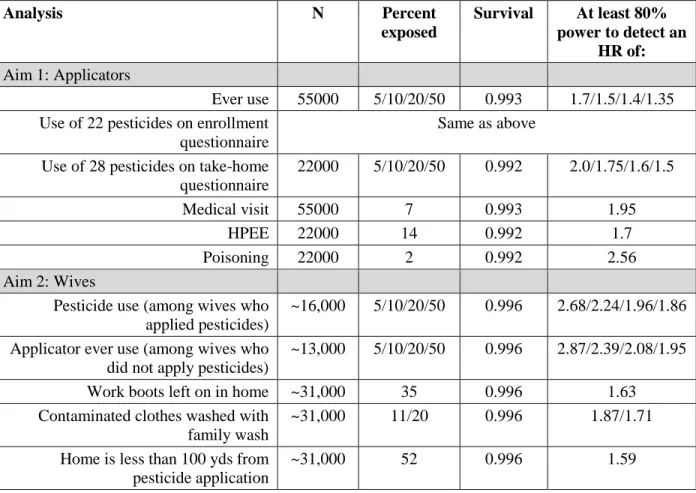
Pre-analysis power calculations were done to evaluate power for each aim, given a fixed sample size, but allowing for flexibility in the percent exposed to specific pesticides. We assumed an average of 15 years of follow-up and ascertained exposure prevalences from published AHS studies. Power
calculations are presented at α = 0.05. Analyses were conducted in SAS 9.2 using the PROC POWER procedure.
Table 2.5: Power calculations for Aim 1 and Aim 2
Analysis N Percent
exposed
Survival At least 80% power to detect an
HR of: Aim 1: Applicators
Ever use 55000 5/10/20/50 0.993 1.7/1.5/1.4/1.35 Use of 22 pesticides on enrollment
questionnaire
Same as above Use of 28 pesticides on take-home
questionnaire
22000 5/10/20/50 0.992 2.0/1.75/1.6/1.5
Medical visit 55000 7 0.993 1.95
HPEE 22000 14 0.992 1.7
Poisoning 22000 2 0.992 2.56
Aim 2: Wives
Pesticide use (among wives who applied pesticides)
~16,000 5/10/20/50 0.996 2.68/2.24/1.96/1.86 Applicator ever use (among wives who
did not apply pesticides)
~13,000 5/10/20/50 0.996 2.87/2.39/2.08/1.95 Work boots left on in home ~31,000 35 0.996 1.63 Contaminated clothes washed with
family wash
~31,000 11/20 0.996 1.87/1.71 Home is less than 100 yds from
pesticide application
~31,000 52 0.996 1.59
39
Strengths and Limitations
This study is the first and only prospective study of specific types, levels and routes of pesticide exposure and any type of kidney disease. Pesticide use and exposure information were obtained in a cohort study specifically designed to evaluate health effects of pesticide exposure, with data on use of 50 pesticides. Variability in cumulative use and types of pesticides used facilitated evaluation of the role of specific pesticides and exposure-response trends in ESRD risk. The large size of the cohort provided sufficient power to analyze categories of pesticide use and exposure, where other studies have only evaluated dichotomous measures of these factors. Enrollment from two states permitted state-stratified analyses, which can be used to compare direction of effect of specific pesticides. We had complete case ascertainment for the outcome of interest and reliable data on the first ESRD service date. Recall bias with regard to the exposure is minimized because of the prospective cohort study design, and reliability of reported pesticide use is satisfactory (136).
40
CHAPTER 3: Pesticide use and risk of end-stage renal disease among licensed pesticide
applicators in the Agricultural Health Study.
Introduction
In 2011, over 600,000 Americans were receiving treatment for end-stage renal disease (ESRD). Little is known about the impact of environmental and occupational factors on risk of ESRD. Some organophosphate (8), organochlorine (9), carbamate (10), and pyrethroid (11) insecticides and triazine herbicides (137) have been shown to cause renal damage and dysfunction in experimental animal models, and case reports of both fatal and non-fatal pesticide poisoning have described nephrotoxic effects of a variety of pesticide classes (13-17). Yet, the impact of long-term pesticide exposure on human kidney function remains largely unknown. Studies conducted in El Salvador, Nicaragua, and Sri Lanka indicate an elevated prevalence of chronic kidney disease among agricultural workers (18-21) compared to those who have never worked in agriculture; pesticide exposure is postulated to be a contributor to kidney disease in these regions, but existing evidence has not confirmed this hypothesis (18-20). To our knowledge, the only study to assess agrochemical exposure and ESRD found self-reported work in a place with frequent or daily exposure to insect or plant spray to be associated with increased ESRD risk (22). These studies lack specificity with regard to pesticide type and have not been able to adequately assess the long-term effects of chronic or acute pesticide exposure on ESRD risk.
41
Methods
Population and case definition:
The AHS recruited private pesticide applicators (mainly farmers) (N= 52,394) in North Carolina and Iowa and commercial pesticide applicators (N=4,916) in Iowa who applied for or renewed a
restricted-use pesticide license between 1993 and 1997. Approximately 82% of eligible private
applicators and 47% of eligible commercial applicators enrolled in the study. At enrollment, applicators provided information on lifetime pesticide use and pesticide use practices, demographic characteristics, lifestyle activities, farm information, and medical history in a self-administered questionnaire (26). Of enrolled applicators, 44% also completed a take-home questionnaire with additional questions about medical history and pesticide use (119). Questionnaires are available on the AHS web site:
http://aghealth.nih.gov/collaboration/questionnaires.html.
42 Exposure assessment
Participants provided information on ever use of 50 specific pesticides along with information on years of use (duration) and average days per year of use (frequency) for 22 of the pesticides on the enrollment questionnaire. The question on ever use was repeated and duration and frequency of use data were obtained on the take-home questionnaire for the remaining 28 pesticides. We evaluated ESRD in relation to ever use of these 50 specific pesticides, using enrollment questionnaire data for 22 pesticides and take-home questionnaire data for the other 28 pesticides.
For specific pesticides, an intensity-weighted exposure metric was generated by multiplying lifetime-days of use (product of duration and frequency of use) by an intensity score. This intensity score accounts for differences in exposure resulting from variation in pesticide application methods, repair of pesticide application equipment, and use of personal protective equipment (114). We used the intensity-weighted lifetime-days as our primary exposure metric. Due to the small number of cases, we used the distribution of use among cases to create cut-points for intensity-weighted lifetime use of specific pesticides. For pesticides used by ≥15% of cases, we categorized intensity-weighted lifetime-days into tertiles with non-users as the referent group. For less frequently used pesticides, intensity-weighted lifetime-days of use were split at the median (<median vs. ≥ median), with non-users as the referent group. Analyses were restricted to pesticides for which there were at least 5 cases in each exposure stratum.
To assess overall pesticide use, we evaluated risk related to duration, frequency and lifetime-days of use of any pesticide. Cumulative lifetime-days of use was categorized into quartiles, and duration and frequency of use were categorized into three levels (≤ the lowest category of use (referent), > lowest category of use to the median value, and > median).