EXPLAINING INDIVIDUAL ATTITUDES TOWARD IMMIGRATION USING SOCIOECONOMIC AND CULTURAL THEORETICAL MODELING
Dale Nicholas Koch
A thesis submitted to the faculty of the University of North Carolina at Chapel Hill in partial fulfillment of the requirements for the degree of Master of Arts in the Department of Political
Science, Concentration European Governance.
Chapel Hill 2018
ABSTRACT
Dale Nicholas Koch: Explaining Individual Attitudes Toward Immigration Using Socioeconomic and Cultural Theoretical Modeling
(Under the direction of Liesbet Hooghe)
Two substantial and growing bodies of literature address variations in individual attitudes toward immigration from a socioeconomic and a cultural perspective, respectively. Fewer
studies, however, seek to reconcile these theoretical perspectives through a more holistic approach. With that in mind, this paper is conceived with an appreciation for explaining immigration attitude formation as a complex web of deeply interconnected factors which vary widely in importance among individuals. I argue that, in addition to socioeconomic factors, cultural elements play an even stronger role in the formation of public opinion toward
TABLE OF CONTENTS
LIST OF TABLES... vi
LIST OF FIGURES ... vii
1. INTRODUCTION ... 1
2. MAIN THEORIES ... 4
2.1 Socioeconomic Theories ... 4
The Labor Market Competition Model ... 4
The Fiscal Burden Model ... 8
2.2 Cultural Theories ... 11
Stereotyping and Prejudice ... 12
Cultural Loss ... 14
2.3 Alternative explanations... 16
3. CORE INSIGHTS OF THE THEORETICAL PERSPECTIVES ... 19
3.1 Primary criticisms of the theories ... 19
3.2 Reconciling the existing theoretical frameworks ... 21
4.1 Key Variables ... 23
4.2 Control Variables ... 29
4.3 Results ... 30
5. CONCLUSION ... 34
LIST OF TABLES
TABLE 1: RACIAL BIAS (SOURCE: EUROPEAN SOCIAL SURVEY 2014/15) ... 13 TABLE 2: LINEAR REGRESSION MODELS OF ATTITUDES
LIST OF FIGURES
FIGURE 1: OPPOSITION TO IMMIGRATION BY COUNTRY ... 1 FIGURE 2: LABOR MARKET MODEL... 5 FIGURE 3: OPPOSITION TO IMMIGRATION BY CULTURAL FACTORS ... 16 FIGURE 4: OPPOSITION TO IMMIGRATION BY NATIVE PREJUDICE
AND SKILL LEVEL ... 25 FIGURE 5: OPPOSITION TO IMMIGRATION BY NATIVES’ VIEWS
ON JOB COMPETITION AND SKILL LEVEL... 27 FIGURE 6: OPPOSITION TO IMMIGRATION BY NATIVES’
1. INTRODUCTION
Immigration policy has been a divisive and high-profile issue in several recent national elections and referendums in Europe and North America. In addition to the United Kingdom’s referendum to leave the European Union, the latest national elections in the United States, the Netherlands, France, Germany, and Austria were largely defined by immigration. Many countries remain divided on this issue: election results are often close, and outcomes across countries have favored pro- and anti-immigration political parties. Public opinion survey data reveal that support for or opposition to immigration varies not just among individuals, but also widely across countries (Figure 1).
Figure 1: Opposition to Immigration by Country
explains variation across countries? There is a large body of literature exploring these questions, from which two general theoretical perspectives emerge. One approach seeks to explain
differences in attitudes toward immigration by examining socioeconomic factors driving
citizens’ opinions (Artiles and Meardi 2014; Citrin et al. 1997; Jaime-Castillo, Marqués-Perales, and Álvarez-Gálvez 2015; Scheve and Slaughter 2001). This approach cites economic concerns among native citizens as a driver of anti-immigrant sentiment. Two prominent theoretical models commonly comprise this socioeconomic explanation. The labor market competition model theorizes that native citizens will be more opposed to immigrants with a similar skill level to their own. In their US study, Hainmueller and Hiscox (2010) claim to disprove this model, finding that both high-skilled and low-skilled workers prefer high-skilled immigrants to those considered to be low-skilled. To add an extra wrinkle to the labor market perspective, US survey data suggests that many individuals believe that new immigration depresses domestic wages (Scheve and Slaughter 2001). Alternatively, the fiscal burden model predicts that it is not fear of labor market competition but the fear of strain on public services caused by immigrant inflows which drives greater opposition to low-skill immigrants. This model predicts greater opposition to low-skill immigrants than high-skill immigrants by wealthy natives – who fear a higher tax burden to finance public services – and poor natives – who are concerned that low-skill
immigrants will reduce the availability of benefits and services – alike. Yet again, Hainmueller and Hiscox (2010) present findings which suggest that both wealthy and poor natives prefer high-skilled immigrants over low-skilled immigrants.
the so-called ‘quality’ of immigrants according to similarities between immigrants’ country of origin and the receiving country, particularly with regards to economic development, education system, language, and culture. Citrin et al. (1997) find significant links between an individual’s personal ideology and affective orientation toward particular ethnic groups and their attitudes toward immigration. Burns and Gimpel (2000) argue that discourse claiming economic reasons for opposition to immigration is often underpinned by prejudicial views toward certain
ethnicities. Another important aspect of the cultural dimension is the concept of natives’ fear of cultural loss reflected by increasing political tension related to globalization and
denationalization (Hooghe, Marks, and Wilson 2002; Hutter and Kriesi 2017; Kriesi et al. 2006). Are these two broad theoretical perspectives – that attitudes toward immigration can be best explained by socioeconomic factors or by cultural factors – incompatible with one another, or do they perhaps complement each other to paint a more complete picture of the factors which affect public opinion toward immigration and which drive anti-immigrant sentiment? In the next section of this paper, I will conduct a review of prominent literature from each of the two main perspectives and summarize the distinct key insights of each. In section three, I will critique the strengths and weaknesses of each competing body of theory and bring together the key insights they offer about variation in attitudes toward immigration when considered together. In section four, I identify and explain key variables and offer my own quantitative analysis of attitudes toward immigration using European Social Survey public opinion data. In section five, I
2. MAIN THEORIES
2.1 Socioeconomic Theories
There is a large body of work which argues that individual preferences for immigration policy can be largely explained by socioeconomic factors. One theoretical approach, the labor market competition model, examines the link between immigration and the effect natives expect immigration to have on competition for jobs and on the level of wages (Mayda 2006; Scheve and Slaughter 2001). Under this model, natives’ immigration preferences vary across two
dimensions: the skill level of natives and the skill level of potential immigrants. A second model, the fiscal burden model, frames the issue instead in terms of competition for and contribution to public benefits and services. Unlike the LMC model, the fiscal burden model is concerned with just one key dimension: this body of research finds that there is greater support for high-skilled immigrants than low-skilled immigrants regardless of natives’ skill level (Artiles and Meardi 2014; Facchini and Mayda 2009; Jaime-Castillo, Marqués-Perales, and Álvarez-Gálvez 2015). Below, I explain each of the two models, laying out their underlying economic mechanisms and examining the subsequent predictions of each.
The Labor Market Competition Model
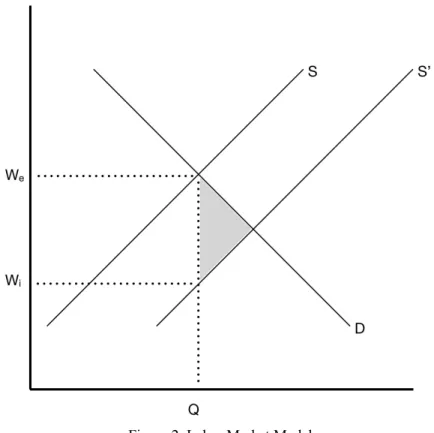
Model of trade and the factor-proportions analysis model. It assumes that labor is mobile and that the market produces multiple tradable outputs, allowing economies to leverage trade theories such as competitive advantage (Scheve and Slaughter 2001). It also assumes that demand for labor is essentially fixed or unaffected by immigration, and so the number of available jobs is finite. The results are modeled in Figure 2: influx of new immigrants into the labor market will shift the labor supply curve outward while the labor demand curve remains unchanged. Instead, new immigrant workers accept wages (Wi) below market value (We) while the overall quantity of jobs (Q) stays the same. The shaded triangle thus represents deadweight loss, or a market
inefficiency resulting from disequilibrium.
Figure 2: Labor Market Model
According to an individual’s skill-level, the model views individuals as operating in one of two general and distinct labor markets. Inflows of low-skill immigrants are therefore expected to only increase competition for low-skill jobs and suppress wages of low-skill workers and high-skill immigrants will lower wages only in the high-skill labor market. This model also assumes that skilled and unskilled labor markets are complementary, meaning that an increase in the supply of unskilled labor reduces the relative supply of skilled labor, thus raising skilled wages, and vice-versa (Mayda 2006).
Whether the model represented by Figure 2 correctly explains the effect of immigration on the labor market – some research argues that it does not (Card 2001; Ottaviano and Peri 2008) – is not so consequential as whether natives perceive it to be so. According to the labor market competition model, the perception of this labor market mechanism by natives explaining the impact of immigration on labor market competition and wages results in a particular set of policy preferences. The model expects natives to form preferences along the skill-level dimension: preferences among low-skill and high-skill natives will be distinct from one another because they are shaped by different expectations about how labor market and wage-setting mechanisms will affect them individually. Under this model, low-skill natives will be more likely to oppose new immigration of low-skill immigrants than of high-skill immigrants, and high-skill natives will have softer views, on average, toward low-skill immigration.
immigrants. While no legal barriers exist to prevent the mobility of workers in the United States or among most European countries, moving costs, community attachments, lack of community or family support, and access to information about economic opportunities in other areas all represent potential technical barriers for both native and immigrant workers that restrict mobility, particularly for low-income workers. Additionally, the labor market competition model only maintains its explanatory ability as long as native workers perceive wage suppression or higher labor market competition and as long as no other economic or noneconomic factors significantly influence individuals’ attitudes. Put another way, the model is only valid if personal economic self-interest, specifically based in concerns over employment and income security, is the primary driver of attitude formation.
Several studies question or challenge the predictions of the labor market competition model (Facchini and Mayda 2009; Hainmueller and Hiscox 2007, 2010). Analysis of survey responses in both the United States and in Europe show that natives prefer highly skilled
Some research does find that immigration negatively impacts natives’ earnings (Borjas,
Freeman, and Katz 1996), however other evidence suggests that immigration has an insignificant (Card 2001) or even a positive effect on wages (Ottaviano and Peri 2008).
The Fiscal Burden Model
A second model under the socioeconomic branch of theory is the fiscal burden model. Like the labor force competition model, the fiscal burden model is based on the assumption that certain natives may view new immigration negatively because they perceive it as increasing competition for limited resources. However, unlike the labor force competition model, which frames the issue of scarcity around jobs and wages, the key resources under the fiscal burden model are those related to the welfare state. The fiscal burden model predicts that natives formulate attitudes about immigration based on the fear that immigration will place increased stress on the public goods and services of the welfare state and affect either the allocation of limited social benefits or the tax burden associated with expanding the user base of benefits.
debate about which model more accurately reflects states’ behavior. Mayda (2006) finds evidence that governments tend to engage with the tax adjustment strategy, seeking to maintain the individual level of benefits. However Jaime-Castillo et al. (2015) argue that states are more likely to adhere to the benefit adjustment model, allowing individual benefits to drop without making major adjustments to overall spending. This is particularly true in a climate of fiscal austerity.
Like the labor force participation model, the fiscal burden model differentiates
individuals by socioeconomic status, either high-skill or low-skill.1 Individual attitudes toward
immigration are thus explained by natives’ perception that the arrival of low-skill immigrants and their subsequent inclusion into the welfare state will result either in a reduction of per capita social transfers by holding taxes constant or an increase in taxes in order to maintain existing per capita benefits (Facchini and Mayda 2009; Hainmueller and Hiscox 2010). For high-skill natives, low-skill immigrants represent a greater tax burden if they are incorporated into the welfare state. Low-skill natives are more likely to oppose low-skill immigrants out of fear that they will
compete for limited public resources, resulting in a lower share of benefits per capita. Based on this relationship, the theory predicts that all natives, regardless of skill level, will hold greater opposition to low-skill immigrants than to high-skill immigrants.
There are some notable shortcomings of the fiscal burden model and the common methodology for testing it which warrant discussion. First, the effect of immigration is likely to be higher in countries with more generous welfare states, as well as those which are more inclusive to non-national residents. Furthermore, it is difficult to obtain a comprehensive
1 Both income and education are sometimes used as proxy variables for skill level, so it should
calculation of a state’s fiscal exposure to immigration since it may not be possible to accurately measure the use of many public services by immigrants such as public roads and transportation, public safety and emergency services, parks, and education (Hainmueller and Hiscox 2010). Certainly, evidence suggests that characteristics of the welfare state have an impact on
differences in attitudes toward immigration. Jaime-Castillo et al. (2015) argue, for instance, that the size of the welfare state can explain differences in attitudes between low and high
socioeconomic status individuals, finding that the impact is greater in countries with greater social expenditure. To explain this observation, the authors suggest that since low-income individuals in generous welfare states are more likely to be affected by a decrease in per capita social benefits, and because there are likely to be a greater number of individuals who are dependent on the welfare state, the negative impact of immigration on natives’ attitudes toward immigration policy will be more severe in countries with more generous welfare states.
Reflexively, they find that the impact of immigration is less potent on native attitudes in countries with less generous and/or more restrictive welfare states. But evidence also suggests that countries with higher inequality are also more likely to see more opposition to immigration. This is something of a paradox since we would expect inequality to correlate negatively with the size of the welfare state. One explanation for these seemingly contrary findings may be that countries with higher social expenditure also tend to focus on social inclusion of immigrants, thereby reducing anti-immigrant sentiment (Artiles and Meardi 2014). This suggests that perhaps it is not so much the size of the welfare state as its quality which helps to explain differences in attitudes toward immigration across countries. Welfare regime theory allows us to consider welfare states by type rather than simply by overall expenditure (Esping-Andersen 1990),
As a final criticism, in addition to the aforementioned theoretical issues with the fiscal burden model, one can speculate that there will be substantial differences across countries in the actual impact of immigration on the welfare state based on variations in the restrictiveness to entry to the welfare systems of different countries.
2.2 Cultural Theories
While there are clearly opposing theories about the role of economic variables in immigration attitude formation, a great deal of literature seeks to address noneconomic factors involved in shaping attitudes toward immigration. Certainly, the economic arguments should not be ignored, as they show that economic factors can account at least for some of the variation in individual attitude formation. However, given the often emotional and deeply personal nature of individual views on immigration policy, these explanations clearly cannot tell the whole story. To understand the aspects of attitude formation that economic approaches miss, I look to social and cultural factors. Given evidence of a strong link between ideology and affective orientations toward particular racial or ethnic groups and individual preferences about immigration (Citrin et al. 1997), I introduce two lines of inquiry.
The first, the role of stereotyping and prejudice, is perhaps the most obvious. This
argument positions opposition to immigration as an expression of somewhat fixed attitudes based on individuals’ underlying prejudices toward other groups. The second highlights the notion of cultural loss which may stem from immigration. Where discussions of individual immigration attitudes based on economic factors often frame the debate in terms of economic policies
Stereotyping and Prejudice
Most of the literature on immigration operates under the assumption that individuals in the native population view all immigrants in a uniform way (Bridges and Mateut 2014), however it may be immediately apparent to the casual observer that this is unlikely. All individuals, to varying degrees, interrelate with other individuals through their own personal complex lens of pre-formulated stereotypes. These stereotypes condition the way we take in information and formulate decisions and judgements about others (Burns and Gimpel 2000).
Racial and ethnic stereotypes are not inherently negative by nature, and some stereotypes can be benign. However, the theoretical linkage between stereotyping, prejudicial attitudes, and opinions about immigration is closely related to the debate over immigration attitude formation. It is common that we ascribe group identities to others and relate other individuals to our
personal stereotypical notions about the ascribed group. Stereotyping is a useful and expedient tool all people use in this way, often unconsciously, to more easily interpret other people through generalizations of learned perceptions about groups’ characteristics and assigning those
characteristics to the group’s members as symbolic labels. Often, and perhaps most prominently, stereotypes are assigned to groups on the grounds of racial or ethnic identity. It is important to note however that prejudicial attitude formation does not necessarily follow from stereotyping; the content of stereotypes determines whether they will result in prejudiced views (Burns and Gimpel 2000).
significant role in individual preferences about immigration in Europe as well. Among those polled by the 2014/15 European Social Survey, 17% said that some racial or ethnic groups were born less intelligent than others and close to 38% said that some groups were born harder working than others (Table 1). Another round of the ESS revealed that, although 47% of respondents (in 2002) preferred to limit the arrival of immigrants, only 32% said they want to limit the arrival of immigrants of the same race as compared with 45% who said they want to limit the arrival of immigrants of different races.2 This seems to suggest a potential racial bias.
Although some European countries favored the restriction of immigration (Greece) more than others (Sweden, Switzerland, Ireland), opposition to the arrival of immigrants of different races was more likely than opposition to the arrival of immigrants of the same race across countries, even in the more pro-immigration countries (Bridges and Mateut 2014).
Table 1: Racial Bias (Source: European Social Survey 2014/15)
Cultural Loss
Fear over cultural loss in response to immigration has been an issue of growing salience for several decades. The rise of globalism has resulted in new groups of winners and losers of policies where borders are more open than ever to trade and immigration. Some scholars have conceptualized this division as a redefinition of existing political dimensions which helps to explain shifting individual preferences as a transformation of national electorates (Hutter and Kriesi 2017; Kriesi et al. 2006). Others have demonstrated, in the context of European integration, the emergence of a new political cleavage. This GAL
(Green/Alternative/Libertarian) – TAN (Traditional/Authoritarian/Nationalism) dimension broadly a spectrum of Euroskepticism or Europeanism along which new political parties are emerging and existing parties attempt to realign (Hooghe, Marks, and Wilson 2002).
1980s. Although each wave was built on a collection of changes to economic, political, and cultural factors, each wave is chiefly concerned with cultural issues (Hutter and Kriesi 2017).
Viewed this way, the cultural dimension of political contestation can be characterized as a conflict between cultural-protectionist and cosmopolitan perspectives. Due to the economic heterogeneity of ‘losers’ of globalization (Kriesi et al. 2006), who we might expect to hold anti-immigration sentiments, this dimension is integral to describing opponents of anti-immigration insofar as opponents’ attitude formation is associated with individual conceptions of ‘national identity’ (Hainmueller and Hiscox 2007) and with a protectionist response based on fear of cultural loss. On the other pole, it should be similarly possible to identify a coalition of culturally tolerant natives who support immigration. Individuals in this group either do not fear cultural loss or they embrace cultural intermixing that immigration may bring, else cultural loss is simply a low-salience issue compared to other factors (for instance, as compared to potential economic gains).
These studies demonstrate that fear of cultural loss and opposition to immigration have become ideologically linked. This linkage is supported using ESS data: feelings about
immigration clearly track positively with feelings about the effect of immigration on cultural life (see Appendix A). Data from the ESS can also provide some insight about beliefs which may underpin this ideology. Figure 3 shows that, for several key identity characteristics – language, religion, race, and commitment to a native way of life – people who responded that it is
highly, and are more likely to believe that immigration benefits the overall national economy (Citrin et al. 1997; Hainmueller and Hiscox 2007). There are two suggested reasons for this: First, education exposes people to ideas about tolerance and embracing diversity, helping them to learn about and appreciate other cultures (Hainmueller and Hiscox 2010). Second, higher
education opens the door to greater employment opportunities which are more likely to insulate people from economic hardships such like unemployment or labor market competition resulting from more immigration.
Figure 3: Opposition to Immigration by Cultural Factors
2.3 Alternative explanations
Specifically, I wish to present two factors which are likely to account for a significant amount of variation in views toward immigration among natives.
One important alternative factor pertains to where natives live in relation to non-natives and people of other racial or ethnic groups. Natives’ proximity to immigrants is usually
measured as the proportion of natives to non-natives in an area population, but it is also
approached through survey questions which ask natives about their perceived ethnic composition of their neighborhood and about their social relationships and casual contact with people from other racial or ethnic groups in their daily lives. The impact of living in proximity to and having regular contact with non-native people is contested among scholars is contested, suggesting that the impact of proximity is somewhat contextual. Burns and Gimpel (2000), for example, find a weak link between residential integration and opposition to immigration. Surprisingly though, they found in their study of individuals in the U.S. that living in close proximity to ethnically dissimilar individuals increased negative racial stereotyping and made natives more likely to oppose immigration, although they stress that the link was not significant. Using European survey results, Bridges and Mateut (2014) discover the opposite effect: in European countries with higher proportions of non-native immigrants in the population, respondents were less likely to oppose the arrival of new immigrants who are of a different ethnicity. Natives’ exposure to immigrants did not have much impact on their opposition to the arrival of immigrants of the same ethnicity, however.
3. CORE INSIGHTS OF THE THEORETICAL PERSPECTIVES
A review of the literature reveals a broad and complex web of contextual factors which influence attitudes toward immigration. Each theoretical model offers particular strengths for explaining why immigration preferences vary, but each also has certain weaknesses either in their inability to explain attitudes beyond a limited scope of countries and time (Bauer, Lofstrom, and Zimmermann 2000; Citrin et al. 1997) or by predicating their arguments upon unrealistic assumptions which simply do not hold up in the real world (Scheve and Slaughter 2001).
3.1 Primary criticisms of the theories
Many of the variables used across studies present obvious issues of collinearity which obfuscate the apparent presence and direction of causation. Most studies employ income or education as a proxy variable for measuring skill level (Bauer, Lofstrom, and Zimmermann 2000; Jaime-Castillo, Marqués-Perales, and Álvarez-Gálvez 2015; Mayda 2006; Scheve and Slaughter 2001) or note that similar results are obtained when substituting education for a more direct measure of skill level (Hainmueller and Hiscox 2007) in relation to immigration
immigrants’ country of origin causes significant variation in natives’ attitudes toward immigration (Bridges and Mateut 2014). Their results support theories about the salience of racial and ethnic prejudice in shaping attitudes toward immigration (Bridges and Mateut 2014; Burns and Gimpel 2000; Citrin et al. 1997).
Examinations across studies of the relationship between natives’ exposure to immigrants or members of other racial or ethnic groups and attitudes toward immigration also raise
questions. It has been demonstrated in Europe that natives who have greater exposure to immigrants are less likely to oppose the arrival of new immigrants of different racial or ethnic backgrounds (Bridges and Mateut 2014). However, a similar study in the US revealed that residential integration of different ethnic groups has also been shown to increase rather than decrease hostility and breed more negative stereotyping, leading to increased prejudicial views (Burns and Gimpel 2000) and resulting in a greater likelihood of opposition to immigration. From these contrasting findings, it would appear that variations in geographical and historical contexts, the composition and distribution of immigrant populations (Bridges and Mateut 2014), and the socioeconomic qualities of the native population make it difficult to reliably compare the effects of natives’ exposure to immigrants across countries.
A second broad criticism that can be leveled on immigration attitudes research in the United States and Europe addresses the direction of causation of the hypothesized relationships. Although the available research tests a variety of different dependent variables across studies, all rely on cross-sectional, but not panel, opinion survey data.3 Hainmueller and Hiscox (2007) point
out that relying on difference-in-difference experiment design rather than using multi-year panel
3 Most European studies utilize data from the European Social Survey; American studies cited in
data weakens the direction of causation arguments in the literature. Since the usefulness of the study of attitudes toward immigration hinges on the ability of the theoretical models to explain actionable factors which significantly influence opposition to immigration, the salience of this point cannot be understated. Serious caution should be exercised assigning causation to any factor in explaining immigration attitudes given the complex web of corollary factors at play which shift in proportionality across countries and time.
3.2 Reconciling the existing theoretical frameworks
Realistically, opposition to immigration is likely a highly personal, tailored attitude based on a complex mixture of causal factors whose significance vary in proportionality among
individuals. We can easily imagine both an individual who forms their preferences about
immigration based on primarily on concerns for personal or national economic wellbeing as well as one whose attitudes are founded mainly on cultural factors or prejudice. Collectively, the body of literature on immigration attitude formation does not give adequate cause to label either type of individual a clear anomaly, or even necessarily a minority, among national populations. In reality, accepting a flexible blend of explanatory factors would appear to be the most beneficial course of study from a real-world application perspective. Burns and Gimpel (2000) submit that “According to one tradition of scholarship, prejudice is ultimately an expression of
4. QUANTITATIVE ANALYSIS
In this section, I will outline and test the relationships between attitudes toward
immigration and several related variables which I identify based on the literature I have reviewed above. Rather than attempt to develop a sophisticated unifying model to predict attitude
formation, I will present several simple models for both individual- and national-level units of analysis. Data presented below is from round 7 of the European Social Survey (2014) which draws a sample from tens of thousands of respondents4 across European countries5.
4.1 Key Variables
Attitude Toward Immigration
To measure the dependent variable in this analysis, attitude toward immigration, I use respondents’ answer to the question, “is your country made a worse or a better place to live by people coming to live here from other countries?" Responses to this question are recorded as thermometer data, where 0 represents “worse” and 10 represents “better.” There are three advantages to this method for measuring attitude toward immigration. First, while many researchers who use this data for similar studies measure this variable based on respondents’ agreement with the statement, “immigration good or bad for country’s economy,” that measure is perhaps better suited to arguments based on economic factors. The measurement I use is more
4 N = 40,185
5 Austria, Belgium, Czech Republic, Denmark, Estonia, Finland, France, Germany, Hungary,
appropriate for an analysis aimed at understanding both economic and cultural factors. Second, thermometer data provides more resolution into understanding individual’s views on
immigration than a simple dichotomous (“support” or “oppose”) variable. Third, this
measurement reduces bias by asking about preferences indirectly by referring to respondents’ home country rather than addressing their personal likes or dislikes directly.
Racial or Ethnic Prejudice
The first key independent variable, and the first cultural variable I will test, is racial or ethnic Prejudice. To detect prejudice, I use two questions from the European Social Survey: “Do you think some races or ethnic groups are born less intelligent than others?” and “Do you think some races or ethnic groups are born harder working than others?” Respondents who indicated prejudicial views by answering “yes” to either or both of these questions were coded 1 while only those who responded negatively to both questions were coded 0. The reasoning behind this methodology is relatively straightforward. The variable prejudice is intended to capture racial or ethnic stereotyping by identifying those individuals who believe that certain groups of people are intrinsically different in terms of capability or ethic on a racial or ethnic basis. It is not intended to quantify racial or ethnic prejudice. Rather, it is merely meant to mark the presence of
prejudicial thinking through negative stereotyping by respondents about people of other races or ethnicities. Therefore, the threshold to indicate prejudice was set intentionally low: any
indication of negative stereotyping is considered equal by this analysis.
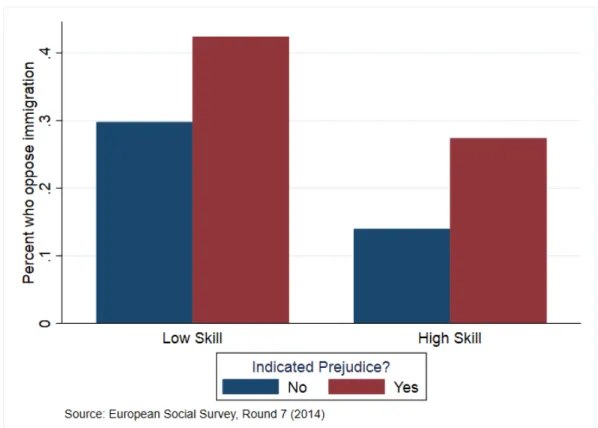
racial or ethnic prejudice in both skill groups, although overall opposition to immigration was lower among high-skill workers.
Figure 4: Opposition to Immigration by Native Prejudice and Skill Level
Fear of Cultural Loss
The next two key independent variables I will test are also on the cultural dimension, each intended to measure cultural loss. The first variable (Cultural Life) measures responses to the question, “Would you say that [country]'s cultural life is generally undermined or enriched by people coming to live here from other countries?” on a thermometer scale from 0 (“Cultural life undermined”) to 10 (“Cultural life enriched”). The advantage to this variable is that it directly measures individuals’ fear of cultural loss as a result of immigration. An array of similar
particular variations on opposition to immigration, which are proximate to the dependent variable, rather than fear of cultural loss itself.
A second independent variable on the cultural dimension, which carries many of the same advantages as the previously discussed variable, measures responses to the question, “It is better for a country if almost everyone shares the same customs and traditions?” Responses to this variable (Share Customs) are given on a scale from 1 (“Agree strongly”) to 5 (“Disagree
strongly”). Both cultural loss variables track positively with attitude toward immigration.
Perception of Immigrant Competition
Another primary independent variable, and one of two key socio-economic variables I will test, is respondent’s perception of the extent to which immigration increases competition in the labor market. This variable (Take Jobs?) is based on answers to the question “Would you say that people who come to live here generally take jobs away from workers in [your country], or generally help to create new jobs?” Respondents answered on a thermometer scale where 0 is “Take away jobs” and 10 is “Create new jobs.” In order to capture the sentiment that
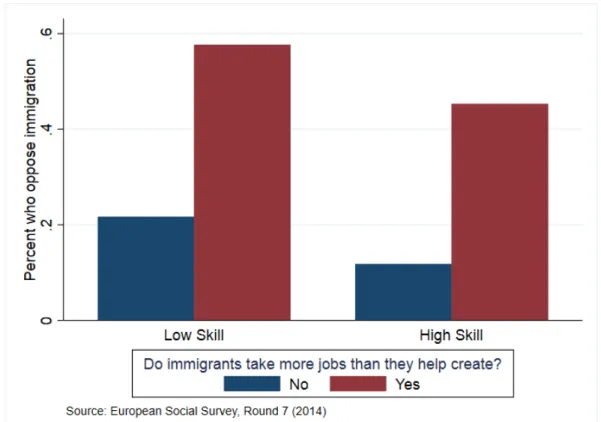
Figure 5: Opposition to Immigration by Natives’ Views on Job Competition and Skill Level
The purpose of including this variable is to incorporate the Labor Market Competition model of immigration policy attitude formation into my analysis. Figure 5 reveals a clear and potentially drastic difference in attitudes toward immigration between respondents who believe that immigrants increase competition for jobs and those who do not. By controlling for the skill level of the respondents, some confirmation of the effect described by the labor market
competition model is evident.
Perception of Welfare State Burden
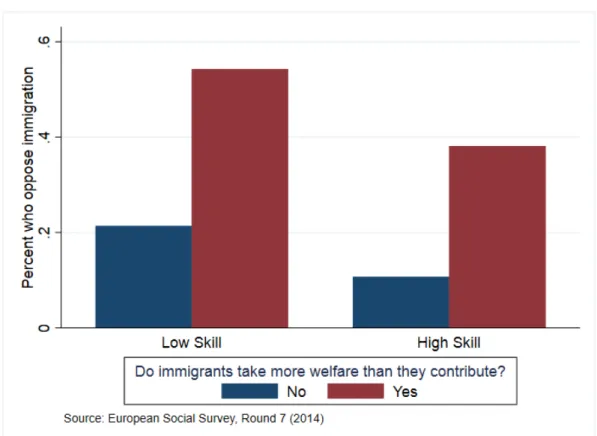
The final key independent variable, and the second of the two socioeconomic variables, that I will test is respondents’ perception that immigration results in a greater burden on the welfare state. Perception of Welfare State Burden (Take Welfare?) is measured based on
more than they put in or put in more than they take out?” Again, responses to this question were recorded as thermometer data which I have recoded as a dichotomous variable where values of 1 indicate the sentiment that immigrants generally take out more than they put into the welfare state. All other responses have been coded to 0.
Figure 6: Opposition to Immigration by Natives’ Perception of Welfare Use and Skill Level
4.2 Control Variables
Skill Level
Skill Level is a critical variable in both socioeconomic models addressed in this paper. As in the above figures, I will use a dichotomous variable for skill level in the following analysis based on educational attainment. Individuals who have attained a bachelor’s degree (or equivalent) or higher are coded as “high skill” (1) for the Skill Level variable. Those whose highest attained level of education is less than a bachelor’s degree are coded as “low skill” (0). A direct comparison of skill level and opposition to immigration shows that high-skill natives are less likely to oppose immigration than low-skill natives. A high-skill level also appears to reduce the effect of prejudice on opposition to immigration, as seen in Figure 4, as high-skill natives who indicated prejudicial views are nearly half as likely to oppose immigration as those with a low-skill level.
Age
Age is another important control variable discussed in the background literature and earlier studies. When considering socio-cultural factors which influence attitudes toward immigration, there is an expectation that younger respondents are likely to exhibit more
cosmopolitan attitudes of ethnic and racial tolerance. Age is coded as interval-level data in this study.
Household Income
negative correlation, however I will show that the relationship mostly dissipates when the other variables are accounted for.
Feelings About Household Income
Previous studies often hint that peoples’ feelings about economic indicators can be much more telling than the indicators themselves. A household may hold a great deal of wealth or benefit from a good income, but what really matters with regards to attitude formation is the feeling that one has a good income. This analysis will measure feelings about household income (Income Feelings) based on responses to the question “"Which of the descriptions on this card comes closest to how you feel about your household's income nowadays?" A response of
“Finding it very difficult on present income” is coded 4, “Finding it difficult on present income” is coded 3, “Coping on present income” is coded 2, and “Living comfortably on present income” is coded 1. Other responses have been omitted.
4.3 Results
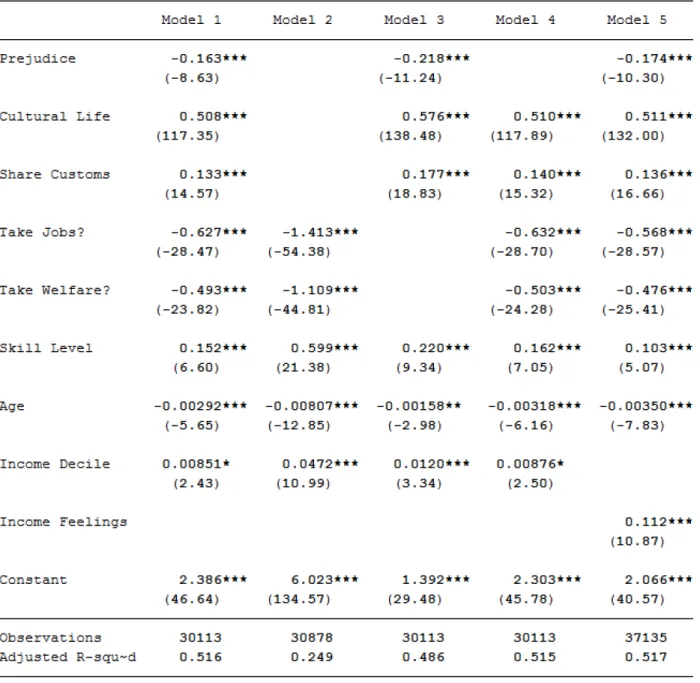
Based on the variables I described, I have constructed five linear regression models (Error! Reference source not found.) testing, in particular, the effects of prejudice on attitudes toward immigration as well as comparing the effects of other cultural variables with the effects of the economic variables, all of which are proximate to the dependent variable. None of the models reveals surprising relationships between the independent variables and opposition to immigration. The most telling insights of the models, rather, are the relative strength or weakness of the effect each variable has on opposition to immigration.
expected, and it is tempered slightly further by the inclusion of my control variables, but it is nevertheless significant. Skill level of the respondent also has a somewhat negative minor effect on the dependent variable. Age has a slight impact on harming attitudes toward immigration, and household income boosts support very slightly. However, the largest effects by far come from respondent’s perceptions of immigration’s cultural and economic impacts.
Table 2: Linear Regression Models of Attitudes Toward Immigration
On the other hand, Model 4 shows that the relative impact of racial or ethnic prejudice on immigration attitudes seems to be far less important. After removing prejudice from the
prejudicial views alone do account for some of the effect on opposition to immigration, the effect is small. In Model 5, I substitute household income with feelings about household income to little effect, although feelings about income do appear to be a slightly more effective indicator than a more direct measure of income.
There are two ways one might interpret the strong effect of Take Jobs? and Take Welfare? relative to prejudice. One is that these variables serve to indicate respondents’ perception about the type of immigration primarily taking place in their country. Those who believe that immigration represents a net increase on the labor market or a net drain on welfare may also believe that most new immigrants to their country are low-skill workers. The Labor Market Competition and Fiscal Burden Models predict that skill level should have a strong influence on opposition to immigration according to immigrant’s skill level, so if this interpretation is correct, we might expect skill level to have a strong effect in the models.
An alternate explanation is that these two variables are measuring, to some extent, prejudicial views rather than economic perceptions. More so than natives’ understanding of the effects of immigration on the economy, they may measure natives’ expectations about the quality of the typical immigrant. We might speculate, then, that natives who believe that most
5. CONCLUSION
An important takeaway from the analysis of the main theories explaining individual attitudes toward immigration is that we can only best understand how attitudes are forms on the whole by considering a broad array of economic and cultural factors together. Due to the complex interplay of these factors and the challenges associated with measuring them primarily from survey data, it would be exceedingly challenging to construct a robust and reliable general model to explain attitude formation toward immigration. I would stress that it was not the purpose of this study to create the groundwork for such a model, rather to better understand the relationship between economic and cultural factors as they pertain to effecting public opinion. I also set out to demonstrate that these theoretical perspectives, while often presented as
competing, are not mutually exclusive to one another.
Anecdotally speaking, the economic impacts of immigration hardly seem to receive too little attention. However, my analysis supports that cultural factors are perhaps even more
REFERENCES
Artiles, Antonio Martín, and Guglielmo Meardi. 2014. “Public Opinion, Immigration and Welfare in the Context of Uncertainty.” Transfer: European Review of Labour and Research 20(1): 53–68.
Bauer, Thomas, Magnus Lofstrom, and Klaus F. Zimmermann. 2000. “Immigration Policy, Assimilation of Immigrants and Natives’ Sentiments Towards Immigrants: Evidence from 12 OECD-Countries.” Swedish Economic Policy Review 7(ii): 11–53.
Borjas, George J, Richard B Freeman, and Lawrence F Katz. 1996. “Searching for the Effect of Immigration on the Labor Market.” The American Economic Review 86(2): 246–51. Bridges, Sarah, and Simona Mateut. 2014. “Should They Stay or Should They Go? Attitudes
towards Immigration in Europe.” Scottish Journal of Political Economy 61(4): 397–429. Burns, Peter, and James G. Gimpel. 2000. “Economic Insecurity, Prejudicial Stereotypes, and
Public Opinion on Immigration Policy.” Political Science Quarterly 115(2): 201–25. Card, David. 2001. “Immigrant Inflows, Native Outflows, and the Local Labor Market Impacts
of Higher Immigration.” Journal of Labor Economics 19(1): 22–64.
Citrin, Jack, Donald P. Green, Christopher Muste, and Cara Wong. 1997. “Public Opinion Toward Immigration Reform: The Role of Economic Motivations.” The Journal of Politics 59(3): 858–81.
Esping-Andersen, Gøsta. 1990. The Three Worlds of Welfare Capitalism. Princeton, N.J.: Princeton University Press.
Facchini, Giovanni, and Anna Maria Mayda. 2009. “Does the Welfare State Affect Individual Attitudes toward Immigrants? Evidence across Countries.” Review of Economics and Statistics 91(2): 295–314.
Haidt, Jonathan. 2012. The Righteous Mind : Why Good People Are Divided by Politics and Religion. New York: Pantheon Books. http://search.lib.unc.edu?R=UNCb7080116. Hainmueller, Jens, and Michael J. Hiscox. 2007. “Educated Preferences: Explaining Attitudes
Toward Immigration in Europe.” International Organization 61(02): 399–442. Hainmueller, Jens, and Michael J. Hiscox. 2010. “Attitudes toward Highly Skilled and
Low-Skilled Immigration: Evidence from a Survey Experiment.” American Political Science Review 104(1): 61–84.
Hooghe, Liesbet, and Gary Marks. 2005. “Calculation, Community and Cues: Public Opinion on European Integration.” European Union Politics 6(4): 419–43.
Hutter, Swen, and Hanspeter Kriesi. 2017. “Restructuring the Party Systems in North-Western Europe.”
Jaime-Castillo, Antonio M., Ildefonso Marqués-Perales, and Javier Álvarez-Gálvez. 2015. “The Impact of Social Expenditure on Attitudes Towards Immigration in Europe.” Social Indicators Research 126(3): 1089–1108.
Kriesi, Hanspeter et al. 2006. “Globalization and the Transformation of the National Political Space: Six European Countries Compared.” European Journal of Political Research 45(6): 921–56.
Mayda, Anna Maria. 2006. “Who Is Against Immigration? A Cross-Country Investigation of Individual Attitudes toward Immigrants.” Review of Economics and Statistics 88(3): 510– 30.
Ottaviano, Gianmarco I.P., and Giovanni Peri. 2008. “Immigration and National Wages: Clarifying the Theory and the Empirics.”
Scheve, Kenneth F., and Matthew J. Slaughter. 2001. “Labor Market Competition and Individual Preferences over Immigration Policy.” The Review of Economics and Statistics 83(1): 133–45.