INTERFACING FEMININITIES: PERFORMANCE, CRITIQUE, AND THE EVENTS OF PHOTOGRAPHY IN AMALIA ULMAN’S EXCELLENCES & PERFECTIONS
Kimberley M. Henze
A thesis submitted to the faculty at the University of North Carolina at Chapel Hill in partial fulfillment of the requirements for the degree of Master of Arts in the Department of Art.
Chapel Hill 2017
ABSTRACT
Kimberley M. Henze: Interfacing Femininities: Performance, Critique, and the Events of Photography in Amalia Ulman’s Excellences & Perfections
(Under the direction of Carol Magee)
Over the course of four months, Amalia Ulman performed “types” of femininity through Instagram’s vernacular of selfies, fashion shots, food porn, and cheeky quotes in an effort to challenge socially constructed and bound ideas of gender. Ulman’s adopted personas, all
TABLE OF CONTENTS
ABSTRACT ... iii
TABLE OF CONTENTS ... iv
LIST OF FIGURES ... v
INTRODUCTION ... 1
CHAPTER ONE ... 8
CHAPTER TWO ... 22
CHAPTER THREE ... 35
CONCLUSION ... 45
FIGURES ... 47
LIST
OF
FIGURES
Figure 1. Amalia Ulman, “artsy-tumblr girl,” Excellences & Perfections, 2014,
https://www.instagram.com/p/m-6bPjFV5b/. ... 47 Figure 2. Amalia Ulman, “sugar baby,” Excellences & Perfections, 2014,
https://www.instagram.com/p/p761dzFVwU/. ... 48 Figure 3. Amalia Ulman, “life goddess,” Excellences & Perfections, 2014,
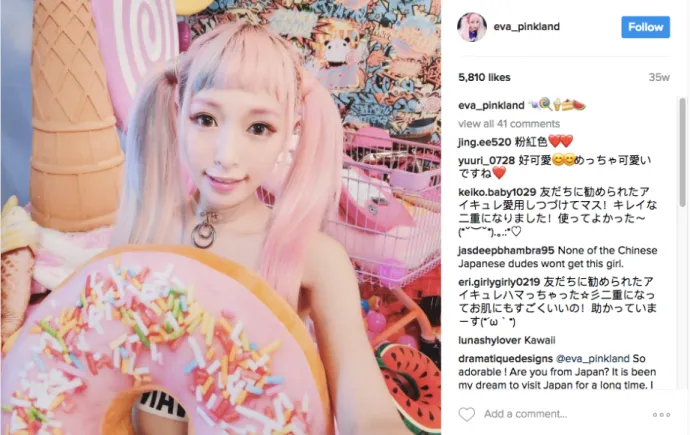
https://www.instagram.com/p/sc48slFV6l/. ... 48 Figure 4. @jam_ponybah, Instagram post, https://www.instagram.com/p/BIhsxZdjnuV/. ... 49 Figure 5. @eva_pinkland, Instagram post, https://www.instagram.com/p/BHwoYcEAfHQ/. .... 49 Figure 6. @chan.tsz.ying, Instagram post, https://www.instagram.com/p/BFlQu3iL5iH/. ... 50 Figure 7. Amalia Ulman, “artsy-tumblr girl,” Excellences & Perfections, 2014,
https://www.instagram.com/p/pPdMqblV4K/. ... 50 Figure 8. Amalia Ulman, “artsy-tumblr girl,” Excellences & Perfections, 2014,
https://www.instagram.com/p/owzk9DFV0O/. ... 51 Figure 9. Cindy Sherman, Untitled Film Still #2, gelatin silver print, 1977. The Museum of
Modern Art, New York. ... 51 Figure 10. Nikki S. Lee, The Yuppie Project #4, chromogenic development print, 1998. Chicago,
Museum of Contemporary Photography. ... 52 Figure 11. @hannahbronfman, Instagram post, https://www.instagram.com/p/BOe-LXilO5Y/. 52 Figure 12. @hiit.whit, Instagram post, https://www.instagram.com/p/BRbzia8Ahu9/. ... 53 Figure 13. @jenselter, Instagram post, https://www.instagram.com/p/BQ9RTJ5hYLx/. ... 53 Figure 14. @bootyprogram, Instagram post, https://www.instagram.com/p/BLsqCNSD4T0/. .. 54 Figure 15. Amalia Ulman, “sugar baby,” Excellences & Perfections, 2014,
https://www.instagram.com/p/qBLIVPlV-X/. ... 54 Figure 16. Amalia Ulman, “sugar baby,” Excellences & Perfections, 2014,
https://www.instagram.com/p/q9Qc1KFV9M/. ... 55 Figure 17. Amalia Ulman, “sugar baby,” Excellences & Perfections, 2014,
https://www.instagram.com/p/qjzmthlVyc/ ... 55 Figure 18. Amalia Ulman, “sugar baby,” Excellences & Perfections, 2014,
Figure 19. Amalia Ulman, “sugar baby,” Excellences & Perfections, 2014,
https://www.instagram.com/p/p5ataiFV4V/. ... 56 Figure 20. Amalia Ulman, “sugar baby,” Excellences & Perfections, 2014,
https://www.instagram.com/p/qGUMyRlVxL/. ... 57 Figure 21. Amalia Ulman, “sugar baby,” Excellences & Perfections, 2014,
https://www.instagram.com/p/qAdsTHlV_n/. ... 57 Figure 22. @kimkardashian, Instagram post, https://www.instagram.com/p/BPWyS01jtgL/. .... 58 Figure 23. @kourtneykardash, Instagram post, https://www.instagram.com/p/BLurajSFK5a/. .. 58 Figure 24. @kyliejenner, Instagram post, https://www.instagram.com/p/363OMyHGhJ/. ... 59 Figure 25. @kyliejenner, Instagram post, https://www.instagram.com/p/37CB3hHGuk/. ... 59 Figure 26. @mndflmeditation, Instagram post, https://www.instagram.com/p/BNUdMEkA-aH/.
... 60 Figure 27. @thetiafox, Instagram post, https://www.instagram.com/p/BRnVKpogrUI/. ... 60 Figure 28. @ameliamarthelia, Instagram post, https://www.instagram.com/p/8I5ilguXvV/. ... 61 Figure 29. Amalia Ulman, “life goddess,” Excellences & Perfections, 2014,
https://www.instagram.com/p/s1qhbVlVwY/. ... 61 Figure 30. Amalia Ulman, “life goddess,” Excellences & Perfections, 2014,
https://www.instagram.com/p/sM87m9FV0S/. ... 62 Figure 31. Amalia Ulman, “life goddess,” Excellences & Perfections, 2014,
https://www.instagram.com/p/sFVf_IlV2p/. ... 62 Figure 32. @__dez07__, Instagram post, https://www.instagram.com/p/BRpTJWJgrQc/. ... 63 Figure 33. @claudiaalende, Instagram post, https://www.instagram.com/p/BPtObkdDgY9/. .... 63 Figure 34. @lucyjsenior, Instagram post, https://www.instagram.com/p/BRG_0HSgh-O/. ... 64 Figure 35. @ewansee, Instagram post, https://www.instagram.com/p/BQ0J5TQD8Gv/. ... 64 Figure 36. Amalia Ulman, “artsy-tumblr girl,” Excellences & Perfections, 2014,
https://www.instagram.com/p/oFPJN9FV6L/. ... 65 Figure 37. @lauraraephotograph, Instagram post,
https://www.instagram.com/p/BQ0J5TQD8Gv/. ... 65 Figure 38. Amalia Ulman, “artsy-tumblr girl,” Excellences & Perfections, 2014,
Figure 39. Amalia Ulman, “artsy-tumblr girl,” Excellences & Perfections, 2014,
https://www.instagram.com/p/pmDrqlFV4p/. ... 66
Figure 40. Barbara Kruger, Untitled (Your gaze hits the side of my face), photograph and type on paperboard, 1981. Washington, DC: National Gallery of Art. ... 67
Figure 41. @emmahenault, Instagram post, https://www.instagram.com/p/BRqm4HpgYN0/. .. 68
Figure 42. @nilzehm, Instagram post, https://www.instagram.com/p/BRql9J2hf-j/. ... 68
Figure 43. Amalia Ulman, “sugar baby,” Excellences & Perfections, 2014, https://www.instagram.com/p/qXK8sfFVyy/. ... 69
Figure 44. @debhewlett, Instagram post, https://www.instagram.com/p/BRoTWzlFkp7/. ... 69
Figure 45. @thefeedfeed, Instagram post, https://www.instagram.com/p/BRqXzGHhDua/. ... 70
Figure 46. @shopmissa, Instagram post, https://www.instagram.com/p/BRnxxYODmNr/. ... 70
Figure 47. @primewayoflife, Instagram post, https://www.instagram.com/p/BRpPcUlFTVG/. 71 Figure 48. @parisparisaz, Instagram post, https://www.instagram.com/p/BRqxKMVA58b/. .... 71
Figure 49. Amalia Ulman, “life goddess,” Excellences & Perfections, 2014, https://www.instagram.com/p/sy8_OzlVwY/. ... 72
Figure 50. Amalia Ulman, “life goddess,” Excellences & Perfections, 2014, https://www.instagram.com/p/sxKKisFV0C/. ... 72
Figure 51. Amalia Ulman, “sugar baby,” Excellences & Perfections, 2014, https://www.instagram.com/p/rFXbwBlV0w/. ... 73
Figure 52. Amalia Ulman, “sugar baby,” Excellences & Perfections, 2014, https://www.instagram.com/p/qLe2VIFVyV/. ... 73
Figure 53. Amalia Ulman, “life goddess,” Excellences & Perfections, 2014, https://www.instagram.com/p/ry6-bMlV_v/. ... 74
Figure 54. Amalia Ulman, “life goddess,” Excellences & Perfections, 2014, https://www.instagram.com/p/sPiL5hFV5U/. ... 74
Figure 55. Amalia Ulman, Screenshot of “artsy-tumblr girl” Instagram bio, Excellences & Perfections, 2014, http://webenact.rhizome.org/excellences-and-perfections/20141014150552/http://instagram.com/amaliaulman. ... 75
Figure 57. Amalia Ulman, Screenshot of “life goddess” Instagram bio, Excellences & Perfections, 2014,
http://webenact.rhizome.org/excellences-and-perfections/20141014162333/http://instagram.com/amaliaulman. ... 75 Figure 58. Amalia Ulman, “artsy-tumblr girl,” Excellences & Perfections, 2014,
https://www.instagram.com/p/nqurgrlV9_/. ... 76 Figure 59. Amalia Ulman, “sugar baby,” Excellences & Perfections, 2014,
https://www.instagram.com/p/prkcSRlV5y/. ... 76 Figure 60. Amalia Ulman, “sugar baby,” Excellences & Perfections, 2014,
https://www.instagram.com/p/qmV6DCFV0p/. ... 77 Figure 61. Amalia Ulman, “sugar baby,” Excellences & Perfections, 2014,
https://www.instagram.com/p/rFXbwBlV0w/. ... 77 Figure 62. Amalia Ulman, “sugar baby,” Excellences & Perfections, 2014,
https://www.instagram.com/p/rCI0eSlV2d/. ... 78 Figure 63. Amalia Ulman, “life goddess,” Excellences & Perfections, 2014,
https://www.instagram.com/p/rrUG3QlV78/. ... 78 Figure 64. Amalia Ulman, “life goddess,” Excellences & Perfections, 2014,
https://www.instagram.com/p/sj6TkSlV3a/. ... 79 Figure 65. Amalia Ulman, “sugar baby,” Excellences & Perfections, 2014,
https://www.instagram.com/p/rcBXSLlV-R/. ... 79 Figure 66. Amalia Ulman, “sugar baby,” Excellences & Perfections, 2014,
https://www.instagram.com/p/pxVqkHlV8P/. ... 80 Figure 67. Amalia Ulman, Excellences & Perfections, at Electronic Superhighway, 1966-2016,
Whitechapel Gallery, London, 2016. ... 80 Figure 68. Amalia Ulman, Excellences & Perfections, at Performing for the Camera, Tate
INTRODUCTION
Amalia Ulman’s 2014 Instagram performance Excellences & Perfections appropriates stereotypical social media images and personas to raise issues of socially-constructed identities and gendered visual vernaculars. In this thesis, I argue that Excellences & Perfections expresses the construction and contingency of social performances in the mid-2010s, a time when image-based social networks and the norms they often reinforce exist in near ubiquity. In particular, I argue that Ulman’s Instagram performance deconstructs the production, engagement, and reception of images and personas on social media. Utilizing precariousness as an aesthetic strategy, Excellences & Perfections destabilizes and critiques the hegemonic norms of gender, such as hypersexualized and hyperfeminine images, language, and interests that pervade social environments.1
At stake in Ulman’s performance is a critical awareness of how the images we see, share, and post on social media influence the way we view and value our world, our communities, and
1 For more on gender stereotypes online, see: Ursula Oberst, Vanessa Renau, Andres Chamarro, and Xavier Carbonell, “Gender Stereotypes in Facebook Profiles: Are Women More Female Online?” Computers in Human Behavior 60 (2016): 559-564; Jen Almjeld, “Collecting
Girlhood: Pinterest Cyber Collections Archive Available Female Identities,” Girlhood Studies 8, no. 3 (Winter 2015): 6-22; Amy Shields Dobson, Postfeminist Digital Cultures: Femininity, Social Media, and Self-Representation (New York: Palgrave Macmillan, 2015); Penny Griffin, Popular Culture, Political Economy, and the Death of Feminism (New York: Routledge, 2015); Melissa Ames and Sarah Burcon, How Pop Culture Shapes the Stages of A Woman’s Life (New York: Palgrave Macmillan, 2016); Shuo Chang, Vikas Kumar, Eric Gilbert, and Loren G. Terveen, “Specialization, Homophily, and Gender in a Social Curation Site: Findings from Pinterest,” in Proceedings of the 17th ACM Conference on Computer Supported Cooperative Work & Social Computing, 674–86. CSCW 2014 (New York: ACM, 2014):
ourselves. While the fields of art history and media studies have examined mobile photography, gender, and new media in depth, this thesis moves these discussions toward a lesser-studied platform (Instagram) and analyzes three mediated, normative personas to illuminate how gendering operates in Excellences & Perfections relative to both social media spheres and contemporary art.2 In what follows, I will introduce Ulman’s work, define and describe the hegemonic norms of femininity as they operate within this thesis, introduce the theories of precariousness and photographic agency that undergird these chapters, and give an overview of the thesis structure.
Excellences & Perfections was a four-month Instagram performance, which Ulman described as “a full immersion in a screen reality” exploring “how we consume images and how they consume us.”3 During this time, Ulman shifted identities on her @amaliaulman profile, presenting herself through Instagram’s norms of selfies, fashion shots, food porn, and cheeky quotes, all while accruing almost 89,000 followers.4 Ulman assumed three different personas, all coded feminine and all formulaic to social media spheres, which developed over three
2 Edgar Gómez Cruz, “Creation and Control in the Photographic Process: iPhones and the Emerging Fifth Moment of Photography,” Photographies 5, no. 2 (2012): 203-221; Larissa Hjorth, Jean Burgess, and Ingrid Richardson, Studying Mobile Media: Cultural Technologies, Mobile Communication, and the iPhone (New York, NY: Routledge, 2012); Elana Levine, “Feminized Popular Culture in the Early Twenty-first Century,” in Cupcakes, Pinterest, and Ladyporn: Feminized Popular Culture in the Early Twenty-First Century, ed. Elana Levine, 1-12 (Chicago: University of Illinois Press, 2015); Susan Murray, “Digital Images, Photo-Sharing, and Our Shifting Notions of Everyday Aesthetics,” Journal of Visual Culture 7, no. 2 (2008): 147-163; Christiane Paul, New Media in the White Cube and Beyond: Curatorial Models for Digital Art (Berkeley: University of California Press, 2008).
3 Amalia Ulman, “Do You Follow? Art in Circulation” Panel, Institute of Contemporary Art, London, transcribed by Rhizome (October 17, 2014):
http://rhizome.org/editorial/2014/oct/28/transcript-do-you-follow-panel-three/.
consecutive “episodes.” While Ulman referred to these episodic characters as “archetypes,” I will use the term “personas” as a less psychoanalytically-loaded concept to explore the hegemonic norms of femininity mimicked and critiqued throughout the performance.5
By “hegemonic norms of femininity,” I mean dominant, pervasive modes of representing and enacting the female experience that often cater to a patriarchal gaze and reinforce
essentializing characterizations of women.6 Within social media environments, these norms manifest in what Amy Shields Dobson has called “digital dreamgirls,” at once particular and universal embodiments of “the one, essential, ideal woman” whose “possibilities for
transformation and replication are endless.”7 Ulman’s three performed personas—which she has labeled the “artsy-tumblr girl,” “sugar baby,” and “life goddess”—each embody aspects of this “essential” woman (figures 1-3).8 The specific norms enacted by Ulman in Excellences & Perfections shift throughout the performance, but all fall into what Shields Dobson has categorized as “heterosexy feminine forms,” which emphasize Western heteronormative
sexuality and traditional, patriarchal ideals of femininity.9 Specifically, Ulman’s representations include self-imagery and textual self-descriptions that exhibit elements of innocence and naivety, “hot and hostile” aggressive sexuality, and domestic dispositions, while Ulman’s posts of
5 Ulman, “Do You Follow? Art in Circulation.”
6 Rosalind Krauss, “Cindy Sherman: Untitled (1993),” Cindy Sherman, ed. Johanna Burton (Cambridge, MA: The MIT Press, 2006).
7 Shields Dobson, 55. 8 Kinsey.
flowers, fashion, interior decor, and desserts operate within normative conceptions of “feminine” activities and interests.10
The posts for each episode were composed of an image and caption crafted by Ulman and posted to Ulman’s public profile. Using the Instagram account (@amaliaulman) on which she was active prior to this piece and on which she has continued to post since (ostensibly as
“herself”), Ulman intentionally set up the confusion and elision of identities, remarking that she opened with an aesthetic (“artsy-tumblr girl”) that “was closer to home [so it] wouldn’t look like too suspicious of a transformation.”11 Images for the 187 posts in the work were either composed and performed by Ulman as enactments of hegemonic norms or appropriated in whole from social media sites like Instagram and tumblr.12 The public settings of the profile enabled Ulman to engage with and attract more followers through the use of hashtags and a riveting narrative. Alongside the posts, Ulman also changed her profile elements—her bio and profile picture—for each episode.
Central to the potency of Excellences & Perfections is the precariousness that evokes instability in these images. As Christine Ross articulates, precariousness refers not to the ephemerality of a work or its contingency (though these characteristics may contribute), but to the ways in which the image or interface of a work moves the viewer into “perceptual
perturbation,” in which an “unsettling of vision [...] occurs at the viewer-image interface [...] troubl[ing] full visual access to the image (and beyond, to the reality to which it
10 Shields Dobson, 65: describes how this aggressive sexuality can be seen a normative
femininity. For a discussion of domesticity see: Justin Charlebois, Gender and the Construction of Dominant, Hegemonic, and Oppositional Femininities (Lanham, MD: Lexington, 2011): 30; Elana Levine, Cupcakes, Pinterest, and Ladyporn: Feminized Popular Culture in the Early Twenty-First Century (Chicago: University of Illinois Press, 2015): 7-11.
11 Kinsey.
refers).”13Deployed in multiple ways, precariousness enables Excellences & Perfections’ rich critique of social media representations. First, the mimicry of hegemonic norms in the work unsettles viewers’ reading and reception of Ulman’s pervasive image-types and personas. This aspect of precariousness is introduced in Chapter One, when I examine the form and content of posts deployed by Ulman. A second aspect of precariousness is deployed through Excellences & Perfections’ placement, mediation, and involvement on Instagram. Chapter Two will
demonstrate more fully how the image-viewer interface thrusts the viewer into a virtual public space, setting Ulman’s performance in dialogue with the social viewing and reinforcement of hegemonic norms that happen there. These affirmations of normative femininity are made visible on the interface, where likes and comments demonstrate mass response and where the viewer-turned-user can interact in tandem, on the same application and interface with which they may post their own images and interact with their own networks.
While I use precariousness to analyze the mimetic, dynamic, and interfaced nature of Excellences & Perfections as a new media work, Ariella Azoulay’s theoretical framework of photography is central to my examination of the events and encounters engendered by Ulman’s images and the hegemonic norms through which they operate. Chapter One examines the images of Excellences & Perfections through the “photographic event,” in which the artist-as-sovereign intentionally crafts and composes images. However, with the Instagram performance, we have to look beyond these images as documentations of normative femininity, understand photography as “a phenomenon of plurality, deterritorialization, and decentralization,” and consider the
agency of the camera and the agency of the photograph in its multiple forms.14 Chapters Two and Three will thus examine the “events of photography” that follow the artist- and camera-initiated photographic event and the agency taken by viewers and images in a continuously unfolding process of spectatorship. In these spheres, a “special form of encounter” emerges “between participants where none of them possesses a sovereign status.”15 Both on Instagram and in the museum space, the images take on new and myriad meanings, reflecting on and challenging the hegemonic norms depicted in various ways.
The individual chapters, therefore, work together to illustrate the various modalities of precariousness. Thus Chapter One also analyzes images from Excellences & Perfections to demonstrate how their form (aesthetic, pose, gesture) and content (selfie, cityscape, fashion) enact and reinforce ideas of gendered identity. Eva Forrest’s concept of the “habit of noticing” and Angelica Svelander and Mikael Wiberg’s theory of “social calibration” provide the context for understanding how Ulman’s performance both mimics and critiques user’s consumption and performance of normative image-types on social media.16
Along with engaging the event of photography and strategies of precariousness as a means of destabilization, Chapter Two moves Ulman’s carefully enacted images into the environment (Instagram) on which they were dispersed. What results is another iteration of performance: not only did Ulman perform with her body for the camera, now she performs networked identities alongside the resulting photographs on a digital interface. Here, I use Christine Ross’s conception of “precarious visuality” and Sarah Pink’s “digital wayfaring” to
14 Ariella Azoulay, “Photography,” Mafte’akh 2e (2011): 67. 15 Ibid., 70.
deconstruct the filters, captions, tags, and environment of Excellences & Perfections and illuminate the new meanings and encounters made possible by the interfaced work.17
Chapter Three’s engagement with the event of photography examines how Excellences & Perfections changes when it moves onto the walls of a museum. I argue that the loss of the interface and the resulting shift in precariousness in the museum space critically undermines the impact of Ulman’s project because it is the user interactions and dynamic nature of Instagram that allow for Ulman’s critique of hegemonic norms of femininity to succeed. To demonstrate this, I will place the exhibition of Excellences & Perfections at the Tate and Whitechapel in London in the context of literature on new media in the gallery, analyze what meanings are highlighted in the museum space, and ultimately demonstrate how the most effective encounter is on the social media interface. I now turn toward an analysis of the photographs conceived and performed by Ulman to articulate how their form and content reflect, mimic, and critique
hegemonic norms of femininity.
17 Ross; Sarah Pink, “Photographic Places and Digital Wayfaring,” in Digital Photography and Everyday Life: Empirical Studies on Material Visual Practices, ed. Gomez Cruz and
CHAPTER ONE
The images created and enacted for Excellences & Perfections embody and self-consciously critique hegemonic norms of gender pervasive to social media environments. By examining their form and content, this chapter undertakes an analysis of the images as
“photographic events,” in which the artist is sovereign, her intention is privileged, and her artistic choices can be critically considered for meaning.18 While the formal analyses conducted here will be complicated in Chapters Two and Three, where I examine how meanings shift with reception on Instagram and in the museum, the analysis here illuminates the performance’s function as an artistic critique of hegemonic norms of femininity while also providing a basis for understanding its further publicly-mediated iterations.
Beyond analyzing the constructed form and content of these images, I will also consider the context from which Ulman’s images emerged to demonstrate the social practices that the artist is working to critique. Here, Angelica Svelander and Mikael Wiberg’s conception of “social calibration” provides a helpful framework for the chapter. In social calibration, users first accumulate a taste for and acceptance of what is expected and successful in online environments (consumption and adoption) and then move forward to execute these norms as their own
(enactment).19 By breaking down the images of Ulman’s performance, we can critically examine the processes that went into their production, i.e., the processes of social reinforcement that Excellences & Perfections is working to critique. The first section of the chapter engages with the content material and photographic frames (selfies, cityscapes, fashion shots, etc.) cultivated in the social image economy and performed across the episodes of Excellences & Perfections. The second section then examines the normative “types” of femininity that Ulman enacts for each episode through poses, captions, and aesthetics. I argue that the content, frames, and
personas appropriated by Ulman in Excellences & Perfections reveal hegemonic norms of gender that undergird visual tropes in social media. Ulman’s strategic parroting of these tropes sets up a tension and precariousness for the viewer, pressing us to question the roles and representations pervasive across social media.
PERFORMING NORMS OF FEMININITY
Within each episode of Excellences & Perfections, Ulman employs specific poses and aesthetic tones to perform distinct normative “types” of femininity for her “artsy-tumblr girl,” “sugar baby,” and “life goddess” personas. While these episodes enact different ideas of what “femininity” is—innocence/naivety, aggressive sexuality, and domesticity—they all employ “heterosexy feminine forms” by grounding their identities and self-expression in essentialized understandings of women’s bodies and constructed gender roles—childlike passivity,
impassioned sexuality, and motherhood, respectively.20 In what follows, I will analyze images from each of the episodes to demonstrate how Ulman constructed poses and tone to mimic trends of popular social media images that reinforce hegemonic understandings of femininity.
Wanting to start the performance with an aesthetic that “was closer to home [so it] wouldn’t look like too suspicious of a transformation,” Ulman adopted the feminized image of sweetness and childlike innocence from “all those Korean girls whose Instagram [she] check[s] every morning.”21 A survey of Korean and Japanese lifestyle bloggers whom Ulman follows on Instagram (figures 4-6) reveals an abundance of pastel pink, doe-eyed selfies, stuffed animals, cutesy fashion, and brightly-colored sweets. For the “artsy-tumblr girl” episode, Ulman
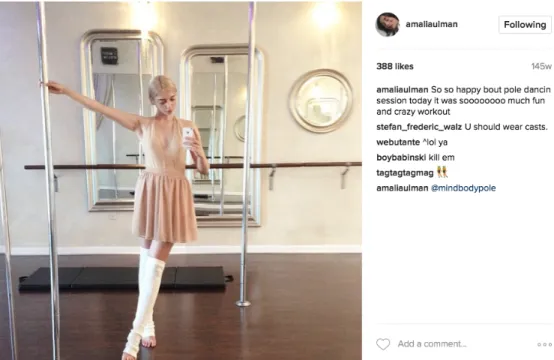
appropriated these poses and the visual tone pervasive to kawaii pop culture, an aesthetic native to Japan but gaining popularity across Asian and global markets. Kawaii is an adjective in Japanese meaning “cute,” “adorable,” or “lovable” as well as a “key affect word used to describe things that are small, delicate, and immature.”22 Figure 7 shows Ulman—or a woman whose image Ulman appropriated as her own—with blonde pigtails in pastel pink pajamas, sitting with a large stuffed animal between her legs. The image, along with its caption of “Good niteeee!!” offer the type of childlike image associated with kawaii. Apart from this aesthetic of cuteness pervading consumer goods, fashion, and beauty, kawaisa also “stimulates feelings of wanting to protect something that is pure and innocent,” a sentiment that undergirds systems of patriarchal control where women are impelled to play “girl[s] whose sexuality is yet to emerge.”23 Figure 8 shows Ulman at a pole-dancing studio but the traditional associations of lasciviousness and loose morals associated with the activity in a strip club are sterilized by her setting, outfit, posturing, and caption. The white light on the left side of the image suggests the presence outside the frame of daylit windows which, combined with two additional interior lights behind Ulman, deny any
21 Ulman quoted in Kinsey; Ulman, “Do You Follow? Art in Circulation.”
22 Matthew Burdelski and Koji Mitsuhashi, “‘She Thinks You’re Kawaii’: Socializing Affect, Gender, and Relationships,” Language in Society 39 (2010): 65.
association with dark, windowless clubs. Furthermore, with the polished wooden floors, ballet bar, mirrors, and practice mat, the space more readily evokes a ballet studio than a nightclub. Ulman’s cutesy, pastel ballerina outfit and her uncompromising pose affirm this more innocent reading, even as the nature of pole dancing itself and the hint of Ulman’s revealed thigh bear sexual connotations. Such images evoke exactly the kind of innocent, burgeoning sexuality associated with kawaisa and thus cater to essentialized ideas of women as childlike, naive, innocent, and delicate.
The “sugar baby” performance differs greatly from the “artsy-tumblr girl” in that Ulman jumped from conceptions of femininity as passive and innocent to aggressive and overtly sexualized. In her exploration of these different “types” of femininity, Ulman operates within a tradition of female artists, including Cindy Sherman and Nikki S. Lee, who use self-portrait photography for performing and highlighting stereotypes of gendered identity. Feminist scholar Laura Mulvey has described Sherman’s Untitled Film Stills (figure 9) as “highly connotative but elusive” mise-en-scènes in which the camera “intrudes into moments in which [the subject] is unguarded, sometimes undressed, absorbed into her own world in the privacy of her own environment,” while Phil Lee described Nikki S. Lee’s Projects (figure 10) as “imitat[ing] semiotic codes of dress, appearance, bodily gestures and postures” of communities, “creating a world of hyperreality where the distinctions between the real and unreal Nikki S. Lee are ambiguous.” 24 Such statements could just as well describe images from Excellences &
Perfections, attesting to the similar efforts by all three artists to capitalize on the sovereignty of the artist to mimic and re-present hegemonic norms of femininity. Azoulay articulates this
24 Laura Mulvey, “A Phantasmagoria of the Female Body: The Work of Cindy Sherman,” New Left Review, 188 (1991): 141; Phil Lee, “Indefinite ‘Nikkis’ in a World of Hyperreality: An
artistic sovereignty as a privileging of the constructed image as “a form of testimony that pertains solely to that which was positioned in front of the lens,” a positioning conceptualized, framed, and—in these cases—enacted by the photographers.25
While analyses of these artist-sovereign perspectives are important and investigation of the works via this traditional approach comprises the majority of the history of photography, Azoulay points out that these analyses examine only one aspect of the photographs, bracketing off the space, time, and intention in which the images were taken as of primary, perhaps sole, significance.26 Ulman, Sherman, and Lee, as artist-sovereigns, all work in this vein to control the way we read femininity in their works. By directing viewers to read their constructed images in particular ways, the artists implicate patriarchal structures of seeing to engender the recognition that the femininities depicted are not inherent to the woman or even to the image but are the product of socially-conditioned readings.
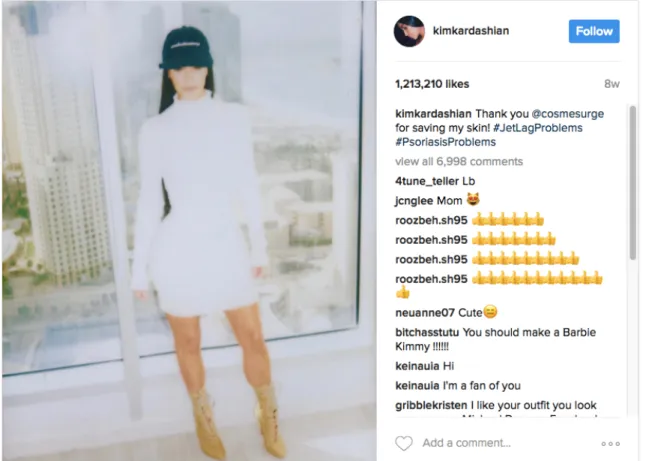
In her first episode-shift of the performance, Ulman moves from the cutesy innocence of the “artsy-tumblr girl” to gestures and poses of Ulman’s “sugar baby” that center on the display of her sexualized body. In gestures common to fitness communities (figures 11-14), Ulman repeatedly pulled up the front of a shirt to reveal her stomach (figures 15-16) or turned perpendicular to a mirror to emphasize her curves (figures 17-18). This episode featured a lot more skin through cleavage-enhancing camera angles and half-naked dancing videos. The visual tenor moved in kind from pastel and pink to a hard urban aesthetic of black and gray tones, animal print, jewelry, and edgy designer labels (figures 19-21), a look most famously associated with Kardashians (figures 22-25), whom Ulman follows on Instagram.
Episode three, the “life goddess,” returns to a lighter, white aesthetic, but this time, rather than the pink pastel of episode one, Ulman uses clean, earthy tones of brown, green, and yellow, mimicking networked communities focused on healthy living and home life (figures 26-28). Gone are the overtly-sexualized poses, and in their place are images attesting to domesticity and self-care (figures 3 and 29). In figure 30, Ulman holds a baby on her hip, her face and attention turned toward the child. Motherhood and propriety are engaged in a caption that reads, “Some quality time with my beautiful cousin Cayetana. She is such a wonderful miracle, I love her.” While the “life goddess” wardrobe is notably more conservative than that of either the “sugar baby” or “artsy-tumblr girl,” signs of Ulman’s sexuality—though restrained—remain. While holding the child, for example, Ulman’s blouse shifts to the left, revealing a hint of her bra. This post affirms the sexualization of her body, but the accidental nature of the shirt-slip gives her a sense of purity. This particular image fits into hegemonic understandings of motherhood, which Carol Smart has tied to culturally-constructed ideas of a “naturalistic chain” of events in
women’s lives, comprising sexual activity, pregnancy, birth, mothering, and motherhood.27 Smart describes the internalization of these stages as a product of the institutionalization and homogenization of motherhood, in which women—whether or not they are actually mothers— are expected to be nurturing, loving, and proper yet still bound to the sexual condition on which the institution of motherhood relies.28
Another aspect of the “life goddess” “type” is a renewed focus on family and domestic concerns. This manifests in an increase in references to family and an increase of images
centered on food and interior design. Figure 31 shows “Sunday brunch with my sister,” in which
27 Carol Smart, “Deconstructing Motherhood” in Good Enough Mothering? Feminist Perspective on Lone Motherhood, ed. Elizabeth Bortolaia Silva (New York: Routledge, 1996): 37.
Ulman, in a high-necked blouse, little makeup, and a simple hairstyle, sits at a table in a homey café. While her body is square with the camera, she looks aside as if not expecting or aware of the camera, which—positioned from the opposite side of the table—we assume must be held by her referenced sister, who snapped an image of the unassuming and un-self-interested Ulman during their family time together. With Ulman’s eyes looking away, the viewer is drawn to the photograph above and behind Ulman, picturing a black man whose eyes directly meet ours. We are drawn more into the background of the image and into the setting in which Ulman is posed. This post is thus constructed to be more about the homey, interior space (likened to “feminine,” domestic spaces in general) and her reason for being there (family time), all affirmed by a caption that references her sister and notes “loved the decoration #ethnic #eclectic.” The “life goddess” thus conforms to essentialized understandings of woman as caregiver, mother, and domestic figure. In these realms, she may still exhibit sexuality, but, in contrast to the “sugar baby,” that sexuality is tied to her reproductive capabilities, her responsibilities within the home, and her “natural” disposition as a caregiver.29
FRAMING NORMS OF FEMININITY
The poses and aesthetics analyzed in the preceding section facilitate the readings of “types” of femininities within each episode, but across the whole performance, Ulman utilizes selfie- and content-types appropriated from social media to mimic and bring to attention the normative frames through which these femininities are portrayed. Not only do users become conditioned to viewing the content they see on social media as worthy of photography, they also
begin to internalize the way this content is posed and framed as model ways for viewing the world around them. Eva Forrest, who followed and interviewed photographers in their everyday life calls this the “habit of noticing;” she found that people who regularly look at or take photos start to see the world around them in photographic frames.30 One participant noted: “I am always thinking with photos in mind; it is kind of an obsession [...] you start to see things through a camera, even if you don’t have one.”31 This compulsive framing is manifest in smartphones, where the digital viewfinder spreads over the same LCD screen on which users view their friends’ and extended networks’ social media photos. The very same pixels that illuminate images for viewing on Instagram are here reappropriated to discover and frame similar images in the user’s own world. The photographer can literally “watch the world becoming an image” parallel to the posts she views regularly.32
Excellences & Perfections operates through and within this continuous social
reinforcement of normative frames. Indeed, Ulman’s construction of personas and frames in the work evolved from her own social calibration process of consumption and adoption. As noted above, in a panel with the Institute of Contemporary Art, Ulman disclosed that she was “inspired by all those Korean girls whose Instagram I check every morning” and used this content to inform her own constructed performance: “I guess out of their daily selfies, I wrote a story in pictures.”33 In what follows, I will use found images—first of selfie-types and then broader content-types—to illustrate the visual norms of framing femininity on Instagram with which
30 Forrest, 193. 31 Ibid., 198.
32 Martin Lister, “Is the Camera an Extension of the Photographer?” in Digital Photography and Everyday Life: Empirical Studies on Material Visual Practices, ed. Gómez Cruz and
Ulman engages and to demonstrate how Excellences & Perfections mimics these posts in both frame and content.
The selfie in many ways continues traditions of female self-portraiture and its exploration of woman-as-object, but—moved to a mass scale and tempo—selfies also bear stereotypes of self-obsession and self-importance.34 The bulk of these stereotypes falls disproportionately on women, who are seen by many viewers as objectifying themselves.35 Selfies thus directly manifest hegemonic understandings of women as “feminine body-subject[s]” who are socially-habituated to make over and present themselves as “object and prey” to the “panoptical male connoisseur.”36
In 2010, the same year that Instagram was created, Apple released its iPhone 4, featuring for the first time on a mobile device a front-facing camera and revolutionizing the selfie game. Front-facing selfies (figures 32-33) enable the photographer-subject to adjust immediately to the most flattering angles, lighting, and posture. In Excellences & Perfections, Ulman’s front-facing selfies, taken at arm’s length, offer attractive images of the artist’s face as well as fragments or hints of the rest of her often-sexualized body. In Figure 2, Ulman’s gaze meets the camera, but rather than serve as a confrontational assertion of empowering sexuality, the look seems to
34 Pavica Sheldon and Katherine Bryant, “Instagram: Motives for Its Use and Relationship to Narcissism and Contextual Age,” Computers in Human Behavior 58 (2016): 89-97; Jang Ho Moon, Eunji Lee, Jung-Ah Lee, and Tae Rang Choi, “The Role of Narcissism in Self-Promotion on Instagram,” Personality and Individual Differences 101 (October 2016): 22-25.
35 Anne Burns, “Self(ie)-Discipline: Social Regulation as Enacted Through the Discussion of Photographic Practice,” International Journal of Communication 9 (2015): 1716-1733; Derek Conrad Murray, “Notes to Self: The Visual Culture of Selfies in the Age of Social Media,” Consumption Markets & Culture 6 (2015): 490-516.
convey permission, welcoming or even expecting the viewer to explore her body on display. Such frames conform to hegemonic ideas of woman as sexed object.
While front-facing selfies primarily feature the face and décolletage, mirror selfies (figures 34-35) allow the photographer to incorporate a greater expanse of space into the image, which allows for visual statements to be made about the environment, outfits, and/or actions of the subject. These mirror images make up more than a third of the selfies in Excellences & Perfections.37 Figure 36 shows Ulman, her phone in her right hand, her left hand on her hip, standing in front of a gold-framed mirror with her eyes cast down at the LCD screen on the front face of her phone. From her perspective, she can adjust her posture, the angle of the camera, fix her hair, check lighting, and frame just enough of the background through the open door beyond to give a sense of the lush hotel of her shoot. Through this emplacement of her body, Ulman demonstrates normative conceptions of women as A) preoccupied with luxury, consumer goods and B) encased/essentialized/imagined within interior, domestic spheres—particularly the bedroom.38
Another type of self-image that Ulman utilizes in the performance is the situated selfie (figures 27 and 37). While the subject here does not hold the camera in these photographs, sometimes recruiting another individual to capture the image, I will—as other researcher have done—include these images in the category of “selfie,” as the subject often conceives,
constructs, poses, and performs the photos herself.39 Like the mirror selfies, these distanced images allow for a greater encapsulation of the environment and actions of the subject, as well as
37 Of the 187 posts in Excellences & Perfections, 83 are selfies, and 28 are mirror selfies. 38 Levine, 1-12; Charlebois, 37-40.
an unobstructed view of the subject’s body and posture. In figure 29, we see Ulman relaxing in a bath, looking out the window in a meditative state as if she’s completely unaware of the camera. Many of Ulman’s situated selfies (figures 31 and 38-39) employ this diverted gaze, offering her body, centered in the image, for uninterrupted and unabashed viewing. Again, here Ulman is working in an established trajectory of artists engaging with these issues. Sherman’s Film Stills, beyond working in a similar exploration of “types” of femininity, also facilitate/allow for the voyeuristic (male) gaze of the camera to “observe [Sherman], composed, simultaneously demure and alluring, for the outside world and its intrusive gaze.”40 While not self-portraiture, Barbara Kruger’s Untitled (Your Gaze Hits the Side of My Face) very explicitly confronts the
objectification/spectacle of woman effected by the male gaze and the ways that it
fixes/restricts/controls the image of woman (figure 40). The compositions and performances of Ulman’s selfies facilitate/critique in kind the visual and ideological positioning of woman-as-object as it is manifest on social media.
The final selfie-type appropriated by Ulman centers the body in a much more
phenomenological position for the viewer. In what Michele Zappavigna has called “‘you could be here with me’ photography,” the photographer-subject incorporates a partial view of her own body into the frame (figures 41-42).41 In doing so, she invites the viewer to imagine themselves into the scene. In Excellences & Perfections, Ulman uses this type of selfie to convey intimate, even provocative images of herself. In Figure 43, we see Ulman’s bare legs stretched out before her on a bed. With a model-like bend in her knee, the intimacy of rumpled bed sheets, and no indication that she is clothed, the camera frame shows just (not) enough of her body to
40 Mulvey, “Cosmetics and Abjection: Cindy Sherman (1991/1996),” in Cindy Sherman, ed. Johanna Burton (Cambridge, MA: The MIT Press, 2006): 68.
tease/please a male gaze. The objects shown to her left—coffee, an iPad, and what appears to be a women’s magazine—suggest the comfortable acceptance of a woman’s place in the home (and the bedroom). Such images frame and perpetuate normative ideas of femininity,
phenomenologically positioning Ulman’s body as an object of consumption for the (male) viewer.
Apart from selfies, Excellences & Perfections employs other normative content-types that reinforce associations of “femininity” with consumer and luxury goods and the domestic sphere. While some content subjects—like landscapes and cityscapes (figure 44)—continue a visual tradition that precedes the advent of camera phones and social media, others—brunch food (figure 45), everyday objects (figure 46), and aestheticized words and quotations (figure 47-48)—emerged as noteworthy and shareable only with the rise of social networking sites in the last 15 years. Not only are these everyday objects and experiences now worthy of photography, the frames of their capture have also been codified. For example, food and coffee posts are often taken in flat lay perspective, which allows the photographer to frame the objects in an idealized, aesthetic composition (figure 45).
Ulman appropriated this image-material and framing for Excellences & Perfections, where cityscapes (figure 49), flatlays of food (figure 50), everyday objects (figure 51), and found quotes (figure 52-53) are exhibited as her own “Instagrammable” frames from everyday life. In Figure 54 from the “life goddess” episode, an intricately-decorated porcelain tea cup with orange and lemon slices sits atop an old copy of Annie Fellows Johnston’s The Little Colonel’s
aesthetically-scattered tea leaves, tea accessories, and an amber, ceramic teapot—all set upon an aged grey wooden table, partially covered by a barely-pink dish towel or napkin. While the resulting image is certainly beautiful, a closer look betrays the almost-absurd constructedness of the space and the norms of femininity that it evokes. Ulman used the image as if it were a snapshot of her own afternoon tea ceremony, but the setting functions primarily as a collocation of objects and activities coded feminine: teacups, women’s literature, baked goods, and flowers in a domestic, kitchen-like setting. Additionally, the aesthetic of the image carefully matches the earthy color scheme of the “life goddess” episode. Less an honest depiction of daily activities, the image in Excellences & Perfections highlights the constructedness of the frames and gendered objects. Dispersed amongst the selfies in Excellences & Perfections, posts like these amplify the normative ideas of femininity—daintiness, consumerism, and domesticity— prevalent across Instagram profiles and performed in kind through Ulman’s self-portraits.
The content, frames, and personas appropriated from social media by Ulman for Excellences & Perfections operate within hegemonic understandings of femininity as sweet innocence, aggressive sexuality, and domestic care. However, by mimicking these distinct visual tropes in a dramatic progression and within an artistic performance, Ulman evokes
CHAPTER
TWO
In the previous chapter, I examined the form and content of images in Excellences & Perfections to demonstrate how Ulman, as sovereign artist, enacted and critiqued hegemonic norms of femininity. Excellences & Perfections, however, was not just a series of photographs, but a time-based, interactive performance of these images on the digital interface of Instagram, which is integral to the full meaning and gravity of the work. Accordingly, this chapter moves the images and analyses of the “photographic event”—in which creative action is central—into the realm of the “event of photography.”42 Rather than relegating meaning to a single moment of capture, Ariella Azoulay describes the event of photography as an “infinite series of encounters” in which parties of any level of involvement with the original event (photographer, subject, viewer of event, or subsequent viewers of the photograph) interact with the image in ever-changing ways and with shifting points of view.43 Azoulay argues that through these levels of dissemination and interaction, sovereignty is decentralized, and each party has equal agency in meaning making around the image.44
When uploaded to Instagram, the visual modalities addressed in the previous chapter are complicated by the verbal and nodal modalities of captions, comments, hashtags, and the
networked interface. Ulman brings this network-involvement into Excellences & Perfections not only by appropriating the established visual norms—as demonstrated in the preceding chapter—
42 Azoulay, “Photography,” 70. 43 Ibid., 77.
but also by infiltrating the networked communities within which those norms dominate, using the same methods of tagging, annotation, and dispersion that everyday users take for granted on social media. I argue that the captions, comments, and tags in Excellences & Perfections further mimic hegemonic norms of framing femininity and that the work, through strategies of
precariousness, unsettles the viewers’ reading and reception of these norms on Instagram and off.
CAPTIONING FEMININITIES
Beyond the carefully constructed norms of femininity analyzed in Ulman’s images in the preceding chapter, the Instagram interface offered the artist an additional platform for hegemonic mimicry by way of her profile and post captions. These annotations provide an “authorial voice” that situates the image, hints at intention, and conforms to hegemonic ideas of femininity. At the same time, they reinforce Ulman’s meanings for the photographic event.45
With each new episode of Excellences & Perfections, Ulman changed both her 150-character bio statement and profile image (figures 55-57). These are the standing features that greet viewers when they first open Ulman’s profile, and together they activate a “discourse of self” that orients the viewer to the interests and identity of the user.46 For Excellences & Perfections, Ulman selected images and crafted bios that concisely manifested the norms she explored in each episode: pink flower emojis and innocent interests in books and movies for the “artsy-tumblr girl;” jewelry emojis and “faux-feminist empowerment” phrases like “*Boss of Me*” for the “sugar baby;” and inspirational quotes for the “life goddess.”47
45 Zappavigna, “Social Media Photography,” 282. 46 Ibid., 277.
As with the images for each post, Ulman crafted her captions with content appropriated from social media norms and aligned them with the tone and aesthetic for each episode. For the “artsy-tumblr girl,” Ulman made extensive use of flower emojis, exclamation points, and “word lengthening” to reinforce her kawaii-inspired constructions of femininity. For example, Ulman captioned her post of a bunny, “Omg i dieeeeeee so fucking cutee” (figures 58). Word
lengthening is the repetition of letters—here, the duplication of e’s—within a word and is a linguistic stylization associated in popular media most often with young women as a means to convey playfulness or sometimes “seductive murmuring.”48 Its use then makes sense for the “artsy-tumblr girl” episode, which I’ve argued Ulman constructed to evoke hegemonic ideas of innocence and burgeoning sexuality. Indeed, the caption for the pole dancing post analyzed visually in Chapter One conveys exactly these connotations of naiveté and sexualization: “so so happy about pole dancin session today it was soooooooo much fun and crazy workout” (figure 8). The caption affirms the presence of the sexualized activity of pole dancing but
simultaneously works to dispel the lasciviousness associated with the activity through a playful, but still indulging, linguistic style.
With the “sugar baby,” the language of captions becomes more crass, words are shortened to letters, and rap lyrics make frequent appearances, all of which are manifest in “U see thers leaders n followers, n i rather b a dick than a swallower” (figure 59).49 While the
48 Public conceptions of this word-lengthening phenomenon as “feminine” can be seen across a number of popular articles emerging in 2013, including the following: Madeleine Davies, “I Can Lengthen My Words and So Can Youuuuuuu,” Jezebel (February 2013):
http://jezebel.com/5987133/i-can-lengthen-my-words-and-so-can-youuuuuuu; Maureen O’Connor, “The 5 Reasons Girls Type Like Thissss,” NY Magazine (February 2013):
http://nymag.com/thecut/2013/02/5-reasons-girls-type-like-thissss.html; Jen Doll, “Why Drag It Out?” Atlantic (March 2013): https://www.theatlantic.com/magazine/archive/2013/03/dragging-it-out/309220/.
provocative images of the “sugar baby” episode center on the sexualization of Ulman’s body and thus accommodate hegemonic norms of sexed femininity, Ulman complicates this reading by articulating messages of seeming self-empowerment through the post’s captions. For example, in this episode, Ulman feigns a boob job and justifies both the surgery and her self-sexualization as her own choice: “reasons i wanna look good / for myself / for myself / to plant the seed of envy in other bitch’s hearts / for myself” (figure 60). Reappropriation of the selfie as an “inherently feminist” form of self-expression and self-empowerment has been attempted by individuals and campaigns across social media. Lindsay Bottos, an artist who explores selfies as creative self-determination has asserted that “[selfies] declare that ‘hey I look awesome today and I want to share that with everyone’ and that’s pretty revolutionary.”50 While this kind of feminist, individual expression can and does exist on social media, many—if not most—of these efforts fall into what Stephen Barnard has called a “(dis)empowerment paradox” in which “personal expressions of beauty may feel empowering at the same moment as those expressions may conform to, and thus reinforce, hegemonic and oppressive cultural norms.”51
Ulman’s “sugar baby” epitomizes this (dis)empowerment paradox. Even as she uses captions to articulate her Instagram posts as empowered individuality, as in “I’m not like the rest” (figure 61) and “I might not be the nicest. But i’m real and dont give a fuck about standing alone” (figure 20), her body-centric poses and performance still conform to hegemonic ideas of “hot and hostile” hypersexualized femininity, a contradiction magnified by posts that seem to be
50 Bottos quoted in Ali Vingiano, “This Tumblr User Shows Her Horrific Anonymous Messages In A Powerful Art Project,” Buzzfeed (Jan 30, 2014):
https://www.buzzfeed.com/alisonvingiano/this-tumblr-user-shows-her-horrific-anonymous-messages-in-a?utm_term=.kaXQ4MAAO#.ppdoGdxx6.
written/created/posted for an interested spectator/voyeur: “wishin you understood wat i feel for u #miss #you” (figure 62).52 The normative “type” of femininity engaged here is what Ulman has referred to as “faux-feminist,” professing self-acceptance and self-determination but still operating within normative sexualized understandings.53
With the shift to the “life goddess,” Ulman retreats from this (dis)empowering language and moves to articulate sentence structures, with fully spelled-out words, correct grammar, and a positive tone. In her first post as “life goddess,” Ulman uploads an image of a traced heart with a length apology “I’m really sorry for my behavior recently […] I committed many mistakes because I wasn’t at a good place in my life tbh. […] I’m very grateful to my family for rescuing me from such a dark void. I was lost.” and signs “Blessings, Amalia” (figure 63). Further into the episode, “Small presents are the best gifts. Paying attention to details” (figure 64) and “The view from my window~ There is so much beauty in this world” (figure 49) are representative of the “life goddess” captions, which accompany images that shift in kind from sexually-aggressive to mature and meditative.
It is in this shift from “sugar baby” to “life goddess” that the arc narrative of Excellences & Perfections reaches its zenith, what Ulman referred to as “redemption” post-“breakdown.”54 Viewers try and fail to rationalize who this person is and how/why she swings so dramatically between characters. The distance between the viewer and the Amalia Ulman behind these mediated representations is made increasingly insurmountable by the inconsistencies in Ulman’s shared identities. The resulting precariousness destabilizes any easy reading of reality or identity behind these images and the hegemonic norms of femininity that they embody.
52 Shields Dobson, 65.
Indeed, the captions themselves influence and complicate the photographic event, thereby making manifest the events of photography that surround these images once posted to Instagram. It is productive, therefore, to examine another aspect of the interface that adds complexity and precariousness to the work and the incumbent events of photography: its networkedness. The follows, likes, and comments that result from Ulman’s shared and tagged performance further complicate and destabilize the viewers’ readings of the work and understandings of the reality behind the mediated personas.
NETWORKED FEMININITIES
Alise Tifentale of the Selfiecity project has asserted that networked sharing is the “raison d’être of a selfie.”55 Ulman facilitated this essential process of sharing in Excellences &
Perfections not just by posting images to her profile but by promoting them to larger public networks through the use of hashtags. These user-generated tags allow users to create and apply their own annotative metadata, connecting their content to other posts with the same hashtag. Social tagging systems like those on Instagram are often championed as democratic because they decentralize the creation of information structures and enable the horizontal discovery,
interaction, and use of tags, “resulting [in an] equal distribution of ‘power’ among all participants.”56 In reality, however, certain established discourses and tags can and do still
55 Alise Tifentale, “The Selfie: Making Sense of the ‘Masturbation of Self-Image’ and the ‘Virtual Mini-Me,’” Selfiecity,
dominate these virtual public spaces, enabling hegemonic norms to persist.57 This section explores the networked quality of Excellences & Perfections by examining Ulman’s use of hashtags, her accumulation of followers, and their networked comments. Analysis of Ulman’s tagging illuminates how the artist capitalized on popular tags to market her normative images and gain followers, while an examination of the resulting follows, likes, and comments demonstrates the “infinite series” of events of photography enabled by the interface.58 I argue that this tagging and networked interaction are what enable the performance to be alive, to grow, and to change beyond the original intentions or contributions of the artist, creating a rich and meaningful manifestation of the networked events of photography.
In an interview with Vulture, Ulman remarked that “it was easy to increase the followers by using shortcuts to popularity, like following the trending topics. If you are using the
Photoshopped image of a woman and a bunch of popular hashtags, the likes are going to go up.”59 In Excellences & Perfections, Ulman used mainstay popular or provocative hashtags like #tbt (throwback Thursday), #brunch, or #undies as well as extensive descriptive hashtags like #happy, #cool, #LA, #girl, #iPhone, and #dolce&gabbana. By increasing her networked visibility through popular tags, Ulman accrued a following of almost 89,000 by the end of her
performance.60
For Ulman, the effort and success of building a following on social media can be read as a manifestation of hegemonic understandings of woman-as-object. Ulman’s concerted efforts to
57 Jurgen Gerhards and Mike Schafer, “Is the Internet a Better Public Sphere? Comparing Old and New Media in the USA and Germany,” New Media & Society 12, no. 1 (2010): 143-160. 58 Azoulay, “Photography,” 77.
gather followers mimics an internalization of this norm, which she has referred to broadly as the “model fantasy […] the most widespread contemporary dream shared by young women of all backgrounds. Being watched means coming to life and being someone.”61 Here, Ulman equates this desire to “be someone” with the normative prescription of self-objectification for women, a desire embodied so well in Excellences & Perfections that Ulman received offers for further (professional) visual objectification: “Very soon, I started receiving messages from men who wanted to shoot me, the very phallic camera lens. I even received an email from a professional photographer in the line of Urban Outfitters and American Apparel.”62
The phenomena of follows and likes are related to the communication studies model of “parasocial relations,” which occurs when a media viewer feels social attraction toward a mediated persona (often a celebrity, athlete, or internet star) and begins to invest emotional energy into that person, even if the relationship remains one-sided.63 Many social media platforms enable, and in certain ways even encourage, this kind of relationship through the asymmetrical act of following.64 In Excellences & Perfections, these parasocial relations are facilitated by networked discovery through hashtags and are manifest in the likes and comments on Ulman’s posts.
Ulman’s followers demonstrated their parasocial evaluations with her normative
performance of femininities through likes—“Only after one week of posting images in my new
61 Ulman, “Do You Follow? Art in Circulation.” 62 Ibid.
63 Rebecca B. Rubin and Michael P. McHugh, “Development of Parasocial Interaction
Relationships,” Journal of Broadcasting & Electronic Media 31, no. 3 (June 1, 1987): 279–92. doi:10.1080/08838158709386664.
persona, the likes went up”—and comments.65 While some followers “accepted” Ulman’s performances, others either found fault with Ulman or the personas she was enacting. For
example, in her final post as the “sugar baby,” Ulman uploaded two videos of herself crying mid-breakdown. Ten-seconds each, these videos show Ulman in a dark room, with just enough light to make out her red-splotched eyes and nose as she lightly gasps and sobs (figure 65). The videos garnered comments of concern and empathy: “Why are you crying,” “miss you so much,” and “:(“.66 Other users were critical or apathetic to Ulman’s performed anguish: “A N N O Y I N G” and “All this shit is so fucking pretentious oh my gah.”67 While these comments were captured by Rhizome at the end of 2014, the last few years have seen additional commentary where viewers address Ulman as an artist directly, praising her work: “Master piece!” “I love your work!” and “Saw this one at liste [OK emoji] congrats on both booths in Basel!”
While the above comments might be read at face value, as the posts continue to garner additional comments, it becomes harder to evaluate whether users are aware of the construction behind the posts. For example, on the same video post of Ulman crying, @cashoutandgetfitted wrote “Thats right, cry. Im getting hott watcheing this,” “#crybitch!,” and “It sounds like you’re #cuttingyourself #lolol,” to which @jordanabragg responded “@cashoutandgetfitted = trying to censor, silence and mediate women who openly express their emotion, via negative comments is not cool/sexy/useful/positive or OK. #crymeariver.” @cashoutandgetfitted rebutted with “The comment section is adding to the art. Open your mind fuccboi.”68 The interactions on Instagram
65 Ulman, “Do You Follow? Art in Circulation.”
66 Archived version of Excellences & Perfections is available at: http://webenact.rhizome.org/excellences-and-perfections. 67 Ibid.
thus continue to challenge/destabilize viewers’ grasp of the line between performance and reality and the hegemonic norms persisting there.
Comments such as these exhibit what Sarah Pink has called “digital wayfaring,” a process that involves not only human movement through the digital-material environment in the way that we use our ever-handy camera phones to document moments and upload them to shared spaces online but also the movement of the images themselves.69 In a “sugar baby” post, Ulman uploaded a mirror selfie in which she’s dressed only in underwear and a short croptop with hair in a bleached-blonde ponytail, standing in a hotel-like space and holding a pillow to her side to make her body appear skinnier (figure 66). The caption addresses the “sugar baby” efforts to exercise more: “#no #excuses #workout #strongisthenewskinny.” However, the meaning of the image shifts for each viewer. As Pink states of digital wayfaring, images and the meanings that they convey are “produced by moving through and not over or on environments, and they are not stopping points so much as outcomes of and in movement,” which requires us to reimagine each photograph not as a representation of a static moment but as a product and producer in motion.70 While some viewers respond to the objectification of Ulman’s body: @vfiles posted the “flushed face” emoji, @beeare_br commented “Holy crap,” and @yerrrrmomzz said “Seems like you wanna be a noir stripper. You’re beautiful,…but borderline boring.” Other comments, though, emerged not in response to the image, but in response to Ulman as a person: @weldingninja originally commented—and has since deleted—“I used to take you seriously as an artist until I found out via Instagram that you have the mentality of a 15 year old hood rat.” @annasoldner responded to @weldingninja “yas,” while @yanzeecandle and @bbcarat defended Ulman with
69 Sarah Pink, “Photographic Places and Digital Wayfaring,” 188.
“Hood rat is a good style” and “Why is the meaning and value of the work diminished when the artist does not act in a way the viewer feels they should?” While these conversations were archived on Rhizome, later viewers’ used the comment section to tag friends, so that they could find the profile and view Ulman’s work as well.
Ulman’s posts were constructed with the knowledge that social media thrives through these kinds of interactions, a knowledge gained by the artist consuming this content herself on Instagram, on Facebook, on tumblr. She built her images and personas from certain “types” of femininities, but then dispersed them out into networked environments, where friends and strangers could consume and interact with them as they willed.
Extending this logic, one could see how each of these posts, likes, tags, comments, or follows on social media serves in some ways as a vote for what types of images will rise above the rest and establish themselves as acceptable—perhaps desirable—mediated representations of identity. Social media thus not only represents but also constructs hegemonic forms of
femininity; users are “not simply passive vessels, but possess agency to accept, contest, or reformulate syndicated images of masculinity and femininity.”71 The Instagram iteration of this work, then, engages the user-viewer not only with representational critiques of hegemony but with(in) the environment where they have power to contest and remodel norms.
This is what differentiates Excellences & Perfections from the work of Cindy Sherman and Nikki S. Lee. Rather than letting constructed images speak for themselves on museum walls, Ulman has placed her posts—as well as the whole profile, performance, and narrative—in the public sphere of social media, where the masses gather to follow, like, comment on, and influence continuing norms of femininity. The “infinite series of encounters” that Azoulay
identifies and the power relations that undergird them leave digital traces and are made visible on the Instagram interface.72 Viewers of the work are left to question whether or not these traces are “real” or “correct.” Here precariousness serves as an aesthetic strategy to render the boundary between person and persona, image and reality ambiguous and unknowable.
Azoulay’s framework of the event of photography here enables us to examine the
Instagram iteration of Excellences & Perfections, with its images, captions, likes, and comments, “as not being a consequence, application or implementation of the photographer's point of view but, rather, as resulting from an encounter between several protagonists.”73 The interface makes these multiple interactions visible for the viewer, brings these lives/events to the fore.
With this perspective, we can move to understand the images, comments, hashtags, followers, and commentators of Excellences & Perfections, Instagram, and social performance on and offline more broadly as participants in the development of a power-laden “communal aesthetic” of norms, validated through various systems of judgment, which manifest on
Instagram as likes, comments, and follows.74 In social media photography, “both the persistence of existing practices and the development of new ones require visible, public performance,” which is why the posts, parasocial capacities, and networkedness of the Instagram interface are so essential to the profundity and meaning of Excellences & Perfections.75 In the following
72 Azoulay, “Photography,” 77.
73 Ariella Azoulay, “What Is a Photograph? What Is Photography?,” Philosophy of Photography 1, no. 1 (2010): 12.
74 Susan Murray, “Digital Images, Photo-Sharing, and Our Shifting Notions of Everyday Aesthetics.” Journal of Visual Culture 7, no. 2 (2008): 151, 158.
CHAPTER
THREE
In 2016, Ulman altered the form of Excellences & Perfections and moved it from its dynamic iteration on Instagram into the physical museum space, an often-contentious site for new media works.76 As a part of exhibitions at the Tate Modern and the Whitechapel Gallery in London, Ulman exhibited Excellences & Perfections through static prints of selfies from the performance. Within these white-cube spaces and in this two-dimensional medium, Excellences & Perfections engages social media representations of femininity within the history of art, provokes a mindful and ritualistic reception, and facilitates encounters and perspectives on the persistence of hegemonic norms related to but distinct from those conceived on the Instagram interface. While the display of Excellences & Perfections at the Tate and Whitechapel galleries has value and engages critically with normative representations of gender perpetuated by social media, these static, limited representations of the work fail to integrate the native interface, its precariousness, and its dynamism as living system. I argue that this loss in the museum space critically undermines the richness of Ulman’s project because as I demonstrate here and in the preceding chapters, it is the ever-changing dynamic nature of the Instagram interface that allows for the critiques of hegemonic norms and the destabilization of the audience’s reading to occur. To demonstrate this, I will place the exhibition of Excellences & Perfections at the Tate and Whitechapel in the context of literature on new media in the gallery, analyze what meanings of