BAYESIAN NONPARAMETRIC METHODS FOR
HIGH-DIMENSIONAL DATA
David C. Kessler
A dissertation submitted to the faculty of the University of North Carolina at Chapel Hill in partial fulfillment of the requirements for the degree of Doctor of Philosophy in the Department of Biostatistics.
Chapel Hill 2013
Approved by:
Dr. David B. Dunson Dr. Amy H. Herring Dr. Stephanie M. Engel Dr. Hongtu Zhu
Abstract
DAVID C. KESSLER: Bayesian Nonparametric Methods for High-Dimensional Data
(Under the direction of Dr. David B. Dunson and Dr. Amy H. Herring)
Bayesian nonparametric (BNP or NP Bayes) methods have enjoyed great strides forward
in recent years. BNP methods embody the belief that inference is best driven by the data
itself with minimal assumptions about the underlying model; this approach has motivated a
wide variety of BNP techniques that have met with with much success.
In the first dissertation paper, we address a long-standing complaint about the nonparametric
priors used in BNP analyses, that they do not necessarily reflect the analyst’s prior belief or
intention, and so are not really Bayesian. In fact, it can be demonstrated that a supposedly
uninformative nonparametric prior framework is actually very informative about certain
aspects of the distribution it models. We develop a novel method to incorporate prior
information about functionals of the unknown distribution, replacing undesirable induced
priors on those functionals with prior distributions that reflect real prior belief. We show
that the new prior enjoys the support characteristics of the original prior, and we demonstrate
with examples the effect of the marginal prior on the quality of inference.
In the second and third dissertation papers, we address challenges in the analysis of
high-dimensional data, with a focus on density regression. Many areas of inquiry, particularly in
genetics research, are concerned with the modeling of a continuous physical trait as some
for this problem in the context of uncorrelated observations, and apply the technique to a
problem in molecular epidemiology. In the third dissertation paper we expand the method
to address correlated observations. We illustrate the utility of the proposed method in an
application to a family-based data from a whole-genome linkage analysis of a neurological
To my mother, Ann Munro Kennedy. I wish you could be here to see this.
To my daughter Ella, who put up with a lot of fatherly absences and now thinks that
“data work” is the thing to do. Little Bear, you deserve a lot of credit for helping me learn
patience and perseverance.
Most of all, to my lovely wife Kate, without whose support and encouragement I would
Acknowledgments
Many thanks go to my advisor, Dr. David Dunson, whose training as an endurance
athlete must have been a valuable asset during these years. He has worked with me through
many difficult parts of this odyssey and I have gotten great benefit from his creativity, his
continued support, and most of all his faith that I could finish.
Thanks to my committee: Dr. Stephanie Engel, Dr. Amy Herring, Dr. Hongtu Zhu, and
Dr. Fei Zou. I have greatly appreciated their participation in this process, their helpful
suggestions, and their availability to discuss details of their work.
Hearty thanks to the good friends I made at UNC, particularly my brothers-in-arms,
Ryan May and Vonn Walter, and my original academic advisor, Dr. Larry Kupper.
The people in the UNC Department of Biostatistics have always worked hard to make
this easier: my gratitude to Melissa Hobgood, Veronica Stallings, Vera Bennett, Evie McKee,
Debbie Quach, David Hill, and Scott Zentz.
Much of this work was done with the support of Training Grant T32ES007018 from the
National Institute of Environmental Health Sciences, National Institutes of Health.
SAS has given me employment, flexibility, and encouragement. I would particularly like
to thank Maura Stokes, Randy Tobias, and Bob Rodriguez.
My collaborators, Dr. Peter Hoff of the University of Washington, Dr. Jack Taylor
of NIEHS, and Dr. Allison Ashley-Koch of Duke University were crucial to my progress.
Peter Hoff in particular gave me hope that things would work out. Dr. Eric Lock and
Heidi Cope at Duke University were instrumental in getting me access to data. I would also
like to thank the individuals and families who participated in the studies that produced the
data.
My in-laws, Ed and Gale Unterberg, have been unwavering in their support.
My family: John Kessler, Mary Clare Kessler, and a long list of Unterbergs, Curtises,
Moburgs, Munros, DeZwartes, Cookes, Larimers, and many others encouraged me to take
Table of Contents
List of Tables . . . x
List of Figures . . . xi
1 Introduction . . . 1
1.1 Literature Review and Motivation . . . 1
1.1.1 Marginally Specified Priors for Nonparametric Bayes Analysis . . . 1
1.1.2 Density Regression With Many Interacting Predictors . . . 7
2 Marginally Specified Priors for Nonparametric Bayesian Estimation . . . 13
2.1 Introduction . . . 13
2.2 Marginally specified priors: Construction and computation . . . 16
2.2.1 Construction of a marginally specified prior . . . 17
2.2.2 Posterior approximation under MSPs . . . 21
2.3 Density estimation with marginally adjusted DPMM . . . 25
2.3.1 Posterior approximation . . . 26
2.3.2 Example: Old Faithful eruption times . . . 28
2.4 Marginally specified priors for contingency table data . . . 33
2.4.1 The canonical Dirichlet prior . . . 34
2.4.2 A marginally specified prior . . . 35
2.5 Discussion . . . 40
3 Learning Phenotype Densities Conditional on Many Interacting Predictors . . . 42
3.1 Introduction . . . 42
3.2 Approach . . . 43
3.3 Methods . . . 47
3.3.1 Prior Structure . . . 50
3.3.2 Full Conditionals . . . 50
3.3.3 Predictor Selection and Parameter Estimation . . . 51
3.4 Simulation Study . . . 54
3.5 Molecular Epidemiology Application . . . 56
3.6 Conclusion . . . 59
4 Nonparametric Selection of Interacting Polymorphisms Predictive of Quantitative Traits From Family Data . . . 60
4.1 Introduction . . . 60
4.1.1 Motivation and Proposed Approach . . . 60
4.1.2 Background on Density Regression . . . 63
4.2 Methods . . . 65
4.2.1 Predictor Selection . . . 66
4.2.2 Density Estimation . . . 71
4.3 Simulation Study . . . 72
4.4 Chiari Malformation I Data . . . 73
4.4.1 Cross-Validation . . . 75
4.4.2 Full Data Set . . . 76
5 Discussion and Future Directions . . . 80
Appendix A: Chapter 2 . . . 82
A.1 Proofs . . . 82
A.2 Figures . . . 86
Appendix B: Chapter 3 . . . 94
B.1 Tables . . . 94
B.2 Figures . . . 100
Appendix C: Chapter 4 . . . 105
C.1 Tables . . . 105
C.2 Figures . . . 106
List of Tables
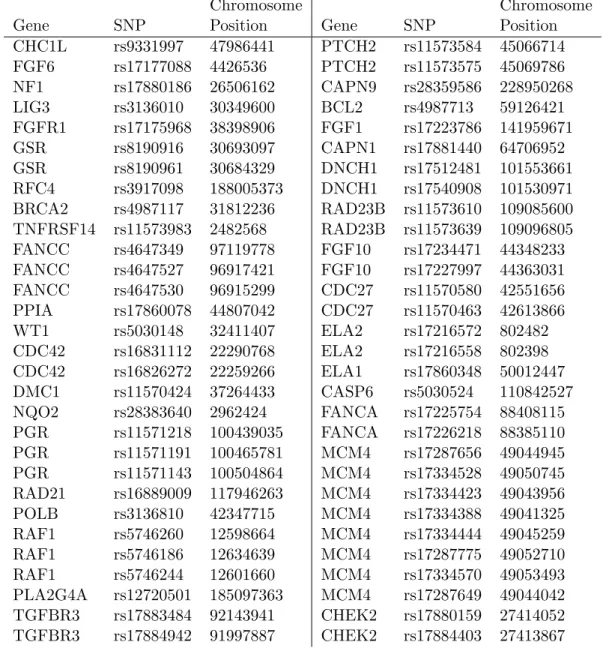
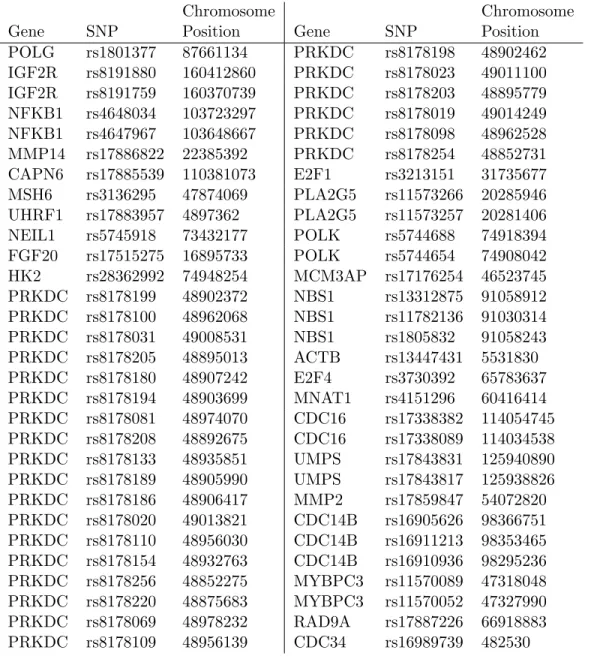
B.1 Details for SNPs included in the final CTF model for
the molecular epidemiology data. . . 94
B.2 Single nucleotide polymorphisms with binary-coded
response profiles matching rs17880594. . . 95
B.3 Single nucleotide polymorphisms with the same
binary-coded response profile as rs9331997. . . 96
B.4 Single nucleotide polymorphisms with the same
binary-coded response profile as rs9331997 (cont’d). . . 97
B.5 Single nucleotide polymorphisms with the same
binary-coded response profile as rs9331997 (cont’d). . . 98
B.6 Comparison of mean square prediction error (MSPE) and coverage proportion (COV) for different methods
applied to molecular epidemiology data. . . 99
C.1 Predictors selected in analysis of full data set, presented
List of Figures
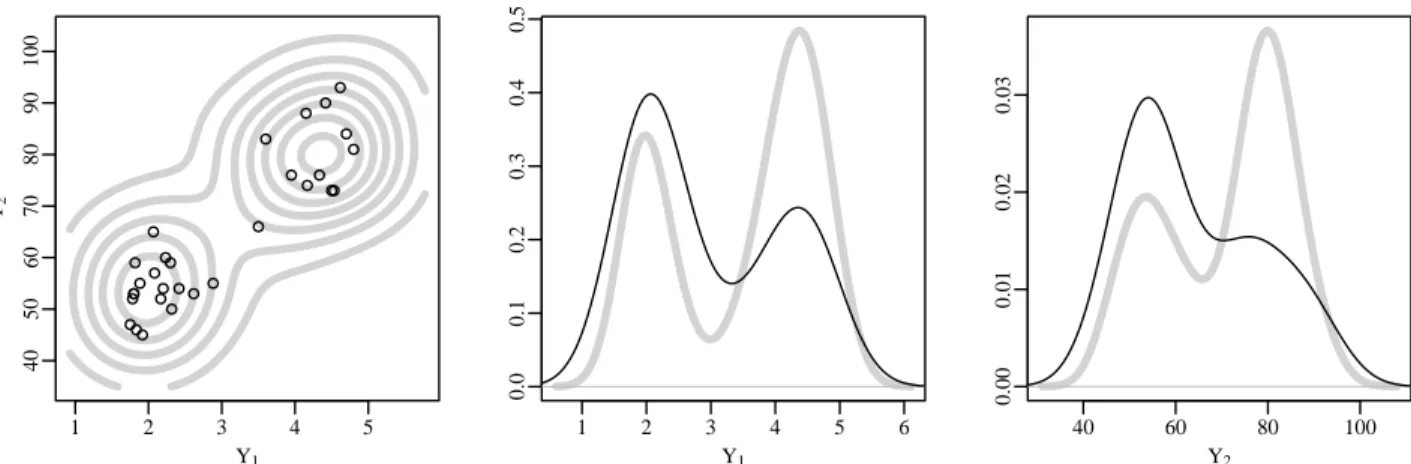
A.1 Population and sample: The left-most panel shows the contours of the population density and a scatterplot of the n = 30 randomly sampled observations. The center and right panels show marginal densities for
the population (light gray) and sample (black). . . 86
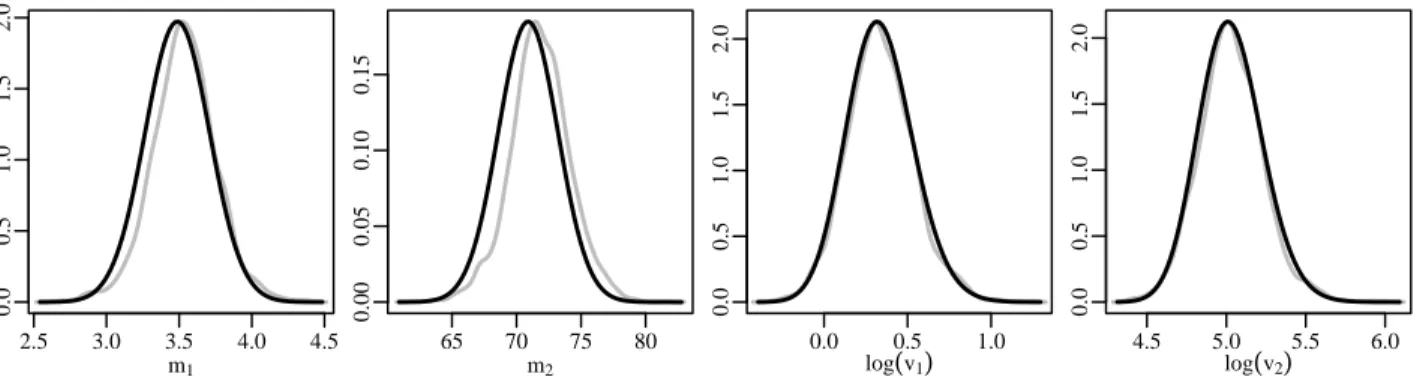
A.2 p1priors (black) and kernel density estimates of priors
induced byπI
0 (grey). . . 87
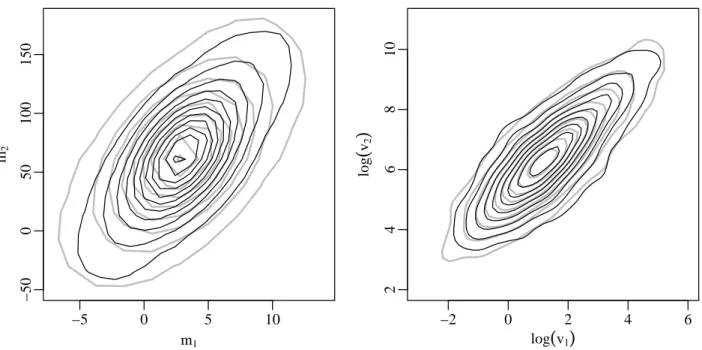
A.3 Comparison of approximatedp0(grey) andp0induced
byπN
0 (black). . . 88
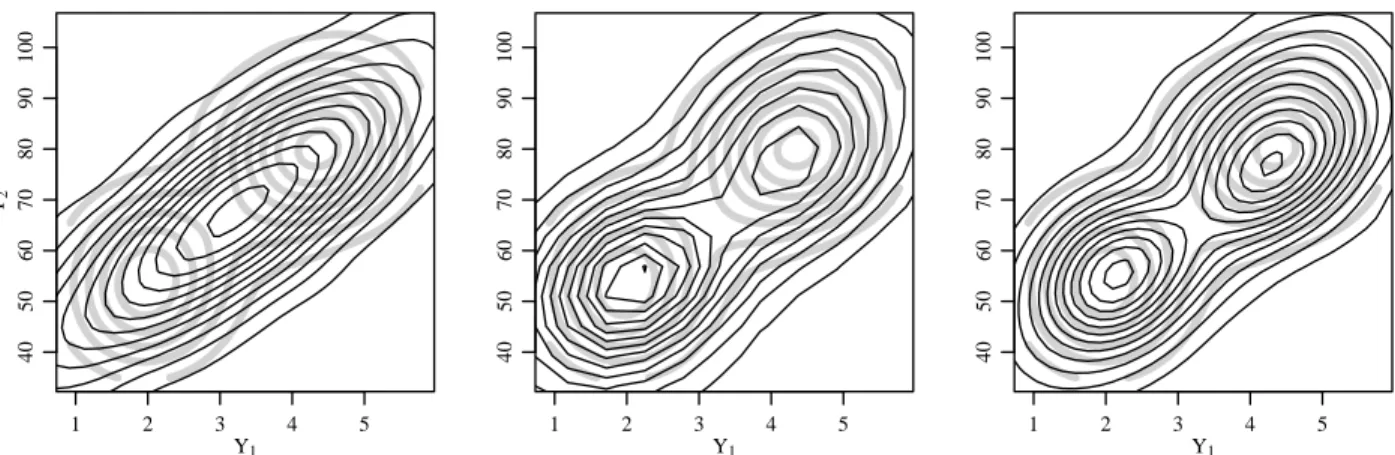
A.4 Contour plots of the posterior predictive density in black and the population density in gray, under πI
0,
πN0 and π1 from left to right. . . 89
A.5 Marginal population densities and estimates from the three priors: informative DPMM (IDPMM), noninformative
DPMM (NDPMM) and marginally specified prior (MSP). . . 90
A.6 Priors (gray) and posteriors (black) for the marginal means and log variances. Gray vertical lines indicate the corresponding population values derived from the
full (n = 272) data set. . . 91 A.7 Comparison of approximatedp0(grey) andp0induced
byπN
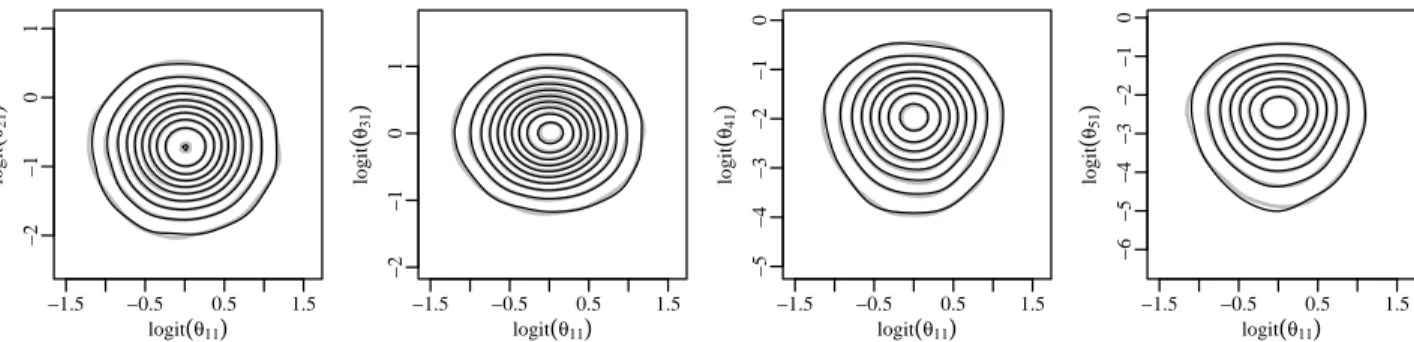
0 (black) for a subset of the margins. To facilicate
comparison, a logit transform was used. . . 92
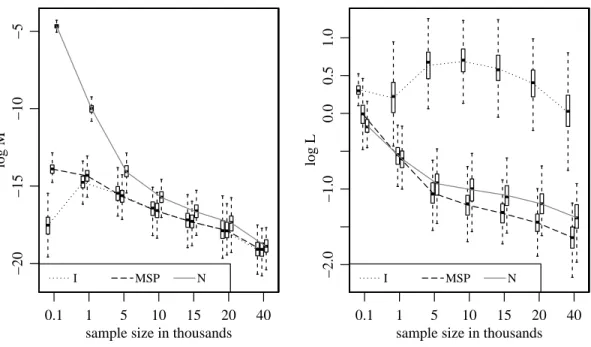
A.8 Comparison of M and L metrics on the log scale for
πI0 (I), π0N (N) andπ1 (MSP) at various sample sizes. . . 93
B.1 Conditional densities with similar means but
predictor-dependent higher moments; (Chung and Dunson 2009) . . . 100
B.2 Hypothetical scenario of conditional distributions with
B.3 Simulation study density; three underlying predictors interact to produce a complex population density. Separate
lines indicate different assumed residual precisions. . . 102
B.4 Simulation study results, demonstrating the improved performance of the CTF in mean square prediction error (MSPE) relative to random forests and comparable performance in coverage (COV) relative to quantile
regression random forests. . . 103
B.5 Selected conditional densities for CTF estimated model of molecular epidemiology data, varying the exposure and the number of copies of the dominant allele at the IGFBP5 SNP. All other SNPs are held at the
“Zero/One Copy” level. . . 104
C.1 Body Mass Index (BMI) data from NHANES 2001-2002. The black curve indicates the empirical BMI density for adults with less than a 9thgrade education; the grey curve is for adults with some college or an associate’s degree. Vertical lines indicate 50th and 90th percentiles for the separate populations; the 50th
percentile for the two populations is very similar. . . 106
C.2 Summary of simulation study results. Grey dots indicate mean square prediction error (MSPE) for the CTFC method. Black dots indicate mean square prediction
error for the Lasso. . . 107
C.3 First-pass inclusion probabilities for predictors selected in at least one leave-out scenario. Heavy gray vertical lines indicate the range of inclusion probabilities across leave-out sets. Predictors selected in all leave-out scenarios are indicated with darker labels on the horizontal
axis. . . 108
C.4 Conditional densities with varying levels of RS6894946 and age at MRI. Rows indicate different levels of RS6894946 (zero/one copy or two copies of the major allele), and columns indicate different levels of the age at MRI variable. Heavy black lines indicate posterior
Chapter 1
Introduction
1.1
Literature Review and Motivation
1.1.1
Marginally Specified Priors for Nonparametric Bayes Analysis
In the first paper, we demonstrate a technique for introducing marginal prior information
into nonparametric Bayes (NP Bayes) analyses. Many real-world data analysis situations
are not well-suited to a description that is governed by a finite-dimensional parameter; this
has led to the development of a rich class of NP Bayes methods. These approaches aim to
obtain inference under a prior that has support on the entire space of relevant probability
distributions (Ferguson 1973). These methods have been applied to a variety of problems,
including quantitative trait loci mapping (Zou et al. 2010), density estimation (Muller et al.
1996), regression and classification (Neal 1999), image segmentation (Sudderth and Jordan
2008), speaker diarization (Fox et al. 2011), and functional data analysis (Petrone et al.
2009). This diversity in application reflects the utility of NP Bayes methods in modern
statistical practice.
NP Bayes techniques require some introduction, since the “nonparametric” label is somewhat
paper, which presented the idea of the Dirichlet process (DP) prior. This paper was titled
“A Bayesian Analysis of Some Nonparametric Problems;” in the NP Bayes setting, the
problem itself is nonparametric, not the analysis. Nonparametric analysis addresses problems
like density estimation and flexible regression models; in both cases the “parameter” to be
estimated has infinite or very high dimension. The attraction of NP Bayes analysis and
nonparametric analysis in general is that structural assumptions about the quantity to be
modeled or estimated are significantly more flexible.
The careful development of NP Bayes techniques has made them successful in the areas
already mentioned. Nevertheless, the complexity of the high- or infinite-dimensional parameter
of interest can make the “Bayes” portion of NP Bayes more challenging. When the parameter
is a complete distribution, a prior on that parameter that is chosen for large support and
convenience in computation can induce priors on functionals of that distribution that are
not consistent with actual information.
We are motivated by situations in which there is reliable prior information about marginal
aspects of an unknown distribution. For example, consider a demographic survey which
collects a small, detailed sample of the population. Assume that an earlier, large-scale census
surveyed a much larger sample of the population, but recorded observations for many fewer
population characteristics. The two surveys, small and large, are not identical and so are
not driven by exactly the same underlying distribution, but they overlap on a few measured
quantities. The Bayesian approach is to use the available prior information from the earlier,
larger survey on those overlapping quantities to inform inference in the newer survey. If
we are using a nonparametric prior for the distribution of interest in the smaller survey, we
may not be able to directly manipulate that nonparametric prior to accommodate this prior
information without inducing undesirable behavior into other aspects of our nonparametric
we cannot guarantee that this bespoke prior will have the same support as generally applied
nonparametric priors.
Density estimation provides a good example of the utility of NP Bayes approaches and
further illustrates the challenges with the inclusion of prior information. In the nonparametric
Bayes treatment of density estimation, the practicioner need not be restricted by a specific
parametric form such as a multivariate normal. The early work of Ferguson (1973; 1974),
Blackwell and MacQueen (1973) and Antoniak (1974) established theoretical properties for
the Dirichlet process (DP) prior, a prior over probability measures. For a given sample
space Y, a DP prior over distributions on Y is parameterized in terms of a “base measure” Q0 on Y and a “concentration parameter” α. One limiting aspect of the DP prior is
that it produces random measures that are almost surely discrete, making it less suitable
for modeling continuous outcomes directly. To address this, Antoniak (1974), Lo (1984),
and Ferguson (1983) presented the idea of a Dirichlet process mixture model (DPMM),
where the DP prior serves as the prior for a mixing distribution; this provides a more
appropriate method for modeling the distribution of continuous quantities. In that setting,
the data are assumed to come from a population with density p(y|Q) = R p(y|ψ)Q(dψ), where {p(y|ψ) : ψ ∈ Ψ} is a simple parametric family. As Q is discrete with probability 1, the resulting model for the population distribution is a countably infinite mixture model,
where the parameters in the component measures are determined byQ0, and the number of
components with non-negligible weights is increasing in α.
Sampling from the posterior distribution under such a prior is problematic due to its
complexity; MCMC techniques were developed in Escobar (1994) and Escobar and West
(1995). These methods performed well for conjugate DPMs; Kleinman and Ibrahim (1998a;b)
demonstrated the use of DPMs to model the distribution of random effects in the generalized
In cases where the base measure Q0 is not conjugate to the component likelihood,
the integrations required in the method of Escobar and West can significantly expand
computation time. Ishwaran and James (2001) developed techniques for an alternative
treatment of the DPM, based upon the “stick-breaking” representation for the DP that
was developed by Sethuraman (1994). The Ishwaran and James approach avoids integrating
over the random mixing measure unlike in the Escobar and West method. This makes
non-conjugate base measures in DPM models more feasible than in the P´olya-urn style of
sampler developed in the earlier works. Sampling methods for DPM models evolved with
the introduction of the retrospective sampler (Papaspiliopoulos and Roberts 2008), the slice
sampler (Walker 2007; Kalli et al. 2011) and the exact block Gibbs sampler (Yau et al. 2011).
These continuing improvements in sampling techniques have prompted the application of the
DPM model to an expanding variety of problems.
In the case of the DPMM, the choice ofαandQ0will have a significant effect on the prior
for the population density, and potentially on posterior inference. Many applications include
priors for the base measure (Escobar and West 1995; Muller et al. 1996) and incorporate
estimation of Q0 and α into the posterior inference. Other approaches have addressed the
challenge of specifyingQ0 by applying empirical Bayes techniques to develop a point estimate
for Q0 (McAuliffe et al. 2006). Although it is common to give the base measure an
over-dispersed form in an attempt to avoid an unduly informative prior, such an approach is
actually highly informative in favoring allocation to a single cluster unlessαis appropriately adapted (Bush et al. 2010). The particular case of the DP prior illustrates the general
challenge of incorporating prior information in a nonparametric setting. The results of
Yamato (1984) and Lijoi and Regazzini (2004) can be extended to adjustαandQ0 in normal
DPMMs so that the induced prior expectation and variance of the population mean can be
Moala and O’Hagan (2010) proposed a method to update a Gaussian process (GP) prior
with expert assessments of the mean and other aspects of an unknown density. As with
the Dirichlet process prior, the GP prior requires specification of the mean and covariance
functions that characterize the GP. These provide a base for the prior in the same way
that the Q0 base measure does for the Dirichlet process prior. In the Moala and O’Hagan
approach, elicitation of these quantities is derived from expert assessments of quantiles of
the unknown distributions.
Many NP Bayes methods for finite sample spaces are built on the Dirichlet distribution
(DD); in this case the unknown parameter π = (π1, . . . , π|Y|−1) can be interpreted as the
parameter of a multinomial distribution. The DD prior is nonparametric in the sense that
it has support on the entire (|Y| −1)-dimensional simplex. Such a prior on a distribution π depends on concentration parameters αj, j = 1, . . . ,|Y|. Large values for these parameters result in a prior concentrated near the center of the simplex, while small values concentrate
the prior at the vertices of the simplex.
This highlights the general challenge with Bayesian methods and the thornier challenge
with nonparametric Bayes methods, the elicitation of a prior. In the usual parametric Bayes
analysis, we are concerned with specifying priors for parameters that have some readily
interpretable effect on the overall model. This can be daunting in complex parametric
models; for example, log-linear models for high-dimensional contingency tables have a large
number of parameters that require prior specifications. In the nonparametric Bayes case, the
parameter of interest has either high or infinite dimension, and elicitation of a meaningful
prior is an even more difficult task.
An increase in dimensionality can quickly become a challenge in the analysis of multivariate
data, whether those data are discrete or continuous. Simply considering the pairwise interactions
interactions increases as the square of the dimension of the observations. In the case of
categorical data the problem can be even more daunting, particularly if we wish to include
all possible interactions. For example, genetics data is sometimes presented as multivariate
unordered categorical data, with each element in an observation indicating one of four
nucleotides. A sequence of 10 nucleotides then needs 410 ≈ 106 parameters to describe a saturated model, while a sequence of only twice as many nucleotides needs 420 ≈ 1012 parameters. This is clearly intractable for any parametric treatment of this problem that
attempts to address the complete dependency structure.
Frequently, simplifying assumptions are made about the extent of meaningful correlations.
For example, the copula Gaussian graphical model presented in Dobra and Lenkoski (2011)
eliminates some of this complexity through the use of the copula and the accompanying
transformation of categorical variables, but the graphical model introduces additional
simpli-fication of the covariance structure in the transformed space so that elements of the Gaussian
covariance are constrained to be zero. More familiar approaches for multivariate unordered
categorical data, such as the log-linear model in either frequentist or Bayesian analysis, might
also discard higher-order interactions pre-emptively. In the case of maximum likelihood
analysis, a complex model applied to a moderately-sized data set will certainly result in
empty cells in such a high-dimensional multiway contingency table; this will mean that
asymptotic assumptions may not hold (Fienberg and Rinaldo 2007). In Bayesian analysis,
the sheer number of models possible under this scenario may make it extremely difficult for
any one model to appear better than another. Prior specification may also be problematic,
though there exist more sophisticated methods for prior choice in this setting (Massam et al.
2009).
An NP Bayes approach to this scenario was proposed by Dunson and Xing (2009).
interaction structure to be unknown, and model the joint distribution of all variables as a DP
mixture of product multinomials. In effect, this treats the observations as if they come from
a mixture of subpopulations. Within each subpopulation the variables are conditionally
independent. Marginalizing over the mixing measure for these subpopulations induces
dependence between the several variables, without making strong assumptions about the
nature of that dependence. This substantially reduces the number of parameters within the
model; in the 20 nucleotide example, the number of parameters is linear in the number
of mixture components. This approach results in a sparse structure for the data, but
Bhattacharya and Dunson (2012) pointed out that increasing the dimension of the problem
could result in a proliferation of components, since the entire observation vector is used to
weight the cluster allocations. As an alternative, Bhattacharya and Dunson proposed the
simplex factor model, a more general solution that potentially avoids this difficulty.
These underline the difficulty with prior elicitation in nonparametric approaches. While
it is possible to introduce simplifying assumptions and more nuanced models, the challenge
of making an appropriate prior specification remains. Our goal in the first dissertation
paper is to retain the large support provided by popular nonparametric priors but to allow
the introduction of prior information where such prior information is available, replacing
induced priors with the desired prior.
1.1.2
Density Regression With Many Interacting Predictors
In the second and third dissertation papers, we are motivated by efforts to link quantitative
traits with genetic and other factors. In many cases, the quantitative traits have nontrivial
distributions, even when conditioning on many predictors, and it is unappealing to assume a
smooth parametric form for these conditional densities. Furthermore, such data commonly
number of observations. Because many phenotypes are associated with more than one locus,
the interaction between multiple loci can be just as important as their separate action. In
these settings of “largep, smalln”, the additional complexity of interactions makes standard methods intractable, and we wish to develop methods that can address predictor selection
at the same time as we consider conditional densities of nontrivial shape. Finally, we wish
to expand these models to accommodate correlated responses, as are found in family-based
studies of complex phenotypes.
A common scenario involves measurements of many single nucleotide polymorphisms
(SNPs) and a continuous, or quantitative, phenotype. In many treatments of this problem,
the strategy is to assess each locus or SNP independently with appropriate controls for overall
false discovery rate (FDR). If it could always be believed that traits of interest are governed
by single factors, then this would be an acceptable approach. However, it seems unlikely
that these traits are so simply explained, and so consideration of multi-factor associations is
desirable.
As discussed in Hoggart et al. (2008), simultaneous consideration of multiple SNPs can
have many advantages. Due to the colossal number of possible multi-factor interactions, this
consideration of many factors simultaneously usually assumes a model where the factors enter
additively, each contributing some part to the quantitative trait. One common approach to
the problem is the Lasso (Tibshirani 1996), which imposes an L1 penalty and limits the
overall sum of coefficients in the additive model, leading to a sparse set of contributing
factors. A corresponding method is ridge regression (Hoerl and Kennard 1970), which uses
anL2penalty, allowing smaller individual contributions to the response from a larger number
of predictors. There are many other methods with the same general approach but using
different penalty structures; for example, the elastic net (Zou and Hastie 2005) combines L1
While each of these methods has advantages, they all assume strictly additive behavior
for the separate factors, with interactions not considered. Practicioners in genetics are well
aware of the possibility for interaction between SNPs, and there are many methods in the
literature to address the more biologically plausible scenario of multi-factor interaction. Lou
et al. (2007) developed a generalized multi factor dimensionality reduction combinatorial
algorithm. Chen et al. (2007) proposed a forest-based approach to identify gene-gene
inter-actions. Zou et al. (2010) used a Gaussian process prior for the regression function that
incorporated variable selection, enabling selection of a subset of interacting SNPs impacting
the mean of the distribution of a quantitative trait. Yi (2010) surveys statistical approaches
for identifying genetic interactions in high-dimensional settings, including genome-wide
asso-ciation studies (GWAS). Cordell (2009) reviews methods for selecting interactions between
genetic loci contributing to human disease.
None of these approaches directly addresses density regression; we wish to acknowledge
the possibility that the conditional density of quantitative traits given genetic factors may
vary in more than just mean location as a function of those factors. This can be of
considerable interest if the conditional mean does not change appreciably but the variance
or skewness do, so that certain combinations of factors influence the probability of more
extreme forms of the trait.
This assessment of behavior outside of mean shifts has prompted the development of
quantile regression (Koenker and Bassett 1978) methods. These have been used in diverse
areas of genetics research, including the assessment of copy number variation (Eilers and
de Menezes 2005) and the analysis of age-dependent gene expression (Ho et al. 2009).
Quantile regression works with selected quantiles of the response of interest, but we are
more concerned with a characterization of the entire response distribution, and so wish to
of body mass index (BMI), a measure of health that has certain clinically important cut
points. In particular, individuals with a BMI in excess of 30 are classified as obese and at
higher risk for many debilitating health consequences. A quantile regression approach can
only estimate whether a specific quantile is above or below the point of interest. Density
regression lets us model the entire conditional distribution so that we can identify the quantile
corrresponding to the obesity cutpoint or any other point of interest.
Density regression has enjoyed extensive treatment in the Bayesian literature. The
hierarchical mixture of experts (HME) model (Jordan and Jacobs 1994) gives one of the
most accessible forms of density regression, representing an arbitrary conditional density as
a convex combination of continuous kernels. The expectation maximization (EM) approach
(Dempster et al. 1977) provides an attractive computational framework for estimating the
parameters in these models via maximum a posteriori estimates. Models like the HME
typically assume a specific or maximum number of kernels for the representation. The NP
Bayes literature has developed a number of methods based upon DP mixtures, where the
number of components is one of the parameters to be estimated. DP mixtures have been
adapted in many different ways to the density regression problem, bringing predictors into
the mean functions for the components, the mixing weights, or both.
One approach to conditional density estimation is described in Muller et al. (1996). In
this approach, one estimates of the joint density of the response and the predictors and then
derives a conditional density. This approach has been developed in several other settings
(Shahbaba and Neal 2009; Hannah et al. 2011; Dunson and Xing 2009) and works well in
those applications. One drawback to these joint estimation methods is the need to estimate
the entire joint distribution when we are interested only in a specific conditional distribution.
The additional effort to estimate what becomes a high-dimensional nuisance parameter is
One challenge to all of these methods is the “curse of dimensionality”, or the increasing
difficulty in obtaining a parsimonious description of the conditional distribution in the
presence of more and more predictors. (Chung and Dunson 2009) proposed methods of
predictor selection in these models, and methods for dimensionality reduction have also
been proposed (Tokdar et al. 2010; Reich et al. 2011), but these encounter difficulty with
larger values of p and do not directly address correlated data.
Random forests (Breiman 2001) provide an approach to density estimation that also
provides support for predictor selection. Nevertheless, the form of the random forest makes
it difficult to assess the role of specific predictors and their influence on the response.
Also, random forests and related ensemble methods do not explicitly address correlated
observations.
This question of correlated data in the presence of many potentially informative predictors
has motived considerable recent research due to the direct relevance for family-based studies
of genetic influences on quantitative traits. Most of this has centered around the adaptation
of the standard linear mixed model (LMM) to high-dimensional predictor sets. Listgarten
et al. (2012) and the related Lippert et al. (2011) propose an LMM-based approach that
uses SNPs to derive a realized relationship matrix between the individuals in the study.
They leverage work by Hayes et al. (2009) demonstrating the advantages of this form of
relationship matrix over that derived from typical pedigree analysis, and develop algorithms
to address the large number of SNPs. In the same direction, Rakitsch et al. (2013) developed
the “LMM-Lasso”, an adaptation of theL1 penalty method to situations involving correlated
observations. These approaches address the important situation of correlated observations
but do not consider the possibility that the conditional density may have a nontrivial form
depending on particular combinations of SNPs.
density regression in settings with many predictors. In addition to addressing predictor
selection, we wish to produce flexible representations for the conditional density that are
suitable for the investigation of behavior outside of simple mean shifts. We also derive
Chapter 2
Marginally Specified Priors for
Nonparametric Bayesian Estimation
2.1
Introduction
Many real-world data analysis situations do not lend themselves well to simple statistical
models indexed by a finite-dimensional parameter. This has led to the development of a
rich class of nonparametric Bayesian (NP Bayes) methods, the general idea of which is to
obtain inference under a prior that has support on the entire space of relevant probability
distributions (Ferguson 1973). These methods have been applied to a variety of problems,
such as density estimation (Muller et al. 1996), image segmentation (Sudderth and Jordan
2008), speaker diarization (Fox et al. 2011), regression and classification (Neal 1999), functional
data analysis (Petrone et al. 2009) and quantitative trait loci mapping (Zou et al. 2010) to
name only a few. This breadth of applications reflects the utility of NP Bayes methods in
modern statistical data analysis.
Many NP Bayes methods are built upon either the Dirichlet distribution (DD) for finite
sample spaces or the Dirichlet process (DP) (Ferguson 1973) for infinite sample spaces.
estimation and inference (Escobar and West 1995) and the steady improvement in sampling
methods (Escobar 1994; Walker 2007; Yau et al. 2011; Kalli et al. 2011) have all made the
DP prior an attractive choice for many applications. For a given sample space Y, a DD or DP prior over distributions on Y is parameterized in terms of a “base measure” Q0 on
Y and a “concentration parameter” α. Although samples from the DP prior are discrete with probability one, this prior is nonparametric in the sense that it has weak support on
the set of all distributions having the same support as Q0. Analogously, the DD prior is
nonparametric in the sense that it has support on the entire (|Y| −1)-dimensional simplex. For both the DD and DP, a large value of α corresponds to a prior concentrated near Q0.
For the DP, a small α results in distributions with probability mass concentrated on only a few points, drawn independently from Q0. For the DD, a small α can result in mass being
concentrated near the vertices of the simplex.
For many NP Bayes methods, the DP is used as a prior for a mixing distribution in a
mixture model: The data are assumed to come from a population with density p(y|Q) =
R
p(y|ψ)Q(dψ), where {p(y|ψ) : ψ ∈ Ψ} is a simple parametric family. A DP prior on Q results in a Dirichlet process mixture model (DPMM) (Lo 1984; Escobar and West 1995;
MacEachern and M¨uller 1998). As Q is discrete with probability 1, the resulting model for the population distribution is a countably infinite mixture model, where the parameters
in the component measures are determined by Q0, and the number of components with
non-negligible weights is increasing in α.
Clearly, the choice ofαandQ0will have a significant effect on the prior for the population
density, and potentially on posterior inference. Many applications include priors for the base
measure (Escobar and West 1995; Muller et al. 1996) and incorporate estimation of Q0 and
et al. 2006). Although it is common to give the base measure an over-dispersed form in an
attempt to avoid an unduly informative prior, such an approach is actually highly informative
in favoring allocation to a single cluster unlessα is appropriately adapted Bush et al. (2010). In many applications, the base measure is given an overdispersed form in an attempt to
avoid an unduly informative prior. Of course, doing so precludes the incorporation of prior
information into the inference. The particular case of the DP prior illustrates the general
challenge of incorporating prior information in a nonparametric setting. The results of
Yamato (1984) and Lijoi and Regazzini (2004) can be extended to adjustαandQ0 in normal
DPMMs so that the induced prior expectation and variance of the population mean can be
approximately specified (as will be discussed further in Section 3), although specification
beyond the population mean is problematic. Moala and O’Hagan (2010) proposed a method
to update a Gaussian process (GP) prior with expert assessments of the mean and other
aspects of an unknown density. As with the Dirichlet process prior, the GP prior requires
specification of the mean and covariance functions that characterize the GP. These provide
a base for the prior in the same way that the Q0 base measure does for the Dirichlet process
prior. In the Moala and O’Hagan approach, elicitation of these quantities is derived from
expert assessments of quantiles of the unknown distributions.
In this paper, we propose a very general method that allows for the combination of an
arbitrary prior on a finite set of functionals with a nonparametric prior on the remaining
aspects of the high- or infinite-dimensional unknown parameter. In the next section we show
how such a partially informative prior distribution can be constructed from the combination
of any prior distribution on the functionals of interest with the conditional distribution of the
parameter given the functionals under a canonical nonparametric prior. We show that the
resulting marginally specified prior (MSP) inherits desirable features from the canonical
approximation under the MSP can typically be made via small modifications to any Markov
chain Monte Carlo algorithm applicable under the canonical prior.
In Section 3 we illustrate the use of the marginally specified prior in the context of
multivariate density estimation using normal DPMMs. In an example, we show that existing
approaches to incorporate prior information on mean and covariance into DPMMs lead to
poor density estimates relative to marginally specified priors unless the parametric base
model is an accurate approximation.
In Section 4 we examine the important problem of NP Bayes analysis of large sparse
contingency tables in the presence of prior information on the margins. In this context, we
develop a marginally specified prior from a canonical NP Bayes approach. In an example, we
illustrate how canonical NP Bayes methods designed to be informative on the margins result
in poor performance in terms of margin-free functionals (such as dependence functions). In
contrast, a marginally specified prior accommodates prior information about the population
margins while being minimally informative about other aspects of the population, resulting
in strong performance in terms of both marginal and margin-free aspects of the population.
A discussion of the results and directions for future research follows in Section 5.
2.2
Marginally specified priors: Construction and computation
We consider the general problem of Bayesian inference for a parameter f belonging to a high- or infinite-dimensional space F. For example, Section 3 considers multivariate density estimation over the space of all densities on Rp with respect to Lebesgue measure, and Section 4 considers the high-dimensional space of multiway contingency tables. In general,
inference is tractable. Typically, practitioners choose a member π0 of such a class based
on support considerations and the feasibility of posterior approximation, rather than how
well it accurately represents any information we have about specific features of f. In this section, we show how to construct a nonparametric priorπ1 that is informative about specific
features off, but has the same support asπ0 and is “close” toπ0 in terms of Kullback-Leibler
divergence. We also show how MCMC approximation methods for π0 can be modified to
obtain posterior inference under π1.
2.2.1
Construction of a marginally specified prior
Letθ =θ(f) be a function off, such as a population mean ofp(y|f), variance, marginal probability vectors or some finite set of functionals, and let Θ be the range of θ. Any prior distribution π0 on (F,A) induces a prior distributionP0 on (Θ,B) defined by
P0(B) =π0({f :θ(f)∈B}), (2.1)
for each B ∈ B. If π0 is chosen for computational convenience, the induced prior P0 need
not show substantial agreement with available prior information P1 for the functional θ(f).
In some cases a prior π0 selected from a computationally feasible class will make the induced
priorP0 similar toP1: The results of Lijoi and Regazzini (2004) and Yamato (1984) provide
some guidance for Dirichlet process priors if the functionals are means, but in general this will
be difficult. Furthermore, depending on the structure of the nonparametric class, selecting
π0 in order to matchP0 toP1 will result inπ0 being inappropriate for other aspects of f. We
present an example in Section 2.3 to illustrate a case where making π0 highly informative
about θ(f) also makes it highly informative about other aspects of f.
Suppose a nonparametric prior π0 has been identified that is viewed as reasonable in
does not represent available prior information P1 about θ. The information in P1 can be
accommodated by replacingP0, theθ-margin ofπ0, with the desired marginP1. Specifically, a
marginally specified prior (MSP)π1forf is obtained by combining the conditional distribution
of f given θ with our desired marginal distributionP1 for θ, so that
π1(A) =
Z
Λ0(A|θ)P1(dθ) ∀A∈ A, (2.2)
where Λ0(A|θ) is the conditional probability of A given θ under π0. A prior π1 constructed
this way should have the desired marginal distributionP1 over(Θ,B), and ifP1 P0, should
also have the same support asπ0, since the conditional probabilities under π1 should match
those under π0.
Such a construction is straightforward if f is finite dimensional. Accommodation of nonparametric problems wheref is potentially infinite dimensional requires some additional mathematical detail. We consider the case where A are the Borel sets of a Hausdorff space F, and θ : F → Θ is a measurable map with respect to a σ-algebra B on Θ. Let the prior π0 be a regular probability measure on (F,A), and let P0 be the induced prior distribution
on (Θ,B), i.e., for all B ∈ B, P0(B) =π0({f :θ(f)∈B}).
Example (Dirichlet process mixture model): Recall the Dirichlet process mixture
model prior, defined by
p(y|Q) =
Z
p(y|ψ)Q(dψ)
Q∼DP(α, Q0),
where {p(y|ψ), ψ ∈ Rp} is a collection of absolutely continuous probability densities over some Euclidean space Y and Q0 is an absolutely continuous probability measure over Rp.
mass measures, Q=d P
wkδψk, where ψ ={ψ1, ψ2, . . .} are an infinite i.i.d. sample from Q0,
andwk=vkQj<k(1−vj), withv ={v1, v2, . . .}are an infinite i.i.d. sample from a beta(1, α)
distribution. Therefore the prior overQ can be represented as a prior overf = (ψ, v)∈R∞. This space, with the usual product topology, is Hausdorff. Now letθ be a moment ofp(y|Q), so that
θ(f) =
Z
g(y)p(y|Q)dy
= ∞
X
k=1
[vk
Y
j<k
(1−vj)]
Z
g(y)p(y|ψk)dy.
The function θ is Borel measurable as long as p(y|ψ) is measurable in ψ for each y ∈ Y. Returning to the marginally specified prior given by (2.2), note that π0(A|θ) is not well
defined on null sets of P0. To make (2.2) meaningful, we restrict attention to informative
prior distributions such thatP1 is dominated byP0. Under this condition and the conditions
on (F,A) and θ given above, the measure π1 on A is well defined and the θ-marginal of π1
is given by P1.
Theorem 1. Let Λ0(·|·) : A ×Θ→ [0,1] be a conditional probability function for π0 given
θ and let P1 be a probability measure on (Θ,B) such that P1 P0. Then π1 : A → [0,1],
defined by
π1(A) =
Z
Λ0(A|θ)P1(dθ),
1. is a probability measure over A;
2. satisfies π1({f :θ ∈B}) =P1(B) for each B ∈ B;
3. is dominated by π0 with Radon-Nikodym derivative
dπ1
dπ0
(f) = dP1 dP0
For notational economy, we have used θ to represent both an element of Θ and as the function mappingF to Θ, depending on the context. A proof of the Theorem is provided in the appendix.
The MSP π1 constructed above is dominated by π0, but ideally we would like it to have
the same support as π0. Sinceπ1 and π0 share conditional distributions, intuitively it seems
that π1 should have reduced support relative to π0 only if P1 has reduced support relative
toP0. This result can be shown with the aid of the Radon-Nikodym derivative given above,
which implies that π1(A) can be computed as
π1(A) =
Z
A
p1(θ(f))
p0(θ(f))
π0(df) = Eπ0[1(f ∈A)
p1(θ)
p0(θ)],
wherep1 andp0are densities ofP1 andP0 with respect to some common dominating measure
(which could be taken to be P0, for example). Based on this identity, we have the following
result:
Lemma 1. SupposeP1 P0 P1. Then π1 π0 π1.
Proof. It is clear from the definition ofπ1thatπ1 π0. To showπ0 π1, letA∈ Abe a set
such thatπ1(A) = 0. We will show thatP0 P1 impliesπ0(A) = 0. LetBj ={θ :pj(θ)>0}
and Aj ={f :θ(f)∈Bj}so that πj(Aj) = Pj(Bj) = 1 for j ∈ {0,1}. We have
0 =π1(A) = π1(A∩A1)
= Eπ0[1(A∩A1)
p1
p0]
= Eπ0[1(A∩A0∩A1)
p1
p0]. (2.3)
Since p1/p0 >0 on A0 ∩A1, (2.3) implies that π0(A∩A0 ∩A1) = 0. Since π0(A0) = 1, we
must have 0 =P0(B1c) = π0(Ac1), and so π0(A) = 0.
We also note that π1 has a characterization as the prior distribution that is closest to
π0 in terms of Kullback-Leibler divergence, among priors with θ-marginal density equal to
p1. This follows from re-expressing the probability measures π1 and π0 in terms of densities
with respect to a common dominating product measure, so that
πk(A∩θ−1B) =
Z
B
Z
A
λk(f|θ)pk(θ) µ(df)×ν(dθ)
for k ∈ {0,1}. The Kullback-Leibler divergence is then
D(π1||π0) =Eπ1[ln
λ1(f|θ)p1(θ)
λ0(f|θ)p0(θ)] =Eπ1[ln
λ1(f|θ)
λ0(f|θ)] +Eπ1[ln
p1(θ)
p0(θ)].
Fixing p1, the divergence is is minimized by setting λ1(f|θ) = λ0(f|θ) for θ a.e. P1, i.e.
matching the conditional distributions, giving D(π1||π0) = D(P1||P0).
Lemma 2. Let P1 P0. Then among probability measures π1 on (F,A) with θ-marginal
equal to P1, the Kullback-Leibler divergence of π0 from π1 is minimized when π1(A) =
R
Λ0(A|θ)P1(dθ) for all A∈ A and θ a.e. P1.
A more detailed derivation of this result is given in the appendix.
2.2.2
Posterior approximation under MSPs
conditional density π(f|y), given by
π(f|y) = p(y|f)π(f) p(y) ≡
p(y|f)π(f)
R
p(y|f0)π(f0)µ(df0),
whereπ(f) denotes the density ofπ with respect to a dominating measureµ. This represents the conditional measure in that RAπ(f|y)µ(df) is a version of the conditional probability π(A|y) for each A∈ A.
For practical reasons the most commonly used priors are those for which there exist
straightforward Gibbs samplers or Metropolis-Hastings algorithms for posterior approximation.
In many cases, simple modifications to these algorithms will allow for the incorporation of
informative priors over functionals of interest. To illustrate, suppose that under priorπ0 we
have a Gibbs sampler for a high dimensional parameter f. Recall that the Gibbs sampler can be viewed as a Metropolis-Hastings algorithm for which the proposals are accepted with
probability one. From this perspective, a Gibbs sampler for approximating the posterior
density π0(f|y) is constructed from proposal distributions with densities J(f∗|f, y) that are
proportional to the posterior density, so that
J(f∗|f, y) J(f|f∗, y) =
π0(f∗|y)
π0(f|y)
. (2.4)
For example, decomposing f as {f1, . . . , fK}, the full conditional distribution π0(fk|f−k, y) is one such proposal distribution.
Posterior approximation of π1(f|y) can proceed by using the proposal distributions of
the Gibbs sampler for π0(f|y), but adjusting the acceptance probability. Specifically, the
algorithm for approximating π1(f|y) proceeds by iteratively simulating proposals f∗ from
probability 1∧rMH, where
rMH =
π1(f∗|y)
π1(f|y)
×J(f|f ∗, y) J(f∗|f, y) = π1(f
∗|y) π1(f|y)
× π0(f|y) π0(f∗|y)
= p(y|f ∗)π
1(f∗)
p(y|f)π1(f)
× p(y|f)π0(f) p(y|f∗)π
0(f∗)
= π1(f ∗)/π
0(f∗)
π1(f)/π0(f)
.
Let theθ-marginal distribution of π0 be P0, and letπ1 be a marginally specified prior based
on π0 and a θ-marginal distribution P1 P0. Let p0 and p1 be the densities of P0 and P1
with respect to a common dominating measure. By Theorem 1, π1(f)/π0(f) = p1(θ)/p0(θ)
and the acceptance ratio simplifies to
p1(θ∗)/p0(θ∗)
p1(θ)/p0(θ)
.
Similarly, an approximation algorithm for π1(f|y) can be constructed from a
Metropolis-Hastings algorithm for π0(f|y) via the same adjustment. Suppose we have a proposal
distribution J(f∗|f, y) such that the acceptance ratio r0
MH for π0 is computable:
r0MH = π0(f ∗|y) π0(f|y)
J(f|f∗, y) J(f∗|f, y)
The Metropolis-Hastings algorithm for approximatingπ1(f|y) usingJ(f∗|f, y) has acceptance
ratio
rMH =
π1(f∗|y)
π1(f|y)
J(f|f∗, y) J(f∗|f, y) = π1(f
∗|y) π1(f|y)
π0(f|y)
π0(f∗|y)
r0MH = p1(θ
∗)/p
0(θ∗)
p1(θ)/p0(θ)
These results show that an MCMC approximation toπ1(f|y) can be constructed from an
MCMC algorithm forπ0(f|y) as long as the ratiop1(θ)/p0(θ) can be computed. The value of
p1(θ) for each θ ∈Θ is presumably available as p1 is our desired prior distribution for θ. In
contrast, obtaining a formula for p0(θ) will be difficult in some settings. In situations where
the dimension of θ is moderate, one simple solution is to obtain a Monte Carlo estimate of p0 based on samples off fromπ0. Specifically, we can obtain an i.i.d. sample{θi =θ(fi), i=
1, . . . , S}fromf1, . . . , fS ∼i.i.d.π0, and then approximatep0 with a kernel density estimate
or flexible parametric family. The method of approximation will depend on the nature of
θ; the approaches just described are appropriate when p0(θ) is absolutely continuous with
respect to Lebesgue measure. Note that this can be done before the Markov chain is run, so
that the same estimate of p0 is used for each iteration of the algorithm.
In situations where obtaining a reliable estimate of p0 is not feasible, it is still possible
to induce a prior p1 that is approximately equal to a target prior ˜p1, as long as p0 is chosen
to be flat compared to ˜p1. This can be done by replacing p0, the θ-marginal density of π0,
with p1(θ) ∝ p0(θ)˜p1(θ) = Kp0(θ)˜p1(θ). This defines a valid probability density as long as
p0p˜1 is integrable, which is the case, for example, if either density is bounded. In terms of
the MCMC approximation to the resulting marginally specified prior π1, the adjustment to
the acceptance ratio is then
p1(θ∗)/p0(θ∗)
p1(θ)/p0(θ)
= p˜1(θ ∗)
˜ p1(θ)
,
which is presumably computable as ˜p1is the desired prior density. In this setting, ˜p1 contains
the marginal prior information and p1 takes on a form with computational convenience.
The proposed algorithm is closely related to importance sampling (IS) methods described
in the literature. Besag et al. (1995) detail an IS-based approach for assessing prior sensitivity.
where h(·) is the original prior used to produce the sample and ˜h(·) is an alternative prior. The similiarity with our proposed method and its use of ratios of the marginally specified
prior p1 to the induced prior p0 is clear; one important distinction is that our method
replaces an induced prior on functionals with an elicited prior on those functionals, rather
than substituting a prior in the main specification.
2.3
Density estimation with marginally adjusted DPMM
Perhaps the most commonly used NP Bayes procedure is the Dirichlet process mixture
model, or DPMM (Lo 1984; Escobar and West 1995; MacEachern and M¨uller 1998). The
DPMM consists of a mixture model along with a Dirichlet process prior for the mixing
distribution. The population density to be estimated and the prior can be expressed as
p(y|Q) =
Z
p(y|ψ)Q(dψ)
Q ∼ DP(αQ0),
whereαand Q0 are hyperparameters of the Dirichlet process prior, withQ0 typically chosen
to be conjugate to the parametric family of mixture component densities, {p(y|ψ) : ψ ∈ Ψ}, to facilitate posterior calculations. In this section we show how to obtain posterior approximations under a marginally specified prior π1 based on a DPMM. The approach
is illustrated with the specific case of multivariate density estimation, for which we take
the parametric family to be the class of multivariate normal densities. In an example
analysis of the well-known bivariate dataset on eruption times of the Old Faithful geyser, we
construct a prior distributionπ1 based on the multivariate normal DPMM with a marginally
specified informative prior on the marginal means and variances. Here, we use a parametric
underπ1is compared to inference under two standard DPMMs, one where the hyperparameters
are chosen to be informative aboutθand another where the hyperparameters are noninformative.
2.3.1
Posterior approximation
Given a sampley1, . . . , yn∼i.i.d.p(y|Q), posterior approximation for conjugate DPMMs is often made with a Gibbs sampler that iteratively simulates values of a function that
associates data indices to the atoms of Q. In a DPMM, sinceQ is discrete with probability one, a given mixture component (atom ofQ) may be associated with multiple observations. Let g : {1, . . . , n} → {1, . . . , n} be the unknown mixture component membership function, so that gi =gj means that yi and yj came from the same mixture component. Note that g can always be expressed as a function that maps{1, . . . , n} onto{1, . . . , K}, whereK ≤n. Inference for conjugate DPMMs often proceeds by iteratively sampling each gi from its full conditional distribution p(gi|y1, . . . , yn, g−i) (Bush and MacEachern 1996). Additional features of Q and p(y|Q) can be simulated given g1, . . . , gn and the data.
This standard algorithm for DPMMs can be modified to accommodate a marginally
specified prior distribution on a parameter θ = θ(Q). Let f = {g, θ} and let π0 be the
prior density on f induced by the Dirichlet process on Q. Our marginally specified prior is given by π1(f) = π0(f)p1(θ)/p0(θ), where p0 is the density for θ induced by π0 and
p1 is the informative prior density. An MCMC approximation to π1(f|y1, . . . , yn) can be obtained via the procedure outlined in Section 2.2. Given a current state of the Markov
chain f = {θ, gk, g1, . . . , gk−1, gk+1, . . . , gn} = {θ, gk, g−k}, the next state is determined as follows:
1. Generate a proposal f∗ = {θ∗, g∗
k, g−k} from π0(θ, gk|g−k, y) = π0(gk|g−k, y)π0(θ|g, y)
by
(b) generating θ∗ ∼π0(θ|gk∗, g−k, y).
2. Set the value of the next state of the chain to f∗ with probability 1∧[p1(θ∗)/p0(θ∗)]/[p1(θ)/p0(θ)],
otherwise let the next state equal the current state.
This procedure is iterated over values of k ∈ {1, . . . , n}, possibly in random order, and repeated until the desired number of simulations of f is obtained. Note that steps 1.(a) and 1.(b) compose a standard Gibbs sampler for the DPMM in which posterior inference
for θ is provided, although typically we would only simulateθ once per complete update of g1, . . . , gn. The algorithm for the marginally specified priorπ1 requires that θ be simulated
with each proposed value ofgk so that the acceptance probability in step 2 can be calculated. Implementing the steps of this MCMC algorithm involves two non-trivial computations:
simulation of θ from π0(θ|g, y), and calculation of p0(θ) in order to obtain the acceptance
probability. General methods for the latter were discussed in Section 2.2. For the former, we
suggest using a Monte Carlo approximation to Q based upon a representation of Dirichlet processes due to Pitman (1996). Let K be the number of unique values of g1, . . . , gn and let nk be the number of observations i for which gi = k. If Q0 is conjugate, then the
parameter values ψ(1), . . . , ψ(K) corresponding to the mixture components can generally be
easily simulated. Corollary 20 of Pitman (1996) gives the conditional distribution ofQgiven ψ(1), . . . , ψ(K) and counts n1, . . . , nK as
{Q(H)|ψ(1), . . . , ψ(K), n1, . . . , nK} d =γ
K
X
k=1
1(ψ(k) ∈H)wk+ (1−γ) ˜Q(H),
where γ ∼ Beta(n, α), w ∼ Dirichlet(n1, . . . , nK) and ˜Q ∼ DP(αQ0). A Monte Carlo
their beta and Dirichlet full conditional distributions. From these values we sample cluster
memberships for a sample of size S from Q using a multinomial(S,{γw1, . . . , γwK,1−γ}) distribution. Note that the countsfor theK+1st category represents the number ofψ-values that must be simulated from ˜Q. To obtain the sample from ˜Q we run a Chinese restaurant process of lengths, and then generate the uniqueψ-values fromQ0 for each partition. This
can generally be done quickly for two reasons: First, the expected number of samples needed
from ˜Q is only Sα/(α+n). For example, with S = 1000, n = 30 and α = 1, we expect to only need about s = 32 simulations from ˜Q. Second, the number of unique values in a sample of size s from ˜Q is only of order logs, which will generally be manageably small.
The marginal sampler we describe above has advantages in terms of efficiency and
convergence rates (MacEachern 1994). However, because it does marginalize out the random
measureQ, we must use the embedded Pitman method to draw samples fromθ(Q) in order to evaluate the Metropolis-Hastings ratio. An alternative approach is to use a stick-breaking
representation that does not integrate out the random measure. We can then use a slice
sampler (Kalli et al. 2011) or exact block Gibbs sampler (Yau et al. 2011) and computeθ(Q) without needing an embedded sampling step, but at the possible expense of lower efficiency
in the sampler.
2.3.2
Example: Old Faithful eruption times
The Old Faithful dataset consists of 272 bivariate observations of eruption times and
waiting times between eruptions, both measured in minutes. To illustrate and evaluate
the MSP methodology we construct two subsets of these data: a random sample of size
n0 = 30 from which we obtain prior information and a second, non-overlapping random
sampling the observed dataset from the remaining observations. The observed sample had
marginal means (2.97,64.2) and marginal variances (1.29,206.7). The prior sample had marginal means (3.54,71.9) and marginal variances (1.24,134.9). For the purpose of this example, we view the full dataset of 272 observations as the true population. A scatterplot
of the observed data and marginal density estimates are shown in Figure A.1. The observed
dataset consisting ofn = 30 observations clearly captures the bimodality of the population. However, the marginal plots indicate that the sample has overrepresented one of the modes.
Suppose our knowledge of the prior sample is limited to the bivariate marginal sample
meansm0 ∈R2 and sample variancesv0 ∈(R+)2. In such a situation it would be desirable to
construct a prior density p1 over the unknown population marginal means m and variances
v based on the values of m0, v0 and n0, and combine this information with the information
in our fully observed sample to improve our inference about the population. Incorporating
this information with conjugate priors would be straightforward if our sampling model were
bivariate normal, but it is difficult in the context of a DPMM. Proposition 5 of Yamato
(1984) indicates that if the base measure Q0 in the Dirichlet process prior is multivariate
normal(µ0,Σ0), then the induced prior distribution on the mean
R
xQ(dx) is approximately multivariate normal(µ0,Σ0/[α+ 1]). This result is not directly applicable to the multivariate
normal DPMM for two reasons, one being thatQrepresents the mixing distribution and not the population distribution, and the other being that in the conjugate multivariate normal
DPMM the parameter ψ in the mixture component consists not just of a mean µbut also a covariance matrix Σ. Specifically, in the conjugate p-variate normal DPMM, the densityq0
of the base measure Q0 forψ = (µ,Σ) is given by
q0(µ,Σ) = normalp(µ:µ0,Σ/κ0)×inverse-Wishart(Σ :S0−1, ν0) (2.5)
densities respectively, the latter being parameterized so that E[Σ] =S0/(ν0−p−1). Given
a choice for α it is possible to obtain values of the hyperparameters (µ0, κ0, S0, ν0) so that
the induced prior distributions on the population mean m(Q) = R R yp(y|ψ)Q(dψ)dy and variance V(Q) =R R yyTp(y|ψ)Q(dψ)dy−m(Q)m(Q)T have the following properties:
E[m(Q)] =m0, Var[m(Q)] =
V0
n0−p−1
≈V0/n0 , E[V(Q)] =
n0+α+ 1
n0
n0V0
n0 −p−1
≈V0
(2.6)
Here,m0is the desired prior mean andV0is the desired prior covariance matrix, derived from
the marginal prior information. Within the context of the DPMM, it is difficult to specify the
prior on V(Q) separately from that on m(Q). We construct three different nonparametric prior distributions for a comparative analysis of the Old Faithful data:
• Informative DPMMπI
0: The base measure densityq0 is as in (2.5) with (µ0 =m0, κ0 =
n0/(α+ 1), ν0 =n0, S0 =ν0V0), where the diagonal of V0 isv0, the marginal variances
from the prior sample, and the correlation is equal to the sample correlation from the
observed data. This results in a prior on Qsatisfying (2.6), thereby utilizing the prior information.
• Noninformative DPMM πN
0 : The base measure density q0 is as in (2.5) with (µ0 =
¯
y, κ0 = 1/10, ν0 = p+ 2 = 4, S0 = Sy), where ¯y is the sample mean from the n = 30 values in the observed sample, and Sy is the sample covariance matrix. This prior does not use information from the prior sample, and is designed to promote relative
diffuseness of the induced prior on the marginal population means and variances. Note
that using sample moments for the hyperparameters weakly centers the prior around
the observed data. We can view this as a type of “unit information” prior (Kass and
Wasserman 1995).
means and marginal variances, we construct a marginally specified prior by replacing
the θ-margin of πN
0 with p1(θ), a product of two univariate normal and two
inverse-gamma densities, chosen to match the prior on θ induced by πI
0 as closely as possible.
Figure A.2 compares p1 with kernel density estimates of the marginal priors induced
byπ0I. Thus πI
0 and π1 have very similar θ-margins, but otherwise π1 matches the more diffuse
prior πN
0 . We can give π1 any θ-margin we wish, but matching the margins of π0I and
π1 facilitates comparison. The hyperparameter α was set to 1 for all of the above prior
distributions. In order to evaluate the Metropolis-Hastings ratios when approximating the
posterior distribution underπ1, we found that a skewed multivariatet-distribution provided a
very accurate approximation to the joint distribution of the marginal means and log variances
induced by πN0 . Via a change of variables, this provides an accurate approximation top0(θ),
with which the acceptance probability is computed for approximation ofπ1(f|y). Figure A.3
gives an assessment of the adequacy of this approximation, comparing a smoothed density
estimate of random draws from the approximated p0 with a smoothed density estimate of
random draws from the truep0 induced by πN0.
We ran Markov chains of length 25,000 under each prior, with parameter values being
saved every 10th iteration, resulting in 2500 simulated values of each parameter with which
to make posterior approximations. The chains showed no evidence of non-stationarity and
mixed well under each prior: Based on the dependent MCMC sequences of length 2500, the
equivalent number of independent observations of θ (i.e., the effective sample sizes) were estimated as above 2000 for each element of θ and under each prior. We did sample from the posterior underπ1 using a stick-breaking representation and a slice sampler. The results
were not markedly different from those obtained using the marginal sampler. This slice
effective sample size of 2500; computational time per independent sample was 95% that of
the marginal sampler.
Posterior predictive distributions under the three priors are shown in Figure A.4. The
informative DPMM provides a poor representation of the population distribution, given in
light gray contours. This is primarily a result of having to set the κ0 hyperparameter to
be moderately large (κ0 = 15) in order to obtain the desired informative prior variance for
the population mean m = (m1, m2). Unfortunately, setting this parameter so high means
that values of µ in the mixture model are tightly concentrated around m0, and so the
multimodality is not captured. In contrast, the posteriors under the noninformative DPMM
πI
0 and the MSP π1 are able to capture the multimodality of the population.
Figure A.5 gives marginal density estimates under the different priors. The figure suggests
that the posterior under π1 is better at representing the underlying population than the
posteriors under the other priors. Recall that the observed sample contains an unrepresentative
number of low-valued observations. The posterior under the non-informative prior πN
0 uses
only the observed data and thus is equally unrepresentative of the population. In contrast,
π1is able to use some information from the prior sample, and is therefore more representative
of the population.
Finally, the marginal posterior distributions of the marginal parameters m and logv are given in Figure A.6. The priors are given in gray and the resulting posterior distributions are
given in black. The population values based upon the full set of 272 observations are given
by gray vertical lines. Across all parameters, π1 gives posteriors that are most concentrated
around the population means. Note that the difference between the priors and the posteriors
underπI
0 is not that large. We conjecture that this is primarily a result of the fact that under
πI
0, most observations are estimated as coming from the same mixture component, thereby