Publication 501
Contents
Cat. No. 15000UWhat’s New . . . 1 Department of the Reminders . . . 1 Treasury
Exemptions,
Introduction . . . 2 InternalRevenue
Standard
Who Must File . . . 2 ServiceWho Should File . . . 3 Filing Status . . . 4
Deduction,
Exemptions . . . 9 Exemptions for Dependents . . . 10
and Filing
Social Security Numbers for
Dependents . . . 21
Information
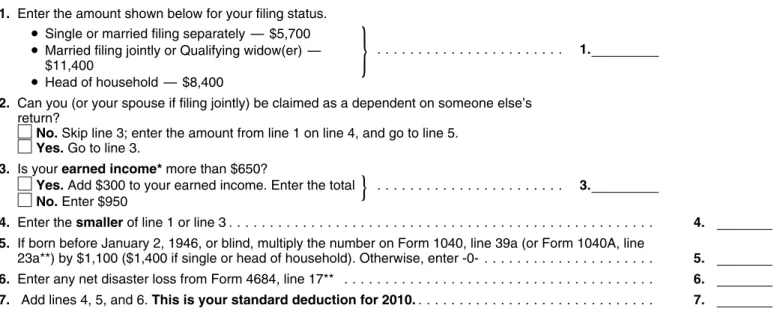
Standard Deduction . . . 212010 Standard Deduction
Worksheet . . . 23
For use in preparing
How To Get Tax Help . . . 24Index . . . 26
2010
Returns
What’s New
Who must file. In some cases, the amount of
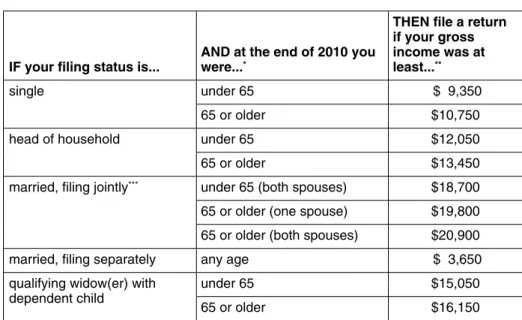
income you can receive before you must file a tax return has increased. Table 1 shows the filing requirements for most taxpayers.
Limits on personal exemptions and overall itemized deductions ended. For 2010, you
will no longer lose part of your deduction for personal exemptions and itemized deductions, regardless of the amount of your adjusted gross income.
Standard deduction increased. The
stan-dard deduction for some taxpayers who do not itemize their deductions on Schedule A of Form 1040 is higher in 2010 than it was in 2009. The amount depends on your filing status. In addition to the annual increase for some taxpayers due to inflation adjustments, your 2010 standard de-duction is increased by:
•
Any state or local sales or excise taxes you paid in 2010 on the purchase of a new motor vehicle after February 16, 2009, and•
Any net disaster loss you had in 2010 be-cause of a disaster that occurred before 2010 and was declared a federal disaster after 2007.You can use the 2010 Standard Deduction Worksheet near the end of this publication to figure your standard deduction. But to increase your standard deduction by taxes paid on the purchase of a new motor vehicle or a net disas-ter loss, you must use Schedule L (Form 1040A or 1040) and attach it to your return.
Get forms and other information
Reminders
faster and easier by:
Taxpayer identification number for aliens.
Internet
IRS.gov
If you are a nonresident or resident alien and you do not have and are not eligible to get asocial security number (SSN), you must apply Comments and suggestions. We welcome depends on your gross income, your filing sta-for an individual taxpayer identification number your comments about this publication and your tus, your age, and whether you are a dependent. (ITIN). Your spouse also may need an ITIN if he suggestions for future editions. For details, see Table 1 and Table 2. You also or she does not have and is not eligible to get an You can write to us at the following address: must file if one of the situations described in
SSN. See Form W-7, Application for IRS Individ- Table 3 applies. The filing requirements apply
Internal Revenue Service
ual Taxpayer Identification Number. Also, see even if you owe no tax.
Individual Forms and Publications Branch
Social Security Numbers for Dependents, later. You may have to pay a penalty if you are
SE:W:CAR:MP:T:I required to file a return but fail to do so. If you
1111 Constitution Ave. NW, IR-6526
Photographs of missing children. The Inter- willfully fail to file a return, you may be subject to
Washington, DC 20224
nal Revenue Service is a proud partner with the criminal prosecution.
National Center for Missing and Exploited Chil- For information on what form to use — Form
dren. Photographs of missing children selected We respond to many letters by telephone. 1040EZ, Form 1040A, or Form 1040 — see the by the Center may appear in this publication on Therefore, it would be helpful if you would in- instructions in your tax package.
pages that would otherwise be blank. You can clude your daytime phone number, including the
Gross income. Gross income is all income
help bring these children home by looking at the area code, in your correspondence.
you receive in the form of money, goods, prop-photographs and calling 1-800-THE-LOST
You can email us at *[email protected]. (The erty, and services that is not exempt from tax. If (1-800-843-5678) if you recognize a child.
asterisk must be included in the address.) you are married and live with your spouse in a Please put “Publications Comment” on the sub- community property state, half of any income ject line. You can also send us comments from defined by state law as community income may
www.irs.gov/formspubs/, select “Comment on be considered yours. For a list of community
Introduction
Tax Forms and Publications” under “Information property states, see Community property statesabout.”
This publication discusses some tax rules that under Married Filing Separately, later.
affect every person who may have to file a fed- Although we cannot respond individually to
Self-employed persons. If you are
eral income tax return. It answers some basic each comment received, we do appreciate your
self-employed in a business that provides serv-questions: who must file; who should file; what feedback and will consider your comments as
ices (where products are not a factor), your filing status to use; how many exemptions to we revise our tax products.
gross income from that business is the gross claim; and the amount of the standard deduc- Ordering forms and publications. Visit
receipts. If you are self-employed in a business
tion. www.irs.gov/formspubs to download forms and
involving manufacturing, merchandising, or
min-Who Must File explains who must file an publications, call 1-800-829-3676, or write to the
ing, your gross income from that business is the income tax return. If you have little or no gross address below and receive a response within 10
total sales minus the cost of goods sold. To this income, reading this section will help you decide days after your request is received.
figure, you add any income from investments if you have to file a return.
and from incidental or outside operations or Internal Revenue Service
Who Should File will help you decide if you sources.
1201 N. Mitsubishi Motorway should file a return, even if you are not required
Bloomington, IL 61705-6613 You must file Form 1040 if you owe any
to do so.
self-employment tax.
Filing Status helps you determine which fil-ing status to use. Filfil-ing status is important in
TIP
Tax questions. If you have a tax question,
determining whether you must file a return, your check the information available on IRS.gov or standard deduction, and your tax rate. It also call 1-800-829-1040. We cannot answer tax
Filing status. Your filing status generally
de-helps determine what credits you may be enti- questions sent to either of the above addresses.
pends on whether you are single or married. In tled to.
some cases, it depends on other factors as well. Exemptions, which reduce your taxable in-
Useful Items
Whether you are single or married is determined come, are discussed in Exemptions. You may want to see:
as of the last day of your tax year, which is
Exemptions for Dependents explains the
December 31 for most taxpayers. Filing status is difference between a qualifying child and a qual- Publication
discussed in detail later in this publication. ifying relative. Other topics include the social
❏ 559 Survivors, Executors, and
security number requirement for dependents, Age. Age is a factor in determining if you must
Administrators
the rules for multiple support agreements, and file a return only if you are 65 or older at the end
the rules for divorced or separated parents. ❏ 929 Tax Rules for Children and of your tax year. For 2010, you are 65 or older if
Standard Deduction gives the rules and dol- Dependents you were born before January 2, 1946.
lar amounts for the standard deduction — a
benefit for taxpayers who do not itemize their Form (and Instructions)
Filing Requirements
deductions. This section also discusses the
❏ Schedule L (Form 1040A or 1040)
for Most Taxpayers
standard deduction for taxpayers who are blind
Standard Deduction for Certain or age 65 or older, and special rules for
depen-You must file a return if your gross income for Filers
dents. In addition, this section should help you
the year was at least the amount shown on the decide whether you would be better off taking ❏ 1040X Amended U.S. Individual Income
appropriate line in Table 1. Dependents should the standard deduction or itemizing your deduc- Tax Return
see Table 2 instead. tions.
❏ 2848 Power of Attorney and Declaration
How To Get Tax Help explains how to get
of Representative
tax help from the IRS.
Deceased Persons
This publication is for U.S. citizens and resi- ❏ 8332 Release/Revocation of Release of
dent aliens only. If you are a resident alien for Claim to Exemption for Child by You must file an income tax return for a dece-the entire year, you must follow dece-the same tax Custodial Parent dent (a person who died) if both of the following
rules that apply to U.S. citizens. The rules to are true.
❏ 8814 Parents’ Election To Report Child’s
determine if you are a resident or nonresident
Interest and Dividends 1. You are the surviving spouse, executor, alien are discussed in chapter 1 of Publication
administrator, or legal representative. 519, U.S. Tax Guide for Aliens.
2. The decedent met the filing requirements
Nonresident aliens. If you were a nonresi- described in this publication at the time of
dent alien at any time during the year, the rules
Who Must File
his or her death. and tax forms that apply to you may be different
from those that apply to U.S. citizens. See Publi- If you are a U.S. citizen or resident alien, For more information, see Final Return for
cation 519. whether you must file a federal income tax return Decedent in Publication 559.
This is true even if under local law the child’s
U.S. Citizens or Resident Aliens
Individuals With Income From U.S.
parents have the right to the earnings and may
Living Abroad
Possessions
actually have received them. If the child does not For purposes of determining whether you must If you had income from Guam, the Common- pay the tax due on this income, the parent is file a return, you must include in your gross wealth of Northern Mariana Islands, American liable for the tax.
income all of the income you earned or received Samoa, or the U.S. Virgin Islands, special rules
abroad, including any income you can exclude may apply when determining whether you must Unearned income. This is income such as under the foreign earned income exclusion. For file a U.S. federal income tax return. In addition, interest, dividends, and capital gains. Trust dis-more information on special tax rules that may you may have to file a return with the individual tributions of interest, dividends, capital gains, apply to you, see Publication 54, Tax Guide for possession government. See Publication 570 and survivor annuities are considered unearned
U.S. Citizens and Resident Aliens Abroad. for more information. income also.
Dependents
Election to report child’s unearned incomeResidents of Puerto Rico
on parent’s return. You may be able toin-A person who is a dependent may still have to clude your child’s interest and dividend income Generally, if you are a U.S. citizen and a bona file a return. This depends on the amount of the
on your tax return. If you choose to do this, your fide resident of Puerto Rico, you must file a U.S. dependent’s earned income, unearned income,
child will not have to file a return. However, all of income tax return if you meet the income re- and gross income. For details, see Table 2. A
the following conditions must be met. quirements. This is in addition to any legal re- dependent may also have to file if one of the
quirement you may have to file an income tax situations described in Table 3 applies.
•
Your child was under age 19 (or underreturn with Puerto Rico. age 24 if a full-time student). (A child born
If you are a bona fide resident of Puerto Rico Responsibility of parent. If a dependent on January 1, 1992, is considered to be
for the whole year, your U.S. gross income does child who must file an income tax return cannot age 19 at the end of 2010; you cannot not include income from sources within Puerto file it for any reason, such as age, a parent, make the election for this child unless the Rico. However, include in your U.S. gross in- guardian, or other legally responsible person child was a full-time student. Similarly, a come any income you received for your services must file it for the child. If the child cannot sign child born on January 1, 1987, is consid-as an employee of the United States or any U.S. the return, the parent or guardian must sign the ered to be age 24 at the end of 2010; you agency. If you receive income from Puerto Ri- child’s name followed by the words “By (your cannot make the election for this child.) can sources that is not subject to U.S. tax, you signature), parent for minor child.”
must reduce your standard deduction, which
•
Your child had gross income only fromin-Earned income. This is salaries, wages,
pro-reduces the amount of income you can have terest and dividends (including capital gain
fessional fees, and other amounts received as
before you must file a U.S. income tax return. distributions and Alaska Permanent Fund
pay for work you actually perform. Earned
in-For more information, see Publication 570, dividends).
come (only for purposes of filing requirements
Tax Guide for Individuals With Income From
•
The interest and dividend income was less and the standard deduction) also includes any
U.S. Possessions.
than $9,500. part of a scholarship that you must include in
your gross income. See chapter 1 of Publication
•
Your child is required to file a return for 970, Tax Benefits for Education, for more infor- 2010 unless you make this election. mation on taxable and nontaxable scholarships.•
Your child does not file a joint return forChild’s earnings. Amounts a child earns by 2010.
performing services are his or her gross income.
•
No estimated tax payment was made for 2010 and no 2009 overpayment wasap-Table 1.
2010 Filing Requirements Chart for Most Taxpayers
plied to 2010 under your child’s name and social security number.
THEN file a return
if your gross
•
No federal income tax was withheld from AND at the end of 2010 you income was at your child’s income under the backupwith-holding rules.
IF your filing status is... were...* least...**
•
You are the parent whose return must beunder 65 $ 9,350
single
used when making the election to report
65 or older $10,750 your child’s unearned income.
under 65 $12,050
head of household For more information, see Form 8814 and
Parent’s Election To Report Child’s Interest and
65 or older $13,450
Dividends in Publication 929.
under 65 (both spouses) $18,700
married, filing jointly***
Other Situations
65 or older (one spouse) $19,800
You may have to file a tax return even if your 65 or older (both spouses) $20,900
gross income is less than the amount shown in
married, filing separately any age $ 3,650 Table 1 or Table 2 for your filing status. See
Table 3 for those other situations when you must
under 65 $15,050
qualifying widow(er) with file.
dependent child
65 or older $16,150
* If you were born before January 2, 1946, you are considered to be 65 or older at the end of 2010.
** Gross income means all income you received in the form of money, goods, property, and services that
Who Should File
is not exempt from tax, including any income from sources outside the United States or from the saleof your main home (even if you can exclude part or all of it). Do not include any social security benefits
Even if you do not have to file, you should file a
unless (a) you are married filing a separate return and you lived with your spouse at any time during
2010, or (b) one-half of your social security benefits plus your other gross income and any tax-exempt tax return if you can get money back. For
exam-interest is more than $25,000 ($32,000 if married filing jointly). If (a) or (b) applies, see the Form 1040 ple, you should file if one of the following applies. instructions to figure the taxable part of social security benefits you must include in gross income.
*** If you did not live with your spouse at the end of 2010 (or on the date your spouse died) and 1. You had income tax withheld from your your gross income was at least $3,650, you must file a return regardless of your age. pay.
2. You made estimated tax payments for the
Table 2.
2010 Filing Requirements for Dependents
year or had any of your overpayment forSee Exemptions for Dependents to find out if you are a dependent. last year applied to this year’s estimated
tax.
If your parent (or someone else) can claim you as a dependent, use this table to see 3. You qualify for the making work pay credit. if you must file a return.
See Schedule M (Form 1040A or 1040). In this table, unearned income includes taxable interest, ordinary dividends, and capital gain distributions. It also includes unemployment compensation, taxable 4. You qualify for the earned income credit.
social security benefits, pensions, annuities, and distributions of unearned income See Publication 596, Earned Income
Credit (EIC), for more information. from a trust. Earned income includes salaries, wages, tips, professional fees, and taxable scholarship and fellowship grants. Gross income is the total of your unearned 5. You qualify for the additional child tax
and earned income. credit. See the instructions for the tax form
Caution. If your gross income was $3,650 or more, you usually cannot be claimed you file (Form 1040, 1040A, or 1040EZ) for
as a dependent unless you are a qualifying child. For details, see Exemptions for more information on this credit.
Dependents. 6. You qualify for the refundable American
opportunity education credit. See Form
8863, Education Credits. Single dependents— Were you either age 65 or older or blind?
M No. You must file a return if any of the following apply. 7. You qualify for the health coverage tax
credit. For information about this credit, 1. Your unearned income was more than $950.
see Form 8885, Health Coverage Tax 2. Your earned income was more than $5,700.
Credit. 3. Your gross income was more than the larger of —
8. You qualify for the refundable credit for a. $950, or
prior year minimum tax. See Form 8801,
b. Your earned income (up to $5,400) plus $300. Credit for Prior Year Minimum Tax —
Indi-viduals, Estates, and Trusts.
M Yes. You must file a return if any of the following apply.
9. You qualify for the first-time homebuyer
1. Your unearned income was more than $2,350 ($3,750 if 65 or older and credit. See Form 5405, First-Time
blind). Homebuyer Credit.
2. Your earned income was more than $7,100 ($8,500 if 65 or older and 10. You qualify for the credit for federal tax on
blind). fuels. See Form 4136, Credit for Federal
3. Your gross income was more than the larger of– Tax Paid on Fuels.
a. $2,350 ($3,750 if 65 or older and blind), or 11. You qualify for the adoption credit. See
b. Your earned income (up to $5,400) plus $1,700 ($3,100 if 65 or older Form 8839, Qualified Adoption Expenses.
and blind).
Married dependents—Were you either age 65 or older or blind?
Filing Status
M No. You must file a return if any of the following apply.
You must determine your filing status before you 1. Your gross income was at least $5 and your spouse files a separate can determine your filing requirements, stan- return and itemizes deductions.
dard deduction (discussed later), and correct 2. Your unearned income was more than $950. tax. You figure your correct tax by using the
3. Your earned income was more than $5,700. section of the Tax Computation Worksheet or
4. Your gross income was more than the larger of — the column in the Tax Table that applies to your
filing status. a. $950, or
You also use your filing status in determining b. Your earned income (up to $5,400) plus $300. whether you are eligible to claim certain other
deductions and credits.
M Yes. You must file a return if any of the following apply. There are five filing statuses:
1. Your gross income was at least $5 and your spouse files a separate
•
Single,return and itemizes deductions.
•
Married Filing Jointly, 2. Your unearned income was more than $2,050 ($3,150 if 65 or older and•
Married Filing Separately, blind).3. Your earned income was more than $6,800 ($7,900 if 65 or older and
•
Head of Household, andblind).
•
Qualifying Widow(er) With Dependent 4. Your gross income was more than the larger of–Child.
a. $2,050 ($3,150 if 65 or older and blind), or
If more than one filing status applies to you, b. Your earned income (up to $5,400) plus $1,400 ($2,500 if 65 or older choose the one that will give you the lowest tax.
and blind).
Marital Status
In general, your filing status depends on
your tax year, you are unmarried or legally sepa- Divorced persons. If you are divorced
whether you are considered unmarried or
mar-rated from your spouse under a divorce or sepa- under a final decree by the last day of the year, ried. For federal tax purposes, a marriage
rate maintenance decree. you are considered unmarried for the whole
means only a legal union between a man and a
State law governs whether you are married year. woman as husband and wife.
or legally separated under a divorce or separate Divorce and remarriage. If you obtain a maintenance decree.
Unmarried persons. You are considered un- divorce in one year for the sole purpose of filing
married for the whole year if, on the last day of
spouse. Your deceased spouse’s filing status is
Table 3.
Other Situations When You Must File a 2010 Return
married filing separately for that year.
If any of the four conditions listed below applied to you for 2010, you must file a Married persons living apart. If you live
return. apart from your spouse and meet certain tests,
you may be considered unmarried. If this applies 1. You owe any special taxes, including any of the following. to you, you can file as head of household even though you are not divorced or legally sepa-a. Alternative minimum tax. (See the Form 1040 instructions for line 45.) rated. If you qualify to file as head of household instead of as married filing separately, your standard deduction will be higher. Also, your tax b. Additional tax on a qualified plan, including an individual retirement
may be lower, and you may be able to claim the arrangement (IRA), or other tax-favored account. (See Publication 590,
earned income credit. See Head of Household, Individual Retirement Arrangements (IRAs), and Publication 969, Health
later. Savings Accounts and Other Tax-Favored Health Plans.) But if you are filing a
return only because you owe this tax, you can file Form 5329 by itself.
Single
c. Social security or Medicare tax on tips you did not report to your employer (seeYour filing status is single if, on the last day of Publication 531, Reporting Tip Income) or on wages you received from an
the year, you are unmarried or legally separated employer who did not withhold these taxes (see Form 8919).
from your spouse under a divorce or separate maintenance decree, and you do not qualify for d. Write-in taxes, including uncollected social security, Medicare, or railroad another filing status. To determine your marital retirement tax on tips you reported to your employer or on group-term life status on the last day of the year, see Marital insurance and additional tax on health savings accounts. (See Publication 531, Status, earlier.
Publication 969, and the Form 1040 instructions for line 60.)
Widow(er). Your filing status may be single if
e. Household employment taxes. But if you are filing a return only because you you were widowed before January 1, 2010, and owe these taxes, you can file Schedule H by itself. did not remarry before the end of 2010. How-ever, you might be able to use another filing f. Recapture taxes. (See the Form 1040 instructions for lines 44 and 60.) status that will give you a lower tax. See Head of Household and Qualifying Widow(er) With De-pendent Child, later, to see if you qualify. 2. You received any advance earned income credit (EIC) payments from your
employer. These payments should be shown in box 9 of your Form W-2. (See
How to file. You can file Form 1040EZ (if you
Publication 596, Earned Income Credit (EIC).)
have no dependents, are under 65 and not blind, and meet other requirements), Form 1040A, or 3. You had net earnings from self-employment of at least $400. (See Schedule SE
Form 1040. If you file Form 1040A or Form (Form 1040) and its instructions.)
1040, show your filing status as single by check-ing the box on line 1. Use the Scheck-ingle column of 4. You had wages of $108.28 or more from a church or qualified church-controlled
the Tax Table, or Section A of the Tax Computa-organization that is exempt from employer social security and Medicare taxes. tion Worksheet, to figure your tax.
(See Schedule SE (Form 1040) and its instructions.)
Married Filing Jointly
tax returns as unmarried individuals, and at the your tax year you and your spouse meet any one You can choose married filing jointly as your of the following tests.
time of divorce you intended to and did remarry filing status if you are married and both you and
each other in the next tax year, you and your your spouse agree to file a joint return. On a joint
1. You are married and living together as
spouse must file as married individuals. return, you report your combined income and
husband and wife.
deduct your combined allowable expenses. You
Annulled marriages. If you obtain a court
2. You are living together in a common law can file a joint return even if one of you had no decree of annulment, which holds that no valid
marriage that is recognized in the state income or deductions. marriage ever existed, you are considered
un-where you now live or in the state un-where
married even if you filed joint returns for earlier If you and your spouse decide to file a joint
the common law marriage began.
years. You must file amended returns (Form return, your tax may be lower than your
com-1040X) claiming single or head of household 3. You are married and living apart, but not bined tax for the other filing statuses. Also, your status for all tax years affected by the annulment legally separated under a decree of di- standard deduction (if you do not itemize deduc-that are not closed by the statute of limitations vorce or separate maintenance. tions) may be higher, and you may qualify for tax
for filing a tax return. The statute of limitations benefits that do not apply to other filing statuses.
4. You are separated under an interlocutory generally does not end until 3 years after your
If you and your spouse each have in-(not final) decree of divorce. For purposes
original return was filed.
come, you may want to figure your tax of filing a joint return, you are not
consid-Head of household or qualifying widow(er) ered divorced.
TIP
both on a joint return and on separate with dependent child. If you are considered returns (using the filing status of married filing unmarried, you may be able to file as a head of Spouse died during the year. If your separately). You can choose the method that household or as a qualifying widow(er) with a spouse died during the year, you are considered gives the two of you the lower combined tax. dependent child. See Head of Household and married for the whole year for filing statuspur-Qualifying Widow(er) With Dependent Child to poses. How to file. If you file as married filing jointly,
see if you qualify. If you did not remarry before the end of the you can use Form 1040 or Form 1040A. If you
tax year, you can file a joint return for yourself have no dependents, are under 65 and not blind,
Married persons. If you are considered mar- and your deceased spouse. For the next 2 and meet other requirements, you can file Form
ried for the whole year, you and your spouse can years, you may be entitled to the special benefits 1040EZ. If you file Form 1040 or Form 1040A, file a joint return, or you can file separate re- described later under Qualifying Widow(er) With show this filing status by checking the box on
turns. Dependent Child. line 2. Use the Married filing jointly column of the
Tax Table, or Section B of the Tax Computation
Considered married. You are considered If you remarried before the end of the tax
Worksheet, to figure your tax. married for the whole year if on the last day of year, you can file a joint return with your new
Spouse died during the year. If your spouse Injury or disease prevents signing. If your to itemize deductions. See Head of Household, died during the year, you are considered mar- spouse cannot sign because of injury or disease later, for more information.
ried for the whole year and can choose married and tells you to sign, you can sign your spouse’s You will generally pay more combined filing jointly as your filing status. See Spouse name in the proper space on the return followed tax on separate returns than you would
died during the year, under Married persons, by the words “By (your name), Husband (or
on a joint return for the reasons listed
TIP
earlier. Wife).” Be sure to also sign in the space
pro-under Special Rules, later. However, unless you vided for your signature. Attach a dated
state-are required to file separately, you should figure
Divorced persons. If you are divorced under ment, signed by you, to the return. The
your tax both ways (on a joint return and on a final decree by the last day of the year, you are statement should include the form number of the
separate returns). This way you can make sure considered unmarried for the whole year and return you are filing, the tax year, the reason
you are using the filing status that results in the you cannot choose married filing jointly as your your spouse cannot sign, and that your spouse
lowest combined tax. When figuring the
com-filing status. has agreed to your signing for him or her.
bined tax of husband and wife, you may want to
Signing as guardian of spouse. If you are consider state taxes as well as federal taxes.
the guardian of your spouse who is mentally
Filing a Joint Return
incompetent, you can sign the return for your
How to file. If you file a separate return, you
Both you and your spouse must include all of spouse as guardian.
generally report only your own income, exemp-your income, exemptions, and deductions on Spouse in combat zone. If your spouse is
tions, credits, and deductions on your individual
your joint return. unable to sign the return because he or she is
return. You can claim an exemption for your serving in a combat zone (such as the Persian spouse if your spouse had no gross income and
Accounting period. Both of you must use the
Gulf area, Yugoslavia, or Afghanistan), and you was not the dependent of another person. How-same accounting period, but you can use
differ-do not have a power of attorney or other state- ever, if your spouse had any gross income or ent accounting methods.
ment, you can sign for your spouse. Attach a was the dependent of someone else, you cannot signed statement to your return that explains
Joint responsibility. Both of you may be held claim an exemption for him or her on your
sepa-that your spouse is serving in a combat zone.
responsible, jointly and individually, for the tax rate return.
For more information on special tax rules for
and any interest or penalty due on your joint If you file as married filing separately, you
persons who are serving in a combat zone, or
return. One spouse may be held responsible for can use Form 1040A or Form 1040. Select this
who are in missing status as a result of serving
all the tax due even if all the income was earned filing status by checking the box on line 3 of
in a combat zone, see Publication 3, Armed
by the other spouse. either form. You also must enter your spouse’s
Forces’ Tax Guide.
Divorced taxpayer. You may be held jointly full name in the space provided and must enter
Other reasons spouse cannot sign. If
and individually responsible for any tax, interest, your spouse’s SSN or ITIN in the space provided
your spouse cannot sign the joint return for any
and penalties due on a joint return filed before unless your spouse does not have and is not
other reason, you can sign for your spouse only
your divorce. This responsibility may apply even required to have an SSN or ITIN. Use the
Mar-if you are given a valid power of attorney (a legal
if your divorce decree states that your former ried filing separately column of the Tax Table or
document giving you permission to act for your
spouse will be responsible for any amounts due Section C of the Tax Computation Worksheet to
spouse). Attach the power of attorney (or a copy
on previously filed joint returns. figure your tax.
of it) to your tax return. You can use Form 2848.
Relief from joint responsibility. In some
cases, one spouse may be relieved of joint liabil- Nonresident alien or dual-status alien. A
Special Rules
ity for tax, interest, and penalties on a joint return joint return generally cannot be filed if eitherfor items of the other spouse which were incor- spouse is a nonresident alien at any time during If you choose married filing separately as your rectly reported on the joint return. You can ask the tax year. However, if one spouse was a filing status, the following special rules apply. for relief no matter how small the liability. nonresident alien or dual-status alien who was Because of these special rules, you will usually There are three types of relief available. married to a U.S. citizen or resident alien at the pay more tax on a separate return than if you
used another filing status that you qualify for. end of the year, the spouses can choose to file a
1. Innocent spouse relief.
joint return. If you do file a joint return, you and
1. Your tax rate generally will be higher than 2. Separation of liability, which applies to joint your spouse are both treated as U.S. residents
it would be on a joint return. filers who are divorced, widowed, legally for the entire tax year. See chapter 1 of
Publica-separated, or who have not lived together tion 519. 2. Your exemption amount for figuring the
al-for the 12 months ending on the date elec- ternative minimum tax will be half that
al-tion of this relief is filed.
Married Filing Separately
lowed to a joint return filer.3. Equitable relief. 3. You cannot take the credit for child and
You can choose married filing separately as
You must file Form 8857, Request for Inno- your filing status if you are married. This filing dependent care expenses in most cases, cent Spouse Relief, to request any of these status may benefit you if you want to be respon- and the amount that you can exclude from kinds of relief. Publication 971, Innocent Spouse sible only for your own tax or if it results in less income under an employer’s dependent Relief, explains these kinds of relief and who tax than filing a joint return. care assistance program is limited to may qualify for them. If you and your spouse do not agree to file a $2,500 (instead of $5,000 if you filed a joint
return). joint return, you have to use this filing status
Signing a joint return. For a return to be
unless you qualify for head of household status, 4. You cannot take the earned income credit. considered a joint return, both husband and wife
discussed next.
generally must sign the return. 5. You cannot take the exclusion or credit for
You may be able to choose head of house- adoption expenses in most cases.
Spouse died before signing. If your hold filing status if you live apart from your
spouse died before signing the return, the exec- spouse, meet certain tests, and are considered 6. You cannot take the education credits (the utor or administrator must sign the return for unmarried (explained later, under Head of American opportunity credit and lifetime your spouse. If neither you nor anyone else has Household). This can apply to you even if you learning credit), the deduction for student yet been appointed as executor or administrator, are not divorced or legally separated. If you loan interest, or the tuition and fees deduc-you can sign the return for deduc-your spouse and qualify to file as head of household, instead of as tion.
enter “Filing as surviving spouse” in the area married filing separately, your tax may be lower,
7. You cannot exclude any interest income
where you sign the return. you may be able to claim the earned income
from qualified U.S. savings bonds that you
Spouse away from home. If your spouse is credit and certain other credits, and your stan- used for higher education expenses. away from home, you should prepare the return, dard deduction will be higher. The head of
8. If you lived with your spouse at any time sign it, and send it to your spouse to sign so that household filing status allows you to choose the
during the tax year:
it can be filed on time. standard deduction even if your spouse chooses
a. You cannot claim the credit for the eld-
Joint Return After
2. You paid more than half the cost ofkeep-erly or the disabled, and
Separate Returns
ing up your home for the tax year.b. You will have to include in income more You can change your filing status by filing an 3. Your spouse did not live in your home dur-(up to 85%) of any social security or amended return using Form 1040X. ing the last 6 months of the tax year. Your equivalent railroad retirement benefits If you or your spouse (or both of you) file a spouse is considered to live in your home
you received. separate return, you generally can change to a even if he or she is temporarily absent due
to special circumstances. See Temporary
joint return any time within 3 years from the due
9. The following credits are reduced at in- absences, later.
date of the separate return or returns. This does come levels that are half of those for a joint not include any extensions. A separate return
4. Your home was the main home of your
return: includes a return filed by you or your spouse
child, stepchild, or foster child for more claiming married filing separately, single, or
a. The child tax credit, and than half the year. (See Home of qualifying
head of household filing status. person, later, for rules applying to a child’s b. The retirement savings contributions
birth, death, or temporary absence during credit.
the year.)
Separate Returns
10. Your capital loss deduction limit is $1,500
After Joint Return
5. You must be able to claim an exemption(instead of $3,000 if you filed a joint re- for the child. However, you meet this test if
Once you file a joint return, you cannot choose
turn). you cannot claim the exemption only
be-to file separate returns for that year after the due
11. If your spouse itemizes deductions, you date of the return. cause the noncustodial parent can claim
cannot claim the standard deduction. If you the child using the rules described later in
can claim the standard deduction, your ba- Exception. A personal representative for a Children of divorced or separated parents
sic standard deduction is half the amount decedent can change from a joint return elected or parents who live apart under Qualifying allowed on a joint return. by the surviving spouse to a separate return for Child or in Support Test for Children of
Divorced or Separated Parents or Parents
the decedent. The personal representative has 12. Your first-time homebuyer credit is limited
1 year from the due date (including extensions) Who Live Apart under Qualifying Relative. to $4,000 (instead of $8,000 if you filed a
of the return to make the change. See Publica- The general rules for claiming an exemp-joint return). If the special rule for long-time
tion 559 for more information on filing income tax tion for a dependent are explained later residents of the same main home applies,
returns for a decedent. under Exemptions for Dependents.
the credit is limited to $3,250 (instead of $6,500 if you filed a joint return).
If you were considered married for part
Head of Household
of the year and lived in a community
Adjusted gross income (AGI) limits. If your You may be able to file as head of household if CAUTION
!
property state (listed earlier underMar-AGI on a separate return is lower than it would you meet all the following requirements. ried Filing Separately), special rules may apply
have been on a joint return, you may be able to in determining your income and expenses. See
1. You are unmarried or “considered
unmar-deduct a larger amount for certain unmar-deductions Publication 555 for more information.
ried” on the last day of the year. that are limited by AGI, such as medical
ex-penses. 2. You paid more than half the cost of
keep-Nonresident alien spouse. You are
consid-ing up a home for the year.
Individual retirement arrangements (IRAs). ered unmarried for head of household purposes
3. A “qualifying person” lived with you in the
You may not be able to deduct all or part of your if your spouse was a nonresident alien at any
home for more than half the year (except
contributions to a traditional IRA if you or your time during the year and you do not choose to
for temporary absences, such as school).
spouse was covered by an employee retirement treat your nonresident spouse as a resident
However, if the “qualifying person” is your
plan at work during the year. Your deduction is alien. However, your spouse is not a qualifying
dependent parent, he or she does not
reduced or eliminated if your income is more person for head of household purposes. You
have to live with you. See Special rule for
than a certain amount. This amount is much must have another qualifying person and meet
parent, later, under Qualifying Person.
lower for married individuals who file separately the other tests to be eligible to file as a head of
and lived together at any time during the year.
household. If you qualify to file as head of
house-For more information, see How Much Can You
hold, your tax rate usually will be lower Earned income credit. Even if you are
con-Deduct? in chapter 1 of Publication 590,
Individ-than the rates for single or married fil-ual Retirement Arrangements (IRAs).
TIP
sidered unmarried for head of household pur-ing separately. You will also receive a higher poses because you are married to a nonresident standard deduction than if you file as single or
Rental activity losses. If you actively partici- alien, you are still considered married for pur-married filing separately.
pated in a passive rental real estate activity that poses of the earned income credit (unless you
produced a loss, you generally can deduct the meet the five tests listed earlier under
Consid-How to file. If you file as head of household,
loss from your nonpassive income up to ered Unmarried). You are not entitled to the
you can use either Form 1040A or Form 1040.
$25,000. This is called a special allowance. credit unless you file a joint return with your
Indicate your choice of this filing status by
However, married persons filing separate re- spouse and meet other qualifications.
checking the box on line 4 of either form. Use the turns who lived together at any time during the
See Publication 596 for more information. Head of a household column of the Tax Table or
year cannot claim this special allowance.
Mar-Section D of the Tax Computation Worksheet to
ried persons filing separate returns who lived Choice to treat spouse as resident. You
figure your tax.
apart at all times during the year are each al- are considered married if you choose to treat
lowed a $12,500 maximum special allowance your spouse as a resident alien. See chapter 1
for losses from passive real estate activities.
Considered Unmarried
of Publication 519.See Rental Activities in Publication 925, Passive
Activity and At-Risk Rules. To qualify for head of household status, you
Keeping Up a Home
must be either unmarried or consideredunmar-Community property states. If you live in Ari- ried on the last day of the year. You are
consid-To qualify for head of household status, you zona, California, Idaho, Louisiana, Nevada, ered unmarried on the last day of the tax year if
must pay more than half of the cost of keeping New Mexico, Texas, Washington, or Wisconsin you meet all the following tests.
up a home for the year. You can determine and file separately, your income may be
consid-whether you paid more than half of the cost of ered separate income or community income for 1. You file a separate return (defined earlier
keeping up a home by using the following work-income tax purposes. See Publication 555, under Joint Return After Separate
Re-Community Property. turns). sheet.
the gross income test (explained later under your qualifying person has been kidnapped. You
Cost of Keeping Up a Home
Qualifying Relative), he is not your qualifying can claim head of household filing status if allKeep for Your Records relative. As a result, he is not your qualifying the following statements are true. person for head of household purposes.
1. The child must be presumed by law
en-Amount forcement authorities to have been kid-Example 3 — girlfriend. Your girlfriend
You Total napped by someone who is not a member
lived with you all year. Even though she may be
Paid Cost of your family or the child’s family.
your qualifying relative if the gross income and
Property taxes $ $ support tests (explained later) are met, she is 2. In the year of the kidnapping, the child Mortgage interest expense not your qualifying person for head of household lived with you for more than half the part of
Rent purposes because she is not related to you in the year before the kidnapping.
Utility charges one of the ways listed under Relatives who do
3. You would have qualified for head of
Repairs/maintenance not have to live with you. See Table 4.
household filing status if the child had not Property insurance
been kidnapped.
Example 4 — girlfriend’s child. The facts
Food consumed
on the premises are the same as in Example 3 except your girl- This treatment applies for all years until the friend’s 10-year-old son also lived with you all
Other household expenses child is returned. However, the last year this
year. He is not your qualifying child and,
be-Totals $ $ treatment can apply is the earlier of:
cause he is your girlfriend’s qualifying child, he is
1. The year there is a determination that the not your qualifying relative (see Not a Qualifying
Minus total amount you ( )
child is dead, or
Child Test, later). As a result, he is not your
paid
qualifying person for head of household pur- 2. The year the child would have reached poses.
Amount others paid $ age 18.
Home of qualifying person. Generally, the
qualifying person must live with you for more
If the total amount you paid is more than the amount
Qualifying Widow(er)
others paid, you meet the requirement of paying more than half of the year.With Dependent Child
than half the cost of keeping up the home.Special rule for parent. If your qualifying
If your spouse died in 2010, you can use married person is your father or mother, you may be
filing jointly as your filing status for 2010 if you eligible to file as head of household even if your
Costs you include. Include in the cost of
up-otherwise qualify to use that status. The year of father or mother does not live with you.
How-keep expenses such as rent, mortgage interest,
death is the last year for which you can file jointly ever, you must be able to claim an exemption for
real estate taxes, insurance on the home,
re-with your deceased spouse. See Married Filing
your father or mother. Also, you must pay more pairs, utilities, and food eaten in the home.
Jointly, earlier. than half the cost of keeping up a home that was
If you used payments you received under
You may be eligible to use qualifying the main home for the entire year for your father
Temporary Assistance for Needy Families
widow(er) with dependent child as your filing or mother. You are keeping up a main home for
(TANF) or other public assistance programs to
status for 2 years following the year your spouse your father or mother if you pay more than half
pay part of the cost of keeping up your home,
died. For example, if your spouse died in 2009 the cost of keeping your parent in a rest home or
you cannot count them as money you paid.
and you have not remarried, you may be able to home for the elderly.
However, you must include them in the total cost
use this filing status for 2010 and 2011. The of keeping up your home to figure if you paid Death or birth. You may be eligible to file as
rules for using this filing status are explained in
over half the cost. head of household if the individual who qualifies
detail here.
you for this filing status is born or dies during the This filing status entitles you to use joint
Costs you do not include. Do not include in
year. You must have provided more than half of return tax rates and the highest standard deduc-the cost of upkeep expenses such as clothing,
the cost of keeping up a home that was the tion amount (if you do not itemize deductions). education, medical treatment, vacations, life
in-individual’s main home for more than half of the This status does not entitle you to file a joint surance, or transportation. Also, do not include
year, or, if less, the period during which the return. the rental value of a home you own or the value
individual lived. of your services or those of a member of your
How to file. If you file as a qualifying widow(er)
household.
Example. You are unmarried. Your mother, with dependent child, you can use either Form for whom you can claim an exemption, lived in 1040A or Form 1040. Indicate your filing status an apartment by herself. She died on Septem- by checking the box on line 5 of either form. Use
Qualifying Person
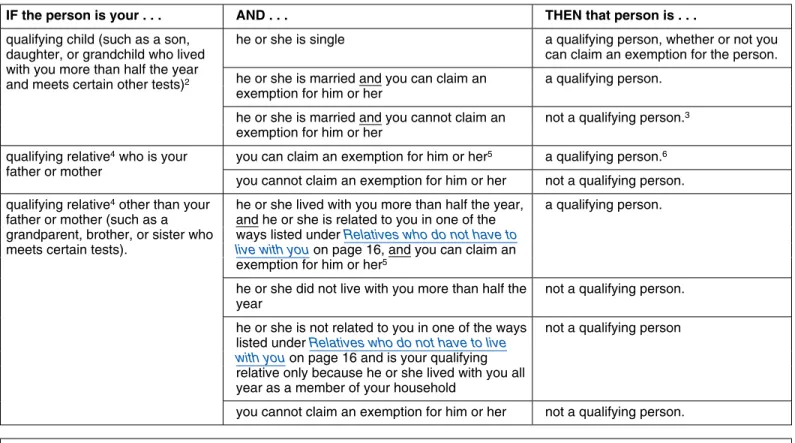
ber 2. The cost of the upkeep of her apartment the Married filing jointly column of the Tax Table for the year until her death was $6,000. You paid or Section B of the Tax Computation Worksheet See Table 4, later, to see who is a qualifying
$4,000 and your brother paid $2,000. Your to figure your tax. person.
brother made no other payments towards your Any person not described in Table 4 is not a
mother’s support. Your mother had no income. Eligibility rules. You are eligible to file your
qualifying person.
Because you paid more than half of the cost of 2010 return as a qualifying widow(er) with de-keeping up your mother’s apartment from Janu- pendent child if you meet all the following tests.
Example 1 — child. Your unmarried son
ary 1 until her death, and you can claim an
lived with you all year and was 18 years old at
•
You were entitled to file a joint return withexemption for her, you can file as a head of
the end of the year. He did not provide more your spouse for the year your spouse
household.
than half of his own support and does not meet died. It does not matter whether you
actu-the tests to be a qualifying child of anyone else. Temporary absences. You and your quali- ally filed a joint return. As a result, he is your qualifying child (see Quali- fying person are considered to live together
•
Your spouse died in 2008 or 2009 and youfying Child, later) and, because he is single, is a even if one or both of you are temporarily absent
did not remarry before the end of 2010. qualifying person for you to claim head of house- from your home due to special circumstances
hold filing status. such as illness, education, business, vacation,
•
You have a child or stepchild for whomor military service. It must be reasonable to you can claim an exemption. This does
Example 2 — child who is not qualifying
assume that the absent person will return to the not include a foster child.
person. The facts are the same as in Example home after the temporary absence. You must
1 except your son was 25 years old at the end of continue to keep up the home during the ab-
•
This child lived in your home all year,ex-the year and his gross income was $5,000. Be- sence. cept for temporary absences. See
Tempo-cause he does not meet the age test (explained rary absences, earlier, under Head of
Kidnapped child. You may be eligible to file
later under Qualifying Child), your son is not Household. There are also exceptions,
de-as head of household even if the child who is
your qualifying child. Because he does not meet scribed later, for a child who was born or
died during the year and for a kidnapped a home that was the child’s main home during the entire part of the year he or she was alive.
child.
Exemptions
•
You paid more than half the cost ofkeep-Kidnapped child. You may be eligible to file Exemptions reduce your taxable income. You
ing up a home for the year. See Keeping as a qualifying widow(er) with dependent child,
can deduct $3,650 for each exemption you claim
Up a Home, earlier, under Head of House- even if the child who qualifies you for this filing
in 2010. If you are entitled to two exemptions for
hold. status has been kidnapped. You can claim
quali-2010, you would deduct $7,300 ($3,650 × 2). fying widow(er) with dependent child filing status
if all the following statements are true.
Example. John Reed’s wife died in 2008. Types of exemptions. There are two types of
John has not remarried. He has continued dur- exemptions you may be able to take:
1. The child must be presumed by law en-ing 2009 and 2010 to keep up a home for himself
forcement authorities to have been kid-
•
Personal exemptions for yourself and your and his child, who lives with him and for whomnapped by someone who is not a member spouse, and he can claim an exemption. For 2008 he was of your family or the child’s family.
entitled to file a joint return for himself and his
•
Exemptions for dependents (dependency2. In the year of the kidnapping, the child
deceased wife. For 2009 and 2010, he can file exemptions).
lived with you for more than half the part of as a qualifying widower with a dependent child.
While each is worth the same amount ($3,650 the year before the kidnapping.
After 2010, he can file as head of household if he
for 2010), different rules, discussed later, apply
qualifies. 3. You would have qualified for qualifying
to each type. widow(er) with dependent child filing status
if the child had not been kidnapped.
Death or birth. You may be eligible to file as a Dependent cannot claim a personal
exemp-qualifying widow(er) with dependent child if the tion. If you are entitled to claim an exemption
As mentioned earlier, this filing status
child who qualifies you for this filing status is for a dependent (such as your child), that
depen-is available for only 2 years following
born or dies during the year. You must have dent cannot claim a personal exemption on his
the year your spouse died.
CAUTION
!
or her own tax return. provided more than half of the cost of keeping up
Table 4.
Who Is a Qualifying Person Qualifying You To File as Head of Household?
1Caution. See the text of this publication for the other requirements you must meet to claim head of household filing status.
IF the person is your . . . AND . . . THEN that person is . . .
he or she is single a qualifying person, whether or not you
qualifying child (such as a son,
can claim an exemption for the person. daughter, or grandchild who lived
with you more than half the year
he or she is married and you can claim an a qualifying person. and meets certain other tests)2
exemption for him or her
he or she is married and you cannot claim an not a qualifying person.3
exemption for him or her
you can claim an exemption for him or her5 a qualifying person.6
qualifying relative4 who is your
father or mother
you cannot claim an exemption for him or her not a qualifying person. he or she lived with you more than half the year, a qualifying person. qualifying relative4 other than your
and he or she is related to you in one of the father or mother (such as a
ways listed under Relatives who do not have to
grandparent, brother, or sister who
live with you on page 16, and you can claim an meets certain tests).
exemption for him or her5
he or she did not live with you more than half the not a qualifying person. year
he or she is not related to you in one of the ways not a qualifying person listed under Relatives who do not have to live
with you on page 16 and is your qualifying relative only because he or she lived with you all year as a member of your household
you cannot claim an exemption for him or her not a qualifying person.
1A person cannot qualify more than one taxpayer to use the head of household filing status for the year.
2The term “qualifying child” is defined under Exemptions for Dependents, later. Note: If you are a noncustodial parent, the term “qualifying child” for
head of household filing status does not include a child who is your qualifying child for exemption purposes only because of the rules described under Children of divorced or separated parents or parents who live apart under Qualifying Child, later. If you are the custodial parent and those rules apply, the child generally is your qualifying child for head of household filing status even though the child is not a qualifying child for whom you can claim an exemption.
3 This person is a qualifying person if the only reason you cannot claim the exemption is that you can be claimed as a dependent on someone
else’s return.
4The term “qualifying relative” is defined under Exemptions for Dependents, later.
5If you can claim an exemption for a person only because of a multiple support agreement, that person is not a qualifying person. See Multiple
Support Agreement.
6See Special rule for parent for an additional requirement.
How to claim exemptions. How you claim an nonresident alien; in that case, your spouse exemption on his or her own tax return. This is exemption on your tax return depends on which must have no gross income for U.S. tax pur- true even if you do not claim the dependent’s
form you file. poses. exemption on your return.
Form 1040EZ filers. If you file Form Head of household. If you qualify for head
Housekeepers, maids, or servants. If these
1040EZ, the exemption amount is combined of household filing status because you are
con-with the standard deduction and entered on line sidered unmarried, you can claim an exemption people work for you, you cannot claim
exemp-5. for your spouse if the conditions described in the tions for them.
preceding paragraph are satisfied.
Form 1040A filers. If you file Form 1040A,
To claim the exemption for your spouse, Child tax credit. You may be entitled to a child
complete lines 6a through 6d. The total number
check the box on line 6b of Form 1040 or Form tax credit for each qualifying child who was of exemptions you can claim is the total in the
1040A and enter the name of your spouse in the under age 17 at the end of the year if you box on line 6d. Also complete line 26.
space to the right of the box. Enter the SSN or claimed an exemption for that child. For more
Form 1040 filers. If you file Form 1040, ITIN of your spouse in the space provided at the information, see the instructions for the tax form complete lines 6a through 6d.The total number top of Form 1040 or Form 1040A. you file (Form 1040, 1040A, or 1040EZ). of exemptions you can claim is the total in the
box on line 6d. Also complete line 42. Death of spouse. If your spouse died during
the year and you file a joint return for yourself
U.S. citizen or resident alien. If you are a and your deceased spouse, you generally can
U.S. citizen, U.S. resident alien, U.S. national claim your spouse’s exemption under the rules
Dependent Taxpayer Test
(defined later) or a resident of Canada or Mex- just explained in Joint return. If you file asepa-ico, you may qualify for any of the exemptions rate return for the year, you may be able to claim If you could be claimed as a dependent by
an-discussed here. your spouse’s exemption under the rules just other person, you cannot claim anyone else as a
dependent. Even if you have a qualifying child or described in Separate return.
Nonresident aliens. Generally, if you are a
qualifying relative, you cannot claim that person If you remarried during the year, you cannot
nonresident alien (other than a resident of
Can-as a dependent. take an exemption for your deceased spouse.
ada or Mexico, or certain residents of India or
If you are a surviving spouse without gross If you are filing a joint return and your spouse Korea), you can qualify for only one personal
income and you remarry in the year your spouse could be claimed as a dependent by someone exemption for yourself. You cannot claim
ex-died, you can be claimed as an exemption on else, you and your spouse cannot claim any emptions for a spouse or dependents.
both the final separate return of your deceased dependents on your joint return. These restrictions do not apply if you are a
spouse and the separate return of your new nonresident alien married to a U. S. citizen or
spouse for that year. If you file a joint return with resident alien and have chosen to be treated as
your new spouse, you can be claimed as an
Joint Return Test
a resident of the United States.exemption only on that return.
More information. For more information on You generally cannot claim a married person as exemptions if you are a nonresident alien, see Divorced or separated spouse. If you ob- a dependent if he or she files a joint return. chapter 5 in Publication 519. tained a final decree of divorce or separate
maintenance during the year, you cannot take Exception. An exception to the joint return Dual-status taxpayers. If you have been both your former spouse’s exemption. This rule
ap-test applies if your child and his or her spouse a nonresident alien and a resident alien in the plies even if you provided all of your former
file a joint return merely as a claim for refund and same tax year, you should see Publication 519 spouse’s support.
no tax liability would exist for either spouse on for information on determining your exemptions.
separate returns.
Personal Exemptions
Example 1. You supported your 18-year-oldExemptions for
daughter, and she lived with you all year while You are generally allowed one exemption forher husband was in the Armed Forces. The yourself. If you are married, you may be allowed
Dependents
couple files a joint return. You cannot take an one exemption for your spouse. These are
exemption for your daughter.
called personal exemptions. You are allowed one exemption for each person
you can claim as a dependent. You can claim an Example 2. Your 18-year-old son and his exemption for a dependent even if your depen- 17-year-old wife had $800 of interest income
Your Own Exemption
dent files a return.and no other income. Neither is required to file a The term “dependent” means:
You can take one exemption for yourself unless tax return. Taxes were taken out of their interest
you can be claimed as a dependent by another
•
A qualifying child, or income due to backup withholding so they file ataxpayer. If another taxpayer is entitled to claim joint return only to get a refund of the withheld
•
A qualifying relative.you as a dependent, you cannot take an exemp- taxes. The exception to the joint return test
ap-tion for yourself even if the other taxpayer does The terms “qualifying child” and “qualifying rela- plies, so you are not disqualified from claiming not actually claim you as a dependent. tive” are defined later.
an exemption for each of them just because they file a joint return. You can claim exemptions for You can claim an exemption for a qualifying
each of them if all the other tests to do so are child or qualifying relative only if these three
Your Spouse’s Exemption
met. tests are met.
Your spouse is never considered your
depen-1. Dependent taxpayer test. Example 3. The facts are the same as in
dent.
Example 2 except your son had $2,000 of 2. Joint return test.
Joint return. On a joint return, you can claim wages and no interest income or backup
with-one exemption for yourself and with-one for your 3. Citizen or resident test. holding. No taxes were taken out of his pay and
spouse. he and his wife are not required to file a tax
These three tests are explained in detail later.
return, but they file a joint return to claim a All the requirements for claiming an
exemp-Separate return. If you file a separate return,
making work pay credit of $124 and get a refund tion for a dependent are summarized in Table 5.
you can claim an exemption for your spouse
of that amount. They file the return to get the only if your spouse had no gross income, is not
making work pay credit, so they are not filing it filing a return, and was not the dependent of Dependent not allowed a personal
only as a claim for refund. The exception to the another taxpayer. This is true even if the other exemption. If you can claim an
ex-joint return test does not apply, so you cannot taxpayer does not actually claim your spouse as CAUTION
!
emption for your dependent, thede-claim an exemption for either of them. a dependent. This is also true if your spouse is a pendent cannot claim his or her own personal