NAVAL
POSTGRADUATE
SCHOOL
MONTEREY, CALIFORNIA
MBA PROFESSIONAL REPORT
Analysis of the 314
thContracting Squadrons Contract
Management Capability Using the Contract Management
Maturity Model (CMMM)
By: Carl J. Jackson Jr.
December 2007
Advisors: Rene G. Rendon,REPORT DOCUMENTATION PAGE Form Approved OMB No. 0704-0188
Public reporting burden for this collection of information is estimated to average 1 hour per response, including the time for reviewing instruction, searching existing data sources, gathering and maintaining the data needed, and completing and reviewing the collection of information. Send comments regarding this burden estimate or any other aspect of this collection of information, including suggestions for reducing this burden, to Washington headquarters Services, Directorate for Information Operations and Reports, 1215 Jefferson Davis Highway, Suite 1204, Arlington, VA 22202-4302, and to the Office of Management and Budget, Paperwork Reduction Project (0704-0188) Washington DC 20503.
1. AGENCY USE ONLY (Leave blank) 2. REPORT DATE December 2007
3. REPORT TYPE AND DATES COVERED
MBA Professional Report
4. TITLE AND SUBTITLE Analysis of the 314th Contracting Squadrons Contract Management Capability Using the Contract Management Maturity Model (CMMM)
6. AUTHOR(S) Carl J. Jackson Jr.
5. FUNDING NUMBERS
7. PERFORMING ORGANIZATION NAME(S) AND ADDRESS(ES)
Naval Postgraduate School Monterey, CA 93943-5000
8. PERFORMING ORGANIZATION REPORT NUMBER
9. SPONSORING /MONITORING AGENCY NAME(S) AND ADDRESS(ES)
N/A
10. SPONSORING/MONITORING AGENCY REPORT NUMBER
11. SUPPLEMENTARY NOTES The views expressed in this thesis are those of the author and do not reflect the official policy or position of the Department of Defense or the U.S. Government.
12a. DISTRIBUTION / AVAILABILITY STATEMENT Approved for public release; distribution is unlimited
12b. DISTRIBUTION CODE
13. ABSTRACT (maximum 200 words)
This research project provides an assessment of the contract management capability of the 314th Contracting Squadron located at Little Rock Air Force Base, Arkansas. The assessment uses a questionnaire covering the six phases of the contract management process. The purpose of this research project is to analyze the 314th Contracting Squadron contracting processes and requirement target areas for improvement efforts by the application of the Contract Management Maturity Model (CMMM) and the associated Contract Management Maturity Assessment Tool (CMMAT) at the 314th Contracting Squadron.
15. NUMBER OF PAGES
61
14. SUBJECT TERMS Contract Management, 314th Contracting Squadron, Little Rock Air Force base, Arkansas, Contract Management Process, Contract Management Maturity Model (CMMM), Contract Assessment Tool (CMMAT)
16. PRICE CODE 17. SECURITY
CLASSIFICATION OF REPORT
Unclassified
18. SECURITY
CLASSIFICATION OF THIS PAGE Unclassified 19. SECURITY CLASSIFICATION OF ABSTRACT Unclassified
20. LIMITATION OF ABSTRACT
UU
NSN 7540-01-280-5500 Standard Form 298 (Rev. 2-89) Prescribed by ANSI Std. 239-18
Approved for public release; distribution is unlimited
ANALYSIS OF THE 314TH CONTRACTING SQUADRONS CONTRACT MANAGEMENT CAPABILITY USING THE CONTRACT MANAGEMENT
MATURITY MODEL (CMMM)
Carl J. Jackson Jr., Captain, United States Air Force
Submitted in partial fulfillment of the requirements for the degree of
MASTER OF BUSINESS ADMINISTRATION
from the
NAVAL POSTGRADUATE SCHOOL December 2007
Authors: _____________________________________ Carl J. Jackson Jr.
Approved by: _____________________________________ Rene G. Rendon, Lead Advisor
_____________________________________
Bryan Hudgens, Support Advisor
_____________________________________
Robert N. Beck, Dean
ANALYSIS OF THE 314
THCONTRACTING SQUADRONS
CONTRACT MANAGEMENT CAPABILITY USING THE
CONTRACT MANAGEMENT MATURITY MODEL (CMMM)
ABSTRACT
This research project provides an assessment of the contract management capability of the 314th Contracting Squadron located at Little Rock Air Force Base, Arkansas. The assessment uses a questionnaire covering the six phases of the contract management process. The purpose of this research project is to analyze the 314th Contracting Squadron contracting processes and requirement target areas for improvement efforts by the application of the Contract Management Maturity Model (CMMM) and the associated Contract Management Maturity Assessment Tool (CMMAT) at the 314th Contracting Squadron.
TABLE OF CONTENTS
I. INTRODUCTION...1
A. INTRODUCTION...1
B. PURPOSE OF STUDY...1
C. BACKGROUND INFORMATION ...2
D. PROBLEM STATEMENT ...2
E. CONCEPTUAL FRAMEWORK...3
F. RESEARCH QUESTIONS ...3
G. NATURE OF STUDY...3
H. LIMITATIONS ...4
I. SIGNIFICANCE OF STUDY...4
J. ORGANIZATION OF THIS REPORT...5
K. SUMMARY ...6
II. LITERATURE REVIEW ...7
A. INTRODUCTION...7
B. ORGANIZATIONAL ASSESSMENTS ...7
C. ASSESSING ORGANIZATIONAL PERFORMANCE IN THE DEPARTMENT OF DEFENSE ...8
D. THE USE OF CAPABILITY MATURITY MODELS ...10
E. THE STATE OF DOD CONTRACT MANAGEMENT ...13
F. STATE OF AIR FORCE CONTRACTING ...14
G. THE CONTRACT MANAGEMENT MATURITY MODEL (CMMM)...16
H. KEY PROCESS AREAS...18
1. Procurement Planning...19
2. Solicitation Planning...19
3. Solicitation ...19
4. Source Selection ...20
5. Contract Administration ...20
6. Contract Closeout ...20
I. MATURITY LEVELS ...21
1. Ad-hoc ...21
2. Basic ...21
3. Structured...21
4. Integrated...22
5. Optimized...22
J. SUMMARY ...24
III. THE 314TH CONTRACTING SQUADRON ...25
A. INTRODUCTION...25
B. THE AIR FORCE CONTRACTING SYSTEM...25
C. THE OPERATIONAL CONTRACTING PROGRAM...27
E. WHY THE 314TH CONTRACTING SQUADRON? ...28
F. SUMMARY ...30
IV. ASSESSMENT RESULTS AND RECOMMENDATIONS ...31
A. INTRODUCTION...31
B. SELECTION OF STUDY PARTICIPANTS ...31
C. THE CONTRACT MANAGEMENT MATURITY ASSESSMENT TOOL ...32
D. ADMINISTRATION OF THE ASSESSMENT...33
E. RESULTS OF THE ASSESSMENT...33
F. INDICATIONS FOR THE SQUADRON & PROCESS IMPROVEMENT RECOMMENDATIONS ...34
G. SUMMARY ...40
V. SUMMARY, CONCLUSION, AND FURTHER RESEARCH...41
A. INTRODUCTION...41
B. SUMMARY ...41
C. RESEARCH CONCLUSION ...42
D. FURTHER RESEARCH AND STUDY...43
LIST OF REFERENCES ...45
LIST OF TABLES
Table 1. Contract Management Key Process Areas, Buyer’s Perspective...18 Table 2. Five Level Maturity Models ...23 Table 3. 314th Contracting Squadron Contract Management Maturity Assessment
LIST OF ACRONYMS
314th CONS 314th Contracting Squadron
AETC Air Education and Training Command
AF Air Force
AFB Air Force Base
AFI Air Force Instruction
AFMC Air Force Material Command AFPD Air Force Policy Directive AMC Air Mobility Command AOR Area of Responsibility
APDP Acquisition Professional Development Program AQC Acquisition
CM Contract Management
CMMM Contract Management Maturity Model
CMMAT Contract Management Maturity Assessment Tool
CMM Capability Maturity Model
CMMI Capability Maturity Model Integration CONUS Continental United States
DAWIA Defense Acquisition Workforce Improvement Act of 1990 DFARS Defense Federal Acquisition Regulation Supplement DoD Department of Defense
DPAP Defense Procurement Acquisition Policy FAR Federal Acquisition Regulation
GAO Government Accountability Office
IG Inspector General
MAJCOM Major Command
ORI Operational Readiness Inspection
PCMM People Capability Maturity Model PMMM Project Management Maturity Model
UCI Unit Compliance Inspection USAF United States Air Force
SA-CMM Software Acquisition-Capability Model
SAF/AQC Assistant Secretary of the Air Force for Acquisition and Contracting SAF/IG Secretary of the Air Force Inspector General
SECDEF Secretary of Defense
SEI Software Engineering Institute SW-CMM Software Capability Maturity Model
I. INTRODUCTION
A. INTRODUCTION
This chapter will provide the purpose of this research project And include background information on the organization where the study took place. It will define the problem statement of the research and the conceptual framework for the Air Force contracting enterprise. The research questions that this study seeks to answer, at the conclusion of the report, are also provided in this chapter, as well as the nature of the study. The assessment tool being used for this research project does have some limitations; those limitations will be discussed in this chapter as well. And finally, the chapter will conclude with the significance of the study, and a short summary.
B. PURPOSE OF STUDY
The United States Department of Defense (DoD) and the Air Force have undergone significant transformations in the past several years. Much of the transformation has taken place in the business segment of DoD operations. With the growing role of outsourcing expected in the DoD transformation initiative, mature contract management processes are paramount. Contract management will play a key role in realizing a seamless transformation of a greater integration of contracted personnel in the DoD. As outsourcing continues to increase, and suppliers become extensions of the government workforce, contract management will continue to grow in importance (Rendon, 2006).
The purpose of this study is to analyze the 314th Contracting Squadron (314th CONS) contracting processes and recommend target areas for improvement efforts. Analysis will be obtained by application of the Contract Management Maturity Model (CMMM) and the associated Contract Management Maturity Assessment Tool (CMMAT) at the 314th CONS, Air Education and Training Command, Little Rock Air Force Base (AFB), Arkansas.
C. BACKGROUND INFORMATION
The 314th Contracting Squadron is Little Rock Air Force Base’s installation contracting organization responsible for the soliciting, evaluation, awarding, administration, and closeout of contract activities in support of the base mission. The 314th Contracting Squadron is a professional organization that prides itself in supporting the 314th Airlift Wing’s flying mission by acquiring and supporting warfighting capabilities through responsive business solutions. The 314th Contracting Squadron has both military and civilian professionals that contract yearly for construction, maintenance, repairs, and facilities services (314th CONS, 2007).
The Air Force contracting environment consists of over 7,000 contracting professionals who are annually responsible for billions of dollars in contract awards (Air Force Strategic Plan, 2006). In fiscal year 2005, Air Force organizations combined to award more than 175,000 contract actions at nearly $55 billion (Air Force Strategic Plan, 2006). Air Force contracting squadrons ultimately serve to the benefit of national security strategy at large, but the squadron’s direct customers include primarily wings, groups, and other squadrons on the installation, as well as maintenance and supply personnel, civil engineering, both contracted and government, and pilots.
D. PROBLEM STATEMENT
With the evolving contract management function in the Department of Defense, and transformation initiatives in the Air Force, measuring and documenting contract management process capability is essential. It is important that, as we move forward with streamlined processes and lesser experienced contracting professionals, we know how mature our contract management processes are. “How mature are the contract management processes at the 314th Contracting Squadron” is the problem statement of this research. In essence, this research will document the contract management process capability maturity level for the 314th CONS. This study defines “maturity” as “a measure of effectiveness in any specific process (Garrett and Rendon, 2005). In terms of contract management, maturity relates to organizational capabilities that can consistently produce successful business results for buyers and sellers of products, services, and
integrated solutions (Garrett and Rendon, 2005). In answering this problem statement, the research will also identify which key areas the 314th Contracting Squadron can target for improvement efforts.
E. CONCEPTUAL FRAMEWORK
The Air Force Contracting Enterprise relies on its separate contracting organizations to have the flexibility and ingenuity to operate in fluid environments that frequently have to navigate changing business conditions. Acquisition leaders must ensure that Air Force processes and resources are integrated into the other Air Force operations and other DoD enterprises. In order to assess the 314th CONS level of integration throughout the installation, a conceptual framework assessment must be utilized. The Contract Management Maturity Model provides the necessary framework.
F. RESEARCH QUESTIONS
This study assesses the maturity level of the 314th CONS contract management processes. The Contract Management Maturity Model (CMMM) is designed to help buying and selling organizations focus on the key areas of process improvement and provide organizations with a framework for improving their levels of performance in terms of contract management competency (Garrett and Rendon, 2005). Given that the 314th Contracting Squadron is only a buying organization, as opposed to a buying and selling organization, this research will only focus on the buyer’s perspective in relation to the CMMM. The following research questions are addressed in this study:
1. What is the 314th Contracting Squadron’s contract management process capability baseline?
2. What factors exist within the squadron that suggest that assigned personnel require additional training?
G. NATURE OF STUDY
This study provides an assessment of the contract management capability of the 314th Contracting Squadron, Little Rock AFB, AR. The assessment uses a sixty question survey provided in the Contract Management Maturity Model. The survey questions are
administered to the warranted contracting officers assigned to the 314th Contracting Squadron. These individuals are the expert business advisors to the 314th Airlift Wing commander and are responsible for procurement actions in support of the 314th Airlift Wings’ flying mission. This research is a qualitative not a quantitative study. The study only provides for the assessment of the organization’s contract management process maturity level and is not a statistical analysis of all base level contracting organizations in the Air Force Contracting Enterprise.
H. LIMITATIONS
The contract management process capability maturity model does have some limitations. As mentioned earlier, this model was designed for the purpose of identifying process problems and weaknesses in an organization’s contract management process. However, it does not provide solutions or solve problems identified by the assessment results. The contract management organization leadership must use the assessment results as a guide for implementing process improvements (Garrett and Rendon, 2005).
Leadership must develop its own roadmap for improvements by establishing an organizational culture that fosters contract management process improvements. Objectives have to be identified and focused on targeted contract management maturity levels in each of the key process areas identified by the contract management maturity model. One way for a base level contracting organization to achieve process improvement is through the development of action plans and performance metrics. Managers at higher levels, within the contracting enterprise, can assist the achievement of desired maturity levels by establishing individual skills and competencies for contract professionals.
I. SIGNIFICANCE OF STUDY
As the contract management function increases in importance, the need for a systematic approach to assessing effectiveness and competence will become critical for an organization to maintain a competitive advantage (Garrett and Rendon, 2005). Just as
commercial firms must sustain profits that exceed the average for its industry to possess a competitive advantage, government contracting organizations must have a business strategy that will achieve and sustain a completive advantage.
The competitive advantage concept applies to the Air Force Contracting Enterprise, and the individual organizations within it, that carry out procurement activities as well. The ongoing transformation within the Air Force contracting enterprise amounts to a business process re-engineering that includes a trend towards downsizing the contracting professional personnel pool, through initiatives like force shaping, and increased strategic sourcing. The 314th CONS area of responsibility (AOR) will eventually be engulfed into one of the five regional contracting centers standing in the Air Force Contracting Enterprise, and with that new alignment, will generate increased importance in contract management processes.
Core organizational competencies must now include structuring, negotiating, and administering long-term contracts (Garrett and Rendon, 2005). Under the realignment with regional contracting centers, there is likely to be more reliance on services contracting, and management capability will be required to have an adequate level of maturity. It’s in the best interest of the 314th CONS to document that process improvement is an area of great importance. Allowing the squadron’s contract management processes to be assessed in this research provides documented proof of its leadership’s continuous process improvement efforts. Prior research into management has shown that enterprises that expect to be successful look to improving processes that have a positive impact on customer satisfaction, and the 314th CONS is no exception in this regard. The squadron has an exceptional track record in providing contracting support to the 314th Airlift Wing, and knows that in this continuously changing environment process, improvement is essential.
J. ORGANIZATION OF THIS REPORT
This research project is organized into five chapters. Chapter I provides an Introduction and Overview of this study as well as the purpose of the study, background information and the problem statement, the conceptual framework, research questions
and the significance of this research. Chapter II consists of a literature review on organizational assessments, and how assessments are performed in the Department of Defense and the U.S. Air Force. The literature review also covers maturity models and introduces the assessment tool used for this research, the Contract Management Maturity Model (CMMM). Chapter III includes background on the organization of base level contracting squadrons and specific information on the 314th CONS. Chapter IV presents findings and results of the data collected at the 314th CONS, Little Rock AFB, AR. Chapter V consists of the summary, conclusion and areas for further research.
K. SUMMARY
The contract management function in the Department of Defense is a rather important part of business operations within the department. Consistency in contracting an organization’s process capability allows contract professionals in the DoD to effectively support the complex mission of the department. This study will provide great insight into the contract management process capability maturity level at one of the Air Force’s top performing contracting organizations. Such insight is vital to continued mission accomplishment, as this will allow for better understanding of the practices and culture of the 314th Contracting Squadron.
This chapter opened with a brief introduction to the chapter and purpose of the study. Next, the chapter covered some background information on the research before continuing on with the problem statement and the conceptual framework. The research questions that will be answered at the conclusion of the study were then introduced, as well as the nature of the study and the limitations of the assessment tool. And last, the chapter covered the significance of this study and the research project structure. Chapter II provides the literature review for this research.
II. LITERATURE
REVIEW
A. INTRODUCTION
The purpose of this chapter is to review literature relevant to this research project. The chapter will cover organizational assessments including defining what they are, as well as the benefits of performing self-assessments. This chapter will also look at what tools are used within the Department of Defense (DoD) and the Air Force, in particular, to measure organizational performance and capability. This literature review will include how the use of maturity models has become an excellent tool for measuring organizational process capability. The chapter will review contract management and the current state of the contract management function in DoD and Air Force operations. And last, the chapter will introduce the Contract Management Maturity Model (CMMM), the definition of contract maturity and the benefit of this assessment tool to the contract management profession.
B. ORGANIZATIONAL ASSESSMENTS
The first step in any transformation initiative is to understand how an organization is performing prior to the transformation initiative being implemented. Organizations experiencing change, or interested in planning a way forward, will benefit from an organizational assessment. These assessments help agencies define areas needing change or improvement, and set the stage for more in-depth planning and other efforts to address key organizational issues. When seeking to improve the performance of an organization, it is helpful to regularly conduct assessments of the current performance of the organization. Assessments might be planned, systematic and explicit, or unplanned and implicit (Organizational Assessment Guide, 2006). Organizational assessments result in a prioritized improvement strategy targeted at leveraging existing strengths and addressing weaknesses.
The need for organizations to be aware of their performance and to make an effort to improve is clear. “Self-knowledge” can bring further benefits to an organization (Lusthaus and Adrien, 1998). Knowledge is also a tool of empowerment that can actually lead to an increase in organizational performance (Lusthaus and Adrien, 1998). An example of the relevant use of an organizational assessment benefiting an upcoming transformation is the implementation of a new homeland security approach. As the federal government implemented a comprehensive Homeland Security strategy, government agencies at both the state and federal levels had to reassess their institutional capabilities and develop improvement strategies (Department of Homeland Security, 2007). Existing programs had to be evaluated and amended and new approaches and procedures had to be instituted.
C. ASSESSING ORGANIZATIONAL PERFORMANCE IN THE DEPARTMENT OF DEFENSE
Within the Department of Defense performance assessments are measured by Inspector General Reviews, Operational Readiness Inspections, and Unit Compliance Inspections. This next section will take a look at each of these assessment tools.
Traditionally, the Inspector General has served as an extension of the eyes, ears, and conscience of the commander (The DoD IG website, 2007). The Inspector General Act of 1978 reads “the Inspector General of the Department of Defense shall be the principle advisor to the Secretary of Defense for matters relating to the prevention of fraud, waste, and abuse in the programs and operations of the Department.” It is also the responsibility of the Inspector General (IG) to keep the SECDEF and the Congress fully informed of serious problems, abuses, and deficiencies the department has in carrying out their statutory duties. The IG of the Department of Defense is obligated, by law, to give particular regard to the activities of the internal audit, inspection, and investigative units of the military departments, with a view towards avoiding duplication, and insuring effective coordination and cooperation (The DOD IG website, 2007). For this research project, the functions and reports of the Office of the Deputy Inspector General for Auditing are the most applicable.
Auditors from the Office of the Deputy Inspector General for Auditing perform assessments primarily to help management arrive at solutions to problems and devise better ways to do business (IG Internal Audit Manual, 1999). To accomplish assessment objectives, auditors must exercise due professional care and conduct audits in a logical and methodical way that conforms to Generally Accepted Government Auditing Standards. In IG inspections of contracting squadrons, the inspectors will typically review historical data such as previously awarded contracts, checking for proper contract documentation and other files. Assessments performed by the IG generally progress through three phases: the survey phase, the field work phase, and the reporting phase. Procedures for assessing an agency or organization within DoD call for findings and recommendations to be identified as early as possible, and for those findings to be discussed with officials in the organization being assessed, before presenting them in writing.
The Air Force Office of the Inspector General has the authority to question the discipline, efficiency, and economy of the Air Force. In accordance with Title 10, United States Code, Section 8014, the Secretary of the Air Force has the sole responsibility for the function of the Inspector General of the Air Force (SAF/IG) and provides for deputies and assistants to the Inspector General. Further defined in the code, no other office or entity may be established or designated within the Air Staff to conduct inspector general functions.
The Air Force also performs Operational Readiness Inspections (ORIs) as a means to assess an organization. ORIs are conducted to evaluate and measure the ability of a unit to perform in wartime, during a contingency or force sustainment mission (AFI 90-201). They are basically a review of the installation’s operations as a whole. Every wing in the Air Force undergoes an ORI approximately every five years. Wings are evaluated in four areas: initial response, employment, mission support and the ability to survive and operate in a hostile environment. An initial response to ORIs usually consists of processing through a mobility line where Airman records are checked for accuracy. The employment and sustainment portion of an ORI is getting to a location and setting up work areas.
During the ORI, inspectors also evaluate the ability of the installation population to identify, mark, report, and avoid post-attack hazards, as well as how individuals perform life saving aid support. A five tiered rating system is used to grade wing performance, and consists of outstanding, excellent, satisfactory, marginal, and unsatisfactory. Base installation personnel usually prepare for this form of assessment by conducting several scheduled operational readiness exercises. In addition to conducting exercises, wings will typically contact other previously inspected units to get an idea of what to expect. This is essentially the preparing wing’s attempt to capture “best practices.”
In addition to conducting IG inspections and ORIs, the Air Force uses a third assessment mechanism to assess organizational performance. That tool is the Unit Compliance Inspection (UCI). UCIs are Air Force inspections conducted to assess areas mandated by law, as well as mission areas identified by senior Air Force and Major Command (MAJCOM) leadership as critical or important to the health and performance of a unit. UCIs are also a reflection on the leadership on the unit. Failure to comply with established directives in these areas could result in significant legal liabilities, penalties, or significant mission impact. During the UCI, MAJCOM inspector generals evaluate each common core compliance area, which is driven by law, executive order, or applicable directive. Examples of common core compliance areas, based on law, are intelligence oversight, transition assistance programs, voting assistance programs, sexual harassment education and prevention, and homosexual conduct policy (AFI 90-201). The UCI focuses on coherence with statutes, directives, and resolutions.
D. THE USE OF CAPABILITY MATURITY MODELS
A maturity model can be used as a benchmark for assessing different organizations for equivalent comparison (Carnegie Mellon SEI, 2007). A Capability Maturity Model (CMM), defined for this research project, is an evolutionary road map for implementing the vital practices for one or more domains of organizational processes. It contains the essential elements of effective processes for one or more disciplines. It
describes an evolutionary improvement path from an ad hoc, immature process to a disciplined mature process with improved quality and effectiveness (Garrett & Rendon, 2005).
Maturity models are developed on the theory that organizations do not move from zero capability to optimum capability instantaneously. Instead, organizations progress along a journey of maturity (Best-Management-Practice website, 2007). Maturity models are management tools that can help organizations implement effective processes in a given management discipline, such as contract management. Maturity models can be used to assess where an organization stands on the maturity journey (therefore what to do next), or can be used as a road map to help organizations implement a new capability (Best-Management-Practice website, 2007).
There are a variety of organizational maturity models, each with varied features and characteristics. There are maturity models for people, software, management, and project management. Most models consist of a five level maturity model, with each level building on the previous level (Garrett and Rendon, 2005). Thus, the most common maturity models reflect an evolutionary increase in maturity, from an ad hoc level to a level in which processes are focused on continuous improvement and adoption of lessons learned and best practices (Garrett and Rendon, 2005).
An example of one such maturity model is the People Capability Maturity Model (PCMM). It is an organizational change model designed on the premise that improved workforce practices will not survive unless an organization’s behavior changes to support them (Software Engineer Institute, 2007). The key practices in the model are designed to help the organization develop the appropriate workforce to execute the organization’s business strategies and integrate improvement in process and workforce capability. The People CMM is intended for are executives and managers, systems and software professionals, and those responsible for improving workforce management practices, amongst others.
The original capability maturity model – SW-CMM, Capability Maturity Model (SW-CMM) for Software – was developed by the Software Engineering Institute (SEI) in the early 1990s and is still widely used as an assessment tool today. SEI is a federally funded research and development center sponsored by the DoD and operated by Carnegie Mellon University. The acceptance and usage of capability maturity models has increased over the past decade (Software Engineer Institute, 2007). The original models were applied to information technology solutions and software solutions.
Some of the information technology disciplines went on to develop capability maturity models to support process improvements in areas such as (1) Systems Engineering – the SE-CMM (Systems Engineering Capability Maturity Model), (2) Software Acquisition – the SA-CMM (Software Acquisition Capability Maturity Model), (3) CMMI-Capability Maturity Model Integration. These models have been adopted by large organizations including the Department of Commerce, the DoD, and the government of the United Kingdom to assess competencies (Software Engineer Institute, 2007).
During the past decade, software organizations conducting improvement programs, guided by a Capability Maturity Model, have reported gains in productivity, quality, time to delivery, accuracy of cost and schedule estimates, as well as product quality. As an organization proceeds from one maturity level to the next, the range of benefits from its improvement activities and processes increases substantially. Since improvements at each maturity level solve different sets of problems, different benefits emerge at each level (Software Engineer Institute, 2007).
There are also models that organizations can use to assist in performing strategic planning for project management and achieving maturity and excellence in a reasonable time frame. One of these models is the Project Management Maturity Model (PMMM). The PMMM is comprised of five levels representing a different degree of maturity in project management. The five levels of maturity consist of 1) common language, 2) common processes, 3) singular methodology, 4) benchmarking, and 5) continuous improvements.
In Level 1, the Common Language, the organization recognizes the importance of project management and the need for good understanding of basic knowledge on project management, along with the accompanying terminology. In Level 2, Common Processes, the organization recognizes that common processes need to be defined and developed such that successes on one project can be repeated on other projects. In Level 3, Singular Methodology, the organization recognizes the synergistic effect of combining all corporate methodologies into a singular methodology, the center of which is project management. Level 4, Benchmarking, contains the recognition that process improvement is necessary to maintain a competitive advantage. And in Level 5, Continuous Improvement, the organization evaluates the information obtained through benchmarking.
E. THE STATE OF DOD CONTRACT MANAGEMENT
Currently within the Department of Defense (DoD), great attention is being paid to transformation of the business operations, and DoD acquisition leadership has placed high priority on the contract management function. Effective contract management capability plays a significant role in the DoD’s responsibility to provide the military forces needed to deter war and protect the security of the United States. The DoD faces many obstacles as it seeks to defend the Constitution and advance U.S. interest around the world. These challenges can be made less cumbersome with effective support from the contracting community in its role as business advisors, policy establishers, and acquisition managers (GAO, 2005).
Most recently, the GAO re-asserted their opinion that Contract Management in the Department of Defense is a high-risk function. The GAO first designated DoD contract management as a high-risk area in 1992, and it remains that way today. The GAO found that the DoD is unable to assure that it is using sound business practices to acquire goods and services needed to meet warfighters’ needs (GAO, 2005). GAO noted that the DoD has significantly increased its spending on contractor-provided technology and management support services, but has not fully implemented a strategic approach to
acquiring the services. GAO stated that the DoD needs to establish a department-wide concept of operations, set performance goals, and ensure accountability for achieving them.
Effective contracting support starts with effective acquisition policy. The Defense Procurement and Acquisition Policy (DPAP) office is responsible for all contracting policy matters in the Department of Defense. DPAP is lead by Mr. Shay Assad, Director DPAP, and he serves as the principle advisor to the Deputy Under Secretary of Defense for Acquisition, Technology and Logistics. DPAP has undertaken a number of initiatives to transform the contracting process and improve business operations. The Government Accountability Office (GAO) recently stated that the DoD will continue to have billions of dollars in inefficiencies to support business functions unless there is a genuine reform of processes (GAO, 2003). The contract management function has always been an area subject to scrutiny.
GAOs recent unflattering assessments of the contracting function have increased the level of scrutiny the contract management community receives. DoD contract management involves the constant overlapping of disciplines under the acquisition umbrella because of the nature of the business environment. To help facilitate management of the nation’s investments in technologies, programs, and product support necessary to ensure support of the armed forces, DPAP established the contract policy office. It is this contracting policy office that provides the critical element that shapes the culture of the contract management function. The policies DPAP put in place set the direction toward how we will manage contracts and how the contracting function will evolve.
F. STATE OF AIR FORCE CONTRACTING
In February 1908, Capt. Charles S. Wallace signed the first Army airplane contract with the Wright Brothers for the Signal Corp (Air Force webservice, 2007). Since that time, the Air Force has not only become a separate service from the Army, but the role of contracting support in the Air Force’s strategic objectives has grown in importance. Contracting support plays an essential role in the warfighters’ ability to
execute tactical objectives (GAO, 2005). The Air Force’s contracting Strategic Plan lays out the road map on how contracting professionals will translate the contracting vision into actionable and measurable steps (AQC on Point, 2005).
The Air Force contracting community is currently in a state of transformation. Recent announcements have been made regarding the direction of the contracting profession in the Air Force. The Air Force Contracting Enterprise leadership has announced plans to regionalize operational contracting support over the next several months. This initiative has been at the forefront of Air Force contracting transformation since the announcement that a business case analysis was conducted to assess the benefits of regionalized support. The regionalization initiative comes on the heels of back-to-back rounds of Air Force Force-Shaping that saw several airmen from the contracting community leave the service.
Air Force Acquisition and Contracting leadership have aggressively sought an agenda that would drastically transform the structure of base level contracting support. Contracting squadrons such as the 314th CONS will be impacted by any such structure transformation. In April 2006, a Business Case Analysis was concluded by the Secretary of the Air Force for Acquisition that recommended a structure that would better realize the benefits of strategic sourcing while leveraging resources. The analysis recommended transformation to the continental United States (CONUS) installation acquisition function.
In July 2007, the Secretary of the Air Force signed off on the approval to transform the current installation contracting support structure. Individual installations will not lose their contracting support under this transformation initiative, however, the contract squadron responsible for providing the support will go away. The contracting support for the base and its tenant units will be the responsibility of a regional contracting squadron. Five regional centers will be introduced to the acquisition and contracting enterprise, and all acquisition management and oversight will consolidate under the Air Force Material Command (AFMC) organization. Air Force leadership made the determination that a concept of regionalizing contract support for installation was strategically in the Air Force’s best interest (Transformation Briefing, 2007).
Under the current organizational structure, the Air Force has 71 buying organizations that primarily focus on providing tactical support to installation tenant units. This results in the inconsistent use of well-trained but limited contracting assets and creates an inability to leverage the scale of efficiency. While the contracting resources are becoming less, the workload of the contracting community and its professionals is not decreasing. This fact and the continuous complexity of on-going mission support commitments, such as deployment ops tempo, compound these challenges. This situation ultimately puts overwhelming stress on the ability of contracting squadrons to effectively perform their mission requirements.
The evolution of the installation contracting squadron, from a tactically focused support organization to a strategically aligned organization, is how Air force leadership plans to address these challenges (On Point Memo, 2007). For the transformation to be effective, the contracting support organization must be based on an agile operating structure with a workforce that has increased technical competence and is able to realize strategic sourcing objectives (Transformation Briefing, 2007). The ultimate objective is to better serve the warfighter with improved customer service, reduced purchasing costs while procuring better quality and accelerated delivery schedules.
G. THE CONTRACT MANAGEMENT MATURITY MODEL (CMMM)
This study involved the application of the Contract Management Maturity Model (CMMM) and the Contract Management Maturity Assessment Tool (CMMAT) to an Air Force operational contracting squadron. The CMMM was selected as the most appropriate assessment tool because it is specifically designed for the type of organization that the 314th CONS represents (Garrett and Rendon, 2005). The CMMM has also been successfully applied, recently, to other Air Force contracting organizations, as well as non-government contracting organizations. Furthermore, the CMMM was developed after extensive research on software maturity models, project management maturity models, and human resource management maturity models. Thus, most of the
models reviewed in the development of the CMMM were project management models. This factor is extremely important because of the close relationship between program management and contract management.
The CMMM has been previously applied at other organizations. A couple of those organizations include the United States Air Force (USAF) Space and Missile Systems Center (SMC) and the Naval Facilities Engineering Command (NAVFAC). In fact, SMC was the organization selected to be the case study location for the CMMM. SMC, which is a subordinate unit of the Air Force Space Command, provides technical excellence for researching, developing, and purchasing military space systems. In addition to these locations the CMMM is currently being applied at the USAF Oklahoma City Air Logistics Center (OK-ALC) and Ogden Air Logistics Center.
The CMMM was developed to provide organizations with a framework or guide for improving their level of contract management performance. The CMMM should be used as a visual tool to help the contracting organization assess the major contract management processes that it must accomplish when buying products, services, and integrated solutions (Garrett and Rendon, 2005). The CMMM can be used in both the public and private sectors. The maturity levels reflected in the model allow an organization to assess its level of process capability for each of the six major phases in its buying process (Garrett and Rendon, 2005).
The origins of the six major contract management functions that the CMMM is built on can be traced back to a 1997 Gregory A. Garrett contract management model where he identified a six phase process covering the totality of contract management activities from both a buyer’s and seller’s perspective (Garrett and Rendon, 2005). Mr. Garrett, who is a respected educator on contract management, captured in his model all the activities associated with contract management, and as such, provided the baseline that would be expanded upon in developing the CMMM.
H. KEY PROCESS AREAS
The CMMM reflects the buyer activities as the following six key processes: (1) procurement planning, (2) solicitation planning, (3) solicitation, (4) source selection, (5) contract administration, and (6) contract closet. Table 1 illustrates the contract management key process areas for the buying organization. These contract management key process areas were used in developing assessment tools for buyers to measure the organization’s contract management process capability.
Table 1. Contract Management Key Process Areas, Buyer’s Perspective
1. Procurement Planning
The process of identifying which business needs can best be met by procuring products or services outside the organization. This process involves determining whether to procure, how to procure, what to procure, how much to procure, and when to procure.
4. Source Selection
The process of receiving bids or proposals and applying evaluation criteria to select a provider.
2. Solicitation Planning
The process of preparing the documents needed to support the solicitation. This process involves documenting program requirements and identifying potential sources.
5. Contract Administration
The process of ensuring that each party’s performance meets contractual requirements.
3. Solicitation
The process of obtaining information (bids and proposals) from prospective sellers on how project needs can be met.
6. Contract Closeout
The process of verifying that all
administrative matters are concluded on a contract that is otherwise physically complete. This involves completing and settling the contract, including resolving any open items.
1. Procurement Planning
In the procurement planning phase, some of the activities include determining the scope of work or description of the product to be procured, conducting effective market research as part of the procurement planning process for analyzing the types of products and services available in the marketplace, and from whom they are available. This phase also considers other program team areas, such as funds availability, preliminary cost and schedule estimates, quality management plans, cash flow projections, risk management and manpower resources (Garrett and Rendon, 2005).
2. Solicitation Planning
The solicitation planning phase follows the procurement planning phase and it includes activities such as the use of standard procurement forms and documents – those forms used to conduct solicitations. It can also include model contracts, item descriptions, terms and conditions, statements of work, work breakdown structures and data item descriptions. This phase is also concerned with making sure solicitations are structured to facilitate accurate and complete responses from prospective contractors (Garrett and Rendon, 2005).
3. Solicitation
The third phase is the solicitation phase. In this phase, an organization maintains a qualified bidders list with information on prospective sellers, such as relevant experience, areas of expertise, and other information. Other activities include conducting market research and advertising to identify new sources of supplies and services as part of the solicitation process. The organization can solicit input from the industry to be used in developing solicitations for certain types of procurements. The organization is also using a paperless process, to the greatest extent possible, issuing solicitations and receiving proposals (Garrett and Rendon, 2005).
4. Source Selection
In the source selection phase, activities include the organization using evaluation criteria, evaluation standards, and a weighting system to evaluate proposals. Proposal evaluation focuses on management criteria, technical criteria, and price criteria. Another activity is the organization comparing price proposals against the organization’s independent cost estimate during the proposal evaluation process. The organization may also, if needed, conduct a pre-ward survey on the potential contractor to verify the contractor’s technical, managerial, and financial capability (Garrett and Rendon, 2005).
5. Contract Administration
Following source selection is the contract administration phase. Here the organization has established a method for assigning contracts to individuals or teams for managing the post-award phase of the contract. On applicable contracts, a pre-performance meeting is conducted to discuss buyer and seller contract administration responsibilities, as well as protocols for communication, performance management, and contract change management. In this phase, you would see the activities that indicate that the organization has an established process for managing and controlling contract changes to cost, schedule, and performance requirements (Garrett and Rendon, 2005).
6. Contract Closeout
In the sixth and final phase, contract closeout, the activities include the organization’s established processes for closing out contracts, ensuring completion of work, complete documentation, and financial resolution of issues. This phase also includes obtaining the seller’s release of claims as well as verifying final payment from the buyer. If there is a contract termination involved, then this phase would also include the contract termination process, such as the required written or oral notification to terminate a contract due to cause or default. And one of the last activities in this phase is the organization maintaining a lessons-learned and best practices database for use in future projects and contracts (Garrett and Rendon, 2005).
I. MATURITY LEVELS
The Contract Management Maturity Model (CMMM) consists of five levels of process maturity with each level building on the previous level of maturity. The maturity levels reflect the existence and strength of organizational key processes based on current best practices. The maturity levels are not based on time but on adoption and implementation of best practices.
1. Ad-hoc
The lowest maturity level is the “ad hoc” level. At this level, the organization acknowledges that contract management processes exist, that the processes are accepted and practiced throughout various industries, and that the organization’s management understands the benefit and value of using contract management processes at this maturity level. At this level, formal documentation of contract management processes may exist within the organization, but are used only on an ad hoc and sporadic basis on various contracts (Garrett and Rendon, 2005).
2. Basic
Level two is the “basic” maturity level. An organization at this level has some basic contract management processes and standards established within the organization, but are not required on all contracts. The standards are applied only to selected complex, critical, or high-visibility contracts. Having this level of maturity would indicate that there is no organizational policy requiring the consistent use of these contract management processes and standards other than on the required contracts (Garrett and Rendon, 2005).
3. Structured
An organization with a “structured” maturity rating is one that has contract management processes and standards fully established, institutionalized, and mandated throughout the entire organization. At this maturity level, the organization’s senior
management is involved in providing guidance, direction, and approval of key contracting strategy, decisions, related contract terms and conditions, and contract management documents (Garrett and Rendon, 2005).
4. Integrated
A level 4 integrated maturity organization has the procurement project’s end-user as an integral member of the procurement team. It also has basic contract management processes integrated with other organizational core processes, such as cost control, schedule management, performance management, and systems engineering. Management of organizations with an “integrated” maturity rating has management that uses efficiency and effectiveness metrics to make procurement-related decisions. This organization’s management understands its role in the procurement management process and executes the process well (Garrett and Rendon, 2005).
5. Optimized
The highest level of contract management maturity that an organization can be rated using the CMMM is Level 5, “optimized.” The organization operating at the “optimized” level evaluates the contract management process periodically using efficiency and effectiveness metrics. The organization also has a continuous process improvement effort implemented to improve the contract management process. A lesson learned and best practice program are implemented to improve the contract management processes, standards, and documentation (Garrett and Rendon, 2005). In addition to the process improvement, a procurement process streamlining initiative is also implemented.
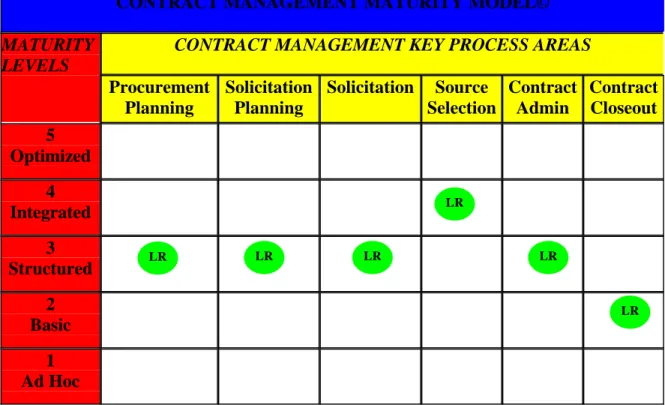
The five level maturity models using the levels of ad hoc, basic, structured, integrated, and optimized are illustrated in Table 2. Descriptions of each maturity level are fully described in this table.
Table 2. Five Level Maturity Models
Level 1 – Ad-Hoc
• The organization acknowledges that contract management processes exist, that these processes are accepted and practiced throughout various industries, and the organization’s management understands the benefit and value of using contract management processes.
• Although there are not any organization-wide established basic contract management processes, some established contract management processes exist and are used within the organization, but applied only on an ad-hoc and sporadic basis to various contracts.
• Informal documentation of contract management processes may exist within the organization, but are used only on an ad-hoc and sporadic basis on various contracts.
• Organizational managers and contract management personnel are not held accountable for adhering to, or complying with, any contract management process or standards.
Level – 4 Integrated
• The procurement project’s end-user customer is an integral member of the procurement team.
• Basic contract management processes are integrated with other organizational core processes such as cost control, schedule
management, performance management, and systems engineering.
• Management uses efficiency and effectiveness metrics to make procurement-related decisions.
• Management understands its role in the procurement management process and executes the process well.
Level – 2 Basic
• Some basic contract management processes and standards have been established within the organization, but are required only on selected complex, critical, or high-visibility contracts, such as contracts meeting certain dollar thresholds, or contracts with certain customers.
• Some formal documentation has been developed for these established contract management processes and standards.
• The organization does not consider these contract management processes or standards established or institutionalized throughout the entire organization.
• There is no organizational policy requiring the consistent use of these contract management processes and standards other than on the required contracts.
Level -5 Optimized
• Contract management processes are evaluated periodically using efficiency and effectiveness metrics.
• Continuous process improvement efforts are implemented to improve the contract management process.
• Lessons learned and best practice programs are implemented to improve the contract management processes, standards, and
documentation.
• Procurement process streamlining initiatives are implemented as part of the process improvement program.
Level – 3 Structured
• Contract management processes and standards are fully established, institutionalized, and mandated throughout the entire organization.
• Formal documentation has been developed for these contract management processes and standards, and some processes may even be automated.
• Since these contract management processes are mandated, the organization allows the tailoring of processes and documents, allowing consideration for the unique aspects of each contract, such as contracting strategy, contract type, terms and conditions, dollar value, and type of requirement (product or service).
• Senior management is involved in providing guidance, direction, and even approval of key contracting strategy, decisions, related contract terms and conditions, and contract management documents.
J. SUMMARY
In this chapter, we discussed organizational assessments including what an organizational assessment entails, as well as the benefits derived from performing an organizational assessment. Then we looked at the Department of Defense and the Air Force and how they assess unit performance. The chapter reviewed tools such as IG inspections, operational readiness inspections, and unit compliance inspections and their impact on mission success. Next we reviewed capability maturity models and how they have become fundamental in assessing organizational process maturity. Then, this literature review identified the current state of DoD and Air Force contracting. It particularly looked at the transformation taking place in Air Force contracting with regional contracting support. The last chapter introduced and defined the Contract Management Maturity Model (CMMM). Chapter III will focus on the site of the study, the 314th CONS at Little Rock AFB.
III. THE
314
THCONTRACTING SQUADRON
A. INTRODUCTION
Chapter III starts with a focus on the Air Force contracting system, which includes defining the Air Force contracting system and providing the system’s primary mission. The chapter will then look at the Operational Contracting Program. The Operational Contracting Program implements the AFPD 64-1, The Contracting System (AFI 64-102, 2005). This chapter will also cover the background on the 314th Contracting Squadron (314th CONS) to include the squadron’s history and mission. The chapter will conclude with an explanation of why this squadron was chosen as the site of the research project.
B. THE AIR FORCE CONTRACTING SYSTEM
The Air Force relies on its contracting system to acquire the supplies and services essential to its operations and warfighting missions. Air Force Policy Directive 64-1 stipulates that the Air Force contracting system will be responsive to mission needs and requirements and will award contracts that are in the best interests of the government. The policy directive also provides that the contracting system will contract for supplies and services using the Federal Acquisition Regulation (FAR), the Defense FAR Supplement (DFARS), and the Air Force FAR Supplement, in addition to other Air Force instructions and policy memorandums.
Air Force contracting activities and their customers consider both technical and business strategies when defining and specifying requirements. They work together to ensure the specifications reflect only what is needed to meet the requirements of the mission. Contracting activities ensure that specifications and statements of work don’t unnecessarily restrict competition or innovation. They also use commercial item descriptions, whenever practicable, and functional specifications instead of detailed design specifications, whenever reasonable.
Air Force contracting activities have the responsibility of employing military and civilian acquisition professionals that are qualified to perform contracting support. The Air Force implemented the Acquisition Professional Development Program (APDP) to ensure all personnel in the contracting workforce have the opportunity for training, education and experience needed to meet certification requirements and qualify for advancement.
To truly understand the contracting function, one must first understand the responsibilities and authorities of senior leadership. The Secretary of the Air Force has delegated contracting authority to specific acquisition officials who then re-delegate the authority to contracting officers and the individual contracting activities. Authority delegated to contracting officers to bind the government on behalf of the Air Force is specific and limited, and carries with it a responsibility to act with the utmost integrity and business etiquette. The contracting officers delegated this authority and responsibility, together with their commanders, ensures actions are within delegated authority and that the highest standards of conduct and business practices are maintained. It is the contracting officer’s responsibility to ensure that contracting actions are in compliance with statutory laws, regulations and directives. The contracting officer is specifically appointed by the Secretary of the Air Force or a designee with the authority to enter into, administer, or terminate contracts and execute related determinations and findings within the limits of the authority delegated. Only a properly warranted contracting officer has the authority to contractually bind the government on behalf of the Air Force.
Mr. Charlie Williams, Jr., the Deputy Assistant Secretary for Contracting, whose office is just referred to as SAF/AQC, develops and implements Air Force contracting policies and procedures, and performs surveillance of major command contracting activities (website: AF Contracting, 2007). SAF/AQC also serves as the Competition Advocate General for the Air Force and provides functional management for Air Force contracting personnel. SAF/AQC answers to his boss, who is the Assistant Secretary of the Air Force for Acquisition, also referred to as SAF/AQ.
C. THE OPERATIONAL CONTRACTING PROGRAM
Air Force Instruction 64-102, Operational Contracting Program, implements The Contracting System, AFPD 64-1 (AFI 64-102, 2005). It does so by providing the general authorities and responsibilities for operational contracting support. Operational contracting units are responsible for providing the timely, effective and efficient cradle-to-grave contract support to meet the needs of installation commanders, deployed commanders, and resident, tenant, and supported units. They also train and equip contingency contracting officers for worldwide deployment.
Air Force operational contracting units may be contracting squadrons, such as the 314th CONS, operational contracting offices, contracting divisions, or another organizational entity designed to meet local contracting support needs. They may be headed by contracting squadron commanders, office chiefs, or directors. Subordinate elements of an operational contracting unit may be a contracting flight, contracting branch, or another organizational component determined locally. Contracting authority for operational contracting comes from the National Security Act of 1947, the Armed Services Procurement Act of 1947, and other statues, regulations, and directives.
D. 314TH CONTRACTING SQUADRON
The 314th Contracting Squadron was activated on 1 December 1991. Prior to activation, the squadron was aligned under the Deputy Commander for Resource Management, and at different times, known as the Base Procurement Office, Base Contracting Division, and the Operational Contracting Division. The 314th CONS has a long history of supporting Little Rock Air Force Base, beginning when the base was initially under construction. It has been the recipient of such awards as Best Procurement Office in 2nd Air Force in 1968, Best Operational Contracting Division in MAC/AMC in 1982, 1991, and 1992, the President’s Award for Outstanding Contributions to the Javits-Wagner-O’Day Act in 1989, the U.S. Small Business Administration Arkansas District Office Arkansas Award of Excellence 8(a) Participation in 2000, the HQ AETC Secretary of the Air Force Small and Disadvantaged Business Achievement Award in
2000, the AETC CE/LGC Partnership Award in 1999 and 2000, AETC SAF Small Business Excellence and Special Achievement Award for fiscal year 2001, and the AETC Small Disadvantage Business Award in 2003 (314th CONS, 2007).
The 314th Contracting Squadron is organized into three flights performing contracting actions in services, commodities, and construction. Their contract management activities include awarding and administering service contracts in support of the 314th Airlift Wing and tenant units. They purchase commodities in support of the base flying mission. They also award and administer local construction projects in support of the services, civil engineering and other squadrons on Little Rock AFB. In addition to providing the contract management of services, commodities, and construction, they also maintain the government purchase card (GPC) program.
Not only does the squadron provide excellent contracting support to the Airlift Wing, contingency contracting officers assigned to the squadron have traveled worldwide, providing contracting support to numerous contingencies including Operation Desert Shield/Desert Storm, Provied Hope and Support Hope, Restore Democracy, Southern Watch, Enduring Freedom, Noble Eagle, Joint Forge, Iraqi Freedom and the Global War on Terrorism (314th CONS, 2007). In addition, the contingency contracting officers also provided assistance in the aftermath of natural disasters such as Hurricane Katrina and the eruption of Mt. Pinatubo in the Philippine Islands. Through the years, regardless of the number of military deployed, the 314th CONS has always provided quality support to the wing. The squadron has been able to maintain their excellent contracting support to its host wing through the dedication of its mission-focused military and civilian contracting professionals. The mission of the squadron is “Acquiring and Supporting Warfighting Capabilities Through Responsive Business Solutions” (314th CONS, 2007).
E. WHY THE 314TH CONTRACTING SQUADRON?
The 314th Contracting Squadron was chosen as the site of the research project because of its excellent reputation in providing contracting support to the 314th Airlift Wing, as well as for the personnel structure of the squadron. The 314th CONS has always
been thought of as one of the better performing contracting support squadrons in Air Education and Training Command (AETC). It has a well known reputation within the Air Force contracting community as being an organization that performs well during Unit Compliance Inspection (UCIs) and does an outstanding job getting its assigned contracting personnel the required contract management training.
The 314th CONS was also chosen because of its number of warranted contracting professionals. In applying the CMMM, it was important to have an adequate number of contracting professionals that would be knowledgeable regarding the squadron’s processes, at every stage of the contract management process, to participate in the questionnaire. All of the respondents to the questionnaire were at least Level II Contracting, certified under the Defense Acquisition Workforce Improvement Act. Additionally, 100 percent of the questionnaire participants were warranted contracting officers. Warranted contracting officers of the United States are government employees that have the authority to obligate the U.S. Federal Government in contractual agreements.
The final reason that this site was chosen is because of the type of contract actions they generally perform in their support of the 314th Airlift Wing. Within the Air Force contracting community, the 314th CONS is considered an operational contracting organization rather than a major weapons systems contracting organization. It was essential to this research project that the contracting organization being assessed was an operational contracting function dealing mostly with small dollar requirements, where the squadron would generally have the opportunity to manage the requirement from procurement planning to contract closeout. Assessing an operational contracting support function, such as the 314th CONS, provides an excellent opportunity to see the level of contract management process capability being provided to the warfighters. In the contracting support arena, operational contracting is often described as “where the rubber meets the road” for contracting support because of the close working relationship contracting professionals have with their customers.
F. SUMMARY
This chapter covered background on the Air Force contracting system and the operational contracting program. It also provided background on the research project site, the 314th CONS, as well as looked at the numerous awards and accolades the squadron has received for its excellent contracting support over the years. This chapter also provided the reason why this squadron was chosen as the research site and the significance of assessing an operational contracting squadron. Chapter IV will cover the findings, results and recommendations of this research project.