www.sii-ic.com
BATTERY PROTECTION IC
FOR 2-SERIAL-CELL PACK
© SII Semiconductor Corporation, 2011-2015
Rev.3.1
_021 The S-8252 Series is a protection IC for 2-serial-cell lithium-ion / lithium polymer rechargeable batteries and includes high-accuracy voltage detection circuits and delay circuits.
The S-8252 Series is suitable for protecting 2-serial-cell rechargeable lithium-ion / lithium polymer battery packs from overcharge, overdischarge, and overcurrent.
Features
• High-accuracy voltage detection function for each cell
Overcharge detection voltage n (n = 1, 2) 3.550 V to 4.600 V (5 mV steps) Accuracy ±20 mV (Ta = +25°C)
Accuracy ±25 mV (Ta = −10°C to +60°C) Overcharge release voltage n (n = 1, 2) 3.150 V to 4.600 V*1 Accuracy ±30 mV
Overdischarge detection voltage n (n = 1, 2) 2.00 V to 3.00 V (10 mV steps) Accuracy ±50 mV Overdischarge release voltage n (n = 1, 2) 2.00 V to 3.40 V*2 Accuracy ±100 mV
Discharge overcurrent detection voltage 0.05 V to 0.40 V (10 mV steps) Accuracy ±10 mV Load short-circuiting detection voltage 0.5 V (fixed) Accuracy ±100 mV Charge overcurrent detection voltage −0.40 V to −0.05 V (25 mV steps) Accuracy ±20 mV
• Charge overcurrent detection function "available" / "unavailable" is selectable.
• Detection delay times are generated only by an internal circuit (external capacitors are unnecessary). Accuracy ±20%
• High-withstand voltage device is used for charger connection pins (VM pin and CO pin: Absolute maximum rating = 28 V)
• 0 V battery charge function "available" / "unavailable" is selectable.
• Power-down function "available" / "unavailable" is selectable.
• Wide operation temperature range Ta = −40°C to +85°C
• Low current consumption
During operation 8.0
μ
A max. (Ta = +25°C) During power-down 0.1μ
A max. (Ta = +25°C)• Lead-free (Sn 100%), halogen-free
*1. Overcharge release voltage = Overcharge detection voltage − Overcharge hysteresis voltage
(Overcharge hysteresis voltage n (n = 1, 2) can be selected as 0 V or from a range of 0.10 V to 0.40 V in 50 mV steps.)
*2. Overdischarge release voltage = Overdischarge detection voltage + Overdischarge hysteresis voltage
(Overdischarge hysteresis voltage n (n = 1, 2) can be selected as 0 V or from a range of 0.1 V to 0.7 V in 100 mV steps.)
Applications
• Lithium-ion rechargeable battery pack
• Lithium polymer rechargeable battery pack
Packages
• SOT-23-6
Block Diagram
DO VM VSS VC VDD CO Charger detection circuit 20 kΩ 300kΩ Divider control circuit Oscillator control circuit 0 V battery charge / charge inhibition circuit + + + + + + + − − − − − − −Remark All diodes shown in figure are parasitic diodes.
3
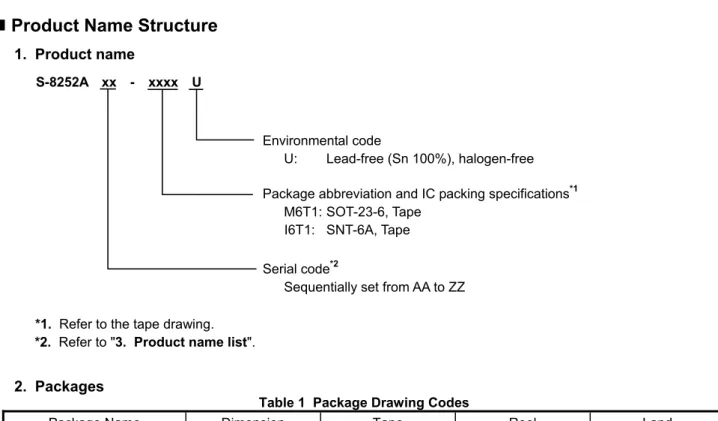
Product Name Structure
1. Product name
S-8252A xx - xxxx U
Package abbreviation and IC packing specifications*1
M6T1: SOT-23-6, Tape I6T1: SNT-6A, Tape Serial code*2
Sequentially set from AA to ZZ Environmental code
U: Lead-free (Sn 100%), halogen-free
*1. Refer to the tape drawing.
*2. Refer to "3. Product name list".
2. Packages
Table 1 Package Drawing Codes
Package Name Dimension Tape Reel Land SOT-23-6 MP006-A-P-SD MP006-A-C-SD MP006-A-R-SD −
3. Product name list
3. 1 SOT-23-6 Table 2 Product Name Over- charge Detection Voltage [VCU] Over- charge Release Voltage [VCL] Over- discharge Detection Voltage [VDL] Over- discharge Release Voltage [VDU] Discharge Overcurrent Detection Voltage [VDIOV] Charge Overcurrent Detection Voltage [VCIOV] 0 V Battery Charge Function Power- down Function Delay Time Combination*1S-8252AAA-M6T1U 4.280 V 4.080 V 2.00 V 2.00 V 0.20 V −0.10 V Unavailable Available (1) S-8252AAB-M6T1U 4.325 V 4.075 V 2.20 V 2.90 V 0.21 V −0.20 V Unavailable Available (1) S-8252AAC-M6T1U 4.300 V 4.100 V 2.40 V 3.00 V 0.20 V −0.20 V Unavailable Available (1) S-8252AAD-M6T1U 4.280 V 4.130 V 2.40 V 2.90 V 0.15 V −0.15 V Unavailable Available (1) S-8252AAE-M6T1U 4.350 V 4.150 V 2.30 V 3.00 V 0.30 V −0.30 V Available Available (1) S-8252AAF-M6T1U 4.350 V 4.100 V 2.40 V 3.00 V 0.15 V −0.15 V Available Available (1) S-8252AAG-M6T1U 4.300 V 4.150 V 2.80 V 3.00 V 0.15 V −0.15 V Available Available (1) S-8252AAH-M6T1U 4.250 V 4.100 V 3.00 V 3.00 V 0.20 V −0.20 V Available Available (1) S-8252AAI-M6T1U 3.650 V 3.450 V 2.00 V 2.70 V 0.20 V −0.20 V Available Unavailable (1) S-8252AAJ-M6T1U 3.900 V 3.500 V 2.00 V 2.50 V 0.20 V −0.20 V Available Unavailable (1) S-8252AAK-M6T1U 4.350 V 4.150 V 2.30 V 3.00 V 0.20 V −0.20 V Available Available (1) S-8252AAL-M6T1U 4.200 V 4.050 V 2.50 V 3.00 V 0.20 V −0.20 V Unavailable Available (1) S-8252AAO-M6T1U 4.250 V 4.100 V 2.50 V 3.00 V 0.20 V −0.10 V Unavailable Available (1) S-8252AAP-M6T1U 4.350 V 4.150 V 2.20 V 2.90 V 0.20 V −0.40 V Unavailable Available (1) S-8252AAQ-M6T1U 4.300 V 4.100 V 2.60 V 3.00 V 0.40 V −0.40 V Unavailable Available (1)
S-8252AAR-M6T1U 4.300 V 4.100 V 2.60 V 3.00 V 0.40 V − Unavailable Available (3) S-8252AAS-M6T1U 4.250 V 4.050 V 2.50 V 3.00 V 0.20 V −0.20 V Available Unavailable (1) S-8252AAT-M6T1U 4.250 V 4.100 V 2.70 V 3.00 V 0.12 V −0.05 V Available Available (1) S-8252AAU-M6T1U 4.275 V 4.075 V 2.50 V 2.90 V 0.30 V −0.10 V Available Available (1) S-8252AAV-M6T1U 4.400 V 4.250 V 2.50 V 2.90 V 0.15 V −0.10 V Available Available (1) S-8252AAW-M6T1U 4.350 V 4.150 V 2.30 V 3.00 V 0.20 V −0.40 V Unavailable Available (1) S-8252AAX-M6T1U 4.230 V 4.030 V 2.75 V 3.05 V 0.15 V −0.10 V Unavailable Available (1) S-8252AAY-M6T1U 4.250 V 4.050 V 3.00 V 3.20 V 0.15 V −0.05 V Unavailable Available (2) S-8252AAZ-M6T1U 4.225 V 4.075 V 2.40 V 2.90 V 0.15 V −0.15 V Unavailable Available (1) S-8252ABA-M6T1U 4.300 V 4.150 V 3.00 V 3.10 V 0.10 V −0.15 V Available Available (1) S-8252ABB-M6T1U 4.300 V 4.100 V 2.00 V 2.00 V 0.12 V − Available Available (3) S-8252ABC-M6T1U 4.300 V 4.100 V 2.00 V 2.00 V 0.055 V − Available Available (3) S-8252ABD-M6T1U 4.300 V 4.100 V 2.40 V 3.00 V 0.20 V −0.20 V Unavailable Available (4) S-8252ABE-M6T1U 4.225 V 4.075 V 2.40 V 2.90 V 0.10 V −0.10 V Unavailable Available (1) S-8252ABF-M6T1U 4.300 V 4.100 V 2.40 V 2.40 V 0.10 V −0.10 V Available Available (1) S-8252ABG-M6T1U 4.280 V 4.130 V 2.40 V 2.90 V 0.15 V −0.15 V Unavailable Unavailable (1) S-8252ABH-M6T1U 4.300 V 4.100 V 2.40 V 2.40 V 0.15 V −0.15 V Available Available (1) S-8252ABI-M6T1U 4.425 V 4.225 V 2.50 V 2.80 V 0.15 V −0.10 V Unavailable Unavailable (1)
S-8252ABQ-M6T1U 4.300 V 4.100 V 2.37 V 2.97 V 0.21 V − Unavailable Unavailable (3)
S-8252ABR-M6T1U 4.300 V 4.100 V 2.30 V 2.70 V 0.28 V −0.25 V Unavailable Available (1)
S-8252ABS-M6T1U 4.350 V 4.150 V 2.00 V 2.40 V 0.25 V −0.40 V Unavailable Available (1)
S-8252ABT-M6T1U 4.450 V 4.250 V 2.30 V 2.70 V 0.28 V −0.25 V Unavailable Available (1)
S-8252ABU-M6T1U 4.500 V 4.300 V 2.00 V 2.40 V 0.25 V −0.40 V Unavailable Available (1)
S-8252ABV-M6T1U 4.300 V 4.100 V 2.37 V 2.57 V 0.21 V − Unavailable Unavailable (3)
S-8252ABW-M6T1U 4.300 V 4.100 V 2.37 V 2.57 V 0.40 V − Unavailable Unavailable (3)
S-8252ABX-M6T1U 4.350 V 4.150 V 2.10 V 2.40 V 0.25 V − Unavailable Unavailable (3)
S-8252ABY-M6T1U 4.450 V 4.250 V 2.30 V 2.70 V 0.37 V − Unavailable Unavailable (3)
S-8252ACB-M6T1U*2 4.300 V 4.100 V 2.27 V 2.37 V 0.21 V − Unavailable Unavailable (3) S-8252ACC-M6T1U*2 4.300 V 4.100 V 2.28 V 2.38 V 0.25 V − Unavailable Unavailable (3) *1. Refer to Table 4 about the details of the delay time combinations.
*2. Load short-circuiting detection voltage: 0.9 V ± 0.1 V
5 3. 2 SNT-6A Table 3 Product Name Over- charge Detection Voltage [VCU] Over- charge Release Voltage [VCL] Over- discharge Detection Voltage [VDL] Over- discharge Release Voltage [VDU] Discharge Overcurrent Detection Voltage [VDIOV] Charge Overcurrent Detection Voltage [VCIOV] 0 V Battery Charge Function Power- down Function Delay Time Combination*1
S-8252AAA-I6T1U 4.280 V 4.080 V 2.00 V 2.00 V 0.20 V −0.10 V Unavailable Available (1) S-8252AAH-I6T1U 4.250 V 4.100 V 3.00 V 3.00 V 0.20 V −0.20 V Available Available (1) S-8252AAM-I6T1U 4.250 V 4.050 V 2.40 V 3.00 V 0.10 V −0.10 V Available Available (1) S-8252AAN-I6T1U 4.325 V 4.075 V 2.20 V 2.90 V 0.21 V −0.10 V Available Available (1) S-8252AAY-I6T1U 4.250 V 4.050 V 3.00 V 3.20 V 0.15 V −0.05 V Unavailable Available (2)
S-8252ABJ-I6T1U 4.300 V 4.100 V 2.40 V 3.00 V 0.21 V −0.25 V Unavailable Available (1) S-8252ABK-I6T1U 4.350 V 4.150 V 2.30 V 2.90 V 0.16 V −0.40 V Unavailable Available (1)
S-8252ABL-I6T1U 4.300 V 4.100 V 2.40 V 2.60 V 0.24 V −0.20 V Unavailable Available (5)
S-8252ABM-I6T1U 4.350 V 4.150 V 2.30 V 2.50 V 0.17 V −0.40 V Unavailable Available (5)
S-8252ABO-I6T1U 4.300 V 4.100 V 2.30 V 2.70 V 0.23 V −0.25 V Unavailable Available (5)
S-8252ABP-I6T1U 4.350 V 4.150 V 2.00 V 2.40 V 0.19 V −0.40 V Unavailable Available (5)
*1. Refer to Table 4 about the details of the delay time combinations.
Remark Please contact our sales office for the products with detection voltage value other than those specified above.
Table 4 Delay Time Combination Overcharge Detection Delay Time [tCU] Overdischarge Detection Delay Time [tDL] Discharge Overcurrent Detection Delay Time [tDIOV] Load Short-circuiting Detection Delay Time [tSHORT] Charge Overcurrent Detection Delay Time [tCIOV] (1) 1.0 s 128 ms 8 ms 280 μs 8 ms (2) 1.0 s 500 ms 8 ms 280 μs 8 ms (3) 1.0 s 128 ms 8 ms 280 μs − (4) 1.0 s 128 ms 8 ms 1 ms 8 ms (5) 1.0 s 128 ms 16 ms 280 μs 8 ms
Remark The delay times can be changed within the range listed Table 5. For details, please contact our sales office.
Table 5
Delay Time Symbol Selection Range Remark Overcharge detection delay time tCU 256 ms 512 ms 1.0 s*1 Select a value from the left.
Overdischarge detection delay time tDL 32 ms 64 ms 128 ms*1 Select a value from the left.
Discharge overcurrent detection delay time tDIOV 4 ms 8 ms*1 16 ms Select a value from the left.
Load short-circuiting detection delay time tSHORT 280 μs*1 500 μs 1 ms Select a value from the left.
Charge overcurrent detection delay time tCIOV 4 ms 8 ms*1 16 ms Select a value from the left. *1. This value is the delay time of the standard products.
Pin Configurations
1. SOT-23-6
1 2 3 5 4 6 Top view Figure 2 Table 6Pin No. Symbol Description 1 DO Connection pin of discharge control FET gate
(CMOS output)
2 CO Connection pin of charge control FET gate (CMOS output)
3 VM Voltage detection pin between VM pin and VSS pin (Overcurrent / charger detection pin)
4 VC Connection pin for negative voltage of battery 1 and connection pin for positive voltage of battery 2 5 VDD Connection pin for positive power supply input and
connection pin for positive voltage of battery 1 6 VSS Connection pin for negative power supply input and
connection pin for negative voltage of battery 2
2. SNT-6A
5 4 6 2 3 1 Top view Figure 3 Table 7Pin No. Symbol Description
1 VM Voltage detection pin between VM pin and VSS pin (Overcurrent / charger detection pin)
2 CO Connection pin of charge control FET gate (CMOS output)
3 DO Connection pin of discharge control FET gate (CMOS output)
4 VSS Connection pin for negative power supply input and connection pin for negative voltage of battery 2 5 VDD Connection pin for positive power supply input and
connection pin for positive voltage of battery 1 6 VC Connection pin for negative voltage of battery 1 and
7
Absolute Maximum Ratings
Table 8
(Ta = +25°C unless otherwise specified) Item Symbol Applied pin Absolute Maximum Rating Unit Input voltage between VDD pin and VSS pin VDS VDD VSS− 0.3 to VSS+ 12 V
VC pin input voltage VVC VC VSS− 0.3 to VDD+ 0.3 V
VM pin input voltage VVM VM VDD− 28 to VDD+ 0.3 V
DO pin output voltage VDO DO VSS− 0.3 to VDD+ 0.3 V
CO pin output voltage VCO CO VVM− 0.3 to VDD+ 0.3 V
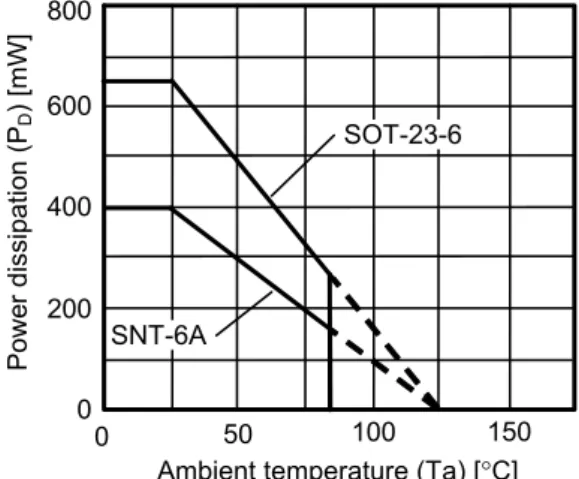
Power dissipation SOT-23-6 PD − 650
*1 mW
SNT-6A − 400*1 mW
Operation ambient temperature Topr − −40 to +85 °C
Storage temperature Tstg − −55 to +125 °C *1. When mounted on board
[Mounted board]
(1) Board size: 114.3 mm × 76.2 mm × t1.6 mm (2) Board name: JEDEC STANDARD51-7
Caution The absolute maximum ratings are rated values exceeding which the product could suffer physical damage. These values must therefore not be exceeded under any conditions.
0 50 100 150 800 400 0 Powe r dissipatio n (P D ) [mW]
Ambient temperature (Ta) [°C] SOT-23-6
200 600
SNT-6A
Electrical Characteristics
1. Ta =
+
25°C
Table 9
(Ta = +25°C unless otherwise specified) Item Symbol Condition Min. Typ. Max. Unit CircuitTest
DETECTION VOLTAGE
Overcharge detection voltage n (n = 1, 2) VCUn − VCU−0.020 VCU VCU+ 0.020 V 1
Ta = −10°C to +60°C*1 V
CU−0.025 VCU VCU+ 0.025 V 1
Overcharge release voltage n (n = 1, 2) VCLn VCL≠ VCU VCL− 0.030 VCL VCL+ 0.030 V 1
VCL = VCU VCL− 0.030 VCL VCL+ 0.020 V 1
Overdischarge detection voltagen (n = 1, 2) VDLn − VDL−0.050 VDL VDL+ 0.050 V 2
Overdischarge release voltage n (n = 1, 2) VDUn VDL≠ VDU VDU− 0.100 VDU VDU+ 0.100 V 2
VDL = VDU VDU− 0.050 VDU VDU+ 0.050 V 2
Discharge overcurrent detection voltage VDIOV − VDIOV−0.010 VDIOV VDIOV+ 0.010 V 2
Load short-circuiting detection voltage VSHORT − 0.40 0.50 0.60 V 2 DETECTION VOLTAGE (WITH CHARGE OVERCURRENT DETECTION FUNCTION)
Charge overcurrent detection voltage VCIOV − VCIOV−0.020 VCIOV VCIOV+ 0.020 V 2 DETECTION VOLTAGE (WITHOUT CHARGE OVERCURRENT DETECTION FUNCTION)
Charger detection voltage VCHA − −1.0 −0.7 −0.4 V 2 0 V BATTERY CHARGE FUNCTION
0 V battery charge starting charger voltage V0CHA 0 V battery charge function"available" 0.0 0.7 1.0 V 2
0 V battery charge inhibition battery voltage V0INH 0 V battery charge function"unavailable" 0.4 0.8 1.1 V 2 INTERNAL RESISTANCE
Resistance between VM pin and VDD pin RVMD V1 = V2 = 1.8 V, V3 = 0 V 100 300 900 kΩ 3
Resistance between VM pin and VSS pin RVMS V1 = V2 = 3.5 V, V3 = 1.0 V 10 20 40 kΩ 3 INPUT VOLTAGE
Operation voltage between VDD pin and
VSS pin VDSOP1 − 1.5 − 10 V −
INPUT CURRENT (WITH POWR-DOWN FUNCTION)
Current consumption during operation IOPE V1 = V2 = 3.5 V, V3 = 0 V − 4.0 8.0 μA 2
Current consumption during power-down IPDN V1 = V2 = 1.5 V, V3 = 3.0 V − − 0.1 μA 2
VC pin current IVC V1 = V2 = 3.5 V, V3 = 0 V 0.0 0.7 1.5 μA 2 INPUT CURRENT (WITHOUT POWR-DOWN FUNCTION)
Current consumption during operation IOPE V1 = V2 = 3.5 V, V3 = 0 V − 4.0 8.0 μA 2
Current consumption during overdischarge IOPED V1 = V2 = 1.5 V, V3 = 3.0 V − 2.5 5.0 μA 2
VC pin current IVC V1 = V2 = 3.5 V, V3 = 0 V 0.0 0.7 1.5 μA 2 OUTPUT RESISTANCE
CO pin resistance "H" RCOH V1 = V2 = 3.5 V,V3 = 0 V, V4 = 6.5 V 2.5 5 10 kΩ 4
CO pin resistance "L" RCOL V1 = V2 = 4.7 V,V3 = 0 V, V4 = 0.5 V 2.5 5 10 kΩ 4
DO pin resistance "H" RDOH V1 = V2 = 3.5 V,V3 = 0 V, V5 = 6.5 V 5 10 20 kΩ 4
DO pin resistance "L" RDOL V1 = V2 = 1.8 V, V3 = 3.6 V, V5 = 0.5 V 5 10 20 kΩ 4 DELAY TIME
Overcharge detection delay time tCU − tCU×0.8 tCU tCU× 1.2 − 5
Overdischarge detection delay time tDL − tDL×0.8 tDL tDL× 1.2 − 5
Discharge overcurrent detection delay time tDIOV − tDIOV×0.8 tDIOV tDIOV× 1.2 − 5
Load short-circuiting detection delay time tSHORT − tSHORT×0.8 tSHORT tSHORT×1.2 − 5
Charge overcurrent detection delay time tCIOV − tCIOV×0.8 tCIOV tCIOV× 1.2 − 5 *1. Since products are not screened at high and low temperature, the specification for this temperature range is guaranteed by
9
2. Ta =
−
40°C to
+
85°C
*1Table 10
(Ta = −40°C to +85°C*1 unless otherwise specified)
Item Symbol Condition Min. Typ. Max. Unit Test Circuit
DETECTION VOLTAGE
Overcharge detection voltage n (n = 1, 2) VCUn − VCU− 0.045 VCU VCU+ 0.030 V 1
Overcharge release voltage n (n = 1, 2) VCLn
VCL≠ VCU VCL− 0.070 VCL VCL+ 0.040 V 1
VCL = VCU VCL− 0.050 VCL VCL+ 0.030 V 1
Overdischarge detection voltage n (n =1, 2) VDLn − VDL− 0.085 VDL VDL+ 0.060 V 2
Overdischarge release voltage n (n =1, 2) VDUn VDL≠ VDU VDU− 0.140 VDU VDU+ 0.110 V 2
VDL = VDU VDU− 0.085 VDU VDU+ 0.060 V 2
Discharge overcurrent detection voltage VDIOV − VDIOV− 0.010 VDIOV VDIOV+ 0.010 V 2
Load short-circuiting detection voltage VSHORT − 0.40 0.50 0.60 V 2 DETECTION VOLTAGE (WITH CHARGE OVERCURRENT DETECTION FUNCTION)
Charge overcurrent detection voltage VCIOV − VCIOV− 0.020 VCIOV VCIOV+ 0.020 V 2 DETECTION VOLTAGE (WITHOUT CHARGE OVERCURRENT DETECTION FUNCTION)
Charger detection voltage VCHA − −1.2 −0.7 −0.2 V 2 0 V BATTERY CHARGE FUNCTION
0 V battery charge starting charger voltage V0CHA 0 V battery charge function
"available" 0.0 0.7 1.5 V 2 0 V battery charge inhibition battery voltage V0INH 0 V battery charge function
"unavailable" 0.3 0.8 1.3 V 2
INTERNAL RESISTANCE
Resistance between VM pin and VDD pin RVMD V1 = V2 = 1.8 V, V3 = 0 V 78 300 1310 kΩ 3
Resistance between VM pin and VSS pin RVMS V1 = V2 = 3.5 V, V3 = 1.0 V 7.2 20 44 kΩ 3 INPUT VOLTAGE
Operation voltage between VDD pin and
VSS pin VDSOP1 − 1.5 − 10 V −
INPUT CURRENT (WITH POWER-DOWN FUNCTION)
Current consumption during operation IOPE V1 = V2 = 3.5 V, V3 = 0 V − 4.5 8.5 μA 2
Current consumption during power-down IPDN V1 = V2 = 1.5 V, V3 = 3.0 V − − 0.15 μA 2
VC pin current IVC V1 = V2 = 3.5 V, V3 = 0 V 0.0 1.2 2.0 μA 2 INPUT CURRENT (WITHOUT POWER-DOWN FUNCTION)
Current consumption during operation IOPE V1 = V2 = 3.5 V, V3 = 0 V − 4.5 8.5 μA 2
Current consumption during overdischarge IOPED V1 = V2 = 1.5 V, V3 = 3.0 V − 2.5 5.5 μA 2
VC pin current IVC V1 = V2 = 3.5 V, V3 = 0 V 0.0 1.2 2.0 μA 2 OUTPUT RESISTANCE
CO pin resistance "H" RCOH V1 = V2 = 3.5 V,
V3 = 0 V, V4 = 6.5 V 1.2 5 15 kΩ 4 CO pin resistance "L" RCOL V1 = V2 = 4.7 V,
V3 = 0 V, V4 = 0.5 V 1.2 5 15 kΩ 4 DO pin resistance "H" RDOH V1 = V2 = 3.5 V,
V3 = 0 V, V5 = 6.5 V 2.4 10 30 kΩ 4 DO pin resistance "L" RDOL V1 = V2 = 1.8 V,
V3 = 3.6 V, V5 = 0.5 V 2.4 10 30 kΩ 4
DELAY TIME
Overcharge detection delay time tCU − tCU× 0.3 tCU tCU× 2.0 − 5
Overdischarge detection delay time tDL − tDL× 0.3 tDL tDL× 2.0 − 5
Discharge overcurrent detection delay time tDIOV − tDIOV× 0.3 tDIOV tDIOV× 2.0 − 5
Load short-circuiting detection delay time tSHORT − tSHORT× 0.3 tSHORT tSHORT× 2.0 − 5
Charge overcurrent detection delay time tCIOV − tCIOV× 0.3 tCIOV tCIOV× 2.0 − 5 *1. Since products are not screened at high and low temperature, the specification for this temperature range is guaranteed by
Test Circuits
Caution Unless otherwise specified, the output voltage levels "H" and "L" at CO pin (VCO) and DO pin (VDO) are judged by the threshold voltage (1.0 V) of the N-channel FET. Judge the CO pin level with respect to VVM and the DO pin level with respect to VSS.
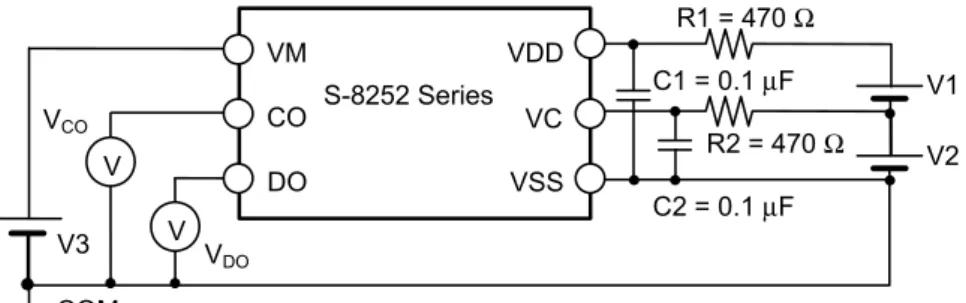
1. Overcharge detection voltage, overcharge release voltage
(Test circuit 1)
Overcharge detection voltage (VCU1) is defined as the voltage V1 at which VCO goes from "H" to "L" when the voltage
V1 is gradually increased from the starting condition of V1 = V2 = VCU −0.05 V, V3 = 0 V. Overcharge release voltage
(VCL1) is defined as the voltage V1 at which VCO goes from "L" to "H" when the voltage V1 is then gradually decreased
after setting V2 = 3.5 V. Overcharge hysteresis voltage (VHC1) is defined as the difference between VCU1 and VCL1.
Overcharge detection voltage (VCU2) is defined as the voltage V2 at which VCO goes from "H" to "L" when the voltage
V2 is gradually increased from the starting condition of V1 = V2 = VCU −0.05 V, V3 = 0 V. Overcharge release voltage
(VCL2) is defined as the voltage V2 at which VCO goes from "L" to "H" when the voltage V2 is then gradually decreased
after setting V1 = 3.5 V. Overcharge hysteresis voltage (VHC2) is defined as the difference between VCU2 and VCL2.
2. Overdischarge detection voltage, overdischarge release voltage
(Test circuit 2)
Overdischarge detection voltage (VDL1) is defined as the voltage V1 at which VDO goes from "H" to "L" when the
voltage V1 is gradually decreased from the starting condition of V1 = V2 = 3.5 V, V3 = 0 V. Overdischarge release voltage (VDU1) is defined as the voltage V1 at which VDO goes from "L" to "H" when the voltage V1 is then gradually
increased. Overdischarge hysteresis voltage (VHD1) is defined as the difference between VDU1 and VDL1.
Overdischarge detection voltage (VDL2) is defined as the voltage V2 at which VDO goes from "H" to "L" when the
voltage V2 is gradually decreased from the starting condition of V1 = V2 = 3.5 V, V3 = 0 V. Overdischarge release voltage (VDU2) is defined as the voltage V2 at which VDO goes from "L" to "H" when the voltage V2 is then gradually
increased. Overdischarge hysteresis voltage (VHD2) is defined as the difference between VDU2 and VDL2.
3. Discharge overcurrent detection voltage
(Test circuit 2)
Discharge overcurrent detection voltage (VDIOV) is defined as the voltage V3 whose delay time for changing VDO from
"H" to "L" is discharge overcurrent detection delay time (tDIOV) when the voltage V3 is increased from the starting
condition of V1 = V2 = 3.5 V, V3 = 0 V.
4. Load short-circuiting detection voltage
(Test circuit 2)
Load short-circuiting detection voltage (VSHORT) is defined as the voltage V3 whose delay time for changing VDO from
"H" to "L" is load short-circuiting detection delay time (tSHORT) when the voltage V3 is increased from the starting
condition of V1 = V2 = 3.5 V, V3 = 0 V.
5. Charge overcurrent detection voltage, charger detection voltage
(Test circuit 2)
5. 1 With charge overcurrent detection function
Charge overcurrent detection voltage (VCIOV) is defined as the voltage V3 whose delay time for changing VCO
from "H" to "L" is charge overcurrent detection delay time (tCIOV) when the voltage V3 is decreased from the
starting condition of V1 = V2 = 3.5 V, V3 = 0 V.
5. 2 Without charge overcurrent detection function
Charger detection voltage (VCHA) is defined as the voltage V3 at which VCO goes from "H" to "L" when the
voltage V3 is decreased from the starting condition of V1 = V2 = 3.5 V, V3 = 0 V.
6. Current consumption during operation
(Test circuit 2)
The current consumption during operation (IOPE) is the current that flows through the VDD pin (IDD) under the set
11
7. VC pin current
(Test circuit 2)
The VC pin current (IVC) is the current that flows through the VC pin (IVC) under the set conditions of V1 = V2 = 3.5 V,
V3 = 0 V.
8. Current consumption during power-down, current consumption during overdischarge
(Test circuit 2)
8. 1 With power-down function
The current consumption during power-down (IPDN) is the current that flows through the VSS pin (ISS) under the
set conditions of V1 = V2 = 1.5 V, V3 = 3.0 V.
8. 2 Without power-down function
The current consumption during overdischarge (IOPED) is the current that flows through the VSS pin (ISS) under
the set conditions of V1 = V2 = 1.5 V, V3 = 3.0 V.
9. Resistance between VM pin and VDD pin
(Test circuit 3)
RVMD is the resistance between VM pin and VDD pin under the set conditions of V1 = V2 = 1.8 V, V3 = 0 V.
10. Resistance between VM pin and VSS pin
(Test circuit 3)
RVMS is the resistance between VM pin and VSS pin under the set conditions of V1 = V2 = 3.5 V, V3 = 1.0 V.
11. CO pin resistance "H"
(Test circuit 4)
The CO pin resistance "H" (RCOH) is the resistance between VDD pin and CO pin under the set conditions of V1 = V2 =
3.5 V, V3 = 0 V, V4 = 6.5 V.
12. CO pin resistance "L"
(Test circuit 4)
The CO pin resistance "L" (RCOL) is the resistance between VM pin and CO pin under the set conditions of V1 = V2 =
4.7 V, V3 = 0 V, V4 = 0.5 V.
13. DO pin resistance "H"
(Test circuit 4)
The DO pin resistance "H" (RDOH) is the resistance between VDD pin and DO pin under the set conditions of V1 = V2 =
3.5 V, V3 = 0 V, V5 = 6.5 V
14. DO pin resistance "L"
(Test circuit 4)
The DO pin resistance "L" (RDOL) is the resistance between VSS pin and DO pin under the set conditions of V1 = V2 =
1.8 V, V3 = 0 V, V5 = 0.5 V.
15. Overcharge detection delay time
(Test circuit 5)
The overcharge detection delay time (tCU) is the time needed for VCO to go to "L" just after the voltage V1 increases
16. Overdischarge detection delay time
(Test circuit 5)
The overdischarge detection delay time (tDL) is the time needed for VDO to go to "L" after the voltage V1 decreases
and falls below VDL under the set condition of V1 = V2 = 3.5 V, V3 = 0 V.
17. Discharge overcurrent detection delay time
(Test circuit 5)
The discharge overcurrent detection delay time (tDIOV) is the time needed for VDO to go to "L" after the voltage V3
increases and exceeds VDIOV under the set conditions of V1 = V2 = 3.5 V, V3 = 0 V.
18. Load short-circuiting detection delay time
(Test circuit 5)
The load short-circuiting detection delay time (tSHORT) is the time needed for VDO to go to "L" after the voltage V3
increases and exceeds VSHORT under the set conditions of V1 = V2 = 3.5 V, V3 = 0 V.
19. Charge overcurrent detection delay time
(Test circuit 5)
The charge overcurrent detection delay time (tCIOV) is the time needed for VCO to go to "L" after the voltage V3
decreases and falls below VCIOV under the set condition of V1 = V2 = 3.5 V, V3 = 0 V.
20. 0 V battery charge starting charger voltage (0 V battery charge function "available")
(Test circuit 2)
The 0 V battery charge starting charger voltage (V0CHA) is defined as the absolute value of voltage V3 at which VCO
goes to "H" (VCO = VDD) when the voltage V3 is gradually decreased from the starting condition of V1 = V2 = V3 = 0
V.
21. 0 V battery charge inhibition battery voltage (0 V battery charge function "unavailable")
(Test circuit 2)
The 0 V battery charge inhibition battery voltage (V0INH) is defined as the voltage V1 at which VCO goes to "L" (VVM+
0.1 V or lower) when the voltage V1 is gradually decreased, after setting V1 = V2 = 1.5 V, V3 = −6.0 V.
VC S-8252 Series CO VM DO V V3 V VDD VSS R1 = 470Ω V1 V2 C1 = 0.1μF C2 = 0.1μF R2 = 470Ω COM VCO VDO
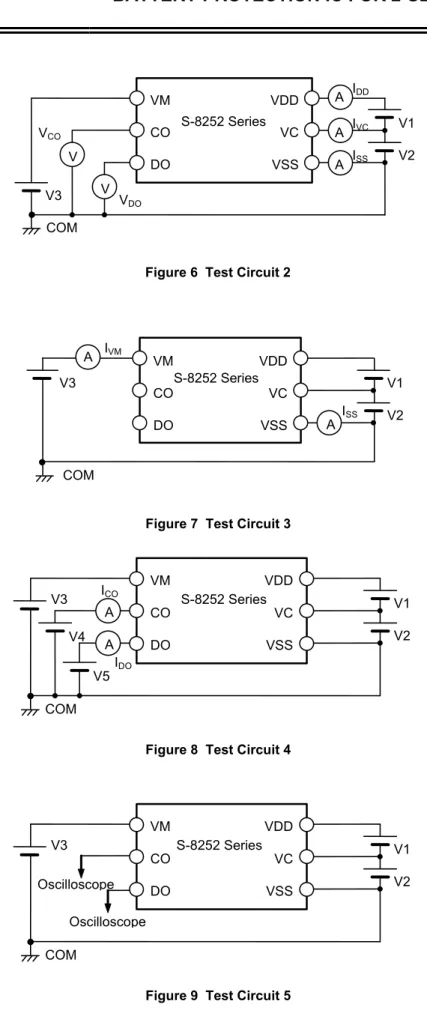
13 CO VM DO S-8252 Series A V4 VDD VC VSS V1 V2 A V5 COM V3 ICO IDO
Figure 8 Test Circuit 4
CO VM DO S-8252 Series VDD VC VSS V1 V2 COM V3 Oscilloscope Oscilloscope
Figure 9 Test Circuit 5
CO VM DO S-8252 Series V V3 V VDD VC VSS A A V1 V2 A COM VCO VDO IDD IVC ISS
Figure 6 Test Circuit 2
CO VM DO S-8252 Series A VDD VC VSS A V2 V1 COM V3 IVM ISS
Operation
Remark Refer to the " Battery Protection IC Connection Example".
Caution Unless otherwise specified, the VM pin voltage is based on VSS.
1. Normal status
1. 1 With charge overcurrent detection function
The S-8252 Series monitors the voltage of the battery connected between the VDD pin and VSS pin and the voltage difference between the VM pin and VSS pin to control charging and discharging. When the battery voltage is in the range from overdischarge detection voltage (VDL) to overcharge detection voltage (VCU), and the
VM pin voltage is in the range from the charge overcurrent detection voltage (VCIOV) to discharge overcurrent
detection voltage (VDIOV), The S-8252 Series turns both the charging and discharging control FETs on. This
condition is called the normal status, and in this condition charging and discharging can be carried out freely. The resistance (RVMD) between the VM pin and VDD pin, and the resistance (RVMS) between the VM pin and
VSS pin are not connected in the normal status.
Caution When the battery is connected for the first time, discharging may not be enabled. In this case, short the VM pin and VSS pin, or set the VM pin voltage at the level of VCIOV or more and VDIOV or less by connecting the charger. The S-8252 Series then returns to the normal status.
1. 2 Without charge overcurrent detection function
The S-8252 Series monitors the voltage of the battery connected between the VDD pin and VSS pin and the voltage difference between the VM pin and VSS pin to control charging and discharging. When the battery voltage is in the range from overdischarge detection voltage (VDL) to overcharge detection voltage (VCU), and the
VM pin voltage is in the range from the charger detection voltage (VCHA) to discharge overcurrent detection
voltage (VDIOV), The S-8252 Series turns both the charging and discharging control FETs on. This condition is
called the normal status, and in this condition charging and discharging can be carried out freely.
The resistance (RVMD) between the VM pin and VDD pin, and the resistance (RVMS) between the VM pin and
VSS pin are not connected in the normal status.
Caution When the battery is connected for the first time, discharging may not be enabled. In this case, short the VM pin and VSS pin, or set the VM pin voltage at the level of VCHA or more and VDIOV or less by connecting the charger. The S-8252 Series then returns to the normal status.
2. Overcharge status
When the battery voltage becomes higher than VCU during charging in the normal status and detection continues for
the overcharge detection delay time (tCU) or longer, the S-8252 Series turns the charging control FET off to stop
charging. This condition is called the overcharge status. RVMD and RVMS are not connected in the overcharge status.
The overcharge status is released in the following two cases ( (1) and (2) ).
(1) In the case that the VM pin voltage is lower than VDIOV, the S-8252 Series releases the overcharge status when
the battery voltage falls below VCL.
(2) In the case that the VM pin voltage is higher than or equal to VDIOV, the S-8252 Series releases the overcharge
status when the battery voltage falls below VCU.
When the discharge is started by connecting a load after the overcharge detection, the VM pin voltage rises more than the voltage at VSS pin due to the Vf voltage of the parasitic diode, because the discharge current flows
through the parasitic diode in the charging control FET. If this VM pin voltage is higher than or equal to VDIOV, the
S-8252 Series releases the overcharge status when the battery voltage is lower than or equal to VCU.
Caution 1. If the battery is charged to a voltage higher than VCU and the battery voltage does not fall below VCU even when a heavy load is connected, discharge overcurrent detection and load short-circuiting detection do not function until the battery voltage falls below VCU. Since an actual battery has an internal impedance of tens of mΩ, the battery voltage drops immediately after a heavy load that causes overcurrent is connected, and discharge overcurrent detection and load short-circuiting detection function.
2. If a charger is connected after the overcharge detection, the overcharge status is not released even when the battery voltage falls below VCL. The S-8252 Series releases the overcharge status when the VM pin voltage returns to VCIOV (or VCHA when without charge overcurrent detection function) or higher by removing the charger.
15
3. Overdischarge status
When the battery voltage falls below overdischarge detection voltage (VDL) during discharging in the normal status
and the condition continues for the overdischarge detection delay time (tDL) or longer, the S-8252 Series turns the
discharging control FET off to stop discharging. This condition is called the overdischarge status.
Under the overdischarge status, the VM pin and VDD pin are shorted by RVMD in the S-8252 Series. The VM pin is
pulled up by RVMD.
RVMS is not connected in the overdischarge status. 3. 1 With power-down function
Under the overdischarge status, when voltage difference between the VM pin and VDD pin is 0.8 V typ. or lower, the power-down function works and the current consumption is reduced to the current consumption during power-down (IPDN). By connecting a battery charger, the power-down function is released when the VM pin
voltage is 0.7 V typ. or lower.
• When a battery is not connected to a charger and the VM pin voltage ≥ 0.7 V typ., the S-8252 Series maintains the overdischarge status even when the battery voltage reaches VDU or higher.
• When a battery is connected to a charger and 0.7 V typ. > the VM pin voltage > −0.7 V typ., the battery voltage reaches VDU or higherand the S-8252 Series releases the overdischarge status.
• When a battery is connected to a charger and −0.7 V typ. ≥ the VM pin voltage, the battery voltage reaches VDL
or higherand the S-8252 Series releases the overdischarge status.
3. 2 Without power-down function
The power-down function does not work even when voltage difference between the VM pin and VDD pin is 0.8 V typ. or lower.
• When a battery is not connected to a charger and the VM pin voltage ≥ 0.7 V typ., the battery voltage reaches VDU or higherand the S-8252 Series releases the overdischarge status.
• When a battery is connected to a charger and 0.7 V typ. > the VM pin voltage > −0.7 V typ., the battery voltage reaches VDU or higherand the S-8252 Series releases the overdischarge status.
• When a battery is connected to a charger and −0.7 V typ. ≥ the VM pin voltage, the battery voltage reaches VDL
or higherand the S-8252 Series releases the overdischarge status.
4. Discharge overcurrent status (Discharge overcurrent, load short-circuiting)
When a battery in the normal status is in the status where the voltage of the VM pin is equal to or higher than VDIOV
because the discharge current is equal to or higher than the specified value and the status lasts for the discharge overcurrent detection delay time (tDIOV) or longer, the discharge control FET is turned off and discharging is stopped.
This status is called the discharge overcurrent status.
In the discharge overcurrent status, the VM pin and VSS pin are shorted by the RVMS in the S-8252 Series. However,
the voltage of the VM pin is at the VDD potential due to the load as long as the load is connected. When the load is
disconnected, the VM pin returns to the VSS potential.
If the voltage at the VM pin returns to VDIOV or lower, the S-8252 Series releases the discharge overcurrent status.
RVMD is not connected in the discharge overcurrent detection status.
5. Charge overcurrent status (with charge overcurrent detection function)
When a battery in the normal status is in the status where the voltage of the VM pin is equal to or lower than VCIOV
because the charge current is equal to or higher than the specified value and the status lasts for the charge overcurrent detection delay time (tCIOV) or longer, the charge control FET is turned off and charging is stopped. This
status is called the charge overcurrent status.
The S-8252 Series releases the charge overcurrent status when the voltage at the VM pin returns to VCIOV or higher
by removing the charger.
The charge overcurrent detection function does not work in the overdischarge status. RVMD and RVMS are not connected in the charge overcurrent detection status.
6. Abnormal charge current status (without charge overcurrent detection function)
If the VM pin voltage falls below the charger detection voltage (VCHA) during charging under normal status and it
continues for the overcharge detection delay time (tCU) or longer, the charging control FET turns off and charging
stops. This action is called the abnormal charge current status.
Abnormal charge current status is released when the voltage difference between VM pin and VSS pin becomes less than charger detection voltage (VCHA).
7. 0 V battery charge function "available"
This function is used to recharge a connected battery whose voltage is 0 V due to self-discharge. When the 0 V battery charge starting charger voltage (V0CHA) or a higher voltage is applied between the EB+ and EB− pins by
connecting a charger, the charging control FET gate is fixed to the VDD potential.
When the voltage between the gate and source of the charging control FET becomes equal to or higher than the threshold voltage due to the charger voltage, the charging control FET is turned on to start charging. At this time, the discharging control FET is off and the charging current flows through the internal parasitic diode in the discharging control FET. When the battery voltage becomes equal to or higher than VDU, the S-8252 Series enters the normal
status.
Caution 1. Some battery providers do not recommend recharging for a completely self-discharged battery. Please ask the battery provider to determine whether to enable or inhibit the 0 V battery charge function.
2. The 0 V battery charge function has higher priority than the charge overcurrent detection function. Consequently, a product in which use of the 0 V battery charge function is enabled charges a battery forcibly and the charge overcurrent cannot be detected when the battery voltage is lower than VDL.
8. 0 V battery charge function "unavailable"
This function inhibits charging when a battery that is internally short-circuited (0 V battery) is connected. When the battery voltage is the 0 V battery charge inhibition battery voltage (V0INH) or lower, the charging control FET gate is
fixed to the EB− pin voltage to inhibit charging. When the battery voltage is V0INH or higher, charging can be
performed.
Caution Some battery providers do not recommend recharging for a completely self-discharged battery. Please ask the battery provider to determine whether to enable or inhibit the 0 V battery charge function.
9. Delay circuit
The detection delay times are determined by dividing a clock of approximately 4 kHz by the counter.
Remark tDIOV and tSHORT start when VDIOV is detected. When VSHORT is detected over tSHORT after VDIOV, the S-8252
Series turns the discharging control FET off within tSHORT from the time of detecting VSHORT.
DO pin VM pin VDD VDD Time VDIOV VSS VSS VSHORT tSHORT Time tD 0 ≤ tD ≤ tSHORT Figure 10
17
Timing Chart
1. Overcharge detection, overdischarge detection
VCUn VDUn (VDLn + VHDn) VDLn VCLn (VCUn − VHCn) Battery voltage VSS CO pin voltage VDD DO pin voltage VSS Charger connection Load connection Status*1
Overcharge detection delay time (tCU) Overdischarge detection delay time (tDL)
(1) (2) (1) (3) (1) VDIOV VSS VM pin voltage VDD VEB− VDD VCIOV VEB− *1. (1): Normal status (2): Overcharge status (3): Overdischarge status
Remark The charger is assumed to charge with a constant current.
2. Discharge overcurrent detection
VDD VSS VSHORT (1) (2) (1) (1) Load short-circuiting detection delay time (tSHORT)(2) VDIOV
Discharge overcurrent detection delay time (tDIOV) VCUn VDUn (VDLn + VHDn) VDLn VCLn (VCUn − VHCn) Battery voltage VSS CO pin voltage VDD DO pin voltage VSS Load connection Status*1 VM pin voltage VDD *1. (1): Normal status
(2): Discharge overcurrent status
Remark The charger is assumed to charge with a constant current.
19
3. Charge overcurrent detection
VDD DO pin voltage VSS VDD VSS CO pin voltage VDD VSS VM pin voltage VCIOV Status*1 (1) (3) Charger connection VEB− VEB−
Charge overcurrent detection delay time (tCIOV)
VCUn VDun (VDLn + VHDn) VDLn VCLn (VCUn − VHCn) Battery voltage (2) Load connection (1) (1) (2) Overdischarge detection
delay time(tDL) Charge overcurrent detection delay time (tCIOV)
*1. (1): Normal status
(2): Charge overcurrent status (3): Overdischarge status
Remark The charger is assumed to charge with a constant current.
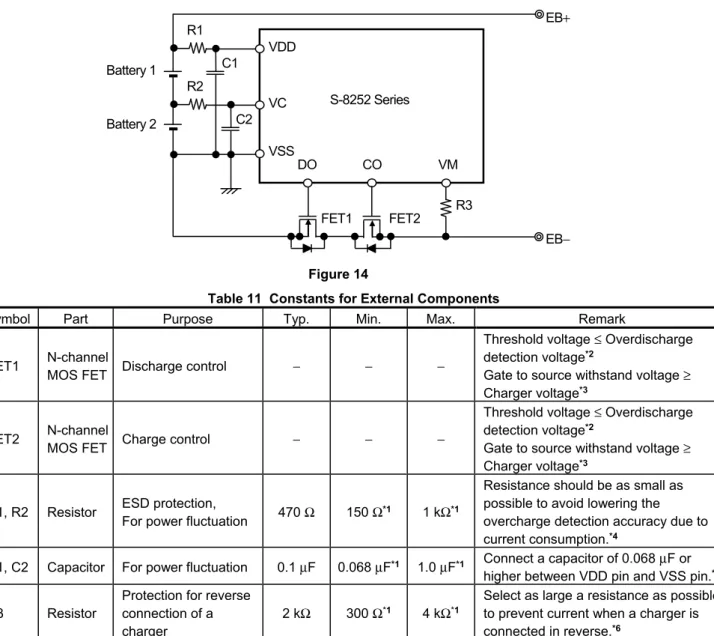
Battery Protection IC Connection Example
R1 Battery 1 C1 VSS DO VDD CO VM S-8252 Series FET1 FET2 EB− EB+ R3 R2 VC Battery 2 C2 Figure 14Table 11 Constants for External Components
Symbol Part Purpose Typ. Min. Max. Remark FET1 N-channel
MOS FET Discharge control − − −
Threshold voltage ≤ Overdischarge detection voltage*2
Gate to source withstand voltage ≥
Charger voltage*3
FET2 N-channel
MOS FET Charge control − − −
Threshold voltage ≤ Overdischarge detection voltage*2
Gate to source withstand voltage ≥
Charger voltage*3
R1, R2 Resistor ESD protection,
For power fluctuation 470 Ω 150 Ω*1 1 kΩ*1
Resistance should be as small as possible to avoid lowering the overcharge detection accuracy due to current consumption.*4
C1, C2 Capacitor For power fluctuation 0.1 μF 0.068 μF*1 1.0 μF*1 Connect a capacitor of 0.068 μF or
higher between VDD pin and VSS pin.*5
R3 Resistor
Protection for reverse connection of a charger
2 kΩ 300 Ω*1 4 kΩ*1
Select as large a resistance as possible to prevent current when a charger is connected in reverse.*6
*1. Please set up a filter constant to be R1 × C1 = R2 × C2.
*2. If the threshold voltage of an FET is low, the FET may not cut the charge current. If an FET with a threshold voltage equal to or higher than the overdischarge detection voltage is used, discharging may be stopped before overdischarge is detected.
*3. If the withstand voltage between the gate and source is equal to or lower than the charger voltage, the FET may be destroyed.
*4. An accuracy of overcharge detection voltage is guaranteed by R1 = 470 Ω. Connecting resistors with other values worsen the accuracy. In case of connecting larger resistor to R1, the voltage between the VDD pin and VSS pin may exceed the absolute maximum rating because the current flows to the S-8252 Series from the charger due to reverse connection of charger. Connect a resistor of 150 Ω or more to R1 for ESD protection.
*5. When connecting a resistor of 150 Ω or less to R1 or R2 or a capacitor of 0.068 μF or less to C1 or C2, the S-8252 Series may malfunction when power dissipation is largely fluctuated.
*6. When a resistor of 4 kΩ or more is connected to R3, the charge current may not be cut.
Caution 1. The above constants may be changed without notice.
2. It has not been confirmed whether the operation is normal or not in circuits other than the above example of connection. In addition, the example of connection shown above and the constant do not guarantee proper operation. Perform thorough evaluation using the actual application to set the constant.
21
Precautions
• The application conditions for the input voltage, output voltage, and load current should not exceed the package power dissipation.
• Do not apply an electrostatic discharge to this IC that exceeds the performance ratings of the built-in electrostatic protection circuit.
• SII Semiconductor Corporation claims no responsibility for any and all disputes arising out of or in connection with any infringement by products including this IC of patents owned by a third party.
Characteristics (Typical Data)
1. Current consumption
1. 1 IOPE vs. Ta 1. 2 IPDN vs. Ta I OPE [ μ A] 0 2 4 6 8 −40 −25 0 25 50 75 85 Ta [°C] 0 25 50 75 85 Ta [°C] 0.100 0.075 0.050 0.025 0 1. 3 IOPE vs. VDD 0 1 2 3 4 6 5 VDD [V] I OPE [ μ A] 0 2 4 6 8 1023
2. Overcharge detection / release voltage, overdischarge detection / release voltage,
overcurrent detection voltage, charge overcurrent detection voltage, and delay time
2. 1 VCU vs. Ta 2. 2 VCL vs. Ta 4.32 4.30 4.28 4.26 4.24 V CU [V] −40 −25 0 25 50 75 85 Ta [°C] 4.14 4.10 4.12 4.08 4.06 4.04 4.02 V CL [V] −40 −25 0 25 50 75 85 Ta [°C] 2. 3 VDL vs. Ta 2. 4 VDU vs. Ta 2.05 2.01 2.03 1.99 1.97 1.95 V DL [V] −40 −25 0 25 50 75 85 Ta [°C] 2.10 2.05 2.00 1.95 1.90 V DU [V] −40 −25 0 25 50 75 85 Ta [°C] 2. 5 tCU vs. Ta 2. 6 tDL vs. Ta 0.8 0.4 0.6 t CU [s] −40 −25 0 25 50 75 85 Ta [°C] 1.0 1.2 1.4 1.6 50 t DL [ms] −40 −25 0 25 50 75 85 Ta [°C] 75 100 150 125 175 200 2. 7 VDIOV vs. Ta 2. 8 tDIOV vs. VDD 0.220 0.210 0.200 0.190 0.180 V DIOV [V] −40 −25 0 25 50 75 85 Ta [°C] 4 6 8 10 12 VDD [V] t DIOV [ms] 4 5 6 7 8 9
2. 9 tDIOV vs. Ta 2. 10 VCIOV vs. Ta 12 10 8 6 4 t DIOV [ms] −40 −25 0 25 50 75 85 Ta [°C] −0.08 −0.09 −0.10 −0.11 −0.12 V CIOV [V] −40 −25 0 25 50 75 85 Ta [°C] 2. 11 tCIOV vs. VDD 2. 12 tCIOV vs. Ta 4 6 8 10 12 VDD [V] t CIOV [ms] 4 5 6 7 8 9 12 10 8 6 4 t CIOV [ms] −40 −25 0 25 50 75 85 Ta [°C] 2. 13 VSHORT vs. Ta 2. 14 tSHORT vs. VDD 0.40 V SHORT [V] −40 −25 0 25 50 75 85 Ta [°C] 0.45 0.50 0.55 0.60 200 150 250 300 350 400 VDD [V] t SHORT [ μ s] 4 5 6 7 8 9 2. 15 tSHORT vs. Ta 200 150 −40 −25 0 25 50 75 85 Ta [°C] 250 300 350 400 t SHORT [ μ s]
25
3. CO pin / DO pin
3. 1 RCOH vs. VCO 3. 2 RCOL vs. VCO
R COH [k Ω ] VCO [V] 7 3 2 1 4 5 6 0 0 6 4 2 8 10 R COL [k Ω ] VCO [V] 0 4 2 8 6 10 10 8 6 4 2 0
3. 3 RDOH vs. VDO 3. 4 RDOL vs. VDO
R DOH [k Ω ] VDO [V] 7 3 2 1 4 5 6 0 0 10 20 30 R DOL [k Ω ] VDO [V] 4 3 2 1 0 0 20 10 30
Marking Specifications
1. SOT-23-6
1 2 3 4 6 5 Top view (1) (2) (3) (4)(1) to (3): Product code (Refer to Product name vs. Product code) (4): Lot number
Product name vs. Product code
Product Name Product Code Product Name Product Code
(1) (2) (3) (1) (2) (3) S-8252AAA-M6T1U C G A S-8252ABA-M6T1U C H A S-8252AAB-M6T1U C G B S-8252ABB-M6T1U C H B S-8252AAC-M6T1U C G C S-8252ABC-M6T1U C H C S-8252AAD-M6T1U C G D S-8252ABD-M6T1U C H D S-8252AAE-M6T1U C G E S-8252ABE-M6T1U C H E S-8252AAF-M6T1U C G F S-8252ABF-M6T1U C H F S-8252AAG-M6T1U C G G S-8252ABG-M6T1U C H G S-8252AAH-M6T1U C G H S-8252ABH-M6T1U C H H S-8252AAI-M6T1U C G I S-8252ABI-M6T1U C H I S-8252AAJ-M6T1U C G J S-8252ABQ-M6T1U C H Q S-8252AAK-M6T1U C G K S-8252ABR-M6T1U C H R S-8252AAL-M6T1U C G L S-8252ABS-M6T1U C H S S-8252AAO-M6T1U C G O S-8252ABT-M6T1U C H T S-8252AAP-M6T1U C G P S-8252ABU-M6T1U C H U S-8252AAQ-M6T1U C G Q S-8252ABV-M6T1U C H V S-8252AAR-M6T1U C G R S-8252ABW-M6T1U C H W S-8252AAS-M6T1U C G S S-8252ABX-M6T1U C H X S-8252AAT-M6T1U C G T S-8252ABY-M6T1U C H Y S-8252AAU-M6T1U C G U S-8252ACB-M6T1U C B B S-8252AAV-M6T1U C G V S-8252ACC-M6T1U C B C S-8252AAW-M6T1U C G W S-8252AAX-M6T1U C G X S-8252AAY-M6T1U C G Y S-8252AAZ-M6T1U C G Z
27
2. SNT-6A
Top view 1 2 3 6 5 4 (1) (2) (3) (4) (5) (6)(1) to (3): Product code (Refer to Product name vs. Product code) (4) to (6): Lot number
Product name vs. Product code
Product Name Product Code Product Name Product Code
(1) (2) (3) (1) (2) (3) S-8252AAA-I6T1U C G A S-8252ABJ-I6T1U C H J S-8252AAH-I6T1U C G H S-8252ABK-I6T1U C H K S-8252AAM-I6T1U C G M S-8252ABL-I6T1U C H L S-8252AAN-I6T1U C G N S-8252ABM-I6T1U C H M S-8252AAY-I6T1U C G Y S-8252ABO-I6T1U C H O S-8252ABP-I6T1U C H P
No. TITLE SCALE UNIT 0.15 1 2 3 4 5 0.35±0.15 0.95 +0.1 -0.05 0.95 mm
No. MP006-A-P-SD-2.0
MP006-A-P-SD-2.0
SOT236-A-PKG Dimensions
No. TITLE SCALE
UNIT
SII Semiconductor Corporation
mm 1 2 3 4 5 6 ø1.5 +0.1-0 2.0±0.05 ø1.0 +0.2-0 4.0±0.1 1.4±0.2 0.25±0.1 3.2±0.2No. MP006-A-C-SD-3.1
MP006-A-C-SD-3.1
SOT236-A-Carrier Tape
Feed directionNo. TITLE SCALE UNIT mm 9.0±0.3 ø13±0.2 (60°) (60°) QTY 3,000
Enlarged drawing in the central part
No. MP006-A-R-SD-2.1
MP006-A-R-SD-2.1
SOT236-A-Reel
SII Semiconductor Corporation
No. TITLE SCALE UNIT mmSNT-6A-A-PKG Dimensions
PG006-A-P-SD-2.0
No. PG006-A-P-SD-2.0
0.2±0.05 0.48±0.02 0.08+0.05-0.02 0.5 1 2 3No. TITLE SCALE UNIT Feed direction 4.0±0.1 ø0.5 1.85±0.05 0.65±0.05 5° mm
PG006-A-C-SD-1.0
SNT-6A-A-Carrier Tape
No. PG006-A-C-SD-1.0
+0.1 -0 1 2 4 3 5 6SII Semiconductor Corporation
No. TITLE SCALE UNIT 9.0±0.3 ø13±0.2 (60°) (60°) QTY.No. PG006-A-R-SD-1.0
PG006-A-R-SD-1.0
Enlarged drawing in the central partSNT-6A-A-Reel
5,000No. TITLE SCALE UNIT mm
SNT-6A-A
-Land Recommendation
PG006-A-L-SD-4.1
No. PG006-A-L-SD-4.1
0.3 0.2 1.36 0.52 1 2Caution 1. Do not do silkscreen printing and solder printing under the mold resin of the package. 2. The thickness of the solder resist on the wire pattern under the package should be 0.03 mm
or less from the land pattern surface.
3. Match the mask aperture size and aperture position with the land pattern. 4. Refer to "SNT Package User's Guide" for details.
1. (0.25 mm min. / 0.30 mm typ.)
2. (1.30 mm ~ 1.40 mm)
0.03 mm SNT
1. Pay attention to the land pattern width (0.25 mm min. / 0.30 mm typ.).
2. Do not widen the land pattern to the center of the package ( 1.30 mm ~ 1.40 mm ).
1.
1. All the information described herein (product data, specifications, figures, tables, programs, algorithms and application circuit examples, etc.) is current as of publishing date of this document and is subject to change without notice.
2. The circuit examples and the usages described herein are for reference only, and do not guarantee the success of any specific mass-production design.
SII Semiconductor Corporation is not responsible for damages caused by the reasons other than the products or infringement of third-party intellectual property rights and any other rights due to the use of the information described herein.
3. SII Semiconductor Corporation is not responsible for damages caused by the incorrect information described herein. 4. Take care to use the products described herein within their specified ranges. Pay special attention to the absolute
maximum ratings, operation voltage range and electrical characteristics, etc.
SII Semiconductor Corporation is not responsible for damages caused by failures and/or accidents, etc. that occur due to the use of products outside their specified ranges.
5. When using the products described herein, confirm their applications, and the laws and regulations of the region or country where they are used and verify suitability, safety and other factors for the intended use.
6. When exporting the products described herein, comply with the Foreign Exchange and Foreign Trade Act and all other export-related laws, and follow the required procedures.
7. The products described herein must not be used or provided (exported) for the purposes of the development of weapons of mass destruction or military use. SII Semiconductor Corporation is not responsible for any provision (export) to those whose purpose is to develop, manufacture, use or store nuclear, biological or chemical weapons, missiles, or other military use.
8. The products described herein are not designed to be used as part of any device or equipment that may affect the human body, human life, or assets (such as medical equipment, disaster prevention systems, security systems, combustion control systems, infrastructure control systems, vehicle equipment, traffic systems, in-vehicle equipment, aviation equipment, aerospace equipment, and nuclear-related equipment), excluding when specified for in-vehicle use or other uses. Do not use those products without the prior written permission of SII Semiconductor Corporation. Especially, the products described herein cannot be used for life support devices, devices implanted in the human body and devices that directly affect human life, etc.
Prior consultation with our sales office is required when considering the above uses.
SII Semiconductor Corporation is not responsible for damages caused by unauthorized or unspecified use of our products.
9. Semiconductor products may fail or malfunction with some probability.
The user of these products should therefore take responsibility to give thorough consideration to safety design including redundancy, fire spread prevention measures, and malfunction prevention to prevent accidents causing
injury or death, fires and social damage, etc. that may ensue from the products' failure or malfunction. The entire system must be sufficiently evaluated and applied on customer's own responsibility.
10. The products described herein are not designed to be radiation-proof. The necessary radiation measures should be taken in the product design by the customer depending on the intended use.
11. The products described herein do not affect human health under normal use. However, they contain chemical substances and heavy metals and should therefore not be put in the mouth. The fracture surfaces of wafers and chips may be sharp. Take care when handling these with the bare hands to prevent injuries, etc.
12. When disposing of the products described herein, comply with the laws and ordinances of the country or region where they are used.
13. The information described herein contains copyright information and know-how of SII Semiconductor Corporation. The information described herein does not convey any license under any intellectual property rights or any other rights belonging to SII Semiconductor Corporation or a third party. Reproduction or copying of the information described herein for the purpose of disclosing it to a third-party without the express permission of SII Semiconductor Corporation is strictly prohibited.
14. For more details on the information described herein, contact our sales office.
1.0-2016.01
![Table 4 Delay Time Combination Overcharge Detection Delay Time [t CU ] Overdischarge Detection Delay Time [tDL] Discharge Overcurrent Detection Delay Time [tDIOV] Load Short-circuiting Detection Delay Time [tSHORT] Charge Overcurrent Detection Dela](https://thumb-us.123doks.com/thumbv2/123dok_us/8590168.2328344/5.892.76.850.161.482/combination-overcharge-detection-overdischarge-detection-discharge-overcurrent-overcurrent.webp)