Standards and Models on and Around Software Requirement Engineering: A Review
with Perspective of Varying Situations
Huma Hayat Khan, Mohd. Naz’ri bin Mahrin, Suriayati bt Chuprat Advanced Informatics School,
Universiti Teknologi Malaysia (UTM) Kuala Lumpur, Malaysia
[email protected] , [email protected], [email protected]
ABSTRACT
As part of our current research project, where we are investigating situational requirement engineering (RE) in Global Software Development (GSD) environment, here we are reviewing the standards and models on and around RE. In specific the objective of the review is to know the state of knowledge about situational RE from domain of standards and models on and around RE. We have reviewed 16 most relevant standards and models, which are directly or indirectly related to RE. We have performed systematic review for our research. The outcome of this study is some situational factors that have a significant consideration for investigating situational RE in GSD environment.
KEYWORDS
Software Requirement engineering (RE), Models, Standards, Global software development (GSD). 1 INTRODUCTION
Requirement engineering comprises of activities; requirement discovery, analysis, specification, validation and management. This process focuses on the usage of repeatable techniques in order to come up with complete, consistent and relevant requirements.
We have come to know from the previous literature on and around requirement engineering process, that there are some factors [1] [2], which can affect the software development and more specifically they are factual for requirement engineering. Some of these factors are human related factors, technical factors, management related factors etc. It is also evident from the literature [3] that not only technical issues but
besides this social, managerial, economic and organizational issues have an influence on requirement engineering process. These factors may become the source of changing situations, which need to be explored in detail.
It is to notify here that this study is a part of our main investigation which deals with the identification of situational factors affecting RE process in GSD environment. In this paper, we have limited our search on standards and models which are on and around RE process for the identification of the state of knowledge about situational factors, which may influence the RE process.
Section II of the paper describes the background of the research undertaken here, while Section III describes the research method which is adopted to identify the situational factors. Section IV describes the results of the research. Where as Section V comprises of discussion part of the research explaining the findings and future work. Section VI consists of conclusion of this research. 2 BACKGROUND
We have focused on the early development phase (RE) of the software life cycle due to the fact of its major effect on software functionality, productivity and development cost. Besides this poorly defines RE process by organization is also considered as another focusing reason for selection of RE phase. The importance of RE process for successful software development is further evident by the work of Boehm who explained the importance of system’s requirements by saying that requirement errors are hundred times more expensive to fix comparing
with system’s implementation errors [4]. Similarly Lutz [5] came up with the statement that critical systems 60% errors are requirements errors. Espite by performing a survey on European companies found that 60% people considered RE problems as very significant [6]. Hall [7] identified from case studies of twelve companies that out of 268 problems identified, 128 were related to requirements problem.
It is notified that the critical nature of RE is the result of some factors which act as a barrier for having quality RE process. There is a need to explore and identify state of knowledge related to varying situations for identifying the situational factors. In order to do so, we have selected the domain of standards and models on and around RE.
3 RESEARCH METHOD:
Our study has been divided into two main steps for identification the state of knowledge related to varying situations from the standards and models on and around RE.
Step1 deals with the selection of relevant standards and models on and around RE. In order to do so we have used the keywords of software requirement engineering AND standards, software requirement engineering AND models. Once we get the data units from the data sources, we again filter them on basis of their title, keywords and abstract. In the end we have left with 16 studies base on standards and models on and around RE. Step2 deals with the exploration of standards and models on and around RE for its support to varying situations. In this step we will review each of the 16 standards and models and determine the state of knowledge about situational RE. This we will perform by identifying the factors from each of the standard and model. These factors are considered as a source for varying situations during RE.
4 RESULTS
Following is the explanation of some of the standards and models on and around RE.
ISO 9001: This International Standard ISO 9001
[8] is by Technical Committee ISO/TC 176, Subcommittee SC 2 and Quality systems. This
mentioned standard is the third edition of ISO 9001 which not only cancels but also replaces the 2nd edition (ISO 9001:1994) with that of ISO 9002:1994 and ISO 9003:1994. ISO 9001 identify requirements for systems of quality management for an organization who a) wants to exhibit its capability to consistently give product that meets up customer requirements b) plans to improve customer satisfaction via valuable system application, together with processes for continuous system improvement and the guarantee of compliance to customer requirements. ISO 9001 requirements are generic and are planned to be appropriate to all organizations, in spite of organization type, organization size and organization product provided for enhancing the customer satisfaction by meeting customer requirements.
Some of the situational factors we have identified from ISO 9001 are as follows. The standard focuses on some aspects which actually vary among the developing teams like: activity priorities are different in development teams when they work together as they identify the linked activities and manage them in different ways. So in order to have an effective organizational functionality these linked activities should properly be prioritized. Similarly this standard also talks about the nature of the organization and says that it varies as different organization has different nature, (mature and immature) so this varying nature of organization impacts on meeting customer and regulatory requirements. The process to perform any activity also varies with organizational context. Besides this the standard also talks about the varying organizational size, activity type, process complexity, process interaction and personal competence. It says that the documentation is influenced by these factors. We also come across some more factors which influence the system effectiveness like; quality policy, quality objective, availability of resources, management review intervals. Besides these factors, resource management (human resource, infrastructure, work environment, customer related processes) also has an influence on system effectiveness. All these factors vary with among
multiple organizations leads to changing situations.
ISO 15504: This is an International standard [9]
for assessing the software processes and is developed in corresponding with other standards of software engineering. The purpose of this standard is to have continuous process improvement with that of the capability determination. The scope of the standard is both on comprehensive and modular scale. Processes comprise acquisition, supply, development, operation, maintenance and support on comprehensive level. On modular level it covers the selection of processes to be assessed and this assess activity is done on capability scale. The standard is the result of the SPiCE-Project (Software Process Improvement and Capability Determination- project). This SPiCE (Software
Process Improvement and Capability
Determination) is an assessment model which is two dimensional; process dimension and capability dimension. There are various versions of this standard like ISO/IEC 15504-2 situates the least requirements for having assessment that guarantee ratings steadiness and repeatability. Similarly ISO/IEC 15504-3 gives direction for inferring the requirements to perform assessment. ISO/IEC 15504-4 recognizes assessment of process as a doing that can be carried out either as initiative for process improvement or as an approach for capability determination. The reason of process improvement is to constantly progress effectiveness and efficiency of the organizations. The point or reason of process capability identification is to recognize the selected processes strengths and weaknesses. ISO/IEC 15504-5 consists of a Process Assessment Model which is based on the Process Reference Model which is explained in ISO/IEC 12207.
The standard focuses on the fact that the organization context in which the process is implemented, competency of the assessor and models for assessment of the process vary. This varying situation influences the process quality.
ISO/IEC 12207:2008: ISO/IEC 12207:2008
standard [10] creates a general framework for software life cycle processes, besides with that of well-defined terminology which can be used by the software industry. It relate to the attainment of
systems or software products and their services whether carried out with in or external to an organization. Considering these aspects the system definition is desired to present the software product or services context. It is to notify that the revision join together ISO/IEC 12207:1995 with its two modification and was synchronized with the corresponding revision of system life cycle processes (ISO/IEC 15288:2002) to align equivalent processes of organization and projects. It is also to consider that this standard may be used independently or together with ISO/IEC 15288, and provides a process related reference model that supports capability assessment of process in unity with process assessment from ISO/IEC 15504-2. So we come across this learning that this standard came into being for the following reasons; to include and rationalize revisions, to present a common terminology among the amendment of ISO/IEC 15288 and ISO/IEC 12207, to offer common names and structure of process where applicable between the amendment of the ISO/IEC 15288 and ISO/IEC 12207:2008, to facilitate the users to progress towards fully synchronized standards and to make available a steady standard, while capitalize on backward compatibility.
This standard clearly describes the fact related to project conduction that it is always in context of the organization. Besides this it also focuses on the software project outcomes and says that they are influenced by the business process of the organizations. Similarly the models to develop software are also influenced by the varying projects activity scope, magnitude, complexity, changing needs and opportunities. It is also to be notified that the life cycle stages, policies, process, procedure to support projects needs vary with organizational context. Operational environment and operational conditions also vary with organizational context which make difficult for the team to model the stakeholders requirement as it vary with the organizational operational environment and conditions. Standard describes the fact that the requirement definition process is influenced by human capabilities and skills. Besides this requirement definition process is also influenced by the workplace, environment, facilities and equipment provided. These factors
vary with the organizational context and have an influence on requirement definition process. IEEE
Std 830-1998: This standard [11] relateswith that
of a good software requirements specification (SRS). This suggested practice is intended for software requirements specification to be developed and used to help in the selection of software products for in-house and commercial usage. This practice illustrates approaches for the software requirement specification. Practice is based on a model whose result is an unambiguous and complete software requirement specification document. SRS can be created directly from this practice or indirectly by using a model for a more precise standard. It is also to be notified that this practice does not discover any specific method or tool for preparing a System or Software
Requirement Specification.
The factors identified from the standard are related to; requirement specification language, requirement representation tools, process approaches and says that these vary among the organizations which influence the system or software requirement specification.
IEEE Std 1233, 1998: This standard [12] provides
guidance for software requirements development, System Requirements Specification (SyRS). It includes requirement identification, requirement organization, requirement presentation, and requirement modification. It is also to be notified that it also addresses the conditions for including operational concepts, constraints related to design, and requirements configuration into the specification. Besides this it also covers the essential distinctiveness and qualities of individual or set of requirements.
The factors identified from this standard is on system requirement specification which influence it like; operational and logistical terms, organization political environment, organization market, organization standard, technical policies and organizational culture. Besides this system requirement specification is influenced by customer community and environment. The standard also describes the fact that the techniques and approaches to identify the requirements also varies on basis of organizational context which influence the requirements gathering or definition process.
IEEE Std 1362™-1998: This standard [13] deals
with the concept of operations (ConOps) document. It is a user-oriented document that explains proposed system characteristics from the users’ perspective. The concept of operation (ConOps) document is used to communicate the system characteristics to the stakeholders and other organizational elements like staffing, training etc. It is also notified that the standard is used to describe not only the user organization(s) but also the user mission(s) besides with that of the objectives of an organization from an integrated systems perspective. It acts as a guide for all software-intensive systems. Irrespective of this; concept in this guide can also be applied for hardware-only systems. The standard is applicable to all software products irrespective of its size, scope, complexity, or criticality.
Similar to other standards, we have identified some of the situational factors related to; operational policies and constraints, operational environment (hardware, software, equipment, personnel), organizational structure, responsibilities, skill level, work activities, model of interaction with system and says that these lead to changing situations.
ISO/IEC 15288: It is an International Standard
[14] ascertains a process framework for explaining systems life cycle. It explains the processes and related terminology for the life cycle from conception till retirement phase. Besides this; ISO/IEC 15288 also supports the process definition, process control, process assessment, and process improvement. This standard is created for following reasons: to come up with a common terminology between the amendment of the ISO/IEC 15288 and ISO/IEC 12207, to provide common names and structure of process between the amendment of the ISO/IEC 15288 and ISO/IEC 12207, to facilitate the users to progress towards fully synchronized standards and to make available a steady standard, while capitalize on backward compatibility.
This standard also highlights the hardware, software elements as the factors vary with organizational context. Besides this the standard also focuses on the human factors, technology factors and processes for the development of
product and services as the factors which vary with the organizational context.
ISO/IEC 24748: It is a standard [15] which directs
for the application base on ISO/IEC 12207:2008. It deals with the concepts of system, project, life cycle, process, organizations concepts, mainly via reference to ISO/IEC 24748-1 and ISO/IEC 12207:2008. This standard also provides guidance for applying ISO/IEC 12207:2008 in organizations and on projects from the perspective of application, strategy and planning. The standard has three editions and this is the most recent one which is deliberately associated with both ISO/IEC 24748-1 and ISO/IEC 24748-2 (which is a guide to the application of ISO/IEC 15288) in terms of terminology, structure and content. It is also to be notified that ISO/IEC 24748 gives amalgamated and consolidated for system’s or software’s life cycle management. Its goal is to ensure stability in system or life cycle’s concepts, models, stages, processes, application and adaptation.
From this standard we have identified some of the situational factors related to; Tools, technologies, process, facilities, equipments and workforce, as standard says that they are required by the development team and organization, which vary with organizational context. Similarly the project relationship management also varies with that of the organizations like formal or informal for specification as policies and procedures varies.
BOOTSTRAP: This is a methodology [16] which
continues to evolve. At the end of 1993 “The European Software Institute” actually decided to uphold transfer of technology and methodologies related to improvement within Europe, besides this they also decides to utilize Bootstrap as a considered tool to not only assess but also analyze the software processes and to set up improvement related programs. In their work author explains the model elements and tells that how this model can be utilized to assess the need to improve the process besides with its readiness for ISO 9001 certification.
We have identified the fact of varying process among organizations from BOOTSTRAP, as this model highlights the fact of varying process among the organizations by focusing on organizational contexts.
The Personal Software Process (PSP): Watts
comes up with “Personal Software Process (PSP)”. This model [17] gives engineers with a framework in order to perform software work. The PSP process comprises of methods, forms, and scripts which illustrate software engineers about planning, measuring, and managing their work. The PSP can be used with any design methodology. Besides this PSP can be used with different aspects of software work like; requirements specification, processes definition, and repairing defects. When engineers use the PSP, the objectives of products with zero defect rates, on time or on schedule production and within estimated costs.
The factors we have identified from this model are related to; engineer knowledge, process quality evaluation and engineer personal work quality as the varying factors among the organizations and has strong impact and influence on software quality.
Requirement Engineering Maturity
Measurement Framework (REMMF): Mahmood
Niazi et al. came up with a framework (REMMF) [18] which is based on Sommerville’s model [24][25]. The key reason of coming up with REMMF is to effectively compute or evaluate the requirement engineering process maturity which are used by organizations and to support practitioners in evaluating the requirement engineering process maturity.
We identified that the framework is based on model focuses the attention towards the requirement engineering problems and says that it varies with the organizational context. It says that communication style, application complexity, lack of training and undefined requirement process is some of the factors which create these problems as they vary with organizational context. Hence also highlights the organizational context aspects.
Software Capability Maturity Model (SW-CMM):
The SW-CMM [19] shows sets of suggested practices in form of key process areas (initial, repeatable, defined, managed and optimized) to improve software process capability. Besides this, it not only guides the software organizations to get control of processes use for software development and maintenance but also guides to progress
toward software engineering and excellence culture.
We identified from the model that it focuses on the varying quality objective factor among organizations for process or product evaluation.
Software Capability Maturity Model Integration
(SW-CMMI): The model CMM Integration [20]
gives guidance to improve organizations besides with the management of product or service from development till maintenance. CMMI help organizations to appraise the organizational maturity, developing improvement priorities and to implement them via approaches. Initial, Managed, Defined, Quantitatively Managed and Optimizing are the key areas of this model.
We identified the factors related to; quality objectives, models, application domain, organizational structure and size and process vary with organizational context. Besides this we came to know that the model focuses the attention towards the fact that the organization process operates in the business context it means that the process improvement efforts vary with organizational business environment. Similarly the model also describes the fact that the process varies among the organizations because the organizations have different contextual variables like; domain, nature of customers, costs, schedule, quality tradeoffs, technical difficulty of work, experience of the people who are indulged in implementing process. We also identified that the terminologies meaning vary among the development teams, which have influence on the software quality. Similarly it also says that the requirement management is greatly influenced by some of the factors like; distinct locations of the team members, engineering capabilities, staff and facilities available and staff experience. Model continues to explain some more factors which have influence on requirement process like; techniques due to varying economy and accountability, training techniques or approaches which vary on basis of work environment, organizational context, knowledge, cost and schedule, availability of critical resources and availability of key personals.
Requirements Capability Maturity Model
(R-CMM): Sarah Beecham et al. [21] come up with a
requirement process improvement model. The
model centers the attention on the requirements engineering process as distinct from the Software Engineering Institute’s (SEI’s) software process improvement framework. This model can be used either together with SW-CMM or separately to assess capability of Requirement Engineering process. The R-CMM comprises an assessment method which helps the user to be aware of their current Requirement Engineering process with perspective of its implementation in opposition to maturity goals.
From this model we identified the factors related to requirement engineering and says that it is greatly influenced by the organizational and technical factors like; poor stakeholders communication, staff retention rate, change resistance, resource allocation, skills, application complexity, requirement understanding, requirement traceability and undefined requirement engineering process. Besides this it also focuses attention towards the varying organizational culture and says that it greatly influences the development and support. Model describes the process improvement aspect and says that it is context sensitive like; product nature, its usage, customer perception about product and evolution and organizational structure. These factors vary with context and have an impact on process improvement.
Requirements Engineering Process Maturity
Model (Uni—REPM): There are number of
models discussed above which particularly focus on requirement engineering process but it is also not to be ignored that all these models are restricted to Bespoke development. This Uni-REPM is a model [22] which via set of activities presents the requirement engineering process maturity. These activities are comprised of seven
areas: Organizational support, Requirements Management Process, Elicitation, Requirements Analysis, Release Planning,
Documentation & Requirements Specification and Requirements Validation. The model provides support to the organizations to identify their process strengths and weaknesses. Besides this it also guides the organizations to better improve the requirement engineering process.
Similar with other models, we have identified that, this model also describes the processes varying nature with the characteristics of organization or environment. Similarly the requirements methods or techniques vary with usage context like, knowledge type and purpose of requirement. It is also notified that the sources of requirements are influenced by social and political aspects. Besides this the model says that the standard for the requirement documentation vary with organizational context as the organization customs, type of product and development process vary in them.
TRILLIUM: This model is for Telecom Product
Development & Support Process Capability.
Trillium model [23] is on basis of a customer
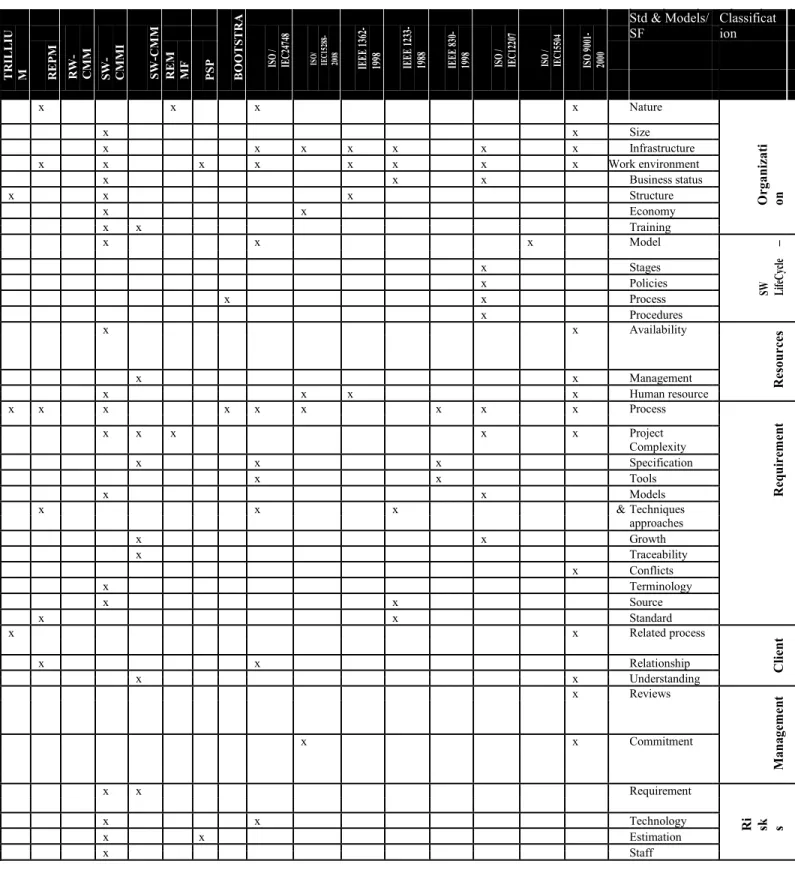
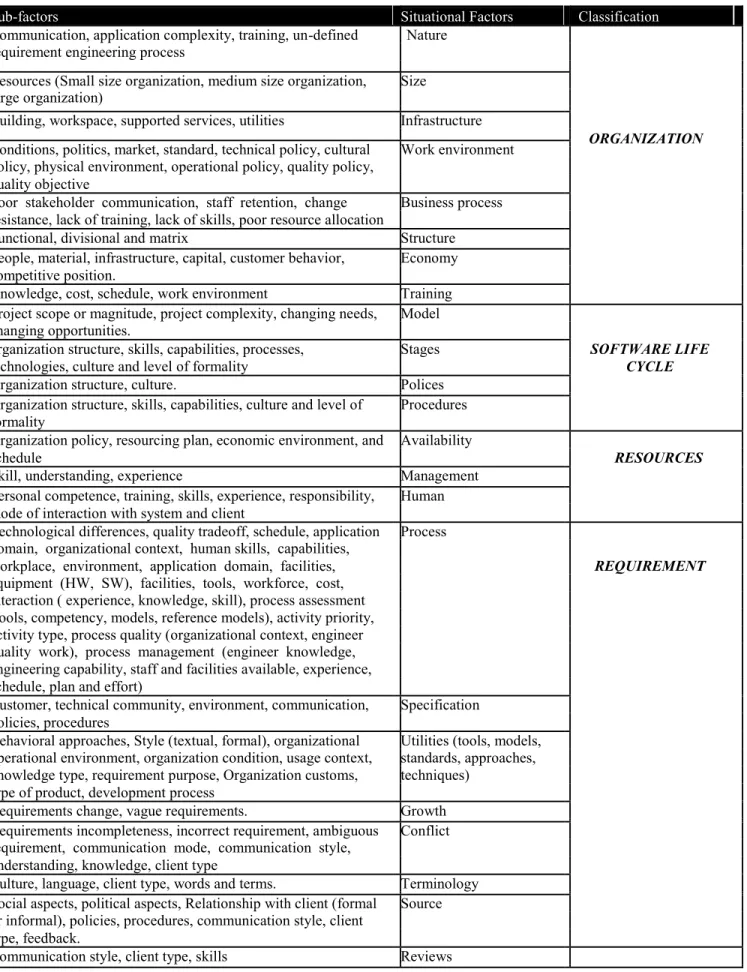
perspective, as apparent in a competitive setting. In this context, capability is to develop a product according to the customer needs, in less cost and with in schedule. This Trillium model is used by the organizations for continuous product development and improvement. This model is based on Capability Maturity Model (CMM). The factors we identified from this model are related to; organizational culture and say that it influences the development capability, process improvement and selection. Table 1 in appendix shows the summary of the identified situational factors. The identified situational factors are further decomposed into several sub-factors which are discussed and shown in Table 2 attached in appendix. In this last phase, 37 factors and 7 classifications that were formed are inspected for potential omissions base upon their duplications. And after omissions and modifications at classification, factors and sub- factors level 28 factors and 6 classifications are found.
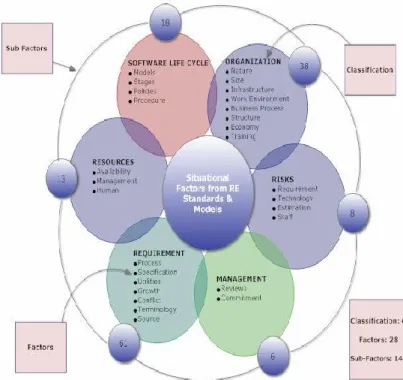
Figure 1 below shows the graphical representation of the supported situational factors from standards and models. As shown in the figure there is 6 classifications under which there are 28 situational factors and 144 sub- factors which are the components of factors.
Figure 1. Graphical representation of situational factors
5 DISCUSSIONS
In this section, we talk about how this work can be helpful for research communities. This work also leads to some possible future work areas. In the end some limitations are also discussed.
5.1 Utilizing Situational Factors:
The situational factors which are identified from the standards and models on and around the area of RE process are the important reference for researchers, who are working in situational RE. Besides this it is equally significant for researchers who are working with defining standards and models for RE, as they can get the state of knowledge about the support of varying situations from each of the standard and model, which later on can be used for defining a model or standard specifically focusing varying situations in RE. Specifically it is useful for the researchers who are working in requirement engineering process improvement with perspective of changing situations. The initial list can also guide the researchers and practitioners working in situational RE, to consider the standards and models as a significant consideration for dealing with changing situations faced by them while performing RE process.
Besides with the initial list identification, this work also contributes in describing all the related standards and models on and around RE process in detail by explaining its purpose and the domain in which these standards and models are used.
5.2 Future Work:
Our upcoming research is focusing to identify the state of knowledge in form of situational factors from other domains; risks related to requirement engineering, environmental factors, requirement engineering process tailoring etc. hence this study acts as a basis for the up coming research and also become one of the various other important inputs for the comprehensive list of situational factors which affect RE process in GSD.
5.3 Limitation:
This study does not cover the identification of factors from industry as the study comprises of the situational factors which are identified from the state-of-the knowledge. We make every effort to cover all the related standards and models on and around RE process but still possible, that we may miss any related standard and model. The threat of misinterpretation and precision can not be ignored too, as it is one of the must factor in every literature review.
6 CONCLUSION
This paper shows the evidence that the situational context is involved in finding the most suitable requirement process definition for any product. The paper covers the standards and modes on and around RE.
The study explores the standards and models and shows their state of knowledge related to varying situations. This we have shown by identifying the situational factors. In the end we come up with the list of unique situational factors which are filtered on basis of explicit and conceptual duplications. After which they are grouped with various labels and then classified accordingly.
We think that the list of situational factors consisting of key situational elements related to RE process represents a strong initial input from the domain of standards and models of RE process towards a comprehensive list of situational factors.
ACKNOWLEDGMENT
"The authors would like to thank ‘The Ministry of Higher Education (MOHE)’ and Research Management Centre, Universiti Teknologi Malaysia for supporting this research work via Grant Number: 07J53"
7 REFERENCES
1. Locke, E.A. and G.P. Latham, A theory of goal setting &
task performance. 1990: Prentice Hall.
2. Chatzoglou, P.D., Factors affecting completion of the
requirements capture stage of projects with different characteristics. Information and Software Technology, 1997. 39(9): p. 627-640.
3. Paul Clarke, Rory V. O’Connor, The situational factors
that affect the software development process: Towards a comprehensive reference framework, Information and Software Technology 54 (2012) 433– 447
4. Boehm, B. W, The economics of software maintenance. In Proceedings of Software Maintenance Workshop (Washington, D.C.), 1983, 9-37.
5. Jantunen, S., “Exploring software engineering practices
in small and medium-sized organizations”,Proceedings of the 2010 ICSE Workshop on Cooperative and Human aspects of Software engineering (CHASE’10), pp.99-101, 2010.
6. Espiti. Software process improvement on the right
road with ESPITI—The ESPITI European Survey Results. ESPITI Newsletter Issue 2, 1996. Available at:
http://www.cse.dcu.ie/cse/international/trispin/News2.html# espiti.
7. Hall, T., Beecham, S. & Rainer, A. Requirements
problems in twelve software companies: An empirical analysis. IEE Proceedings—Software, (2002) 149(5), 153–160.
8. Weissfelner, S. ISO 9001 for Software Organizations. In
K. Emam & N, 1999.
9. ISO/IEC 15504, Joint Technical Committee ISO/IEC
JTC, Software and system engineering, 2004.
10. ISO/IEC 12207:2008, Systems and software engineering
— Software life cycle processes, Software & Systems Engineering Standards Committee of the IEEE Computer Society, 2008.
11. IEEE Std 830-1998, IEEE Recommended Practice for Software Requirements Specifications, Software Engineering Standards Committee, 1998.
12. IEEE Std 1233, 1998 Edition, IEEE Guide for
Developing System Requirements Specifications, Software Engineering Standards Committee of the IEEE Computer Society, 1998.
13. IEEE Std 1362™-1998 (R2007), IEEE Guide for
Information Technology—System Definition— Concept of Operations (ConOps) Document, Software Engineering Standards Committee of the IEEE Computer Society, 2007.
14. IEEE Std 15288-2008, Systems and software
engineering —System life cycle processes, Software & Systems Engineering Standards Committee of the IEEE Computer Society, 2008.
15. IEEE Guide— Adoption of ISO/IEC TR 24748-3:2011,
Systems and Software Engineering—Life Cycle Management, Software & Systems Engineering Standards Committee, 2012.
16. Hasses, V., Messnarz, R., Koch, G., Kugler, H. J., and
Decrinis, P. Bootstrap: Fine tuning process assessment. IEEE Software 11, 4, 25–35, 1994.
17. Humphrey, W. Managing the Software Process.
Addison-Wesley, Reading, Mass, 1989.
18. Niazi, M., Cox, K., & Verner, J. An empirical study
identifying high perceived value requirements engineering practices. In Fourteenth International Conference on Information Systems Development (ISD’2005). Karlstad University, Sweden August 15–17, 2005.
19. Paulk M.C., and Chrissis M.B., The 2001 High Maturity
Workshop (CMU/SEI-2001-SR-014), Software
Engineering Institute, Carnegie Mellon University, Pittsburgh, PA, January 2002.
20. Ahern, D. M., Clouse, A., and Turner, R. CMMI
Distilled. Addison-Wesley, Reading, Mass. 2001
21. Beecham S., Hall T., and Rainer A., “Building a
Requirements Process Improvement Model,” Technical Report No. 378. University of Hertfordshire: Hatfield, 2003.
22. Gorscheck, T., Svahnberg, M., & Kaarina, T.
Introduction and application of a lightweight requirements engineering process evaluation method. In
Proceedings of the Requirements Engineering
Foundations for Software Quality (REFSQ’03) (pp. 83– 92). Klagenfurt/Velden, Austria, 2003.
23. Coallier, F. Trillium: A model for the assessment of
telecom product development and support capability. In Software Process Improvement, R. B. Hunter and R. H. Thayer, Eds. IEEE Computer Society Press, Los Alamitos, Calif. 1999.
24. Sommerville, I. and Sawyer, P. Requirements
Engineering: A Good Practice Guide. Wiley, Chichester.1997.
25. Sommerville, I., & Ransom, J. An empirical study of
industrial requirements engineering process assessment and improvement. ACM Transactions on Software Engineering and Methodology, 14(1), 85–117, 2005.
Appendix
Table 1. Situational Factors from Standards and Models
Classificat Std & Models/ B OO T ST R A ion SF IS O 9 00 1-20 00 IS O / IE C15 50 4 IS O / IE C1 22 07 IE EE 8 30 -1998 IE EE 12 33 -19 88 IE EE 13 62 -19 98 IS O/ IE C1 52 88 -2008 IS O / IE C2 47 48 SW -C M M SW -C M M I RW -C M M T R IL L IU M RE PSP M MF R E PM Nature x x x x Size x x O rg an iz ati on Infrastructure x x x x x x x Work environment x x x x x x x x Business status x x x Structure x x x Economy x x Training x x – Model x x x SW LifeCy cle Stages x Policies x Process x x Procedures x R es ou rc es Availability x x Management x x Human resource x x x x Process x x x x x x x x x R eq uir em en t Project x x x x x Complexity Specification x x x Tools x x Models x x Techniques & x x x approaches Growth x x Traceability x Conflicts x Terminology x Source x x Standard x x Client Related process x x Relationship x x Understanding x x M an ag em en t Reviews x Commitment x x Requirement x x Ri sk s Technology x x Estimation x x Staff x
Table 2. Classifications, situational factors and sub-factors
Classification Situational Factors
Sub-factors
Nature Communication, application complexity, training, un-defined
requirement engineering process
Size Resources (Small size organization, medium size organization,
large organization)
Infrastructure Building, workspace, supported services, utilities
ORGANIZATION
Work environment Conditions, politics, market, standard, technical policy, cultural
policy, physical environment, operational policy, quality policy, quality objective
Business process Poor stakeholder communication, staff retention, change
resistance, lack of training, lack of skills, poor resource allocation
Structure Functional, divisional and matrix
Economy People, material, infrastructure, capital, customer behavior,
competitive position.
Training Knowledge, cost, schedule, work environment
Model Project scope or magnitude, project complexity, changing needs,
changing opportunities.
SOFTWARE LIFE
Stages organization structure, skills, capabilities, processes,
CYCLE
technologies, culture and level of formality
Polices Organization structure, culture.
Procedures Organization structure, skills, capabilities, culture and level of
formality
Availability Organization policy, resourcing plan, economic environment, and
RESOURCES
schedule
Management Skill, understanding, experience
Human Personal competence, training, skills, experience, responsibility,
mode of interaction with system and client
Process Technological differences, quality tradeoff, schedule, application
domain, organizational context, human skills, capabilities,
REQUIREMENT
workplace, environment, application domain, facilities, equipment (HW, SW), facilities, tools, workforce, cost, interaction ( experience, knowledge, skill), process assessment (tools, competency, models, reference models), activity priority, activity type, process quality (organizational context, engineer quality work), process management (engineer knowledge, engineering capability, staff and facilities available, experience, schedule, plan and effort)
Specification Customer, technical community, environment, communication,
policies, procedures
Utilities (tools, models, Behavioral approaches, Style (textual, formal), organizational
standards, approaches, operational environment, organization condition, usage context,
techniques) knowledge type, requirement purpose, Organization customs,
type of product, development process
Growth Requirements change, vague requirements.
Conflict Requirements incompleteness, incorrect requirement, ambiguous
requirement, communication mode, communication style, understanding, knowledge, client type
Terminology Culture, language, client type, words and terms.
Source Social aspects, political aspects, Relationship with client (formal
or informal), policies, procedures, communication style, client type, feedback.
Reviews Communication style, client type, skills
Classification Situational Factors
Sub-factors
MANAGEMENT
Commitment Values, skills, leadership style
Requirement Uncertain requirements, vague requirements, infeasible design
RISKS
Technology Unavailable technology
Estimation Unrealistic estimates (cost, schedule, effort),
skills,
understanding
Staff Inadequate staff