Problematic Behavior: What do CACREP Accredited Program Policies and Procedures Reflect
by Maranda Brown
A dissertation submitted to the Graduate Faculty of Auburn University
in partial fulfillment of the requirements for the Degree of
Doctor of Philosophy Auburn, Alabama
August 6, 2011
Keywords: problematic behaviors, gatekeeping, remediation Copyright 2011 by Maranda Brown
Approved by
Jamie Carney, Chair, Professor of Special Education, Rehabilitation, and Counseling Chippewa Thomas, Associate Professor of Special Education, Rehabilitation, and Counseling
Abstract
Counselor Education programs are ethically obligated by accreditation standards and professional codes of ethics to identify counselors-in-training whose academic, clinical, and personal performance indicate problematic behavior that would potentially prevent them from entering the profession (McAdams, Foster, & Ward, 2007). Despite these obligations, criteria by which to address problematic behavior are not readily available, and programs are resigned to independently interpret and develop policies and procedures to address these issues. This present study identifies and analyzes the policies that address how Council for Accreditation of
Counseling and Related Educational Programs (CACREP) doctoral Counselor Education
programs define, assess, and remediate problematic behavior. To fulfill this purpose, a review of the literature and policy analysis was undertaken. Once the data was gathered, qualitative
analysis was utilized to answer the questions about the components of the policies. Coding procedures identified emergent themes. The study intends to provide implications for counselor education programs, counselor educators, and prospective CACREP programs.
Acknowledgments
I would like to express my most sincere gratitude to my advisor, Dr. Jamie Carney, for her guidance and support in the accomplishment of this research and my success in this program. In addition, I appreciate the willingness of Drs. Chippewa Thomas and John Dagley to be part of my committee. Without your feedback during this process, I could not have been a success. Furthermore, support given by Drs. Daniel Henry and Paris Strom is acknowledged with sincere appreciation.
I am blessed to have been raised by wonder parents who instilled in me a strong work ethic, resiliency, and to value education. Thanks to my parents for your prayers, love, and support. This endeavor would not have been possible without a strong support system of friends who encouraged, supported, and listened to me throughout the journey. Most importantly, I am grateful to friends who provided childcare, nurture, and love to my son Kenneth who, when I began the program, was a toddler. My pressing toward the mark in this program was mainly to create a better life and opportunities for my son Kenneth. I thank him for being motivation to me and allowing his mom to pursue this goal.
Nelson Mandela in a 1994 Presidential Inauguration said, “Our deepest fear is not that we are inadequate. Our deepest fear is that we are powerful beyond measure. It is our light, not our darkness that frightens us…We are born to manifest the glory of God that is within us.” This work is dedicated to every individual who’s ever been told that they can’t, that they wouldn’t,
and began to believe it. I charge you to defy the odds because you are so much more than you can see and you are so much more than what you’ve heard!
Table of Contents
Abstract ... ii
Acknowledgments ... iii
List of Tables... viii
Chapter I. Introduction...1
Statement of the Problem ...6
Purpose and Significance...7
Research Questions ...9
Definition of Terms...9
Summary...10
Chapter II. Literature Review...12
Introduction...12
Problematic Behavior ...13
Types of Problematic Behavior...16
Professional Standards and Calls ...20
APA ...20
ACA ...22
Professional Calls...25
Post-Admission ...36
Remediation, Intervention and Dismissal...39
Summary...42
Chapter III. Methodology...43
Sample ...43
Measures ...44
Procedures...45
Data Analysis ...49
Summary...49
Chapter IV. Results...51
Demographics ...52
Results ...52
Themes Across Definitions of Problematic Behavior ...53
Common Themes in How Problematic Behavior is Assessed ...58
How Problematic Behavior is Assessed ...58
When Problematic Behavior is Assessed ...64
Who Assesses Problematic Behavior...66
Common Themes in the Process and Procedures Identified for Remediation of Problematic Behavior...67
Summary...71
Chapter V. Discussion...72
Introduction...72
Research Question 2 ...75
Research Question3 ...77
Limitations...79
Recommendations for Future Research...80
Implications ...81
Summary...82
References ...84
Appendix A: List of Policies Reviewed...94
List of Tables
Table 1 Common Factors Associated with Student Unsuitability in Social Science Programs.. 16
Table 2 Words Used to Define Problematic Behavior... 52
Table 3 Tools used to Assess Problematic Behavior ... 59
Table 4 Common Assessment Areas Used in Tools to Assess Problematic Behavior...61
CHAPTER I. INTRODUCTION
Counselor educators are skilled teachers and practitioners who are professionally trained to prepare counselors through academic instruction, supervision, and clinical practice.
Individuals within the field may work in a variety of settings including, primary schools, universities, mental health centers, governmental agencies, and private practice. Within these settings, unique opportunities and challenges exist, requiring varying levels of responsibility. In the role of a counselor, the American Counseling Association (ACA) has denoted the primary responsibility of promoting the welfare of the client (ACA, 2005). As a counseling supervisor, one is further required to provide performance appraisal and evaluative feedback (ACA, 2005). From the instructor role, one is expected to be a professional role model who adheres to ethical, legal, and regulatory aspects of the profession (ACA, 2005). Ultimately, the counselor educator is required to monitor counselors-in-training in regard to professional fitness to serve as a
counselor. This role, the evaluation of counselors-in-training, is often deemed as one of the most critical responsibilities of counselor educators (Brear, Dorrian, & Luscri, 2008; Carney & Cobia, 1996; Frame & Stevens-Smith, 1995; Kerl, Garcia, McCullough, & Maxwell, 2002; Li, Trusty, Lampe, & Lin, 2008; Lumadue & Duffey, 1999; McAdams, Foster, & Ward, 2007; Olkin & Gaughen, 1991).
The task of evaluating counselors-in-training requires the identification of ideal and problematic behaviors. Problematic behavior has been referred to by many terms; professional
Vacha-Haase, 1999), problematic students/ trainees (Cobb, 1994 as cited in Wilkerson, 2006; Rosenberg, Arcinue, Getzelman, & Oren, 2005), professionally deficient trainees (Gaubatz & Vera, 2006), and most notably, impairment (Forrest et al., 1999; Lamb, Presser, Pfost, Baum, Jackson, & Jarvis, 1987). Impairment exists within many disciplines and was formerly
recognized first within the medical field when the American Medical Association (AMA) made an effort to assist impaired physicians (Sheffield, 1998). An impaired physician as defined by the AMA is one that is unable to practice medicine with reasonable skill and safety due to physical or mental disabilities to include deterioration due to aging or loss of motor skill, or abuse of alcohol and drugs (Robertson, 1980, as cited in Stadler, Willing, Eberhage & Ward, 1988). In his work with substance abusing physicians, Bissell (1983), made a distinction between incompetent physicians, unethical physicians, and impaired physicians with the latter being those who were poorly trained or failed to stay current in the field. After the medical field defined impaired and the behaviors that characterize impairment, the concept was broadened within other disciplines.
By 1981 the American Psychological Association began exploration of problematic behavior by including an open forum on its conference agenda, which identified some of the most frequent problems (physical and emotional handicaps, alcohol and drug dependence, sexual relationships with students and/or clients, mental illness and suicide) contributing to impairment (Stadler et al., 1988). Rosenberg et al. (2005) defined impairment for psychology trainees as having a serious deficit in the areas of personal functioning, knowledge and application of professional standards, and competency in areas such as conceptualization, diagnosis, assessment, and appropriate clinical interventions.
It was not until the publication of an article on counselor impairment in the February 1988 issue of the Journal of Counseling & Development that problematic behavior gained significant attention within the counseling profession (ACA, 2009). Forrest et al. (1999) defined impairment as diminished professional functioning attributable to personal distress, burnout, and/or substance abuse and unethical and incompetent professional behavior. Causes for such distress can be due to chemical dependency, mental illness, and personal conflict and often interfere in professional functioning (Laliotis & Grayson, 1985). Emerson and Markos (1996) saw additional distress factors, depression and sexual exploitation, as a hallmark of their impairment definition. Lawson and Venart (2005) note that therapeutic impairment, as defined by an ACA Taskforce on Impaired Counselors, “occurs when there is a significant negative impact on a counselor’s professional functioning which compromises client care or poses the potential for harm to the client.” In providing the ethical framework that addresses impairment ACA (2005) refers to physical, mental, or emotional problems that could result in harming the client or others. A variety of terms and definitions, across multiple disciplines, exist that embody similar characteristics and behaviors.
It has been asserted that a distinction should be made between impairment and
problematic behavior because of the relationship between some forms of problematic behavior (e.g., psychological disorders) and the recognition in the ADA (Americans with Disability Act) about the protection of rights of persons with these types of disabilities (Frame & Stevens-Smith, 1995; Vacha-Haase, Davenport & Kerewsky, 2004). Additionally, Rosenberg et al. (2005) note that impairment “suggests diminished functioning from an adequate level of competence.” Moreover, the term incompetent has negative connotations that suggest an individual hasn’t achieved a desired level of competence and place universities at risk for litigation (Rosenberg
et al., 2005). The choice of terminology is marred, containing risks and implications associated with each. Therefore, for the purposes of this research the term problematic behavior has been adopted to guide the remedial practices within CACREP Counselor Education programs. A shift to a similar descriptor has been advocated for by Rosenberg et al. (2005). The term impairment is utilized to maintain the fidelity of previous literature citations.
Problematic behavior can occur at any point within graduate training and may even be evident at the time of program application. To address this issue many programs have developed admission criteria or methods to assess for indicators of problematic behavior. However, it is very challenging to develop such assessment with demonstrated success. For example, Eriksen and McAuliffe (2006) postulate that a review of undergraduate grades and standardized test scores are ineffective in predicting effective acquisition of counseling skills. For this reason, many colleges and universities utilize an interview process that involves screening, aimed at identifying individuals that may not be best suited for pursuit of a degree in counselor education. Such interviews allow faculty to assess personal characteristics, which have been cited as a contributing factor to successful counseling outcomes (Wampold, 2001). Students recommend enhanced admissions procedures and screening to address this issue (Rosenberg et al., 2005).
Gatekeeping is a means to address these concerns. Gatekeeping aims to ensure the health of the profession by controlling access to it through evaluation of student suitability for the profession (Brear et al., 2008). Colleges and universities implement identified evaluative criteria and processes that help guide evaluative decisions necessary for admissions and matriculation. Despite the most effective gatekeeping strategies a college and university might employ, there is always an occasion for gateslipping to occur. Gateslipping occurs when deficient trainees continue to advance through training programs without remediation, dismissal, or follow-up
(Gaubautz & Vera, 2006). This is just another area of support for assessing and addressing the issue of problematic behavior in programs, and thus the reason why we see and must address problematic behavior within counselor education programs.
Gaubatz and Vera (2006) reported that impaired counselors in training constituted between 4% and 5% of students requiring remediation with as many as 10% of students in programs needing but not receiving remediation. Research has indicated that problematic behavior often encompasses inadequate social skills, deficient interpersonal skills, supervision difficulties, unprofessional demeanor, and academic dishonesty (Vacha-Haase, 1996).
Supporting this are the findings that as much as 89% of student impairment was the result of insufficient clinical skills and/or personality or emotional problems (Procidano, Busch-Rossnagel, Reznikoff & Geisinger, 1995).
Since problematic behavior often corresponds to social, psychological and emotional problems it is not surprising that peers in programs are often the first to identify this type of behavior. An investigation by Mearns and Allen (1991) indicated that 95% of students were aware of impairment among their peers which suggests the vital role that students can possess in gatekeeping. The disparity previously noted by Gaubatz and Vera (2006) between the
percentage of students that are impaired and remediated (4–5%) and those that are impaired and unremediated (10%) suggests that a greater level of identification exists among peers that go unreported to faculty. Gaubatz and Vera’s (2006) findings underscore this notion, in that students are more keenly aware of deficiencies among their peers than faculty are. A 2004 random survey of ACA members revealed that 63.5% of counselors have known someone that they would identify as impaired and 75.7% agreed that impairment presents a significant risk to the profession (ACA, 2009).
One of the reasons peers may be identifying this behavior is that individuals experiencing these concerns are often hesitant to seek help or unaware of the impact of their behavior. This raises additional concerns, for masking problematic behavior in and of itself can contribute to increasing the severity or impact of the impairment. Hard (2007) noted that monitoring one’s own impairment is a difficult task when one is experiencing the effects of impairment. In addition there are varying levels of self-awareness, insight, and willingness to acknowledge personal limitations (Schwartz-Mette, 2009). For this reason Schwartz-Mette (2009) suspects that self-acknowledgment and/or self-monitoring are not sufficient to remediate the problem of identifying impairment. Olsheski and Leech (1996) speculate reluctance to self-report and peer-reporting may be due in part to undefined and uncertain procedures and consequences.
Compounding this reluctance is the fact that few published, formal assessment tools exist for conducting evaluation of students’ personal and professional development (Hensley, Smith & Thompson, 2003). With a scarcity of assessment tools peers are relied upon as a means to evaluate impairment.
Statement of the Problem
Counseling literature is replete with writings that underscore the importance of assessing and evaluating problematic behavior of counselors-in-training. Olkin and Gaughen (1991) note that faculty are charged in their responsibilities to evaluate students for academic and clinical proficiency. Carney and Cobia (1996) assert that evaluation of problematic behavior should be integrated into overall assessment in counseling programs. Brear et al. (2008) regard screening and assessment as an important and essential component of counselor educators’ responsibilities. This is reinforced in the ACA Code of Ethics (1995) which clarifies that these are required and necessary responsibilities for counselor educators (see Standard F.9. Evaluation and
Remediation of Students). Similarly, CACREP standards (2009, Section I.L, & I.P) emphasize the role of assessing and remediating problematic behavior as an integral part of counselor training. Moreover, these professional standards specify that this process should be integrated into admissions decisions and all aspects of students’ progression through their programs. In addition, Standard F.9.a of the ACA Code of Ethics (2005) clarifies that students need to be informed, prior to admission and while in the program, about the specific processes and practices that a program uses to meet this professional standard. This meets a standard of informed
consent, allowing students to make an informed decision about a program, and their enrollment prior to their accepting admission.
While these standards have been established there are still concerns and questions about the methods and means that counselor education programs use to implement such standards. In addition, there are concerns about what constitutes problematic behavior (Ericksen & McAuliffe, 2006; Rosenberg et al., 2005). These issues all combine to create a central issue; programs are mandated to assess problematic behavior as part of admissions and program matriculation. However, there is a paucity of research that addresses how programs meet this requirement; of special interest is how programs meet the requirement to provide informed consent. This includes consideration of how problematic behavior is defined, what are the characteristics and content of policies and procedures and how they are distributed to students (Elman & Forrest, 2007; Henderson, 2010; Ziomek-Daigle & Christensen, 2010)
Purpose and Significance
Accreditation standards and ethical standards require colleges and universities to identify and address factors that could impede counselors-in-training ability to become effective
of these articles focused on the profession of counseling and rarely examined the concept of the remedial practices employed by universities to address the problematic behavior.
These articles provide a framework that clearly benefits the field and underscores the impact of problematic behavior on the profession. However, to date, information on the specific remedial practices aimed at addressing problematic behavior is limited. Hensley et al. (2003) indicated that counselor educators need guidance to develop comprehensive written policies to address problematic behavior that are made available to those students. Moreover, Frame and Stevens-Smith (1995) underscore the necessity of having clearly defined policies and procedures that are implemented. Additionally, Baldo and Softas-Nall (1997) offer considerations for inclusion in these prospective policies. The purpose of this study was to examine how accredited counseling programs define, assess, and remediate problematic behavior of
counselors-in-training.
The outcome data obtained in this study identifies the common themes in how problematic behavior is defined, the methods used to assess problematic behavior, and the processes used to remediate problematic behavior. Moreover, providing definitive criteria on assessment, evaluation, and remediation can guide fair and legally defensible decision making about problematic behavior. Ultimately the outcome data from this study could improve the screening of problematic behaviors and provide useful information to inform formalized policies that address problematic behavior. This study attends to gaps in literature on the remediation processes and the policies and procedures that address problematic behavior in counselor education programs. This study has the potential to contribute to prior research that has emphasized the importance of having well-developed policies and procedures in counselor education. Information gained from this study provides additional information that could
potentially contribute to the enhancement of existing policies and procedures and the establishment of new policies and procedures for colleges and universities who desire to be CACREP recognized. Finally, it is believed this study highlights the need for ensuring these policies and procedures are accessible and routinely communicated to counselors-in-training.
Research Questions Research questions for this study were as follows:
1. What are the common themes across definitions of problematic behavior in CACREP accredited doctoral Counselor Education programs?
2. What are the common themes in how problematic behavior is assessed in CACREP accredited doctoral Counselor Education programs?
3. What are the common themes in the processes and procedures identified for remediation of problematic behavior in CACREP accredited doctoral Counselor Education programs?
Definition of Terms
CACREP: Council for Accreditation of Counseling and Related Educational Programs. As an accrediting body, CACREP provides leadership to promote excellence in the professional preparation of counseling and related educational programs (CACREP, 2010).
Counselor Education: An academic discipline that focuses on promoting the training of competent professional counselors (Hill, 2004).
Gatekeeping: Gatekeeping is the evaluation of student suitability for professional practice. It is a mechanism that aims to ensure the health of the profession by controlling access to it. It involves the identification of evaluative criteria and process, and the accountability of the
gatekeeper to apply the criteria and take responsibility for the evaluative decisions (Brear et al., 2008).
Gateslipping: The rate at which potentially deficient trainees in a given program may advance through their training without remediation, dismissal, or follow-up (Gaubautz & Vera, 2006).
Impairment: Trainee impairment is an interference in professional functioning that is reflected in one or more of the following ways: (a) an inability and/or unwillingness to acquire and integrate professional standards into one’s repertoire of professional behavior; (b) an
inability to acquire professional skills to reach an acceptable level of competency; (c) an inability to control personal stress, psychological dysfunction and/or excessive emotional reactions that interfere with professional functioning (Lamb et al., 1987).
Problematic Behavior: Those behaviors, attitudes, or characteristics that need to be the focus of attention and change but are not considered excessive or inappropriate; they may in fact be important components of one’s learning experience (Wilkerson, 2006).
Remediation: Instruction during the progress of a course (or study of a body of material) in acquisition of basic prerequisite skills that are essential for eventual success in the course. In the current educational literature, the term remedial instruction is almost always paired with developmental instruction (i.e., “remedial/developmental”), suggesting an inseparable
relationship between the alleviation of deficiencies and the development of new competencies (McAdams & Foster, 2007).
Summary
In closing, this chapter provided an overview of the ethical responsibility that counselor educators have to define, assess, and remediate problematic behavior. Of particular concern to
this current study is the absence of research on how CACREP accredited doctoral counselor education programs address these responsibilities. Counselor educator roles, ethical
requirements, and defining the issue of problematic behavior were reviewed. Additionally, the chapter addressed the focus of this study. The literature review for this study is discussed in the following chapter.
CHAPTER II. REVIEW OF THE LITERATURE
Introduction
Counselor education programs are responsible for producing graduates that are ready to assume all the responsibilities of professional practice. Thus, programs must make decisions regarding their knowledge, skill, and personal disposition for the profession (Brear et al., 2008; Wilkerson, 2006). More often than not this process is not met with difficulty; however, there are occasions where faculty must question a student’s suitability for the profession. Completion of a training program is typically the measure by which professional associations accredit readiness to practice (Brear et al., 2008). Moreover, ethical and accreditation standards provide a
framework for the continual evaluation, appraisal and the need for policies to remediate students when appropriate. The ACA denotes this responsibility in F.5.a. of the Code, “provide
supervisees with ongoing performance appraisal and evaluation feedback,” and F.5.b. further indicates that “supervisors assist supervisees in securing remedial assistance when needed” (ACA, 2005). Consistent with the ACA Code of Ethics, the CACREP standards state that “program faculty conducts a systematic developmental assessment of each student’s progress throughout the program (Standard P). There is, however, a paucity of research on the actual practices counselor education programs employ to assess, address, and remediate problematic behavior.
Problematic Behavior
An array of terminology has been used to describe problematic behavior. Descriptive words such as deficient (Gaubatz & Vera, 2002; Procidano et al., 1995), problem (Gaubatz & Vera, 2006; Olkin & Gaughen, 1991), professional performance deficiencies (McAdams & Foster, 2007), incompetent (Brear et al., 2008; Forrest et al., 1999), bad (Wheeler, 2000),
problematic students/trainees (Rosenberg et al., 2005; Cobb, 1994, as cited in Wilkerson, 2006), professionally deficient trainees (Gaubatz & Vera, 2006), troublesome (Russell & Peterson, 2003), unsuitable (Brear et al., 2008) and impairment (Boxley, Drew & Rangel, 1986; Forrest et al., 1999; Huprich & Rudd, 2004; Lamb et al., 1987). When such an array of terminology exists, confusion is evident. Terminology has been interchanged and definitions overlapped (Vacha-Haase et al., 2004). Definitions have been appended (Lamb, Cochran, & Jackson, 1991) and variations in application of terminologies have been drawn (Orr, 1997).
The term impaired was used in other professions, social work and medicine, when describing problematic professionals (Forrest et al., 1999). Similarly, early in the 1980s, the term was adopted by mental health professionals early on to describe a range of situations involving professional performance deficiencies with students (Forrest, et al., 1999; Frame & Stevens-Smith, 1995; Huprich & Rudd, 2004; Lamb et al, 198, 1991; Wilkerson, 2006). Lamb et al. (1987) defined impairment within a training context as:
an interference in professional functioning that is reflected in one or more of the following ways: (a) an inability and/or unwillingness to acquire and integrate
professional standards into one’s repertoire of professional behavior; (b) an inability to acquire professional skills to reach an acceptable level of competency; (c) an inability to
control personal stress, psychological dysfunction and/or excessive emotional reactions that interfere with professional functioning. (p. 598)
This definition has been cited and referenced in several articles (Forrest et al., 1999; Henderson, 2010; Oliver et al., 2004) and used as the basis to expand definitions. However, the terms impaired and impairment are marred with criticism (Bhat, 2005; Bemak et al., 1999).
It has been asserted that a noted distinction should be made between impairment and problematic behavior because of the relationship between some forms of problematic behavior (e.g., psychological disorders) and the recognition in the ADA (Americans with Disability Act) about the protection of rights of persons with these types of disabilities (Frame & Stevens-Smith, 1995; Vacha-Haase, Davenport & Kerewsky, 2004). Disability as defined by the ADA is: “(A) a physical or mental impairment that substantially limits one or more of the major life activities of such individual; (B) a record of such an impairment; or (C) being regarded as having such an impairment” (ADA, 1990, sec. 3[2]). Use of the term impairment therefore has implications that counselor educators must be aware of and care taken when evaluating students for retention in counselor education programs (Frame & Stevens-Smith, 1995). Additionally, Rosenberg et al. (2005) note that impairment “suggests diminished functioning from an adequate level of competence.” Moreover, the term incompetent has negative connotations that suggest an individual hasn’t achieved a desired level of competence and place universities at risk for
litigation (Rosenberg et al., 2005). Elman and Forrest (2007) called for discontinuation of use of the term impaired.
Alternatives to the use of the terms impaired or impairment have been suggested. Most recently, a plethora of terminology has been offered, terms that deal with character and fitness. Johnson and Campbell (2002, 2004, as cited in Elman & Forrest, 2007) define character as
integrity, prudence, caring, and sensitivity to the welfare of others and fitness to practice as emotional stability, which includes personal adjustment, psychological health, and absence of substance. Elman and Forrest (2007) have offered problems with professional competence as an alternative to describe problematic behavior. Forrest, Miller, and Elman (2008) later expanded this alternative descriptor to trainees identified with problems of professional competence. Terminology has continued to evolve, shifting from emphasis that would suggest program dismissal toward potential for remediation. Noted inconsistencies in terminology and definitions make it difficult to assess, address, and remediate problematic behavior (Bhat, 2005).
For the purposes of this research the term problematic behavior has been adopted to explore the remedial practices within the Council for Accreditation of Counseling and Related Educational Programs (CACREP) counselor education programs. The term impairment will be utilized to maintain the fidelity of previous literature citations. The new descriptor, problematic, has been recommended and is beginning to be adopted, though the term has not been fully operationalized (Brear et al., 2008; Oliver, et al., 2004; Rosenberg et al., 2005; Vacha-Haase et al., 2004). Problematic behavior, as defined by Wilkerson (2006) are those behaviors, attitudes, or characteristics that need to be the focus of attention and change but are not considered
excessive or inappropriate; they may, in fact, be important components of one’s learning experience. Kress and Protivnak (2009) note these behaviors are exhibited in academic or dispositional deficiencies. Problematic behavior may result in an interference in professional functioning that is manifested in many ways. Interference in professional functioning may be the result of personal distress, burnout, and/or substance abuse that could result in unethical and incompetent professional behavior (Forrest et al., 1999). Left unaddressed, these physical, mental, or emotional problems could have significant negative impact on client care (Lawson &
Venart, 2005) and place counselor education programs at risk for legal litigation (Schoener, 1999). Therefore it is necessary for faculty to be able to “recognize when students’ personal issues or behaviors prohibit them from following professionally accepted standards of practice” (Kerl et al., 2002).
Types of Problematic Behavior
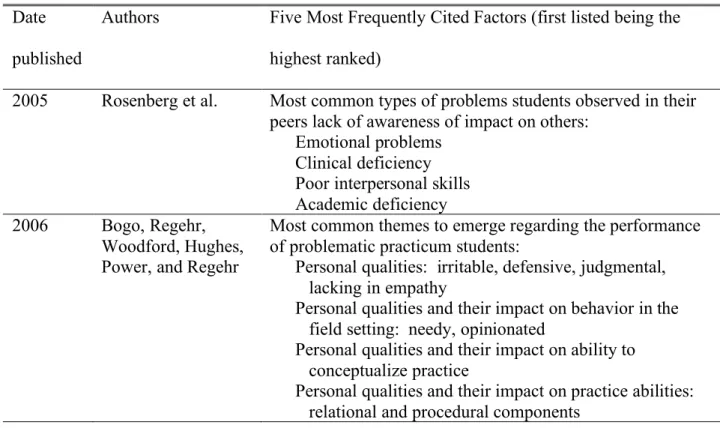
Many factors can contribute to impairment and at any given time all counselors operate on a pendulum from ‘well’ to ‘impaired,’ as noted by the ACA (2009). Forrest et al. (1999) found clinical deficiencies, interpersonal problems, problems in supervision, and personality disorders as the most common factors found in impairment. Brear et al. (2008) expanded these factors as illustrated in Table 1, which synthesizes 14 empirically based studies citing the most frequently cited factors involving student impairment.
Table 1
Common Factors Associated with Student Unsuitability in Social Science Programs Date
published
Authors Five Most Frequently Cited Factors (first listed being the highest ranked)
1983 Biaggio, Gasparikova-Krasnec, and Bauer
Most frequently ranked conditions considered sufficient to warrant dismissing a doctoral clinical student presuming warning has been given:
Violation of professional ethics Psychopathology
Substandard academic performance Therapy skills not mastered
Judgment poor
Table 1 (continued) Date
published
Authors Five Most Frequently Cited Factors (first listed being the highest ranked)
1986 Boxley et al. Most frequently cited factors associate with intern’s impairment: Personality disorder Depression Emotional problems Marital problems Physical illness
1991 Olkin and Gaughen Most frequently cited problems for which students are identified:
Academic deficits
Problems in clinical skills
Pervasive interpersonal problems Problems in supervision
Intrapersonal problems
1995 Koerin and Miller Most frequently listed types of non-academic situations or behaviors that warrant terminating a student from a masters social work program:
Ethics issues
Mental health issues Substance abuse
Field performance problems Classroom behavior problems
1995 Procidano et al. Most frequently cited problems of a non-academic nature which show evidence of being unsuitable for clinical work:
Limited clinical skills
Personality/emotional problem Unethical behavior
1997 Ryan, Habibis, and
Craft Most likely non-academic reasons our program actively pursues counseling out a student: Obvious emotional/mental problems
Inability to respect human diversity Non-conformity to social work values
Personal values inconsistent with social work
2003 Russell and Peterson Most frequently ranked concerns from list of indicators of student impairment:
Ethical violations Unprofessional conduct Suicide attempts
Table 1 (continued) Date
published
Authors Five Most Frequently Cited Factors (first listed being the highest ranked)
2004 Huprich and Rudd Most commonly reported impairments based on knowledge of program over past 10 years:
Personality disorder Depressive symptoms Adjustment disorder Anxiety symptoms Alcohol
2004 Lafrance, Gray and
Herbert Most frequently cited potential indicators that suggest a person may not be suitable for the practice of social work: Personal qualities: maturity, integrity
Capacity to develop professional social work relationships with clients, colleagues, staff, and community members
Congruence between what individuals bring to the profession and the values, principles, and beliefs of the social work profession
2004 Oliver et al. Most frequently cited types of problems/impairments observed in student colleagues:
Depression and other mood disorders Personality disorders or traits
Anxiety disorders Eating disorders Substance abuse
2004 Vacha-Haase et al. Most frequently cited types of student difficulties actually encountered during the past year that did not lead to termination:
Inadequate clinical skills Defensiveness in supervision Deficient interpersonal skills Emotional problems
Physical illness 2005 Busseri, Tyler, and
King Most commonly cited reasons, apart from academic performance, for making judgments about the need for dismissal of a particular trainee:
Ethical infractions or reasoning
Problematic clinical skills development or performance Failure to respond sufficiently to remediation plans Unprofessional demeanor
Table 1 (continued) Date
published
Authors Five Most Frequently Cited Factors (first listed being the highest ranked)
2005 Rosenberg et al. Most common types of problems students observed in their peers lack of awareness of impact on others:
Emotional problems Clinical deficiency Poor interpersonal skills Academic deficiency 2006 Bogo, Regehr,
Woodford, Hughes, Power, and Regehr
Most common themes to emerge regarding the performance of problematic practicum students:
Personal qualities: irritable, defensive, judgmental, lacking in empathy
Personal qualities and their impact on behavior in the field setting: needy, opinionated
Personal qualities and their impact on ability to conceptualize practice
Personal qualities and their impact on practice abilities: relational and procedural components
The academic and non-academic factors cited vary in the terminology used. Intrapersonal and interpersonal skills are the most common factors associated with student unsuitability as shown in the referenced studies in Table 1. A number of risk factors can contribute to the vulnerability of counselor impairment. Olkin and Gaughen (1991) devised 16 indicators to address when looking at student impairment: ethical violation, unprofessional conduct, suicide attempts, substance use/abuse, possible signs of a personality disorder, decreased academic performance, social inappropriateness, poor clinical skills, references of suicide, emotional difficulties, defensiveness in supervision, evidence of mood disorder, physical illness, hyperactivity/hypomanic behavior, poor hygiene, and poor writing skills (Olkin &
Gaughen, 1991). According to the ACA (2009), these risk factors often manifest themselves in burnout, compassion fatigue, vicarious traumatization, mental health conditions, substance
abuse, over-involvement and overwork, contagion, and relationship problems. Moreover, these risk factors reveal that impairment can exist prior to entry into the profession and thus could be identified earlier on with effective gatekeeping practices. Counselor educators must know how to address these factors and adhere to the ethical standards and accreditation requirements.
Professional Standards and Calls
Professional codes and accreditation standards articulate the professional responsibility and obligation Counselor Education programs have to assess, address, and remediate problematic behavior. These codes and standards are typically the first line of defense professionals use to support research on evaluation and retention. To frame these codes and standards, this
researcher began with the American Psychological Association (APA) which for over 30 years has provided guidance respective to the evaluation of students.
APA
The Guidelines and Principles for Accreditation of Programs in Professional Psychology (2007) provided prescriptive recommendations for student evaluation. Within the accreditation domain and standards it notes that programs must have policies and procedures that govern student and intern performance evaluation, feedback, advisement, retention, and termination decisions (Domain A: Eligibility). Doctoral graduate programs must also make available policies and procedures not only to the student and interns, but to all interested parties (Domain A: Eligibility). Domain E: Student-Faculty Relations, further specifies that:
4. At the time of admission, the program provides the students with written policies and procedures regarding program and institution requirements and expectations regarding students’ performance and continuance in the program and procedures for the termination of students. Students receive, at least annually, written feedback on the extent to which
they are meeting the program’s requirements and performance expectations. Such feedback should include:
(a) Timely, written notification of all problems that have been noted and the opportunity to discuss them;
(b) Guidance regarding steps to remediate all problems (if remediable); and
(c) Substantive, written feedback on the extent to which corrective actions are or are not successful in addressing the issues of concern. (p. 11)
More specifically, Section B. Internships, explicitly specifies a greater frequency of feedback, as well as prescriptive guidance on what that feedback should encompass (Domain E: Intern-Staff Relations).
It appears that the guidelines evolve based on the classification of the student. Postdoctoral residences feedback must include:
(a) An initial written evaluation provided early enough in the program to serve as the basis for self-correction (if needed);
(b) A second written evaluation that occurs early enough to provide time for continued correction (if needed) or development;
(c) Discussions and signing of each evaluation by the resident and the supervisor; (d) Timely written notification of all problems that have been noted, the opportunity
to discuss them, and guidance regarding steps to remedy them (if remediable); and
(e) Substantive written feedback on the extent to which corrective actions are or are not successful in addressing those problems. (p. 27)
Residency students, upon entry into the program are immediately provided program requirements, performance expectations, written grievance, conflict resolution procedures, and polices regarded continuation and program termination (Domain E: Resident-Supervisor Relations). These guidelines place emphasis on professional behavior and performance; and clearly articulate programs’ responsibilities to assess, evaluate, remediate and terminate students.
The APA Ethical Principles of Psychologists and Code of Conduct (APA, 2002) is yet another resource that provides guidance on standards that are specific to evaluation of
problematic behavior. The APA code notes that its professionals strive to do no harm and “safeguard the welfare and rights of those with whom they interact professionally and other affected persons” (p. 3). This principle speaks to the intention of gatekeeping. Further, the APA programs must maintain program descriptions that communicate the requirements necessary to satisfactorily complete the program (Standard 7.02). Student evaluation is based upon the
student’s performance. When addressing student assessment and performance, a specific process for providing that feedback should be noted. This process for feedback is communicated at the onset of the supervisory relationship. The APA principles are specific to psychologist and are provided as a means to see what exists within similar professions.
ACA Many of the principles and standards within the ACA code parallel those of the APA. The ACA Code of Ethics (2005) outline ethical responsibilities and principles aimed to ensure professional development so that counselors and counselors-in-training do no harm to clients. Entries in the Code outline specific behaviors that govern program responsibilities, to include counselor evaluation and dismissal. As role models for professional behavior, counselor educators are “knowledgeable about ethical, legal, and regulatory aspects of the profession” (Section F.6.a.). This modeling and awareness are critical, as a primary obligation is to monitor
services provided by counselors-in-training, ensuring client welfare (Section F.1.a.). This responsibility further prescribes how to monitor and assess the students. Specifically, supervisors must “meet regularly with supervisees to review case notes, samples of clinical work, or live observations” (Section F.1.a.). Thus the supervisor is evaluating the ability and appropriateness of the services being provided by the counselor-in-training to ensure client welfare.
The ethical mandate to evaluate, remediate, and endorse are outlined in Section F.5. of the Code. This section specifies that ongoing performance appraisal and evaluative feedback should be provided to counselors-in-training and documented (Section F.5.a.). The Code goes on to specify how counselor educators should address remediation (Section F.5.b.). This evaluative process is critical because supervisors also “endorse supervisees for certification, licensure, employment and completion of academic and/or training programs” (Section F.5.d.). This endorsement cannot be provided when supervisors believe impairment exists. Certain mandates outlined in the Code should be made aware to prospective students at the time program application is made.
Prospective students should be made aware, in advance of admission, about program expectations to include: “the type and level of skill and knowledge acquisition required for successful completion of the training; bases for evaluation; and student and supervisee evaluation and dismissal policies and procedures” (Section F.7.a.). Further, counselor education programs have a responsibility prior to admission and throughout the program to ensure students are abreast of expectations and evaluative methods. This is articulated in Section F.9. Evaluation and Remediation of Students, which is one of the most critical sections relevant to gatekeeping efforts of counselor education programs. Standards require appraisal and evaluative feedback to
be ongoing, thus providing an opportunity for counselor educators to be aware of address student limitations (Sections F.9.a.; F.9.b.). When limitations are identified, Section F.9.b. further requires counselor educators to utilize consultation, be assistive, ensure due process, and sufficiently document their decisions. The last standard contained within this section addresses personal counseling as an intervention to address remediation. Ethical concerns have been raised about this requirement (Kaslow et al., 2007). Specifically, concerns around balancing
accountability with confidentiality and lack of research to support effectiveness of personal counseling for remediation have been identified (Kaslow et al., 2007; Olkin & Gaughen, 1991; Vasquez, 1999).
Counselors-in-training are to “refrain from offering services when their physical, mental, or emotional problems are likely to harm a client (Section F.8.b.). Although counselors-in-training are to be aware of this mandate, counselor educators are to ensure this through gatekeeping and remediation assistance; similarly, the CACREP standards address evaluation and dismissal of problematic behavior in students. CACREP (2009) requires that counselor education programs describe the academic unit, each program offered, including admissions criteria as well as the “minimum program requirements and matriculation requirements” (p. 3). Doctoral admission criteria must include “academic aptitude for doctoral-level study,” and “fitness for the profession, including self-awareness and emotional stability” (Sections I.D.1. & 2.). The standards further stipulate the time parameters for communication of expectations and policies. Prior to admission or at the beginning of the first term of enrollment, students should participate in a new student orientation (Section I.L.1.) and a student handbook provided
inclusive of a student retention policy that explains student remediation and dismissal procedures of the program (Section I.K.2.d.). Student retention policy as defined by the standards is a
“policy by which program faculty members evaluate each student for academic, professional, and personal fitness to continue in a counseling program.” The academic performance,
professional development and personal development of counselors-in-training must be assessed and this assessment must be done throughout the program (Section I.P.). Programs must have a protocol for evaluating and addressing problematic behavior to ensure accreditation by the CACREP.
Additionally, faculty are required to assist with transitioning students out of the program when evaluation has deemed it necessary (Section I.P.). Olkin and Gaughen (1991) found that a lot of programs relied on students to self select transitioning out as opposed to the program recommending students to leave. The transition of students is a critical element when considering institutional and individual liability as evidenced in a landmark case against
Louisiana Tech University where it was argued that the university had an obligation not only to the student but also to the public to ensure program graduates were competent (Kerl, et al., 2002). Clearly there is a professional and ethical obligation for programs to protect clients. Professional codes, accreditation standards, and the profession echo this need.
Professional Calls
In addition to professional codes and accreditation standards, the profession mirrors the sentiment that it is incumbent upon programs to assess, evaluate, and remediate problematic behavior. Problematic behavior that is demonstrated through skill deficiencies should be anticipated during the preparation of counselors (McAdams & Foster, 2007) thus programs should be proactive in its approach to dealing with this issue (Olkin & Gaughen, 1991). Brear et al. (2008) see the challenges of gatekeeping as twofold in that faculty must develop relevant and explicit criteria to measure students and have a framework in which gatekeeping can work
within. Dufrene and Henderson (2009) echo these sentiments in that the challenge comes in “identifying and implementing useful supervision strategies.” Faculty are responsible for replenishing the profession with knowledgeable and skilled professionals. A failure to equip students with the necessary skills can result in unwelcomed ramifications (Custer, 1994). Corey, Corey, and Callanan (1998) note better identification is necessary as well as effective
remediation. This is underscored by McAdams and Foster (2007) who see effective remediation practices as an ongoing need that should reflect fair and just opportunities. In their own
experiences, the College of William and Mary highlight the need for faculty to create and maintain a framework for evaluation (McAdams & Foster, 2007). These gatekeeping methods begin with operational definitions, expected behaviors, accessible policies and procedures, continual evaluation, and remedial and dismissal protocols (Olkin & Gaughen, 1991). In
addition to the needs as illustrated by the profession, students are concerned about gatekeeping. A Mearns and Allen (1991) study found that 95% of graduate students experienced peers with problematic behaviors. Oliver et al., (2005) report the problematic behavior encountered by peers caused (a) disruption of class time, (b) difficulties applying the cohort model during
supervision, and (c) challenges related to individual learning. These disturbances can further impact the students experience and regard for the profession and faculty (Oliver et al., 2004; Mearns & Allen, 1991). Left unaddressed these experiences can contribute to negative emotionality and adversely affect the educational climate. Despite these ramifications and student desires to uphold ethical standards, students felt they lacked the knowledge on how to address problematic behavior (Mearns & Allen, 1991). Similarly, students as well as
professionals struggle with voicing concerns about problematic peers because of the potential for negative repercussions (Thomas, 2010). Notedly, this leaves the magnitude of responsibility on
faculty. Students have concerns about problematic behavior being inadequately addressed by their colleges and universities.
According to Oliver et al. (2004) a study found that students did not believe problematic behavior was adequately addressed at their colleges and universities nor was the topic discussed during course enrollment. In Rosenberg et al.’s (2005) exploratory study, students further indicated that their programs had no established procedures for dealing with problematic behavior. Similarly, Oliver et al. (2004) found that 53% of participants in their study were not aware of the policies and procedures to address problematic behavior. Further, students felt that there was not an adequate outlet to address concerns about problematic behavior with faculty (Rosenberg et al., 2004). This exposure to problematic behavior and uncertainty as to how to address it can contribute to a precarious environment.
To ensure adherence to professional codes, accreditation standards, field and student expectations, gatekeeping should be on the forefront of the profession. We are obligated to the profession and to those it serves to ensure fitness and this begins prior to program admission. Professional codes and accreditation standards clearly communicate the responsibility and obligation counselor education programs have to access, address, and remediate problematic behavior. The literature further supports the need to address problematic behavior. As noted by Wilkerson (2006) and Dufrene and Henderson (2009), these standards and guidelines are void of the specifics on how to carry them out, thus, each program is responsible for developing its own policy and action.
Counselor Education Programs’ Response to Problematic Behavior In his monumental article in 1975, J. L. Bernard discusses the dismissal of clinical
guidelines require that within program descriptions students be made aware that they can be dismissed for the program for ethical violations and/or unsuitability for the profession; routine written evaluations that objectively evaluate personal, clinical, professional, and interpersonal functioning; when problematic behavior exists, a written remediation plan is accomplished; and if improvement is not sufficiently made within the allotted time, the student is advised of dismissal hearing and time is allowed to prepare for the meeting and discuss the consequences (O’Halloran, 1997). As noted by Bernard (1975), counselor education programs must have sound policies and procedures in place to address problematic behaviors that impede students. McAdams and Foster (2007) note that standards fall short in specifying the type and extent of remediation necessary. Multiple models exist as a framework for programs to use for
remediation. These models are presented to address how programs have approached retention and dismissal.
Knoff and Prout (1985) offer procedural guidance for psychology programs that may help shape remedial processes across disciplines. The first step in this process is to develop a policy statement or formal policy that addresses the student’s development. Moreover, the policy should detail the expected behaviors, parameters for not meeting the expected behaviors, and place emphasis placed on adherence to ethical standards. Subsequently, the policy should be provided to students upon entry into the program. Integral to the policy is the evaluation and review of students, inclusive of academic, skill acquisition, personal and professional progress, which should occur on an annual basis (Knoff & Prout, 1985). Further this model suggests that all relevant program faculty or a designated committee conduct the evaluation. Emphasis should be placed on practicum, internships, and field experiences. An interview format and/or written feedback can be provided to communicate the evaluation findings. If an area of concern has
been identified, students must be formally notified and a plan to remediate those concerns is developed with the students input. This in turn places the student on probation. Four options are available to faculty when reevaluating the student: (1) continuation in the program, (2)
continued probation and remediation, (3) counsel the student out of the program, and (4)
dismissal from the program. If the latter option is determined, written notification of the reason for impending dismissal is required and due process provided for the student to request a formal review of the matter.
Frame and Steven’s-Smith (1995) established a monitoring and dismissal process that has been widely used to shape remediation practices. The Frame and Stevens-Smith model is a three step model involving evaluation, review, and outcome that addresses: being open, flexible, positive, cooperative, willingness to use and accept feedback, aware of impact on others, able to deal with conflict, able to accept personal responsibility, and able to express feelings effectively and appropriately (Frame & Stevens-Smith, 1995). Frame and Stevens-Smith, professors at the University of Colorado at Denver, utilize the Personal Characteristics Evaluation Form to evaluate the students against the nine aforementioned characteristics. Students are assessed based on the characteristics in each course they are enrolled in at midterm and at the semester’s end (Frame & Stevens-Smith, 1995).
An alternative to Frame and Stevens-Smith has been developed by Baldo and Softas-Nall (1997). Baldo and Softas-Nall believed that the Frame and Stevens-Smith model placed the faculty member(s) in a difficult position to potentially become the target of the student’s
frustration over an undesirable evaluation. Their model provides for a faculty review committee and utilizes the entire counseling faculty for evaluating student progress. The University of Northern Colorado (UNC) utilizes this model for its student review and retention. On a yearly
frequency, program faculty meet to assess student progress. The reevaluation options available to faculty are along the same premise as those purported by Knoff and Prout (1985). When progress is unsatisfactory, students are notified and a meeting is established with their advisor to discuss the review and the procedures necessary for remediation. If probation is required, a written remediation plan is collaboratively developed by the student and the advisor and requires approval from the retention committee. A copy of the plan, along with the student and advisor signature is provided to the student and placed within the student’s file.
Southwest Texas State University counseling faculty developed the Professional Counseling Performance Evaluation (PCPE) to evaluate, communicate, and remediate problematic behavior (Kerl et al., 2002). The PCPE is a part of all experiential courses and optional for use within didactic courses. To this end, it is important to note that just because a counselor-in-training does exceptionally well on written and oral course work, they could fail a course based on the PCPE evaluation for that course. Such an evaluation could result in the initiation of a remediation plan or referral to a faculty review committee. Kerl et al. (2002) further indicate that utilizing the PCPE from entry into the program and consistently throughout matriculation reduces gateslipping potential. Furthermore, the PCPE has withstood legal dismissal challenges.
McAdams et al. (2007) outline what is done at The College of William and Mary concerning retention and dismissal. Specifically they utilize the Professional Performance Review Policy (PPRP), which is a protocol to evaluate and address problematic behavior (McAdams et al., 2007). The PPRP measures students against the following criteria: openness to new ideas, flexibility, cooperativeness with others, willingness to accept and use feedback, awareness of own impact on others, ability to deal with conflict, ability to accept personal
responsibility, ability to express feelings effectively and appropriately, attention to ethical and legal considerations, and initiative and motivation. The methods by which to assess each criteria are provided in descriptive terms and applied to a one-to-five Likert scale (McAdams et al., 2007). The PPRP is introduced to students early on, at new-student orientation and it’s also included in the student handbook. Introducing these policies early on is beneficial and essential to the policies addressing problematic behavior. The PPRP in a 2006 CACREP reaccreditation visit was noted as an exemplary policy and provided to be beneficial when the university was challenged in federal court for dismissal of a student (McAdams et al, 2007). Moreover, having a uniformed, predetermined, and published policy aided the litigation for the university. Critical to William and Mary’s dismissal decisions is a vote from the full counselor education faculty (McAdams et al., 2007). Once this vote is accomplished, the recommendation is reviewed by the associate dean and subsequently by the dean who makes the final decision. Specific to this university’s policy, a student has the opportunity to address the dean regarding the decision. Building upon the models of Frame and Stevens-Smith and Baldo and Softas-Nall is a model offered by Lumadue and Duffey.
The model offered by Lumadue and Duffey (1999), utilized at Southwest Texas State University differs from previous models in that it begins with the admissions process. A copy of the Professional Performance Fitness Evaluation (PPFE) is included within prospective student’s admission package, thus placing an emphasis on evaluation at the onset of the student’s
academic career (Lumadue & Duffey, 1999). The evaluation criteria contained within the PPFE goes beyond the abstract characteristics of Frame and Stevens-Smith model and include specific behaviors (Lumadue & Duffey, 1999). Wilkerson (2006) synthesized the common components of Baldo and Softas-Nall, Frame and Stevens-Smith and Lumadue and Duffey as:
a. policies and procedure manuals specifying program expectations b. systematic process for regular student evaluation and critique
c. outline of procedures used to identify and notify students when problematic behaviors exist
d. step-by-step procedures to document student concerns
e. sequences for the development of time-based and outcome-focused plans to address problematic behavior
f. follow-up review protocol to determine student’s future status in the program g. formal sequences to follow if dismissal is indicated
h. elaboration of student’s rights and responsibilities for confidentiality and appeals process.
A more recent model has been presented by Dufrene and Henderson. Dufrene and Henderson (2009) purport that previous models focus heavily on dismissal rather than
remediation and therefore they provide a model that looks specifically at how remediation should occur. Based upon their model, the process of remediation begins with a discussion between student’s supervisors and/or clinical faculty coordinator. Once a collaborative decision is reached among faculty and supervisor, an individual remediation plan (IRP) is developed by the university supervisor based upon the student’s problematic areas (Dufrene & Henderson, 2009). The faculty clinical coordinator, supervisors, and the student meet to discuss the purpose of remediation, due process, informed consent, and the IRP are reviewed. During this meeting, an opportunity for collaborative input is provided to the student and if necessary the IRP is revised. Consultation is integral to this process, because other counselor educators are consulted
is not implied due to the potential legal ramifications that could ensue (Dufrene & Henderson, 2009; McAdams et al., 2007). The elements contained within the IRP are professionalism of the trainee, counseling skills of the trainee, and documentation of clinical work by the trainee (Dufrene & Henderson, 2009) which are consistent with problematic behaviors experienced by counselors-in-training (Li et al., 2008). Specific directives are contained within each element. The elements of the IRP are based upon the individual needs of the counselor-in-training. Similar to the PPRP, a Likert scale is utilized to assess each item with the IRP. IRP’s are time specific and are updated weekly to reflect the supervision session, and movement toward the indicators contained within. Additionally, notes are maintained of the supervision session and faculty and student signatures are required. Utilization of an IRP is just one aspect of
gatekeeping.
Although a survey by Olkin and Gaughen (1991) revealed that a large number of programs were void of written gatekeeping policies and of those that had policies few utilized formal evaluations. Multiple gatekeeping models exist for counselor education programs to utilize to develop sound policies and procedures to address problematic behavior. The
aforementioned models provide a framework that some programs have implemented; however, additional recommendations are provided.
If remedial practices have been found to be ineffective and dismissal has to be pursued students must be informed about their right to appeal. Knoff and Prout (1985) provide a process for dismissing students within psychology programs that might inform the counselor education dismissal process. Formal policy should address the role of personal and professional
development, as well indicate adherence to ethical standards; evaluation and review should be ongoing with feedback given on at least an annual basis; remediation plans should behaviorally
define problems, identify the goals and expected behavior, indicated methods to reach the goals, identify date to attain goals and/or date for reevaluation and be provided to the student (Knoff & Prout, 1985). As consideration is given to reevaluation Knoff and Prout (1985) suggest options such as continuation in program, continued probation, counsel student out of the program and/or dismissal. To understand the effectiveness of these recommendations, further, evaluation is necessary to having sound remedial practices (Frame & Stevens-Smith, 1995). Thus programs should consider evaluation as a means to enhancing and refining practices and allow the data to inform changes.
Specific guidance from the APA, ACA, and the CACREP has been provided. This review of the literature has highlighted various models programs have utilized to address remediation and dismissal. Additionally, policy and procedure recommendations have been provided. Next, we will look at what programs are doing at various intervals to address problematic behavior.
Pre-Admission
Gatekeeping as a process involves student selection. At time of program application, problematic behavior may be evident. Thus, counselor educators begin assessing suitability through a systematic process prior to admissions. Many programs have developed admission criteria or methods to assess for indicators of problematic behavior, which typically begin with a review of undergraduate grades and standardized test scores.
Based on a qualitative study of CACREP master’s level programs, Ziomek-Daigle and Christensen (2010) provide a four-phase gatekeeping process. The pre-admission phase of gatekeeping involved reviews of applicants’ academic aptitude and interpersonal interaction. The academic aptitude criterion includes a review of standardized test scores, grade point
average (GPA), recommendation letters, education, work experience, and a goal/personal statement. It is noteworthy that GPA requirements vary from university to university as well as standardized test scores. Many programs have developed admission criteria or methods to assess for indicators of problematic behavior, which typically begin with a review of similar academic aptitude criteria. However, Eriksen and McAuliffe (2006) note that this review alone is
ineffective in predicting counseling skills. To accommodate this concern, some colleges and universities utilize processes that involve interpersonal interaction.
The interpersonal interaction criterion includes individual/group interviews with faculty, role play vignettes, writing samples, and an informal session. Baldo et al. (1997) encourages utilization of a faculty review committee to facilitate gatekeeping practices. This committee can be reflected in the initial interview process. Interviews allow exploration of interpersonal styles and interaction styles. Interviews involving multiple faculty members allow some evaluation of personal characteristics. Role-plays have been used to assess multiculturalism and as a means to gauge cultural sensitivity (Ziomek-Daigle & Christensen, 2010). Informal meet and greet sessions often involve current students within the program and allow for multiple interactions (Ziomek-Daigle & Christensen, 2010). Eriksen and McAuliffe (2006) note that personal characteristics of counselors have been connected to client outcomes thus the need to gauge empathy, cultural sensitivity, communication skills, and ability to build rapport. Further, Olkin and Gaughen (1991) suggest that interpersonal and interpersonal fitness be considered.
Further the pre-admission procedures also allow faculty to communicate the program expectations, means of evaluation, and provided written program materials and manuals. This ensures programs satisfy requirements of accrediting bodies and professional bodies. Southwest Texas State provides prospective students a copy of the PPFE, which is an evaluative tool
utilized throughout their program. Gatekeeping strategies begin prior to admission, though these strategies may not reveal problematic behavior. Reliance on preadmissions screening and admissions criteria is not enough. Therefore it is necessary for gatekeeping to be ongoing and continuous throughout the program.
Post-Admission
Gatekeeping is an ongoing and continuous process that begins at pre-admission and continues through program exit (Brear et al., 2008). Monitoring and evaluating student’s fitness for the profession is the retention aspect of gatekeeping. Ziomek-Daigle and Christensen (2010) note that because of the continual process of evaluation, some student’s admittance is only provisional until certain criterion are met. In the post-admission phase of gatekeeping as outlined by Ziomek-Daigle and Christensen (2010) the academic aptitude criterion includes a review of counseling skills, academic performance, and standardized tests. Continued evaluation is occurring during clinical course work, practicum, and internship experiences. Course work and grades is one means to evaluating students during the program. Specific emphasis is often placed on skills courses, multicultural courses, and application of ethical principles throughout course work. Integrating discussions on ethics, standards, and university policies and procedures into coursework is integral to ensuring students are abreast and informed (McAdams et al., 2007).
Skill acquisition for counselors-in-training extends beyond the classroom and into practicum experiences that involve supervision, direct service delivery, and teaching. Olkin and Gaughen (1991) looked at evaluation of graduate students in clinical programs and found that the majority of programs identify problematic behavior through academic course work (65%). The other means of identification occurred through practicum or other clinical course work followed