CO Alarm Model Number(Located on the back of alarm): CO Alarm Assembly Number (Located on back of alarm): Date of Manufacture(Located on back of alarm): Date of Purchase:
Where Purchased:
Carbon Monoxide
Alarm
User’s Guide
Please have the following information ready if you are calling customer Service:
810-0934 REV D SIGNALING LISTED
UL
AAtttteennttiioonn::Please take a few minutes to thoroughly read this manual, which should be saved for future reference and passed on to any subsequent owner. If you have any ques-tions about the operation or installation of your alarm, please call our toll free Consumer Hotline at 1-800-880-6788.
Kidde CO Alarm with Digital Display and Peak Level Memory
Model: KN-COPP-3
See page 26 for “What to do
when the alarm sounds”
Contents
Thank you for the purchase of your new Kidde carbon monoxide alarm. If you have any questions about the operation or setup of your CO alarm, WARNING: THIS CARBON MONOXIDE ALARM IS NOT A SUBSTITUTE FOR INSTALLING AND MAINTAINING AN APPROPRIATE NUMBER OF SMOKE ALARMS IN YOUR HOME. THIS ALARM WILL NOT SENSE SMOKE, FIRE, OR ANY POISONOUS GAS OTHER THAN CARBON MONOXIDE. FOR THIS REASON YOU MUST INSTALL SMOKE ALARMS TO PROVIDE EARLY WARNING OF FIRE AND TO PROTECT YOU AND YOUR FAMILY FROM FIRE AND ITS RELATED HAZARDS.
WARNING: THIS PRODUCT IS INTENDED FOR USE IN ORDINARY INDOOR RESIDENTIAL AREAS. IT IS NOT DESIGNED TO MEASURE COMPLIANCE WITH COMMERCIAL AND INDUSTRIAL STANDARDS. THIS ALARM IS NOT SUITABLE FOR INSTALLATION IN HAZ-ARDOUS LOCATIONS AS DEFINED IN THE NATIONAL ELECTRICAL CODE . INDIVIDUALS WITH MEDICAL PROBLEMS MAY CONSIDER USING WARNING DEVICES WHICH PROVIDE AUDIBLE AND VISUAL SIGNALS FOR CARBON MONOXIDE CONCENTRATIONS UNDER 30 PPM.
IMPORTANT: THIS CARBON MONOXIDE ALARM IS DESIGNED TO DETECT CARBON MONOXIDE FROM ANY SOURCE OF IMPROPER OR MALFUNCTIONING APPLIANCES. THE INSTALLATION OF THIS DEVICE SHOULD NOT BE USED AS A SUBSTITUTE FOR PROPER INSTALLATION, USE AND MAINTENANCE OF FUEL BURNING APPLIANCES INCLUDING APPROPRIATE VENTILATION AND EXHAUST SYSTEMS
WARNING: THIS ALARM WILL NOT WORK WITHOUT POWER. THIS ALARM REQUIRES A CONTINUOUS SUPPLY OF POWER.
WARNING: THIS UNIT IS NOT A SMOKE ALARM. IT WILL NOT SENSE SMOKE OR FIRE. FOR EARLY WARNING OF FIRE YOU MUST INSTALL SMOKE ALARMS, EVEN THOUGH CARBON MONOXIDE CAN BE GENERATED BY FIRE.
Introduction
Quick Set Up Guide
Features
Installation
Operation
Maintenance
Technical Information
Limited Warranty
3
Introduction
This Kidde carbon monoxide (CO) alarm is an important part of your family’s
home safety plan. As a new owner of a CO alarm, there are some basic facts
you should know for your protection
and
convenience.
Many people think that CO alarms operate like smoke alarms. Like smoke
alarms, CO alarms monitor the air in your home and sound a loud alarm to
warn you of trouble.
The way you respond to a CO alarm is quite different than a smoke alarm.
That’s because a house fire and a carbon monoxide problem are two distinctly
different situations. If your smoke alarm were to alarm, you would quickly be
able to judge the level of danger you were in with your senses. You can see and
smell the smoke, feel the heat, see, and possibly hear the fire burning. You can
also readily see if your smoke alarm is alarming in a non-emergency situation,
for example someone smoked up the kitchen with some burnt toast. Because
your sense of sight, smell, hearing and touch give you information, you can
almost instantly judge what action to take if you hear your smoke alarm.
Carbon monoxide (CO) is invisible, odorless, tasteless, non-irritating, poisonous
gas that is completely undetectable to your senses. It is created when any fuel is
burned – gasoline, propane, natural gas, oil, wood, coal, and even tobacco. When
oxygen is limited during combustion, more CO is produced. Serious problems
can develop when combustion by-products are not properly vented outside the
house. That’s why it’s so important to your safety that you have a carbon
monoxide alarm.
Please take the time to completely read this guide to familiarize yourself with
the facts about carbon monoxide, how your new unit works, and what to do if
it alarms. Find a handy place to keep this manual so that it will be readily
avail-able when you have a question.
Thank you for making Kidde a part of your complete home safety program.
With proper installation and use, your new Kidde CO alarm will provide you with
years of dependable service.
Quick Set Up Guide
Step 1
Determine the best location for your CO alarm(s). Usually this is in or near
bedrooms. Refer to page 10 for complete information.
Step 2
Your CO alarm is equipped to be mounted as a corded unit, a direct plug unit
or a table top unit. In the “as shipped” configuration, the unit can be plugged
directly into a wall socket. (If your outlets are mounted horizontally, please
refer to page 13, “to rotate adapter”). If the transformer/adapter is taken out
of the unit, the alarm can be mounted on the wall at eye level, while the
trans-former is plugged into a wall socket. The unit can also be set on a table if the
support at the bottom of the unit is pulled out (see “rear view” illustration on
page 6). Refer to page 10 for information on installing your alarm.
Step 3
A 9V battery is needed for backup in the event of a power outage. When
installing the battery, use an Energizer 522, Duracell MN 1604 or, for extended
life, use an Ultralife lithium power cell model U9VL. Any of these batteries can
be purchased where you bought the alarm or at your local hardware store. To
install the battery, open the back door and snap battery connector onto battery.
You will hear the alarm sound briefly to indicate the unit is receiving power.
Place battery into battery compartment and replace back door. Refer to page
13 for information to remove the back door.
Step 4
Plug the alarm into a standard, unswitched 120 volt AC electric outlet in one
of the configurations listed in step 2. Refer to page 6 for more details.
We urge you to read this entire guide in the sequence
it is presented. If you only read one part of this guide
initially, read the following two pages!
Listed below are seven easy steps for setting up your Kidde CO alarm.
Please read the entire guide for complete information.
Setting up your alarm for first time operation:
5
Step 5
You will either see a flashing red dot or you will see three eights in the
digital display indicating the alarm is warming up. After approximately 20
sec-onds, the first reading will appear on the digital display. The number on the
dig-ital display should be zero (0). If not, see page 15 for complete information on
normal operating characteristics.
Step 6
Make sure the red dot in the digital display is blinking. Then test the unit’s
operation by pressing and releasing the Test/ Reset button. Within 15 seconds
you will hear 4 quick “chirps” -followed by 5 seconds of silence- followed by
4 quick “chirps”. For complete testing information, refer to page 16.
Step 7
While testing the alarm, have someone else check that the alarm can be heard
easily from the sleeping areas. The alarm should be located where it can wake
you if it alarms at night.
C
Ca
au
uttiio
on
n::
Continuous exposure to the loud 85
deci-bel alarm at close range over an extended period of time may cause hearing
loss.
Your Kidde CO alarm is now monitoring for the presence of carbon
monox-ide.
Features
Alarm Sounder Digital Display Test/Reset Button Blinking Red Dot Peak Level ButtonKidde CO Alarm – rear view
Removable Adapter Adapter Thumb Release Thumb Grip for Back Door
Removal (Slide Down) Back Door Key Holes Door “Latches” at all four corners of back door Kidde CO Alarm – front view
7
Features
9V Backup Battery (Shown installed)
Rear view with back door removed
Power Cord
Adapter Cord Strain Relief
Note: Your Kidde CO alarm is NOT battery operated.
T
he backup battery is to supply short-term backup power during
a power outage. In the event of a power outage, the battery will
continue operating the alarm for at least 20 hours.
The Unique Features of this Kidde CO Alarm
Digital Display
The continuous digital display shows you the level of carbon monoxide (if any) the unit is sensing. The unit updates the digital display every 15 seconds .
N
N
o
ot
te
e:
:If the unit reading is zero (0), then 30 ppm or less of CO has been sensed by the alarm within the last 15 seconds.Test/Reset Button
The Test/Reset button has three functions:
1. Press this button to test the unit weekly (see page 16 for further details).
2. Press this button if the unit alarms to silence the alarm. This will reset the unit and it will then start monitoring for CO. If the CO concentra-tion is above 70 ppm the alarm will again sound within 6 minutes. 3. Press the Test/Reset button to reset peak level memory. (See page 19). Cord Recess Install Backup Battery as shown Battery Connector
Features
Peak Level Button
By pressing this button, you can see the peak CO level recorded by the alarm since it was last cleared or unplugged. This Kidde feature allows you (or a heating contractor or a fireman) to see exactly how serious the CO problem you have so you can react accordingly.
Sensor
The sensor is a highly sensitive, electrochemical sensor that is CO-specif-ic to help avoid false alarms.
Sounder Alarm
This is the loud 85 decibel pulsing alarm that will sound to alert you to a potential problem. An alarm condition is 4 quick “chirps” – followed by 5 seconds of silence – followed by 4 quick “chirps”. This pattern repeats until the alarm is silenced or a high level of CO is no longer pre-sent.
C
C
a
au
ut
ti
io
on
n:
:Continuous exposure to this sound level at close range over an extended period of time may cause hearing loss. We recommend you cover the sounder with your finger or thumb while testing the alarm.Keyholes
When the alarm is mounted to the wall, the keyholes slide onto the screws mounted in the wall.
Pull-Out Transformer/Adapter
This unique Kidde feature enables the alarm to be used as a direct plug unit, a wall mounted unit or a table top unit.
9 Volt Back-up Battery
Note: This CO alarm is not battery operated.
The 9 volt battery supplies short term backup power during power out-ages
9
Features
What Carbon Monoxide Alarms Can and Cannot Do
CO alarms are designed to sense unacceptable levels of CO from mal-functioning furnaces, appliances, gas engines or other sources. This Carbon Monoxide alarm is not a substitute for installing and maintaining an operational smoke alarm.
CO alarms provide early warning of the presence of carbon monoxide, usually before a healthy adult would experience symptoms.
This early warning is possible, however, only if your Kidde CO alarm is located, installed and maintained as described in this user’s guide. This CO alarm is designed to act as a monitor, it is not designed for use as a short-term testing device to perform a quick check for the presence of CO.
CO alarms have limitations. Like any other electronic device, CO alarms are not fool-proof.
CO alarms have a limited operational life. You must test your CO alarm weekly, because it could fail to operate at any time. If your CO alarm fails to test properly, or if its self-diagnostic test reveals a malfunction, immediately have the unit replaced. See back page for warranty infor-mation. This CO alarm also has an "operational end of life" feature which will indicate when to replace the alarm. See page 28 for details of this feature.
CO alarms can only sense CO that reaches the unit’s sensor. Carbon monoxide may be present in other areas without reaching the alarm. The rate at which CO reaches the unit may be affected by doors or other obstructions. In addition, fresh air from a vent or open window or any other source may prevent CO from reaching the sensor. Please observe cautions on page 5 “Where to install your alarm.”
CO could be present on one level of the home and not reach a CO alarm installed on a different level. For example, CO in the basement may not reach an alarm on the second level, near the bedrooms. For this reason, we recommend you provide complete coverage by placing a CO alarm on every level of the home.
CO alarms should not be used to detect the presence of natural gas (methane), propane, butane, or other combustible fuels.
CO alarms are not a substitute for property, disability, life or other insur-ance of any kind. Appropriate insurinsur-ance coverage is your responsibility. Consult your insurance agent.
Where to Install Your CO Alarm
Your Kidde CO alarm should be mounted in or near bedrooms and living areas. It is recommended that you install a Kidde CO alarm on each level of a multi-level home. You may use the number and location of smoke alarms installed in your home according to current building code requirements as a guide to the location of your Kidde CO alarm(s).
W
WH
HE
EN
N C
CH
HO
OO
OS
SIIN
NG
G Y
YO
OU
UR
R IIN
NS
ST
TA
AL
LL
LA
AT
TIIO
ON
N L
LO
OC
CA
AT
TIIO
ON
NS
S,, M
MA
AK
KE
E S
SU
UR
RE
E
Y
YO
OU
U C
CA
AN
N H
HE
EA
AR
R T
TH
HE
E A
AL
LA
AR
RM
M F
FR
RO
OM
M A
AL
LL
L S
SL
LE
EE
EP
PIIN
NG
G A
AR
RE
EA
AS
S.. IIF
F Y
YO
OU
U
IIN
NS
ST
TA
AL
LL
L O
ON
NL
LY
Y O
ON
NE
E C
CA
AR
RB
BO
ON
N M
MO
ON
NO
OX
XIID
DE
E A
AL
LA
AR
RM
M IIN
N Y
YO
OU
UR
R H
HO
OM
ME
E,,
IIN
NS
ST
TA
AL
LL
L T
TH
HE
E A
AL
LA
AR
RM
M N
NE
EA
AR
R B
BE
ED
DR
RO
OO
OM
MS
S,, N
NO
OT
T IIN
N T
TH
HE
E B
BA
AS
SE
EM
ME
EN
NT
T O
OR
R
F
FU
UR
RN
NA
AC
CE
E R
RO
OO
OM
M..
Two labels have been provided with important information on what to do in case of an alarm. Add the phone number of your emergency service provider in the space provided. Place one label next to the alarm after it is mounted, and one label near a fresh air source such as a door or window.
CAUTION: This alarm will only indicate the presence of carbon monoxide at the sensor. Carbon monoxide may be present in other areas.
IMPORTANT:Improper location can affect the sensitive electronic components in this alarm. Please see the next section describing where NOT to install this alarm.
• Insure that all vents of the unit are unobstructed. • For tabletop mounting we recommend the unit be
placed no higher than three feet from the floor.
Installation Instructions
DINING KITCHEN BEDROOM BEDROOM
BEDROOM LIVING ROOM
Recommended Locations
11
Installation Instructions
Where Not to Install Your CO Alarm
To avoid causing damage to the unit, to provide optimum
protection, and to prevent unnecessary alarms, follow
the instructions below where NOT to install this alarm:
It is recommended that you do not install this CO alarm in garages, kitchens or furnace rooms. Installation in these areas could lead to nuisance alarms, may expose the sensor to substances that could damage or contaminate it, or the alarm may not be heard by persons in other areas of the home, especially if they are sleeping.
In the garage, vehicle exhaust can contain some carbon monoxide. These levels are higher when the engine is first started. Within hours of starting a vehicle and backing it out of the garage, the levels present over time can activate the alarm and become a nuisance.
In the kitchen and furnace room, some gas appliances can emit a short burst of carbon monoxide upon start-up. This is normal. If your CO alarm is mounted too close to these appliances, it may alarm often and become a nuisance. If you must install a Kidde CO alarm near a cooking or heating appliance,
install
AT LEAST 5 FEET away from the appliance.
Do not install in excessively dusty, dirty or greasy areas such as kitchens, garages and furnace rooms. Dust, grease or household chemicals can contaminate or coat the alarm’s sensor, causing the alarm not to operate properly.
Do not obstruct the vents located at the top and bottom of the alarm. Place the alarm where drapes, furniture or other objects do not block the flow of air to the vents.
Do not install in dead air space, such as peaks of vaulted ceilings or gabled roofs, where carbon monoxide may not reach the sensor in time to provide early warn-ing.
Do not install in turbulent air from ceiling fans. Do not install near doors and win-dows that open to the outside, near fresh air vents, or anywhere that is drafty. Rapid air circulation from fans or fresh air from outside may cause the sensor to display an inaccurate reading in the presence of CO.
Do not install this alarm in a switch- or dimmer-controlled outlet.
Do not install in areas where the temperature is colder than 40˚F (4.4˚C) or hotter than 100˚F (37.8˚C). These areas include unconditioned crawl spaces, attics, porch-es and garagporch-es. Extreme temperaturporch-es will affect the sensitivity of the alarm. Do not install CO alarm near deep cell large batteries. Large batteries have emis-sions that can cause the alarm to perform at less than optimum performance.
Avoid the following:
• Excessive spillage or reverse venting of fuel burning appliances caused by outdoor ambient conditions, such as: 1) Wind direction and/or velocity, including high gusts of wind. Heavy air in the vent pipes (cold/humid air with extended periods between cycles). 2) Negative pressure differential resulting from the use of exhaust fans. 3) Simultaneous operation of several fuel burning appliances competing for limited internal air. 4) Vent pipe connections vibrating loose from clothes dryers, furnaces or water heaters. 5) Obstructions in or unconventional vent pipe designs which can amplify the above situations.
• Extended operation of unvented fuel burning devices (range, oven, fireplace, etc.).
• Temperature inversions which can trap exhaust gasses near the ground.
• Car idling in an open or closed attached garage, or near a home.
How to Install Your Alarm
Your Kidde CO alarm with its removable adapter allows you to install the alarm as a wall mounted unit, a direct plug unit, or as a table top unit.
Direct Plug Alarm
Refer to “Where to Install Your CO Alarm” on page 10 for general guidelines as to where to locate your CO alarm.
In its “as shipped” configuration, your Kidde CO alarm is ready to be plugged directly into a wall socket.
To install:
1. Choose a standard 120V unswitched outlet to plug the alarm into.
2. Pull the slide support out approximately 1/4”
until the slide snaps into place. This will help support unit in the wall outlet.
3. Plug the alarm into the outlet.
Installation Instructions
Back of the alarm when used as direct plug unit
13
If the outlet is mounted horizontally (sideways):
If you are going to use your alarm as a direct plug and you are going to plug in to an outlet that is mounted horizontally (sideways), you will need to rotate the adapter 90˚.
To rotate the adapter:
1. With back of the unit facing towards you and the adapter located at the top, place your thumbs on thumb grips.
2. Pull with your thumbs in the direction of the arrows on the thumb grips and slide the back door toward you until it stops.
3. Place your index finger into the small opening along the bottom of the adapter. Catch the edge of the door with your finger or finger nail and lift the door out.
3. Next, place your thumbs on the adapter thumb releases.
4. Spread adapter thumb releases out and carefully turn alarm over. This will allow adapter to slide out.
5. Lift the adapter completely out of the alarm and rotate the adapter 90˚ to the right (clockwise). Snap it firmly back into place.
6. Carefully replace the back door. Insure the “latches” on all four corners of the door are lined up, then press the door into place.
7. Push with your thumbs in the direction opposite of the arrows on the thumb grips and slide the back door toward the top until it stops.
8. Plug the alarm into an unswitched wall socket.
Wall Mounted Alarm
Refer to “Where to Install Your CO Alarm” on page 10 for general guide-lines as to where to locate your alarm.
Installation tips for power cord models:
The power cord option provides more flexibility in mounting locations and allows the alarm to be easily installed at eye level.
N
Noottee::If you mount the alarm high on a wall, make sure it is
at least 6"
from the ceiling
.
Any higher than this, the alarm will be in “dead air space” and carbon monoxide may not reach the sensor.Installation Instructions
Back of the alarm when used as direct plug unit for sideways outlet.
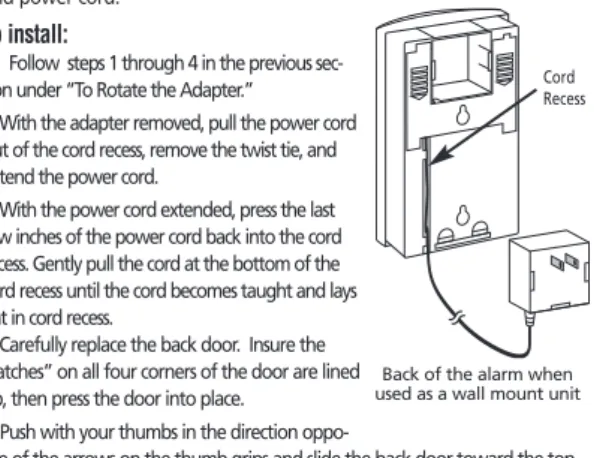
For a wall-mounted unit, you will need to pull out the removable adapter and power cord.
To install:
1. Follow steps 1 through 4 in the previous sec-tion under “To Rotate the Adapter.”
2. With the adapter removed, pull the power cord out of the cord recess, remove the twist tie, and extend the power cord.
3. With the power cord extended, press the last few inches of the power cord back into the cord recess. Gently pull the cord at the bottom of the cord recess until the cord becomes taught and lays flat in cord recess.
4. Carefully replace the back door. Insure the “latches” on all four corners of the door are lined up, then press the door into place.
5. Push with your thumbs in the direction
oppo-site of the arrows on the thumb grips and slide the back door toward the top until it stops.
6. Mark the location for the two mounting holes on the wall spaced vertically 2 5/8" apart.
7. If you are mounting the alarm in plaster board or drywall, drill a 3/16" hole into the wall and insert the plastic anchors provided. Install the two screws provid-ed into the wall or wall anchors until the screw head is approximately 1/8" from the wall.
8. Hook the unit over the screw head and into the keyhole in back of the unit.
9. Plug the adapter into an unswitched wall socket.
Table Top Alarm
You can use your Kidde CO alarm as a table top unit. Follow steps 1 thru 4 above under “Wall Mounted Alarm”. Instead of mounting the unit to a wall, pull out the slide support and stand the unit on a table, bedside stand, or chest of draw-ers. (refer to the diagram on page 6).
Installation Instructions
Back of the alarm when used as a wall mount unit
Cord Recess
WALL
15
Normal Operating Characteristics
When you first power up the unit,the alarm will sound briefly to let you
know the unit is receiving power and that the alarm circuit is functioning. You will see three eights on the digital display, indicating the alarm is in the start-up mode. The three eights will remain for approximately 20 seconds. You will see a blinking red dot to the lower right of the digital display. The blinking dot shows that the alarm is operating.
Within 20 seconds, your CO alarm will start monitoring for CO. The number indicates a measurement of carbon monoxide in parts per million (ppm).
Note:The number will probably be zero (0). This is a normal condition for most households and shows that no measurable amount of CO has been detected.
The alarm has begun monitoring the air for carbon monoxide and will con-tinue to do so as long as it receives power.
When the alarm is unplugged or loses power and a good 9V battery is installed, the alarm will automatically switch to its battery backup mode and you will notice the following:
• The digital display will show a blinking dot only – this helps conserve the battery’s power.
• The digital display will show a number only if it senses carbon monox-ide while in backup mode.
• If CO is detected while on battery backup, the alarm pattern is 4 quick beeps – followed by 5 seconds of silence –followed by 4 quick beeps. After 4 minutes, the alarm pattern is 4 quick beeps every 60 seconds. Note:The alarm will operate on battery backup for at least 20 hours. When AC power is restored, the alarm will automatically switch back to nor-mal operating mode.
When the alarm is unplugged or loses power and you have a low battery
installed,you will notice the following:
• A fading alarm will sound alerting you the unit has switched to its backup mode, but the 9V battery is low.
• A blinking dot will be displayed and the sounder will chirp every 15 seconds.
• When peak level is pushed, the display will alternate between “Lb.” and CO reading.
Operation
Operation
How to Test Your Alarm
Testing the Electronics
You should test the alarm once a week, following the directions listed below. If at any time you test the alarm and it does not perform as described below, have it replaced immediately. See “How to know if your alarm is functioning” on page 17 for a description of the characteristics of a mal-functioning alarm and what you should do if a malfunction occurs. Observe the alarm weekly to make sure the red dot is blink-ing, indicating normal operation.
If the dot is not blinking, unplug the alarm, then plug it in again. This will clear the alarm for restart. If the dot does not resume blinking, your alarm may be malfunctioning.
To test the alarm,press the Test/Reset button. If the unit is operating
prop-erly, you should notice the following:
• The display shows three eights , and then shows a num-ber (usually around 200). You should then hear 4 quick beeps – followed by 5 seconds of silence – followed by 4 quick beeps. The unit will then show the three eights for several seconds. It will then return to monitoring for carbon monoxide.
Familiarize yourself and household members with the alarm pattern described above. In the event of a CO incident, this pattern will continue to repeat as long as CO is present.
N
NOOTTEE::Pressing the Test/Reset button tests the functions of the alarm’s inter-nal components, circuitry and micro-computer. YYOOUU DDOO NNOOTT NNEEEEDD TTOO P
PRREESSSS TTHHEE TTEESSTT BBUUTTTTOONN TTOO TTAAKKEE AA CCOO RREEAADDIINNGG.. CO readings are auto-matically shown on the alarm’s digital display. If the alarm shows zero (0), then no measurable amount of CO has been sensed by the alarm within the past 15 seconds.
Blinking Dot
Constant exposures to high or low humidity may reduce battery life.
We recommend you replace your 9V battery at least every six months.
When the battery is depleted:
• A blinking dot will be displayed and the sounder will chirp approximately every 30 seconds.
• Pressing the test button will result in a chirp approximately every one second. The alarm will not detect CO if battery is depleted. Replace the battery.
17
How to Know If Your Alarm is Malfunctioning
Your alarm performs an internal self-diagnosis every 15 seconds to make sure that it is functioning properly. The alarm is designed to alert you in the unusu-al event of a munusu-alfunction.
If the alarm malfunctions.
In the rare event that your alarm malfunctions, it will alert you with one of these signal groups (depending upon the type of malfunction that occurs):
Malfunction Signal Group 1 - Component Failure
– An intermittent “chirping” alarm will sound every 20 seconds., and – An “Err” message will appear on the digital display
OR
,
Malfunction Signal Group 2 - Microprocessor Failure
– The alarm will sound continuously, and – The digital display will be blank, and
– The alarm cannot be shut off by pushing the “Test/Reset” button Unplug the alarm immediately and return for warranty exchange (see “Warranty” on back page).
Low Battery Warning
If the 9V battery is missing, or if the battery’s power is low, a “Lb” message will display which blink’s alternately with the current CO reading every second. If this happens, you need to replace the battery. Refer to page 15 for more on low bat-tery warnings.
What to do if you’re not sure...
PLEASE familiarize yourself with the malfunction alert, and do not confuse these signals with an alarm. After reading the information above, if you are still unsure whether your alarm is operating properly, call the Kidde toll-free consumer hotline at 1-800-880-6788 to do a quick diagnostic check of the alarm over the phone. The customer service represen-tative will be able to assist you and answer your questions.
Never ignore a CO alarm. A true alarm is an indication of potentially dangerous levels of carbon monoxide. CO alarms are designed to alert you to the presence of carbon monoxide before an emergency, before most people would experience symptoms of carbon monoxide poisoning, giving you time to resolve the problem calmly.
The Peak Level Memory Button
Although the peak level feature will display levels below 30 PPM, these levels will not result in an alarm no matter how long the device is exposed to these lev-els.
The peak level feature is helpful in identifying CO occurrences below 30 PPM. Although the unit will not automatically display levels below 30 PPM, it will detect and store these readings in memory. By pressing the peak level button, concentration levels as low as 11 and up to 999 PPM will be displayed. Concentrations of CO between 0 and 30 PPM can often occur in normal, every-day conditions. Concentrations of CO below 30 PPM may be an indication of a transient condition that may appear today and never reappear. Just a few examples of conditions and/or sources that may cause readings are heavy auto-mobile traffic, a running vehicle in an attached garage, an appliance that emits CO when starting up, a fire in a fireplace or charcoal in a nearby barbecue. A temperature inversion can trap CO generated by traffic and other fuel burning appliances causing readings of CO.
Normally, the digital display will read “0” and under certain conditions you may notice levels of 30 or more for short periods of time, by using the Peak level memory feature on the Kidde CO alarm you can view concentrations of CO between 11 and 30 PPM. Use the concentrations shown in memory as a tool in identifying the source of the CO. It may be helpful to purchase additional Kidde CO Alarms to place in different locations throughout your house to isolate the CO source. Monitor the CO concentrations shown in the peak level memory to see if readings occur in certain areas at certain times of the day, or near a par-ticular appliance.
Once the source is located, correcting the problem may be as easy as opening a window, venting an appliance, backing a running car out of the garage a safe distance from living quarters, closing the garage door, and letting the car warm up outside. It could be possible that a weather condition caused the reading and the condition may or may not happen again.
19
Some CO conditions may start out as low level leaks but could develop into CO concentrations that could become harmful. If this happens, the CO alarm will detect the dangerous level and alarm, notifying you and others of the condi-tions. DO NOT ignore high concentration readings above 30 PPM or a CO alarm-ing device that is in alarm. Refer to page 12 for more details.
CO concentrations displayed below 30 PPM in "Peak Level" memory are for ref-erence only and the accuracy of the concentration shown may not be as accu-rate as noted on page 27.
To Reset the Peak Level Memory…
SStteepp 11..Press the peak level button.
S
Stteepp 22..With the peak level button still pressed, press the test/reset button for two seconds and release.
The number on the display will turn to “0”. The memory has now been cleared and the alarm will begin monitoring for CO within a few minutes.
How to Care for Your Alarm
To keep your alarm in good working order, you must follow these simple steps:
• Test the alarm once a week by pressing the Test/Reset button (see page 8). • Vacuum the alarm cover once a month to remove accumulated dust. Use the soft brush attachment of your vacuum cleaner, and unplug the alarm from the electrical outlet before vacuuming.
• Instruct children never to touch, unplug or otherwise interfere with the alarm. Warn children of the dangers of CO poisoning.
• Never use detergents or solvents to clean the alarm. Chemicals can perma-nently damage or temporarily contaminate the sensor.
• Avoid spraying air freshener, hair spray, paint or other aerosols near the alarm.
• Do not paint the alarm. Paint will seal the vents and interfere with proper sensor operation.
• Do not mount the alarm directly above or near a diaper pail, as high amounts of methane gas can cause temporary readings on the digital dis-play.
Note:If you will be staining or stripping wood floors or furniture, painting, wall-papering, or using aerosols or adhesives for a do-it-yourself project or hobby, before you begin: Remove the alarm to a remote location to prevent possible damage to or contamination of the sensor.You may wish to unplug the alarm and store in a plastic bag during the project. Never ignore a CO alarm. A true alarm is an indication of potentially dangerous levels of carbon monoxide. CO alarms are designed to alert you to the presence of carbon monoxide before an emergency, before most people would experience symptoms of carbon monoxide poisoning, giving you time to resolve the problem calmly. The following is a list of substances that at high levels can affect the sensor and cause temporary readings on the digital display that are not carbon monoxide readings:
Methane, propane, iso-butane, ethylene, ethanol, alcohol, iso-propanol, benzene, toluene, ethyl acetate, hydrogen, hydrogen sulfide, sulfur dioxides.
Also mostaerosol sprays, alcohol based products, paints, thinners, solvents, adhe-sives, hair sprays, aftershave, perfumes, auto exhaust
Maintenance
WHAT YOU SHOULD DO:
21
What is Carbon Monoxide?
Carbon monoxide (CO) is an odorless, colorless, poisonous gas created when any fuel is burned – gasoline, propane, natural gas, oil, wood, coal, and even tobac-co. When combustion air is limited, more CO is produced. Serious problems can develop when combustion by-products are not properly vented outside the house.
You’ve probably heard about carbon monoxide poisoning in the news recently. It’s a problem receiving more attention because groups like the American Lung Association and the Consumer Product Safety Commission have made it a prior-ity to warn the public about the dangers of this deadly household poison.
What are the Effects of CO Exposure?
When you breathe carbon monoxide, it enters your bloodstream through your lungs and attaches to red blood cells. These red blood cells, called hemoglobin, carry oxygen throughout your body. Carbon monoxide mole-cules attach to the red blood cells 200 times faster than oxygen, preventing the flow of oxygen to your heart, brain and vital organs. As carbon monox-ide accumulates in your bloodstream, your body becomes starved for oxy-gen. The amount of carbon monoxide in a person’s body can be measured by a simple blood test, called a “carboxyhemoglobin level” test . The early symptoms of carbon monoxide poisoning are often mistaken for the flu – headache, dizziness, weakness, nausea, vomiting, sleepiness, and confusion.
Could Your Family be at Risk from CO Poisoning?
Carbon monoxide is the number one cause of poisoning deaths in the United States. According to the Mayo Clinic, at least 10,000 Americans are affected by CO poisoning each year.
While anyone is susceptible, experts agree that unborn babies, small chil-dren, senior citizens and people with heart or respiratory problems are especially vulnerable to CO and are at the greatest risk for death or serious injury.
Where Does CO Come From?
Inside your home malfunctioning and improperly vented appliances used for heating and cooking are the most likely sources of carbon monoxide. Vehicles run-ning in attached garages can also produce dangerous levels of carbon monoxide. A by-product of combustion, carbon monoxide can be a potential problem from a number of common sources – automobiles,
furnaces, water heaters, fireplaces, wood stoves, charcoal grills, gas ranges, space heaters and portable generators.
When these appliances are in good working condition with
proper ventilation, lethal carbon monoxide gas is vented outdoors where it quick-ly disperses. But even the slightest malfunction or misuse of any of these sources can lead to a build-up of carbon monoxide in your home that can become dead-ly before you’d even know it’s there.
And you don’t have to have ancient appliances to have a problem. Today’s more energy-efficient, airtight home designs can trap CO-polluted air inside where it can quickly build to lethal levels.
What Can You do to Protect Your Family?
To be safe, know the possible sources of CO in your home. Keep fuel-burning appliances and their chimneys and vents in good working condition. Learn the early symptoms of exposure, and if you suspect carbon monoxide poisoning, move outside to fresh air and get emergency help. A blood test can confirm that CO caused the problem.
Your first line of defense is an annual inspection and regular maintenance of your appliances. Contact a licensed contractor or call your local utility company for assistance.
But remember, problems can begin after an inspection is over, like a crack in a furnace heat exchanger, or a leak in a water heater vent, a bird’s nest blocking a flue or other sources that are nearly impossible to detect: That’s why you need the 24-hour protection provided by a CO alarm.
Home Safety Tips
What You Can Do...
• Buy only appliances approved by a nationally recognized testing laboratory. • Choose fuel-burning appliances that can be vented to the outdoors,
whenever possible.
• Make sure appliances are installed according to manufacturer’s instructions and local building codes. Most appliances should be installed by professionals and should be inspected by the proper authority after installation. • Have the heating system, vents, chimney and flue inspected and cleaned by a
qualified technician every year.
• Follow manufacturer’s directions for safe operation of all fuel-burning appli-ances.
• Examine vents and chimneys regularly for improper connections, visible rust or stains.
23
• Notice problems that could indicate improper appliance operation: – Decreasing hot water supply
– Furnace unable to heat house or runs constantly – Sooting, especially on appliances
– Unfamiliar or burning odor – Yellow or orange flame
• Be aware of the symptoms of carbon monoxide poisoning:
– headaches, dizziness, weakness, sleepiness, nausea, vomiting, confusion and disorientation.
• Recognize that CO poisoning may be the cause when family members suffer from flu-like symptoms that don’t disappear but improve when they leave home for extended periods of time.
What You Should Not Do...
• Never burn charcoal inside a home, garage, cabin, RV or camper.
• Never install, service, or convert fuel-burning appliances from one type to another without proper knowledge, skills and tools. • Never use a gas range, oven, or clothes dryer for heating. • Never operate unvented gas-burning appliances, such as kerosene or natural gas space heaters, in a closed room. • Never operate gasoline-powered engines (like vehicles,
motorcycles, lawn mowers, yard equipment or power tools) in confined areas such as garages or basements, even ifan outside door or window is open.
• Never ignore a safety device when it shuts off an appliance. • Never ignore a CO alarm.
Be Aware of the Warning Signs of Carbon Monoxide:
Clues You Can See...
• Streaks of carbon or soot around the service door of your fuel-burning appliances.
• A yellow or orange flame may indicate a problem with natural gas appliances.
• Excessive rusting on flue pipes or appliance jackets. • Loose or missing furnace panel.
• Moisture collecting on the windows and walls of furnace rooms.
• Loose or disconnected vent/chimney, fireplace or appliance.
• Small amounts of water leaking from the base of the chimney, vent or flue pipe. • Rust on the portion of the vent pipe visible from outside your home. • The absence of a draft in your chimney (indicating blockage). • Fallen soot from the fireplace chimney.
• Loose, damaged or discolored bricks on your chimney.
Clues You Cannot See...
• Internal appliance damage or malfunctioning components • Improper burner adjustment
• Hidden blockage or damage in chimneys
The maximum allowable concentration for continuous exposure for healthy adults in any 8-hour period, according to OSHA*. Slight headache, fatigue, dizziness, nausea after 2-3 hours.
Frontal headaches within 1-2 hours, life threatening after 3 hours.
Dizziness, nausea and convulsions within 45 minutes. Unconsciousness within 2 hours. Death within 2-3 hours.
Headache, dizziness and nausea within 20 minutes. Death within 1 hour.
Headache, dizziness and nausea within 5-10 minutes. Death within 25-30 minutes. Headache, dizziness and nausea within 1-2 minutes. Death within 10-15 minutes. Death within 1-3 minutes.
50 ppm
200 ppm
400 ppm
800 ppm
1,600 ppm
3,200 ppm
6,400 ppm
12,800 ppm
Reminder:
This chart relates to the exposure of healthy adults.Concentration of CO in the Air
(ppm = parts per million)
Approximate Inhalation Time and Symptoms Developed
Understand the Effects of Carbon Monoxide Exposure:
* Occupational Safety and Health Administration
25
Determine if anyone in the household is experiencing symptoms of CO poison-ing. Many cases of reported CO poisoning indicate that while victims are aware they are not well, they become so disoriented they are unable to save themselves by either exiting the building or calling for assistance. Also young children and household pets may be the first affected.
The following symptoms are related to CARBON MONOXIDE POISONING and should be discussed with ALL members of the household:
Become familiar with these common symptoms from
CO poisoning.
Common Mild Exposure Symptoms:
Headaches, running nose, sore eyes, often
described as “flu” like symptoms.
Common Medium Exposure Symptoms:
Dizziness, drowsiness, vomiting
Common Extreme Exposure Symptoms:
Unconsciousness, brain damage, death.
IIff y
yo
ou
u e
ex
xp
pe
erriie
en
ncce
e e
ev
ve
en
n m
miilld
d ssy
ym
mp
ptto
om
mss o
off C
CO
O
p
po
oiisso
on
niin
ng
g,, cco
on
nssu
ulltt y
yo
ou
urr d
do
occtto
orr iim
mm
me
ed
diia
atte
elly
y!!
If alarm signal sounds 4 quick “chirps”, 5 seconds off:
1) Immediately move to fresh air - outdoors or by an
open door or window. Check that all persons are
accounted for. Do not re-enter the premises or move
away from the open door or window until
emer-gency services responders have arrived, the premises
have been aired out, and your alarm remains in its
normal operating condition.
2) Call your emergency services.
3) Immediately move to fresh air - outdoors or by an
open door/window. Do a head count to check that all
persons are accounted for. Do not reenter the
premis-es nor move away from the open door/window until
the emergency services responders have arrived, the
premises have been aired out, and your CO alarm
remains in its normal condition.
4) After following steps 1-3, if your alarm reactivates
within a 24 hour period, repeat steps 1-3 and call a
qualified technician to investigate for sources of CO
from fuel burning equipment and appliances, and
inspect for proper operation of this equipment.
If problems are identified during this inspection have
the equipment serviced immediately.
Note any combustion equipment not inspected by the technician and consult the manufacturer’s instructions, or contact the manufacturer’s directly, for more information about CO safety and this equipment. Make sure that motor vehicles are not, and have not been, operating
PHONE NUMBER
What to do When the Alarm Sounds
▲
!
WARNING:
Actuation of your CO
Alarm indicates the presence of Carbon
Monoxide (CO) which can KILL YOU.
When the CO alarm senses a dangerous level of CO, the unit will emit a loud alarm pattern. The alarm pattern is 4 short “chirps” – followed by 5 seconds of silence – followed by 4 short “chirps”. (Note: When the unit is disconnected from the 120V power supply and is on battery backup, the alarm pattern will continue for the first 5 minutes after detecting CO and then the cycle will repeat every one minute). Know how to respond to a CO emergency. Periodically review this user’s guide and discuss with all members of your family.
(fire department or 911)
W
H
A
T
T
O
D
O
W
H
E
N
T
H
E
A
L
A
R
M
S
O
U
N
D
S
PHONE NUMBERThis Kidde CO alarm meets the alarm response
time requirements which are as follows:
At 70 ppm, the unit must alarm within 60-240 minutes. At 150 ppm, the unit must alarm within 10-50 minutes. At 400 ppm, the unit must alarm within 4-15 minutes.
WARNING:This device is designed to protect individuals from acute effects of
carbon monoxide exposure. It will not fully safeguard individuals with specific medical conditions. If in doubt, consult a medical practitioner. Individuals with medical problems may consider using warning devices which provide audible and visual signals for carbon monoxide concentrations under 30 ppm.
27
How the Unit Determines When to Alarm
Your Kidde CO alarm uses advanced technology to monitor the environment in your home and warn you of unacceptable levels of carbon monoxide. An internal microcomputer works together with the carbon monoxide sensor inside the alarm to determine the levels of carbon monoxide in the air and to calculate the rate that CO would be absorbed into the human body. The micro-computer is calibrated to trigger the unit’s alarm before most people would experience any symptoms of carbon monoxide poisoning. Because carbon monoxide is a cumulative poison, long-term exposures to low levels can cause symptoms, as well as short-term exposures to high levels. Your Kidde unit has a
time weighted alarm
, so the higher the level of carbon monoxide present, the sooner the alarm will be triggered.Power: 120V AC units: 60 Hz, Current 60 mA max. Sensor: Sensor calibrated at 150 ppm (±25 ppm). Temperature: Operating range: 40˚F (4.4˚C) to 100˚F (37.8˚C). Humidity: Operating range 5-95% non-condensing. Mounting: Accessories supplied for wall mount, direct plug
and table top applications.
Alarm: 85+ dB at 10’ @ 3.4 ± 0.5 KHz pulsing alarm.
Technical Information
Accuracy of the Digital Display
Each Kidde CO Alarm is calibrated at a CO concentration of 150 ppm in air, at 80˚ F (+/- 10˚ F). Depending on the ambient condition (temperature, humidi-ty) and the condition of the sensor, the alarm readings may vary. The digital reading tolerances are:
Ambient: 80˚ F (+/- 10˚ F), atmospheric pressure +/- 10%, 40% +/- 3% relative
humidity.
Tolerance Reading (of displayed reading)
Replacement of the Alarm
Seven years after initial power-up, this unit will “chirp” every 30 seconds to indicate that it is time to replace the alarm.
A label has been provided that has “replace by:” printed on it. Write the replace by date on the label and affix it to the front of the alarm so that it is visible after mounting, The date written on the label should be after seven (7) years of cumulative power.
REPLACE THE ALARM IMMEDIATELY! IT WILL NOT DETECT CO IN THIS CONDITION.
Technical Information
Brief “888” and flash-ing dot. One short“chirp”. Self checking whenAC powered
None–unit will quickly display
a zero.
START UP AND NORMAL OPERATION
Flashes alternate-“Lb” and dot flashes alternately with “0” One short “chirp” every 15 seconds. Start-up or reset phase when AC powered and low battery. Install or Replace 9V battery
Display shows Alarm Sound Unit Status RecommendedAction
Steady “0” and flash-ing dot
None Normal AC opera-tion (sensing no
CO) and with good battery
None
Steady display of high number
(in the hun-dreds of PPM) and flashing dot
4 quick beeps, 5 seconds off, repeat HIGH LEVEL OF CO DETECTED Refer to page 24
IIff aatt aannyy ttiimmee yyoouu tteesstt tthhee aallaarrmm aanndd iitt ddooeess nnoott ppeerrffoorrmm aass Your new Kidde carbon monoxide alarm is a sophisticated electronic device – yet very simple to understand. Basically, the unit will display a “0” if it does not sense carbon monoxide and if you have a good 9V backup battery installed.
If it senses carbon monoxide, it will display a reading so you can see if you have a non-threatening or emergency situation.
However, if the backup battery is low or missing, or if the unit malfunctions it will display other readings (and alarm differently) to alert you that something is wrong with the alarm.
Please familiarize yourself and other family members to the difference between a CO reading and a reading signifying a problem with the alarm itself.
29
READINGS YOU MAY SEE WHEN UNIT IS AC POWERED
Unit malfunc-tion when AC powered Steady Err and flashing dot “chirp” every 30 seconds Call Kidde Customer Service at 1-800-880-6788 Flashing
dot None Normal battery onlyoperation. Unit will show reading only
if it senses CO None
Flashing dot and “Err”
None Normal AC oper-ation (sensing no CO) and with good battery None Flashing dot None Normal AC oper-ation (sensing no CO) and with good battery
None
No display Constant alarm
Near dead bat-tery or unit malfunction
Replace battery. If this does not fix, Call
Kidde Customer Service at 1-800-880-6788
READINGS YOU MAY SEE WHEN UNIT IS ON TEMPORARY BATTERY BACKUP
IIff aatt aannyy ttiimmee yyoouu tteesstt tthhee aallaarrmm aanndd iitt ddooeess nnoott ppeerrffoorrmm aass d
deessccrriibbeedd,, hhaavvee iitt rreeppllaacceedd iimmmmeeddiiaatteellyy..
Limited Warranty
WARRANTY COVERAGE: THE MANUFACTURER WARRANTS TO THE ORIGI-NAL CONSUMER PURCHASER, THAT THIS ALARM WILL BE FREE OF DEFECTS IN MATERIAL AND WORKMANSHIP FOR A PERIOD OF FIVE (5) YEARS FROM DATE OF PURCHASE. THE MANUFACTURER’S LIABILITY HEREUNDER IS LIMITED TO REPLACEMENT OF THE PRODUCT, REPAIR OF THE PRODUCT OR REPLACEMENT OF THE PRODUCT WITH REPAIRED PRODUCT AT THE DISCRETION OF THE MANUFACTURER. THIS WARRANTY IS VOID IF THE PRODUCT HAS BEEN DAMAGED BY ACCIDENT, UNREASON-ABLE USE, NEGLECT, TAMPERING OR OTHER CAUSES NOT ARISING FROM DEFECTS IN MATERIAL OR WORKMANSHIP. THIS WARRANTY EXTENDS TO THE ORIGINAL CONSUMER PURCHASER OF THE PRODUCT ONLY.
Warranty Disclaimers: Any implied warranties arising out of this sale, including but not limited to the implied warranties of description, mer-chantability and fitness for a particular purpose, are limited in duration to the above warranty period. In no event shall the Manufacturer be liable for loss of use of this product or for any indirect, special, incidental or conse-quential damages, or costs, or expenses incurred by the consumer or any other user of this product, whether due to a breach of contract, negligence, strict liability in tort or otherwise. The Manufacturer shall have no liability for any personal injury, property damage or any special, incidental, contin-gent or consequential damage of any kind resulting from gas leakage, fire or explosion.
Some states do not allow limitations on how long an implied warranty lasts, so the above limitation may not apply to you.
Some states do not allow the exclusion or limitation of consequential or incidental damages, so the above limitations or exclusions may not apply to you.
Legal Remedies: This warranty gives you specific legal rights and you may also have other rights that vary from state to state.
Warranty Performance:During the above warranty period, your product will be replaced with a comparable product if the defective product is returned, postage prepaid, to KIDDE , Customer Service Department, 1394 South Third Street, Mebane, NC 27302, together with proof of pur-chase date. Please include a note describing the problem when you return the unit. The replacement product will be in warranty for the remainder of the original warranty period or for six months, whichever is longer. Other than the cost of postage, no charge will be made for replacement of the
Limited Warranty
31
Important:
Do not remove the back cover of the alarm. Back
cover removal will void the warranty.
Your
Kidde Carbon Monoxide Alarm
is not a substitute for property,
disability, life or other insurance of any kind. Appropriate insurance
coverage is your responsibility. Consult your insurance agent.
Also, Kidde makes no warranty, express or implied, written or
oral, including that of merchantability or fitness for any
particu-lar purpose, with respect to the batteries.
The above warranty may not be altered except in writing signed
by both parties hereto.
For Warranty Service:
In many cases the quickest way to exchange your CO alarm is to
return it to the original place of purchase. If you have questions,
call the KIDDE customer service department at
1-800-880-6788 for assistance.
Please send products and all other correspondence to:
KIDDE
Attn.: Customer Service Department
1394 South Third Street
QUESTIONS OR FOR MORE INFORMATION
Call our Consumer Hotline at 1-800-880-6788
or contact us at our website at www.KiddeUS.com