SYNTHESIS, DOCKING STUDIES, AND BIOLOGICAL
EVALUATION OF ANTI-ULCER ACTIVITY OF
4-ALLYL-5-(4-R
1)-PHЕNYLTHIOMETHYL-1,2,4-TRІАZОLE-3-YL-MERCAPTOАCETIC ACID DERIVATIVES
Victoriya Georgiyants
[a], Lina Perekhoda
[a], Narzullо Saidov
[b] andIdibеg Kadamov
[b]Keywords: synthesis, anti-ulcer activity, rational drug design, triazoles.
A simple and efficient synthesis of 4-allyl-5-(4-R1)-phenylthiomethyl-1,2,4-triazole-3-yl-mercaptoacetic acid derivatives 7a-l is described
herein. This technique uses a direct alkylation 3-mercapto-4-allyl-5-(4-R1)-phenylthiomethyl-1,2,4-triazoles 5a-b, with substituted
chloracetic acid anilides 6a-k, and 4'-bromo-2-chloroacetophenone 6l. The probability of anti-ulcer activity of the newly synthesized substances 5a-b and 7a-l was simulated by the computer program PASS and docking studies. The findings show that all substances of this group may be used for the treatment NSAID-inducеd ulcers.
*Corresponding Authors Fax:+300506357443
E-Mail: [email protected]
[a] National University of Pharmacy, Department of Pharmaceutical Chemistry, 53, Pushkinska St, Kharkiv, Ukraine 61002
[b] Tajic National University, Department of Pharmacy, Rudaki avenue,17, Dushanbe, Republic of Tajikistan, 734035
Introduction
The peptic ulcer disease is a serious gastrointestinal disorder that requires a targeted therapeutic strategy. The traditional medical approach to treating ulcers uses antacids, histamine-2 blockers, and proton pump inhibitors. Proton pump inhibitors are one of the most commonly prescribed classes of medications in the primary care setting and are often used in the treatment of acid-peptic diseases. Unfortunately, the use of these drugs can increase the risk of osteoporosis and the risk of certain allergies to foods. Besides, they block stomach acid production heighten the risk of an increasingly common infectious form of diarrhea.1 Thus, the search for novel molecule templates with anti-ulcer activity that may lead to the creation of new drugs remains an important task of pharmaceutical and medicinal sciences.
Literature survey clearly demonstrate the high therapeutic potential of 1,2,4-triazole derivatives, good amount of information is available on antimicrobial,2 anti-inflammatory,3,4 analgesic,5 neurotropic6 and other types of biological activities of these compounds.7-10 3-Mercapto-1,2,4-triazole derivatives with alkyl, aryl, and acyl substituents at various positions exhibit one of highest level of activity in this class of compounds.11-13 The interest of scientists in these derivatives is determined by their high reactivity. We believe that a perspective direction of modification of biological properties of 3-mercapto-1,2,4(4Н)-triazole derivatives is introducing of acetanilide, acetophenone, and allyl substituents into their structure. Therefore, the synthesis of 4-allyl-5-(4-R1 )-phenylthio-methyl-1,2,4-triazole-3-yl-mercaptoacetic acid derivatives
presents particular interest. At the beginning of our research, the literature sources on their preparation were scarce. The purpose of this work is the synthesis of new derivatives of 1,2,4-(4Н)-triazoles, prediction of their probable anti-ulcer activity by the computer program PASS, conducting the docking study, and comparison of their anti-ulcer activity in vivo on the acute alcohol-prednisolone model NSAID-inducеd ulcers in rats.
Experimental
Synthesis
In the initial stage of the research the precursors for the 3-mercapto-4-allyl-5-(4-R1)-phenylthiomethyl-1,2,4(4H )-tria-zoles 5a-b synthesis were obtained. Alkylation thiophenols
1 with ethyl chloroacetate yielded esters 2, which in turn were converted in the corresponding phenylthioacetic acid hydrazides 3 by hydrazinolysis. Reaction of 3 with allyl isothiocyanate led to corresponding substituted phenylthiosemicarbazides 4. The merkapto-triazoles 5a-b
with excellent yields was obtained by cyclization of the substituted phenylthiosemicarbazides under basic homogeneous catalysis conditions. Compounds 5a-b
required no further purification and was used in the subsequent reactions.
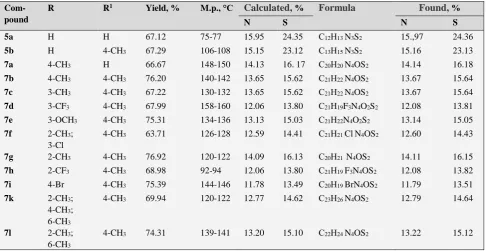
Table 1. Physical properties and other data
Scheme1. Synthesis route of title compounds
All research chemicals were purchased from the Sigma-Aldrich (USA) and used as such for the reactions. Reactions were monitored by thin layer chromatography carried out using pre-coated silica gel plates (E. Merck and Co., Darmstadt, Germany). The technique described above was found to be an efficient method for the preparation of 4-allyl-5-(4-R1
)-phenylthiomethyl-1,2,4-triazole-3-yl-mercaptoacetic acid derivatives 7a-l.
General procedure for the synthesis of 3-mercapto-4-allyl-5-(4-R1) -phenylthiomethyl-1,2,4(4H) -triazole (5a-b)
0.1 mol of substituted allyl isothiocyanate was added dropwise with vigorous stirring to a solution of 0.1mol of phenylthioacetic acid hydrazides 3 in 100 mL of ethanol. The reaction mixture was heated to reflux for 1 h, cooled and the precipitate of formed substituted phenylthio-semicarbazide 4 was filtered out and dried. To a suspension of 0.01 mol substituted phenylthiosemicarbazide 4 in 80 ml water were added 0.02 mol KOH. The reaction mixture was refluxed for 5 hours. After cooling, the solution was acidified with hydrochloric acid to pH = 3-4. The resulting precipitate merkaptotriazole was filtered, washed with water and dried.
General procedure for the synthesis of 4-аllyl-5-(4-R1
)-phenyl-thiomethyl-1,2,4-triazole-3-yl-mercaptoacetic acid anilides (7a-k)
To a solution of 0.002 mol mercaptotriazole 5a-b in 20 ml of ethanol was added 20 ml of an aqueous solution of 0.002 mol of KOH. To the resulting reaction mixture was poured with stirring an solution of 0.002 mol of substituted anilides chloracetic acid 6a-k in ethanol. The resulting solution was heated to reflux for 1 h, cooled, poured into 200 ml of water. The precipitate of the product was filtered off and dried.
Synthesis of 4-allyl-5-(4-R1
)-phenylthiomethyl-1,2,4-triazole-3-ylthio-1-(4-bromo)-acetophenone (7l)
20 mL of an aqueous solution of 0.002 mole of KOH was added to a solution of 0.002 mol merkaptotriazole 5a in 20 mL of ethanol. 0.002 mol of 4'-bromo-2-chloroacetopheno-
Com-pound
R R1 Yield, % M.p., °С Calculated, % Formula Found, %
N S N S
5a H H 67.12 75-77 15.95 24.35 С12Н13 N3S2 15.,97 24.36
5b H 4-CH3 67.29 106-108 15.15 23.12 С13Н15 N3S2 15.16 23.13
7a 4-CH3 H 66.67 148-150 14.13 16. 17 С20Н20 N4OS2 14.14 16.18
7b 4-CH3 4-CH3 76.20 140-142 13.65 15.62 С21Н22 N4OS2 13.67 15.64
7c 3-CH3 4-CH3 67.22 130-132 13.65 15.62 С21Н22 N4OS2 13.67 15.64
7d 3-CF3 4-CH3 67.99 158-160 12.06 13.80 С21Н19F3N4O2S2 12.08 13.81
7e 3-OCH3 4-CH3 75.31 134-136 13.13 15.03 С21Н22N4O2S2 13.14 15.05
7f 2-CH3;
3-Cl
4-CH3 63.71 126-128 12.59 14.41 С21Н21 ClN4OS2 12.60 14.43
7g 2-CH3 4-CH3 76.92 120-122 14.09 16.13 С20Н21 N4OS2 14.11 16.15
7h 2-CF3 4-CH3 68.98 92-94 12.06 13.80 С21Н19 F3N4OS2 12.08 13.82
7i 4-Br 4-CH3 75.39 144-146 11.78 13.49 С20Н19 BrN4OS2 11.79 13.51
7k 2-CH3;
4-CH3;
6-CH3
4-CH3 69.94 120-122 12.77 14.62 С23Н26 N4OS2 12.79 14.64
7l 2-CH3;
6-CH3
4-CH3 74.31 139-141 13.20 15.10 С22Н24 N4OS2 13.22 15.12
5a-b
7a-k 4
NH2NH2
6a-k 7l 1 2 6l 3 SH R1 S O O R1 S NH NH2 O R1 NC S R1 S O N H N H N H S Br O S N N S R1 N Br O Cl N S R1 N N S O N H Cl N H O N N N SH S R1 R R
ClCH2COOEt
K2CO3
5a-b
7a-k 4
NH2NH2
6a-k 7l 1 2 6l 3 SH R1 S O O R1 S NH NH2 O R1 NC S R1 S O N H N H N H S Br O S N N S R1 N Br O Cl N S R1 N N S O N H Cl N H O N N N SH S R1 R R
ClCH2COOEt
ne 6l in ethanol was added to the resulting reaction mixture with stirring. The resulting solution was heated to reflux for 1 h, cooled, poured into 200 ml of water. The precipitate of the desired product was filtered off and dried.
All obtained compounds 5a-b and 7a-l after crystallization from ethanol or isopropanol are white crystalline substances with clear melting points, soluble in most organic solvents. Melting points (mp) were determined on a Kofler melting point apparatus. Purity of these compounds was checked by thin layer chromatography and supported by spectroscopic data. Physical properties and other data are shown in Table 1.
1H NMR Structure determination
The 1H NMR spectra were obtained on an NMR Spectrophotometer (Bruker Avance II 200 NMR) using DMSO-d6 as a solvent. Chemical shifts were expressed in parts per million relative to TMS as an internal standard.
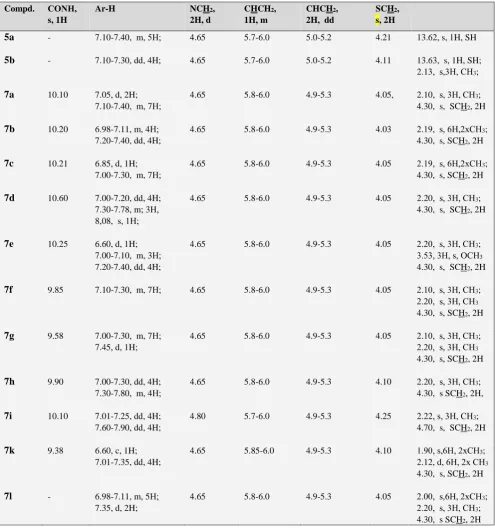
The structure of compounds 5a-b was confirmed by 1H NMR spectroscopy. The singlet signal in the range 13.62 to 13.63 ppm is due to the proton mercapto group in compounds 5a-b. The structures of compounds 7a-l from
5a-b also was confirmed by 1H NMR spectrum. The mercapto group proton signal in compounds 7a-l disappears. A singlet at 9.38 –10.60 ppm in substances synthesized 7a-l
spectrums has been confirmed presents amide group in structures obtained. The signals of aromatic protons were observed in the ranges 6.60 –7.78 ppm. As shown in Table 2, the signals of both methylene groups associated with sulfur atom in the synthesized compounds 5a-b and 7a-l as two singlets are common and occur in the spectra in the range δ 4,05 to 4,30 ppm.16
Theory/calculation
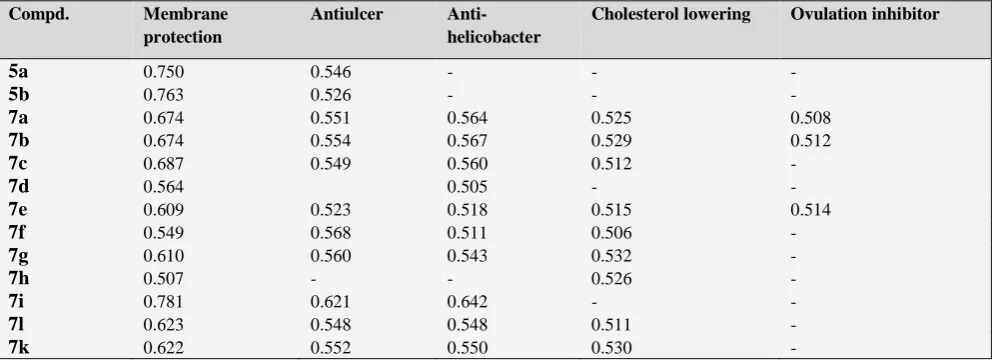
Pharmacological activity for all compounds synthesized was expected according to PASS computer program (Prediction of Activity Spectra for Substances).17 All chemical structures were generated using ISIS DRAW 4.0 software. The chemical structures were stored in .mol format and were represented in PASS as a set of Multilevel Neighborhoods of Atoms (descriptors). MNA-descriptors were calculated iteratively for each atom of the structure using the following rules. The zero-level MNA descriptor was presented as an atom. The descriptor of the first level consists of the atom's zero-level descriptor and zero-level descriptors of its neighboring atoms sorted lexicographically. The prognosis showed a high probability of the anti-ulcer activity for these substances. The presumption can be made that all compounds of this group may exhibit high anti-ulcer (probable activity (Pa) from 0.523 to 0.621) and anti-helicobacter (Pa from 0.505 to 0.642) activities. The compound with highest probability of these activities is 7i. The computer prediction results are shown in Table 3. As known, myofibroblasts are considered to play an important part in ulcer healing, expressing COX-2 and synthesizing prostaglandins when exposed to inflammatory stimuli. Prostaglandins have anti-secretory effect on gastric acid; and protect the lining of the stomach from the damaging effects of the acid. Therefore, ligands, which can prevent rapid metabolic conversion prostaglandins into inactive products, may be used for treating of NSAID-inducеd ulcer.18
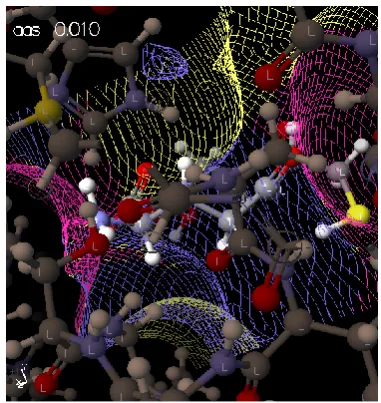
The interaction of compounds 5a-b and 7a-l (as ligands) with protein 3DWW residues of enzyme human MPGES1 (as receptors) were studied by docking using SCIGRESS software.19 As shown in Figure 1, enzyme human MPGES1 constitutes an inducible glutathione-dependent integral membrane protein as the endogenous ligand.20.
Figure 1. Ligand glutathione in active site protein 3DWW. Active site amino acid residues are represented as sticks colored according to residue type (Sequence protocol-Karplus and Schultz Flexibility).
Predicting the binding affinity and rank-ordering ligands in database screens was implemented by modified and expanded version of the SCIGRESS scoring function. Quantum docking method, in which both 3DWW and ligand are rigid, was adopted and binding energy values were compared with each other.21
The docking study was performed using Scigress Explorer 7.7 installed in a single machine running on a 3.4 GHz Intel Core 2 Duo Processor with 1GB RAM and 160 GB Hard Disk with Windows XP as the Operating System.
All ligands 5a-b and 7a-l were docked into the active site of the crystal structure of MPGES1 (PDB entry code 3DWW) using automated docking. The enzyme human MPGES1, which constitutes an inducible glutathione-dependent integral membrane protein modeled using the electron crystallographic structure at 3.5 Å resolution was downloaded from the RCSB Protein Data Bank (PDB ID: 3DWW) (www.pdb.org). Water molecules were removed and hydrogen added to crystal structure of protein before docking. After assigning charge and protonation state final refinement (energy minimization) was done using MM3 force field runs.
Table 2. 1H NMR spectralcharacteristics of the synthesized compounds5 a-b, 7a-l
The optimization of the cleaned molecules was done through MO-G computational application that computes and minimizes the energy of heat of formation. The MO-G computational application solves the Schrodinger equation for the best geometry of the ligand molecules. The augmented Molecular Mechanics (MM2/MM3) parameter was used for optimizing the molecules up to its lowest stable energy state. This energy minimization was done until the energy change is less than 0.001 kcal mol-1 or the molecules are updated almost 300 times. For automated docking of ligands into the active sites we used genetic algorithm with a fast and simplified Potential of Mean Force (PMF) scoring scheme. PMF uses atom types, which are similar to the empirical force fields used in Mechanics and Dynamics.
A minimization is performed by the Fast-Dock engine, which uses a Lamarkian genetic algorithm (LGA) so that individuals adapt to the surrounding environment. The best fits are sustained through analyzing the PMF scores. This process repeats for almost 3,000 generations with 500 individuals and 100,000 energy evaluations. Other parameters were left to their default values.
Structure-based screening involves docking of candidate ligands into protein targets, followed by applying a PMF scoring function to estimate the likelihood that the ligand will bind to the protein with high affinity or not. At the end of the docking study, the minimum Consensus score for the best ligand position for each of ligands was obtained.22 Details are given in Table 4.
Compd. СONH, s, 1H
Ar-H NCH2,
2H, d
CHCH2,
1H, m
CHCH2,
2H, dd
SCH2,
s, 2H
5a - 7.10-7.40, m, 5Н; 4.65 5.7-6.0 5.0-5.2 4.21 13.62, s, 1H, SH
5b - 7.10-7.30, dd, 4H; 4.65 5.7-6.0 5.0-5.2 4.11 13.63, s, 1H, SH; 2.13, s,3Н, СН3;
7a 10.10 7.05, d, 2H; 7.10-7.40, m, 7Н;
4.65 5.8-6.0 4.9-5.3 4.05, 2.10, s, 3Н, СН3;
4.30, s, SCH2, 2H
7b 10.20 6.98-7.11, m, 4Н; 7.20-7.40, dd, 4H;
4.65 5.8-6.0 4.9-5.3 4.03 2.19, s, 6Н,2хСН3;
4.30, s, SCH2, 2H
7c 10.21 6.85, d, 1H; 7.00-7.30, m, 7Н;
4.65 5.8-6.0 4.9-5.3 4.05 2.19, s, 6Н,2хСН3;
4.30, s, SCH2, 2H
7d 10.60 7.00-7.20, dd, 4H; 7.30-7.78, m; 3Н, 8,08, s, 1Н;
4.65 5.8-6.0 4.9-5.3 4.05 2.20, s, 3Н, СН3;
4.30, s, SCH2, 2H
7e 10.25 6.60, d, 1H; 7.00-7.10, m, 3Н; 7.20-7.40, dd, 4H;
4.65 5.8-6.0 4.9-5.3 4.05 2.20, s, 3Н, СН3;
3.53, 3Н, s, OСН3
4.30, s, SCH2, 2H
7f 9.85 7.10-7.30, m, 7Н; 4.65 5.8-6.0 4.9-5.3 4.05 2.10, s, 3Н, СН3;
2.20, s, 3Н, СН3
4.30, s, SCH2, 2H
7g 9.58 7.00-7.30, m, 7Н; 7.45, d, 1H;
4.65 5.8-6.0 4.9-5.3 4.05 2.10, s, 3Н, СН3;
2.20, s, 3Н, СН3
4.30, s, SCH2, 2H
7h 9.90 7.00-7.30, dd, 4H; 7.30-7.80, m, 4Н;
4.65 5.8-6.0 4.9-5.3 4.10 2.20, s, 3Н, СН3;
4.30, s SCH2, 2H,
7i 10.10 7.01-7.25, dd, 4H; 7.60-7.90, dd, 4H;
4.80 5.7-6.0 4.9-5.3 4.25 2.22, s, 3Н, СН3;
4.70, s, SCH2, 2H
7k 9.38 6.60, c, 1H; 7.01-7.35, dd, 4H;
4.65 5.85-6.0 4.9-5.3 4.10 1.90, s,6Н, 2хСН3;
2.12, d, 6Н, 2х СН3
4.30, s, SCH2, 2H
7l - 6.98-7.11, m, 5Н; 7.35, d, 2H;
4.65 5.8-6.0 4.9-5.3 4.05 2.00, s,6Н, 2хСН3;
2.20, s, 3Н, СН3;
Table 3. Results predicted by computer program PASS
Compd. Membrane protection
Antiulcer Anti-helicobacter
Cholesterol lowering Ovulation inhibitor
5a 0.750 0.546 - -
-5b 0.763 0.526 - -
-7a 0.674 0.551 0.564 0.525 0.508
7b 0.674 0.554 0.567 0.529 0.512
7c 0.687 0.549 0.560 0.512
-7d 0.564 0.505 -
-7e 0.609 0.523 0.518 0.515 0.514
7f 0.549 0.568 0.511 0.506
-7g 0.610 0.560 0.543 0.532
-7h 0.507 - - 0.526
-7i 0.781 0.621 0.642 -
-7l 0.623 0.548 0.548 0.511
-7k 0.622 0.552 0.550 0.530
-Table 4. Consensus docking score
Compd. 5a 5b 7a 7 b 7 c 7 d 7 e 7 f 7 g 7 h 7 i 7 k 7l
Consensus docking score
-68.6 17.3 273.2 -7.2 -23.2 -70.5 -45.6 82.3 24.3 6.3 -16.8 107.5 234.7
Results and discussion
Results of docking studies have shown that molecule 7d
showed better binding energies than the others. The amino acids residues present in cavity of 3DWW protein mainly Arg70, 126, Gln134, Gsh 154, His 113, Tir 117,130, Glu 77, Arg110, Arg 126 (active site) were involved in the interactions with ligands. In the present work, 13 derivatives of 1,2,4-triazole were evaluated for their anti-ulcer activity through PASS program and docking studies. Later results were compared with experimental data on acute alcohol-prednizolon model NSAID-induced ulcers on rats, which suggests that only three derivatives of 1,2,4-triazole (compounds 7c, 7d, and 7i) have substantial anti-ulcer activity.
Overall, this work illustrated that potential anti-ulcer compounds were found among new derivatives 1,2,4-(4H)– triazole. Compound 7i was substantially more active than others and requires further study. In conclusion, excellent agreement between molecular docking combined with results of computer program PASS simulations and experimental affinities of these ligand series is apparent. The agreement of the computational and experimental results suggests that the docking studies and computer program PASS may become a valuable tool in the search for new drugs. The binding pattern can be further used as a tool for the structure-based novel anti-ulcer drug design.
Acknowledgements
The authors gratefully acknowledge the financial support from the National University of Pharmacy and the Tajic National University. The authors have declared no conflict of interest.
References
1Valle, D. L, Peptic ulcer diseases and related disorders. In:
Braunwald, E., Fauci, A. S., Kasper, D. L., Hauser, S. L., Longo, D. L., Jameson, J. L., editors. Harrison’s principles
of internal medicine. 16-th ed. New York: McGraw-Hill.
2005
2Navidpour, L., Shafaroodi, H., Amini K., Fazeli, M. R.,
Jamalifar, H., Shafiee, A., Bioorg. Med. Chem. 2006, 14(8), 2507-2017.
3Saidov., N.B, Kadamov, I.M., Georgiyants, V.A., Zh. Org. Farm.
Khim., 2013, 11(1), 44-48.
4Abdel-Megeed, A. M., Abdel-Rahman., H. M, Alkaramany, G. E.,
Eur. J. Med. Chem.2008, 43(4), 642-647.
5L.Labanauskas, E.Ubrenaite, P.Gaidelis, A. Brukstus, Farmaco.
2004, 59, 255-259.
6Saidov N. B., I. M. Kadamov, Georgiyants, V. A., Zh. Org. Farm.
Khim., 2012, 10(4), 25-28.
7Mathew, V., Giles, D., Keshavayya, J.et al,. Arch. Pharm.2009,
342(4), 210-220.
8Tozkoparan, B., Aktay, G., Yesilada E., Arzneimittel-Forsch.,
2001, 51(6), 470-477.
9Karathikeyan, M.S., Eur. J. Med. Chem, 2009, 44(2), 827-833. 10Saidov, N. B., Kadamov, I. M., Georgiyants, V. A., Taran, A. V.,
Khim. Farm. Zh., 2013, 47(11), 11-15
11Labanauskas, L., Kalkas, V., Udrenaite, E., Pharmazie, 2001,
56(8), 617-619.
12Tozkoparan, B., Kupeli, E., Izik, E., Arzneimittel-Forsch., 2005,
55(9), 533-540.
13Demchenko, A. M., Yanchenko, V. O., Shatirkina, T. V.,
Lozinskiy, М.О., Farm. Zh., 2003(2), 57-60.
14Joule, K., Mills J. A., Heterocyclic Chemistry. Blackwell Science,
2004, 728.
15Garratt, P. J., Katntzky, A. R., Rees, C. W., 1,2,4-Triazoles.
16Breitmaier, E., Structure elucidation by NMR in organic
chemistry, 3rd ed. – John Wiley @ Sons Ltd, Chichester,
2002.
17Poroikov, V., Filimonov, D., Computer-aided prediction of
biological activity spectra. Application for finding and optimization of new leads, Rational Approaches to Drug Design, Eds. Holtje, H.-D. Sippl, W., Prous Science, Barcelona, 2001, 403-407.
18Abraham, D. J. (ed.) Burger's Medicinal Chemistry and Drug
Discovery, v.4 - Drug Discovery and Drug Development
Sixth Edition. - A Wiley-Interscience Puplication, A John Wiley and Sons, Inc., 2003.
19Scigress Explorer Ultra 7.7 Bio Applications Getting Started
Manual, Fujitsu Limited, Poland, 2012.
20Jegerschold, C., Pawelzik, S., Purhonen, P., Bhakat, P., Gheorghe,
K. R., Gyobu, N., Mitsuoka, K., Morgenstern, R., Jakobsson, P. J., Hebert, H., Proc. Natl. Acad. Sci. USA, 2008, 105, 11110-11115.
21Chi Zhang, Song Liu, Qianqian Zhu, and Yaoqi Zhou, J., Med.
Chem,2005, 48, 2325-2335
22Clark, R. D., Strizhev, A., Leonard, M., Blake, J. F., Matthew, J.
B., J. Mol. Graphics Model,2002, 20, 281-295