Recent Advances in Multi-paradigm Modeling
(MPM 2011)
Asserting the Correctness of Software Language Translations
Bruno F. Barroca, Vasco M. Amaral
12 pages
Guest Editors: Vasco Amaral, C ´ecile Hardebolle, Hans Vangheluwe, L ´aszl ´o Lengyel, Peter Bunus
Managing Editors: Tiziana Margaria, Julia Padberg, Gabriele Taentzer
Asserting the Correctness of Software Language Translations
Bruno F. Barroca1, Vasco M. Amaral1
Centro de Inform´atica e Tecnologias de Informac¸˜ao (CITI) Departamento de Inform´atica, Faculdade de Ciˆencias e Tecnologia,
Universidade Nova de Lisboa, Portugal1
Abstract: While building a new language, we assign its semantics by mapping its
syntax onto a semantic domain. To do so, we can either(i)do it operationally, by
means of small-step morphisms within the same semantic-domain; or(ii)by means
of a translation (syntax-to-syntax transformation), onto a target language that has already an operational semantics defined. Despite the fact that it is possible to build the set of syntactic correspondences from a given translation, it is still not clear how we can assert about the correctness of these syntactic correspondences in w.r.t. both the source and target language’s underlying semantics.
In this paper, we combine the above described techniques by analyzing the trans-lation and establishing a semantic retrans-lation between the respective operational se-mantics, in order to assert the correctness of that translation. We demonstrate our approach with a concrete translation between two languages: State Machines and Petri Nets; and decide about its correctness by using their respective operational se-mantics as oracles. Finally, we discuss about the validity of our assertions in w.r.t. language translations in general.
Keywords: Translations, Model Transformations, Structured Operational Seman-tics (SOS), Translation Analysis, Translation Symbolic Space, Bissimulation
1
Introduction
One of the challenges of multi-paradigm modeling is to be able to accept that we can look at any existing (or intended) artifact in multiple perspectives simultaneously, in a sound and co-herent fashion—i.e., without the existence of logical contradictions between the involved views over that artifact. These different views can be realized by means of domain specific modeling
languages (DSMLs) [KT08], hence enabling the end-users—the modelers involved in a domain
specific modeling (DSM) activity—with a pragmatic and usable way to understand their par-ticular views. These DSMLs, capture the occurrence of reusable patterns while describing an artifact in a particular perspective (i.e., limited to a given domain), and provide to the end-users a pragmatic way to apply these reusable patterns in a controlled fashion.
The concern on model comprehension refers to the cognitive capabilities of the end-users while understanding their own models and dealing with its intrinsic complexity. Hence, the quality level of a model is specially biased to the computational complexity of the underlying analysis algorithms involved in the extraction of a clear rational over the specified models. In general, depending on the expressiveness of the used language, the size of the model’s analysis
One solution to solve this complexity management problem while dealing with models is to provide syntax-to-syntax model transformations (or translations throughout this paper) between DSMLs. The translations can enable the reuse of the capabilities offered by the different lan-guages and associated tools, such as efficient analysis algorithms and data structures, simulation and visualization capabilities, etc.
The translations are also specifications that generically describe how sentences in one lan-guage are translated to another lanlan-guage. The systematic use of model transformations is in the heart of model driven development (MDD) approaches, where software development’s complex-ity is dealt in a systematic way.
DSLTrans [BLA+10] is a syntax-to-syntax model transformation language designed to define
analyzable language translations. Moreover, this language imposes, by construction in its seman-tics, that all translations are confluent and terminating. These properties are in fact determinant for the analyzability of the translations due to the finite size of the translation’s analysis/symbolic space. The analysis of a translation tries to figure-out what are all the possible general relations between syntactic structures (i.e patterns) expressed in the source language, and its translated versions expressed on the target language. These structural (rather syntactic) correspondences between languages can be automatically checked on a given translation by means of a verification
method [LBA10].
However, it is still not clear how we can assert the correctness of the translations’ structural correspondence set in w.r.t the underlying semantics of both source and target languages — i.e the translation might be semantically wrong if a model in the source language do not have exactly the same meaning after being translated to the target language.
In this paper, we discuss how can we assert about the correctness of a translation, by establish-ing a generic semantic relation between both source and target languages’ semantic definitions.
In Section2we present what are the main research trends in this subject. Then, in Section3, we
give an theoretical overview of the approach while introducing the involved basic concepts. In
Section4, we demonstrate our approach by means of an experiment that consisted in:(i)
build-ing a translation specification between the State Machine Language and the Petri Net Language;
and(ii)asserting about its correctness w.r.t. their semantics expressed by means of Structured
Operational Semantics (SOS). In Section 5, we discuss the results of the experiment, and we
elaborate on how this approach can be used to assert the correctness about language translations
in general. Finally, in Section6we conclude and present future insight on the research on this
subject.
2
Related Work
The quality of model transformations, and in particular the quality of translations is a subject
of great interest. [Kus04] presented some important guidelines and properties that need to be
checked during the validation of some model transformation: syntactic correctness of both in-put and outin-put models; termination and confluence (unique results and determinism); semantic equivalence or semantics preservation; safety or liveness (to ensure preservation of structural or security properties).
source metamodel is in general not automatic and not even easy to master for a quality engineer. There are many examples of work on trying to analyse language transformations at the meta
level by reaching proofs from the transformation rules [Con09], [BGL05]. For instance, in
[Con09] an encoding of the lambda-calculus into the pi-calculus (by three simple recursive rules) is presented, as well as the proof that some semantic properties of the lambda-calculus are preserved after the encoding into the pi-calculus. Although these languages are relatively small—even minimalist in our context—the proof that these semantic relations hold between them is still not easy perform by a quality language engineer.
In order to aid the construction of the proof of semantic preservation along a set of
transfor-mation rules [ALL10] introduced a language to anotate those rules with assertions. The idea
is to then pass these annotations to a reasoning framework that will derive, at the meta level,
conclusions about the overall transformation. The work presented in [ABK07] aims at validating
a model transformation by using the Alloy tool. In this case, Alloy simulates the transforma-tion by generating a model example of the source language and then analyzing the results of the transformation.
The authors of [FHLN08] present a constructive fashion to automatically generate a valid
transformation (the authors refers to transformations as ontology alignment) which in princi-ple would preserve the semantic properties of the input and output models. This generation is done by using the Similarity Flooding algorithm which is based on a calculation of a distance measurement between source and target languages.
3
Overview of the approach
In our approach, we use formal models of software languages calledlinguistic metamodels(or
just metamodels throughout this paper) in order to be able to decide if a given model (or just sentence throughout this paper) is a syntactically valid expression of a given language. This de-cision is realized by relating both the terms and their composition on a given sentence, and the terms and their composition on the metamodel. For instance, if we look at the shapes of these sentences as being graphs (i.e made out of vertices and edges relating vertices), then we can re-late the expressed sentences with the metamodel of its language by means of an instance relation
(also referred in the literature as theconformance relation). A sentence being an instance of
a metamodel means that(i) every concept in the sentence is also present in the metamodel of
the language, and (ii) every relation between two concepts in the sentence is also present in
the metamodel of the language relating those concepts. Additional constraints are introduced to distinguish the types of these relations (e.g containment or association relations), and their car-dinalities (e.g one to one associations, one to many, etc.). These metamodels could in principle be used to generate sentences on a given language. However the complete set of sentences that conforms to a language is typically infinite. Nevertheless, this conformance relation is merely
syntactic, which means that the referred metamodels corresponds to the so calledabstract
syn-tax of a language, since they filter the structure and shape of valid expressions of that language by only looking to their explicit structure regardless of their implicit value/meaning.
Plotkin [Plo04]). Plotkin proposed that all the computation steps of a valid computer program while running in hypothetical computer system can be generically described by means of a
fi-nite set of pre/pos condition rules. These rules form what we call theStructural Operational
Semantics(SOS) of a software language. If we take a program expressed in a given software language, we can use these SOS rules to collect all of its possible computation steps, and then
build up a graph which we call the program’stransition system. In this graph, each edge is a
transition generated by the conclusion of an application of a SOS rule while symbolically exe-cuting that program. These edges relates source and target vertices, where each vertex represents the computation state (i.e values in the hypothetical machine’s memory) before and after that transition occurred in the symbolic execution. A path in a given transition system, is called a
symbolic executiontrace. Note also that with these SOS rules, the implicit meaning of a finite
sentence cannot simply be made explicit because there may be a possible infinite amount of possible SOS rule applications (i.e its transition system can be infinite).
Despite the fact that the language sentences’ transition systems can be infinite, it is still pos-sible, for instance, to use their SOS descriptions for checking or proving that two different sen-tences in a language have the same meaning or value, by establishing an semantic equivalence
re-lation between their transition systems. Examples of these rere-lations are the strong
bisimulation-equivalence, or some other weaker forms such as thesimulation equivalence[Par81].
Intuitively, two transition systems are bisimilar-equivalent if all of their possible moves (exe-cution traces) match each other.
When we perform a translation between a source sentence and a target sentence, the first thing to consider while asserting correctness of a given translation, is that those sentences may be expressed in different languages, and that translation preserves its abstraction level. Which means that the transition systems of every sentence expressed in the source language, and of its respective translated sentence expressed in the target language, are bisimilar-equivalent. In other words, to prove that a given translation is correct, we would need to verify this equivalence between the transition systems of every possible sentence expressed in the source language, and of their counter-parts in the target language.
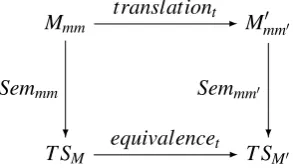
Since a language have an infinite amount of possible sentences, this proof would never termi-nate. Clearly, we have to take a closer look on how the translation is being specified, and extract from it a finite amount of relevant sentence pairs (from both source and target language) in order to check the semantic equivalence of their transition systems. These relations are illustrated in
the commutative diagram in the Figure1. In practice, there may be several ways of transversing
this diagram. However, in our experiment we only show one operational method to transversing it in a tractable way.
Mmm
translationt
- Mmm0 0
T SM Semmm
? equivalencet
- T SM0 Semmm0
?
Figure 1: A commutative diagram illustrating the logical principles of the approach. MandM0
are representative sentences from source and target languages of the translation. These
repre-sentative sentences that can be extracted from a translation specification, where mm andmm0
are metamodels identifying each language,Semmm andSemmm0 are each one a set of SOS rules
defined for each language, and TransitionSystemM and TransitionSystemM0 are the resulting
transition system from each sentenceMandM0respectively.
Depending on the expressiveness of the model transformation language used to express a given translation, it might be even impossible to prove that the number of the translation’s symbolic states is finite.
DSLTrans, is a graph-based model transformation language that enables the specification of translations. These translations are expressed by means of groups of rules organized in a list of sequential layers — which means that the group of rules in the first layer, is executed before every other groups. As in a regular graph-based model transformation language, these rules are
formed by a left-hand-side graph (which we call thematch modelof the transformation rule),
and by a right-hand-side graph (which we call theapply modelof the transformation rule). Every
translation expressed in this language is proved by construction to be confluent and terminating. Moreover, it is also proved that the number of relevant sentence pairs (translation’s symbolic
states) extracted from a DSLTrans’ translation is finite [LBA10]. In our experiment, we will only
assert the correctness of translations expressed in DSLTrans.
4
Case Study: Translating State Machines to Petri Nets
To demonstrate our approach, we present a case study of a translation between two languages: State Machines and Petri Nets.
meaning (in this case computational behaviour) with its translated petri net versions. Thus, we will use a strong equivalence relation such as bisimilar-equivalence.
4.1 Preparing the Translation
In this experiment, both the State Machine Language and the Petri Nets Language’s abstract
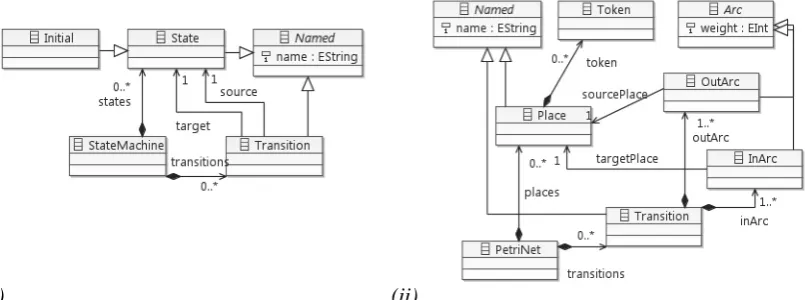
syntax were defined by means of Ecore-based metamodels1, as shown in Figure2.
In this experiment, the language engineer defined its translation using the DSLTrans’ trans-formation tool, which uses EMF-based metamodel specifications in order to load state machine sentences — i.e conformant with the State Machine Metamodel— and produce petri net sen-tences — i.e conformant with the Petri Net Metamodel.
(i) (ii)
Figure 2: The State Machine Language Metamodel (i), and the PetriNet Language
Meta-model(ii)
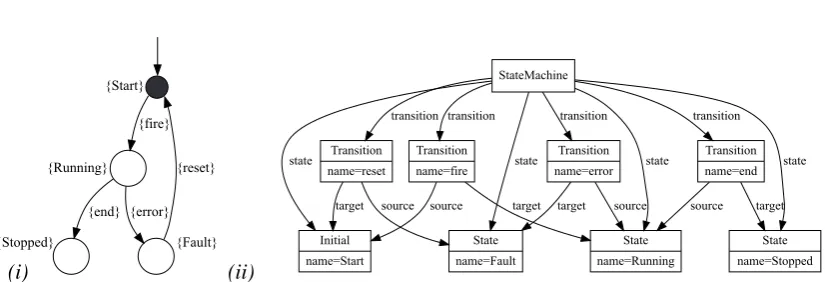
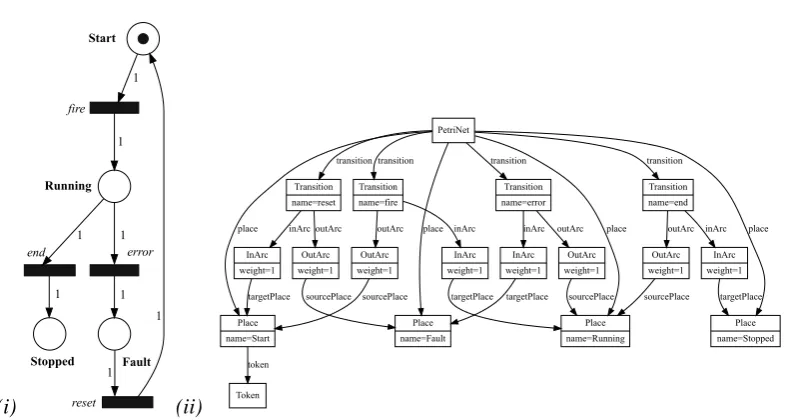
Once the abstract syntax of the language is defined, the language engineer defines its concrete syntax and its semantics definition. The concrete syntax definition of a language usually extends the existing abstract syntax with symbols and usable metaphors that enable the domain experts to quickly understand the sentences in that language. In our examples, for readability, we prefer to use the concrete syntax versions of both state machines and petri nets sentences. As a reference, we exemplify how the same sentences look like by using or not its concrete syntax definitions
in Figures 3 and 4, where we show examples of sentences expressed in the State Machines
Language, and the Petri Nets Language respectively.
As mentioned before, the operational semantics of the language can be made explicit by means of a set of SOS rules. In this experiment, the language engineer defined two small semantics,
one for each language. Theoperational semantics of the State Machine languageis formed
by the following SOS rule defined for an arbitrary State Machine sentences:
(Transitions source
−−−→States) ∧ (Transitions target
−−−→State0s)
cs(States)
transition
−−−−−→cs(State0s)∈T Ss
,
This SOS rule says that ifi)we have aTransitiondefined in a given State Machine sentences,
which is connected to both aStates(by means of asourcerelation), and to aState0s(by means of
atargetrelation); andii)the current state of execution happens to beStates(writtencs(States)),
then there will exist atransitionin the transition system of the sentences (writtenT Ss), from
cs(States)tocs(State0s). Thistransitionmeans that it is possible to move from a current state
ofStates toState0s given the current state machine sentences. Moreover we need to build the
first current state (cs(Initials)) by just saying thatInitials =⇒ cs(Initials), while imposing that
sneeds to have exactly oneInitialstate.
The transition system of a particular sentence expressed in the State Machine Language is
therefore a set of all the possible−−−−−→transition relations between current states, denoted ascs(StateS).
Also note that the transition system of the State Machine Language is finite: intuitively, given a particular state machine, the value of the current state value will range on all the defined
states, and the number of−−−−−→transition between the current states will be bounded by the number
of transitions defined in that particular state machine.
Thesemantics of the Petri Net languageis defined by the following SOS rule defined for an
arbitrary petri net sentencep:
∀(Transitionp outArc
−−−→OutArc0) :
(OutArc0p−−−−−−→sourcePlace Place0p)∧(Place0p,T0)∈M =⇒ OutArc0p.weight≤T0 m(M)−−−−−→transition m({(Placep,T+InArcp.weight−OutArcp.weight)})∈T Sp
,
where for an arbitrary place p(herein called Placep), InArcp is an ingoing arc of p such that
(Transitionp inArc
−−−→InArcp) ∧ (InArcp
targetPlace
−−−−−−→Placep), andOutArcpis an outgoing arc ofp
such that(Transitionp
outArc
−−−→OutArcp) ∧ (OutArcp
sourcePlace
−−−−−−→Placep). Notice thatMis also
called the marking of the petri net, and is initially calculated as:
M={(Placep,T)|T =|{(Placep token
−−−→Tokenp)}|}
. (i) {Start} {Running} {fire} {Fault} {error} {Stopped} {end} {reset} (ii) StateMachine Initial name=Start state State name=Running state State name=Fault state State name=Stopped state Transition name=fire transition Transition name=error transition Transition name=reset transition Transition name=end transition
source target target source
target source source target
Figure 3: The standard visual representation of a state machine using state machine language’s
concrete syntax(i), and its internal hierarchical EMF representation(ii): a model instance of the
(i) Start fire 1 Running error end Fault reset Stopped 1 1 1 1 1 1 1 (ii) PetriNet Place name=Start place Place name=Running place Place name=Fault place Place name=Stopped place Transition name=fire transition Transition name=error transition Transition name=reset transition Transition name=end transition Token token InArc weight=1 inArc OutArc weight=1 outArc targetPlace sourcePlace InArc weight=1 inArc OutArc weight=1 outArc targetPlace sourcePlace InArc weight=1 inArc OutArc weight=1 outArc targetPlace sourcePlace InArc weight=1 inArc OutArc weight=1 outArc targetPlace sourcePlace
Figure 4: The standard visual representation of a petri net using the language’s concrete
syn-tax(i), and its internal hierarchical EMF representation(ii): a sentence instance of the petri nets
metamodel. There exists very efficient verification algorithms/techniques developed to determine invariants of a petri net sentence, such as the overall number of tokens.
The semantics of a particular Petri Net expression is a set of all the possible−−−−−→transition relations
between markings. Each marking value (denoted here asM) represents the number of tokens
on each place at some point in the run-time of a particular petri net sentence. Intuitively, there may be transition systems of Petri Net sentences that may not be finite. In fact, if we consider a simple petri net sentence with a cycle that produces more tokens than it consumes, the resulting number of value combinations for its marking would be already infinite.
4.2 The Translation Specification and its Properties
Despite the fact that the two presented languages do share similar concepts, their semantics are very different in nature, as shown above. However, when the language engineer considers to specify a translation between them, there is some assumption of semantic compatibility between them. In other words, the language engineer assumes that there exists a translation where every state machine, and its translated version in petri nets, have exactly the same behaviour. Therefore everything meaningful that we can express in the State Machines language should also have the same meaning in the Petri Nets Language.
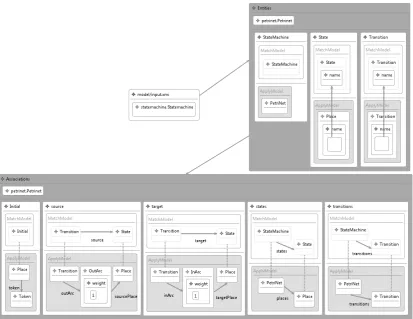
In this small experiment, the language engineer produced the translation shown in Figure5.
The patterns in both match and apply models refer to elements of the State Machine and Petri Net
metamodels, respectively. The language engineer, first wrote the layerEntitieswhich specifies
a direct 1 to 1 mapping between all the concepts of state machines with some significant ones
from the petri nets’ language (e.gState:Expis translated toPlace). Then, the language
(relevant) state machine term compositions with petri net compositions. These compositions may involve the introduction of new concepts. For instance, to translate the relation named
sourcebetweenState:ExpandTransition, the language engineer had to introduce the concept ofOutArc.
Figure 5: A DSLTrans’ translation specification between the State Machine Language and the PetriNet Language.
At first glance, this translation seems to make sense, but it remains an intuition based on the empirical knowledge of the language engineer. For instance, consider that the translation has
in fact a mistake, where the weight of the producedOutArcin rulesourceis not 1, but 2. This
specification would in fact produce meaningless petri nets from meaningful state machines. If
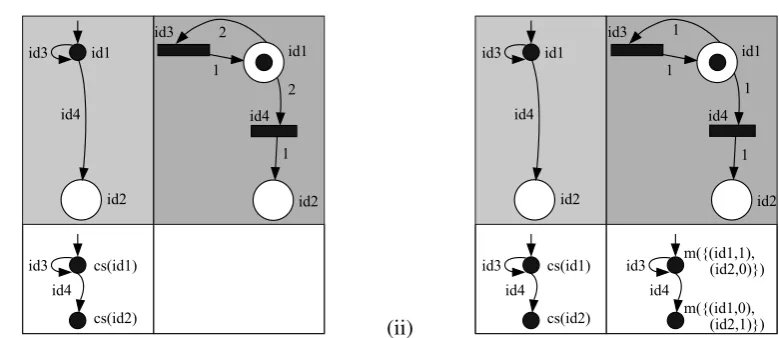
we generate a translation’s symbolic state which is a pair (M,M0) of relevant sentences from our
translation, as shown in Figure6(i) — the resulting transition systemsT SM andT SM0 are not
bisimilar-equivalent — in fact, in this case,T SM0 is empty, since the resulting petri net is
dead-locked. A similar symbolic state resulting from the analysis of the correct translation presented
in Figure5, is shown in Figure6(ii).
Both of the presented symbolic states were a result of an analysis over the presented
(i)
id1 id3
id2 id4
id1
id2 id3 2
id4 2 1
1
cs(id1) id3
cs(id2) id4
(ii)
id1 id3
id2 id4
id1
id2
id3 1
id4 1 1
1
cs(id1) id3
cs(id2) id4
id3 id4
m({(id1,1), (id2,0)})
m({(id1,0), (id2,1)})
Figure 6: DSLTrans’ symbolic states (top) annotated with their transition systems (bottom). On
the left(i), a symbolic state of an erroneous translation. On the right(ii), a symbolic state of the
correct one.
with ruletarget, exploring the different cases where both the source nodes and target nodes of
the transitions are the same or not. In the symbolic state presented in Figure6(ii)the
bisimilar-equivalence relationRbetween both state machine and petri net’s transition systems the can be
expressed as the following:
(cs(id1)),m({(id1, 1),(id2, 0)}))∈R, and(cs(id2)),m({(id1, 0),(id2, 1)}))∈R
In fact, if we look into the complete set of symbolic states generated from the translation
pre-sented in Figure5, and keep only the symbolic states which have valid statemachine sentences
(i.e having only one initial state on their match pattern parts), we can express the same
bisimilar-equivalence relationRin a more comprehensive way:
(cs(State),m({(Trans(State), 1)} ∪ {(Place0, 0)|Place0!=Trans(State)}))∈R,
whereTransis the translation function given the translation specification under analysis. In other
words, all petri net sentences generated in this particular translation will be bisimilar to their original state machine counterparts. Also, during symbolic execution, they will have globally exactly one token, and this token will lie on a place which corresponds exactly to the current state of the corresponding state machine.
5
Discussion of the Results
longer use this method to assert the correctness of that translation — note that in the experiment
presented in the Section4, the source language of State Machines — as some other DSMLs —
did had a finite transition system. Notice that we do not require that the transition systems of all sentences in the target language of a translation to be finite — this is due the fact that our translations are not (by definition) bi-directional, and our assumptions rely only on that.
Besides that, having the fact that DSMLs’ semantics are usually realized by means of code generators without any use of operational semantics, it is questionable the use of this technique in practice. However, the intuition is that this technique can be applied if the language engineer builds up a component model from its generated code — i.e by making the generated code conformant with a component language, and by using its associated SOS semantics.
6
Conclusions and Future Work
In this paper, we presented a technique that enables the language engineers to assert the correct-ness of language translations. In particular, we validated a translation between a State Machine Language and Petri Nets Language. We showed that the resulting relation between their transi-tion systems is sound w.r.t. the language engineer’s intentransi-tion while specifying its translatransi-tion — i.e every state machine is translated to a particular kind of petri nets that have as an invariant, the fact that all of its possible markings will have a global size of tokens equal to one. Also, we discussed about the current limitations of this technique while being applied to assert the correctness of translations of DSMLs in general.
As future work, we will apply this technique to component models built from code generator patterns, in order to study what are the main restrictions that have to be applied to the component language so that the resulting semantic domain of that component language becomes finite, and therefore analyzable.
Acknowledgements: This work was developed in the context of the following research institu-tion: CITI fund PEst-OE/EEI/UI0527/2011 Centro de Inform´atica e Tecnologias da Informac¸˜ao (CITI/FCT/UNL) - 2011-2012
Bibliography
[ABK07] K. Anastasakis, B. Bordbar, J. K¨uster. Analysis of Model Transformations via Alloy.
In Baudry et al. (eds.), Proceedings of the workshop on Model-Driven
Engineer-ing, Verification and Validation (MoDeVVA 2007), Nashville, TN (USA). Pp. 47–56. Springer, Berlin/Heidelberg, October 2007.
[ALL10] M. Asztalos, L. Lengyel, T. Levendovszky. Towards Automated, Formal Verification
of Model Transformations. InICST 2010: Proceedings of the 3rd International
[BGL05] Formal Verification of Java Code Generation from UML Models. Fujaba Days, september 2005.
[BLA+10] B. Barroca, L. Lucio, V. Amaral, V. Sousa, R. Felix. DSLTrans: A Turing
Incom-plete Transformation Language. InProc. 3rd International Conference on Software
Languages Engineering - SLE 2010. Springer-Verlag, 2010.
[Con09] A Logical Interpretation of the Lambda-Calculus into the Pi-Calculus, Preserving
Spine Reduction and Types. In CONCUR 2009 - Concurrency Theory - Lecture
Notes in Computer Science. Volume 5710, pp. 84–98. Springer Berlin / Heidelberg, 2009.
[FHLN08] J.-R. Falleri, M. Huchard, M. Lafourcade, C. Nebut. Metamodel Matching for
Automatic Model Transformation Generation. In Czarnecki et al. (eds.), Model
Driven Engineering Languages and Systems, 11th International Conference, MoD-ELS 2008, Toulouse, France, September 28 - October 3, 2008. Proceedings. Lecture Notes in Computer Science 5301, pp. 326–340. Springer, 2008.
doi:http://dx.doi.org/10.1007/978-3-540-87875-924
[KT08] S. Kelly, J.-P. Tolvanen.Domain-Specific Modeling. Wiley-IEEE Computer Society
Press, March 2008.
[Kus04] J. M. Kuster. Systematic Validation of Model Transformations. InEssentials of the
3rd UML Workshop in Software Model Engineering (WiSME2004). 2004.
[LBA10] L. Lucio, B. Barroca, V. Amaral. A Technique for Automatic Validation of
Model Transformations. In ACM/IEEE MoDELS 2010. Springer-Verlag, 10 2010.
URL=http://http://models2010.ifi.uio.no/.
[Par81] D. Park. Concurrency and Automata on Infinite Sequences. In Proceedings of the
5th GI-Conference on Theoretical Computer Science. Pp. 167–183. Springer-Verlag, London, UK, 1981.
http://dl.acm.org/citation.cfm?id=647210.720030
[Plo04] G. D. Plotkin. A structural approach to operational semantics.J. Log. Algebr.
Pro-gram.60-61:17–139, 2004.
[Plu98] D. Plumpf. Termination of graph rewriting is undecidable.Fundamenta Informaticae