Proceedings of the
Sixth International Workshop on
Graph Transformation and Visual Modeling Techniques
(GT-VMT 2007)
Ensuring Containment Constraints in Graph-based Model
Transformation Approaches
Christian K¨ohler, Holger Lewin, Gabriele Taentzer
12 pages
Guest Editors: Karsten Ehrig, Holger Giese
Managing Editors: Tiziana Margaria, Julia Padberg, Gabriele Taentzer
Ensuring Containment Constraints in Graph-based Model
Transformation Approaches
Christian K¨ohler1, Holger Lewin2, Gabriele Taentzer3
Department of Software Engineering, CWI Amsterdam, The Netherlands
Department of Software Engineering and Theoretical Computer Science Technical University of Berlin, Germany
Department of Mathematics and Computer Science Philipps-University Marburg, Germany
Abstract:
Within model driven software development, model transformation has become a key activity. A number of transformation approaches for metamodel-defined modeling languages have been developed in the past years and are going to be established in research and industry. None of these have made it to a standard yet. There is a demand for correct model transformation in various senses. Formal methods are helpful for showing correctness issues of model transformations. As one approach, graph transformation has been applied to the field of model transformation and is a perspective for achieving provable correct model transformations. We show in this paper, thatcontainment associationsas proposed by the OMG are an integral part of MOF-based languages and imply a couple of constraints which must be ensured in model transformation approaches. Based on a double-pushout approach to graph transformation, conditions are stated that ensure these containment constraints. This is an important step for achieving formal transformation semantics for modeling languages based on MOF, or specifically EMF.
Keywords:Model Transformation, Graph Transformation, MOF, EMF
1
Introduction
In this paper we consider a special kind of models, which are calledstructural data models. These models do not include any definition of behavior, but structural aspects only. Therefore, they are mainly used to specify domain specific languages. The two most popular modeling languages for structural data models are the Meta Object Facility (MOF) [OMG06] and the
Eclipse Modeling Framework (EMF) [EMF]. While MOF is a slightly richer language, EMF comes with powerful code generation facilities. The key concepts in both languages are classes with inheritance and attribution and associations with multiplicity and containment properties. EMF can generate Java code which supports the creation, modification, storage, and loading of model instances. Moreover, it provides generators to support the editing of instance models.
It is possible to interpret these structures as graphs and define model transformations formally through graph transformations. Attribution of nodes and edges [EEPT06], node inheritance [EEPT05] and multiplicity constraints for nodes and edges [TR05] have already been studied in this area. An important property that has not been considered in this context arecontainment
orcompositeassociations.
Containment associations define an ownership relation between objects. Thereby, they induce a tree structure in model instantiations. In UML 2, ownership does not only occur in the form of composite associations between classes, but also at various other points, like components and their subcomponents or states and substates in state charts. In MOF and EMF, the tree structure induced by containment associations is further used to implement a mapping to XML, known as XMI (XML Metadata Interchange).
Containment always implies a number of constraints for model instantiations that must be ensured at run-time. The MOF specification [OMG06] states as semantical constraints for con-tainment edges the following:
• ”An object may have at most one container.”
• ”Cyclic containment is invalid.”
As mentioned earlier, EMF provides full implementations of their models. These implemen-tations always ensure these constraints. In fact, the MOF specification also says how such a constraint should be ensured, e.g.:
• ”If an object has an existing container and a new container is to be set, the object is removed from the old container before the new container is set.”
However, there is no suggestion how to avoid a cyclic containment of objects. Being a part of the MOF specification, these two properties are essential for valid models and therefore must be always ensured. This is especially the case when it comes to defining transformations for these models. A model transformation approach for MOF and EMF has to deal with these issues, i.e. must ensure that the result of a model transformation conforms to these constraints. We consider in this paper a graph transformation approach with formal semantics. The way of ensuring the containment constraints as stated in the MOF specification is not applicable in this context, since it would break the formal transformation semantics and therefore make existing results on termination and confluence of graph transformations invalid.
This paper is structured as follows: Section 2 gives a short introduction to model transfor-mation by algebraic graph transfortransfor-mation. In Section 3, we consider graphs with containment relations and define the necessary containment conditions which have to be fulfilled by graph transformations. Section 4 gives a short description of related work in this area. At last, Section 5 contains a conclusion and refers to possible future work in the field of model checking and model transformation.
2
Model Transformation by Graph Transformation
Model transformations define relations between model instances. The most common scenario is a mapping from a source model to a target model. In this situation, an instance of the target model can be either completely constructed from scratch or updated incrementally. Transforma-tions are usually defined through transformation rules. Basing model transformation on graph transformation, rules consist of one positive pattern, an arbitrary number of negative patterns and a description of the in-place modifications that should be performed. To apply a rule, it is nec-essary to either specify or automatically find a pattern match in the model instance that should be transformed. Thereafter, the existence of negative patterns has to be checked. If they are fulfilled, the in-place modifications can be applied.
In the graph transformation approach, patterns are given through graphs, while transformations of graphs are usually defined through pushout constructions. Here, we use thedouble-pushout
approach (DPO) where a transformation rule is given by a span of injective graph
homomor-phisms(L←l K→r R). Such a rule can be applied w.r.t. a given matchminto a source model instance. See the following figure:
L K R
M C N
Source Target
(PO) (PO)
l
o
o r //
m
c
n
g
o
o hh ////
Trans f ormation //
3
Graphs with Containment Edges
Classes and associations can be interpreted as nodes and edges in a model graph. Accordingly, objects and links can be seen as nodes and edges in an instance graph. The ’instance of’-relation between these two graphs is achieved through a typing graph homomorphism, assigning to each object (each link) of an instance graph, a class (an association) in the corresponding model graph.
Definition 1(Graph with containment edges) A graph with containment edges is a tupleG= (V,E,C,source,target)consisting of a set of nodesV, a set of edgesE, a distinguished set of containment edgesC⊆E and two functions source,target :E →V assigning a source and a target node to each edge. The containment edges induce the following transitive binary relation:
• contains1={(x,y)∈V×V | ∃e∈C:(source(e) =x∧target(e) =y)} ∪ {(x,y)∈V×V | ∃z∈V :(x contains z∧z contains y)}
The containment edges must have the following properties:
• e1,e2∈C:target(e1) =target(e2) ⇒ e1=e2(at most one container).
• (x,x)∈/containsfor allx∈V (no cycles).
This definition ensures that there are no containment cycles and that an object has at most one incoming containment edge, i.e. not more than one container. Accordingly, a homomorphism for graphs with containment edges is a usual graph homomorphism that preserves containment edges and their order properties.
Definition 2(Homomorphism for graphs with containment edges) Given two graphs with con-tainment edgesG1,G2, a pair of functions (hV,hE) withhV :V1→V2andhE :E1→E2forms
a valid homomorphismh:G1→G2for graphs with containment edges, if it has the following
property:
• e∈C1 ⇒ hE(e)∈C2(containment edges are preserved).
These two definitions induce the category of graphs with containment edges, which will be denoted asCGraphsin the following.
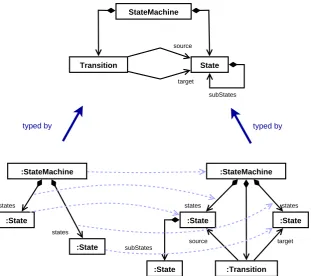
As already mentioned above, typing is accomplished by a graph homomorphism from an in-stance graph to a model graph. It is important to note that the constraints for containment edges as stated in Definition1apply to instance graphs only, not to model graphs. As shown in Fig-ure1, model graphs can have containment cycles, being thesubstatesrelation in this example. However, an instance of this model must not violate these constraints. Correspondingly, the con-straints in the MOF specification apply to objects and links only, not to classes and associations. Since we use the DPO approach to transform graphs with containment edges, it is necessary to show that the category of graphs with containment edges has pushouts2[EEPT06]. Pushouts
:StateMachine
:State
:State :StateMachine
:State :State
:Transition
target source
states
states
states states
:State
subStates
StateMachine
Transition State
source
target
subStates
typed by typed by
Figure 1: A model graph (top), two instance graphs (bottom) and a typed graph homomorphism.
of plain graphs are constructed as inSet(componentwise for nodes and edges). Given a span of graph homomorphisms(G1←G0→G2), the pushout result can be constructed by gluing the
graphsG1,G2over the interface graphG0. Transformation rules in the DPO approach are spans of injective graph homomorphisms. Applying such a transformation rule consists of two steps. At first, a pushout complement graph and then a usual pushout graph has to be constructed. This construction is now considered for graphs with containment edges.
Containment edges can be seen as a conservative extension of plain graphs. A pushout of graphs with containment edges must also be a valid pushout of plain graphs, forgetting the con-tainment properties of the edges. Given a span of valid graphs with concon-tainment edges, the question arises whether the pushout result as constructed for plain graphs also is a valid graph with containment edges. The pushout morphisms must be valid homomorphisms for graphs with containment edges respectively (preserve the containment edges).
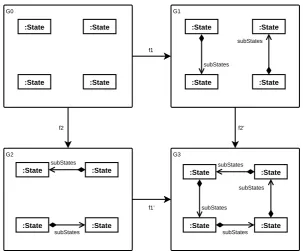
As shown in Figure2, the result graph does not necessarily have the designated order proper-ties. Although graphsG0,G1andG2are valid graphs with containment edges, the’at most one
:StateMachine
:State :State
G0
:StateMachine
:State :State
G1
:StateMachine
:State :State
G2
:StateMachine
:State :State
G3 f1
f1’
f2 f2’
subStates subStates
states states states
states states states
Figure 2: Invalid pushout of graphs with containment edges. A State node in the result graphG3
has two containers.
:State
:State :State
G0
:State
:State :State
G1
:State
:State :State
G2
:State
:State :State
G3 f1
f1’
f2 f2’
:State :State
:State :State
subStates subStates
subStates
subStates subStates
subStates subStates
subStates
Figure 3: Invalid pushout of graphs with containment edges The pushout resultG3 has a
Definition 3(Newly contained points) For a homomorphism between graphs with containment edgesh:G0→G1, the set ofnewly contained points NCPh⊆V0is defined as
• NCPh={x∈V0| ∀y∈V0: (y,x)∈/contains0 ∧ ∃z∈V1: (z,hV(x))∈contains1}3
Definition 4 (Cyclic contained points) For a span of homomorphisms between graphs with
containment edges (G1
f1
←G0
f2
→G2), the set ofcyclic contained points CCPf1,f2 ⊆V1∪V2 is defined as
• CCPf1,f2 ={x∈V1∪V2|([x]≡,[x]≡)∈ t(R)}
where t(R) is the transitive completion ofR={([x1]≡,[x2]≡)|(x1,x2)∈ contains1∪contains2}
and[x]≡ denotes the equivalence class of anx ∈V1∪V2 w.r.t. the equivalence relation ≡=
t(s(r(∼))), with∼= {(f1(x0),f2(x0))|x0 ∈V0}.
Given a homomorphismh:G0→G1of graphs with containments,NCPhis the set of nodes
inG0 that do not have a container in G0, but do have one inG1. The definition of the set of cyclic contained pointsCCPf1,f2 is more complex. It is based on the equivalence relation≡that states which nodes ofG1andG2have a common source in the interface graphG0and which are
therefore glued together in the pushout resultG3. The relationt(R)is the transitive closure of the containment relations ofG1andG2, based on the equivalence classes induced by≡. Cyclic
contained points are those nodes for which this relation is reflexive, i.e. ([x]≡,[x]≡)∈ t(R). These nodes must form a containment cycle in the pushout resultG3by construction.
These two definitions ofnewly contained pointsandcyclic contained pointsinduce the condi-tion under which a pushout of graphs with containment edges exists.
Definition 5(Containment condition) Given a span of graphs with containment edges(G1
f1 ←
G0
f2
→G2), where f1 and f2 are valid homomorphisms for graphs with containment edges, the
containment condition is stated as:
• NCPf1∩NCPf2=/0 and • CCPf1,f2 =/0
If the newly contained points of f1 and f2 are disjoint, as stated in the first condition, each
node in the result graph has at most one container. For ensuring that there is no containment cyclic inG3the set of cyclic contained points must be empty.
Theorem 1(Pushouts of graphs with containment edges) Given a span of homomorphisms between graphs with containment edges(G1←f1 G0→f2 G2), the pushout result in the category of graphs(G1 f
0
2
→G3 f
0
1
←G2)forms also a valid pushout inCGraphs, if and only if the containment condition holds for the span(G1
f1
←G0
f2 →G2).
3 contains
Proof. At most one container.Leta∈NCPf1∩NCPf2, then:
• f1(a),f2(a)have incoming containment edgese1∈C1,e2∈C2that have no origin inG0.
• b:= f20◦f1(a) = f10◦f2(a)∈V3. The images ofaare glued together by construction.
• bhas two incoming containment edges f10(e2)6= f20(e1).
Conversely, considerb∈V3with two incoming containment edges:
• Without loss of generality, the containment edges can be written as f20(e1)and f10(e2)with
e1∈C1ande2∈C2. If both had an origin inG1for instance,G1would already violate the
containment properties.
• There isa∈V0with f20◦f1(a) =b= f10◦f2(a). The nodebmust have origins inV1,V2and finallya∈V0 because there must be target nodes ofe1 ande2and these must have been
glued together to the nodeb∈V3.
• Nodeahas no incoming containment edge. Otherwise this edge would have images inG1
andG2and there would be only one incoming containment edge forbinG3. Therefore,a
is a is a newly contained point, both of f1and f2.
No cycles. The idea of the proof is the construction of a sequence of nodesa0, ...,aninG1∪G2
that corresponds to a containment cycle in the pushout graphG3. Every cycle inG3 consists of
edges fromG1andG2. SinceG1andG2are cycle free, the cycle inG3emerges from gluing of
edges by identifying certain nodes. Nodes fromG1∪G2are identified, iff they are in the same
equivalence class w.r.t. equivalence relation≡. So every containment cycle inG3corresponds
to a sequencea0, ..,an s.t. there is either a containment edge fromai toai+1 orai andai+1 are
identified inG3. Furthermorea0andanare identified inG3.
If there is ax3 ∈V3: x3contains3x3, then exista0, ...,an∈ V1∪V2with:
• i∈[0,n]:∃(ai,ai+1)∈ contains1∪contains2. If there is a path of containment edges
inG3, the path consists of containment edges that have preimages inE1∪E2. We write this path as list ofai ∈V1∪V2. At least one of the ai is container for ai+1, since every
containment path consists of at least one edge.
• (ai,ai+1)∈/ contains1∪contains2⇒[ai]≡ = [ai+1]≡. If there is no containment edge from
aitoai+1, both are in the same equivalence class w.r.t. the pushout construction, i.e. they
will be identified inG3. These are the points where the subpaths fromG1andG2are glued to the containment path inG3.
• [a0]≡ = [an]≡. Without loss of generality, the path begins and ends at nodes which are
glued.
• f10/2(a0) =f10/2(an) =x3, withf10/2(ai) = f10(ai)ifai ∈V1and f10/2(ai) = f20(ai)ifai ∈/V1.
Conversely, if there is a pair(r1,r2)∈ t(R)withr1=r2, there exista0, ...,an ∈ V1∪V2with
• i∈[0,n]:∃(ai,ai+1)∈ contains1∪contains2.(r1,r2)∈ t(R)implies a containment path
consisting of at least one containment edge ofE1∪E2.
• (ai,ai+1)∈/ contains1∪contains2⇒[ai]≡ = [ai+1]≡. Ifai does not contain ai+1, they
denote the points where the subpaths fromG1andG2are glued inG3.
• [a0]≡ = r1 = r2 = [an]≡.
So there is at least one containment edge inG3s.t.:
• (f10/2(ai),f10/2(ai+1)) ∈contains3
• (f10/2(ai),f10/2(ai+1)) ∈/contains3⇒ f10/2(ai) = f10/2(ai+1)
• f10/2(a0) = f10/2(an)
So there is a containment cycle inG3:(f10/2(a0),f10/2(an)) ∈ contains3.
Using the DPO approach to graph transformation, we can state the conditions under which a match is valid for a given rule now. That means the result has a valid graph structure (no dangling edges) and all containment constraints are fulfilled. The first constraint is ensured by checking thegluing condition[EEPT06] before constructing the pushout complement. When constructing the pushout complement, edges and nodes may be deleted from the input graph. Containment constraints cannot get violated in this phase, because containment cycles or multiple containers for an object can only appear if containment edges areadded to a valid model instance. After computing the pushout complement, the containment condition must be verified to construct the actual transformation result through a pushout of graphs with containment edges.
4
Related Work
Graphs with additional order structure are also discussed in [DSLO04], where the nodes and edges are labelled using partially ordered sets. However, this partial order is an additional fea-ture and not induced by the graph strucfea-ture. Therefore, one injective morphism in a span is already enough for ensuring the existence of a pushout in the category of these so calledPoset labelled graphs. Moreover, these graphs are applied in the area of architectural design of soft-ware components.
pushout construction being the basic building block of algebraic graph transformation, is defined such that the result graph is an object of the corresponding category.
So calledownership typesare an object oriented model for containment. An extensive intro-duction to ownership types can be found in [Cla01]. This approach is based on an extension of Abadi and Cardelli’s object calculus with subtyping. A so called containment invariant is introduced to prove the soundness of ownership types systems.
5
Conclusion and Future Work
The extension of the graph-based approach to model transformation by graphs with containment edges better reflects transformations of MOF, EMF and UML 2 models. The containment con-dition stated above ensures that a transformation rule can only be applied to a model instance, if the result does not violate any containment constraints.
In the case of EMF, the implementations generated from a model ensure at run-time that these containment constraints are always satisfied. If EMF detects a violation of these constraints at a certain point, it deletes containment edges that produce the problem. This behavior breaks the formal semantics that was achieved through the graph transformation approach. Therefore, it is important to first check whether the result of a transformation step would be valid. Only if this is ensured, the rule can actually be applied. By that, we can avoid the problems of invalid model instances, ensuring formal transformation semantics.
Even though it can be argued, that this approach is conservative (since it restricts the possible applications of a transformation rule), it has the advantage of avoiding situations where an invalid model instance has to be repaired, by deleting edges for instance. Especially, the naive strategy of applying a transformation first, without any restrictions and repairing the model in the end might lead to unexpected results. Moreover, it is not obvious how to resolve problems like containment cycles in a canonical way.
The containment condition can be used in model transformation frameworks to ensure well-defined transformation semantics. The gluing condition together with the containment condition are the basis for semantical analysis of MOF/EMF model transformation, e.g. termination and confluence (critical pair analysis) [EEPT06].
Further work should lead to notions of consistency of model transformations which might not only be limited to basic model constraints, but also high-level properties of models and model transformations formulated in OCL for instance. A translation of OCL constraints into the language of graph transformation has been started in [WTEK06]. Consistency checks are probably going to play an important role in the field of model driven engineering in the future. A comprehensive theoretical foundation can lead to an improved tool support to check the quality of models and model transformations.
Bibliography
[BKK05] G. Busatto, H.-J. Kreowski, S. Kuske. Abstract Hierarchical Graph Transformation.
[BRST05] J. Bezivin, B. Rumpe, A. Sch¨urr, L. Tratt. Model Transformation in Practice Work-shop Announcement. 2005.
http://sosym.dcs.kcl.ac.uk/events/mtip/
[CH03] K. Czarnecki, S. Helsen. Classification of Model Transformation Approaches.
OOPSLA 03 Workshop on Generative Techniques in the Context of Model-Driven Architecture, 2003.
[Cla01] D. Clarke. Object Ownership and Containment. PhD thesis, School of Computer Science and Engineering University of New South Wales, 2001.
http://citeseer.ist.psu.edu/468103.html
[DSLO04] M. Denford, A. Solomon, J. Leaney, T. O’Neill. Architectural Abstraction as Transformation of Poset Labelled Graphs.Journal of Universal Computer Science, vol. 10, no. 10, 1408-1428, 2004.
http://www.jucs.org/jucs 10 10/architectural abstraction as transformation/ Denford M.pdf
[EEL+05] H. Ehrig, K. Ehrig, J. de Lara, G. Taentzer, D. Varr´o, S. Varr´o-Gyapay. Termination Criteria for Model Transformation.Proc. Fundamental Approaches to Software En-gineering (FASE), Lecture Notes in Computer Science, ISSN 0302-9743, Springer Verlag, 2005.
http://www.springerlink.com/content/dkpvlnfgrn3k8xp7/
[EEPT05] H. Ehrig, K. Ehrig, U. Prange, G. Taentzer. Formal Integration of Inheritance with Typed Attributed Graph Transformation for Efficient VL Definition and Model Ma-nipulation. Proc. of IEEE Symposium on Visual Languages and Human-Centric Computing (VL/HCC’05), IEEE Computer Society, 2005.
[EEPT06] H. Ehrig, K. Ehrig, U. Prange, G. Taentzer. Fundamentals of Algebraic Graph Transformation, EATCS Monographs, ISBN 3-540-31187-4, Springer Verlag. 2006. http://www.springer.com/3-540-31187-4
[EMF] Eclipse Modeling Framework (EMF) Homepage. http://www.eclipse.of/emf
[EMT] Eclipse Model Transformation (EMT) Project Homepage at TU-Berlin. http://tfs.cs.tu-berlin.de/emftrans
[Koe06] C. Koehler. A Visual Model Transformation Environment for the Eclipse Modeling Framework. Diploma thesis, Technical University of Berlin. 2006.
http://tfs.cs.tu-berlin.de/emftrans/papers/06-ChristianKoehler.pdf
[KS06] A. K¨onigs, A. Sch¨urr. Tool Integration with Triple Graph Grammars - A Survey.
Electronic Notes in Theoretical Computer Science 148, 113-150, 2006.
http://www.cs.kent.ac.uk/projects/ocl/oclmdewsuml04/papers/6-kuster sendall wahler.pdf
[OMG06] Object Management Group (OMG). Meta Object Facility (MOF) Core Specification Version 2.0. 2006.
http://www.omg.org/technology/documents/modeling spec catalog.htm#MOF
[TEB+06a] G. Taentzer, K. Ehrig, E. Biermann, G. Kuhns, E. Weiss, C. Koehler. Graphical Definition of In-Place Transformations in the Eclipse Modeling Framework.Model Driven Engineering Languages and Systems, Lecture Notes in Computer Science 4199, Springer Verlag, 2006.
http://www.springerlink.com/content/t681013811w30537/
[TEB+06b] G. Taentzer, K. Ehrig, E. Biermann, G. Kuhns, E. Weiss, C. Koehler. EMF Model Refactoring based of Graph Transformation Concepts.To appear in the Electronic Communications of the EASST, 2006.
[TEG+06] G. Taentzer, K. Ehrig, E. Guerra, J. de Lara, L. Lengyel, T. Levendovszky, U. Prange, D. Varr´o, S. Varr´o-Gyapay. Model Transformation by Graph Trans-formation: A Comapartive Study. Model Transformations in Practice Workshop, MoDELS 2005, 2006.
http://sosym.dcs.kcl.ac.uk/events/mtip05/submissions/
[TR05] G. Taentzer, A. Rensink. Ensuring Structural Constraints in Graph-Based Models with Type Inheritance.Fundamental Approaches to Software Engineering, Lecture Notes in Computer Science 0302-9743, Springer Verlag, 2005.
http://www.springerlink.com/content/98tey0jerhy7pryn