Volume 6 (2007)
Proceedings of the
Sixth International Workshop on
Graph Transformation and Visual Modeling Techniques
(GT-VMT 2007)
The Jury is still out:
A Comparison of AGG, Fujaba, and PROGRES
Christian Fuss, Christof Mosler, Ulrike Ranger, and Erhard Schultchen
14 pages
Guest Editors: Karsten Ehrig, Holger Giese
Managing Editors: Tiziana Margaria, Julia Padberg, Gabriele Taentzer
The Jury is still out:
A Comparison of AGG, Fujaba, and PROGRES
Christian Fuss, Christof Mosler, Ulrike Ranger, and Erhard Schultchen
[fuss|mosler|ranger|schultchen]@i3.informatik.rwth-aachen.de http://www-i3.informatik.rwth-aachen.de
Department of Computer Science 3 (Software Engineering) RWTH Aachen University, Germany
Abstract: Graph transformation languages offer a declarative and visual
program-ming method for software systems with complex data structures. Some of these languages have reached a level of maturity that allows not only conceptual but also practical use. This paper compares the three widespread graph transformation lan-guages AGG, Fujaba, and PROGRES, considering their latest developments. The comparison is three-fold and regards conceptual aspects, language properties, and infrastructure features. Because of the different relevance of these aspects, we do not determine a clear winner but leave it to the reader.
Keywords: Graph Transformation Languages, AGG, Fujaba, PROGRES
1
Introduction
Graph transformation languages are one branch of visual programming languages, which provide advanced concepts for modeling software tools. Some languages reached a level of maturity that allows utilization in practice. In this paper, we compare the three widespread general-purpose languages AGG, Fujaba, and PROGRES. Our goal is to point out main differences in conceptual aspects, language properties, and infrastructure features. There exist some comparisons of graph transformation languages dating back several years, e.g. [BTMS99,FNT98,Roz97]. Compar-isons that are more recent focus only on particular application areas, e.g. [Agr04] deals with model integration aspects. In [VSV05], the runtime efficiency of the generated applications is analyzed. While this paper concentrates on general-purpose languages, [MG05,TEG+05] de-scribe also languages dedicated to model transformation and to model checking, e.g. GReAT [KASS03] and GROOVE [Ren04].
We do not only want to update the older comparisons, considering recent developments, but also lay focus on practical aspects. We do not claim our comparison is complete. This paper shall support users when deciding, which language is most appropriate for his or her application. We hope especially a novice in the area of graph transformation languages will profit from this practical overview.
2
Compared Aspects
The graph transformation languages are compared by different aspects, which are introduced in this section. We compare the theoretical concepts building each language’s background, the language features when specifying a graph transformation system, and the infrastructure offered to edit and run these systems.
2.1 Theoretical Concepts
Graphs are clear and intuitive data structures, whose fundamentals are mathematically founded. Since the late 1960s, different approaches to graph grammars have been developed, which dif-fer e.g. in their graph model, the expressiveness of transformation rules, and the definition of semantics. Basically, two main approaches can be distinguished, which are briefly described in the following.
The algebraic approach considers a graph as a 2-sorted algebra, where nodes and edges are typed, attributed, and identified. The derivation of a graph by applying a graph transformation rule is defined by pushouts known from category theory. The approach allows formal and easy to understand proofs of properties on graphs and on graph transformation rules, e.g. the amalgama-tion of graph transformaamalgama-tion rules. Two different branches concerning the derivaamalgama-tion have been evolved within the algebraic approach, namely the double pushout approach (DPO) [CEH+97] and the single pushout approach (SPO) [EHK+97]. In DPO, a derivation is constructed by two pushouts using a gluing graph between the left-hand side and the right-hand side of a transfor-mation rule, which enables to reverse transfortransfor-mations. A graph transfortransfor-mation rule can only be applied if all edges incident to its match in the working graph and to the context graph are specified within the transformation rule, which leads to complex specifications. For this reason, SPO has been developed, which overcomes this restriction and constructs only one pushout for a derivation. Thus, the graph transformation rules are easier, but the theoretical properties of SPO are limited.
The set-theoretic approach [Nag79] offers an intuitive understanding of graph transformation systems, but does not provide a theoretical foundation that is as powerful as in the algebraic approach. Graphs are described as sets of nodes and edges and the effect of applying a graph transformation rule is defined by set-theoretic operations. In contrast to the algebraic approach, edges are considered as relations between nodes and thus are neither identified nor attributed. The approach allows more expressiveness within graph transformation rules, e.g. embedding rules, which enable user-defined embedding of a rewritten sub-graph in its context graph. Fur-thermore, the application of graph transformation rules can be managed by control structures offering a backtracking mechanism for determining matches of transformation rules. The ap-proach does not provide any means for describing static and derived graph properties. These aspects are integrated in the logic-oriented approach [Sch91], which is an enhancement of the set-theoretic approach. The approach allows to define an explicit graph schema and uses predi-cate logic formulas for defining graphs and graph transformation rules.
2.2 Language Properties
In this subsection, we examine properties of graph transformation languages, concerning the graph model and graph transformations, in general. Some of the properties are similar to those compared in [BTMS99], some are owed to new developments in AGG, Fujaba, and PROGRES.
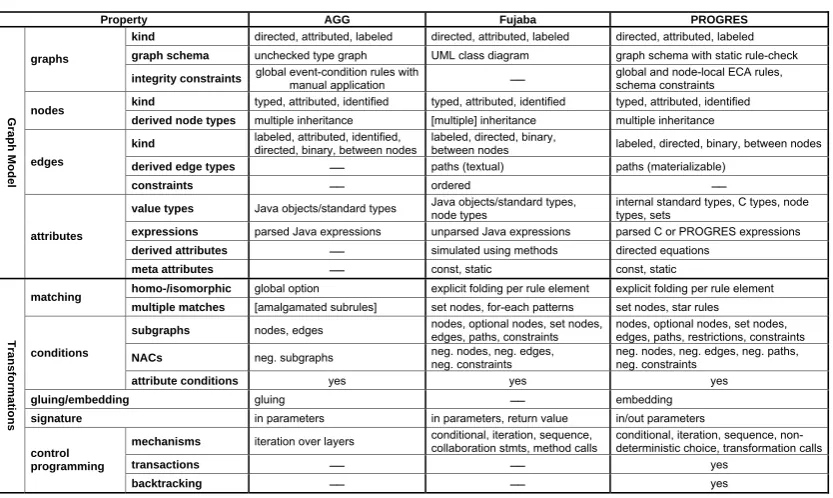
Table 1shows a feature matrix listing all properties. The sections on AGG, Fujaba, and PRO-GRES describe properties implemented for each language in detail.
Table 1: Feature matrix with language properties
Property AGG Fujaba PROGRES
kind directed, attributed, labeled directed, attributed, labeled directed, attributed, labeled
graph schema unchecked type graph UML class diagram graph schema with static rule-check
graphs
integrity constraints global event-condition rules with manual application global and node-local ECA rules, schema constraints
kind typed, attributed, identified typed, attributed, identified typed, attributed, identified
nodes
derived node types multiple inheritance [multiple] inheritance multiple inheritance
kind labeled, attributed, identified, directed, binary, between nodes labeled, directed, binary, between nodes labeled, directed, binary, between nodes
derived edge types paths (textual) paths (materializable)
edges
constraints ordered
value types Java objects/standard types Java objects/standard types, node types internal standard types, C types, node types, sets
expressions parsed Java expressions unparsed Java expressions parsed C or PROGRES expressions
derived attributes simulated using methods directed equations
Graph Model
attributes
meta attributes const, static const, static
homo-/isomorphic global option explicit folding per rule element explicit folding per rule element
matching
multiple matches [amalgamated subrules] set nodes, for-each patterns set nodes, star rules
subgraphs nodes, edges nodes, optional nodes, set nodes, edges, paths, constraints nodes, optional nodes, set nodes, edges, paths, restrictions, constraints
NACs neg. subgraphs neg. nodes, neg. edges, neg. constraints neg. nodes, neg. edges, neg. paths, neg. constraints
conditions
attribute conditions yes yes yes
gluing/embedding gluing embedding
signature in parameters in parameters, return value in/out parameters
mechanisms iteration over layers conditional, iteration, sequence, collaboration stmts, method calls conditional, iteration, sequence, non-deterministic choice, transformation calls
transactions yes
Transforma
tions
control programming
backtracking yes
Graph Model
Graphs. The working graphs of all discussed languages are directed, attributed, node- and edge-labeled. The structure of the working graphs is constrained by graph schemas that define node and edge types and their relations. Transformation rules should be checked against the schema to avoid syntactical errors at specification time. Integrity constraints are used to prohibit certain patterns in the working graph. They are checked at runtime. Transformations of hierarchical graphs can be found in literature but are not implemented in any of the languages.
Nodes. In the three languages, nodes are generally typed, attributed, and identified elements.
Node types can be derived from other types by inheritance.
Edges. Edges are typed, directed and connect two nodes in all three languages. Edges might
Attributes. Besides the type label, graph elements might carry attributes, which are defined
by the element type. Value types can be standard types, often borrowed from host languages like Java or C (evaluation of expressions might also be borrowed). Derived attributes are not set directly, but evaluated according to an equation that might reference other graph elements. Additionally, sets and graph elements are useful attribute values.
Graph Transformation Rules
Graph transformation rules describe possible transformations of the working graph. They can be divided into compound rules, combining other rules by control structures and simple rules. Simple rules have a left-hand side (LHS) and a right-hand side (RHS). If the LHS is found in the working graph (i.e. it can be matched), the match is replaced by the RHS.
Matching. A rule match is a morphism that maps a rule’s LHS elements to elements from the
working graph. If LHS elements are mapped to only one working graph element, the morphism is a homomorphism. Non-homomorphic constructs are e.g. set nodes, amalgamated rules (AGG), star-rules (PROGRES). If each LHS element is mapped to a different element from the working graph, the morphism is injective (default). Whether the matching is non-injective (i.e. one working graph element can play multiple transformation roles) might be determined per graph grammar, per rule, or per rule element.
Conditions. Conditions define constraints for rule applications. Structural conditions are found
in the LHS of a rule and include nodes, optional nodes, set nodes, paths, and restriction ex-pressions. Restrictions constrain the match of a rule node by attribute or structure conditions. Attribute conditions are defined by expressions referring to element attributes. Negative applica-tion condiapplica-tions (NACs) [HHT96] define structures that must not be found in the working graph, if a rule is applied; these might be integrated into the LHS or separated and range from simple negative nodes and edges to negative paths and complete negative partial graphs.
Gluing/Embedding. Gluing means the merging of two nodes into one, which owns all incident
edges and all non-conflicting attributes of both. Embedding is somehow similar: it allows the redirection of incident edges from one node to another.
Signature. Procedure-like signatures support the use of graph transformation rules in a way
known from imperative programming. Input parameters allow the parameterization of rules, while output parameters let transformation results influence following rules.
Control Structures. With control structures, the definition of compound rules is possible by
combination through conditional, iteration, and chaining statements. Statements with non-deter-ministic behavior and backtracking allow the convenient specification of many graph algorithms. The chaining of rules should be accompanied by transactions, in order to rollback a chain of rules if one fails.
2.3 Infrastructure
as syntax-directed editing. At least some analyzing functions, e.g. a sophisticated type checker, should be integrated to detect and explain inconsistencies with respect to the language’s static semantics. Basic layout algorithms for the rules should be available in the editor.
For testing a specification, the language environment should provide an interpreter. During an interpreter session, the environment performs a sequence of graph transformations and visualizes the working graph. Different application strategies for transformation rules should be possible, e.g. a debugging mode allowing step-by-step execution. Additionally, a code generator should produce compilable source code for a general programming language to support the development of stand-alone applications. The generator’s backend should be sufficiently flexible to allow the extension to further programming languages. A graphical framework providing access to the specified graph transformation rules should be available to obtain an executable application.
To store large graphs and support efficient manipulation of graph structures, a database should be provided. It should also support undo/redo of transformation rules and provide persistence for the working graph. Another requirement concerns the extensibility of the language environ-ments. Monolithic architectures are hard to extend, while plug-in structures are more flexible.
Sometimes the user is confronted with limited choices concerning the platform for installation of the language environment. Therefore, the language environments should be available for at least the most common operating systems, and offer an easy and fast installation. Ideally, the environment should be implemented in a platform independent language like Java and be freely available. As all presented languages are distributed under the terms of the GNU (Lesser) General Public License.
2.4 Example
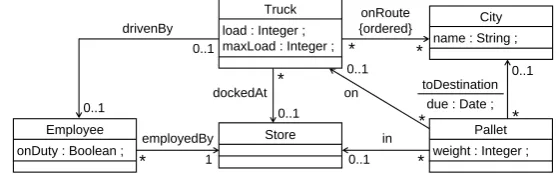
To explain the different aspects of each graph transformation system in the next sections, we introduce a simple example of a Shipping Company. The Shipping Company resembles the example used in [ERT99]. Its graph schema is illustrated inFigure 1as a class diagram. In the example,Pallets of differentweights are keptin Stores. EveryPallethas to be brought to a certain
Cityby aTruck, which is modeled by atoDestination-edge storing also theduedate. ATruckhas a maximum loading weight (maxLoad) and stores its current weight (load). The order of aTruck’s target cities is determined by a route, which is modeled by orderedonRoute-edges. TheTruckis
drivenByanEmployeeof aStore. The boolean attributeonDutyindicates whether theEmployeeis at work.
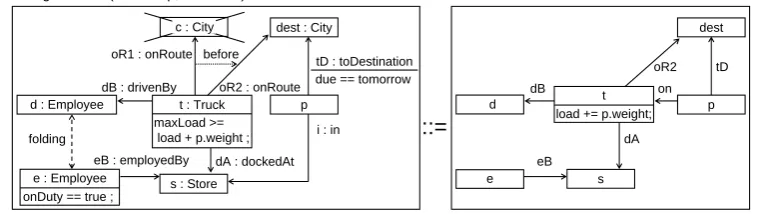
Figure 2shows the sample graph transformation ruleloadUrgentPallet, which is used for loading
Store Employee
onDuty : Boolean ; drivenBy employedBy dockedAt in onRoute {ordered} Truck
load : Integer ; maxLoad : Integer ;
on
Pallet weight : Integer ; 1 * * 0..1 0..1 0..1 * 0..1 * 0..1 * * 0..1 * City
name : String ;
toDestination due : Date ;
dest : City
e : Employee
onDuty == true ; s : Store eB : employedBy folding
dB : drivenBy
dA : dockedAt i : in oR1 : onRoute
c : City c : City
before
tD : toDestination
dest d e s eB dB dA oR2 tD
o : on d : Employee
::= loadUrgentPallet (in Pallet p, out Truck) =
return t ;
p p
due == tomorrow
t : Truck maxLoad >=
load + p.weight ; oR2 : onRoute
t load += p.weight;
Figure 2: Graph transformationloadUrgentPallet
a givenPallet pin a suitableTruck t. The match forloadUrgentPalletis determined by the following constraints: The working graph is searched for the destinationCity destand the currentStore sof the givenPallet p, which isdue tomorrow. Additionally, aTruck t dockedAt Store shas to be found, whose first targetCityis equal to the destinationdestofPallet p. This is modeled by the negative nodeCity c, i.e. there exists noCity c, which isbefore City deston the route ofTruck t. Furthermore, the maximum load ofTruck tmust not be exceeded by theweightofPallet p. To loadPallet pon
Truck t, anEmployeeis needed, which isonDuty. As even the driverdofTruck tmay help to load
Pallet p, if he is employed byStore s,Employeesdandeare connected by afolding-construct. This enables the non-injective matching of the driver and the store employee in the working graph. A match found for the LHS is transformed according to the RHS: Thein-edge incident toPallet pis deleted and a newon-edge is created connectingPallet pandTruck t. Theload-attribute ofTruck t
is updated andtis returned.
3
AGG
Conceptually, AGG (Attributed Graph Grammar) [ERT99] follows the algebraic approach to graph transformation and implements single-pushout behavior. The implementation is based on the Colimit library [Wol98], which provides colimit construction for category theory of signa-tures and graph strucsigna-tures. Colimit could easily be used for the transformation of hierarchical graphs, but AGG does not support this.
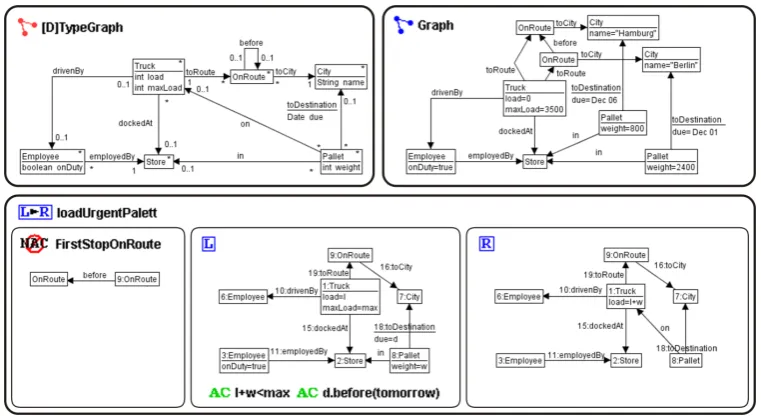
An AGG graph grammar consists of a type graph, a start graph, and simple rules. Figure 3
shows a graph grammar for the Shipping Company example fromSubsection 2.4.
Figure 3: A simple AGG graph grammar for the Shipping Company example
to check structural properties of the working graph.
The start graph defines an initial working graph. All nodes and edges in a working graph are typed, identifiable, and might be attributed. Figure 3(top right) shows a simple start graph for the example, with a small 3.5tTruckhaving two cities on his route (Berlin before Hamburg) and a driver, who is anEmployeeof theStore. TwoPallets with differentweights are stored in thestore, with destinations Berlin and Hamburg. They have to arrive on December 1st resp. 6th.
AGG only supports simple rules. The LHS consists only of nodes and edges (no other ele-ments are available). Injective matching can be switched on and off globally1. With non-injective matching, the employee node from the working graph can be matched for the depicted rule in
Figure 3as node 6 (driver) and node 3 (store worker). NACs are subgraphs defined outside the LHS that must not be fulfilled. Here there must not be anotherOnRoutenodebeforenode 9. At-tribute conditions, e.g.d.before(tomorrow)2, are defined in a special attribute editor (not depicted) and can contain arbitrary Java expressions. The match is determined by the LHS, NACs, and attribute conditions. One feature not shown in the example is gluing, i.e. two nodes are merged into one node. The resulting node owns all non-conflicting attributes and edges. Merge conflicts have to be solved interactively by the user. For the complete grammar, AGG allows to compute critical pairs of rules. i.e. rules which execution disable the application of other rules.
The execution of rules can be programmed slightly, by defining layers for the rules. Then the execution loops over the sequence of all rules on one layer, until none is executable anymore, then the loop is executed on the next layer until the last. Additionally, single rules can be selected for execution manually.
The editing of graph grammars is done by a graphical editor, which is completely built in Java and easily installed on different platforms. The editor has a GUI that is intuitive, but does not
1 Non-homomorphic matching, i.e. multiple matches for one rule element, can be obtained in AGG with
amalga-mated subrules [TB94], which is an extension not yet publicly available.
offer much support for syntax-directed editing. Positive is the good integration of the interpreter into the AGG editor. The generation of executable code from the graph grammar is not possible but grammar specifications can be exported to XML files.
The TIGER framework [EEHT05] allows the generation of visual editors for an AGG graph grammar. For that, the graph grammar has to be decorated by a visual concrete syntax for all elements. The generated editors are GEF-based Eclipse-plugins, where the user can pick single rules for execution. The editors use AGG’s Java API to interpret the graph grammar.
AGG is based on a very sound theory and the editor is simple to use and install. This allows easy testing of prototypical specifications. [MTR06] gives a good example of a small prototyp-ical reengineering editor specified with AGG, relying on the notion of critprototyp-ical pair analysis. For an application in larger projects, code generation and control structures are missing.
4
Fujaba
Originally, the focus of Fujaba (From UML to Java And Back Again) was to provide a visual modeling tool based on UML diagrams and to generate Java code from these models. Mean-while, Fujaba also supports other metamodels and output formats. Adaptation to special ap-plication domains is eased by the template-based code generation module and the plugin based architecture. For example, Fujaba has been applied in [BGS05] to model real-time systems, in-cluding extensions of the modeling language. Fujaba has also been applied in the MOFLON framework [AKRS06] for building model transformation systems based on MOF and QVT.
In Fujaba, graph schemas are modeled using simplified UML class diagrams, resembling the one shown in Figure 1. Classes can be attributed and any Java class or ordinal type is sup-ported as attribute type. Derived attributes are not directly offered, but can be simulated by a method replacing the getter-method generated for the attribute. We therefore model thegetLoad
method to derive the truck’sload. Thus, this attribute does not require manual update when pal-lets are loaded on the truck. Inheritance of classes is supported, although multiple inheritance is restricted to interfaces. Overloading of methods and polymorphism is handled by the Java environment at runtime. Attributed associations, inheritance on associations or n-ary relations are not supported. Fujaba provides ordered associations, which impose a total ordering on the link instances during runtime. This feature is well-suited to model theonRouteassociation.
The behavior of applications is modeled using so-called Story Diagrams [FNTZ98] which combine UML-collaboration diagrams with activity diagrams. From each Story Diagram,
jaba generates a Java method operating according to the modeled transformation rule. Story Diagrams consist of one start and at least one stop activity, and an arbitrary number of Story Pat-terns operating on the runtime graph. These elements are connected through transitions. Story Patterns correspond to rules in AGG, but incorporate LHS and RHS into one diagram using the stereotypes«create»and«destroy». For pattern matching, Fujaba offers obligatory, optional, set and negative node variables. By default, Fujaba creates injective morphisms from variables to objects, so that two variables are never bound to the same object. This behavior can be disabled per pair of variables. Attribute assertions may constrain the matched objects by an unparsed (thus arbitrary) Java expression. Furthermore, Fujaba supports obligatory, optional and negative edges between variables and textual path expressions. For ordered associations, additional constraints can be specified for the matching, e.g. firstor last. Every pattern requires at least one bound variable which can be provided by a parameter of the Story Diagram, thethisobject the method is invoked on, variables bound in preceding patterns or by an arbitrary Java expression. From these bound variables, the other variables of the pattern are bound to objects from the runtime graph by traversing links of given type. Transformation rules are conducted after the complete pattern has been matched, and may create and delete elements, set attributes and call methods on matched objects.
Figure 4shows a Story Diagram implementing theloadUrgentPallettransformation rule. The required bound variable is provided by the method parameterp, from which the other variables are bound. Attribute assertions are used to check if theTrucktis not overloaded and the given Palletp needs urgent delivery (due attribute denotes tomorrow). Injective matching is disabled for variablesdandeby adding the{maybe d==e}constraint. For the orderedonRouteassociation,
{first}retrieves the first link fromtto aCity. If pattern matching succeeds, the runtime graph is transformed by removing thePallet’sinedge to theStoreand creating anonedge to theTruck.
To model the control flow, Story Patterns may hold transitions to multiple successors. In the depicted example, two stop activities exist. By the transition guard[success], the left one is called when the transformation rule succeeds and returns the matched truck as return value. Otherwise, the right stop activity returns null. Transitions may form loops, causing repeated execution of Story Patterns. Also, for-each-patterns allow to process every match of a Story Pattern instead of only one match.
The formal background of Story Patterns is obtained from the logic-oriented approach de-scribed inSubsection 2.1. However, some of their semantic aspects are only incompletely de-fined (cf. [TMG06]). The Fujaba environment also performs very limited checks on the modeled diagrams, so the specifier is often not warned about erroneous specifications.
The generated source code can easily be integrated into existing projects or used in rapid-prototyping frameworks. eDOBS is a plugin for the Eclipse IDE which visualizes the runtime graph of a Fujaba-generated application. With the help of the CoObRA framework, generated applications are able to store their runtime states persistently. Recently, the graph-oriented data-base DRAGOS and the related UPGRADE [BJSW02] framework were adapted to support Fu-jaba. Being entirely written in Java, Fujaba works on multiple platforms and is easy to set up. Besides the regular stand-alone application, an Eclipse-plugin embedding Fujaba into the IDE is under development.
5
PROGRES
PROGRES (PROgrammed GRaph REwriting System) [SWZ99] is the eldest of the presented graph languages and environments. The logic-oriented approach [Sch91] forms the basis of PROGRES, which offers a proprietary language allowing the specification of a graph schema and consistent graph transformation rules.
PROGRES provides various constructs for defining a graph schema of a specification. For node types, three different types of attributes can be defined: Intrinsic attributes, whose values are assigned directly, meta attributes, which constitute class attributes and thus have the same value for every instance, and derived attributes. Values of derived attributes are computed dependent on attribute values of other nodes and are automatically updated when their values are invalid. For example, the node typeTruckshown inFigure 5owns a derivedload-attribute, whose value is the sum of all loadedPallet weights. ThePallet weightsare obtained by traversing the incoming
on-edges of theTruck. PROGRES supports the object-oriented paradigm regarding node types, which includes inheritance relations between node types, polymorphism, type-specific attributes and methods. Edge types define the type name, the source and target node types, and their cardinalities. Paths may be modeled allowing complex navigations through the working graph, traversing arbitrary edges of different types. PROGRES also enables the specification of graph constraints, e.g. there are at most n instances of a certain node type within the working graph. If such a constraint is violated, an appropriate repair action can be executed. Based on the schema, incremental analyzes check the specification for inconsistencies and show appropriate error messages.
Besides the graph schema, PROGRES offers modeling of graph queries and graph transforma-tion rules, which may have several input and output parameters. A graph query defines a test for the existence of a graph pattern in the working graph. A graph transformation rule modifies the working graph. For their execution, the underlying graph database DRAGOS [Böh04] provides transactions for graph operations (ensuring ACID-properties). For every transformation rule, pre- and postconditions may be specified, which imply constraints on the working graph before
::=
`4 : Destination `3 : City
`5 : Store before
`8 : OnRoute
`6 : Employee
`9 : Employee `1 = p
`2 : Truck toCity `7 : OnRoute
toDestCity toDestination inStore employedBy toRoute toRoute drivenBy
`4 : Destination `3 : City
`5 : Store `6 : Employee
`9 : Employee `1 = p
`2 : Truck toCity `7 : OnRoute
toDestCity
toDestination employedBy
toRoute
drivenBy
node_type Truck : ITEM intrinsic
maxLoad : integer ; derived
load : integer = 0 + all self.<-on-.weight ; end ;
folding { `6 , `9 } ;
condition `2.maxLoad > `2.load + `1.weight ; `4.due = tomorrow ; `9.onDuty = true ; return t := 2´ ;
end ;
transformation loadUrgentPalett ( p : Palett, out t : Truck) =
on
dockedAt dockedAt
resp. after the execution of the rule. Furthermore, a qualifier determines if a transformation rule should be applied to one match or to all possible matches in parallel. Graph transformation rules are classified as production (simple rule) or transaction (compound rule).
Productions are similar to AGG rules and Story Patterns in Fujaba. They are visually specified and allow to create and delete nodes and edges. They are described by a LHS and a RHS, which may contain obligatory nodes and edges, paths, optional nodes, set nodes, and restrictions on nodes. NACs are modeled by negative nodes, edges, paths, and restrictions. Additionally, a production may have a condition- and a transfer-part to imply conditions on attribute values resp. to change the value of node attributes. PROGRES allows the specification of embedding rules for redirecting edges incident to deleted nodes and embedding new nodes into the working graph. The folding-statement enables the non-injective mapping of two nodes in the production to the same node in the working graph.
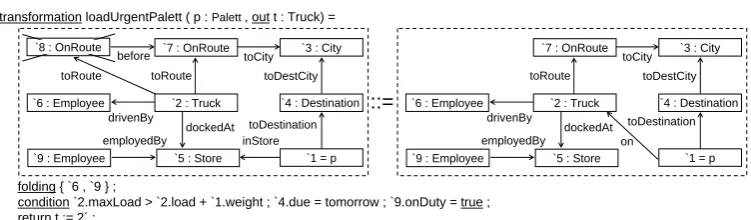
Figure 5shows the PROGRES productionloadUrgentPalletintroduced inSubsection 2.4. The production uses two edge-node-edge constructs for the orderedonRoute-edge and the attributed
toDestination-edge, as these sorts of edges are not supported by PROGRES. Thefolding-construct, the attribute conditions and the return-statement are represented as textual statements. As the
load-attribute ofTruck tis defined as derived attribute, its value is not assigned explicitly.
In contrast to productions, transactions contain control structures for combining transforma-tion rules and queries. This includes to sequence transformatransforma-tion rules and to execute one of a set of rules non-deterministically. Furthermore, loop- and condition-statements may be used.
PROGRES is the most expressive graph language of the three presented languages and offers extensive support for modeling big software systems. But the proprietary language is fairly complex and difficult to learn. From a specification, C and Java source code can be generated. This code can be used for rapid prototyping by applying the UPGRADE-framework. AHEAD [JSW00] is a good example of an industrial-sized project specified with PROGRES.
The syntax-directed PROGRES editor, that also features an interpreter, guides the user well, but is not really intuitive. In addition, it is only available for Linux. A further disadvantage of PROGRES is its monolithic architecture, which makes the development and implementation of new language concepts difficult.
6
Summary
Table 2 summarizes aspects of the three languages that are most important to their practical applicability, e.g. their support at specification time through a rich editor.
Table 2: Language aspects most important to practical applicability
AGG Fujaba PROGRES
language expressiveness - o ++
most wanted features for practical applicability
control structures, paths, check
against schema paths, check against schema, search without bound object namespaces, view concept language learnability graphical part intuitive (but many things hidden in dialogs) UML-like, easy hard due to rich expressiveness specification editor mixed graphical/dialog-based mixed graphical/unparsed Java mixed graphical/textual, syntax-directed
interpreter manually controllable step-through
code generation adaptable, template-based, Java not adaptable, C and Java
GUI support TIGER [EEHT05] eDOBS, UPGRADE UPGRADE [BJSW02]
With the algebraic approach, AGG offers a graph transformation language with a sound theo-retical basis. This offers convenient implementation possibilities for projects relying on theoreti-cal notions. It provides a well-developed environment which can easily be installed and applied. However, the language does not seem rich enough for general purpose applications, the main disadvantage being the lack of control structures. Therefore, AGG still has to prove that it can be applied in large-scale projects.
The biggest advantage of Fujaba is its use of UML, which requires only little learning effort from the user. In addition, the vivid community is working intensively on improvements and further extensions. However, the language lacks a formal definition, forcing the user to inspect the code when in doubt about language semantics. Additionally, due to the lack of analyzes the user is not sufficiently guided during the specification process, often leading to malfunctioning or unexpected behavior of the generated code.
PROGRES offers the most sophisticated language, although there are still some features miss-ing. The infrastructure, including a syntax-directed editor, an interpreter, and a code generation mechanism, provides the highest level of maturity. The experience with industrial-sized projects proves the practical usability of PROGRES. However, the environment does not conform to today’s standards, requiring a painstaking installation process and providing a relatively incon-venient interface, particularly to new users. Additionally, it is very hard to extend this extensive environment and language for new features.
The jury is still out: Because of the different relevance of the compared aspects, we cannot give final advice, but leave it to the reader to decide which language to use.
Bibliography
[Agr04] A. Agrawal. Model Based Software Engineering, Graph Grammars and Graph Transformations. Area paper, EECS at Vanderbilt University, 2004.
[AKRS06] C. Amelunxen, A. Königs, T. Rötschke, A. Schürr. MOFLON: A Standard-Compliant Metamodeling Framework with Graph Transformations. In Rensink and Warmer (eds.), Model Driven Architecture - Foundations and Applications (ECMDA-FA’06). LNCS 4066, pp. 361–375. Springer, 2006.
[BGS05] S. Burmester, H. Giese, W. Schäfer. Model-Driven Architecture for Hard Real-Time Systems: From Platform Independent Models to Code. In Proc. of the Euro-pean Conf. on Model Driven Architecture - Foundations and Applications (ECMDA-FA’05), Nürnberg, Germany. LNCS 3748, pp. 25–40. Springer, 2005.
[BJSW02] B. Böhlen, D. Jäger, A. Schleicher, B. Westfechtel. UPGRADE: A Framework for Building Graph-Based Interactive Tools. In Mens et al. (eds.). ENTCS 72, pp. 149– 159. Elsevier Science Publishers, 2002.
[Böh04] B. Böhlen. Specific Graph Models and Their Mappings to a Common Model. Pp. 45– 60 in [PNB04].
[CEH+97] A. Corradini, H. Ehrig, R. Heckel, M. Korff, M. Löwe, L. Ribeiro, A. Wagner. Al-gebraic Approaches to Graph Transformation – Part I: Basic Concepts and Double Pushout Approach. In [Roz97], pp. 163–245, 1997.
[EEHT05] K. Ehrig, C. Ermel, S. Hänsgen, G. Taentzer. Generation of visual Editors as Eclipse Plug-ins. In 20th IEEE/ACM Int. Conf. on Automated Software Engineering, ASE’05. Pp. 134–143. ACM Press, New York, 2005.
[EEKR99] H. Ehrig, G. Engels, H.-J. Kreowski, G. Rozenberg (eds.). Handbook on Graph Grammars and Computing by Graph Transformation: Applications, Languages, and Tools. Volume 2. World Scientific, 1999.
[EHK+97] H. Ehrig, R. Heckel, M. Korff, M. Löwe, L. Ribeiro, A. Wagner, A. Corradini. Alge-braic Approaches to Graph Transformation – Part II: Single Pushout Approach and Comparison with Double Pushout Approach. In [Roz97], pp. 247–312, 1997.
[ERT99] C. Ermel, M. Rudolf, G. Taentzer. The AGG Approach: Language and Environment. In [EEKR99], pp. 551–603, 1999.
[FNT98] T. Fischer, J. Niere, L. Torunski. Konzeption und Realisierung einer integrierten Entwicklungsumgebung für UML, Java und Story-Driven-Modeling. Master Thesis, University of Paderborn, 1998.
[FNTZ98] T. Fischer, J. Niere, L. Torunski, A. Zündorf. Story Diagrams: A new Graph Rewrite Language based on the Unified Modeling Language. In Ehrig et al. (eds.), 6th Int. Workshop on Theory and Application of Graph Transformation (TAGT). LNCS 1764, pp. 296–309. Springer, 1998.
[HHT96] A. Habel, R. Heckel, G. Taentzer. Graph Grammars with Negative Application Con-ditions. Fundamenta Informaticae 26(3/4):pp. 287–313, 1996.
[JSW00] D. Jäger, A. Schleicher, B. Westfechtel. AHEAD: A Graph-Based System for Mod-eling and Managing Development Processes. In Nagl et al. (eds.). LNCS 1779, pp. 325–339. Springer, 2000.
[KASS03] G. Karsai, A. Agrawal, F. Shi, J. Sprinkle. On the Use of Graph Transformation in the Formal Specification of Model Interpreters. Journal of Universal Computer Science 9(11):1296–1321, Nov. 2003.
[MG05] T. Mens, P. V. Gorp. A Taxonomy of Model Transformation and its Application to Graph Transformation. 2005. , presented at the 1stInternational Workshop on Graph and Model Transformation, GraMoT’05, Tallinn, Estonia.
[MTR06] T. Mens, G. Taentzer, O. Runge. Analysis Refactoring Dependencies using Graph Transformation. Software Systems Modeling (SoSyM), 2006.
[PNB04] J. L. Pfaltz, M. Nagl, B. Böhlen (eds.). 2ndInt. Workshop on Applications of Graph Transformations with Industrial Relevance, AGTIVE’03. LNCS 3062. Springer, 2004.
[Ren04] A. Rensink. The GROOVE Simulator: A Tool for State Space Generation. Pp. 479– 485 in [PNB04].
[Roz97] G. Rozenberg (ed.). Handbook on Graph Grammars and Computing by Graph Transformation: Foundations. Volume 1. World Scientific, 1997.
[Sch91] A. Schürr. Operationales Spezifizieren mit programmierten Graphersetzungssyste-men. PhD-Thesis, RWTH Aachen University, 1991.
[SWZ99] A. Schürr, A. J. Winter, A. Zündorf. The PROGRES Approach: Language and Envi-ronment. In [EEKR99], pp. 487–550, 1999.
[TB94] G. Taentzer, M. Beyer. Amalgamated Graph Transformations and Their Use for Specifying AGG - an Algebraic Graph Grammar System. In Int. Workshop on Graph Transformations in Computer Science. Pp. 380–394. Springer, 1994.
[TEG+05] G. Taentzer, K. Ehrig, E. Guerra, J. de Lara, L. Lengyel, T. Levendovszky, U. Prange, D. Varró, , S. Varró-Gyapay. Model Transformation by Graph Transformation: A Comparative Study. In Proceedings of the International Workshop on Model Trans-formations in Practice, MTiP’05 (Satellite Event of MoDELS 2005). Montego Bay, Jamaica, 2005.
[TMG06] M. Tichy, M. Meyer, H. Giese. On Semantic Issues in Story Diagrams. In Giese and Westfechtel (eds.), Fujaba Days 2006. Technical Report tr-ri-06-275, pp. 10–14. University of Paderborn, Germany, 2006.
[VSV05] G. Varró, A. Schürr, D. Varró. Benchmarking for Graph Transformation. In 2005 IEEE Symposium on Visual Languages and Human-Centric Computing (VL/HCC). Pp. 79–88. IEEE Computer Society, 2005.