International Journal of Advances in Social Science and Humanities
Available Online at: www.ijassh.com
RESEARCH ARTICLE
Specification of a Model for the Study of Vocational Training and
Job
Javier Carreón Guillén
1, Cruz García Lirios
21Social Work, National School Social Work/ National University Autonomous of Mexico, Mexico City
2Social Work, Huehuetoca Unit Academic, Autonomous University of State of Mexico, State of Mexico,
Mexico City.
Abstract
The theory of human capital essentially means that there is an indirect relationship between vocational training and job placement. Leadership and leadership styles are mediators in this process, because they transfer values and norms that guide needs and expectations, as well as skills and knowledge in order to carry out the tasks and achieve the achievements. In this sense, the objective of the present work was to specify a model for the study of human capital. A non-experimental, documentary, cross-sectional and exploratory study was carried out with a selection of sources indexed to Latin American leading repositories, considering the publication period and ISSN and DOI registration. Since the specified model can be contrasted, the inclusion of factors such as stress, harassment, mobbing and burnout is recommended to establish the scope and limits of the model.
Keywords:Human capital, Vocational training, Job placement, Model, Specification.
Introduction
The purpose of this research is to specify a model of dependency relations between the variables determining and indicative of vocational training and job placement in the Social Work degree of a public university in Mexico City.
A non-experimental, documentary, cross-sectional and exploratory study was carried out with a non-probabilistic selection of sources indexed to leading repositories in Latin America. The information was processed in content analysis matrices with the purpose of specifying the model of reflective dependency relations between the constructs of professional formation and labour insertion.
The documentation to be analysed was selected considering the publication period from 2000 to 2016, the conceptualization of the keywords: human capital, vocational training and labour insertion, as well as its
ISSN (International Standard Serial
Number) and DOI (Digital Object Identifier).
The analysis of the content was based on the symptom technique, which consists in
processing the concepts and their
relationship in a network based on the breakdown that the authors perform and the discussion they establish regarding the keywords.
The specification of the model was carried out assuming that the constructs of human capital, vocational training and labour insertion maintain relations of dependability testable. In this way the routes of conceptual relations were drawn.
The university degree is more profitable for women than for men when compared to
other educational levels. University
graduates earn 41% more than high school graduates, while in men this difference is 32%. The university students also have a level of unemployment (6.9% among the
graduates) much lower than other
compared to workers with lower secondary education has dropped by 40%. The
university advantage in terms of
unemployment has also declined. The unemployment rate of secondary school graduates has increased from 27% higher than that of university students to 17% between 1995 and 2005. The same rate has not changed in the case of comparing it with workers with pre-secondary education (Around 40% higher than university students). The difference in the employment rate among graduates of compulsory education and university graduates has dropped from 19 to 13 points between 1997 and 2004 [1].
52.2% of the university graduates
interviewed continue to live in their parents' homes despite their high occupancy and average age (28 years). The vast majority of graduates (74.8%) attended courses they chose as the first option. University graduates take an average of 6.2 months to find their first job after college [2].
Early contacts with the world of work often involve a temporary contractual relationship (74.9% in the first job) after three years’ graduates reach a much higher level of job stability. In the last employment, the indefinite contracts represent 45.1% of the total contracts of the graduates of the sample [3].
In the last job, 27.6% had a higher education level and 10.4% dissociated the tasks from their job with the university degree. 70.7% of graduates are quite satisfied or very satisfied with their current job, although only 47.7% of respondents are quite or very satisfied with their salary [4].
72% would return to do the same race in the same university. However, 17.7% of the graduates of the sample indicate that if they had to take the decision again for university studies, there would not do it with a high degree of probability [5].
The official unemployment rate in the period in which they were surveyed (11.2%) is somewhat lower than the median cited by the respondents (15%). The unemployment rate estimated by the students is close to
that when they began their studies, so the explanation could be certain inertia in their expectations [6].
The perception of the labour market situation is very close to reality. The unemployment rate for young university graduates (under 30) is 15% (real rate in
2003: 15.5%) while 10% of the
unemployment rate for young people are graduates and / or Vocational training [7].
Theory of Human Capital
Within the framework of Human
Development in which health, education and employment are its most prevalent dimensions. The concept of human capital alludes to a balance between demands and resources, opportunities and capacities, as well as skills and knowledge each and every one oriented towards insertion in a global and local labour market [8].
Thus, human capital involves a set of strategies, intentions and actions dedicated to the application of knowledge and the development of skills so that, based on objectives and tasks of cooperation, goals are obtained, which are disseminated among a group that Can reproduce the process with the same quality [9].
However, the theory of human capital warns that there are barriers and facilitators that inhibit or potentiate the realization of purposes. This is the case of the relationship between vocational training and job placement. Because syllabus seems to be disconnected from the demands of the global or local market, vocational training increasingly conforms to the requirements of the working environment [10].
Although vocational training is close to the skills and knowledge required by micro, small and medium-sized organizations that employ 90% of the workforce, labour insertion involves a selection process involving different professionals competing for a reduced number of vacancies [11].
Nevertheless, the global labour market
increasingly requires greater
entrepreneurship, innovation and
competitiveness without underestimating the empathy, commitment and satisfaction that employees must have to efficiently perform their work. Therefore, the formation of human capital also implies a degree of freedom of decision and action oriented to the transformation of organizations [13].
In this sense, human capital theory warns that vocational training depends on the formation of transformational rather than traditional leadership. This is because
entrepreneurship, innovation and
competitiveness depend on high doses of trust, commitment and job satisfaction. In that sense, human capital is the essential growth factor in an organization [14].
As an organization's currency, human capital requires continuous training and even anticipation of uncertainty and risk scenarios. The coping of threats suggests the formation of leaders who transform the organization and do not chain it into a traditional, vertical and univocal style of leadership [15].
In this way, the formation of human capital will correspond to labour insertion whenever the market demands more and more innovative products and services that satisfy the consumers [16].
In the case of Higher Education Institutions (HEIs), the formation of human capital and labour insertion depends on a high degree of institutional isomorphism that human capital theory considers fundamental to carry out the task of anticipating unemployment scenarios [17].
Roughly, institutionalism consists of a set of values and norms that affect the culture and the work climate of the relationships and the work climate of the tasks. This is because organizations are confined to business development policies, or to alliances with the state that determine them in terms of their business relationships [18].
In this institutional framework, human
capital theory suggests that leaders share
goal-oriented styles of management
regardless of the skills and knowledge that guide innovation, but they regulate the proposals that emerge from organizations associated with state institutions [19].
However, when organizations need to transcend and enter the global market they establish strategic alliances with other
organizations that condition their
association according to the degree of
entrepreneurship, innovation and
competitiveness. In this context, human capital theory explains the process by which individuals establish networks of knowledge and, based on their capacity for information processing, decision making and execution skills, achieve a level of competence according to local and global demands [20].
If entrepreneurship consists of balancing
financial opportunities, establishing
business opportunities and producing goods with a high demand, then human capital is an essential part of the entrepreneurship process, since, based on continuous training in processing Information and dissemination of proposals has competitive advantages [21].
In the case of innovation, understood as the generation of initiatives according to a demand and the feasibility of being reproduced to reach a quota of productivity, human capital formation also shows competitive advantages over organizations dedicated to reproducing knowledge. That is to say that producing knowledge not only applicable but reproducible generates prestige and this is crystallized in patents.
In this way, the formation of human capital is increasingly close to guarantee labour insertion due to its high degree of
transformation and expectations of
knowledge reproduction [22].
State of Knowledge of Human Capital
of professional training and even labour insertion. In this sense, as software learning intensifies and traditional leaders are learned, labour insertion is closer to being achieved [23].
However, in organizations with a more democratic, open, participative, horizontal and intercultural work culture, information and communication technologies, including digital networks, are not determinants of professional training and insertion in local marking. This means that the diversity of demands and resources seems to corroborate the hypothesis that entrepreneurship and innovation do not necessarily correspond to productivity and competitiveness, but to job satisfaction [24].
In fact, the type of work culture affects the climate of relations, the climate of goals, the climate of task and the climate of innovations. It is the electronic technologies and devices that enhance the learning of skills that the global market requires, but inhibits opportunities in the local market [25].
That is to say, the differences between the global market and the local market consist of the values and norms that in the first case are more practical and oriented to the consumption; it will show that in the second
case the satisfaction is a common good that is persecuted in a locality [26].
The differences between a locality and a city determine the type and size of the organization, but also condition the reach and expectations of human capital. From values and norms that can be local or institutional, transformational leaderships are not always the factor that organizations require to be inserted in one or another global or local scope.
In this way, the formation of human capital is determined by a series of variables that precede or proceed, although depending on the type and size of the organization will be the factor of change, entrepreneurship, innovation and competitiveness, but if this is possible in A labour environment where trust, commitment and satisfaction do not prevail, then human capital will lose its influence.
Specification of a model for the study of human capital
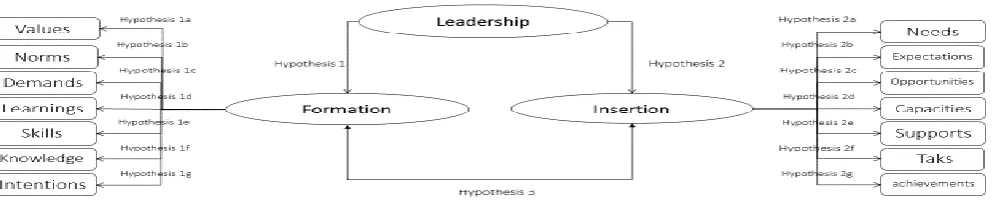
The relationship between human capital formation and labour insertion would be mediated by leadership, which in a sense is also a training process, but unlike employees, leaders are mediators of vocational training and job placement (see Figure 1 and hypotheses 1, 2 and 3).
Figure1: Specification of a model for the study of human capital Source: Prepared by the author
In the case of the formation of human capital, this involves factors that reflect it as is the case of values, norms, demands, learnings, skills, knowledge and intentions
and achievements (see hypotheses 2a, 2b, 2c, 2d, 2e, 2f, and 2g).
Final Considerations
The contribution of this work to the state of knowledge and the revision of the literature consists of the specification of a model for the study of human capital formation, transformation leadership and labour insertion.
In relation which human capital formation depends on the level of scientific and technological development, the present study warns that technologies, devices and information networks are a key factor in the explanation of organizations dedicated to the Establishment of strategic alliances, but ignored in the cooperative societies as competitive advantage.
The formation of human capital seems to be determined by the context and culture of the organization. In that sense, the specification of a model will allow the contrast of the normative and normative determinants of the organizations with respect to the internal capacities and resources.
Vocational training is a result of business development policies that include constant evaluation processes. In this sense, the quality of the processes inside the organizations determines its structure and also the requirements of selection and training of personnel.
In contrast, the present paper argues that the formation of human capital depends on the level of talent crystallized in skills and knowledge rather than the climate of relationships and tasks that are established in organizations dedicated to the quality of their processes and products.
The formation of human capital, in relation to labour insertion, would be closer to the
mediation that the transformational
leadership exerts on the employee and the commitment that he acquires and develops before the demands of his leader. It is a process in which the learnings have a greater impact than training and therefore condition labour satisfaction.
The work commitment is the result of a climate of empathic relationships between leaders and followers, but also entails the learning of norms and values of cooperation that, in the case of corporations, seem to be distant from their objectives, tasks and goals.
In the present work, the specification of a model for the study of vocational training is based on the establishment of values and norms as reflective indicators, but in relation to the expectations and capacities of the insertion in the labour market.
However, the course and personal trajectory differs from group goals, tasks and goals. Even with the formation of networks of knowledge, personal expectations and abilities seem to follow performance schemes acquired from leaders, but especially from peers. In this sense, the inclusion of factors that inhibit vocational training and job placement such as stress, burnout and mobbing is recommended.
Job satisfaction do not depend on skills or knowledge, but rather on skills that in the case of emotional intelligence are a
preponderant factor in performance,
innovation and job satisfaction. The present study does not include these emotional, affective and sentimental variables, but it is recognized that, coupled with the intensive use of technologies, devices and electronic networks, it potentiates the formation of human capital and gives competitive advantages for labour insertion.
Acknowledgement
Project financed by UNAM-DGAPA-PAPIIT
References
1. Abreu, M (2002) Prospectiva de las
organizaciones bursátiles en México.
Denarious. 5. (31):54.
2. Adenike, A (2011) Organization climate as a
3. Almedon, a (2005) Resilience hardiness sense of coherence, and posttraumatic growth: all pats leading to “Ligth at the end of the tunnel”. Journal of Loss and Trauma. 10. (253):265.
4. Alonso, P (2008) Estudio comparativo de la
satisfacción laboral en el personal de administración. Revista de Psicología del Trabajo y las Organizaciones. 24. (25)40.
5. Barranco, C (2009) Trabajo social calidad de
vida y estrategias resilientes. Portularia. 9. (133):145.
6. Castro, A Teorías (2006) implícitas del
liderazgo, contexto y capacidad de
conducción. Anales de Psicología. 22, (89):97.
7. Chattopahyay, E (2001) examining the
effects of work externalization through the lens of social identity theory. Journal of Applied Psychology. 86, (781):788.
8. Cortés, J La (2010) resiliencia: una mirada
desde la enfermería. Ciencia y Enfermería. 16, (27):32
9. Díaz, O Trabajo (2012) Social ante la crisis
económica. Portularia Revista de Trabajo Social. 12. (239):244.
10. Fioretino, M La (2008) construcción de la
resiliencia en el mejoramiento de la calidad de vida y la salud. Suma Psicológica. 15. (95):114.
11. Hermosa, A (2006) Satisfacción laboral y
síndrome de bournout en profesores de educación primaria y secundaria. Revista Colombiana de Psicología. 15. (81):89.
12. Herreros, F (2004) ¿Por qué confiar? Formas
de creación de confianza social. Revista Mexicana de Sociología. 66.(605):626.
13. Kundu, K (2007) Development of the
conceptual framework of the organizational climate. Vidyasagar University Journal of Commerce. 12 .(100):110.
14. López, E (2001) ¿Liderazgo carismático en
las organizaciones? Elementos para una reflexión sobre el cambio en las relaciones intra-organizacionales. Revista de Psicología Social. 16. (97):115.
15. Maruco, M Síndrome (2012) de Burnout en
pediatras. Análisis de variables que podrían potenciar la aparición y agudización de los hospitales generales. Revista Académica de Ciencias Sociales.16. (1):9.
16. McGee, H (2006) the healing circle:
resiliency in nurses. Issues in Mental Health Nursing. 27.(43):57.
17. Melano, M Ciudadanía y (2007) autonomía
en Trabajo Social. El papel de los saberes
políticos, científicos-técnicos. Revista
Alternativas: Cuadernos de Trabajo Social. 15. (99):110.
18. Morales, J Decaimiento (2002) mortandad y
sobre vivencia organizacional: gestión
estratégica de las organizaciones mexicanas en el neoliberalismo. Denarious.5.(55):74.
19. Omar, A Liderazgo (2010) transformador y
satisfacción laboral: el rol de la confianza en el supervisor. Liberabit. 17. (129):137.
20. Pastor, E Trabajo (2012) Social, capital
social, inteligencia cooperativa y diálogo significante en el ámbito local. Portularia Revista de Trabajo Social. 12. (91):99.
21. Peña, N (2009) Fuentes de resiliencia en
estudiantes. Liberabit.15.(59):64.
22. Ruíz, S Las (2009) políticas públicas y las
acciones privadas en cooperación al
desarrollo: perspectivas y propuestas para el Trabajo Social. Portularia Revista de Trabajo Social. 9(147):154.
23. Salgado, A Métodos (2005) instrumentos
para medir la resiliencia. Liber+abit, 11.41):48.
24. Scheper, N A talent (2008) for life:
reflections of human vulnerability and resilience. Ethnos. 3 (25):56.
25. Sepulveda, L Las (2010) trayectorias de vida
y el análisis de curso de vida como fuentes de conocimiento y orientación de políticas sociales. Perspectivas: Revista de Trabajo Social. 21(27):54.
26. Vargas, J Organización (2011) del trabajo y