Available online at: www.ijassh.com
RESEARCH ARTICLE
Population and Economic Growth in Nigeria: is there an Empirical
Evidence of Causality?
Aidi Hakeem O*, Emecheta Chisom, Ngwudiobu Ikenna M
Department of Economics, University of Nigeria, Nsukka, Nigeria.
Abstract
Studies that seek to explain the relationship between population growth and economic growth in Nigeria are at the moment very scanty. This study investigated the causal relationship between these afore-mentioned variables (i.e. population growth and economic growth) in Nigeria using annual time series data covering the period of 1970 to 2013. The study relied on the Granger-Causality technique to capture the objective of the study. The result of the neither Granger-Causality test showed that neither economic growth (GDPGR) caused population growth (POPGR) nor population growth (POPGR) caused economic growth (GDPGR) during the period under-studied. In the absence of any causal link between our variables of concern, this study thus recommended that the Nigerian government (in order to take advantage of the huge population size) invests more in education/human capital development in order to boost both the quantity and quality of the labour force which in turn is expected to positively impact economic growth in the long-run.
Keywords: Economic growth and causality, Population growth.
Introduction
The relationship between population and economic growth has a long history in economics. With the publishing of the ground-breaking paper titled “An essay on the principle of population” by Thomas Malthus of the classical school of thought in
1798 followed by numerous other
publications by notable economics scholars including Pigou, Marshal and Keynes, the entire world became more aware of the need to understand the dynamics of population as a prerequisite to efficient economic planning as well as achieving sustainable economic growth.
Economic growth is a fundamental
macroeconomic policy objective which countries all over the world (i.e developed and developing) continue to strive to achieve. Although there are other important macroeconomic policy objectives such as full employment, price stability and balance of payment equilibrium, economic growth can solely be facilitated by proper management or attainability of equilibrium of all these other macroeconomic policy objectives. Even in the developed countries where significant
level of economic growth has been attained, efforts are still being put in place not just to sustain the level of growth but also to improve on the periodic rate of growth. Note that pressure is on the developing nations (Nigeria inclusive) to accelerate the level of economic growth as well as the rate of growth that are still relatively very low.
The motivation to have a comprehensive data of the entire human population in Nigeria according to Okolo [1] started formally in the early twentieth century (few years before the amalgamation in 1914). Osagiede [2] revealed that the population census covering the entire Nigeria was first taken in 1911 in which the result revealed a total of 16.06million people, this was followed by 1921 population census which showed that Nigeria’s population has risen to 18.72million.Ten (10) years later (i.e. 1931), the population has risen to 19.09million (despite exclusion of provinces
in the Eastern region where the
Outbreak of 2nd world war, the 1931 population closed the chapter of an era of population census based on estimation which Osagiede [2] tagged “population guesstimation period”
In 1950 through to date began another era called the “post population guesstimation”
period. The first population census
conducted during this period was the 1950-53 population census in which a total population of 30.42million was announced.
Following the cancellation of 1962
population census due to legal tussles that resulted from the perceived inflation of figures in certain regions of the country, another nationwide headcount taken in 1963 with the population of Nigeria then standing at 55.6million [3]. The result of the 1973 population census was also cancelled therefore there was no population census held until 1991. The 1991 national head count revealed that Nigeria’s population was 89 million [4]. It is important to note however that Nigeria population at the moment according to World Bank is roughly 185million even though the last population census in Nigeria back in 2006 revealed about 140million.
From the above, it is not beyond the bound of rationality to agree that population census as a vital tool for making tenable economic plans towards development has a long history in Nigeria. However, since knowing the total number of heads in the country seems not to be of enough help to economic planners and policymakers in the country particularly in the face of frightening rate of expansion (in population size) as against the limited available resources makes economic growth difficult to achieve thus formulation of policies to address this problem became inevitable. The first population policy tagged “Nigeria policy on population for unity, progress and self-reliance” was rolled out in 1988 (during the military regime of Gen. Ibrahim B. Babangida), the second (Nigeria policy on population for sustainable development) came up in 2003 (under the
democratic governance of Olusegun
Obasanjo). The key objective of these two population policies was to check the threatening rate of population expansion in the country.
Although, the relationship between
population and economic growth all over the world has remained a subject of intense debate in literature (this implies there is absence of unanimity among numerous researchers who have carried out researches on the subject matter), most of the researchers still consider population as a vital variable in the analysis of growth in an economy [5].To support this claim,
Akintunde, Olomola and Oladeji [6] explain that the need to improve the welfare of people in the society now and in the future means population as well as its growth rate have to be integrated and prioritised in the development plans of most third world countries. Nigeria’s economy is currently faced by many other socio-economic
challenges that are hindering the
attainment of its various macroeconomic objectives (including economic growth), the high rate of population coupled with the alarming rate with which it is growing could be a big thorn on the flesh of both Nigerian government and policymakers.
As observed in literature, country with huge population size (such as china) took advantage of this demographic advantage by investing in education and absorbing those within the working age into the labour force. This will stimulate productivity and economic growth in the long-run [7]. The situation in Nigeria however seems not to be similar to that of China as sizeable number of Nigerians (in their prime/productive age) who could have played significant roles in the development of the country have remained partially or fully unengaged, stranded and helpless. Supporting this is the data from the World Bank [8] which revealed that unemployment rate in Nigeria is still unacceptably and relatively high (i.e. 13.6% in 1991, rose to 13.8% in 2001 and 14.2% in 2012).
governments and other researchers (interested in related studies) to this important aspect that seems to have been neglected by previous studies.
Theoretical and Empirical Review
of Literature
Theoretical Literature
According to Blanchet [9] and Hudgson there are three (3) alternative views to population-economic growth nexus namely the population pessimistic, the population optimistic and the population neutralist view. The population pessimistic view was the view held by the followers of the Malthusian school of thought. This school of thought was named after the proponent (Thomas Malthus) of this theory. In his paper titled “an essay on the principle of population”, Thomas Malthus explained that persistent growth in population will bring an economy to a standstill if urgent steps are not taken. He noted further that more population means more mouth will have to be fed and that since population was growing (at geometric progression) at a faster rate that food supply (growing at arithmetic progression) this disequilibrium will adversely affect the economy. This point was supported by scholars like Coale and Hoover [10] and Ehrlich [11] who stated that rapid population growth was bound to negatively exert the economy since it will overwhelm any induced response by
technological progress and capital
accumulation.
The population optimistic view put forward by the renowned Danish economist- Ester Boserup [12] in 1981. This economist noted that contrary to the negative relationship between population and economic growth acclaimed by the Malthusian theorists, rapidly growing population will impact positively on an economy because a rapidly growing population will make room for economics of scale as well as promotion of technological and institutional innovations [13]. The followers of this theory strongly counter the Malthusian’s position of inevitable future food shortage (resulting from population expansion) by explaining that advancement in technology will
positively influence productivity thus
neutralising any potential threat of growing population on food supply. These theorists recalcitrant belief in technology as a way out was also backed by Simon [14] who noted that humans are only weights to earth without skill, science and technology therefore output/productive capacity can be expanded using own knowledge, fore-thought and skills.
The population neutralist theorists came up with a view entirely different from the two schools of thoughts earlier discussed. They explained that population growth has no single-handed influence on the available resources. Bloom and Freeman [15] noted
that population neutralist theorists
contended that population growth in isolation (from other factors) has neither a positive nor negative impact on economic growth. In the words of Kelley [16] population neutralism is a doctrine positing the absence of any significant relationship between population growth and rate of economic growth. This claim has been tested empirically by scholars like Sachs and Warner [17] who observed that the perceived negative correlation between population growth and economic growth becomes unobservable once other variables (such as country size, openness to trade, level of education attainment among others) are excluded in the model. Population neutralist view dominated the thinking of scholars about population growth in the last half-century [18].
Empirical Literature
Onwuka [19] evaluated the impact of growing population on economic growth in Nigeria between 1980 and 2003 using OLS regression model. The study relied on annual time series data for its analysis, among the variables of interest incorporated in the model are GDP growth rate, population, growth rate of population, lagged
per capita output, oil production,
However, Adewole undertook a research to unravel the highly contentious relationship between the effects of population on economic growth in Nigeria using an annual time series data covering the period of 1981 to 2007. The researcher chose OLS regression method for analysis, variables included in the model are real gross domestic product (RGDP), population and per capita income (PCI). The researcher found among other things that a strong
positive relationship existed between
population and economic growth (measured as both RGDP and PCI) during the period considered.
Oramah [20] studied the effects of population growth on Nigeria economy using a double time growth analysis. The researcher highlighted the need for population control in Nigeria by explaining the potential danger that can ensue from disregarding trend at which population is growing worldwide. The researcher focussed more on the impact of population growth on non-renewable resource consumption and depletion, land degradation and waste
disposal, weather modification, rapid
urbanisation and even desertification. Among the factors identified as influencing population size in Nigeria are religion, education, male-child preference, old-age social security, high infant mortality etc.
Nwosu, Dike and Okwara [21] in an empirical research studied the relationship between population growth and economic growth in Nigeria between 1960 and 2008 using annual time series data. OLS techniques were combined with granger causality test for the study. The core variables included in the model were GDP and population growth. The researchers found among other things that population growth has a significant impact on economic growth during the period under-studied; the
researchers also established that a
sustainable long-run relationship between economic growth and population growth.
Kothare [22] embarked on a research with a view to establishing the relationship between population growth and economic growth in India. The study covered all provinces in India and covered a period of
1988 to 1998. The researcher employed the combination of descriptive and analytical statistical tools on the data obtained on variables of interest from India. The empirical result of the study revealed that population growth has significantly and positively impacted economic growth during the period considered. The researcher concluded by showing that the result is valid for both short-run and long-run situation.
Ukpolo [23] empirically measure the economic association between population growth and economic growth in Africa using Johansen and Granger-causality techniques. The study is based on annual time series data collected on the variables of concern from the two selected countries (Nigeria and Coted’ivoire). The estimation results showed that the variables are co-integrated, that is, long-run relationship existed between the variables in Nigeria but not in Coted’ivoire. The results further revealed a negative long-run causal relationship between the two variables of concern in Nigeria (i.e
population growth negatively affects
economic growth) in the long-run. In Coted’ivoire, the results showed that population growth causes economic growth only in the short-run.
Schneider, Havlik, Schmid, Valin, Mosnier, Obersteiner, Bottcher, Skalsky, Balkovic, Sauer and Fritz [24] reassessed the impacts of population growth, economic development and technical change on global food production and consumption using partial
equilibrium model. The variables
incorporated for analysis in the model include population, average GDP per capita, average crop productivity factor, arable land loss (from urbanisation) and change in non-agricultural water usage. The results of the partial equilibrium and simulation model showed that population growth leads to highest increase in total food production, it also revealed that changes in income exerted a positive influence on per capita food consumption.
(OLS) regression techniques on annual time series data obtained on variables listed in the model such as GDP, population growth, lagged value of fertility rate and net migration. The study revealed that lagged fertility does not affect the economic growth in the two-variable regression; however, the study further revealed a significant negative relationship between population growth and economic growth upon the inclusion of net-migration as a variable in the model. The researcher therefore concluded that net-migration is a key determinant of economic growth.
Dao [25] examined the relationship between population and economic growth in Africa using data that covered selected forty-five (45) African economies. The researcher employed the used of panel data regression analysis for the study, among the variables listed in the model include fertility rate, per capita GDP growth, trade openness, dependency ratio (old and young) among others. The researcher deduced from the findings that the relationship between population growth and per capita GDP growth is linear and negative. The findings further revealed that fertility rates have a negative impact on economic growth and also that old dependency ratio positively affects per capita GDP growth.
Ali, Ali and Amin [26] examined the impact
of population growth on economic
development in Pakistan between 1975 and 2008 using the autoregressive distribution lag model (ARDL). The study incorporated real GDP as the dependent variable while population growth, real GDI growth, export growth, trade openness, unemployment rate and human resource development were listed as explanatory variables.
The research established a significant positive relationship between population growth and economic growth but population growth was found to exert negatively on unemployment. The researchers concluded that for meaningful economic growth is achieved, government should create more conducive environment for investment so as
to provide more jobs and reduce
unemployment.
Data and Methodology
The core variables of this study are population growth and growth rate of real gross domestic product (the chosen proxy for economic growth). This is a time series study thus annual time series data ranging from 1970 to 2013 were obtained on the mentioned variables from the World Bank-World development Indicator [8]. Note that actual data are used for the purpose of analysis, no major transformation or massaging/mining was done on the obtained data.
As observed under the section on empirical literature, most studies that seek to explain the relationship between population and economic growth mostly focussed on the linear relationship between these variables
thus have relied on the use of
simple/multiple regression analysis, vector autoregressive model among numerous other methods.. In line with the crux of this study, we will adopt the Granger causality technique [27] for analysis as this will enable us to establish whether or not these variables (population growth and economic growth) truly have any causal relationship.
Pre-Estimation Test
As a precondition for valid and reliable result, the variables were put to unit-root test. The popular augmented Dickey-Fuller was used and the results obtained are presented in Table 1 and 2 below:
Table 1 above shows that although growth rate of population was not stationary at level, it became stationary after first difference since the ADF test statistics of -3.921822 is now greater than the corresponding (Mackinnon) critical values of -3.626784, -2.945842 and -2.611531 at 1%, 5% and 10% level of significance respectively.
Exogenous: Constant
Lag Length: 6 (Automatic - based on SIC, maxlag=9)
t-Statistic Prob.*
Augmented Dickey-Fuller test statistic -3.921822 0.0047
Test critical values: 1% level -3.626784
5% level -2.945842
10% level -2.611531
*MacKinnon (1996) one-sided p-values.
Augmented Dickey-Fuller Test Equation Dependent Variable: D(POPGR,2) Method: Least Squares
Date: 11/22/15 Time: 17:01 Sample (adjusted): 1978 2013
Included observations: 36 after adjustments
Variable Coefficient Std. Error t-Statistic Prob.
D(POPGR(-1)) -0.171341 0.043689 -3.921822 0.0005
D(POPGR(-1),2) 1.277042 0.105034 12.15835 0.0000
D(POPGR(-2),2) -0.509749 0.172466 -2.955655 0.0063
D(POPGR(-3),2) -0.034018 0.141837 -0.239837 0.8122
D(POPGR(-4),2) 0.520622 0.139765 3.724988 0.0009
D(POPGR(-5),2) -0.683128 0.137525 -4.967314 0.0000
D(POPGR(-6),2) 0.441777 0.083025 5.321019 0.0000
C 9.47E-05 0.000896 0.105645 0.9166
R-squared 0.975698 Mean dependent var -0.003251
Adjusted R-squared 0.969623 S.D. dependent var 0.029974
S.E. of regression 0.005224 Akaike info criterion -7.477877
Sum squared resid 0.000764 Schwarz criterion -7.125984
Log likelihood 142.6018 Hannan-Quinn criter. -7.355057
F-statistic 160.5972 Durbin-Watson stat 1.870081
Prob(F-statistic) 0.000000
Source: Computed by Authors using Eviews (version 8)
Table 2: Stationarity test result for economic growth (GDPGR)
Null Hypothesis: GDPGR has a unit root Exogenous: None
Lag Length: 0 (Automatic - based on SIC, maxlag=9)
t-Statistic Prob.*
Augmented Dickey-Fuller test statistic -4.967534 0.0000
Test critical values: 1% level -2.619851
5% level -1.948686
10% level -1.612036
*MacKinnon (1996) one-sided p-values.
Augmented Dickey-Fuller Test Equation Dependent Variable: D(GDPGR) Method: Least Squares
Date: 11/22/15 Time: 17:06 Sample (adjusted): 1971 2013
Included observations: 43 after adjustments
R-squared 0.368714 Mean dependent var -0.456112
Adjusted R-squared 0.368714 S.D. dependent var 9.866031
S.E. of regression 7.838910 Akaike info criterion 6.979058
Sum squared resid 2580.838 Schwarz criterion 7.020016
Log likelihood -149.0497 Hannan-Quinn criter. 6.994162
Durbin-Watson stat 2.193250
Source: Computed by Authors using Eviews (version 8)
Note that the stationary form of the variables are used for estimation [27] .
Model Specification
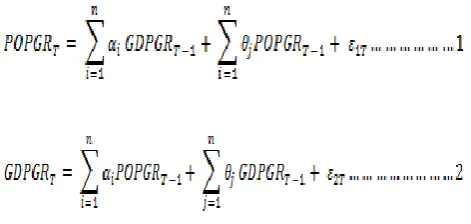
Having met the required and sufficient condition (for stationarity of variables being considered), the model to capture the objective of this study is specified as follows:
Where POPGR is the growth rate of population and GDPGR is the growth rate of real GDP (used as proxy for economic
growth). Note that and are the error
terms which are assumed to be uncorrelated
in the above equations. These equations will be estimated using Granger-Causality technique (noted earlier), the result of the findings is presented in what follows.
Results and Discussion
To determine the maximum lag length of the variables, the researchers used the Akaike information criteria (AIC). According to Gujarati and Porter [27] the lower the value of AIC, the better the model. In this study, the maximum lag length selected based on
the AIC value was the 4th lag of the
variables. The result of the Granger-Causality test is presented in what follows:
From the above table, the null hypotheses are clearly stated (i.e. POPGR does not Granger cause GDPGR and vice versa). Note that the growth rate of both population and real GDP (a proxy for economic growth) were used for the analysis.
Table 3: Result of the granger-causality test Pairwise Granger Causality Tests
Date: 11/24/15 Time: 14:24 Sample: 1970 2013
Lags: 4
Null Hypothesis: Obs F-Statistic Prob.
POPGR does not Granger Cause GDPGR 39 0.28014 0.8885
GDPGR does not Granger Cause POPGR 0.73533 0.5752
Source: Computed by Authors using Eviews (version 8)
To interpret the result in Table 3, we considered the probability statistics or value. For the first hypothesis (POPGR does not
Granger cause GDPGR), since the
probability value of 0.8885 (equivalent to 88.55%) is greater than 5%, we do not reject the null hypothesis. Therefore, we agree that population growth (POPGR) does not Granger-cause economic growth (GDPGR) during the period under consideration.
Looking also at the second hypothesis (GDPGR) does not Granger-cause POPGR), the P-value of 0.5752 (equivalent to 57.52%) is also greater than 5% in absolute term thus we do not reject the null hypothesis. That is, economic growth (GDPGR) does not Granger-cause population growth (POPGR
Conclusion
This study examined the presence or otherwise of causal relationship between population growth (POPGR) and economic growth (GDPGR) in Nigeria over the period 1970 to 2013. The result of the study however revealed that population growth (POPGR) does not just Granger cause GDPGR but also that there exists absence of empirical evidence to also reject the null hypothesis that economic growth (GDPGR) does not Granger cause population growth (POPGR). The result of the study supports the position of the population neutralists
view that population growth does not single-handedly exert (positively or negatively) economic growth. In addition, the result of the finding revealed that Nigeria as a country has not been able to take advantage of the unique demographic features compared to the like of China. In order to take advantage of the huge population size, this study recommends that the Nigeria government invest more in education/human capital development so as to improve the quality and quantity of labour force in order to fasten economic growth as well as improving on the yearly rate of growth. [28-29].
References
1. Okolo A (1999) The Nigerian census: Problems and prospects. The American Statistician, 53(4), 321-325.
2. Osagiede EO (2014) Population census in Nigeria. The
Nigerian Observer. Retrieved from
https://www.nigerianobservernews.com/2014/12/09/populati on-census-in-nigeria.
3. Eniayejuni AT, Agoyi M (2011) A biometrics approach to population census and national identification in Nigeria: A prerequisite for planning and development. Asian Transactions on Basic and Applied Sciences. 1:60-67. 4. Mimiko F (2006) “Census in Nigeria: The politics and
imperative of depolarisation.” African and Asian Studies. 5(1):1-22.
5. Kotani S, Kotani K (2012) The effect of net-migration on population-growth relationship in Indonesia. Asian Journal of Empirical Research. 2(2):62-72.
6. Akintunde TS, Olomola PA, Oladeji SI (2013) Population dynamics and economic growth. Journal of Economics and Sustainable Development. 4(13):148-157.
7. Zhang NJ, Guo M, Zheng X (2012) China: Awakening giant developing solutions to population aging. The Gerontologist. 5(2):589-596.
8. World Bank (2014) World bank development indicator. World Bank, Washington Dc, USA.
9. Blanchet D (1991) On interpreting observed relationship between population growth and economic development: A graphical exposition. Population and Development Review.17:105-114.
10. Coale AJ, Hoover E (1958) Population growth and economic development in low income countries. Princeton, New Jersey, Princeton University Press.
11. Ehrlich PR (1968) Population control or race oblivion? The population bomb. New York: Ballantine Books.
12. Boserup E (1981) Population and technological change: A study of longterm trends. University of Chicago Press.
13. Kuznets S (1967) Population and economic growth. Proceedings of the American Philosophical Society, 111:170-193.
14. Simon J (1981) The ultimate resource. Princeton: Princeton University Press.
15. Bloom DE, Freeman RB (1986) Economic development and the timing and components of population growth. Journal of Policy Modelling. 10:57-81.
16. Kelley AC (1988) Economic consequence of population change in the third world countries. Journal of Economic Literature. 26(4):685-728.
17. Sachs JD, Warner AM (1995) Natural resource abundance and economic growth. NBER Working Paper No: 5398. 18. Kelley AC (2001) The population debate in historical
perspective: Revisionism revised. Oxford University Press. 19. Onwuka EC (2006) Another look at the impact of Nigeria’s
growing population on the country’s development. African Population Studies. 21(1):1-18.
20. Oramah IT (2006) The effects of population growth in Nigeria. Journal of Applied Science. 6:1332-1337.
21. Nwosu C, Dike A, O, Okwara KK (2014) International Journal of Engineering And Sciences. 3(11):7-18.
22. Kothare R (1999) The impact of population growth on economic growth in India. Journal of Social Science India. 410:1-14.
23. Ukpolo V (2002) Population growth and economic growth in Africa. Journal of Developing Societies, 18(4):315-329. 24. Schneider UA, Havlik P, Schmid E, Valin H, Mosnier A,
Michael O, Bottcher H, Skalsky R, Balkovic J, Sauer T, Fritz S (2011) Impacts of population growth, economic development and technical change on global food production and consumption. Elsevier Journal of Agricultural System. 104:204-215.
25. Dao MQ (2012) Population and economic growth in developing countries. International Journal of Academic Research in Business and Social Sciences. 2(1):6-17. 26. Ali S, Ali A, Amin A (2013) Impact of population growth on
economic development of Pakistan. Middle-East Journal of Scientific Research. 18(4):483-491.
27. Gujarati DN, Porter DC (2009) Basic Econometrics (5th Ed), New York: McGraw-Hill.
28. Bank (2013) World bank development indicator. World Bank, Washington Dc, USA.