Available online throug
ISSN 2229 – 5046
DUFOUR EFFECT ON UNSTEADY MHD FLOW PAST AN IMPULSIVELY STARTED
INCLINED OSCILLATING PLATE WITH VARIABLE TEMPERATURE AND MASS DIFFUSION
U. S. RAJPUT
1, GAURAV KUMAR
2*
1,2
Department of Mathematics and Astronomy, University of Lucknow, Lucknow – (U.P.), India.
(Received On: 16-01-16; Revised & Accepted On: 31-01-16)
ABSTRACT
D
ufour effect on unsteady MHD flow past an impulsively started inclined oscillating plate with variable temperature and mass diffusion is studied here. The fluid considered is gray, absorbing-emitting radiation but a non-scattering medium. The governing equations involved in the present analysis are solved by the Laplace-transform technique. The velocity and temperature profile are discussed with the help of graphs drawn for different parameters like Grashof number, mass Grashof Number, Prandtl number, Dufour number, the magnetic field parameter and Schmidt number.Keywords: MHD, Dufour effect, oscillating inclined plate, variable temperature and mass diffusion.
INTRODUCTION
The study of flow for an electrically conducting fluid has many applications in engineering problems and plays important role in different areas of science and technology, like chemical engineering, mechanical engineering, biological science, petroleum engineering, biomechanics. Such problems frequently occur in petro-chemical industry, chemical vapour deposition on surfaces, cooling of nuclear reactors. The influence of magnetic field on viscous, incompressible and electrically conducting fluid is of great importance in many applications such as magnetic material processing, glass manufacturing control processes and purification of crude oil. Lighthill [1] has investigated the response of laminar skin friction and heat transfer to fluctuations in the stream velocity. Longitudinal vortices in natural convection flow on inclined plates was studied by Sparrow and Husar [2]. Free convection effects on the oscillatory flow an infinite, vertical porous, plate with constant suction was analyzed by Soundalgekar[3] which was further improved by Vajravelu and Sastri [5]. Rajput and Kumar [13] has investigated unsteady MHD poiseuille flow between two infinite parallel plates through porous medium in an inclined magnetic field with heat and mass transfer. Datta and Jana [4] has considered oscillatory magneto hydrodynamic flow past a flat plate with Hall effects. MHD flow between two parallel plates with heat transfer was investigated Attia and katb[6]. Rajput and Kumar [9] has analyzed MHD flow past an impulsively started vertical plate with variable temperature and mass diffusion. Heat and mass transfer in MHD boundary layer flow past an inclined plate with viscous dissipation in porous medium was studied by Singh [10]. Mishra et al[11] has investigated free convective flow of visco-elastic fluid in a vertical channel with dufour effect. Radiation absorption and dufour effect to MHD flow in vertical surface was considered by Kesavaiah and Satyanarayana[12]. Postelnicu[7] has analyzed Influence of chemical reaction on heat and mass transfer by natural convection from vertical surfaces in porous media considering soret and dufour effects. Analytic solution of heat and mass transfer over a permeable stretching plate affected by chemical reaction, internal heating, dufour-soret effect and Hall effect was studied by Ibrahim [8]. We are considering the dufour effect on unsteady MHD flow past an impulsively started inclined oscillating plate with variable temperature and mass diffusion. The results are shown with the help of graphs.
MATHEMATICAL ANALYSIS
In this paper we have considered MHD flow between two parallel electrically non conducting plates inclined at an angle
α
from vertical. x axis is taken along the plate and y normal to it. A transverse magnetic field B0 of uniformstrength is applied on the flow. The viscous dissipation and induced magnetic field has been neglected due to its small
effect. Initially it has been considered that the plate as well as the fluid is at the same temperature
T
∞ and theconcentration level
C
∞ everywhere in the fluid is same in stationary condition. At time t > 0, the plate startsThe flow modal is as under:
,
)
(
)
(
2 0 * 2 2ρ
σ
α
β
α
β
υ
g
Cos
T
T
g
Cos
C
C
B
u
y
u
t
u
+
−
+
−
−
∂
∂
=
∂
∂
∞∞ (1)
,
2 2 2 2y
C
C
C
K
D
y
T
C
k
t
T
p s T m p∂
∂
+
∂
∂
=
∂
∂
ρ
(2),
2 2y
C
D
t
C
∂
∂
=
∂
∂
(3)with the corresponding initial and boundary conditions:
,
,
,
0
:
0
=
=
∞=
∞≤
u
T
T
C
C
t
for all y,,
)
(
,
)
(
,
:
0
2 0 2 00
ω
υ
υ
t
u
C
C
C
C
t
u
T
T
T
T
t
Cos
u
u
t
>
=
=
∞+
w−
∞=
∞+
w−
∞ at y=0, (4)∞
∞
→
→
→
T
T
C
C
u
0
,
,
asy
→
∞
,
here u is the velocity of the fluid, g - the acceleration due to gravity,
β
- volumetric coefficient of thermal expansion, t- time, T-temperature of the fluid,β
*- volumetric coefficient of concentration expansion, C- species concentration in the fluid,ν
- the kinematic viscosity,ρ
- the density,C
p- the specific heat at constant pressure, Cs - Concentrationsusceptibility, k - thermal conductivity of the fluid, D - the mass diffusion coefficient ,
D
m- is the effective mass diffusivity rate,T
w- temperature of the plate at y= 0,C
w-species concentration at the plate y= 0,B
0- the uniform magnetic field,σ
- electrically conductivity.The following non-dimensional quantities are introduced to transform equations (1), (2) and (3) into dimensionless form:
,
)
(
)
(
,
,
)
(
)
(
,
)
(
,
,
)
(
,
C
μ
,
,
,
)
(
)
(
,
,
2 0 3 0 * 2 0 2 0 3 0 0 0 2 0 ∞ ∞ ∞ ∞ ∞ ∞ ∞ ∞−
−
=
=
−
−
=
−
=
=
−
=
=
=
=
−
−
=
=
=
=T
T
C
C
C
C
K
D
D
tu
t
C
C
C
C
C
u
C
C
g
G
u
B
M
u
T
T
g
G
k
P
D
S
T
T
T
T
u
u
u
yu
y
w p s w T m f w w m w r r c w u Pυ
υ
υ
β
ρ
υ
σ
βυ
ρυ
µ
υ
θ
υ
ωυ ω (5)where
u
- is the dimensionless velocity,t
- dimensionless time,θ
- the dimensionless temperature,C
-the dimensionless concentration,G
r - thermal Grashof number,G
m - mass Grashof number,µ
- the coefficient of viscosity,P
r - the Prandtl number,S
c - the Schmidt number,D
f - dufour number,K
T-Thermal diffusion ratio and M - the magnetic parameter .Thus the model becomes
,
u
M
C
Cos
α
G
θ
Cos
α
G
y
u
t
u
m r 2 2−
+
+
∂
∂
=
∂
∂
(6),
1
2 2 2 2y
C
D
y
P
t
r f∂
∂
+
∂
∂
=
∂
∂
θ
θ
(7)
,
1
2 2y
C
S
t
C
c∂
∂
=
∂
∂
(8)with the following boundary conditions:
,
0
,
0
,
0
:
0
=
=
=
≤
u
C
t
θ
for ally
,
t
C
,
t
θ
,
t
ω
Cos
u
:
0
t
>
=
=
=
aty
=0, (9),
0
,
0
,
0
→
→
→
C
Dropping bars in the above equations, we get
,
2 2Mu
C
Cos
G
Cos
G
y
u
t
u
mr
+
−
+
∂
∂
=
∂
∂
αθ
α
(10)
,
1
2 2 2 2y
C
D
y
P
t
r f∂
∂
+
∂
∂
=
∂
∂
θ
θ
(11)
,
1
2 2y
C
S
t
C
c∂
∂
=
∂
∂
(12)with the following boundary conditions:
,
0
,
0
,
0
:
0
=
=
=
≤
u
C
t
θ
for all yt,
C
t,
θ
ωt,
Cos
u
:
0
t
>
=
=
=
at y=0, (13)0
,
0
,
0
→
→
→
C
u
θ
asy
→
∞
.
The dimensionless governing equations (10) to (12), subject to the boundary conditions (13), are solved by the usual Laplace - transform technique.
The solution obtained is as under:
(
)
(
)
(
)
(
)
.
)
2
2
2
(
)
(
4
4
)
(
4
)
2
2
2
))(
2
(
2
2
(
4
)
1
(
2
2
2
2
)
(
4
)
(
4
4
)
1
(
2
2
2
2
4
10 15 17 8 15 15 17 8 12 2 2 2 14 16 7 14 14 16 6 11 31 2 31 30 5 17 2 3 2 1 2 2 2 4 16 2 3 2 1 13α
π
π
π
π
π
π
α
π
α
π
α
π
π
π
π
π
α
α
α
α
ωCos
A
G
S
A
S
A
A
t
AA
A
A
A
S
yMA
P
S
M
Cos
S
P
D
G
M
Cos
G
P
S
M
Cos
S
P
D
G
P
A
P
A
A
t
MA
A
A
A
P
yMA
y
M
A
e
y
A
t
M
A
t
M
M
Cos
G
e
S
A
A
S
A
y
M
A
t
MA
A
e
P
S
M
Cos
S
P
D
G
P
S
M
Cos
S
P
D
G
M
Cos
G
P
A
A
P
A
y
M
A
t
AA
A
e
A
e
u
m c c c r c c r f r r r c c r f r r r r y A r y A c c y A r c c r f r r c c r f r r r r y A it−
+
+
+
−
+
−
+
−
−
+
+
+
−
+
+
+
−
+
+
−
+
+
+
+
−
−
−
−
−
+
+
+
+
+
=
− − − −(
)
(
)
.
2
)
(
2
29 2815 14 2 15 14 29 2 14
+
−
+
−
+
−
−
−
−
=
r c r cr c
c r f
r
t
A
A
y
A
P
A
S
y
t
A
P
A
S
P
S
S
P
D
tP
y
A
y
t
A
π
π
θ
].
2
)
(
)
2
1
[(
2 c 2Scc c
e
S
S
erfc
S
t
c
ηπ
η
η
η
−
−+
=
The expressions for the constants involved in the above equations are given in the appendix.
RESULT AND DISCUSSION
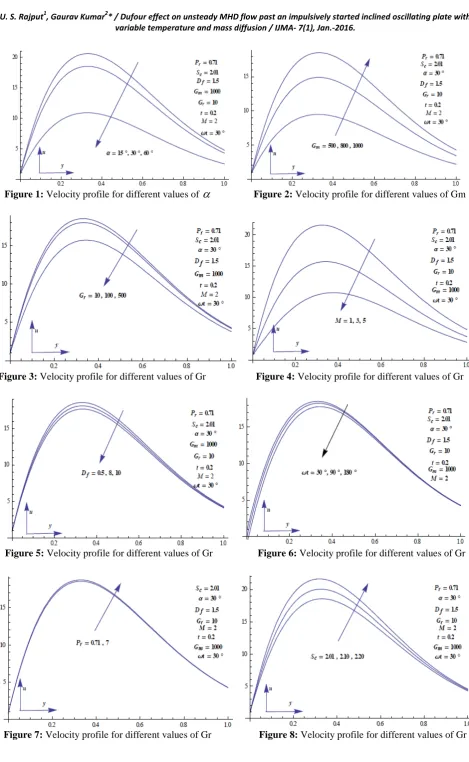
Figure 1: Velocity profile for different values of
α
Figure 2: Velocity profile for different values of GmFigure 3: Velocity profile for different values of Gr Figure 4: Velocity profile for different values of Gr
Figure 5: Velocity profile for different values of Gr Figure 6: Velocity profile for different values of Gr
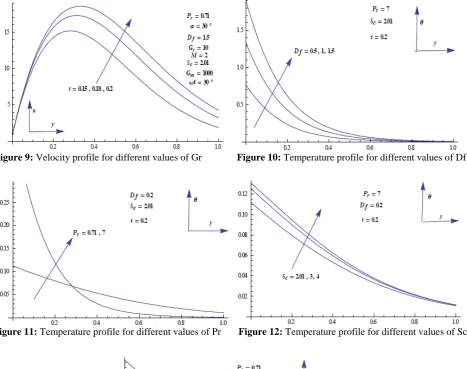
Figure 9: Velocity profile for different values of Gr Figure 10: Temperature profile for different values of Df
Figure 11: Temperature profile for different values of Pr Figure 12: Temperature profile for different values of Sc
Figure 13: Temperature profile for different values of t
CONCLUSION
In this paper a theoretical analysis has been done to study the Dufour effect on unsteady MHD flow past an impulsively started inclined oscillating plate with variable temperature and mass diffusion. Solutions for the model have been derived by using Laplace - transform technique. Some conclusions of the study are as below:
• Velocity increases with the increase in mass Grashof Number, Prandtl number, Schmidt number and time. • Velocity decreases with the increase in the angle of inclination of plate, thermal Grashof number, the magnetic
field, Dufour number and phase angle.
• Temperature profile increases with the increase in Dufour number, Prandtl number, Schmidt number and time.
APPENDEX
),
1
(
12
18 2 191
A
e
A
A
=
+
+
My−
A
2=
−
A
1,
A
3+
A
1=
2
(
1
+
A
18),
A
4=
−
1
+
A
20−
A
26(
1
−
A
21),
),
)(
1
(
21 27 264
5
A
A
A
A
A
=
−
+
−
A
6=
−
1
+
A
22−
A
26(
1
−
A
23),
A
7=
−
A
6,
A
8=
−
1
+
A
24−
A
27(
1
−
A
25),
,
A
A
=
−
15 28,
2
c c
A
y
tS
S
A
y
tA
,
35 2 34 33 3213
A
A
e
A
e
A
A
=
+
−
−z a+iω−
−z a+iω+ itω,
2
1
14
+
−
=
t
P
y
erf
A
r,
2
1
15
+
−
=
t
S
y
erf
A
c,
1 1 16 r r r P MP y P Mte
A
−+− + −
=
17 1 1 c,
c c S MS y S Mt
e
A
−+− + −
=
,
2
2
18
−
=
t
y
t
M
erf
A
,
2
2
19
+
=
t
y
t
M
erf
A
, 2 1 2 20 + − − = t P MP t y erf A r r , 2 1 2 21 + − + = t P MP t y erf A r r , 2 1 2 22 − + − = t P y P M t erf A r r , 2 1 2 23 + + − = t P y P M t erf A r r , 2 1 2 24 − + − = t S y S M t erf A c c , 2 1 2 25 + + − = t S y S M t erf A c c,
,
1 2 26 r r P MP ye
A
=
−+,
1,
2 27 c c S MS y
e
A
=
−+,
4,
28 2 t S y ce
A
−=
,
4,
29 2 t P y r
e
A
−=
,
2
2
30
−
=
t
y
M
t
erf
A
,
2
2
31
+
=
t
y
M
t
erfc
A
32,
ω
ω y M i
i M y
e
e
A
=
− ++
− −A
33=
e
−y M+iω+2itω+
e
y M−iω+2itω,
, 2 2 2 2 34 + − + − − = t i M t y erf t i M t y erf
A
ω
ω
,
2
2
2
2
35
+
+
+
−
+
=
t
i
M
t
y
erf
t
i
M
t
y
erf
A
ω
ω
REFERENCES
1. M.J. Lighthill, “The response of laminar skin friction and heat transfer to fluctuations in the stream velocity”, Proc. R. Soc., A, 224 (1954), 1 - 23.
2. E.M.Sparrow and R.B.Husar, “Longitudinal vortices in natural convection flow on inclined plates”, J. Fluid. Mech., 37, 251-255, 1969.
3. V. M. Soundalgekar, “Free convection effects on the oscillatory flow an infinite, vertical porous, plate with constant suction” , I, Proc. R. Soc., A, 333 (1973), 25 - 36.
4. Datta N and Jana R. N., “Oscillatory magneto hydrodynamic flow past a flat plate will Hall effects”, J. Phys. Soc. Japan, 40, (1976), 14-69.
5. K.Vajravelu and K. S. Sastri, “Correction to, Free convection effects on the oscillatory flow an infinite, vertical porous, plate with constant suction”, I', Proc. R. Soc., A ,51 (1977), 31 - 40.
6. Attia H A and katb N A, “MHD flow between two parallel plate with Heat Transfer”. Acta Mechanica, 117, (1996), 215-220.
7. Postelnicu, A., “Influence of chemical reaction on heat and mass transfer by natural convection from vertical surfaces in porous media considering Soret and Dufour effects”. Heat Mass Transfer, 43: 5, (2007), 95-602. 8. Ibrahim a. abdallah, “analytic solution of heat and mass transfer over a permeable stretching plate affected by
chemical reaction, internal heating, dufour-soret effect and hall effect”, thermal science: vol. 13 no. 2, (2009), pp. 183-197.
9. U. S. Rajput and Surendra Kumar, “MHD Flow Past an Impulsively Started Vertical Plate with Variable Temperature and Mass Diffusion”, Applied Mathematical Sciences, Vol. 5, , no. 3,(2011) 149 – 157.
10. P. K. Singh, “Heat and Mass Transfer in MHD Boundary Layer Flow past an Inclined Plate with Viscous Dissipation in Porous Medium”, International Journal of Scientific & Engineering Research, Volume 3, Issue 6, June-2012.
11. S.R. Mishra, G.C. Dash and M. Acharya, “Free Convective Flow of Visco-Elastic Fluid in a Vertical Channel with Dufour Effect”, World Applied Sciences Journal 28 (9): (2013)1275-1280.
12. Damala Chenna Kesavaiah and P V Satyanarayana, “Radiation absorption and dufour effects to mhd flow in vertical surface" ,global Journal of engineering, Design & Technology, Vol 3(2); (2014)51-57.
13. U. S. Rajput and Gaurav Kumar, “Unsteady MHD Poiseuille Flow between two Infinite Parallel Plates through Porous medium in an Inclined Magnetic Field with Heat and Mass Transfer” international journal of mathematical archive-Vol 6(11), (2015)128-134.
Source of support: Nil, Conflict of interest: None Declared