ISSN: 2347-7474
International Journal Advances in Social Science and Humanities
Available Online at: www.ijassh.com
RESEARCH ARTICLE
The Tree of a Delicate Global Innocence
Maria José da Silva Faria
Ph.D. in Business Sciences, Assistant Professor, Universidade Lusíada, Norte (Campus de Vila Nova
de Famalicão e Campus do Porto), Portugal.
Abstract
Corruption is not a new, modern issue or with purely economic links. It is an old fact that has always
had an impact on the economy, society, politics and other spheres. However, never as now has been so
much discussed, conveyed in the social media, criticized by some and ostracized by others, although
"acclaimed" by a minority that shows interest in the same or in its exercise. Because it is an expanding
economic mechanism, authorities around the world are more attentive, increasingly developing,
improved and efficient tools for combating and detecting fraud and corruption. This work aims to verify
what forms companies have to correct or detect the existence of fraud. The methodology used was a
bibliographical review of the main writings of fraud and the plight of the most committed frauds in the
average of the last decades. It is concluded that the phenomenon is rooted around the world, Portugal
is no exception and the last cases that the news has revealed demonstrate not only the impunity or
insufficiency of the current judicial system but also a weak critique of public opinion whose memory
seems ephemeral.
Keywords:
Fraud, Corruption, Audit, Accounting, Normalization, Crime.
Concept, Origin and Links to Other
Concepts
Talking about fraud is neither easy nor
simple. It is a controversial subject, satirized
often in the media and, in some
circumstances, begins to be accepted
normally although in others it is even
ignored. Perera, Freitas and Imoniana [1]
add that the phenomenon is recent, but by
interrelated factors, it is difficult to
conceptualize it. Massi [2] reinforces that
there is still no consensus as to its
definition, indicating that while some care
about perceiving their process others are
engaged in formulating and maintaining
schemes. Marujo [3] understands that fraud
involves a concealment, which in many cases
causes the difficulty of being detected, but in
cases where it is detected, the true value of
the losses may never be known.
The author Santos [4] in the investigations
carried out understands that there is much
to write about fraud, the more so that edit,
decide, publish, investigate, audit, in such a
way that the theme must be drafted at will.
The issue of fraud is a matter that
encompasses a multifaceted process that
requires a multidisciplinary approach to
minimize its risk impact on companies [5]
For the Association of Certified Fraud
Examiners (ACFE) fraud consists in the
appropriation of assets, corruption and
fraud committed in the financial reporting
[6] For Moura [7] it is an ethical bankruptcy,
greed, dissimulation and disclaimer to
everything that is tender to the ego.
Authors Gonçalves and Pimenta [8] argue
that fraud is an intentional act carried out
by natural or legal persons, carried out with
astuteness, and which effectively or
potentially causes damages to citizens,
institutions, countries and the environment,
for the violation of good Practices, or even
the law itself, is therefore a phenomenon
that involves the whole of society. With the
same appreciation, the same analysis of
fraud
is
found
in
several
sites,
characterizing it as an intentional act that
materializes in the omission, manipulation
of transactions, adulteration of facts,
concealment of documents and other
Also on this site, it is pointed out that fraud
is not an error, because an error is an
unintentional act in the preparation of
records and accounting statements that can
lead to errors, which does not correspond to
the perception of fraud. Marujo [3] is of the
opinion that often the border between
normal and abnormal or fraudulent is very
tenuous, even in the face of admittedly
intentional practices reports that the
fraudulent report presents an intentional
distortion in the performance of a company.
In the same line of study, Pimenta [10]
argues that fraud is a violation of the law,
although it is often not judged as such if
committed by the State or by the "owners of
the world". Regardless of the object, person,
space or moment, fraud is a violation of
ethics that must be judged by all and never
forgiven by many [11].
In a very simple way the concept of fraud
begins with an almost harmless act, but
under an umbrella of deception. It is
preceded by a process of decision of the
respective author, fruit of the evaluation
that makes of certain aspects that
contextualize "the here and now" [12] It is
therefore a kind of equation where the
variables that compose it may be the
pressure caused by the deprivation of
liquidity, addictions such as gambling or the
consumption of alcohol, drugs or other
substances; May be due to a strong
propensity for the display of something for
self-assertion such as cars, jewelry,
perfumes, clothing, computing devices, or
other, which provide access to privileged
groups and restricted circles of individuals.
In either case, recourse to fraud derives
from the lack of money to acquire something
not easily attainable with the existing
financial availability, the capacity of each of
us to perceive risks and to make the decision
to do so or not, and cumulatively, of to verify
that the instances of punishment do not
seem to observe the existence of fraud and,
therefore,
there
is
no
blame
and
punishment, but impunity, particularly in
public figures [13].
Moreira [6] notes in his studies that
corruption is becoming a form of economic
habitualism with social acceptance, where
its existence seems to be self-feeding.
Pimenta [14] adds that it worsens public
services, blocks and deters the income
created, lavishes wealth in favor of some,
erodes the Social cohesion, undermines
democracy and reduces freedom.
Soon, the opportunity to practice fraud is
becoming a path to be followed, not a
shortcut to be eliminated. This is where the
emphasis should be on training and
professional qualification [3] [15]. In order to
combat fraud, it is necessary to study not
only its concept but also its origins, because
different forms of action and accountability
may be involved depending on it. One of the
possible causes of fraud may be the lack of
generalized information, transparency [16]
in this paper; we present some of the
theories that attempt to explain the
existence of fraud: theories from classical
antiquity, to the classical criminological
school or to the school of criminal sociology
[16].
In addition to the theories and schools that
seek to study fraud behavior, in Portugal
several scholars point out that the presence
of fraud in our daily lives has intensified in
the face of our indifference and is becoming
almost
contagious,
possibly
almost
inevitable [17-18]. It is the tip of a world
covered by a fog that masks its existence
[19]. It is able to create resources aside from
any registration, off shore operations, money
laundering, tax evasion, all of this
reproducing at a viral speed [20-21]. It is not
practiced exclusively by individuals outside
organizations, although it is easier to blame
the external enemy and in self-defense to
claim ignorance [19].
The different origins and ramifications of
fraud against other crimes have an impact
on society at the economic, financial,
political,
social,
fiscal,
criminal,
environmental, and other levels summarized
by Pimenta [18].
Increased
corruption
lowers
the
importance of investment in domestic
output, decreases economic growth;
The existence of much corruption makes
the country less attractive for foreign
investment;
exports and imports, leading to the
worsening of external debt, the flight of
our resources abroad;
Corruption diminishes the quality of
public
investment,
particularly
in
infrastructure;
Corruption negatively influences average
income per person, while aggravating
inequalities in income distribution;
Diverts resources that should be used for
economic
growth,
thus
combating
unemployment, and the well-being of
populations;
The worse the position of a country on
Transparency
International's
list
(Portugal was 25th in 2001, 32nd in 2008
and 29th in 2016, further away from the
less corrupt) is worse off in the Human
Development Index (Which measures
development
in
health
conditions,
education and the income enjoyed by
citizens);
More corruption equals less efficient
government services and poorer quality of
health services;
Corruption lowers government spending
on education;
Corruption promotes tax evasion (the
corrupter
adulterates
accounts
for
satiating and covering up wealth, off shore
companies are used as payment channels,
bribed companies are going to sell at lower
prices, have fewer profits and cause a
decrease Government revenues and taxes
paid;
Corruption increases pollution because it
reduces the effectiveness of environmental
regulations, controls and limits the success
of biodiversity maintenance projects;
Corruption is related to increased crime.
For many origins and ramifications that
fraud can have Camacho [22] argues that its
beginnings reside in the financial system as
the cornerstone of the world today. The
author argues that a capitalist system with
a free and borderless market that I
personally advocate at least until the
political administration of Donald Trump
goes into governance and without limits to
the free movement of capital creates the
ideal cradle for its branching. Pimenta [21]
understands that in addition to capital
markets, globalization has also fostered the
appearance of fictitious capital. The existing
freedom created favorable conditions for the
emergence and development of fraud,
corruption, money laundering and other
economic crimes [22]. Marujo [3] notes that
Price Water house Coopers - PWC in 2011
published a report on the four most reported
types of economic crime: misappropriation of
assets, fraudulent financial statements,
bribery and corruption, and cybercrime. In
this report, we can see that the profile of the
internal fraud practitioner is young
collaborators or middle managers, less than
40 years of age, who have been in the
company for less than 5 years [3]. In
addition to the financial system, individual
behaviors such as pride and greed, popular
acceptance of certain acts, political vows,
and the complacency we carry out at any
given moment, play a key role in the
practice of fraud [22].
Portuguese law has been amended to curb
fraud, but it is not enough because its
growth is notorious, so the dream of an
effective national judicial system is far from
perfect even because the improvements of
fraudulent
techniques
anticipate
the
creation of laws [19-14]. One of the laws by
which Portugal has been debated to combat
corruption is the law of illicit enrichment,
which is based on an inexplicable wealth in
the face of legally enjoyed income [21].
One way of solving it would be to explain the
revenues or wealth detected in order to force
the target of the fraud to pay the tax
differential and a fine in the face of the
omission of information. If it were found
that the wealth resulted from embezzlement
or other illegal activity, then the situation
would be different could culminate in the
sentence with penalty for illicit enrichment.
In any case, a joint amendment to the penal
code is important, so as to raise the
awareness of political office holders in order
to improve the law, so as not only to combat
fraud in general, but also fraud and
corruption in the State [23].
fraud,
credit
frustration,
criminal
association, qualified disobedience, breach of
secrecy, crimes Customs, tax crimes,
qualified fraud, breach of trust and crimes
against social security [24] It is up to the
Portuguese Court of Auditors to implement
audit actions to prevent fraud and in this
context has imported some international
practices such as [3] Strengthening the
coverage of the universe of control;
Intensify and improve the evaluation of
internal control systems - ICS;
Strengthening control in areas of
increased risk of fraud and corruption;
Strengthening control of conflicts of
interest;
Strengthen control of accounting omissions
and falsifications;
To
prepare
comprehensible
reports
accessible to all citizens;
Promote the public disclosure of reports;
Encourage the adoption of personnel
management processes in the civil service
that promote the selection and motivation
of employees who are distinguished by
their integrity and competence;
Strengthen cooperation and exchange of
experiences and information with other
national
and
international
entities
involved in the fight against corruption;
Establish and improve mechanisms for
receiving and handling complaints of
irregularities;
To promote regular training in the field of
techniques and procedures for detecting
situations that indicates corruption.
The complexities of some anti-fraud
processes in Portugal have a gigantic gap
between their beginning and end, which can
condition good results because the offender
can escape without being detected. An
example is VAT carousel fraud throughout
Europe that gives rise to tax forgiveness of
thousands of euros per year [25].
In addition to changing the law and judicial
speed, it would be urgent to train fraud
detection specialists, as these individuals
would not only be able to assess situations of
potential fraud risk, but also coordinate
teams to combat fraud and deal with
lawsuits to prosecute violators. For Moreira
[26-27] the understanding, prevention and
detection of fraud consists of holding
knowledge
in
accounting,
auditing,
computer science, psychology, criminology,
research among other professional areas.
Pimenta [28] argues that fraud is possible to
be detected, combated and condemned, but
the secret results in its prevention and
restriction of its breadth because it requires
knowledge
and
multidisciplinary
professionals
with
an
attitude
of
investigation
and
vigilance.
Fraud
practitioners have sparked debate around
the world.
Moreira [29] notes that the Green Paper -
Audit Policy: Lessons from the Crisis has
questioned the role of the auditor as an
anti-fraud agent. He himself understands that
this role should be reinforced by a fraud
expert who is properly recognized and
certified (Fraud Examiner or Forensic
Accountant). However, this opinion has been
discussed in the highest international
patents particularly in the preparation of
more detailed reports in large and medium
enterprises.
Regarding
small
and
microenterprises, the discussion of the
subject reveals that this action would be
equally useful, but the cost-benefit ratio
would be significant [30].
These discussions highlight a long way to go
in combating the eradication of fraud. In
addition to the legal procedures, academic
support of prepared professionals, it is
important to recognize that in the
overwhelming majority of cases the
performers camouflage fraud. For Teixeira
[31] fraud can involve 3 elements: 1) an
affirmation on the part of the issuer that has
a false implication; 2) to believe on the part
of the receiver in what he believes to be true
and to carry out actions based on this same
assumption; 3) the receiver causes harm to
him and others when he performs the
actions that are expected of him or her.
companies they are responsible for accounts;
Money laundering transactions, through
legal business that serves only to justify the
existence of money; Manipulation of
accounting records, such as national banks
do through the practice of smooth results, a
practice that is not illegal and allows
financial institutions to present results
between different consecutive years without
major fluctuations; etc. For Maia [15-32]
this manipulation of results is increasingly
on the agenda due to the injury that causes
those interested in accounting information.
The same does not apply to the use of illegal
checks, the use of checks or other false
documents,
declarations
or
invitations to a faithful depositary of
non-existent fortunes, forgery of credit cards,
payments for something that does not exist
[33] Among many other illegalities and
illicitness’ that the imagination does not
limit and human understanding finds it
difficult to account for what has happened
lately in the contributions to political
campaigns [28] In this way it can be seen
that the materialization of fraud can be
constituted by many different activities, for
example Castro [34] reported:
Purchase or sale of goods or services to
companies in which there is a hidden
interest.
Admission or purchase of goods or services
in exchange for a bribe, that is, in
exchange for the purchase of money,
travel, future employment or other
compensation.
Manipulation of competitions still in the
specifications so that the winner is what
interests you.
Theft of cash from the cashier.
Withdrawals of money from deposits that
would supposedly go to the Bank.
Submission of personal expense invoices
as being of work.
Receipt of checks from endorsed clients in
your favor.
Creation of front companies to bill goods or
services that do not exist to other company
(s) where it has powers or influence.
Facilitation of the registration of overtime
in your favor or of members of your team.
Use of undue commissions on human
resources for miscellaneous payments.
Creation of ghost employees with
settlement of monthly salary where the
beneficiary is the own.
Falsification
of
the
register
of
remunerations to inflate the patrimony
proper.
Change in the description of an expense to
be submitted for professional judgment.
Ask to increase a representation expense
(for example the value of meals) to be
reimbursed this amount much higher than
what actually occurred.
Fake signatures of a company check so
that it becomes available for itself.
Falsify the Bank Identification Number
(NIB) of a supplier so that the payments
made are credited to itself.
Issuance of Credit Notes or sales
cancellations
without
them
having
actually happened in order to keep the
payment of the customer.
Theft of items from inventory or goods or
tools, etc.
Use of company assets to your benefit such
as computers, cars, mobile phone without
any kind of permission.
Simulation of the destruction of assets of
the company that have been assigned to be
replaced by others to end up being
damaged?
Etc.
ethnicity, academic background, etc. Fraud
shapes not only the individual personality
but also influences the psychology of each
citizen, it soon depends on other factors of
the origin and beliefs of the people. We may
also regard fraud as a means to some while
to others it is not even a means to an end
that justifies its performance, so fraud is a
kind of functional relativity because it either
functions as a means or does not function as
such. Adding to these perceptions also joins
the understanding that we can make of the
fraud when we perceive it as such if it
harms us or not, in question is an egocentric
contingency that only allows the individual
to look at his navel [36].
It is because of the existence of so many
perceptions of fraud and so much practice of
fraud that Pimenta [37] understood that at
one point the fraud led to the so-called
shadow economy, also known as a parallel
economy, where tax evasion is only a small
joke compared to Production and exchange
of goods illegally carried out since: drugs,
organ trafficking, people, weapons and other
illegalities such as the company's mill
premiums and the abrupt bankruptcies of
some economic giants. The shadow economy
in Portugal represents more than 21% of the
legal product of the economy [38] probably
this number would be much higher because
the law does not consider tax evasion and
fraud as components of the shadow economy.
In issue is the fact that a trader who has not
issued an invoice for tax evasion, for
example
in
VAT,
which
by
the
circumstances and taxes in question is
considered element of the shadow economy.
If we are faced with fictitious transactions
between companies in the European Union
to receive VAT, then we are facing a
carousel fraud that is not accounted for in
the shadow economy. The discrepancy in the
understanding of these situations deserves
repair, legal adjustments and add a
terminological ambiguity because in any of
the cases we are facing a parallel economy,
unregistered
economy,
economy
not
observed by the authorities or underground
economy [39].
The efforts of the United Nations
Convention against Corruption have made it
possible to study fraud as a cross-country
problem, to view it as a threat to the
security of societies, a weakness for the
confidence of individuals and institutions, as
well as an earthquake Ethics, values and
democratic morality [13]. This discussion
around the concept of fraud and corruption
allows us to characterize its existence with a
different provenance. Depending on this
provenance we can find different typologies
of fraud and corruption. Not wanting to sort
each typology, but to list their existence, we
can first mention the existence of financial
fraud associated with financial groups such
as banks and insurance companies.
Economic fraud, practiced by economic
groups, companies and other entities that
carry out economic crimes, particularly
using information technology or holding
strategic geographical positions. The sports
fraud,
associated
with
referees,
practitioners, agents and sports leaders,
among other sports professionals. Social
fraud, when in question, are bound by pacts
of silence, abuse of power, extortion,
exchange of favors, sexual offenses,
manipulation of minors / elders, among
other visible acts in the exercise of social
control and the order of citizens in general.
Political fraud, when concerned is the
compensation of corrupt through gloves,
bribes, commissions, electoral votes, holders
of public office or political. Finally,
environmental fraud, when in question is
committed crimes against the environment
in general.
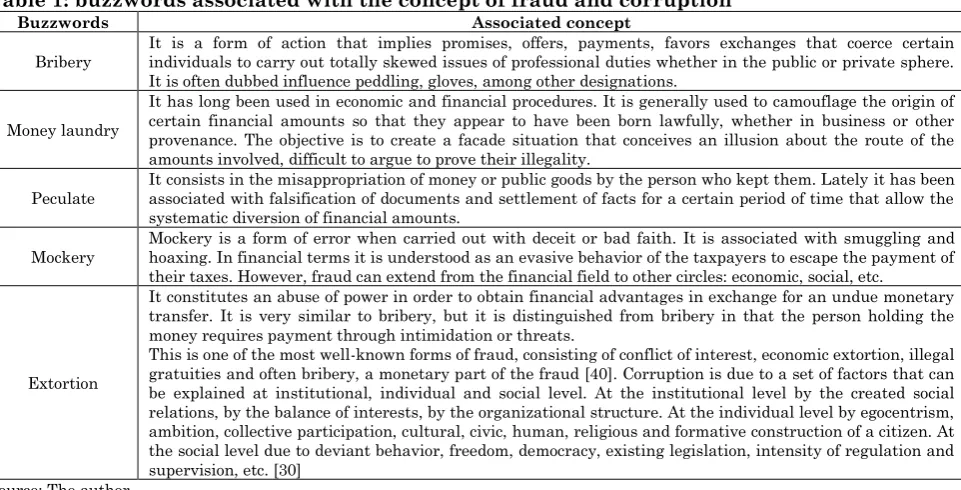
Therefore, when we talk about fraud,
corruption, and different typologies we have
to analyze some associated concepts (Table
1), because together they will allow us to
form an opinion, think of solutions and
measures to combat fraud.
Table 1: buzzwords associated with the concept of fraud and corruption
Buzzwords Associated concept
Bribery
It is a form of action that implies promises, offers, payments, favors exchanges that coerce certain individuals to carry out totally skewed issues of professional duties whether in the public or private sphere. It is often dubbed influence peddling, gloves, among other designations.
Money laundry
It has long been used in economic and financial procedures. It is generally used to camouflage the origin of certain financial amounts so that they appear to have been born lawfully, whether in business or other provenance. The objective is to create a facade situation that conceives an illusion about the route of the amounts involved, difficult to argue to prove their illegality.
Peculate It consists in the misappropriation of money or public goods by the person who kept them. Lately it has been associated with falsification of documents and settlement of facts for a certain period of time that allow the systematic diversion of financial amounts.
Mockery Mockery is a form of error when carried out with deceit or bad faith. It is associated with smuggling and hoaxing. In financial terms it is understood as an evasive behavior of the taxpayers to escape the payment of their taxes. However, fraud can extend from the financial field to other circles: economic, social, etc.
Extortion
It constitutes an abuse of power in order to obtain financial advantages in exchange for an undue monetary transfer. It is very similar to bribery, but it is distinguished from bribery in that the person holding the money requires payment through intimidation or threats.
This is one of the most well-known forms of fraud, consisting of conflict of interest, economic extortion, illegal gratuities and often bribery, a monetary part of the fraud [40]. Corruption is due to a set of factors that can be explained at institutional, individual and social level. At the institutional level by the created social relations, by the balance of interests, by the organizational structure. At the individual level by egocentrism, ambition, collective participation, cultural, civic, human, religious and formative construction of a citizen. At the social level due to deviant behavior, freedom, democracy, existing legislation, intensity of regulation and supervision, etc. [30]
Source: The author.
We all know that fraud exists, that it is
punishable, that it is difficult to follow its trail
and cumulatively there are a multitude of
reasons that seem to lead citizens to their
practice or else to ignore their existence
because what passes us by is not Our
responsibility [33] The author Pimenta [33]
lists a series of observations that defend his
ideology:
If fraudsters and traffickers account for less
than 1% of the population, how do you
justify the remaining 99% being so
distracted?
If the vast majority of businesses and other
institutions are victims of fraud, is it a good
business to prevent them from taking
action?
If the strength of an institution is more
measurable by the ability to detect and
prevent fraud than by its apparent absence,
because it insists on covering up the
situation, including the police?
If the intentional escape of taxes harms all
citizens and the State should not go beyond
the mere requirement of payment?
If we receive e-mail every day that we want
to cheat because we do not promote
initiatives for a more regular and effective
enlightenment?
There are several reasons for this to turn back,
this makes sense, either by its very nature the
"shadow" economy is not immediately visible
and fraud uses the simulation; On the other
hand, information on these subjects is scarce,
and there is a fear of publicly addressing these
issues;
In
addition
our
distraction,
condescension and "goodness" are inscribed in
deep sociological reasons, visible in the
indicators of social psychology, in the "Fear of
Existence" or in the surveys on corruption and
political practices; And if it were already
enough the emergence of an individualism
followed by a relative degeneration of ethical
relations, weakening the referential of social
intervention [38].
The various typologies of fraud imply different
ways of acting, because their universe has
multiple contours, concepts and multifaceted
understandings [41] When one perceives the
logic associated with the individual who
commits fraud, it is important to study the
criteria that led him to such a practice:
motivation, modus operandi, profile, and
vulnerable areas and control in processes and
public or private entities [9].
Different Forms of Fraud
Study Author,
year Object
The Economy Not Registered in Portugal http://www.gestaodefraude.eu/images/gf_upload/e002.pdf
Study of the economy not registered in Portugal. It concluded that this represents
more than ¼ of the national GDP. Forensic Accounting in Portugal - Empirical Evidence
http://www.gestaodefraude.eu/images/gf_upload/e001.pdf
The author carried out a study at the national level with the use of surveys and interviews, which concludes that the professional Forensic
Accounting is not very explicit in Portugal, so that his study needs to deepen with the higher education institutions to investigate if there is
a discipline With this matter. Fraud Quantification Outline in Portugal
http://www.gestaodefraude.eu/images/gf_upload/wp003.pdf [42] committed in Portugal and in the US and UK. The author compared the amount of fraud He concluded that in Portugal it is almost three
times bigger than in the USA and twice as big as in the United Kingdom.
Conflicts of Interest
http://www.gestaodefraude.eu/images/gf_upload/wp001.pdf The authors understand that the resolutions of conflicts of interest are to anticipate them, not to harm one of the parties by communicating
the conflict, to separate different areas of interest, to increase remunerations to lower the
level of seduction, to involve several agents that allow to appease and to find A way of
solution, more legislation and more transparency in information. Transparency International annual reports
http://www.transparency.org/publications/annual_report
The author argues that the existence of these reports is very important, but that no transparency should be demanded when individually we do not mirror it. In addition,
this should not be feared, because the seriousness that transparency demands is unquestionable, it should not be a dream nor a
process of change or adaptation, but rather a breath for us to continue to fight for realism. GRECO - Group of States against Corruption, of the Council of
Europe
http://www.coe.int/t/dghl/monitoring/greco/evaluations/index_en. as
Portugal is part of this working group on the fight against corruption, which hailed national
efforts to criminalize this with the entry into force of Law nº. 30/2015 of 22 April, amending the Penal Code and other legislation criminal.
Portugal also followed GRECO's recommendations in ratifying the Additional
Protocol to the Criminal Convention on Corruption and efforts to ensure more
transparency in political financing. Http://www.dgpj.mj.pt/sections/noticias/conselh
o-da-europa-greco Transparency International Corruption Barometer
http://www.transparency.org/ corruption shows that 48% of the Portuguese The most recent study of the barometer of consider that corruption has worsened in Portugal in the last year and 39% do not see improvements in the levels of corruption in our
country.
Http://www.dn.pt/portugal/interior/metade-dos-
portugueses-ve-corrupcao-como-principal-problema-do-pais-5500378.html Corruption and Ethics in Democracy: The Case of Portugal
http://www.obercom.pt/client/?newsId=410&fileName=obf3.pdf The authors understand that the media is a strong tool in building national opinion on corruption.
The slowness of justice, the results and the continuity of the acts lead to a social condemnation on the effectiveness of the control of corruption. Media can help if at the
expense of sensational news seek to do more work and better research in these matters. Social Discourse on the Problem of Corruption in Portugal
http://www.gestaodefraude.eu/images/gf_upload/wp007.pdf
The author, besides commenting on the role of the press in the case of the fraud, understood to
study the dimension of this crime in Portugal and to ascertain the opinion of the Portuguese
about the fraud. He concluded that the Portuguese do not believe much in the news of
the media about corruption and appear not to show great concern about certain situations
against others in the same "basket" of corruption.
Social Perception of Corruption in Portugal
http://bocc.ubi.pt/pag/maia-antonio-a-percepcao-social-sobre-a--corrupcao-em-portugal.pdf
António João Maia, s/d
the investigation process and increase the results of cases transmitted by the media. United Nations Convention against Corruption
http://www.un.org/ga/search/view_doc.asp?symbol=A/RES/58/4
United Nations Office on
Drugs and Crime – UNODOC , s/d
The United Nations Convention against Corruption is filling the gap of non-global
bodies in the fight against fraud and corruption. It is composed of a set of 71 articles
and 8 chapters dealing with topics such as prevention, penalization, asset recovery and international cooperation. Each chapter should
be imported and adapted to the reality of each country. Http://www.unodc.org/lpo-brazil/pt/corrupcao/convencao.html Source: the author.