International Journal of Advances in Management, Economics and Entrepreneurship
Available online at:
www.ijamee.info
RESEARCH ARTICLE
Turkey’s Image as a Tourist Destination in Northern Europe
Hasan Ayyildiz
1, Gulcin Bilgin Turna
2*
1Karadeniz Technical University, Trabzon, Turkey.
2Recep Tayyip Erdogan University, Rize, Turkey.
*Corresponding Author: Email:[email protected]
Abstract
Many countries in Northern Europe spend their holidays in Southern Europe to enjoy the good weather and tourist attractions. Turkey has been a powerful country which attracts foreign tourists besides its major competitors such as Spain, Greece and Italy which are situated in the same geographic area and offer similar characteristics such as good climate and rich cultural heritage. Since 2008, mentioned Mediterranean countries have been suffering a deep economic crisis whereas Turkey appears as an emerging force with strong government efforts with its growth prospects and opportunities. In this study, questionnaires were conducted in Sweden and the Netherlands in order to understand how they perceive Turkey as a country and tourism destination. Opinions of visitors and non-visitors were compared both using quantitative and qualitative data. Cognitive country image, affective country image and destination beliefs factors were analyzed in order to make contributions to the area of tourism destination image (TDI). The results also reveal that media and word-of-mouth communication are the most important sources of information for Swedish and Dutch people in the perception of Turkey.
Keywords: Country image, Turkey, Tourism destination image, Sweden, The Netherlands.
Introduction
John Hunt [1] who is credited with being the first to establish the importance of image as an influencer of travel behavior, defined image as „impressions‟ or „the perceptions held by potential visitors about an area‟. Early studies of TDI focused on the measurement of tangible attributes to determine their relative importance. In a study of regional images in America, Mayo found scenery, lack of congestion, and climate to be most significant where Anderssen and Colberg found cost, climate, and scenery to be the most significant attributes of destination image [2].Crompton [3] defined destination image as „the sum of beliefs, ideas, and impressions that a person has of a destination‟. He surveyed 617 students from 12 U.S. universities in American universities to assess Mexico‟s TDI in terms of two dimensions: a descriptive dimension and an importance dimension. The most significant descriptive attributes were cost and climate. However, the attributes rated as being most important were sanitation and safety.
Another important study in TDI was by Gunn in 1972 [4]. Her three-stage theory of image development involved “organic”, “induced” and “modified-induced”.
In the first stage, the mental construct of a place is defined as “organic”, derived unintentionally through life‟s contacts with education, media and people. The next stage, defined as “induced”, represents an image modified by promotional travel information. The last stage, defined as “modified-induced” represents an image changed by actual travel and personal experience. From this point, visitor experience was recognized as a key influencer [4].
the opinions of visitors and non-visitors were compared both using quantitative and qualitative data.
Turkey-A Popular Destination
The Reputational Institute‟s Country Rep Trak™ Pulse provides a standardized metric to assess to what degree Turkey is successful in governing its reputation among the general public in the G8 countries [7]. The study presents the respondents‟ particular feelings towards Turkey compared to other countries in terms of their willingness to visit, invest in, work and/or live in the country, and to buy a country‟s products. It allows evaluation of the country‟s successful reputation performance and the opportunities that arise consequently to attract tourists, investors and employees.
Turkey‟s political and economic liberalization in the 1980s and its bid for full membership of the European Union have made it an attractive destination for European tourists [8]. Today, Turkey has also become a popular destination for European retirees, particularly for British, German, Dutch and Nordic citizens. Turkey offers what Northern Europeans are in search of: sunshine, a healthy climate, relaxed and outdoor life style, free of formalities and the availability of property for purchase or rental [9].
Table 1 represents world‟s top tourism destinations. In 2011, Turkey moved up one position to sixth place (with 29 million tourists) overtaking the United Kingdom.
Table 1: International tourist arrivals (million)
2010 2011
1 France 77,1 79,5 2 The USA 59,8 62,3 3 China 55,7 57,6 4 Spain 52,7 56,7 5 Italy 43,6 46,1
6 Turkey 27,0 29,3
7 The UK 28,3 29,2 8 Germany 26,9 28,4 9 Malaysia 24,6 24,7 10 Mexico 23,3 23,4
Source: UNWTO Tourism Highlights [10]
Turkey’s Image in Europe
Turkey has demonstrated success in preserving the attribute of being an island of peace and stability in such a region. Turkey is one of the rare democracies located in vast geography extending
from Europe to the Pacific Ocean and to the Middle East. Turkey has a special place within the Atlantic-European and Eurasian zones. It is in the position of aiming at integration with the western society, in addition to being a democratic, secular and contemporary country of the Islamic world [11].
The global nature of the current financial and economic turbulences, result in imbalances in the global system, which trigger feelings of uncertainty [12]. On the other hand, Turkish economy has been undergoing a substantial
transformation since 2001. Macroeconomic
stability produced major drop in interest and inflation, while increased productivity rates enabled the Turkish economy to maintain an average annual growth rate of 5.9%, which is considerably above the historical average, during the 2002-2008 period [13]. Turkey achieved rapid economic growth during the last decade, and showed a significant resilience during the economic crisis in 2008. Economic growth and political stability over the past decade have transformed Turkey into an important commercial centre making it more attractive, competitive, and fast growing market for companies from all over the world [14].
Until 1961, more people left the Netherlands than people who moved into the country. It began to face a labor shortage by the mid 1950s, which became more serious during the early 1960s. At the time, Turkey had a problem of unemployment, low GNP levels and high population rates. So the import of labor solved problems on both ends [15]. The first Turkish immigrants arrived in the Netherlands in the beginning of the 1960s at a time were the Dutch economy was wrestling with a shortage of workers [16]. On 19 August 1964, the Dutch government entered into a “recruitment agreement” with Turkey. Thereafter, the number of Turkish workers in the Netherlands increased rapidly [17]. Based on the commemoration of Turkey-The Netherlands 400 years of trade, both have good political relations with each other and share a desire to strengthen their ties.
emigrants remain traditionalist. That is why Turkey‟s enormous improvements over recent decades, and in particular since 2001, do not register with most Europeans [18].
The relations between Turkey and Sweden are progressing in a very positive manner. Sweden, which is pursuing an active foreign policy in regional and international issues, substantively contributes to the EU foreign policy. Within this framework, Sweden is one of the leading countries
that strongly support Turkey‟s EU
membership. The number of Swedish tourists
visiting Turkey exceeded 617,000 in
2012. Approximately 115,000 emigrants from Turkey live in Sweden, half of whom also have Swedish citizenship [19].
Study Design
In this study, cognitive image constructs (quality of life, wealth, technology level, education) were adapted from Orbaizve Papadopoulos [20] and affective image constructs from Beerli and Martin [21] (pleasant), Echtner and Ritchie [22] (safety), Heslop and Papadopoulos [23] (trustworthy),
Orbaiz and Papadopoulos [20] (friendly).
Destination beliefs constructs were adapted from
Elliot [24] (appealing scenery, suitable
accommodation, quality attractions, lots to see and do, value for money, good overall destination).
Table 2 represents the demographic profile of the respondents of our questionnaire concerning questions about Turkey‟s tourism destination image. The target population for this study consisted of university students aged between 18-30 in the Netherlands and Sweden. In addition, their information sources about Turkey and the things come to their minds when they think of Turkey‟s destinations.
Dutch respondents were 363 university students studying either tourism or marketing and some young faculty members selected from Has Den Bosch University (67) and Rotterdam Erasmus University (296). Swedish respondents were from Halmstad University (311) having similar backgrounds. Most of the respondents are single students who are 20-24 years old and have income between EUR 30.001-50.000.
Table 2: Demographic profile of respondents (%)
Evaluation Variable Sweden (n=311) The NL
(n=363)
Gender Male 30.23 55.65
Female 69.77 44.35 Trips to other countries
in the last 3 years 0 1 5.47 7.07 2.20 2.74
2 15.43 5.51
3 13.83 9.63
4 9.97 8.82
5 - more 48.20 71.10
Visited Turkey Yes 37.90 39.90
No 62.10 60.10
Despite being young, the respondents have traveled frequently. With the help of their major of study and travel experience abroad make them knowledgeable about other countries. The items on the questionnaire were measured using a 5-point Likert type scale, ranging from “completely disagree” to “completely agree.” Mentioned universities were visited for two weeks. Appointments were taken from the faculty members in order to conduct the questionnaire before or after class. With the support of the professors, questionnaire was filled studiously in English.
Cognitive Image of Turkey
Cognitive evaluation refers to beliefs and knowledge about an object, in this case, Turkey.
Affective Image of Turkey
Cognitive evaluation refers to beliefs and knowledge about an object whereas affective evaluation refers to feelings about the object [25-28]. In other words, cognitive element of destination image describes the beliefs and information that people have about a place. Affective element describes what people feel about a place; it is about loving or not loving somewhere [29]. Social and environmental psychological tradition regards cognition and affect as interrelated elements, where affect is largely dependent on cognition. However, Russell and Snodgrass [30] argued that behavior may be influenced by the (estimated, perceived, or remembered) affective quality of an environment rather than by its objective properties directly. The affective component of destination image expresses feelings toward a destination, which can be favorable, unfavorable, or neutral [31]. Gartner [25] suggested that the affective component comes into play at the stage when different travel alternatives are evaluated. Many studies revealed that affective country image has more effect on destination beliefs than cognitive country image
[24, 32]. In terms of affective image, it is seen from the table 4 that visitors rated higher than non-visitors. It can be concluded that when people visit Turkey, they tend to develop more positive affective image.
Destination Beliefs of Turkey
Experience of a tourist is considered to be highly emotional value and of personal significance to every individual and relates to significant experience value as against tangible products [33, 34]. It is evident that destination image of a country influences the choice in decision making process of a tourist [35-41]. A location with a strong and positive brand image is more likely to be chosen by a tourist as a location to travel [42,43]. As it can be concluded from table 4, respondents who have visited Turkey have more positive attitude toward Turkey‟s tourism potential. Dutch seem to be more positive, probably because they had low expectations before visiting or they are exposed to many Turkish immigrants in their country so they developed familiarity and sympathy.
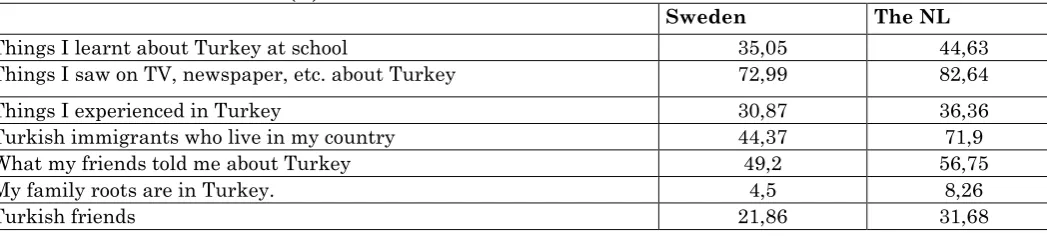
Table 3: Information sources (%)
Sweden The NL
Things I learnt about Turkey at school 35,05 44,63 Things I saw on TV, newspaper, etc. about Turkey 72,99 82,64 Things I experienced in Turkey 30,87 36,36 Turkish immigrants who live in my country 44,37 71,9 What my friends told me about Turkey 49,2 56,75
My family roots are in Turkey. 4,5 8,26
Turkish friends 21,86 31,68
It can be concluded from table 3 that Dutch people are more exposed to Turkish people and Turkey. They learnt more about Turkey on TV and at school than Swedes. Media, Turkish immigrants in the Netherlands and word-of-mouth (what friends told me) are the most important information sources. For Swedes, media, word-of-mouth and Turkish immigrants in Sweden are the most important information sources.
Recent protests that have been held
in Turkey since 28 May 2013 initiated by about 50 environmentalists opposing the replacement of the “Gezi Park” with a shopping mall in “Taksim”, at the heart of Istanbul. The protests
developed into riots and nationwide
demonstrations when the police attackedwith tear gas and water cannons. The Western press referred to the “Turkish Spring” at first, but the events in the Arab world two years ago do not reflect today‟s situation in Turkey. Taksim Square
is not Tahrir Square, Turkey is not an Arab country which has been ruled by a dictatorial one-man regime. Turkey has a working democracy, governments come and go via national elections, minority rights have been improved again by the government and Turkey is adopting the European Union norms [44].
Conclusion
facilities and activities, local transport services, hospitality and customer care, hygiene, sanitation and cleanliness, level of prices whereas Spain was
perceived to have better destination airport services and language communication [45].
Table 4: Mean scores of the variables – Sweden and the Netherlands (5-Point likert scale) Swedish / Dutch Respondents
Cognitive Image of Turkey Visitors (N=118 / 145) Nonvisitors (N=193 / 218) Average
1. Quality of life 2,66 / 3,01 2,79 / 2,83 2,73 / 2,92 2. Good economy 2,81 / 3,13 2,95 / 2,97 2,88 / 3,05 3. Rich people 2,64 / 2,64 2,72 / 2,58 2,68 / 2,61 4. Technology level 2,66 / 3,03 2,77 / 2,79 2,72 / 2,91 5. Good education 2,91 / 2,98 2,80 / 2,81 2,86 / 2,90 6. Modern country 2,77 / 2,91 2,89 / 274 2,83 / 2,83 Average 2,74 / 2,95 2,82 / 2,79 2,78 / 2,87
Affective Image of Turkey
1. Friendly people 3,63 / 3,97 3,51 / 3,56 3,57 / 3,77 2. Safe country 3,10 / 3,19 3,05 / 2,94 3,08 / 3,07 3. Trustworthy people 2,98 / 3,46 3,11 / 3,09 3,05 / 3,28 4. Pleasant people 3,60 / 3,81 3,42 / 3,44 3,51 / 3,63 5. Ideal to live 2,59 / 2,80 2,58 / 2,27 2,59 / 2,54 6. Ideal to visit 3,86 / 3,88 3,58 / 3,44 3,72 / 3,66 Average 3,29 / 3,52 3,21 / 3,12 3,25 / 3,32
Destination Beliefs of Turkey
1. Good scenery 4,02 / 4,19 3,77 / 3,77 3,90 / 3,98 2. Suitable accommodation 3,15 / 3,41 3,06 / 3,11 3,11 / 3,26 3. High quality attractions 3,59 / 3,82 3,58 / 3,37 3,59 / 3,60 4. Lots to do and see 3,94 / 4,12 3,70 / 3,73 3,82 / 3,93 5. Good value for the money 4,03 / 4,21 3,73 / 3,56 3,88 / 3,89 6. Good tourism destination 4,18 / 4,17 3,99 / 3,64 4,09 / 3,91 Average 3,82 / 3,99 3,64 / 3,53 3,73 / 3,76
Wilcoxon T test (p<0,05)
British holidaymakers visiting Turkey found that friendliness of local people, value for money, attitude of staff working in tourism, safety and security, local transport, natural environment, speed of check-in and check-out at the resort airports, quality of restaurants and bars, responsiveness to customer complaints, food, facilities on the beach are ranked as the most positive elements of the tourism industry in Turkey. As the number of visitors coming from main tourist generation countries (especially from OECD countries such as Germany, the UK and Benelux countries) with inclusive tours increased, the accommodation capacity and other tourist facilities in major tourist destinations within Turkey increased as well [46].
Bridging two continents, Turkey is a gateway to East and West. Turkey has different climatic regions ranging from temperate rainy climate of
the Black Sea Region to subtropical
Mediterranean in the south. Over the last two decades Turkey has made many investments on infra and super structure. This includes transport
infrastructure, modernization and construction of new airports. International airports in the main cities, resort destinations, the efficiency of services and advanced communication network system meet all the requirements of contemporary tourism [47].
Turkey‟s tourism image is quite positive in Northern Europe where people crave for sun shine and mild climate. Visitors hold more positive beliefs than non-visitors. Travel experience does not have much influence on cognitive beliefs; it has more influence on affective beliefs. Once people have visited Turkey, after experiencing Turkish hospitality and running from one surprise to another where traditional and modern go hand in hand, they keep coming and recommending Turkey to their acquaintances.
world average and the future prospects in the long term seem also to be very bright [48]. Turkey, as a developing country, adopted tourism not only as an alternative economic growth strategy, but also as a tool to create a favorable image on an international platform through exemplifying immediate implementation of an outward-oriented economic development policy [49].
Every year, almost 30 million international tourists go back to their country happily after experiencing destinations in Turkey. Especially Europeans, whose expectations are low before visiting Turkey, tend often to be impressed by the objects, artifacts and the people Turkey has on offer. Through word-of-mouth they recommend Turkey to their acquaintances spreading the country‟s positive image.
Acknowledgements
The first version of this paper was presented during International Academic Conference on Social Sciences in 2013 at Elit Hotel in Istanbul. The authors would like to express their gratitude to diverse actors: university students who filled in our questionnaire and faculty members who helped us conduct our research at Has Den Bosch University and Erasmus University in the Netherlands and Halmstad University in Sweden.
Funding
The correspondent author, Gulcin BILGIN TURNA is grateful for doctoral student support from The Scientific and Technological Research Council of Turkey (TUBITAK).
References
1. Hunt JD (1975) Image as a factor in tourism development, Journal of Travel Research, 13 (3):1-7. 2. Anderssen P, Colberg RT (1973) Multivariate Analysis in Travel Research: A Tool for Travel Package Design and Market Segmentation, Proceedings of the Fourth Annual Conference, Sun Valley, Idaho, Travel Research Association.
3. Crompton John L (1979) An assessment of the image of mexico as a vacation destination and the influence of geographical location upon that image, Journal of Travel Research, 17(4):18-23.
4. Gunn CA (1972) Vacations cape: Designing Tourist Regions, Austin: Bureau of Business Research, University of Texas.
5. Green PE, Rao VR (1971) Conjoint measurement for quantifying judgmental data, Journal of Marketing Research, 8:355-63.
6. Green PE (1974) On the design of choice experiments involving multifactor alternatives, Journal of Consumer Research, (1):61-68.
7. Berens G, Fombrum Charles J, Ponzi LJ, Trad NG, Nielsen K (2011) in the International Place Branding Yearbook Managing Reputational Risk, Go, Frank M., and Govers, R (eds.), Basingstoke, U.K: Palgrave MacMillan, p. 77-91.
8. Kaiser C, Friedrich K (2004) Migration Decisions, Living Environments and Adjustments to Changing Needs of Elderly Germans on Mallorca”, in A.M. Warnes, (ed.), Final Report ESF-Network, Sheffield. 9. Balkir C, Kirkulak B (2009) Turkey, the New Destination for International Retirement Migration, Migration and Mobility in Europe, Edward Elgar Publishing, MPG Books Group, UK.
10.World Tourism Organization (2012), UNWTO Tourism Highlights. Available online (cited on 10
March 2013):
http://dtxtq4w60xqpw.cloudfront.net/sites/all/files/d ocpdf/unwtohighlights12enlr_1.pdf
11.Republic of Turkey-Ministry of National Defense, 2012. Available online: (cited on 7th June 2013). http://www.msb.gov.tr/Birimler/GNPP/html/pdf/p1c 2.pdf
12.Go F, Govers (2011) Introduction to the International Place Branding Yearbook Managing Reputational Risk, Go, Frank M., and Govers, R (eds.), Basingstoke, U.K: Palgrave MacMillan. 13.Republic of Turkey-Ministry of Industry and Trade
(2010), Turkish Industrial Strategy Document (2011-2014), Towards EU Membership. Available online (cited on 7 June 2013): http://www.sanayi.gov.tr/Files/Documents/TurkiyeS anayiStratejisiIngilizce.pdf
14.Republic of Turkey-Prime Ministry Investment Support and Promotion Agency, Invest in Turkey, 2012. Available online (cited on 16June 2013):
http://www.invest.gov.tr/en-us/turkey/factsandfigures/pages/economy.aspx 15.Ogan CL (2001) Communication and Identity in the
Diaspora: Turkish Migrants in Amsterdam and Their Use of Media, Lexington Books, ISBN 0-7391-0269-9.
16.Vermeulen H, Penninx R (2000) Immigrant Integration: The Dutch Case”, Het Spinhuis, ISBN 90-5589-176-2.
17.Baumann G, Sunier (1995) T, Post-Migration Ethnicity: De-essential zing Cohesion, Commitments, and Comparison, Het Spinhuis, ISBN 90-5589-020-0.
19.Republic of Turkey-Ministry of Foreign Affairs, 2012. Available online (cited on 7th June 2013): http://www.mfa.gov.tr/relations-between-turkey-and-sweden.en.mfa
20.Orbaiz LV, Papadopoulos N (2003) Toward a model of consumer receptivity of foreign and domestic products, Journal of International Consumer Marketing, 15(3):101-126.
21.Beerli A, Martin JD (2004) Factors Influencing Destination Image, Annals of Tourism Research, vol. 32(3):657-681.
22.Echtner MC, JRB Ritchie (1993) The Measurement of Destination Image: An Empirical Assessment”, Journal of Travel Research, 31(4):2-13.
23.Heslop LA, Papadopoulos N (1993) But Who Knows Where or When: Reflections on the Images of Countries and Their Products” in Product-Country Images: Impactand Role in International Marketing, International Business Press, New York, pp. 39-75.
24.Statia E (2007) A comparative analysis of tourism destination image and product-country image, Ph.D. dissertation, Sprott school of business, Carleton university, Ottawa Ontario, Canada. 25.Gartner WC (1993) Image Formation Process, in
Communication and Channel Systems in Tourism Marketing, M. Uysal and D. R. Fesenmaier, Eds., New York: Haworth Press, pp. 191-215.
26.Baloglu S, Brinberg D (1997) Affective images of tourism destination, Journal of Travel Research, vol. 35(4)11-15.
27.Walmsley DJ, Jenkins JM (1993) Appraisive Images of Tourist Areas: Application of Personal Constructs, Australian Geographer, 24(2):1-13. 28.Ward LM, Russel JA (1981) The psychological
representation of molar physical environments, Journal of Experimental Psychology General, 110(2):121-152.
29.Coban S (2012) The Effects of the Image of Destination on Tourist Satisfaction and Loyalty: The Case of Cappadocia, European Journal of Social Sciences, 29(12):222-232.
30.Russell JA, Snodgrass J (1987) Emotion and Environment, D. Stockols and I. Altman (Eds.), Handbook of Environmental Psychology, p. 245-280. 31.Stepchenkova S, Morrison AM (2008) Russia‟s destination image among American pleasure travelers: Revisiting Echtner and Ritchie, Tourism Management, 548-560.
32.Ayyildiz H, Bilgin Turna G (2013) Perceived image of spain and germany as a tourist destination for dutch travelers, Journal of Economics, Business and Management, 1(1):85-89.
33.Otto JE, Ritchie JRB (1996) The Service Experience in Tourism”, Tourism Management, 17(3):165-174.
34.McIntosh AJ, Ciggs A (2005) An exploration of experiential nature of boutique accommodation, Journal of Travel Research, 44(1):74-81.
35.Ashworth G, Goodall B (1988) Marketing in the Tourism Industry: The Promotion of Destination Regions, London: Routledge.
36.Chon K (1990) The role of destination image in tourism: A review & discussion, Tourist Review, 13:2-9.
37.Mansfeld Y (1992) From motivations to actual travel, Annals of Tourism Research, 19:399-419. 38.Cooper C, Fletcher J, Gilbert D, Wanhill S (1993)
Tourism: Principles and Practice, London: Pitman Publishing.
39.Milman A, Pizam A (1995) The Role of Awareness and Familiarity with a Destination: The Central Florida Case”, Journal of Travel Research, 33(3):21-27.
40.Waryszak R (2000) An examination of the role of beneficial image in tourist destination selection, Journal of Travel Research, 39(1):37-44.
41.Bigne JE, Sanchez MI, Sanchez J (2001) Tourism image, evaluation variables and after purchase behaviour: Inter-Relationship, Tourism Management, 22:607-616.
42.Goodrich JN (1978) The relationship between preferences for and perceptions of vacation destinations, Journal of Travel Research, 17(2):8-13. 43.Woodside A, Lysonski S (1989) A General Model of Traveler Destination Choice, Journal of Travel Research, 27:8-14.
44.Euronews 3 June 2013. Available online (retrieved
on 3 June
2013):http://www.euronews.com/2013/06/03/is-this- the-turkish-spring-the-view-from-the-euronews-istanbul-correspondent-/
45.Kozak M (2002) Measuring comparative destination performance: A study in Spain and Turkey, Journal of Travel and Tourism Marketing, 13(3):83-110. 46.Kozak M, Rimmington M (1999) Measuring Tourist
Destination Competitiveness: Conceptual Considerations and Empirical Findings”, International Journal of Hospitality Management, 18:273-283.
47.TURSAB, Association of Turkish Travel Agencies, 2010. Available online (cited on 17 June 2013): http://www.tursab.org.tr/en/statistics/development- of-turkish-tourism-in-brief/turkeys-tourism-potential-and-resources_1079.html
48.TURSAB, Association of Turkish Travel Agencies, 2010. Available online (cited on 17 June 2013): http://www.tursab.org.tr/en/statistics/development-
of-turkish-tourism-in-brief/turkish-tourism-industry-today_1075.html
developing countries: The case of turkey,
International Journal of Contemporary Hospitality Management, 13(7):352-359.
Biographies
Hasan Ayyildiz was born in Trabzon, Turkey in 1968. He received his bachelor‟s degree in the Faculty of Political Science from Ankara University, Ankara, Turkey in 1991; his master‟s and PhD degree in Marketing from Istanbul University, Istanbul, Turkey in 2000. He worked as a research assistant from 1991 to 2003 in the Faculty of Forestry at Karadeniz Technical University in Trabzon, Turkey. Currently, he serves as an Associate Professor of Faculty of Economics and Administrative Sciences, Department of Business Administration in Karadeniz Technical University. He has many papers published in both national and international conferences. He has published 2 books and more than 35 journal papers.