International Journal of Advances in Management and Economics
Available online at:
www.managementjournal.info
RESEARCH ARTICLE
India-Venezuela: Analysis of Demonetization Measures
Alberto Jose Hurtado Briceno*, Sadcidi Zerpa de Hurtado
Department of Economics and Economic Studies Group on Asia (ESGA), University of the Andes, Mérida, Venezuela.
*Corresponding Author: Email:[email protected]
Abstract: In 2016, the governments of India and Venezuela decided to demonetize the highest denomination banknotes in their economies. Both decisions involved the loss of millions of banknotes and funds to reduce the risks faced by the two countries in the face of the generalization of illegal economic activities, but, as a radical measure, demonetization conditioned the decisions of economic agents. This article aims to perform a comparative analysis of the demonetization measures implemented in India and Venezuela. For this purpose, the origin of the measure in both countries, the objectives set by the government and the results obtained were compared. The analysis made it possible to identify the differences and similarities of this type of government intervention.
Keywords: comparative analysis, demonetization, economic policy, monetary policy, money.
Article Received: 11 Feb. 2019 Revised: 19 Feb. 2019 Accepted: 28 Feb. 2019
Introduction
Demonetization is a monetary policy measure where the circulation of all or part of the pieces of the current monetary cone in the economy is declared illegal. In other words, the legal character of one or more banknotes that make up the money in circulation is eliminated. Governmental action that is used to reduce the problems generated by the counterfeiting of money, the smuggling of coins and banknotes, as well as the movement of funds obtained from illegal economic activities.
With short-term results, demonetization is used to legalize funds from the underground economy as well as to identify the size of the formal sector of the economy. It is an economic policy decision that requires a joint effort between government authorities and the central bank to guarantee the deposit and exchange of demonetized money, without harming the purchasing power of its owners [1].
The government of India launched on
November 8, 2016, the process of
demonetization of the 500 and 1,000 rupee notes, a strategy to reduce the impact of illegal activities on the economy, eradicate black money and minimize corruption. In a context of reduced banking inclusion, high
financial illiteracy [2], and high dependence on cash transactions [3], this demonetization was presented and applied as a radical policy to mitigate the parallel economy and redefine the formal economy [4-6]. A few days later, on December 11, 2016, the Venezuelan government announced the circulation of the 100 bolivares note, with the purpose of achieving economic, monetary and price stability, eliminating the smuggling of banknotes, assuring the population the enjoyment of their economic rights and access to merchandise, achieving a higher level of efficiency and quality in government management, and eliminating the laundering of bolivares.
This was due to limitations on access to
banking services, difficulties in the
development of alternative payment systems to cash, recurrent changes in the planning and logistics of the measure, as well as the high dependence of different sectors of the economy on the use of coins and banknotes for their transactions.
In this sense, the article aims to perform a comparative analysis of the demonetization measures implemented by the governments of India and Venezuela in 2016. For this, the comparative method is presented. Next, the origin of the measure in both countries is compared, the objectives proposed by the government as well as the results obtained and, finally, the differences and similarities of this type of government intervention are identified.
The Comparative Method
As part of the daily dynamics of every society, the comparison arises recurrently as a way of
recognizing the presence of events,
identifying the impacts that they have generated and facilitating the decision making that leads to the conservation or abandonment of certain behavior. According to Rosato and Boivin [7], it is one of the features of scientific activity that is most present in the daily life of every population, especially when it is used to organize knowledge and facilitate interpersonal relationships.
For their part, Piovani and Krawczyk [8] consider that the practice of comparison has represented, and continues to represent, an indispensable instrument when responding to the problems of natural and social sciences. Within the social sciences, the comparative method is proposed as a process of interactive construction that groups
theoretical arguments with empirical
evidence to explain reality [9].
For Fideli [10] this method implies the study of two or several properties enunciated in two or more objects, for a precise moment or in a lapse of time. In the same way it has been defined as the description and explanation of the conditions and results obtained, similar and different, between societies, nations and cultures [11].
Also as the methodology that allows analyzing the connections that have the facts
occurred during the same time,
simultaneously, or as events of a time in relation to events of other times, linking them as antecedents and causes or effects and consequences [12]. In practical terms, the implementation of comparative studies is
not limited to a specific strategy;
investigations based on the secondary analysis of statistical data are generally more frequent and receive greater dissemination; there are also comparative analyzes based on primary data that require previous fieldwork, as well as the systematization and analysis of the data; and there are even comparative
research resulting from qualitative
methodologies such as life histories or case studies [8].
Recognizing this multiplicity of approaches, Gómez Diaz and De León [12] argue that all comparative analysis has a starting point and a logical sequence, including the following steps: 1) Configuration of a theoretical structure that supports research, obtained from previous studies and works on the object of study, that allows defining the properties and characteristics of the cases or phenomena to be compared, and that integrates, on the one hand, the defining characteristics of the object or phenomenon, and on the other hand, the empirical referents that can be highlighted; 2) Justification of the resulting cases that are effectively comparable and relevant, taking into account as areas of interest the object, context, time and space; and 3) Carrying out the analysis of the cases through the comparison of the selected variables and the identification of differences or similarities.
Taking as reference the guidelines presented here for the development of a comparative
analysis, the comparison of the
demonetization measures implemented by the governments of India and Venezuela is made below. To this end, demonetization is considered to be a monetary policy measure in which the circulation of all or part of the pieces of the current monetary cone in an economy is declared illegal.
commitment to replace demonetized pieces with new coins and notes.
The demonetization measures implemented by the governments of India and Venezuela during the last quarter of 2016 were monetary policy decisions through which the legal tender status of the 500 and 1,000 rupee notes, as well as the 100 bolivares note, was removed as part of a government strategy to fight the underground economy.
To this end, complementary policies were implemented, execution periods were defined and guidelines were established for the circulation of the new coins and notes. In this way, both governmental decisions result in effectively comparable cases taking into account the following variables: 1) Origin of the measure, 2) Objectives and 3) Results.
Comparative Analysis of
Demonetization Measures
Next, a comparative analysis of both demonetization measures by comparing the selected variables and identifying differences and similarities.
Origin
The government of India decreed the release of the 500 and 1,000 rupee notes on November 8, 2016, while the government of Venezuela announced the demonetization of the 100 bolivares notes issued by the Central Bank of Venezuela (BCV, by its initials in Spanish) on December 11, 2016, there being a lapse of one month and three days of difference between the two decisions. Both measures were announced in public speeches by the highest representative of the executive power of the two countries, and the population was taken suddenly.
The governmental decisions implemented in this manner correspond to measures of monetary shock, which seek to facilitate the achievement of their objectives by preventing economic agents from having time to modify their behavior and adjust their expectations.
As part of the demonetization measure, the governments of the two countries announced complementary policies that included: 1) Government commitment to put new banknotes into circulation at the current monetary cone, in the case of India, immediately the 500 and 2,000 rupee banknotes, and in Venezuela, from December
15 through the incorporation of five new banknotes: 500, 1,000, 2,000, 5,000, 10,000 and 20,000 bolívares; 2).
Authorization for the population to deposit the demonetized banknotes, for India, in banks and post offices from November 10 to December 30 with no limit to the amounts deposited, for Venezuela, in banks owned by the public sector during the 72 hours after the measure was announced, a decision that was later incorporated into the offices of private banks, reaching a limited number of bank lockers and generating restrictions on the amounts deposited by customers; 3) Authorization for the exchange of the demonetized bills for the pieces of the new monetary cone, in India until November 24 by previous identification of the client and maximum 4,000 rupees in authorized bank and post offices, after December 30 in the offices of the Reserve Bank of India (RBI), in Venezuela, through the BCV ticket offices during the 10 banking days after the period established to deposit them; and 4) No restrictions on the use of cashless payment systems, i.e. checks, credit and debit cards, electronic purses and electronic fund transfers.
On the other hand, there were
complementary policies exclusive to the Government of India: a) Closure and limit to cash withdrawal through ATMs, on 9 and 10 November the ATM network did not provide service and from 11 November began to operate with a limit to withdrawal of Rs. 2,000 per card per day; and b) Restrictions on withdrawal of funds by customers in the banking system, initially of Rs. 10,000 per day and Rs. 20,000 per week, modified for 25 November to Rs. 24,000 per week. While the government of Venezuela decreed the closure of the land, air and maritime borders of the country during the period granted for the exit of circulation of the 100 bolívares bill.
Objectives
smuggling of banknotes, the economic war, the exchange distortion and the induced inflation that sectors of the population were using to destabilize the Venezuelan financial system and undermine the quality of life of the inhabitants of this country; c).
Ensure that citizens enjoy economic rights and free access to goods and services, as well as the progressive satisfaction of individual and collective needs; d) Achieve greater efficiency and quality in government management aimed at restructuring the Venezuelan economy; and e) Eliminate the laundering of bolívares for illegal activities from the border with Colombia [14].
Authorities in both countries agree that demonetization can be used to: confront and eliminate the smuggling of banknotes, eliminate money laundering, and eliminate the use of illegal money from underground economic activities, smuggling of goods, drug
trafficking, and corruption. For the
government of India, it is a measure that allows terrorism to be tackled by eliminating the sources of financing for this activity. The
Venezuelan authorities proposed
demonetization as a measure capable of facilitating the achievement of economic, monetary and price stability; assuring the population the enjoyment of economic rights
and access to goods and services, as well as the progressive satisfaction of the individual and collective needs of Venezuelans; and providing greater efficiency and quality in government management in the process of restructuring the Venezuelan economy. Results
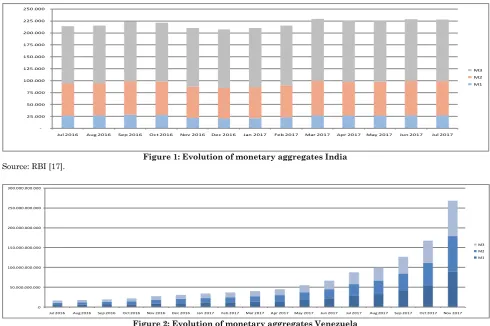
Regarding the results reached, the analysis of macroeconomic variables allows concluding that in both countries the measure generated a liquidity shock that altered the evolution of the economy. Thus, the monetary aggregates were modified differently for both countries. On the one hand, M1, M2 and M3 decreased in India during the months of November and December, recovering the previous level and its stability as of January 2017 (see Figure 1), due to the effort made by the RBI. On the other hand, the growth rate of Venezuela's monetary aggregates was reduced from December 2016 to February 2017, and a phase of expansion began that continues to the present (see Figure 2).
The continued growth of monetary
aggregates in Venezuela, despite
demonetization, is due to the government's interest in encouraging productive activity through expansive fiscal policy: subsidies, transfers and social missions [15, 16].
-25.000 50.000 75.000 100.000 125.000 150.000 175.000 200.000 225.000 250.000
Jul 2016 Aug 2016 Sep 2016 Oct 2016 Nov 2016 Dec 2016 Jan 2017 Feb 2017 Mar 2017 Apr 2017 May 2017 Jun 2017 Jul 2017 M3 M2 M1
Figure 1: Evolution of monetary aggregates India
Source: RBI [17].
0 50.000.000.000 100.000.000.000 150.000.000.000 200.000.000.000 250.000.000.000 300.000.000.000
Jul 2016 Aug 2016 Sep 2016 Oct 2016 Nov 2016 Dec 2016 Jan 2017 Feb 2017 Mar 2017 Apr 2017 May 2017 Jun 2017 Jul 2017 Aug 2017 Sep 2017 Oct 2017 Nov 2017 M3 M2 M1
Figure 2: Evolution of monetary aggregates Venezuela
With regard to the population's demand for deposits and for coins and banknotes, different results were obtained. In India,
from the announcement of the
demonetization until May 2017, the level of cash in the hands of the public was reduced and the demand for deposits by the population increased, but from April 2017
this result changed, making cash again the main means of payment used by the Indians (see Figure 3). While in Venezuela, as can be seen in Figure 4, demonetization deepened the gap between funds deposited in banking system institutions and resources held in coins and notes, with the demand for deposits being greater than the demand for cash.
-2.000 4.000 6.000 8.000 10.000 12.000 14.000 16.000 18.000
Jul 2016 Aug 2016 Sep 2016 Oct 2016 Nov 2016 Dec 2016 Jan 2017 Feb 2017 Mar 2017 Apr 2017 May 2017 Jun 2017 Jul 2017
Currency with the public Demand Deposits
Figure 3: Evolution of Currency with the Public and Demand Deposits India
Source: RBI [17].
0 10.000.000.000 20.000.000.000 30.000.000.000 40.000.000.000 50.000.000.000 60.000.000.000 70.000.000.000 80.000.000.000
Jul 2016 Aug 2016 Sep 2016 Oct 2016Nov 2016 Dec 2016 Jan 2017 Feb 2017 Mar 2017 Apr 2017 May 2017 Jun 2017 Jul 2017 Aug 2017 Sep 2017 Oct 2017Nov 2017
Currency with the Public
Demand Deposits
Figure 4: Evolution of Currency with the Public and Demand Deposits Venezuela
Source: BCV [18].
As for the evolution of interest rates and the
level of savings in the economy,
demonetization produced dissimilar results due to the difference in the complementary policies implemented by governments. The government of India with a low interest rate policy during the demonetization execution period together with the increase in funds received by banks through customer deposits, boosted credit activity, increased credits granted by the RBI and the banking system.
In Venezuela, disincentives to savings deepened due to the fact that demonetization further weakened the interest rates received by bank clients for their savings and fixed-term deposits, at the same time that it generated an abrupt increase in the interest
rate charged by banks for their loans. According to Hurtado and Zerpa [6], passive interest rates in the Venezuelan money market, that is, what people receive for depositing their resources in banks, have been aligned with a downward bias since December 2016 as a consequence of the
management of the BCV and the
demonetization measure of the 100 note.
2017 for savings deposits that ended up paying, on average between January and November, 12.55% monthly return to Venezuelan savers; while the interest rate for time deposits showed slight increases until reaching an average monthly balance of 14.67% in the same period.
These results account for a strategy of disincentive to savings and stimulus to consumption. The interest rate on loans granted by banks grew 3.63% between November and December 2016, as a consequence of the high demand for money evident during the demonetization, which made the financing of economic agents more expensive.
This situation was reversed during 2017, when the monthly rate charged by banks averaged 21.49% between January and November. This result was due to expectations about the new pieces of the monetary cone, their incorporation into the economy and the frequent extensions to the deadline for the circulation of the 100 note, all of which reduced the pressure on the demand for money and reduced the cost of borrowing.
The demonetization in both countries increased the use of cashless payment
systems. Both in India and in Venezuela, payments by electronic transfers took a predominant role in facilitating commercial exchange during the period of execution of the measure, as well as the use of credit and debit cards. In India, mobile banking and prepaid services had a marginal impact and in Venezuela, despite the implementation of alternative systems, their incorporation was restricted by the conditions of the country's telecommunications system [1].
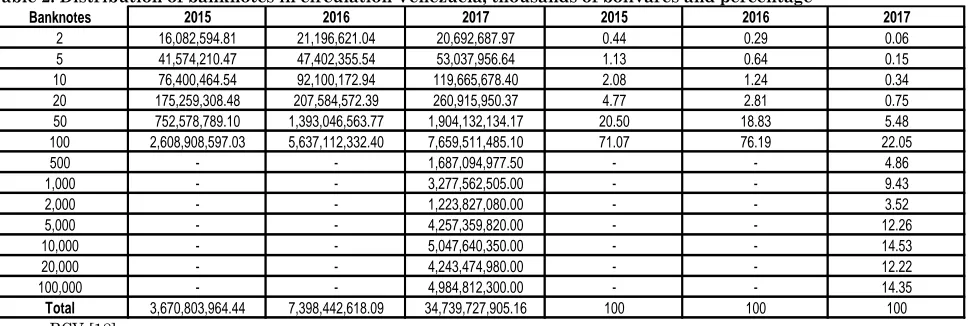
The distribution of banknotes in circulation was modified in both economies, with different results. In India, the new higher denomination 1,000 rupees became the most widely available unit of currency (see Table 1), which allowed a quick substitution of banknotes declared illegal and reduced transaction costs for the population, but increased the vulnerability of the economy to underground economic activities where this type of banknotes has a high demand.
And in Venezuela, despite the
demonetization, the 100 note continued to be used in the economy, increasing its issuance and rising its role within the cash in circulation (see Table 2). This allows us to infer that the measure of the Venezuelan
government was an incomplete
demonetization.
Table 1: Distribution of banknotes in circulation India, billions of rupees and percentage
Source: RBI [19]
Table 2: Distribution of banknotes in circulation Venezuela, thousands of bolívares and percentage
Banknotes 2015 2016 2017 2015 2016 2017
2 16,082,594.81 21,196,621.04 20,692,687.97 0.44 0.29 0.06 5 41,574,210.47 47,402,355.54 53,037,956.64 1.13 0.64 0.15 10 76,400,464.54 92,100,172.94 119,665,678.40 2.08 1.24 0.34 20 175,259,308.48 207,584,572.39 260,915,950.37 4.77 2.81 0.75 50 752,578,789.10 1,393,046,563.77 1,904,132,134.17 20.50 18.83 5.48 100 2,608,908,597.03 5,637,112,332.40 7,659,511,485.10 71.07 76.19 22.05
500 - - 1,687,094,977.50 - - 4.86
1,000 - - 3,277,562,505.00 - - 9.43
2,000 - - 1,223,827,080.00 - - 3.52
5,000 - - 4,257,359,820.00 - - 12.26
10,000 - - 5,047,640,350.00 - - 14.53
20,000 - - 4,243,474,980.00 - - 12.22
100,000 - - 4,984,812,300.00 - - 14.35
Total 3,670,803,964.44 7,398,442,618.09 34,739,727,905.16 100 100 100
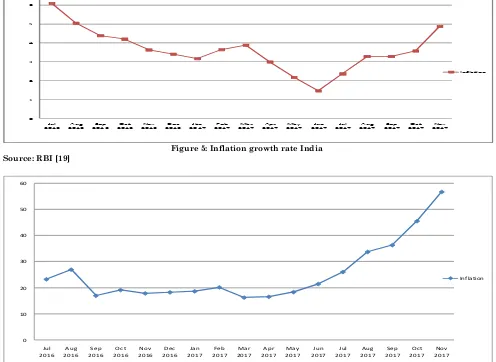
The demonetization had different effects on the evolution of the price level in both economies. Despite the good performance of the RBI's anti-inflation policy, the outflow of Rs. 500 and Rs. 1,000 banknotes increased inflation in India in the first quarter of 2017 (see Figure 5). While in Venezuela, the
measure that removed the 100 bolívares bill from circulation slowed the growth rate of Venezuelan inflation (see Figure 6), it did not prevent prices from continuing to grow in the economy or facilitate the strengthening of the
local currency.
0 1 2 3 4 5 6 7
Jul 2016
Aug 2016
Sep 2016
Oct 2016
Nov 2016
Dec 2016
Jan 2017
Feb 2017
Mar 2017
Apr 2017
May 2017
Jun 2017
Jul 2017
Aug 2017
Sep 2017
Oct 2017
Nov 2017
Inflation
Figure 5: Inflation growth rate India Source: RBI [19]
0 10 20 30 40 50 60
Jul 2016
Aug 2016
Sep 2016
Oct 2016
Nov 2016
Dec 2016
Jan 2017
Feb 2017
Mar 2017
Apr 2017
May 2017
Jun 2017
Jul 2017
Aug 2017
Sep 2017
Oct 2017
Nov 2017
Inflation
Figure 6: Inflation growth rate Venezuela Source: National Assembly of Venezuela, own estimates [20]
And with respect to the impact of the
measure on productive activity, the
demonetization negatively affected the gross domestic product of both countries. Thus, the speed of India's economic growth was reduced from 7% in the last quarter of 2016 to 6.1% in the first quarter of 2017. The Indian authorities recognize the short-term negative macroeconomic impact of demonetization, mainly because of its effects on various sectors between November and December 2016, which moderated in January 2017 and began to dissipate from February 2017 [17].
Highlighting the contraction in the general demand for goods as a consequence of the cash shortage, and the fall in production due to the difficulty in canceling wages in the
unbanked informal sector. While in
Venezuela productive activity fell even more in 2016, due to the impact of demonetization on the economy and the deepening of the imbalances created by erroneous economic policies implemented in previous years.
The effects of the demonetization, mainly those generated by the successive extensions to the circulation of the demonetized banknote, the delay in the incorporation of the new pieces of the monetary cone, the delay in the adaptation of the banking
system's technology to the highest
denomination notes, and the validity of incentives for the demand for cash in parallel markets, had an impact on the Venezuelan economy, which contracted by 14% during 2017 [21], thus ending in recession for the fourth consecutive year.
Similarities and Differences of
Desmonetization Measures
In the context of the origin variable, the following are recognized as similarities in the demonetization measures carried out in India and Venezuela: 1) Implemented during the last quarter of 2016, 2) Presented by the highest representative of the executive branch of both countries, 3) Measures of monetary shock that took the population by
surprise, and 4). In both cases
complementary policies were implemented to allow the development of the measure,
including: government commitment to put new banknotes into circulation, authorization and deadline for the deposit and exchange of demonetized banknotes, as well as freedom for the use of alternative payment systems to cash. On the other hand, there are notable differences between the two measures: 1) The period given to the population to deposit and exchange bills without liberating power, only 72 hours in Venezuela and from November 10 to December 30 in India, which demonstrates the interest of the Venezuelan authorities to obtain immediate results, and the intention of the Indian authorities to minimize the impact of the measure on the country's unbanked population; 2).
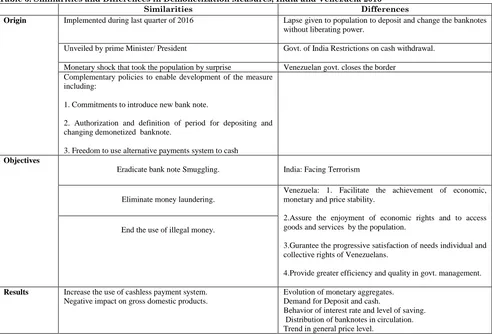
The Indian government's restrictions on cash withdrawals, both at bank offices and at ATMs, with the intention of reducing the demand for banking services that would prevent it from meeting the high demand for deposits; and 3) The closure of the border by the Venezuelan government to minimize the impact of smuggling and money laundering on the measure (see Table 3).
Table 3: Similarities and Differences in Demonetization Measures, India and Venezuela 2016 Similarities Differences
Origin Implemented during last quarter of 2016 Lapse given to population to deposit and change the banknotes without liberating power.
Unveiled by prime Minister/ President Govt. of India Restrictions on cash withdrawal.
Monetary shock that took the population by surprise Venezuelan govt. closes the border Complementary policies to enable development of the measure
including:
1. Commitments to introduce new bank note.
2. Authorization and definition of period for depositing and changing demonetized banknote.
3. Freedom to use alternative payments system to cash
Objectives
Eradicate bank note Smuggling. India: Facing Terrorism
Eliminate money laundering.
Venezuela: 1. Facilitate the achievement of economic, monetary and price stability.
2.Assure the enjoyment of economic rights and to access goods and services by the population.
3.Gurantee the progressive satisfaction of needs individual and collective rights of Venezuelans.
4.Provide greater efficiency and quality in govt. management.
End the use of illegal money.
Results Increase the use of cashless payment system. Negative impact on gross domestic products.
Evolution of monetary aggregates. Demand for Deposit and cash.
Behavior of interest rate and level of saving. Distribution of banknotes in circulation. Trend in general price level.
Source: Prepared by the authors
There are similarities in the government's objectives of eradicating the smuggling of banknotes, eliminating money laundering
and ending the use of illegal money. And there are marked differences in the goals set
government's perception of the scope of the measure. The government of India considers demonetization as a way to confront terrorism, limiting the sources of illegal money used to finance these activities. While the Venezuelan government, with a broader perception of the impact of its intervention in
the monetary system, proposed for
demonetization macroeconomic and
microeconomic goals of the type: guarantee the enjoyment of economic rights and access to goods and services of all the population, the satisfaction of individual and collective needs, and greater efficiency and quality of government management. This breadth of objectives, in addition to differentiating both experiences, leaves room for inefficient use of government resources and distances the population from solving its main problems. And both countries have similar results in the impact demonetization had on the use of cashless payment systems and the negative effect it had on gross domestic product.
While there are differences in the results obtained with respect to the evolution of monetary aggregates, the demand for deposits and cash by the population, the behavior of interest rates and the level of savings, the distribution of banknotes in circulation, and the trend of the general price level in both economies.
Conclusions
In 2016 the governments of India and Venezuela decided to demonetize the 500 and 1,000 rupee notes, as well as the 100 bolivares note, stripping the pieces in circulation of these denominations of their status as legal tender. Both decisions implied the loss of millions of bills and funds to reduce the risks faced by both countries in
the face of the generalization of underground economy activities. The demonetization conditioned the decisions of economic agents in both India and Venezuela due to limitations on access to banking services, difficulties in developing alternative payment systems to cash, recurrent modifications in the planning and logistics of the measure, as well as the high dependence of different sectors of the economy on the use of coins and banknotes for their transactions. After analyzing the origin of both measures, in addition to their objectives and results, it is concluded that demonetizations in India and Venezuela are similar in: 1) Date of implementation, 2) Presentation by the country's highest authority, 3) Monetary shock, 4) Use of complementary policies, 5)
Government objectives
Sadcidi Zerpa de
Hurtado
of eradicate the smuggling of banknotes, eliminate money laundering and end the use of illegal money, and 6) Positive impact on the use of cashless payment systems and negative effect on gross domestic product. While they differ in: 1).The time given to the population to deposit and exchange banknotes without liberating
power, 2) The Indian government's
restrictions on the withdrawal of cash, 3) The closing of the border by the Venezuelan government, 4) The objectives of confronting terrorism for the Indian government, and
guaranteeing macroeconomic and
microeconomic goals in the case of the Venezuelan government; and 5) The effect on monetary aggregates, demand for deposits and cash, interest rate, level of savings, distribution of banknotes in circulation and evolution of the general price level.
References
1. Hurtado, S Zerpa (2019) India-Venezuela:
Análisis comparativo de las medidas de desmonetización (Mérida: ULA, GEEA,).
Retrieved from
http://www.saber.ula.ve/handle/123456789/ 45688
2. G Rani (2016) Effects of demonetization on
retail outlets, International Journal of Applied Research, 2(12):400-401.
3. N Gajjar (2016) Black money in India:
Present Status and Future Challenges and Demonetization, International Journal of
Advance Research in Computer Science and Management Studies, 4(12):47-54.
4. Dash A (2017) study on socio economic
effect of demonetization in India,
International Journal of Management and Applied Science, 3(3):13-15.
5. M Kaur (2017) Demonetization: Impact on
cashless payment system, 6th International
Conference on Recent Trends in
6. Hurtado, S Zerpa (2018) India: Results of
demonetization 2016, Humania del Sur,
13(25):169-186. Retrieved from
http://erevistas.saber.ula.ve/index.php/hum aniadelsur/article/view/14139/21921925233
7. Rosato, M Boivin (2013) Los tipos de
análisis: etnográfico, comparativo y
procesual. Diferencias, semejanzas y cruces (Buenos Aires: UBA). Retrieved from
https://www.aacademica.org/000-063/227.pdf
8. J Piovani, N Krawczyk (2017) Los estudios
comparativos: algunas notas históricas, epistemológicas y metodológicas, Educação
& Realidade, 42(3):821-840. doi:
10.1590/2175-623667609
9. J Maxwell (1996) Qualitative research
design. An interactive Approach (Londres: Sage publications).
10.R Fideli (1998) La comparazione (Milán:
Agneli).
11.N Smelser (2003) On comparative analysis,
interdisciplinarity and internationalization in Sociology, International Sociology, 4(18):643-657.
12.Gómez Díaz, E De León (2014) Método
comparativo, in K. Sáenz (Ed.), Métodos y
técnicas cualitativas y cuantitativas
aplicables a la investigación en ciencias sociales (México: Tirant Humanidades México) 223-251.
13.Government of India (2016) Gazette
Notification N° 2652, November 8.
Retrieved from
http://164.100.60.243/WriteReadData/2016/ 172521.pdf
14.Bolivarian Republic of Venezuela (2016)
Gaceta Oficial Extraordinaria N° 6.275, December 11.
15.Hurtado, S. Zerpa (2016) Misiones sociales:
Contextualización de su Origen, concepto y evolución, in A. Hurtado (Coord.), Misión Alimentación: Origen, evolución e impacto, 1 (Mérida: ULA-CDCHTA) 17-52. Retrieved from
http://www.saber.ula.ve/handle/123456789/ 43556
16.Hurtado, S Zerpa (2016) Misiones sociales
en Venezuela: concepto y contextualización,
Sapienza Organizacional, 3(6):37-64.
Retrieved from
http://erevistas.saber.ula.ve/index.php/sapi enza/article/view/7824/7746
17.RBI, Annual Report (2017) August.
Retrieved from
https://www.rbi.org.in/scripts/AnnualRepor tPublications.aspx?Id=1208#T1
18.BCV, Estadísticas del sector monetario y
del sector financiero, several years.
Retrieved from
http://www.bcv.org.ve/estadisticas/billetes-y-monedas
19.RBI, Database on Indian Economy, several
years. Retrieved from
https://dbie.rbi.org.in/DBIE/dbie.rbi?site=ho me
20.National Assembly of Venezuela, Índice de
Precios al Consumidor de la Asamblea Nacional, several years. Retrieved from http://www.asambleanacional.gob.ve/docum entos_archivos/inpcan-199.pdf
21.IMF (2018) Country Data: Venezuela.
Retrieved from
![Figure 4: Evolution of Currency with the Public and Demand Deposits Venezuela Source: BCV [18]](https://thumb-us.123doks.com/thumbv2/123dok_us/7837542.2090443/5.595.51.542.157.535/figure-evolution-currency-public-demand-deposits-venezuela-source.webp)