PHOTOCATALYTIC ACTIVITY OF CdS-ZnS COMPOSITE AND
THEIR COMPONENTS
Taruna Dangi,
[a]Basant Menariya,
[a]Rakshit Ameta
[a]and Suresh C. Ameta
[a]Keywords: ZnS; CdS; composite; photocatalytic activity; Evan’s blue.
A composite of CdS and ZnS was prepared by simple solid state mechanochemical method and it was used for photocatalytic degradation of Evan’s blue. The photocatalytic efficiency of CdS-ZnS composite was compared with pure CdS and ZnS. The effect of various parameters such as pH, the concentration of dye, amount of semiconductor and light intensity was observed. The optimum conditions obtained for this degradation were: Evan’s blue = 1.3 × 10‾5 M, pH = 5.5, amount of composite = 0.12 g and light intensity = 50.0 mWcm‾2. It was found that coupled chalcogenide CdS - ZnS shows better photocatalytic activity as compared with pure CdS and ZnS for the degradation of Evan’s blue in the presence of visible light.
* Corresponding Authors
E-Mail: [email protected]
[a] Department of Chemistry, PAHER University, UDAIPUR – 313003 (Raj.) INDIA
Introduction
Industrial activities have introduced large quantities of chemicals in the environment causing potential harm to the ecosystem. Among pollutants, dyes are one of the major sources of environmental contamination. As the international environmental standards are becoming more stringent, many research studies have focused their attention on the treatment of waste water. Although there are various techniques available to remove or degrade these pollutants like adsorption, air stripping, biological methods, various oxidation processes, etc., each one has its advantage and limitations. Recently, photocatalytic treatment of waste water has gained much attention, because it provides an eco-friendly pathway for removal of such pollutants.
Beydoun et al.1 reported that photocatalysis (an advanced oxidation process) provides a highly improved, eco-friendly, efficient, sustainable, and affordable solution to wastewater treatment to get fresh water demands of the future generation. Gaya and Abdullah2 reported that heterogeneous photocatalysis via various metal oxides was found to be an effective way which adequately addresses many of the water quality issues. ZnS is an important II-VI semiconductor with wide band gap 3.7 eV. The wide band gap semiconductors are ideal as photocatalysts due to rapid electron-hole pair generation by photo-excitation3,4. ZnS also attracted attention in fields of photoconductors, photocatalysts, optical sensors and electroluminescent materials5
Patil et al.6 prepared ZnS-graphene composite by microwave irradiation method. The composite is used as a photocatalyst in degradation of methylene blue with irradiation by 663 nm light. Under the same conditions, the photocatalytic activity of the pure ZnS was also studied. The ZnS-GNS composite was found to enhance the rate of photodegradation of methylene blue as compared to ZnS alone.
Degradation of dyes is a popular method to check the photocatalytic activity of different type of photocatalyst. Sharma et al.7 reported that Bromophenol blue, Crystal violet and Reactive red were successfully photo-reduced using thioglycerol capped and uncapped ZnS nanoparticles after 3.0 h of irradiation. Since the photocatalytic activity depends on the generation of electron- hole pairs and the existence of different phases, they have tried to correlate the optical and morphological studies with these results to understand the phenomenon of photocatalytic activity at the nanoscale. Though the Ultra-violet irradiation can efficiently degrade the dyes, naturally abundant solar radiation is also very useful in the mineralization of dyes.
Eyasu et al.8 synthesized the chromium doped ZnS nanoparticles, with (0.05, 0.1, 0.2 and 0.3 mol % of Cr) using incipient wetness impregnation method. As-synthesized Cr-ZnS composite was used in dye degradation of Methyl orange (MO) was studied under UV and visible radiation and effect of parameters such as concentration, pH, and initial dye concentration were studied on the photocatalytic degradation of MO dye. It was observed that photocatalytic degradation decreased with increasing dye initial concentration.
CdS is a well-known photocatalyst that has been used as a visible-light photocatalyst. CdS has a narrow direct band gap (2.4 eV), so it is also used as a photosensitizer of various wide band gap semiconductor photoanodes in photoelectrochemical cell9-11. Ahluwalia et al.12 synthesized Se-ZnS nanocomposites of different wt% were impregnated onto ZnS by calcination at 200°C. The specific surface area notably increased from 54 m2 g─1 (ZnS) to 75 m2 g─1 with different wt% of Se loading. The band edge absorption at 330 nm (3.77 eV) of bare ZnS significantly red-shifted to 357 nm (3.30 eV), after 1 wt% Se loading. 1 wt% Se-ZnSNCs exhibited the highest photodegradation efficiency (95%) of Methyl orange dye as compared to ZnS (55%) under 160 min UV light irradiation.
estimated using UV-visible absorption spectra as 4.22 and 2.64 eV, respectively. Photocatalytic degradation of Methylene blue was carried out using mixtures of ZnS and CdS nanoparticles under a 500W halogen lamp of visible light irradiation. The study of the variation in the composite of ZnS-CdS, a composition of 1:4 (by weight) was found to be very efficient in degradation of Methylene blue. Higher degradation efficiency and reaction rate were achieved by increasing the amount of ZnS-CdS composite and initial pH of the solution.
Urchin-like ZnS/CdS semiconductor composites were successfully prepared by combining solvothermal route with homogeneous precipitation process. The optical properties and photocatalytic activities of the as-prepared ZnS/CdS composites toward such organic dyes as Methyl orange, Pyronine B, Rhodamine B and Methylene blue were separately investigated. It was found that the ZnS/CdS composites exhibit excellent photocatalytic degradation activity for the above mentioned dyes under UV irradiation, as compared to corresponding pure ZnS and commercial anatase TiO2 (P-25). This enhanced activity may be related to the modification of CdS nanoparticles on the surfaces of thorns of ZnS urchins and a tentative mechanism for the enhanced photocatalytic degradation activities of the ZnS/CdS composite catalyst was proposed14.
Ivetic et al.15 synthesized ternary and coupled binary zinc oxide/tin oxide nanocrystalline powders by a simple solid-state mechanochemical method. The degradation of alprazolam, a short-acting anxiolytic of the benzodiazepine class of psychoactive drugs by ternary (Zn2SnO4 and ZnSnO3) and coupled binary (ZnO/SnO2) oxides under UV irradiation were observed and compared with pure ZnO and SnO2. In the present work, the composite of cadmium sulfide with zinc sulfide was prepared by simple solid state mechanochemical method and it was used for photocatalytic degradation of Evan’s blue.
Experimental
Preparation of composite
A composite of CdS and ZnS was prepared by simple solid state mechanochemical method. Composite (CdS – ZnS) was prepared by mixing the same amount of CdS and ZnS (in ratio 1:1) and then ground with pestle and mortar. It was then used for photocatalytic degradation of Evan’s blue.
Characterization of composite
X-rays diffraction pattern of the pure CdS-ZnS composite samples recorded in X-ray diffractometer (XPERT-PRO model) is shown in Fig. 1. Average particle size of the crystalline composite powder was calculated by Debye Scherrer’s equation and it was found to be 39.98 nm.
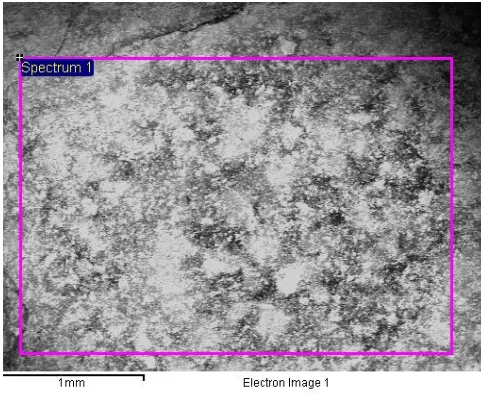
The surface morphology and elemental composition were observed by scanning electron microscope equipped with an energy-dispersive X-ray spectrophotometer (SEM JEOL Japan make,5610V model).
Figure 1. X-ray diffraction spectrum of composite
The SEM image of CdS-ZnS composite is shown in Fig. 2. It shows that particles have a rough surface with irregular size.
Figure 2. SEM of composite
Photocatalytic degradation
0.0960 g of Evan’s blue was dissolved in 100.0 mL of doubly distilled water so that the concentration of dye solution was 1.0 x 10─3 M. It was used as a stock solution and further diluted to working solutions as and when required. The absorbance of Evan’s blue solution was observed with the help of spectrophotometer (Systronic Model 106) at λ max = 610 nm. It was irradiated with a 200 W tungsten lamp. The reaction solution was exposed to visible light.
A water filter was used between light source and solution to cut off thermal radiations. The dye solution was placed in equal amounts in four beakers.
• The first beaker containing Evan’s blue solution was kept in dark
• The third beaker containing solution Evan’s blue and 0.12 g CdS-ZnS composite was kept in dark
• The fourth beaker containing Evan’s blue solution and 0.12 g CdS-ZnS composite was exposed to light
After exposing these beakers for 3 hours, the absorbance of the solution in each beaker was measured with the help of a spectrophotometer. The absorbance of the solution of first three beakers was found almost constant, but the solution of the fourth beaker absorbance had a decrease as compared to the initial value of absorbance. It is clear from all these observations that the degradation required both; light and semiconductor composite.
A solution of 1.3 × 10‾5 M Evan's blue was prepared in doubly distilled water and 0.12 g of ZnS, CdS and CdS-ZnS composite was added to it in separate beakers. The pH of reaction mixture was adjusted to 8.5 and then this mixture was exposed to a 200 W tungsten lamp (50.0 mWcm‾2). The absorbance was measured with increasing the time of exposure. Here, a linear plot between 1 + log A and time was found, which shows that Evan's blue degradation followed pseudo-first order kinetics. The rate constant was calculated with the help of given formula –
k = 2.303 × slope (1)
Results and discussion
The results of a typical run of optimum condition is shown in Table 1.
Table 1. A typical run
[Evan’s blue] = 1.3 × 10⁻⁵ M; amount of composite = 0.12 g; pH = 5.5; light intensity = 50.0 mW cm−2
Effect of pH
It has been observed that the rate of photocatalytic degradation of Evan’s blue increases with increase in pH up to 5.5. Further increase in pH above 5.5 resulted in a decrease in the rate of reaction.
An electron from conduction band is abstracted by dissolved oxygen to generate O2‾•. This anion radical is unstable in acidic medium and will form HO2• radical by reacting with protons of the medium. An increase in the rate of photocatalytic degradation of dye with the increase in pH may be due to the availability of more HO2• radicals. A decrease in the rate of photocatalytic degradation of the dye may be due to the fact that Evan's blue is present in its anionic form, which will experience a force of repulsion with the negatively charged surface of the semiconductor due to absorption of more OH‾ ions on the surface of the photocatalyst.
Table 2. Effect of pH
[Evan’s blue] = 1.3 x 10⁻⁵ M; amount of composite = 0.12 g; light intensity = 50.0 mW cm─2
Effect of dye concentration
The effect of dye concentration on the photocatalytic degradation of Evan’s Blue was observed in the range of 0.7 × 10⁻⁵ to 2.1 × 10⁻⁵ M and results are reported in Table 3. As the concentration of the dye was increased, it was observed that the dye degradation increases but after 1.3 × 10⁻⁵M (optimum condition), the efficiency of the photocatalytic degradation showed a declining behavior. Here, the dye will start acting as aninternal filter and it will not allow the desired light intensity to reach the surface of the semiconductor present at the bottom of the reaction vessel.
Table 3. Effect of dye concentration
Amount of composite = 0.12 g; pH = 5.5; Light intensity = 50.0 mW cm‾2
Time (min.) Absorbance (A) 1+logA
0.0 0.693 0.8407
10.0 0.652 0.8142
20.0 0.604 0.7810
30.0 0.553 0.7427
40.0 0.519 0.7152
50.0 0.493 0.6928
60.0 0.543 0.7348
70.0 0.505 0.7033
80.0 0.470 0.6721
90.0 0.418 0.6212
Rate constant (k) with CdS = 6.91 × 10⁻5 sec⁻1
Rate constant (k) with ZnS = 4.11 × 10⁻5 sec⁻1
Rate constant (k) with CdS-ZnS = 8.91 × 10⁻5 sec⁻1
pH Rate constant, k × 105 s-1
5.0 7.12
5.5 8.90
6.0 7.10
6.5 5.68
7.0 4.02
7.5 3.33
8.0 2.59
8.5 2.31
9.0 2.00
9.5 1.2
[Evan's Blue] × 105 M Rate constant, k × 105 s-1
0.7 3.30
0.9 5.09
1.1 6.72
1.3 8.90
1.5 7.61
1.7 6.38
1.9 5.32
Effect of amount of composite
The amount of semiconductor is also likely to affect the degradation of dye and therefore, different amounts of semiconductor were used. The results are reported in Table 4. When the semiconductor amount was kept low, the rate of degradation of dye was also less. It was observed that as the amount of photocatalyst was increased, the rate of photocatalytic activity increases. The rate of degradation was optimum at 0.12 g of the semiconductor. Beyond 0.12 g, the rate constant decreases slightly. Because after this value, an increase in the amount of photocatalyst will only increase the thickness of the photocatalyst layer and not the exposed the surface area. This was confirmed by taking reaction vessels of different dimensions. This slight decline may be due to the fact that excessive amount of photocatalyst may create hindrance and blocks light penetration.
Table 4. Effect of composite photocatalyst
Amount of composite (g) Rate constant, k × 105 s1
0.02 3.90
0.04 4.87
0.06 5.91
0.08 6.82
0.10 7.38
0.12 8.90
0.14 7.70
0.16 6.92
[Evan’s blue] = 1.3 x 10⁻⁵ M; pH = 5.5; light intensity = 50.0 mWcm‾2
Effect of light intensity
The distance between the light source and exposed surface area of photocatalyst was varied to determine the effect of light intensity on the photocatalytic degradation of Evan’s blue. The results are summarized in Table 5. The results show that photocatalytic degradation of Evan’s blue was more on increasing the intensity of light as this increases the number of photons striking per unit area of photocatalyst surface per unit time. The maximum rate was observed at 50.0 mW cm−2 for degradation of Evan’s blue. On further increasing the intensity above 50.0 mWcm−2, there was a slight decrease in the rate of photodegradation. This may be due to some thermal effects or side reactions.
Table 5. Effect of light intensity
Light intensity (mW cm-2) Rate constant, k × 105 s-1
20.0 5.98
30.0 7.12
40.0 7.93
50.0 8.90
60.0 7.99
70.0 7.21
[Evan’s blue] = 1.3 x 10⁻⁵ M; amount of composite = 0.12 g; pH = 5.5
Mechanism
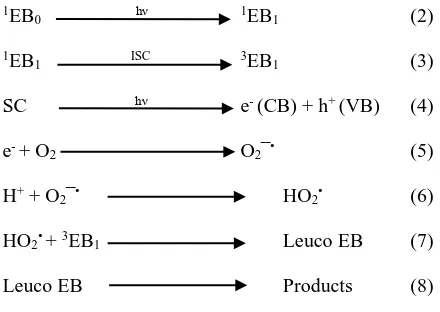
On the basis of all these observations, a tentative mechanism for degradation of dye is proposed as:
1EB
0 hν 1EB1 (2) 1EB
1 ISC 3EB1 (3) SC hν e- (CB) + h+ (VB) (4) e- + O
2 O2‾‾• (5) H+ + O
2‾‾• HO2• (6) HO2• + 3EB1 Leuco EB (7) Leuco EB Products (8)
Evan’s blue dye (EB) absorbs suitable wavelength and gives its first excited singlet state. Then it undergoes intersystem crossing (ISC) to give the triplet state of the dye. On the other hand, the semiconducting composite CdS-ZnS also uses the radiant energy to excite its electron from valence band to the conduction band. This electron will be abstracted by oxygen molecule (dissolved oxygen) generating superoxide anion radical (O2─ •). This anion radical will be converted to HO2• radical as the medium is acidic, where it is unstable and reacts with H+. This HO
2• radical converts the dye to its leuco form, which is degraded in final products. •OH radical does not participate as an active oxidizing species in this degradation reaction. This was confirmed by the fact that the rate of photodegradation was not affected appreciably by the presence of hydroxyl radical scavenger, isopropanol.
Conclusion
A comparative study has been carried out between the photocatalytic activity of pure CdS, ZnS and their composite. Evan’s blue dye has been used as a model system to compare their photocatalytic performances. The rate constants for photocatalytic degradation of Evan's blue using CdS, ZnS and CdS-ZnS were 6.91 × 10⁻⁵, 4.11 × 10‾5 and 8.91 × 10‾5 sec‾1, Respectively. These results indicate that the composite CdS-ZnS show better results as compared to CdS and ZnS alone. The observation of present work will explore the use of composites for better photocatalytic performance.
Acknowledgements
References
1Beydoun, D., Amal, R., Low, G., and McEvoy, S., Nanopart, J.
Res., 1999, 1, 439–1,458.
2Gaya, U. I. and Abdullah, A. H., J. Photochem. Photobiol., C, 2008, 9(1), 1-12.
3Pan, S. and Liu X., J. Solid State Chem., 2012, 191, 51-56. https://doi.org/10.1016/j.jssc.2012.02.048
4Hu, J. S., Ren, L. L., Guo, Y. G., Liang, P. H., Cao and A. M., Angew. Chem. Int. Ed., 2005, 44, 1269-1273. https://doi.org/10.1002/anie.200462057
5Yan J., Fang, X. S., Zhang, L. D., Bando, Y., Gautam U. and K., Dierre B., Nano Lett., 2008, 8, 2794–2799. https://doi.org/10.1021/nl801353c
6Patil, B. N. and Acharya S. A., Adv. Mat. Lett., 2014, 5(3), 113-116. https://doi.org/10.5185/amlett.2013.fdm.16
7Sharma, M., Jain, T., Singh, S. and Pandey, O. P., Solar Energy, 2012, 86 (1), 626–633.
https://doi.org/10.1016/j.solener.2011.11.006
8Eyasu, A., Yadav O. P. and Bachheti, R. K., Int. J. Chem. Tech
Res., 2013, 5(4), 1452-1461.
9Gao, X. F., Sun, W. T., Hu, Z. D., Ai, G., Zhang, Y. L., Feng, S., Li, F. and Peng, L.-M., J. Phys. Chem. C, 2009, 113, 20481-20485.
https://doi.org/10.1021/jp904320d
10Wu, Y., Tamaki, T., Volotinen, T., Belova L., and Rao, K. V., J.
Phys. Chem. Lett., 2010, 1, 89-92.
https://doi.org/10.1021/jz900008y
11Xu, F., Volkov, V., Zhu, Y., Bai, H. Y., Rea, A., Valappil, N. V., Su, W., Gao, X., Kuskovsky, I. L. and Matsui, H., J. Phys.
Chem. C, 2009, 113, 19419-19423.
https://doi.org/10.1021/jp903813h
12Ahluwalia, S., Prakash, N. T., Prakash, R. and Pal, B., Chem.
Eng. J., 2016, 306, 1041–1048.
https://doi.org/10.1016/j.cej.2016.08.028
13Soltani, N., Saion, E., Hussein,M. Z., Erfani, M., Abedini, A., Bahmanrokh G., Bahmanrokh, G., Manizheh, N. and Vaziri, P., Int. J. Mol. Sci., 2012, 13(10), 12242-12258.
https://doi.org/10.3390/ijms131012242
14Liu, S. Li H. and Yan, L., Mat. Res. Bull., 2013, 48(9), 3328– 3334. https://doi.org/10.1016/j.materresbull.2013.05.055
15Ivetic, T. B., Fincur, N. L., Ðacanin, L. R., Abramovic, B. F. and Lukic-Petrovic, S.R., Mater. Res. Bull., 2015, 62, 114-121.
https://doi.org/10.1016/j.materresbull.2014.11.001.
Received: 27.05.2017.