157
© 2017 by the Serbian Biological Society How to cite this article: Vrbničanin S, Onć-Jovanović E, Božić D, Sarić-Krsmanović M, Pavlović D, Malidža G, Jarić S. Velvetleaf (Abutilon theophrasti medik.) productivity in competitive conditions. Arch Biol Sci. 2017;69(1):157-66.
Velvetleaf (
Abutilon theophrasti
Medik.) productivity in competitive conditions
Sava Vrbničanin1*, Eleonora Onć-Jovanović2, Dragana Božić1, Marija Sarić-Krsmanović3, Danijela Pavlović4, Goran Malidža5 and Snežana Jarić6
1 University of Belgrade, Faculty of Agriculture, Nemanjina 6, Belgrade 11080, Serbia
2 Institute “PKB Agroekonomik”, 11000 Belgrade, Serbia
3 Pesticide and Environment Research Institute, Banatska 31b, Belgrade 11080, Serbia
4 Institute for Plant Protection and Environment, Drajzerova 9, Belgrade 11040, Serbia
5 Institute of Field and Vegetable Crops, M. Gorkog 30, Novi Sad 21000, Serbia
6 Department of Ecology, Institute for Biological Research ‘Siniša Stanković’, University of Belgrade, 11060 Belgrade, Serbia
*Corresponding author: [email protected]
Received: February 12, 2016; Revised: April 11, 2016; Accepted: April 19, 2016; Published online: October 4, 2016
Abstract: Velvetleaf (Abutilon theophrasti Medik.) is an invasive alien species in many countries and one of the major weeds in summer row crops worldwide. Weed-management techniques that reduce weed production need to be investigated to provide new approaches. The first step in this process is the determination of weed productivity in different competitive conditions. Field experiments were conducted in 2006 and 2008 in an experimental field in Padinska Skela to quantify growth and seed production of velvetleaf in maize, as well as in a velvetleaf monoculture. A density of velvetleaf ranging from 1 to 8 plants m-1
was artificially created. In a mixture with maize, velvetleaf was sown in crop rows. The growth of velvetleaf was estimated based on plant height, fresh aboveground biomass and leaf area index (LAI). Velvetleaf fecundity was determined as seed mass plant-1 and seed mass m-2. Differences between years in plant production were very prominent. In general, velvetleaf
productivity in maize depended on its density. Intraspecific competition had a major influence on growth and seed production when velvetleaf density was from 4 to 8 plants m-1 in maize rows. This information indicates that environmental conditions
and weed density can promote/reduce inter- and intraspecific competition and help in the construction of population dynam-ics models to predict population density, seed bank and competitiveness of weeds and reduce inputs for weed management.
Key words: velvetleaf; density; vegetative parameters; fecundity.
INTRODUCTION
Herbicides are highly effective in reducing weed populations, but their continuous use is often offset by an increased abundance of more tolerant weed species [1], or by the development of herbicide resis-tance [2-4]. Moreover, if weed control is not aimed to achieve total weed eradication, then a proportion of the population present will survive to produce seeds that will then produce plants in crops in subsequent years [5]. An understanding of seed production and the seed soil bank is crucial for understanding the potential impact of such less intensive weed control. Thus, there is a growing need for the development of cost-effective, environmentally safe, integrated and alternative weed management strategies.
own vegetative productivity and fecundity in row crops [15,16].
Abutilon theophrasti Medik. (syn. A. avicennae Gaertn. = velvetleaf) has been cultivated in China since the beginnings of civilization as a fiber plant. From China it spread through Asia Minor to the Balkan Peninsula as a potential fiber crop plant. Velvetleaf is a major weed in maize and other summer row crops in many European countries [17,18]. In Serbia, velvetleaf is the predominant weed species found in maize and other row crops, occupying more than 50% of arable fields [19]. It is also one of the most troublesome weeds in both maize and soybean in the USA [11].
The successful colonization by velvetleaf can be explained by its biological/ecological set of traits and inadequate weed management on arable and non-arable land. Velvetleaf is an erect summer an-nual species up to 2 m tall, with high seed produc-tion (up to 50000+ ha-1) [20]. Velvetleaf seeds mature within 15 to 24 d [21]. Most seeds fall near the par-ent plant, but some disperse to greater distances via water, mud, soil movement, manure and especially agricultural operations. The seeds are hard-coated, survive ingestion by poultry and most livestock, and resist decomposition by soil microorganisms [22]. Some seeds remain dormant and viable even when the seed coat is broken. Most seeds germinate from mid-spring through early summer, with optimal ger-mination temperatures ranging from 16 to 20°C. Seeds can survive for 50 years or more in the soil seed bank [23]. In an Iowa study, only 8% of the velvetleaf seed produced germinated the year after seed production, with an additional 15% emerging within a 4-year pe-riod [24]. In another study, under ideal conditions for velvetleaf germination and emergence, only 54% of the seed emerged the year after seed production [25]. These studies demonstrate that if left untreated, low densities of velvetleaf may produce sufficient seed to cause an economic problem for many years. Also, if velvetleaf emerges simultaneously with maize it is almost always able to grow taller than the maize. Velvetleaf height and leaf area increase rapidly in the vegetative phase, during which the major portion of plant biomass is produced [16,17]. In addition, the growth of weed species can also be influenced by in-traspecific competition. Aguiar et al [26] reported that under relatively stable environmental conditions (i.e.
when there is a lack of disturbance or stress), the co-existence of species with similar requirements occurs when intraspecific competition is more intense than interspecific competition.
Understanding weed-crop interactions is crucial in predicting crop yield loss, but it is also important to understand how these interactions affect weed pro-ductivity. Therefore, this research was conducted to characterize the vegetative productivity and fecundity of velvetleaf in a monoculture (without maize) and in a maize crop, according to weed density and envi-ronmental conditions during two experimental years. Furthermore, this research established a basis for con-structing population dynamics models to predict the likely consequences of lower-input weed management that is being promoted to reduce the environmental impact of weed control.
MATERIALS AND METHODS Field experiments
velvetleaf seedlings were manually thinned to defined densities. In main plot I, maize was planted at a stan-dard density 0.70 x 0.25 m (57000 plants ha-1). During both seasons all other weed species were controlled by hand weeding regularly.
Parameters of competitiveness
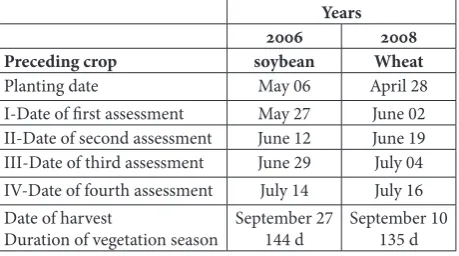
Plant height, fresh aboveground biomass per plant and leaf area index (LAI) were measured every two weeks beginning three weeks after planting in 2006 and four weeks after planting in 2008 (Table 1). Four total destructive harvests were taken per treatment (3 plants x 4 replications = 12 plants) from two lateral rows on either side of the plot (first, second, fifth and sixth rows) in both years. Plant height was measured from the soil surface to the highest point of the stem tissue. Aboveground shoots were clipped at the soil surface and weighed immediately in the field for fresh biomass. Leaves were removed from the shoots and leaf area measured using a Delta-T leaf area meter (Delta-T Devices, Burwell, Cambridge, UK). LAI per plant was calculated as the ratio of total leaf area divided by the area of the soil over which the plant grew. As vel-vetleaf seed capsules matured, samples were obtained by hand-harvesting the middle two rows (third and fourth rows), each of 5 m in length in every plot. Vel-vetleaf fecundity was calculated as seed mass plant-1 and seed mass m-2. Environmental conditions during two experimental years are shown in Table 2.
Data analyses
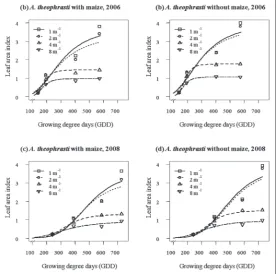
Statistical procedures were carried out using STATIS-TICA 5.0 software. Due to variations in averages for all parameters and variations in weather conditions (rainfall in the growing season was 309.4 mm and 235.6 mm in 2006 and 2008, respectively) from each year were analyzed separately. Data were subjected to one-way ANOVA (F-values) to evaluate the main effects of velvetleaf densities on velvetleaf vegetative productivity (plant height, fresh biomass plant-1, LAI) and fecundity (seed mass plant-1, seed mass m-2) in the treatment without maize (intraspecific competi-tion) and in the treatment with maize (interspecific competition). Plant height, fresh biomass, as well as LAI, were analyzed using a four-parameter log-logistic model, where the C term was fixed at 0 [27]:
Y= C + (D-C)/{1+exp[B(log X – log E)]} where Y is the response (e.g., plant height), C is the lower limit, D is the upper limit, X is GDD (growing degree days) calculated (see below) after crop plant-ing, E is GDD giving a 50% response between the upper and lower limit (also known as inflection point, I50 or ED50), and B is the slope of the line at the inflec-tion point. The graphs were made with R program (R Development Core Team 2006) utilizing the dose-response curves (drc) statistical addition package.
Temperatures were converted to GDD using the following equation:
GDD = Σ [{(Tmax + Tmin)/2} - Tbase] where Tmax and Tmin are the daily maximum and minimum air temperatures (°C), respectively, and Tbase is the base temperature (10°C).
RESULTS
Velvetleaf seedling emergence began quickly after planting in 2006, but was delayed by approximately 7 d in 2008 (Table 1). Environmental conditions (rainfall
Table 1. Time line and additional information about the trials.
Years 2006 2008 Preceding crop soybean Wheat
Planting date May 06 April 28
I-Date of first assessment May 27 June 02
II-Date of second assessment June 12 June 19
III-Date of third assessment June 29 July 04
IV-Date of fourth assessment July 14 July 16
Date of harvest
Duration of vegetation season September 27144 d September 10 135 d
Table 2. Rainfall and GDD in 2006 and 2008 at the experimental field.
Month Rainfall (mm) GDD
2006 2008 2006 2008 April
May 34.6 37.649.0 164.15 218.6011.15
June 135.6 39.6 268.25 320.05
July 14.8 42.0 362.21 333.65
August 98.8 35.0 329.55 356.40
September 27.2 70.0 193.60 121.50
and GDD) during the two years of this study were par-tially different (Table 2). In 2006, rainfall from plant-ing to harvestplant-ing date was high (24% higher durplant-ing the growing period than in 2008 for the same period), especially during June when the differences were the highest. On the other hand, GDD during the grow-ing periods were similar in both years despite a 9-d shorter vegetation season in 2008. Because of environ-mental differences between years, velvetleaf vegetative and fecundity data could not be pooled because of the lack of homogeneity between variances. Therefore, the results are presented individually for each year.
Velvetleaf vegetative productivity
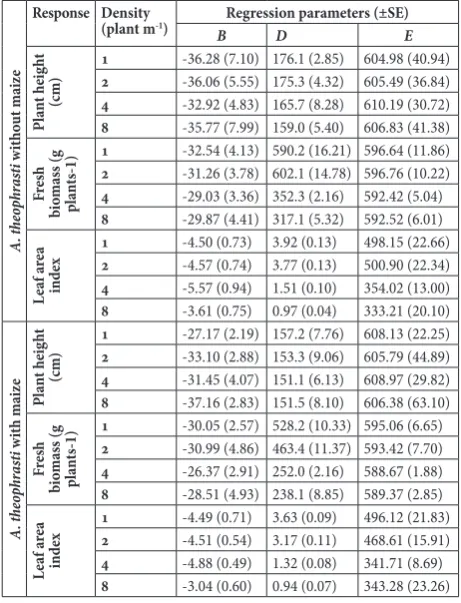
Regression parameters (±SE) for plant height, fresh biomass and leaf area index plant-1 production of
vel-vetleaf at 1, 2, 4 and 8 plants m-1, in treatments without and in a mixture with maize, are given in Tables 3 and 4 for 2006 and 2008, respectively. Velvetleaf density did not have a significant effect on its height in either of the treatments (with or without maize) in earlier growing periods, but the height was significantly af-fected by the density during the late season (F=5.6609; P≤0.01), except with maize in 2008 (Fig. 1). Further-more, higher velvetleaf heights were measured in all treatments without maize.
The effect of velvetleaf density on fresh biomass plant-1 was significant (F=3.8355-278.2835; P≤0.01 or
P≤0.05) during both years, except at the first assess-ment (Fig. 2; Tables 3 and 4). Starting from the second assessment, in both years at higher velvetleaf densities (4 and 8 plants m-1) lower fresh biomass was obtained in both treatments, with and without maize. Contrary to this, at lower densities (1 and 2 plants m-1)
signifi-Table 3. Regression parameters (±SE) for plant height, fresh
bio-mass and leaf area index plant-1 production of Abutilon theophrasti
at 1, 2, 4 and 8 plants m-1 in treatments without maize and in a
mixture with maize, in 2006 (Fig. 1a, b; Fig. 2a, b; Fig. 3a, b).
A. t heo ph ra sti w itho ut ma iz e
Response Density (plant m-1) BRegression parameters (±SE)D E
Pl an t he ig ht (cm)
1 -20.15 (1.64) 172.0 (4.71) 418.61 (30.91)
2 -20.28 (4.41) 169.3 (4.50) 415.50 (31.45)
4 -21.54 (4.81) 171.7 (4.32) 417.91 (32.15)
8 -22.63 (1.63) 157.7 (6.11) 416.44 (56.22)
Fr es h bi omass (g p la nts-1)
1 -19.87 (0.60) 678.4 (27.80) 408.22 (12.57)
2 -20.18 (2.14) 644.5 (8.00) 408.31 (13.93)
4 -17.11 (3.07) 468.0 (8.94) 408.30 (9.70)
8 -18.13 (4.28) 402.2 (15.46) 407.95 (11.21)
Le af a re a ind ex
1 -2.83 (0.35) 3.99 (0.14) 291.89 (18.94)
2 -2.79 (0.36) 3.80 (0.21) 281.59 (19.25)
4 -7.15 (0.76) 1.76 (0.06) 183.11 (2.45)
8 -6.55 (1.03) 1.07 (0.05) 171.51 (4.42)
A. t heo ph ra sti wi th ma iz e Plant height (cm)
1 -20.50 (1.26) 164.5 (9.13) 419.78 (48.28)
2 -20.41 (2.65) 159.3 (6.97) 415.88 (49.03)
4 -20.97 (1.30) 154.2 (9.08) 417.26 (44.06)
8 -19.85 (1.87) 140.2 (17.78) 416.22 (64.74)
Fresh biomass (g plants-1)
1 -19.43 (1.43) 628.2 (38.83) 408.22 (12.57)
2 -20.18 (2.14) 607.3 (30.64) 408.31 (13.93)
4 -17.11 (3.07) 310.6 (18.83) 408.30 (9.70)
8 -18.13 (0.28) 273.3 (13.77) 407.95 (11.21)
Leaf area index
1 -2.87 (0.36) 3.80 (0.09) 300.82 (19.36)
2 -2.68 (0.37) 3.41 (0.19) 287.59 (21.35)
4 -6.35 (0.99) 1.44 (0.03) 178.78 (3.70)
8 -5.79 (1.16) 0.98 (0.05) 172.16 (4.80) Regression parameters are estimated by Eq. (1)
B − the slope of the line at the infection point, C − the lower limit, D − the upper limit, E − the growing degree days (GDD) giving a 50 % response between the upper and lower limit (also known as inflection point).
Table 4. Regression parameters (±SE) for plant height, fresh
bio-mass and leaf area index plant-1 production of Abutilon theophrasti
at 1, 2, 4 and 8 plants m-1 in treatments without maize and in a
mixture with maize, in 2008 (Fig. 1c, d; Fig. 2c, d; Fig. 3c, d).
A. t heo ph ra sti w itho ut ma iz e Response Density
(plant m-1) Regression parameters (±SE)
B D E
Pl an t he ig ht (cm)
1 -36.28 (7.10) 176.1 (2.85) 604.98 (40.94)
2 -36.06 (5.55) 175.3 (4.32) 605.49 (36.84)
4 -32.92 (4.83) 165.7 (8.28) 610.19 (30.72)
8 -35.77 (7.99) 159.0 (5.40) 606.83 (41.38)
Fr
es
h
bi
omass (g plants-1)
1 -32.54 (4.13) 590.2 (16.21) 596.64 (11.86)
2 -31.26 (3.78) 602.1 (14.78) 596.76 (10.22)
4 -29.03 (3.36) 352.3 (2.16) 592.42 (5.04)
8 -29.87 (4.41) 317.1 (5.32) 592.52 (6.01)
Le af a re a ind ex
1 -4.50 (0.73) 3.92 (0.13) 498.15 (22.66)
2 -4.57 (0.74) 3.77 (0.13) 500.90 (22.34)
4 -5.57 (0.94) 1.51 (0.10) 354.02 (13.00)
8 -3.61 (0.75) 0.97 (0.04) 333.21 (20.10)
A. t heo ph ra sti w ith ma iz e Pl an t he ig ht (cm)
1 -27.17 (2.19) 157.2 (7.76) 608.13 (22.25)
2 -33.10 (2.88) 153.3 (9.06) 605.79 (44.89)
4 -31.45 (4.07) 151.1 (6.13) 608.97 (29.82)
8 -37.16 (2.83) 151.5 (8.10) 606.38 (63.10)
Fr
es
h
bi
omass (g plants-1)
1 -30.05 (2.57) 528.2 (10.33) 595.06 (6.65)
2 -30.99 (4.86) 463.4 (11.37) 593.42 (7.70)
4 -26.37 (2.91) 252.0 (2.16) 588.67 (1.88)
8 -28.51 (4.93) 238.1 (8.85) 589.37 (2.85)
Le af a re a ind ex
1 -4.49 (0.71) 3.63 (0.09) 496.12 (21.83)
2 -4.51 (0.54) 3.17 (0.11) 468.61 (15.91)
4 -4.88 (0.49) 1.32 (0.08) 341.71 (8.69)
8 -3.04 (0.60) 0.94 (0.07) 343.28 (23.26) Regression parameters are estimated by Eq. (1)
cantly higher fresh biomass was found in both years and both treatments. The greatest dif-ferences of density effects on the fresh bio-mass were confirmed at the last assessment, where the difference between the lower and higher density in 2006 were 40.7 and 56.5%, and in 2008 46.3 and 55.0% in the treatments without and with maize, respectively. Also, velvetleaf fresh biomass in both treatments was higher in the first than in the second year. The effects of velvetleaf density on LAI were similar to those on the fresh biomass. LAI was significantly (P≤0.05) affected by vel-vetleaf density at all times in the treatment without (F=8.8493-193.7320) and treatment with maize (F=25.3460-225.8788) in both years except in the first assessment (Fig. 3; Tables 3 and 4). Generally, LAI of velvetleaf in both treatments decreased with increasing plant densities. The largest difference in LAI was confirmed in the last assessment between the lower and higher density, which corre-sponded to 73.2 and 74.2% in 2006, and 75.3 and 74.1% in 2008, in treatments without and with maize, respectively. Also, velvetleaf LAI values were higher in the treatment without maize when compared to the treatment with maize. In addition, similarly to fresh biomass, the values of LAI in both treatments were higher in 2006 than in 2008.
Velvetleaf fecundity
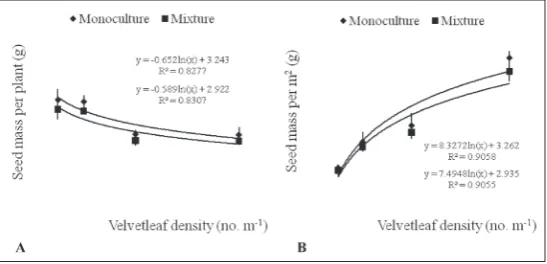
Generally, in both years the seed mass plant-1 decreased as velvetleaf density increased, while seed mass m-2 increased as velvetleaf density increased in treatments without and with maize (Figs. 4 and 5; Table 5). The effect of velvetleaf density on seed mass plant-1 in treatments without and with maize was sig-nificant in both years (P≤0.05; F2006=13.7383 and 10.6254, F2008=10.6254 and 31.8309). De-pending on the density (from D4 to D1), vel-vetleaf seed mass plant-1 ranged between 2.71 and 4.35 g, and 2.44 and 3.52 g in treatments without and with maize in 2006, respectively. A similar trend was found in 2008, were seed mass plant-1 ranged between 2.80 and 3.15 g,
Fig. 1. Velvetleaf height affected by velvetleaf density (D1- 1 plant m-1, D 2- 2
plants m-1, D
3- 4 plants m-1, D4- 8 plants m-1) in treatments without and with
maize. The regression lines were plotted using Eq. (1), and the parameter values are reported in Table 3 and 4.
Fig. 2. Velvetleaf fresh biomass effected by velvetleaf density (D1- 1 plant m-1,
D2- 2 plants m-1, D
3- 4 plants m-1, D4- 8 plants m-1) in treatments without and
and 1.80 and 2.84 g in treatments without and with maize, respectively. Quite the reverse, velvetleaf seed mass m-2 was significantly higher at the higher density (from D1 to D4) and ranged between 21 and 30.98 g, and 5.03 and 27.88 g in treatments without and with maize in the first year, respectively. The same trend was confirmed in the second year, were seed mass m-2
ranged between 4.50 and 22.83 g, and 4.05 and 20.55 g in treatments without and with maize, respectively.
DISCUSSION
Variable seed germination in 2006 and 2008 induced by environmental conditions in the pre-planting
pe-Fig. 3. Velvetleaf LAI affected by velvetleaf density (D1- 1 plant m-1, D2- 2 plants m-1, D3- 4 plants m-1, D4- 8 plants m-1) in treatments without and with maize. The regression lines were plotted using Eq. (1), and the parameter values are reported in Table 3 and 4.
Table 5. Velvetleaf seed production in different conditions.
D
ens
ity Treatments 2006 2008
seed mass
plant-1 seed mass m-2 seed mass plant-1 seed mass m-2
D1 monoculture 4.35±0.50 6.21±0.50 3.15±0.36 4.50±0.50 mixture 3.52±0.12 5.03±0.46 2.84±0.06 4.05±0.40 D2 monoculture 4.14±0.47 11.82±0.90 3.09±0.59 8.81±0.65 mixture 3.72±0.04 10.64±0.96 2.78±0.03 7.93±0.60 D3 monoculture 2.87±0.52 16.38±1.10 2.02±0.36 11.54±0.95
riod (in a 30-d pre-planting period, 81.2 mm rainfall fell in 2006, compared with only 36.4 mm in 2008; data not shown) may explain the difference in emer-gence of velvetleaf. Differences in emeremer-gence time and environmental conditions during the growing period, as well as velvetleaf density, affected velvetleaf vegeta-tive productivity (fresh biomass plant-1 and LAI) and fecundity in both treatments, without and with maize. In our studies, increasing plant density often tended to decrease velvetleaf height but these results differ from those of Bailey et al. [16] and Werner et al. [28] where velvetleaf height was found to increase as plant density increased throughout the season. In addition, plant height differed between treatments and
years. Depending on density, velvetleaf plants were taller in the treatment without maize compared with the treatment with maize by 4.4 to 11.1% and 4.7 to 12.8% in 2006 and 2008, respectively. Interspecific competition has shown a greater negative impact on velvetleaf height than intraspecific competition. The differences in velvetleaf height between years at all densities were not consistent when comparing treat-ments without and with maize. In the treatment with-out maize, velvetleaf plants were higher in relation to the treatment with maize in 2008 in all densities except at D3; while in the treatment with maize vel-vetleaf was taller in 2006 in all densities except at D4. Therefore, the impact of interspecific competition was
Fig. 4. Velvetleaf seed mass in 2006. A – velvetleaf seed mass plant-1. Bars
represent the standard error of the mean. The equation in the treatment
with-out maize was y = -0.893 ln(x) + 4.446, R2 = 0.890, and in the treatment with
maize was y = -0.632 ln(x) + 3.722, R2 = 0.670. B – velvetleaf seed mass m-2.
Bars represent the standard error of the mean. The equation in the treatment
without maize was y = 11.379 ln(x) + 4.517, R2 = 0.922, and in the treatment
with maize was y = 10.481 ln(x) + 3.675, R2 = 0.930.
Fig. 5. Velvetleaf seed mass in 2008. A – velvetleaf seed mass plant-1. Bars
represent the standard error of the mean. The equation in treatments without
maize was y = -0.652 ln(x) + 3.243, R2 = 0.828, and in treatments with maize
was y = -0.589 ln(x) + 2.922, R2 = 0.831. B – velvetleaf seed mass per m2. Bars
represent the standard error of the mean. The equation in treatments without
maize was y =8.327 ln(x) + 3.262, R2 = 0.906, and in treatments with maize
prominent in the year with poor rainfall distribution (during June, the period of intensive velvetleaf growth, when cumulative rainfall was 135.6 and 39.6 mm in 2006 and 2008, respectively), which affected velvetleaf height in almost all densities.
Velvetleaf fresh biomass production decreased with increasing density and this decrease was pro-portional to density, which was the result of intra- and interspecific competition. In both years and all densi-ties, interspecific competition was stronger than intra-specific. Our findings are in agreement with those of Scholes et al. [29] who reported a negative correlation between velvetleaf density and velvetleaf biomass pro-duction (at the lowest density the average plant weight was about 34 g, whereas at the highest density, the average plant weight was about 8.5 g). However, Wer-ner et al. [28] reported a positive correlation between velvetleaf density and velvetleaf dry weight production m-2. In addition, differences in plant fresh biomass between years were probably due to environmental conditions during the early-season growth (Table 2). Generally, velvetleaf produced a higher fresh biomass plant-1 in all treatments in 2006 with favorable rainfall distribution. These results are in agreement with those of Conley et al. [30] based on weed density and cohort emergence time, where the maximum shoot biomass or fecundity m-2 differed between years. Also, Bailey et al. [16] found that velvetleaf density had no effect on the fresh weight, dry weight and stem diameter of velvetleaf plants in 1997. However, in 1998, all these parameters decreased significantly with increasing velvetleaf density. In our study, velvetleaf produced less fresh biomass plant-1, depending on density, in the treatment with maize compared with the treatment without maize by 7.4-33.8% in 2006 and 10.6-33.1% in 2008, which was the result of interspecific competi-tion. Lindquist et al. [11] also observed a substantially reduced velvetleaf biomass in a mixture with soybean. They explained that the reduction in velvetleaf sur-vival in the mixture with soybean may have been due to competition for light because complete canopy clo-sure occurred within 40 to 50 d after planting in the mixed stand plots.
In both treatments (velvetleaf with and without maize) and both years, velvetleaf LAI was negatively correlated with velvetleaf density. This demonstrates that the lack of space due to a denser plant population
tended to hinder the growth and development of leaf area and vice versa. Our findings contrast with those of Scholes et al. [29] who reported a positive corre-lation between velvetleaf density and LAI. As with fresh biomass, LAI was higher in 2006 than in 2008. This suggests that velvetleaf that emerged later, due to poor rainfall distribution in the 2008 season, formed a smaller leaf area and was less competitive against maize than when it emerged early in 2006. Similar results were reported by Conley et al. [30] for relative leaf area of giant foxtail (Setaria faberi Herrm.), which depended on density in soybean.
Increased velvetleaf density tended to increase seed mass m-2 and decrease seed mass plant-1 of vel-vetleaf in treatments with and without maize in both years. The reduction in fecundity in the treatment with maize may be due to competition for light be-cause canopy closure occurred within 50 d after plant-ing in the mixture with maize. A similar findplant-ing was reported by Cardina et al. [15], who measured maize yield and velvetleaf fecundity in response to density of early- and late-emerging velvetleaf. Our results coincided with past studies where seed production per plant decreased as velvetleaf density increased in rows of cotton [16]. Munger et al. [31] reported high velvetleaf seed production in a mixture with soybean in one year (770 seeds plant-1), but low production in another year (17 seeds plant-1). They attributed the low seed production to interspecific competition for water. Earlier, Zanin and Sattin [32] also observed a high velvetleaf seed production (3379 and 4520 seeds plant-1) when grown in plots with maize. Seed produc-tion of this magnitude represents a substantial input to the seed bank, which is particularly important for velvetleaf seeds and which may survive for up to 50 years in soil [23].
they are likely to produce a greater number of seeds. In addition, this result indicates that environmental conditions (distribution of rainfall throughout the season) and velvetleaf density can promote/reduce inter- and intraspecific competition. These data, with additional future experiments in similar environ-mental conditions and cropping systems, can help us construct population dynamic models to predict the population density, seed bank and competitiveness of velvetleaf and reduce input in weed management.
Acknowledgments: We are grateful to the Ministry of Education, Science and Technological Development of the Republic of Serbia for supporting this investigation (Projects III 46008, TR31073 and 173018) and EU-FP7-REGPOT-AREA Project No 316004. We would also like to thank Steve Quarrie for improving our English.
Authors’ contribution: Sava Vrbničanin participated in the design of this study, the collection of samples, carried out all analysis, measurements and calculations, drafted and wrote the manuscript. Eleonora Onć-Jovanović, Dragana Božić, Marija Sarić-Krsmanović and Danijela Pavlović participated in the work related to field experiments during two vegetation seasons. Goran Malidža par-ticipated in data analyses and interpretation, and Snežana Jarić helped in drafting and writing the manuscript including critically revision of the manuscript. All authors have read and approved the final version of manuscript.
Conflict of interest disclosure: The authors declare that they have no competing interests.
REFERENCES:
1. Norsworthy JK. Effect of tillage intensity and herbicide pro-grams on changes in weed species density and composition in the southeastern coastal plains of the United States. Crop Prot. 2008;27:151-60.
2. Gray JA, Balke NE, Stoltenberg DE. Increased Glutathione Conjugation of Atrazine Confers Resistance in a Wisconsin
Velvetleaf (Abutilon theophrasti) Biotype. Pestic Biochem
Phys. 1996;55:157-71.
3. Beckie HJ, Tardif FJ. Herbicide cross resistance in weeds. Crop Prot. 2012;35:15-28.
4. Délye C, Jasieniuk M, Le Corre V. Deciphering the evo-lution of herbicide resistance in weeds. Trends Genet. 2013;29(11):649-58.
5. Lutman PJW, Wright KJ, Berry K, Freeman SE, Tatnell L.
Estimation of seed production by Myosotis arvensis, Veronica
hederifolia, Veronica persica and Viola arvensis under dif-ferent competitive conditions. Weed Res. 2011;51:499-507. 6. Statistical Yearbook of the Republic of Serbia [Internet]. Belgrade: Statistical Office of the Republic of Serbia. 2015. [cited November 2015]. Available from: http://webrzs.stat. gov.rs/WebSite/Public/PageView.aspx?pKey=82.
7. Murphy SD, Yakubu Y, Weise SF, Swanton CJ. Effect of planting patterns and inter-row cultivation on competi-tion between corn and late emerging weeds. Weed Sci. 1996;44:856-70.
8. Rajcan I, Swanton CJ. Understanding maize-weed competi-tion: resource competition light quality and the whole plant. Field Crops Res. 2001;71:139-50.
9. Oljača S, Vrbničanin S, Simić M, Stefanović L, Dolijanović Z.
Jimsonweed (Datura stramonium L.) interference in maize.
Maydica. 2007;52:329-35.
10. Teasdale JR, Cavigelli MA. Subplots facilitate assessment of corn yield losses from weed competition in a long-term sys-tems experiment. Agron Sustain Dev. 2010;30:445-53. 11. Lindquist JL, Maxwell BD, Buhler DD, Gunsolus JL.
Vel-vetleaf (Abutilon theophrasti) recruitment, survival, seed
production, and interference in soybean (Glycine max).
Weed Sci. 1995;43:226-32.
12. Lindquist JL, Mortensen DA, Clay SA, Schmenk R, Kells
JJ, Howatt K, Westra PA. Stability of corn (Zea mays) –
vel-vetleaf (Abutilon theophrasti) interference relationships.
Weed Sci. 1996;44:309-13.
13. Teasdale JR. Influence of corn (Zea mays) population and
row spacing on corn and velvetleaf (Abutilon theophrasti)
yield. Weed Sci.1998;46:447-53.
14. Nurse RE, DiTommaso A. Corn competition alters the
ger-minability of velvetleaf (Abutilon theophrasti) seeds. Weed
Sci. 2005;53:479-88.
15. Cardina J, Regnier E, Sparrow D. Velvetleaf (Abutilon
theo-phrasti) competition and economic thresholds in conventional
and no-tillage corn (Zea mays). Weed Sci. 1995;43:81-7.
16. Bailey WA, Askew SD, Dorai-Raj S, Wilcut JW. Velvetleaf (Abutilon theophrasti) interference and seed production dynamics in cotton. Weed Sci. 2003;51:94-101.
17. Sattin M, Zanin G, Berti A. Case history for weed
competi-tion/population ecology: velvetleaf (Abutilon theophrasti) in
corn (Zea mays). Weed Tech. 1992;6:213-19.
18. Travlos IS, Kanatas PJ, Economou G, Kotoulas VE, Chachalis D, Tsiorost T. Evolution of velvetleaf interference with maize hybrids as influenced by relative time of emergence. Exp Agr. 2012;48(1):127-37.
19. Vrbničanin S, Malidža G, Stefanović L, Elezović I, Stanković-Kalezić R, Marisavljević D, Radovanov- Jovanović K, Pavlović D, Gavrić M. Distribution of some economic harm-ful, invasive and quarantine weeds in Serbia. I part: Spatial distribution and frequency of eight weed species. Biljni lekar.
2008;XXXVI:303-13. Serbian.
20. DiTomaso JM, Healy EA. Weeds of California and Other Western States. Oakland: University of California, Agricul-tural and NaAgricul-tural Resources; 2007.
21. Weaver SE, Hamill AS. Effects of soil pH on competitive
ability and leaf nutrition content of corn (Zea mays L.) and
three weed species. Weed Sci. 1985;33:447-51.
22. Kremer RJ, Hughes LB, Aldrich RJ. Examination of microor-ganisms and deterioration resistance mechanisms associated with velvetleaf seed. Agron J. 1984;76:745-9.
23. Spencer NR. Velvetleaf, Abutilon theophrasti (Malvaceae),
24. Hartzler RG. Velvetleaf population dynamics following a single year’s seed rain. Weed Tech. 1996;10:581-6.
25. Forcella F, Wilson RG, Dekker J, Kremer RJ, Cardina J, Anderson RL, Alm D, Renner KA, Harvey RG, Clay S, Buhle DD. Weed seed bank emergence across the corn belt. Weed Sci. 1997;45:67-76.
26. Aguiar MR, Lauenroth WK, Peters DP. Intensity of intra- and interspecific competition in coexisting shortgrass spe-cies. J Ecol. 2001;89:40-7.
27. Seefeldt SS, Jensen JE, Fuerst EP. Log-logistic analysis of herbicide dose-response relationships. Weed Technol. 1995;9:218–27.
28. Werner EL, Curran WS, Harper JK, Roth GW, Knievel DP.
Velvetleaf (Abutilon theophrasti) interference and seed
pro-duction in corn silage and grain. Weed Tech. 2004;8:779-83.
29. Scholes C, Clay SA, Brix DK. Velvetleaf (Abutilon
theo-phrasti) effect on corn (Zea mays) growth and yield in South Dakota. Weed Tech. 1995;9:665-8.
30. Conley SP, Binning LK, Boerboom CM. Estimating giant foxtail cohort productivity in soybean based on weed den-sity, leaf area, or volume. Weed Sci. 2002;50:72-8.
31. Munger PH, Chandler JM, Cothren JT, Hons FM. Soybean
(Glycine max) – velvetleaf (Abutilon theophrasti)
interspe-cific competition. Weed Sci. 1987;35:647-53.
32. Zanin G, Sattin M. Threshold level and seed production of
velvetleaf (Abutilon theophrasti Medicus) in maize. Weed