Available online throug
ISSN 2229 – 5046
INVESTIGATING IMPACTS OF SOCIAL MEDIA IN ACADEMICS
ANU DAHIYA
1* AND SALAJ CHHIKKARA
21,2
SECTOR 23, SONIPAT, HARYANA – 131001, India.
(Received On: 11-02-20; Revised & Accepted On: 15-03-20)
ABSTRACT
T
his paper focuses on observing effects of social media on student’s academic performance. The research takes primary data and uses quantitative approach to identify research objectives. The target data size for this study was based on students of two majors of Trgc P.G girls College, Sonepat. And the data was analysed with weka tool. This observation has identified that Twitter has light positive relation with students academic performance. Research of this study show students are better to focus when encountered with education related issues on Twitter. It has suggested that Twitter has become most important tool in education industry. And could have a significant amount of impact on students academic performance.Keywords: Social Networks, Weka Tool, Twitter, Classification, EM.
INTRODUCTION
Today the Web has assumed an uncompromising stance in individuals' lives. It is hard to envision a young fellow who in any event once multi day did not check for updates in interpersonal organizations and did not leaf through the news lines. The cutting edge reality expects us to keep in contact and stay informed concerning the most recent news and patterns. Be that as it may, does this pattern influence the execution of understudies? At the point when web based life, for example, Twitter, YouTube and Twitter showed up, our reality was separated into on the web and disconnected. Internet based life are online innovation stages that assistance to associate individuals together far and close. It is utilized to fabricate relationship among individuals. With their assistance, we can speak with one another, even on various mainlands, tune in to music, read books, take a gander at photographs and substantially more. Web-based social networking have significantly streamlined our lives and firmly attached to ourselves [17]. Amid the time spent finding people for colleagues, youths go into various associations and find the opportunity to talk with a moderately unlimited number of people and premium social occasions, with a wide scope of characters, take in an extensive proportion of stories, have the chance to exchange suppositions and discussion about issues essential to them. Hence, clients of informal communities, much of the time, are a delegate of the more youthful age.
As per researchers, informal organizations are particularly hazardous for young people, as they structure a bogus impression that affection and fellowship are anything but difficult to overcome and similarly as simple to obliterate [5]. Likewise, youngsters who are familiar with the quick stream of Web life, reality may seem, by all accounts, to be exorbitantly dull, and they can have a go at, making it difficult to "re-establish" it by making incautious activities. Some are supporters of the utilization of web based life. They guarantee that the last give access to learning and help understudies trade data rapidly. Others imagine that understudies' utilization web-based social networking essentially to impart about everything with the exception of studies and that they just divert understudies from the learning procedure. The utilization of internet based life by under studies approaches fundamental data as brisk as conceivable [18]. Numerous colleges and schools the world over confine the entrance to interpersonal organizations inside its structures. They legitimize this by helping understudies focus on their examinations. Then again, they deny understudies the chance to utilize the various materials accessible on these assets, for example, logical recordings on YouTube[8]. The setting of study is the one of the school in eastern region of Saudi Arabia, the Jubail College School (JUC). JUC is an associate of the Regal Commission for Jubail& Yanbu. It was set up in 2006 to accomplish the destinations of the Imperial Commission, in creating HR and to give the Saudi labor high instruction and preparing with the goal that they can legitimately deal with the Kingdoms' developing economy in its different divisions [7]. The point of this investigation is to discover the effect of internet based life on scholastic execution of chose undergrads. To accomplish this, current examinations will be dissected, just as study among respondents will be led. Respondents are the sixty (60) understudies who are effectively utilizing web-based social networking.
LITERATURE REVIEW
As indicated by (KORE, 2014) in his examination attempted to analyze the understudies utilization of long range interpersonal communication destinations and their observations about the impacts of the utilization; the instance of chose Adama private academies. The investigation began with the exploration addresses worried about the how, and the why utilization of person to person communication destinations, the impact of long range informal communication locales, the impact or the job of instructors. So as to complete the expressed goals or inquiries of the exploration, both subjective and quantitative information were gathered from test interpersonal interaction destinations clients of Hawas, and afterward broke down the information through distinct insights, for example, rate, cross classification, recurrence, and chi square trial of affiliation. The discovering demonstrates most of the respondents were utilizing SNS enlisting on two interpersonal interaction destinations account.
What's more, understudies usually included on SNS using facebook. Thus that face book distinguished the significant SNS inclination of the understudies. Besides, most of the understudies were utilizing SNS going through 1-2 hours every day by and large for scholarly utilize and not exactly an hour daily all things considered for non scholastic use. This investigation inspected the connection between face book rehearses on scholastic execution of understudies. A cross-sectional overview was directed from Walk 2012 to Walk 2013 in Jimma College and 490 postgraduate understudies were taken an interest in this exploration. The information were gathered utilizing a pre-tried organized selfadministrated survey. The outcome was examined regarding distinct insights pursued by inferential measurements. The outcomes showed that there is no noteworthy connection between use time and recurrence of login face book with understudy GPA. In view of this discovering, blocking face book isn't arrangement since understudies can without much of a stretch access face book by their cell phones and utilizing cell phone to get to confront book may have made an issue on their scholastic execution by cultivating understudies occupied with performing various tasks actuates. The consequence of the examination likewise demonstrated that there is a negative moderate and noteworthy connection between utilizing portable to visit face book and understudy GPA (Nebiat Negussie, 2014). Reviewing what has been composed in(Aida Abdulahi, 2014) where the writers composed immense research going to recognize the negative impacts of informal community locales, for example, Face book among understudies College researchers. The specialist appropriated 152 overviews to understudies of the picked college to look at and examine the negative impacts. They utilizing study survey measures scholarly execution, wellbeing danger, protection and security issues and in conclusion Face book such time spent web based utilizing Face book.
The discoveries and investigation demonstrates that the specialist rejects the invalid theory for all the three theories. Which implies that there is a connection between understudies’ execution a d utilizing SNS? Likewise, there is additionally a connection between understudies utilizing informal community locales and wellbeing danger. Besides, there is likewise a connection between understudy utilizing Facebook and protection and security issues. Another exploration was held to decide the effect of online life on the scholarly execution of understudies. Innovation is blasting quickly from year to year, and the more youthful ages are the ones gotten in this fast change. This explore expects to discover the effect of online networking on the scholastic execution of the more youthful age in Egypt. Polls were dispersed through the online life stage, Face book and messages, among an example of understudies matured 12-19. The example comprised of 110 male and female understudies matured 12-19, which are in evaluations 7 to 12. They are from various financial classes and the sorts of school programs differed among, German and National. The discoveries exhibit that there is no connection between internet based life and scholarly execution; this is obviously anticipated in their general evaluation normal (Tarek A. El-Badawy, 2015). The past examinations have demonstrated that to break down the effect of web based life on the understudy's scholastic execution, to make balance between long range informal communication and scholarly exercises of understudies to stay away from mishaps in the scholarly execution of the understudies. To accomplish this, the review inquire about strategy was utilized. Subjects were drawn from the College of Abuja, utilizing the straightforward irregular testing method and purposive examining. Four research addresses guided the examination.
schools and meetings of leaders of the senior secondary schools. The investigation uncovered that lion's share of respondents utilized What Sapp and Face book for making companions and talking. What's more, lion's share of respondents experienced negative impacts. A study configuration gives a quantitative portrayal of some part of the populace that is examined through the information gathering process (Frankel and Wallen, 1995). The investigation likewise utilized the poll as the information accumulation instrument for the examination. It was additionally uncovered from the discoveries of the examination that the significant reasons why most understudies' utilized What Sapp and Face book was on the grounds that the vast majority of their companions utilized it, they were less expensive and they could also talk with different companions in the meantime. This was steady with the affirmation made by Marion and Omotayo (2011) that "Face book is an extraordinary method to meet companions and keep upon what they are doing. Once out add a companion to your Facebook companion show you will dependably know, when they are adding things to their blog or refreshing their profile. (Ahsan ul Haq and Sohail Chand, 2012) This is the main investigation of its sort in India concentrating on the reason for the Face book utilization and its conceivable effect on the understudies' scholastic execution. Following are the destinations we will chiefly take a gander at: However female clients invest more energy in Face book than their partners yet male clients have more Face book companions. Face book use, by and large, unfavorably influencing the scholastic execution of understudies however this unfriendly impact is watched more noteworthy for male understudies. A self-regulated survey is utilized for gathering information from an example of 384 understudies.
The examination reveals that 87.5% of the understudies have account on the Face book and no sexual introduction contrasts found. Male and female on the typical put square with vitality in web. This finding can be furthermore explored anyway one support of this finding is that, all things considered, male understudies put more vitality in playing sports, social gathering with sidekicks and despite that the utilization of the Face book making it troublesome for them to play out their best in their academic work. This issue will be also examined and discussed in our future work (R. Subramanian, 2015). Segments that sway our understudies' present web based systems administration use and its impact. The online life ought to be seen even more broadly for better appreciation of factors that sway the utilization, affirmation, and lead of the Indian understudies. Reviews were controlled with the understudies and analysts who viably look into web. In this paper, the utilization of academic uses of online person to person communication by the school understudies was isolated from every other person taken for examination and trade. The master proposed to consider the usage of academic applications by the school understudies and particularly envisioned to watch the downloading behavior of the understudies. How much dimension of insightful applications, for instance, Software's, video talks, sound books, electronic books, electronic journals, electronic magazines, analyze articles and PPT archives were downloaded with the true objective of educational headway was removed from every other person focused in this part. (Hyatt, 2011) this examination was to grasp the association between time gone through by understudies busy with understudy co-curricular incorporation, online long range casual correspondence, and inspecting on their educational execution. Additional elements, for instance, understudy living course of action, sexual introduction, ethnicity, class standing and work for pay were also considered. Existing this examination was to grasp the association between time gone through by understudies busy with understudy co-curricular consideration, online long range casual correspondence, and Information for this quantitative examination started from an online association of an investigation. The amount of respondents was 613, which was a 28% response rate. An alternate backslide examination was used close by other truthful examination. Undeniable estimations were dismembered for all components.
All data was self-reported by understudies. In order to address the examination questions proposed by this examination, a quantitative research arrangement was used. Expressly used. Specifically, a relationship research arrangement was used to address the examination questions proposed. Relationship investigate plans are generally used to find associations between components using a lone report people. The revelations exhibited genuinely basic, contrary connections between's the amount of hours gone through by understudies busy with co-curricular consideration and online individual to individual correspondence as it relates to review point. The revelations of this examination both maintained and conflicted with existing composition regarding these matters. The finding of authentic significance for most factors can probably be attributed to the generous model measure in the examination these disclosures offer additional open entryways for research by other under examination issues specialists who are enthusiastic about understudy accomplishment factors like those joined into this examination.
CONCEPTUAL FRAMEWORK
Use Of Internet
By Students
Data Collection On
basis of Usage
Analysis of
Data
Final
Observation
STATEMENT OF PROBLEM
The objective of this paper is to identify the positive and negative effects on students academic results. This paper mainly focses on;
1. What are social media platform accessed by students majorly? 2. How much time students devote on using social media overall?
3. What is the effect of social networks on students’s academic performance?
ASSUMPTIONS
The current observation will analyse the impact of social network on students’ academic performance assume the following:
1. Student use social network to study and work
2. Average time spent by students on social networking is 6 hrs.
3. The impact of social media could be positive and negative at the any instant of time.
RESEARCH METHODOLOGY
This observation was acqquit final year Trgc students in Haryana, India. The Data collected for this purpose was of 104 entries. Therefore the faculties were Applied sciences and Computer science and Information technology .These 104 selected students are the last year students in the college and familiar to the usage of twitter and they were applicable to our study. The sample size consisted of two selected faculties, some selected students from each faculty was the sample of the study, to determine the best sample size for the population, and the sample size of this study was 51 respondents. A justification of sample size, “because the researcher use Slovene’s formula N =N/ (1+ (N*e^2)), where n= sample size, N= population size, 104 and e = margin of error of 10%. N=104/ (1+ (104*0.01)) = 51 entities. This study was utilized probability sampling procedure particularly simple random sampling method. EM clustering involves you selecting the sample at random from the sampling frame using either random number tables or a computer. The EM process is continued until your required sample size has been reached. The study was use Questionnaire as tool of collecting data and information from required students. Because it was the most appropriate in collecting view students whose place is not geographically spread. The researcher use adapted questionnaire that was and adding necessary ones. The questionnaire consisted of two sections: demographic and attribute. The total items of questionnaire were 18 items.
DATA PRESENTATION AND ANALYSIS
The students Ages, the questionnaire was consisting of 51 students. The age between 20 and 30 years of respondents were 35 and their percentage 43%, and the age between 31 and 40 years was 24 and their percentage 29.6 was The age between 41 and 50 years of respondents were 12 and their percentage 14.8, and the age between 50 and over years was 6 and their percentage was 7.4%, The above table shows the respondents of questionnaire were consist of 77 respondents. The male of respondents were 50 and their percentage 61%, and the female was 27 and their percentage was 39%.
Table-1: Age of Students
Table-2: Gender of Students S.No Description Frequency Weight 1 Male 56 56.0 2 Female 1 1.0 3 Female 48 48.0
Table-3: Purpose of Social Media S.No Description Frequency Weight 1 Work 63 63.0
2 Socialising 42 42.0 Description Frequency 20-23 18
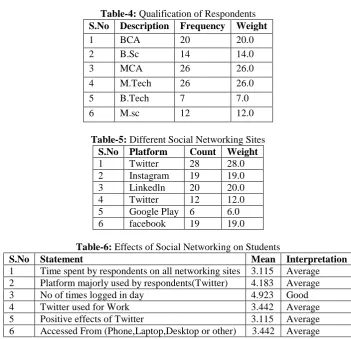
Table-4: Qualification of Respondents S.No Description Frequency Weight 1 BCA 20 20.0
2 B.Sc 14 14.0 3 MCA 26 26.0
4 M.Tech 26 26.0
5 B.Tech 7 7.0
6 M.sc 12 12.0
Table-5: Different Social Networking Sites S.No Platform Count Weight 1 Twitter 28 28.0 2 Instagram 19 19.0 3 Linkedln 20 20.0 4 Twitter 12 12.0 5 Google Play 6 6.0 6 facebook 19 19.0
Table-6: Effects of Social Networking on Students
S.No Statement Mean Interpretation
1 Time spent by respondents on all networking sites 3.115 Average 2 Platform majorly used by respondents(Twitter) 4.183 Average 3 No of times logged in day 4.923 Good 4 Twitter used for Work 3.442 Average 5 Positive effects of Twitter 3.115 Average 6 Accessed From (Phone,Laptop,Desktop or other) 3.442 Average
From Table 1, we have observed frequency of students using twitter of age group 26-29 is larger than other age groups in the data set. These group of people is either using twitter for socialising or work depending on requirement. And the frequency of using twitter is 36 out of whole data set which is larger as compared to other data sets.
In Table 2, Gender evaluation of people using social networking is done. On the basis of data available we have observed total no of males using social networking sites are larger than the total no of females. And their respective weights are 56.0 and 48.0.
Students using twitter are more for work than socialising as described in Table 3. Calculated weights for these attributes are 63.0 and 42.0 respectively.
From Table 4, it has been analysed that students having major BCA uses social media and carries weight 20.0. Students from B.Sc having weight 14.0, MCA 26.0, M.Tech 26.0, B.Tech 7.0 and M.Sc 12.0.
Table 5, is about identifying the no of social media platforms used by students to perform the task are Twitter having weight count 28.0,instagram having weight count 19.0,LinkedLn having weight count 20.0, Twitter having weight count 12.0, Google play having weight count 6.0, and facebook having weight count 19.0.
In final analysis, the effects of social networks is evaluated and specified through Table 6.
Through this table it has been analysed that Mean of the time spent by all the students are 3.115, which would be considered as average case in final interpretation.
Further platform majorly used by respondents is twitter for their work and assignments also for social purpose .Their final count is 4.183 which is also average case of interpretation.
Mean of total no of time a respondent logged in a day is 4.923 which is considered to be Good case of interpretation.
Twitter is used for work majorly by our respondents and having final count 3.442 average contribution to whole population of data.
Positive effects of twitter are 3.115 and averagely contribute towards whole data set.
CONCLUSION
Specifically, According to the Observations of this study, It has been identified that Twitter use has light negative effect on student’s academic performance, which Majority of respondents mentioned that there is light negative connection between student’s twitter use and academic performance, the negative association between twitter usage and students academic performance showed that students might have improved good performance due to the stable of twitter. When respondents interact and connect with their friends on twitter they contribute in giving their ideas and post much more issues that might not be related entirely to their academics related problems. Students also identified their main use for twitter is socialising. Students believe that twitter is significantly purposeful in university life which they connect with huge number of people they might otherwise not known. In past years twitter became one of the best informative tool and students are seen to be actively participated on twitter this indicate that they spend significant amount of time that was likely to utilize their academic career. Students can get access to information about various parts and organisation so it can be said that twitter is not only to be used for socialising but for all the information and needs to be used in stable manner because it can also help students to improve in their schedule of learning.
REFERENCES
1. Aida Abdulahi, B. S. 2014. A Study on the Negative Effects of Social Networking Sites Such as Facebook among Asia Pacific University Scholars in Malaysia. International Journal of Business and Social Science. 2. Anjugu Jessica Ndaku, A. 2. 2013. Impact of social media on the students academic performance, (a study of
students of university of abuja). caritas university.
3. Chand, A. u. December 2012,. Pattern of Facebook usage and its Impact on Academic Performance of University Students: A Gender Based Comparison. Bulletin of Education and Research, 3/10.
4. Cherry, K. 2016, August 27. What Is a Sample? Retrieved February 19, 2017, from verywell.com: https://www.verywell.com/what-is-a-sample-2795877
5. Elhuda, A. and Dimetry, 2014. The Impact of Facebook and Others Social Networks Usage on Academic Performance and Social Life among Medical Students at Khartoum University. International journal of scientific & technology research, 1-3.
6. Glass, et al., 2013. (n.d.). The influence of personality and facebook use on student academic performance. 7. Goodwin, C. J. 2010. Research in Psychology Methods and Design. Hoboken: John Wiley & Sons, Inc. 8. Helen, N. and Eke Miss, C. O. 2014. The Use of Social Networking Sites among the Undergraduate Students
of University of Nigeria, Library Philosophy and Practice (ejournal), 5/27.
9. Helou, et al., 2012. Students’ Perceptions on Social Networking Sites Influence on Academic Performance. 7828 Asian Journal of Science and Technology, Vol. 09, Issue, 03, pp.7823-7829, March, 2018,
10. International Journal of Social Networking and Virtual Communities (Int J SocNet & Vircom), 7-15.
11. Kabre and Brown, J. 2011. The influence of facebook usage on the academic performance and the quality of life of college students. Savannah State University, 10611 Abercorn Street Apt 79, Savannah, GA 31419, United State. , 1.
12. Kirschne and Karpinski. (nd). FACEBOOK® AND Academic performance.
13. Kore, T. 2014. Students’ use of social networking sites and their perceptions about the effects of the use: the case of selected adama preparatory schools. haramaya: haramaya university.
14. Mark Salvation, N. A. 2014. The Influence of Social Network Sites (SNS) upon Academic Performance of Malaysian Students. International Journal of Humanities and Social Science, Vol. 4, No. 10(1), pp131-137. 15. Martínez-Mesa, J, G.-C. D. 2014. Sample size: how many participants do I need in my research? Anais
Brasileiros de Dermatologia, 89(4). pp609.
16. Méndez, E. 2012. Evaluating IDRC Results Research Excellence, What’s in Good? International Development Research Centre (IDRC).
17. Ndaku, A. 2013. Impact of social media on students academic performance. abuja: caritas university.
18. Nebiat Negussie, G. K. 2014. Relationship between Facebook Practice and Academic Performance of University Students. Asian Journal of Humanities and Social Sciences (AJHSS).
19. Negussie and Ketema, 2014. Relationship between Facebook Practice and Academic Performance of University Students. Asian Journal of Humanities and Social Sciences (AJHSS), 1-3.
20. Negussie, A. and Ketema, 2014. Relationship between Facebook Practice and Academic Performance of University Students. Asian Journal of Humanities and Social Sciences (AJHSS), 30-31.
21. Salaria, N. 2012. Meaning of the term- descriptive survey research method. International Journal of Transformations in Business Management, Vol. No. 1, Issue No. 6. Sarath, A. and Nonis, G. I. (January/ February 2006).
22. Academic Performance of College Students: Influence of Time Spent Studying and Working. Arkansas state university, 1/151.
24. Students. Global Journal of Computer Science and Technology: E Network, Web & Security, 29-32.
25. Thuseethan, S. K. 2009/2011. Influence of Facebook in Academic Performance of Sri Lankan University Students. Department of Computing and Information Systems Sabaragamuwa University of Sri Lanka, 3/4.
Source of support: Nil, Conflict of interest: None Declared.