© 2019 by the Serbian Biological Society How to cite this article: Lenzi C, Grasso C, Nicoara M, Savuca A, Ciobica A, Plavan 329 GI, Strungaru SA. Influence of environmental colors and long-term sex isolation on zebrafish shoaling behavior. Arch Biol Sci. 2019;71(2):329-37.
Influence of environmental colors and long-term sex isolation on zebrafish shoaling behavior
Christian Lenzi1, Chiara Grasso1, Mircea Nicoara2, Alexandra Savuca2,*, Alin Ciobica2, Gabriel I. Plavan2 and
Stefan A. Strungaru2
1University of Turin, Department of Life Sciences and System Biology, Via Accademia Albertina 13, 10123 Torino, Italy
2“Alexandru Ioan Cuza” University of Iasi, Department of Biology, Faculty of Biology, Bd. Carol I, 20A, 700505, Iasi, Romania
*Corresponding author: [email protected]
Received: January 18, 2019; Revised: February 23, 2019; Accepted: March 5, 2019; Published online: May 19, 2019
Abstract: Zebrafish has a complex social behavior and little is known about the role of sexual preference and their envi-ronmental social interactions. In this study we investigated the potential influence of envienvi-ronmental colors and shoaling preferences of zebrafish male and female populations, with a focus on visual communication. Males and females were kept for 7 days in gender-isolated tanks, with a specific habitat color for each group: green for males and red for females. After the pre-test period, all the animals were kept separated and 8 noninvasive behavioral tests were conducted in a T-maze, with the application of different visual stimuli. We did not observe any clear influence of environmental coloring on social zebrafish choices. Significant sex-related differences were found in shoaling partner preference (i.e. same sex vs. other sex, one fish vs. three fish) as follows: females showed a tendency to avoid other females and spent more time with males. Male fish did not display a preference between one or three fish stimuli and they shoaled more with another male and less with a potential sexual partner. There was an obvious difference between males and females in responses and selection of shoaling partners.
Keywords: zebrafish; environmental coloring; sexual preferences; shoaling; social behavior
INTRODUCTION
Danio rerio (zebrafish) [1] is a popular tropical freshwater fish, member of the family Cyprinidae [2]. The species shows many advantages in behavioral research and is an important and widely-used vertebrate model organism in molecular biology, developmental biology, genetics, toxicology, oncology and neuroscience research [3, 4].
Zebrafish are native to the Himalayan region and their range includes much of northern India, Ban-gladesh and parts of southern Nepal [5]. In the wild, zebrafish is found mostly in still and stagnant waters, such as lakes, puddles, ponds, rice fields, ditches and small watercourses; in areas where it is present, it tends to be very abundant [6]. The high concentration of fertilizers in rice crops promotes the growth of zoo-plankton, one of the main components of zebrafish diet, favoring the presence of the species at such sites [7].
Zebrafish is a very social species and researchers worldwide are increasingly studying a huge range of
behaviors exhibited by zebrafish [8-10]. Most of the studies on its sociality examined its shoaling behavior, i.e. aggregation in groups. Shoaling plays a key role in foraging, predator avoidance and reproductive success [2]. Previous studies showed that the early social envi-ronment in which individuals developed can influence shoaling phenotype preference [11]. Generally, at high temperature fish are more active, and zebrafish prefer to shoal with a bigger group of individuals [12].
groups of males or females [13]. In contrast, in the study conducted by Etinger et al. [14] it was observed that both males and females preferred to approach an individual of the same sex, rather than one of the opposite sex. The same preference also manifested itself in the choice between groups of 3 individuals, but only for females. The reasons hypothesized by the researchers are related to the fact that female zebraf-ish within a group of only females can decrease the risk of predation and avoid unwanted approaches by males [14]. In another study [16], female zebrafish preferred to stay with one or two males when no other females were around, and they spent around 5% of the observation time with female-only groups [16]. The authors of this work reported in their preliminary experiments (unpublished data) that females kept to-gether in an aquarium have reproductive suppression, behave aggressively toward each other and develop a dominance hierarchy.
In zebrafish, the existence of visual discrimina-tion learning of environmental coloring [17] and prey capture based on early visual system development [18] was demonstrated. Despite the existence of preference and avoidance, behaviors towards colors of different wavelengths have been well documented for this spe-cies; however, the results are conflicting.
It was demonstrated that 5 days post fertilization (dpf) zebrafish larvae have an innate preference for blue or red over other environmental colors [19]. Peeters et al. [20] observed that both larvae and adult zebrafish have a significant preference for blue zones and avoid yellow environments, but this aversion can be diminished by treatment with anxiolytic drugs. In another study [21], a natural preference of adult zebraf-ish, regardless of sex, for short wavelength colorations (e.g. blue and green) was highlighted again, although in that experiment, the animals were not-tested for red color. In fact, as is the case for other aquatic species, the influence of the color red in particular contexts such as foraging [22] and mating [23] was demon-strated in zebrafish. In addition, what has emerged in experiments is that zebrafish exhibit a natural aversion towards blue, with no significant preferences for other colors, either with long or short wavelengths [24-26].
Another question is the natural preference of ze-brafish for dark or light surroundings. There are also
contradictory observations on this subject. One study suggests that when given a choice, adult zebrafish prefer brighter light environments [27], while another study [28] demonstrated a natural preference for darker light environments. A possible explanation for this is given by the results of a subsequent study in which it was shown that zebrafish preference for light or dark environments is dependent on ambient light levels and olfactory stimulation [29].
In this work we investigated the role of sex and environmental coloring in shoaling preference of zebrafish. In particular, our focus was to determine whether zebrafish show a color preference for their habitat after a sex-isolation period, and whether the environmental coloring can influence the response to several fish social stimuli that differ for sex and number composition. Thus, different noninvasive experimental tests were run in a multipurpose cross-maze in the laboratory and all the behaviors were recorded using video-tracking software (“test home color vs. other color”, “test home color vs. no color”, “test home color vs. other sex 1”, “test home color vs. same sex 1”, “test home color vs. other sex 3”, “test home color vs. same sex 3”, “test other sex 1 vs. same sex 1” and “test same sex 1 + home color vs. other sex 1”).
MATERIALS AND METHODS
Ethics statement
The animals were strictly maintained and treated ac-cording to EU Commission Recommendation of 18 June 2007 on guidelines for the accommodation and care of animals used for experimental and other scien-tific purposes[30], and Directive 2010/63/EU [31] of the European Parliament and Council of 22 September 2010 on the protection of animals used for scientific purposes. The local committee approved the testing. No animal was harmed, killed or suffered during the trials.
Subjects and housing
A total of 150 (males and females) sexually mature (5-6-month old) red GloFish® zebrafish were obtained
acclimatization. Males (N=10) and females (N=10) were randomly extracted from this population, kept separately in two groups for 7 days, and each group was housed in a 5 L (19.5x30x17 cm) tank (Supplementary Fig. S1). The tanks were provided with aquarium aerators and the water was changed once a day in the morning, 2 h before the behavioral observations. The temperature was maintained at 21-22°C on a 14:10/h light cycle; salinity and acidity were kept within a limited range (275-279 mg/L TDS, 7.94-7.98 pH). The experiment was repeated with another same size group of males and females extracted from the housing aquarium. Their sex isolation started 7 days after the previous experimental groups. All fish used in the study were fed with “Amtra Prima Flake” fodder (Croci S.p.A.) twice daily.
Experimental design
During the pre-test phase, the tanks were externally coated with non-transparent plasticized sheets of a specific habitat color, referred to as the “home color”, for each zebrafish group: green for males and red for females. After the sexual-isolation period, behavioral observations were performed using a 5 L multi-purpose cross-maze made from transparent Plexiglas that was modified to a T-maze. For this study, the part at the top of the central aisle of the cross-maze was separated with an overshadowed Plexiglas panel of the experimental environment. Although the water was changed daily, an aquarium aerator was located in this isolated zone and was used for oxygen recycling during the behavioral tests. The remaining T-maze was the actual testing environment. The start-point and the stimuli zones were separated from the recording area by transparent Plexiglas panels. Depending on type of test, a social or habitat stimulus was located in each arm (left or right) of the T-maze (Supplementary Fig. S1). For the behavioral observations that involved an environmental coloring preference, panels with the same color tone of the pre-test tanks were utilized.
Behavioral measurements and tests
Zebrafish behavior was recorded and analyzed by EthoVision XT 11.5 video-tracking software (Noldus Information Technology, Netherlands). This software has been utilized to track movements of animals in a maze (Noldus, 2010) and is an efficient way to replace
manual observations, being faster and more accurate [32]. For this experiment we used a camera acA1300-60gc (Basler GnICam), with a 1280x960 resolution and 50/s frames. The camera, fixed above the center of the cross-maze, was directly connected to the video-tracking software inside the computer. An infrared radiation slab was located under the cross-maze in order to obtain high contrast video-images. During each trial of all behavioral tests, the camera, after 1 min of accli-matization in the start-point zone, recorded for 4 min per trial each zebrafish. A 2D virtual maze, fitting the real experimental environment, was created to point out the stimuli zones and allow the software to detect and record the movements of the focal fish. The same selected variables, considered as the most useful for this study, were used for each behavioral test: cumulative duration (%) and mean duration per entrance in arm (s). After the pre-test sex-isolation period (7 days), zebrafish males and females continued to be kept separated in the same tanks while 8 different behavioral tests were executed. For all behavioral tests, 3 trials per animal were made at different times during daylight. Color and social stimuli were randomly placed and to avoid the “tank effect” or habituation, their position was alternated between the two arms (left or right) of the cross-maze for each trial/tested fish to ensure that the response was real. The central arm was considered to be the neutral arm and was used for accommodation, for lowering the stress level for each subject.
The first two tests, “test home color vs. other color” and “test home color vs. no color”, were conducted to investigate if the pre-test environment has any influence on habitat color preference. In the first behavioral test, in one arm of the cross-maze the selected habitat color for each group (green for males and red for females) was present, while in the other arm the opposite habitat color was present. In the second behavioral test, the “other color” zone was replaced with an environment without any habitat color. In literature, many authors experimented with innate color preferences in zebrafish but in our study we added an “imprinting” element on the choice of habitat color.
In the third behavioral test, “test home color vs.
the other arm there was one fish of the opposite sex to the focal animal. The fourth behavioral test, “test home color vs. same sex 1”, was similar to the third one. What was changed was the sex of the “stimulus” fish. In the fifth behavioral test, “test home color vs. other sex 3”, we followed the third test’s protocol but used 3 fish instead of one. The sixth behavioral test, “test home color vs. same sex 3”, was similar to the fifth test, but the “stimulus” fish was of the same sex as the focal animal. In the seventh behavioral test, “test other sex 1 vs. same sex 1”, we studied the shoaling preference of zebrafish without any influence from environment coloring. In one cross-maze there was one fish and in the other arm there was a fish of the opposite sex.
In the eighth and last behavioral test, “test same sex 1 + home color vs. other sex 1”, we examined whether habitat color can alter the social choice of the focal animal. The “stimulus” fish was of the same sex as the focal fish and the habitat color panel was placed in one arm of the cross-maze, while in the other arm there was one fish of the opposite sex. Each test needed one day to be performed. At the end of the experiment, each fish was returned to the isolation aquarium. The fish spent a total of 15 days in the isolation colored aquariums. After the tests, the fish were returned to the housing aquarium.
Statistical analysis
Behavioral raw data were analyzed using OriginPro 2016 software. The Kolmogorov-Smirnov test was used to evaluate the normality of distribution, while Levene’s test was adopted to test for homoscedasticity. Between the male and female samples, behavioral variables were compared using the Student’s t (parametric condition) and Mann-Whitney U tests (non-parametric
condi-tion); within the single sex-specific sample, Student’s t (parametric condition) and Wilcoxon signed-rank tests (non-parametric condition) were run. In the last part of the statistical analysis, the post hoc Tukey test was conducted. Significance was set at p<0.05 in all experimental tests.
RESULTS
Test home color vs. other color
In the first behavioral test, females were generally more active than males, considering their maximum acceleration (Mann-Whitney U test, U=260, N1=30, N2=30, P=0.005), minimum acceleration (Mann-Whitney U test, U=626, N1=30, N2=30, P=0.009), activity (Student’s t-test, t=-2.014, N1=30, N2=30, P=0.049) and total distance crossed (Student’s t-test, t=-2.099, N1=30, N2=30, P=0.040).
Males showed a significant choice (Fig. 1) for the “home color”, both for cumulative duration (Student’s t-test, t=-2.547, N1=30, N2=30, P=0.017) and mean duration (Wilcoxon signed-rank test, W=125, Z=2.272, N1=30, N2=30, P=0.023), while females spent more time (cumulative duration, %) close to the “other color” zone (Student’s t-test, t=-2.365, N1=30, N2=30, P=0.013). Moreover, male fish, when compared to females, had a stronger preference for the habitat color zone, both for cumulative duration (Student’s t-test, t=2.146, N1=30, N2=30, P=0.040) and mean duration (Mann-Whitney U test, U=284, N1=30, N2=30, P=0.044).
Test home color vs. no color
In the second behavioral test, females had a highest score of rotation frequency when compared to males (Student’s t-test, t=-2.182, N1=30, N2=30, P=0.033), and no differences for the other per-formance variables were detected. The females demonstrated equal
prefer-Fig. 1. Time spent in the arm with stimuli
per entrance (mean±SD) (A); cumulative
ence between two stimulus zones (Fig. 2), both for the cumulative dura-tion (Student’s t-test, N1=30, N2=30, P=0.460) and for the mean duration (Wilcoxon signed-rank test, W=208, Z=1.643, N1=30, N2=30, P=0.100). Males, instead, significantly preferred the “no color” zone both for the cu-mulative duration (Wilcoxon signed-rank test, W=78, Z=-2.260, N1=30, N2=30, P=0.024) and for the mean duration (Wilcoxon signed-rank test, W=76, Z=-2.1, N1=30, N2=30, P=0.036).
Environmental coloring did not have any influence on the shoaling preference in the third, fourth, fifth and sixth behavioral tests: both males and females chose for the cumulative and mean duration the social arm of the cross-maze.
Test home color vs. other/same sex 1
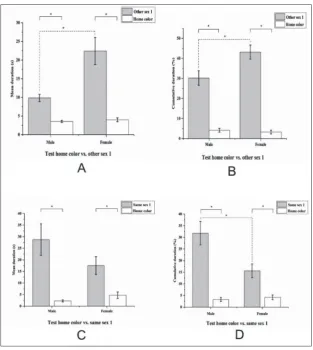
In the third behavioral test, both males and females showed a signifi-cant preference (Fig. 3) for the “other sex 1” zone, both for the cumula-tive duration (males: Student’s t-test, t=7.918, N1=30, N2=30, P<0.001; fe-males: Wilcoxon signed-rank test, W=435, Z=4.692, N1=30, N2=30, P<0.001) and the mean duration (males: Student’s t-test, t=6.138, N1=30, N2=30, P<0.001; females: Stu-dent’s t-test, t=4.668, N1=30, N2=30, P<0.001). Between the two samples, the females had a stronger prefer-ence for the social zone, both for the cumulative duration (Student’s t-test, t=-2.566, N1=30, N2=30, P=0.013) and the mean duration (Student’s t-test, t=-3.203, N1=30, N2=30, P=0.002). Males showed the highest score for cumulative du-ration in the “same sex 1” zone as compared to the female sample (Student’s t-test, t=2.821, N1=30, N1=30, P=0.007).
Fig. 2. Time spent in the arm with stimuli per entrance (mean±SD) (A); cumulative duration of activity in the arm with stimuli (mean±SD) (B), with results for comparison tests (*p<0.05; **p<0.01).
Test home color vs. other sex 3
In the fourth behavioral test (Fig.4), both males and females preferred the fish stimulus, with respect to cumula-tive duration (males: Student’s t-test, t=6.060, N1=28, N2=28, p<0.001; fe-males: Wilcoxon signed-rank test, W=136, Z=3.490, N1=30, N1=30, P<0.001) and mean duration (males: Wilcoxon signed-rank test, W=275, Z=4.151, N1=30, N1=30, P<0.001; females: Wilcoxon signed-rank test, W=253. Z=4.090, N1=30, N1=30, P<0.001). The females exhibited the best performance for maximum ac-celeration (Student’s t-test, t=-2.369, N1=30, N2=30, P=0.021) and rotation frequency (Student’s t-test, t=-2.208, N1=30, N2=30, P=0.031).
For the fifth behavioral test (Fig. 4), we registered a significant shoaling preference in the two samples regard-ing cumulative duration (males: Stu-dent’s t-test, t=6.214, N1=30, N2=30, P<0.001; females: Wilcoxon signed-rank test, W=136, Z=3.490, N1=30, N2=30, P<0.001) and mean dura-tion (males: Student’s t-test, t=5.251, N1=30, N2=30, P<0.001; females: Stu-dent’s t-test, t=6.557, N1=30, N2=30, P<0.001). However, the females showed a stronger preference for the “other sex 3” zone, regarding the mean duration variable (Student’s t-test, t=-2.130, N1=30, N2=30, P=0.041) and the highest score for rotation frequency (Student’s t-test, t=-2.222, N1=30, N2=30, P=0.032).
Test home color vs. same sex 3
In the sixth behavioral test (Fig. 5), both males and females displayed a preference for the social stimulus with regard to cumulative duration (males: Student’s t-test, t=8.018,
Fig. 4. Time spent in the arm with stimuli per entrance (mean±SD) (A); cumulative dura-tion of activity in the arm with stimuli (mean±SD) (B), with the results for comparison tests (* p<0.05; ***p<0.001).
Fig. 5. Time spent in the arm with stimuli per entrance (mean±SD) (A); cumulative dura-tion of activity in the arm with stimuli (mean±SD) (B), with the results for comparison tests (*p <0.05; ***p<0.001).
N1=30, N2=30, P<0.001; females: Student’s t-test, t=5.029, N1=30, N2=30, P<0.001) and mean dura-tion (males: Student’s t-test, t=4.900, N1=30, N2=30, P<0.001; females: Wilcoxon signed-rank test, W=118, Z=2.560, N1=30, N2=30, P=0.007). The males had a stronger preference, with the highest score in “same sex 3” zone for the cumulative duration (Student’s t-test, t=2.400, N1=30, N2=30, P=0.021) and the lowest in “home color” zone for mean duration (Student’s t-test, t=-2.566, N1=30, N2=30, P=0.016). The females exhibited the highest score for maximum acceleration (Student’s t-test, t=2.265, N1=30, N2=30, P=0.029).
Test other sex 1 vs. same sex 1
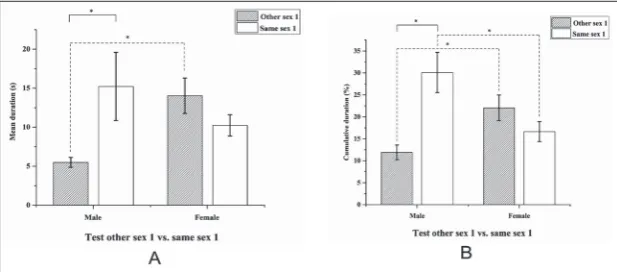
In the seventh behavioral test (Fig. 6) the male sample showed a significant preference for the “same sex 1” zone rather than the “other sex 1” zone, both for cumulative (Student’s t-test, t=-3.799, N1=30, N2=30, P=0.001) and mean duration (Wilcoxon signed-rank test, W = 28, Z=-2.676, N1=30, N2=30, P=0.007). There were no differences between the two stimulus zones for females, both for cumulative (Student’s t-test, t=1.569, N1=30, N2=30, P=0.133) and mean duration (Stu-dent’s t-test, t=1.332, N1=30, N1=30, P=0.200). But, comparing males and females for the time spent close to the two stimuli, for females we observed a higher cumulative duration (Student’s t-test, t=-3.007, N1=30, N2=30, P=0.005) and mean duration (Student’s t-test, t=-3.628, N1=30, N2=30, P<0.001) in the “other sex 1” zone, and for males, a higher cumulative duration (Student’s t-test, t=2.637, N1=30, N2=30, P=0.012) in the “same sex 1” zone.
Test same sex 1 + home color vs. other sex 1
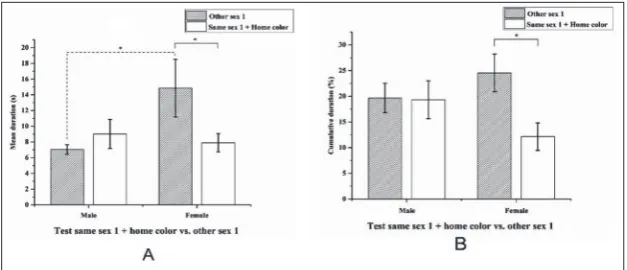
In the eighth and last behavioral test (Fig. 7), we found a potential effect of the environmental coloring compared to the results of the seventh test. In this instance, the females showed a significant preference for the “other sex 1” zone, both for cumulative dura-tion (Student’s t-test, t=2.096, N1=30, N2=30, P=0.032) and mean duration (Wilcoxon signed-rank test, W=177, Z=3.280, N1=30, N2=30, P=0.001). For the males, there was an equal preference between the two stimulus zones, both for the cumulative (Student’s t-test, t=0.064, N1=30, N2=30, P=0.949) and mean duration (Student’s t-test, t=-0.946, N1=30, N2=30, P=0.357).
DISCUSSION
Since environmental coloring does not seem to have a definitive role in zebrafish sociality, we wanted to exam-ine the sex-related shoaling differences by comparing the social stimuli preferences in different behavioral tests. We found significant differences when we com-pared the findings of “test home color vs. other sex 1” and “test home color vs. same sex 1”. The females showed an evident preference for the “other sex 1” stimulus with regarding to the cumulative duration (Student’s t-test, t=5.655, N1=30, N2=30, p<0.001), while males had an equal preference between the two stimuli (Student’s t-test, t=-0.172, N1=30, N2=30, P=0.864). Comparing the results of “test home color vs. other sex 3” and “test home color vs. other sex 1”, we found that female fish shoaled more with one male fish and less with 3 males (Student’s t-test, t=-2.733, N1=30, N2=30, P=0.013). Again, the males did not show a significant preference (Student’s t-test, t=0766, N1=30, N2=30, p=0.453).
Lastly, we compared the mean duration scores for the social stimuli zones for “test home color vs. other sex 3” and “test home color vs. same sex 3”. Females showed a stronger preference for the “other sex 3” (Wilcoxon signed-rank test, W=110, Z=2.146, N1=30,
N2=30, p=0.032) zone, and males for the “same sex 3” zone (Student’s t-test, t=-2.362, N1=30, N2=30, P=0.029).
Zebrafish are characterized by behavioral differ-ences between males and females. Zebrafish shoal-ing appears relatively early durshoal-ing postembryonic development, but the visual preferences for specific shoal-mates is established much later in development, and this preference appears immutable once it has been established [2,5]. We found sex-specific shoaling preferences and that females, considering the different variables for each behavioral test, were generally more active than males.
Since the absence of a natural preference between the red and green settings was previously documented in this species [24-26], we assigned randomly one habitat color per group. We observed in the first and second behavioral tests that environmental coloring does not have an “imprinting” effect on adult zebraf-ish. In fact, males preferred an empty arm instead of a green zone and females showed a higher preference for the green arm than the red one. Moreover, habitat colors in general did not influence the sociality of zebrafish when collocated alone in one arm of the cross-maze. In agreement with other studies [13-15], both males and females chose to spend most of the time close to the social compartment compared with an area without conspecifics. In all behavioral tests in which the environmental coloring influence on the shoaling preference was evaluated, we found sex-related differences. In particular, in the “test other sex 1 vs. same sex 1”, male fish shoaled more with an individual of the same sex, while females did not show a real preference between “other sex” or “same sex” stimuli. These results about female shoaling prefer-ences are not in agreement with the ideas provided in previous experiments [16], according to which a female group placed in a small environment without males tends to develop hierarchies of dominance with inter-individual negative interactions, compromising their reproductive success.
In the last behavioral test, we found that the re-sponse of the “home color + same sex 1” stimulus acted as a repellent element for male and female zebrafish. We speculate that zebrafish avoid an environment with environmental coloring, independent of the color, if it has the possibility to choose. In fact, as we found in
the eighth behavioral test, it is possible that the “home color” has a sort of negative influence on the natural shoaling preference of zebrafish.
CONCLUSIONS
We found significant sex-related differences between zebrafish responses to the different behavioral test. Male zebrafish shoaled more with an individual of the same sex rather than with a female. Females were more active but no significant difference between the two sex-stimulus zones was shown for females. Similar to what was documented in previous investigations, both males and females preferred social behavior instead of a zone without individuals and only with environmental coloring. The role of environmental coloring on shoaling preference remains unclear and further studies are needed to better investigate this.
Funding: This study was financially supported by the Project Resources Pilot Center for cross-border preservation of the aquatic biodiversity of Prut River MIS-ETC 1150 Romania-Ukraine-Republic of Moldova.
Author contributions: C.L. and S.A.S. developed the theory and performed the experiment. C.G. and A.C. verified the analytical methods and A.S. contributed to the interpretation of the results. M.N. and G.I.P. encouraged C.L. and S.A.S. to investigate this specific issue, provided research ideas related to it and supervised the obtained findings. All authors discussed the results and C.L., S.A.S., A.S. and A.C. wrote the final manuscript.
Conflict of interest disclosure: All authors declare that there are no conflicts of interest for this study.
REFERENCES
1. Hamilton F. An account of the fishes found in the river Gan-ges and its branches. Edinburgh, London: Archibald Con-stable and Co;1822. 333 p.
2. Engeszer RE, Da Barbiano LA, Ryan MJ, Parichy DM. Tim-ing and plasticity of shoalTim-ing behaviour in the zebrafish,
Danio rerio. Anim Behav. 2007;74(5):1269-75.
3. Gerlai R. High-throughput behavioral screens: the first step towards finding genes involved in vertebrate brain function using zebrafish. Molecules. 2010;15(4):2609-22.
4. Kalueff AV, Stewart AM, Gerlai R. Zebrafish as an emerging model for studying complex brain disorders. Trends Phar-macol Sci. 2014;35(2):63-75.
6. Spence R, Fatema MK, Ellis S, Ahmed ZF, Smith C. The diet, growth and recruitment of wild zebrafish (Danio rerio) in Bangladesh. J Fish Biol. 2007;71(1):304-9.
7. Spence R, Gerlach G, Laurence C, Smith C. The behav-iour and ecology of the zebrafish, Danio rerio. Biol Rev. 2008;83(1):13-34.
8. Darrow O, Harris WA. Characterization and development of courtship in zebrafish, Danio rerio. Zebrafish. 2004;1(1):40-5.
9. Rosenthal GG, Ryan MJ. Assortative preferences for stripes in danios. Anim Behav. 2005;70:1063-6.
10. Kalueff AV, Gebhardt M,Stewart AM,Cachat JM,Brimmer
M,Chawla JS. Towards a Comprehensive Catalog of
Zebraf-ish Behavior 1.0 and Beyond. ZebrafZebraf-ish. 2013;10(1):70-86. 11. Engeszer RE, Ryan MJ, Parichy DM. Learned social
prefer-ence in zebrafish. Curr Biol. 2004;14(10):881-4.
12. Pritchard VL, Lawrence J, Butlin RK, Krause J. Shoal choice in zebrafish, Danio rerio: the influence of shoal size and activity. Anim Behav. 2001;62(6):1085-8.
13. Ruhl N, McRobert SP. The effect of sex and shoal size on shoaling behaviour in Danio rerio. J Fish Biol. 2005;67:1318-26.
14. Etinger A, Lebron J, Palestis BG. Sex-assortative shoaling in zebrafish (Danio rerio). Bios. 2009;80(4):153-8.
15. Snekser JL, Ruhl N, Bauer K, McRobert SP. The Influence of Sex and Phenotype on Shoaling Decisions in Zebrafish. Intern J Comp Psychol. 2010;23:70-81.
16. Delaney M, Follet C, Ryan N, Hanney N, Lusk-Yablick J, Gerlach G. Social Interaction and Distribution of Female Zebrafish (Danio rerio) in a Large Aquarium. Biol Bull. 2002;203(2):240-1.
17. Colwill RM, Raymond MP, Ferreira L, Escudero H. Visual discrimination learning in zebrafish (Danio rerio). Behav Process. 2005;70(1):19-31.
18. Gahtan E, Tanger P, Baier H. Visual prey capture in larval zebrafish is controlled by identified reticulospinal neurons downstream of the tectum. J Neurosci. 2005;25(40):9294-303.
19. Park JS, Ryu JH, Choi TI, Bae YK, Lee S, Kang HJ, Kim CH. Innate Color Preference of Zebrafish and Its Use in Behav-ioral Analyses. Mol Cells. 2016;39(10):750-5.
20. Peeters BW, Moeskops M, Veenvliet AR. Color Preference in Danio rerio: Effects of Age and Anxiolytic Treatments. Zebrafish. 2016;13(4):330-4.
21. Bault ZA, Peterson SM, Freeman JL. Directional and color preference in adult zebrafish: Implications in behavioral and
learning assays in neurotoxicology studies. J Appl Toxicol. 2015;35(12):1502-10.
22. Spence R, Smith C. Innate and Learned Color Preference in the Zebrafish, Danio rerio. Ethology. 2008;114:582–8. 23. Owen MA, Rohrer K, Howard RD. Mate choice for a novel
male phenotype in zebrafish, Danio rerio. Anim Behav. 2012; 83:811-20.
24. Avedesh A, Martin-Iverson MT, Chen M, Groth DM, Mondal A, Morgan N, Lardelli M, Martins NR, Verdile G. Evaluation of color preference in zebrafish: A possible poten-tial model for learning and memory disorders. Alzheimers Dement. 2011;7:1-7.
25. Avedesh A, Martin-Iverson MT, Mondal A, Chen M, Ask-raba S, Morgan N, Lardelli M, Groth DM, Verdile G, Martins NR. Evaluation of color preference in zebrafish for learning and memory. J Alzheimers Dis. 2012;28:459-69.
26. Avedesh A, Martin-Iverson M, Mondal A, Chen M, Verdile G, Martins NR. Natural Color Preference in the Zebrafish
(Danio rerio). P Meas Behav. 2010;27:155-7.
27. Gerlai R, Lahav M, Guo S, Rosenthal A. Drinks like a fish: zebra fish (Danio rerio) as a behaviour genetic model to study alcohol effects. Pharmacol Biochem Behav. 2000;67(4):773-82.
28. Serra EL, Medalha CC, Mattioli R. Natural preference of zebrafish (Danio rerio) for a dark environment. Braz J Med Biol Res. 1999;32(12):1551-3.
29. Stephenson JF, Whitlock KE, Partridge JC. Zebrafish Prefer-ence for Light or Dark Is Dependent on Ambient Light Lev-els and Olfactory Stimulation. Zebrafish. 2011;8(1):17-22. 30. Commission Recommendation (2007/526/EC) of 18 June
2007 on guidelines for the accommodation and care of ani-mals used for experimental and other scientific purposes (notified under document number C(2007) 2525). Offic J Eur Union. 2007;50:197.
31. Directive 2010/63/EU of the European Parliament and of the Council of 22 September 2010 on the protection of animals used for scientific purposes. Offic J Eur Union. 2010;53:276. 32. Blaser R, Gerlai R. Behavioral phenotyping in zebrafish:
Comparison of three behavioral quantification methods. Behav Res Methods. 2006;38:456-69.
Supplementary Data
Supplementary Fig. S1.