ISSN-L: 2501 - 1235 Available on-line at: www.oapub.org/edu
doi: 10.5281/zenodo.3546453 Volume 5 │ Issue 12 │ 2019
ANALYZING THE RELATIONSHIP
BETWEEN ANAEROBIC PERFORMANCE WITH
ISCHEMIC PRECONDITIONING (IP) APPLICATION
Selin Baikoğlu1i,
Erdem Kaşıkçıoğlu2,
Şensu Dinçer3,
Türker Şahinkaya4, Cevat Güler5
1Res. Asst. Dr.,
İstanbul University-Cerrahpaşa,
The Department of Sports and Health Sciences Turkey 2Prof., İstanbul University, Sport Medicine Department, Turkey 3Specialist, İstanbul University, Sport Medicine Department, Turkey 4Lecturer, İstanbul University, Sport Medicine Department, Turkey 5Lecturer, İstanbul University,
The School of Foreign Languages,
Turkey
Abstract:
The purpose of this study is to analyze the effects on recovery and anaerobic resistance when ischemic preconditioning is applied to the lower extremities of athletes. 12 male volunteers participated in this study with average age of 21.58±1.52 years. After all details of this study were explained to participants and approvals were collected, rast anaerobic power test was applied on consecutive days and blood lactate levels were measured. For the data analysis, researchers applied the Wilcoxon Signed Ranks test among a parametric test to evaluate pre- and post- ischemia/reperfusion rast test results. Additionally, a repetitive Friedman test analysis was used for analyzing lactic acid parameters. Additionally, a repetitive Friedman test analysis was used for analyzing lactic acid parameters. The significance level for the test results was determined as p<0.05, and values below this level were evaluated as statistically
significant. When rast anaerobic power test results before and after the ischemia-reperfusion application were considered, it was seen that there was positive decrease in the fatigue index value, a positive increase in maximum power output and average power values, and that this had statistically significant results (p<0.05). Additionally, analysis results showed that when temporal level effects of ischemic preconditioning on lactic acid was analyzed, there was no difference on blood lactate values. One cycle of ischemia and reperfusion application showed statistically positive advancement for anaerobic power parameters. In this sense, it can be stated that ischemic preconditioning application increased anaerobic resistance in athletes.
Keywords: ischemic pre-conditioning, rast anaerobic power test, lactic acid, ischemia, reperfusion
1. Introduction
Athletes and coaches search for various methods to increase their athletic performance so as to be champions in their fields. It is important to guide athletes in training to satisfy their branch-specific unique sportive performance. These reasons lead sport scientists to physiologic measurements of athletes in different sports branches under field or laboratory conditions and to identify the relationship between test results and performance (Rhodes & McKenzie, 1984; Thorland et al., 1980). Ischemia is the insufficient oxygen flow to tissues or organs due to decreased blood flow caused by blockage in the arteries and reperfusion is the achievement of regular blood flow back to these tissues and organs (Granger & Korthuis, 1995; Zimmerman & Granger, 1994). Ischemic preconditioning is the protective mechanism for cells, tissues, or organs against damages against long term ischemia periods that can occur after short-term repetitive ischemia/reperfusion attacks (IP) (Murry, 1986).
Since the first discovery of this phenomenon in 1986, studies started to focus on positive benefits of protective effects on heart-muscle damages, heart-rhythm problems, coronary artery damages, and micro-vascular functional problems. Although the mechanism of ischemic preconditioning is unknown at the cellular level, it is believed that it has an important effect on protein kinas C activation, adenosine receptor stimulation, and ATP-dependent potassium canal activation (Baines et al., 1997).
upper leg in lower extremity and reported that there was no positive effect (Foster et al., 2011). Gibson et al. reported that there was no change in peak torque and total workforce values (Gibson et al., 2015).
The purpose of this study is to identify potential benefits of IP on anaerobic performance and lactic acid level by using an anaerobic rast test. This study will help increase our knowledge related to IP for increasing physical performance after tiring exercises. In line with the study purpose, the main hypothesis is that exercise performance will develop in a positive direction after adjusting to ischemia caused by IP factor created with a pressure cuff. If this study proves that IP increases athletic performance, it can be applied in rehabilitation techniques and performance development programs.
2. Method
2.1. Study Group
Participants were selected among people with similar height, weight, and age. Individuals without hypertension, vein problems, diabetes, cardiovascular diseases, lung disease, and any other muscle or skeleton system problems were included in this study. Additionally, participants were selected among individuals who were not using any medication and had not participated in any sportive activity for the past 6 months. Participants were asked if they smoked, used alcohol, or used any type of ergogenic supplement. After evaluating all these positive and negative factors that may impact the study, 12 healthy voluntary male students between 20-24 years old (21.58±1.52) in Istanbul University Sport Science Faculty were selected as experiment group. Participants were orally informed before this study and signed an approval form after reading and understanding the form. The planned applications and tests were applied between 09:00-12:00 after a light breakfast.
2.2 Experiment Design
Blood lactate values of participants that completed rast test were measured on min (0), 3 and 7. Values measured by rast test and lactate measurement were recorded. 2 days after the first test, the physiologic values of the subject were measured by resting on the ground before ischemia. Blood flow to both legs of the subjects were cut for 5 minutes with compression to femoral region with a pressure cuff with equal systolic blood pressure and ischemia is created. Physiologic values of each participant were measured in every minute after ischemia started and these values were simultaneously recorded. Blood lactate values of subjects that completed ischemia-reperfusion cycle were measured before rast test and subjects were tested after this measurement. As the test ended, blood lactate levels were measured at min 0, 3. and 7.
2.3 Exercise Protocol
Exercise protocol started after completing compression. Subjects were asked to run 35-meter long test field 6 times. After completing each run, the running time was recorded, and 10 seconds of resting was applied. The test was completed after the subject runs a 35-meter area for 6 times. Data obtained from subject group was recorded after rast anaerobic power test.
2.4. Statistical Analysis
After completing test measurements, obtained data were analyzed with SPSS 20 package program on computer environment. Anthropometric measurement values, physiologic parameter values, rast test, and lactic acid values of participants were recorded as the variables of this study.
For data analyzed, paired samples Wilcoxon Signed Ranks test was applied to evaluate pre- and post- I/R rast test results. Additionally, repetitive Friedman test analysis was used for analyzing lactic acid parameters. The significance level for test results was determined as p<0.05, and values below this level were evaluated as statistically significant.
3. Findings
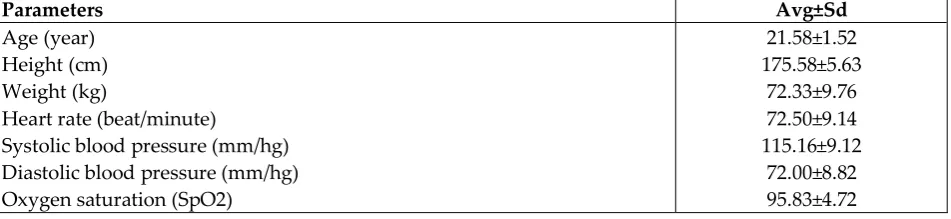
Table 1: Anthropometric properties and heart rate at rest, oxygen saturation, and blood pressure values of all participants (n:12)
Parameters Avg±Sd
Age (year) Height (cm) Weight (kg)
Heart rate (beat/minute)
Systolic blood pressure (mm/hg) Diastolic blood pressure (mm/hg) Oxygen saturation (SpO2)
21.58±1.52 175.58±5.63
72.33±9.76 72.50±9.14 115.16±9.12
Table 2: Wilcoxon analysis results of rast anaerobic power test before IP and after IP
Parameters Avg±Sd WZ P
FI before IP 17.879±4.845
-2.187 0.028*
FI after IP 13.699±3.916
Max. Power before IP 751.7±84.5
-3.059 0.002**
Max. Power after IP 629.0±93.3
Min. Power before IP 466.5±56.2
-2.237 0.25
Min. Power after IP 439.9±71.3
Avg. Power before IP 537.7±69.0
-3.059 0.002**
Avg. Power after IP 605.5±64.2
The power parameters for all participants are shown on Table 2. When non-parametrical Wilcoxon analysis results were compared for power parameter value of rast test before and after IP, it was seen that there was positive decrease in the fatigue index value in rast test after IP, positive increase in maximum power output and average power output and these showed statistically significant results (p<0.05).
Table 3: LA level comparison before and after rast anaerobic power test before IP
Parameters Averages Sd P
LA1 2.05 0.57
0.00**
LA2 9.09 1.85
LA3 13.95 2.43
LA4 14.02 2.04
*LA1:LA level before rast test, LA2: LA level at min 0 after rast test, LA3: LA level at min 3 after rast test, LA4: LA level at min 7 after Rrst test
Friedman test p value p<0,01
When Table 3 is analyzed, the Friedman test among non-parametric tests was selected to compare lactate values in rast anaerobic power test before and right after IP. P value was set as 0.012. It was seen that there was significant difference among blood lactate parameter comparison of min 0., 3. and 7. measured after rast test based on LA levels before rast test analysis (p<0.012).
Table 4: LA level comparison before and after rast anaerobic power test after IP application
Parameters Averages Sd P
LA1 2.54 0.97
0,00**
LA2 10.10 4.56
LA3 12.40 3.21
LA4 13.00 3.91
*LA1:LA level before rast test after IPK application, LA2: LA level at min 0 after rast test after IPK application, LA3: LA level at min 3 after rast test after İPK application, LA4: LA level at min 7 after rast test after IPapplication
Friedman test p value p<0,01
It was seen that there was significant difference among blood lactate parameter comparison of min 0., 3. and 7. measured after rast test based on LA levels before rast test analysis (p<0.012).
4. Results
Although numerous scientific application data, and recommendations are presented to increase exercise performance of sport players, one of the most interesting areas of research in this field is ischemic preconditioning. Since this method is affordable and can easily be applied, it is applied as one of the interesting methods to sport players who desire to increase exercise performance, and gain advantages for contests and races. Although effects of ischemic preconditioning on muscle power and kinematic of athletes was analyzed in laboratory environment in various studies, there are different findings and results for acute effects. This study focused especially on mechanisms after reperfusion in contraction mechanism in ischemic preconditioning methods and effects of these on anaerobic power. This study aims to reflect acute changes in the ischemic effect on anaerobic force by using a rast anaerobic power test. At the same time, as another purpose of this study, this study investigated lactic acid value change as an indicator of anaerobic performance at the end of ischemia-reperfusion cycle. In this study, both lower extremities were subject to ischemia to achieve more effective results with larger skeletal muscle masses during ischemic preconditioning. Accordingly, both lower extremities were occulted from femoral region below ingual ligament. It is believed that including larger muscle groups to ischemia simultaneously is can better express the relationship between anaerobic power and performance. It is necessary to accept that the systemic impact by ischemia in small muscle groups and adaptive changes can be weak. It is believed that systemic effect on different muscle groups with larger muscle mass has critical importance.
As a result of power parameter analysis obtained from rast test, it was seen that ischemia-reperfusion cycle might have significant effect on anaerobic power. It is believed that this effect is limited as applied ischemia-reperfusion cycle occurred in one cycle. Fatigue index plays a vital role for athletes to sustain their performances. When rast test vales after ischemia were considered, it was seen that there was a decrease in fatigue index as the indicator of anaerobic power in the positive direction compared to rast test before ischemia. Decreased fatigue index and statically significant positive increase in maximum power and average power parameters are the clearest results of this study. In addition to these parameters, we have obtained relatively significant results in minimum power value analyzed before and after IP.
When literature is reviewed, although there were significant difference with the Wingate test for other ischemia-reperfusion studies conducted with different methods, there are also significant amount of articles with different results (Foster et al., 2011;
male athletes (Patterson et al., 2014). Kraus et al. supported Patterson et al. in Wingate test studies by creating ischemia and found that it had statistically significant effect on peak torque and average power values, and had feedbacks regarding IP increasing anaerobic performance (Kraus et al., 2015). Studies with different findings reported that IP had no positive increase for performance. Lalonde and Curnier found that IP caused no increase on any anaerobic power parameter values. Authors reported that there was statistically significant decrease in average power and peak torque parameters in each repetition (Lalonde and Curnier, 2015). Another study that supported decrease in power and peak parameters was conducted by Hittinger et al. which created ischemia on both upper legs of 15 triathlon participants and showed that there was no
improvement in anaerobic performance (Hittinger et al., 2015). Baikoğlu and Kaldırımcı
(2019) used a different application method and applied 5 minute ischemia-reperfusion cycle on both upper legs. Results of that study reported that ischemia-reperfusion
application lead to no change in anaerobic power values (Baikoğlu & Kaldırımcı, 2019).
It is believed that the most important properties for different results presented by all of these different studies analyzing anaerobic performance were caused by characteristics of the experiment group as well as the ischemia method. Despite these results, and especially since anaerobic power parameters and ischemia/reperfusion acute response showed no statistical significance, it is unclear how chronic ischemia-reperfusion chronic effects change and happen.
Additionally, this study tried to investigate large muscle mass ischemia lactic acid value with the applied study method. When blood lactate levels were compared with each other measured before and after rast anaerobic power test without ischemia-reperfusion cycle (min 0., 3. and 7.) showed statistically significant difference. When these measurements were made for the second time to understand the effect of IP on lactate, ischemia-reperfusion cycle was created at blood lactate level. When blood lactate levels of subject after rast test (min 0., 3. and 7.) were compared with each other, we achieved significant results. In both cases, when lactic acid level increase was compared with each other at temporal level, it is an important result to obtain increasing blood lactic acid levels. Study results show that ischemia-reperfusion cycle had no significant effect on blood lactate level. Additionally, since intramuscular lactic acid levels were no considered, this weakens significance of lactic acid change.
Similar results to our study were presented by Bailey et al. who worked on 13 trained athletes, investigated effects of IP on aerobic performance during maximal and sub-maximal exercise, and found that during sub-maximal test, lactate concentration decreased at each workload increase (Bailey et al., 2012b). Additionally, since post-exercise blood-lactate level could be an indicator for anaerobic capacity, some studies compared blood lactate values of experiment and control group and reported that there was no difference between IP and post-exercise blood lactate levels (Clevidence et al., 2012; Paixao et al., 2014).
the sample size to detect better and more accurate results reported with modest rates until now. Additionally, direct comparisons are needed to identify different IP protocols, exercise methods, individual fitness levels, and differences in past sports and whether these factors played a role on IP are effective and to better understand potentially responding or non-responding phenotypes to IP. Generally, applicability of IP as an ergogenic support and second level clinical rehabilitation is promising but there is still need for more research.
Reference
Baikoğlu S., Kaldırımcı M. (2019). Effect of ıschemıc pre-conditioning on lactate and
anaerobıc performance. Acta Medica Mediterranea, 35, 159-164.
Bailey T. G., Birk G. K., Cable N. T., Atkinson G., Green D. J., Jones H., Thijssen D. H. (2012b). Remote ischemic preconditioning prevents reduction in brachial artery
flow-mediated dilation after strenuous exercise. Am J Physiol Heart Circ Physiol, 303, 533–538.
Baines C. P., Goto M., Downey J. M. (1997). Oxygen Radicals Released During Ischemic Preconditioning Contribute to Cardioprotection in The Rabbit Myocardium, J Mol Cell Cardiol, 29, 207-216.
Clevidence M. W., Mowery R. E., Kushnick M. R. (2012). The effects of ischemic preconditioning on aerobic and anaerobic variables associated with submaximal cycling performance. Eur J Appl Physiol, 112, 3649-3654.
Crisafulli A., Tangianu F., Tocco T., Concu A., Mameli O., Mulliri G., Caria M. A. (2011).
Ischemic Preconditioning of The Muscles İmproves Maximal Exercise
Performance But Not Maximal Oxygen Uptake in Humans. J Appl Physiol, 111, 530-536.
De Groot P., Thijssen D., Sanchez M., Ellenkamp R., Hopman M. T. (2010). Ischemic Preconditioning Improves Maximal Performance in Humans. Eur J Appl Physiol,
108, 141-146.
Foster G. P., Westerdahl D. E., Foster L. A., Hsu J. V., Anholm J. D.. (2011). Ischemic Preconditioning of The Lower Extremity Attenuates The Normal Hypoxic
İncrease in Pulmonary Artery Systolic Pressure. Respir Physiol Neurobiol, 179, 248–253.
Gibson N., Mahony B., Tracey C., Fawkner S., Murray A. (2015). Effect of Ischemic Preconditioning on Repeated Sprint Ability in Team Sport Athletes. J Sports Sci,
33, 1182-1188.
Granger D. N., Korthuis R. J. (1995). Physiologic mechanisms of postischemic tissue injury. Annu Rev Physiol, 57, 311-332.
Jean-St E., Manlhiot C., Li J., Tropak M., Michelsen M. M., Schmidt M. R., Mccrindle B. W., Wells G. D., Redington A. N. (2011). Remote Preconditioning Improves Maximal Performance in Highly Trained Athletes. Med Sci Sports Exerc, 43, 1280–
1286.
Kjeld T., Rasmussen M. R., Jattu T., Nielsen H. B., Secher N. H. (2014). Ischemic Preconditioning of One Forearm Enhances Static and Dynamic Apnea. Med Sci Sports Exerc, 46, 151–155.
Kraus A. S., Pasha E. P., Machin D. R., Alkatan M., Kloner R. A., Tanaka H. (2015). Bilateral Upper Limb Remote Ischemic Preconditioning Improves Anaerobic Power. Open Sports Med J, 9, 1-6.
Lalonde F., Curnier D. Y. (2015). Can anaerobic performance be improved by remote ischemic preconditioning? J Strength Cond Res, 29, 80–85.
Murry C. E., Jennings R. B., Reiber K. A. (1986). Preconditioning with ischemia: a delay of lethal cell injury in ischemic myocardium. Circulation, 74, 1124-1136.
Paradis-Deschênes P., Joanisse D. R., Billaut F. (2017). Sex-Specific İmpact of Ischemic
Preconditioning on Tissue Oxygenation and Maximal Concentric Force. Front Physiol, 7, 674-682.
Patterson S. D., Bezodis N. E., Glaister M., Pattison J. R. (2015). The Effect of Ischemic Preconditioning on Repeated Sprint Cycling Performance. Med Sci Sports Exerc,
47, 1652–1658.
Paixao R. C., da Mota G. R., Marocolo M. F. (2014). Acute effect of ischemic preconditioning is detrimental to anaerobic performance incyclists. Int J Sports Med, 35, 912–915.
Rhodes EC, McKenzie DC. (1984). Predicting marathon times from anaaerobic threshold measurements. Physician Sports Med, 12, 95-98.
Thorland W., Sandy S., Refsell M. (1980). Anaerobic threshold and maximal oxygen consumption rates as predictors of cross country running performance. Med. Sic. Sports Exercise, 12, 87.
Creative Commons licensing terms