ARTIGO ORIGINAL
ABSTRACT
Introduction: Aortic valve replacement surgery is done to increase patients’ life expectancy and improve their health-related quality of life. Several published studies have found improvement in health-related quality of life after this procedure, but none have involved patients in Portugal. This study sought to evaluate patients’ health-related quality of life after the implantation of aortic prostheses and compare these values with preoperative health-related quality of life and the general Portuguese population’s health-related quality of life.
Material and Methods: A retrospective study was done with elective patients who underwent implantation of an aortic prosthesis between August 2011 and April 2016. Health-related quality of life was evaluated using the Short Form 36 Health Survey and Short Form 6 Health Survey questionnaires in the preoperative period and 3, 6 and 12 months post-surgery. Descriptive and inferential analyses were conducted to process the data and compare preoperative health-related quality of life with postoperative values and the Portuguese population’s norms.
Results: The sample included 506 patients with an average age of 70.6 years. The majority are male (53.6%). The postoperative results show a statistically significant improvement compared to preoperative health-related quality of life in all eight dimensions of the Short Form 36 Health Survey. When contrasted with the general Portuguese population, patients’ health-related quality of life is lower in the preoperative period, improving postoperatively and reaching higher than average health-related quality of life levels in some subgroups of patients and in various dimensions. An analysis of the Short Form 6 Health Survey results revealed that the patients undergoing this surgery have a higher level of preoperative problems compared with the general population, but these patients’ values approach those of the general population by the end of one year post-surgery.
Discussion: This is the first study in Portugal that compares health-related quality of life using a validated scale, before and after the aortic prosthesis implantation surgery. The results demonstrate a significant improvement in all dimensions, which is not consistently observed in other published studies.
Conclusion: The results confirm that the implantation of aortic prostheses improves patients’ health-related quality of life, over time bringing it close to the general population’s levels.
Keywords: Aortic Valve/surgery; Heart Valve Prosthesis Implantation; Quality of Life; Surveys and Questionnaires RESUMO
Introdução: O objetivo da cirurgia de substituição valvular aórtica é o aumento da esperança de vida e a melhoria da qualidade de vida relacionada com a saúde. Existem vários estudos que evidenciam melhoria da qualidade de vida relacionada com a saúde nestes doentes, mas não aplicados à população portuguesa. O objetivo deste estudo é avaliar a qualidade de vida relacionada com a saúde pós-implantação de prótese aórtica e comparar com a qualidade de vida relacionada com a saúde pré-operatória e da população em geral.
Material e Métodos: Foi feito um estudo retrospetivo de doentes eletivos submetidos a implantação de prótese aórtica entre agosto de 2011 e abril de 2016. A qualidade de vida relacionada com a saúde foi avaliada com o Short Form 36 Health Survey Instrument e com o Short Form 6 Health Survey Instrument no pré-operatório e aos 3, 6 e 12 meses pós-cirurgia. Foram realizadas análises descritivas e inferenciais para analisar globalmente a amostra e para comparar a qualidade de vida relacionada com a saúde pré-operatória com a pós-operatória e com as normas da população portuguesa.
Resultados: Foram incluídos 506 doentes, com idade média de 70,6 anos, sendo 53,6% do sexo masculino. Os resultados do pós-operatório evidenciam uma melhoria estatisticamente significativa quando comparados com o pré-pós-operatório nas oito dimensões do Short Form 36 Health Survey Instrument. Comparando com a população Portuguesa em geral, a qualidade de vida relacionada com a saúde dos doentes é inferior no pré-operatório, melhorando no pós-operatório, atingindo níveis de qualidade de vida relacionada com a saúde superiores nalguns subgrupos de doentes e em algumas dimensões. Os resultados do Short Form 6 Health Survey Instrument revelam maior intensidade de problemas no pré-operatório quando comparados com a população em geral, aproximando-se dos valores população em geral ao final de um ano pós-cirurgia.
Discussão: Este é o primeiro estudo realizado em Portugal que compara a qualidade de vida relacionada com a saúde, usando uma escala validada, antes e depois da cirurgia de implantação de prótese aórtica. Os resultados demonstram a existência de uma melhoria significativa em todas as dimensões, o que não acontece consistentemente noutros estudos publicados.
Conclusão: A implantação de prótese aórtica melhora a qualidade de vida relacionada com a saúde dos doentes, permitindo que esta se aproxime dos resultados da população em geral.
Palavras-chave: Implante de Prótese de Válvulas Cardíacas; Inquéritos e Questionários; Qualidade de Vida; Válvula Aórtica/cirurgia
Does Aortic Valve Replacement Surgery Improve Patients’
Quality of Life?
A Cirurgia de Substituição Valvular Aórtica Melhora a
Qualidade de Vida dos Doentes?
1. Serviço de Cirurgia Cardiotorácica. Hospital de Santa Marta. Centro Hospitalar de Lisboa Central. Lisboa. Portugal. 2. Faculdade de Ciências Médicas. Universidade Nova de Lisboa. Lisboa. Portugal.
3. Escola Superior de Gestão, Hotelaria e Turismo. Universidade do Algarve. Faro. Portugal. 4. Centro de Estudos e Investigação em Saúde. Universidade de Coimbra. Coimbra. Portugal. Autor correspondente: Lara N. Ferreira. [email protected]
Recebido: 14 de janeiro de 2018 - Aceite: 15 de maio de 2018 | Copyright © Ordem dos Médicos 2018
Pedro COELHO1,2, Lara N. FERREIRA3,4, Clara VITAL1, José FRAGATA1,2
ARTIGO ORIGINAL INTRODUCTIONThe prevalence of aortic stenosis is age-dependent,
from a low of 0.02% in patients aged 18-44 to a high of 2.8% in patients over 75.1 Angina, dyspnoea and syncope are the
major symptoms of the disease2 and their presentation is
directly related to mean survival of 5, 3 and two years, re-spectively.3 Aortic valve replacement is the treatment for a
high number of patients, aimed at an increased survival and an improvement in patient’s quality of life.4 Mostly elderly
patients have undergone this surgery, at a time when their life expectancy had already been reached and therefore health-related quality of life (HRQoL) is of crucial signifi-cance.
An increasing relevance regarding the study of HRQoL in cardiac patients has been found over the past few years5-9
and generic instruments such as the Short Form 36 Health Survey Instrument (SF-36) or the EuroQol (EQ-5D) have been mostly used. In fact, different articles were focused on the study of HRQoL in patients having undergone sur-gery,10-14 although few have been carried out in Portugal15,16
and none involved a comparison with the Portuguese popu-lation, which would allow for the identification and assess-ment of the impact of the disease.
This study was aimed at the measurement of the HRQoL in patients submitted to aortic valve replacement in a Portu-guese surgical centre over a five-year period (2011-2016).
MATERIAL AND METHODS Study design
This was a retrospective study with prospectively col-lected data at the Department of Cardiothoracic Surgery in the Hospital de Santa Marta. All the patients who underwent an aortic valve prosthesis implantation between Aug 2011 and Apr 2016 were included in the study and patients who underwent urgent and emergent surgery, as well as those who were admitted to other hospitals before surgery were excluded from the study, together with those who were not able to complete the questionnaire due to language diffi-culties. Patients who underwent any other procedure apart from the aortic valve prosthesis implantation at the same surgical time were also excluded. The SF-36v2 was applied in person to patients on the day before surgery and at 3, 6 and 12 months postoperatively. Telephone questionnaires were applied to patients who attended follow-up with more than a 15-day delay from the previously described dates or to patients lost to follow-up. Survey has been applied by nurses who were responsible by perioperative nursing. Tel-ephone questionnaires were applied by nurses who were responsible by patient’s follow-up.
Respondents were explained about the study aims, namely the fact that questionnaires were applied as a rou-tine to all patients who underwent surgery at the depart-ment and that results allowed for monitoring patient health status. An informed consent has been completed by all the patients.
Measures
Self-awareness of health status and HRQoL were meas-ured through the Short Form 36 Health Survey (SF-36v2) and the Short Form 6 Health Survey (SF-6D), respectively.
Short Form 36 Health Survey- SF-36v2
A total of eight health-related dimensions are measured with this 36-item survey on a 0 to 100 scale - the SF-36, with the extreme scores corresponding to the worst and the best possible HRQoL, including physical functioning (PF), role physical (RP), bodily pain (BP), general health (GH), vitality (VT), social functioning (SF), role emotional (RE) and mental health (MH).17,18 A comprehensive description of the
compo-nents of each dimension may be found in Ferreira et al.19
The eight SF-36 dimensions may be aggregated in physical and mental health summary scales20. PF, RP, BP
and GH are combined in a physical health summary (PHS) score, while MH, RE, SF and VT are included in a mental health summary (MHS) score. This instrument is used all over the world either in general population21,22 as in
popula-tion subgroups23 or in groups of patients24,25 and different
translations and validities have been developed. Earlier this century the first version of the instrument was validat-ed for the Portuguese population.26,27 The original version
of the SF-36 was subsequently modified by the authors in order to allow for an adaptation of the SF-36 to different languages and cultural environments and a second version has been developed (SF-36v2).28 The second Portuguese
version and the Portuguese norms for this version were de-veloped in 2003.29 This new version (SF-36v2) as well as
its norms were based on the responses of a sample of the Portuguese population (n = 2,549) to the survey and to socio-demographic subjects. Data were collected in 1999 by personal interview at respondents’ homes.
The relevance of normative values or population norms that may be used as reference data for the interpretation of the scores obtained in a certain study has been mentioned by different studies.21,30 These data allowed for the
compari-son of data from different patients with specific conditions vs. those from the general population within a similar age group and/or gender.31,32 These comparisons allow for the
identification of health status burden in a specific population with a certain disease. Therefore, the results obtained in this study were compared to the norms for the Portuguese population regarding the SF-36v229 and to those
regard-ing physical and mental health summary in SF-36v2.19 The
norms regarding physical and mental health summary of the SF-36 were published by Ferreira et al.19 Data were
ARTIGO ORIGINAL Short Form 6 Health Survey- SF-6D
The SF-6D is an econometric index based on preferenc-es regarding 11 items of the SF-36 that were converted into a six-dimension system, with four to six levels each, allow-ing for the development of a total of 18,000 different health
states33 and was aimed at the evaluation of one of the most
widespread health profiles, the SF-36, i.e. also making it an instrument for preferences measurement. A representative sample of the UK population has been used by the authors and scores were assigned to 249 health states defined with the SF-6D by using the standard gamble technique.33 These
scores allowed for an estimate of econometric models in which different weights were assigned to the levels of each dimension in SF-6D and scores for SF-6D health states were generated. These health state scores corresponded to an index, the SF-6D index, which may be considered as a continuous value on a 0.35-1.00 scale. The popularity of the 6D comes from the fact that it was obtained from the SF-36 and therefore it may be used in every language to which the SF-36 (both versions) has been officially translated and validated. Scoring systems have been developed for differ-ent countries over the past few years,34-38 the Portuguese
version of the SF-6D was developed in 200639 and the
Por-tuguese scoring system for the SF-6D in 2010.40
The development of norms for the SF-6D allowed for the analysis of health care outcomes and the outcomes of other interventions, the measurement of disease burden and comparisons between subgroups of the population and the general population, as well as regional comparisons or comparisons between countries. As regards the SF-6D, normative data have been published for different countries including the United Kingdom,41 Australia30 and Portugal.42
A representative sample of the Portuguese population (n = 1,500) has responded to the SF-36v2 through a telephone interview. The scoring system of the SF-6D has been used to obtain the SF-6D index and the norms for the SF-6D re-garding the Portuguese population. Additional details on the study design and sampling are available in Ferreira et al.42
Data analysis
Descriptive and inferential analysis have been applied to socio-demographic variables, to SF-36v2 dimensions, to SF-36v2 physical (PHS) and mental health summary (MHS), to SF-6D dimensions and to the SF-6D index scores. Fre-quency distributions and descriptive statistical measures were obtained. Charts were also used to provide for bet-ter understanding on the comparison between estimated mean scores in SF-36v2 dimensions and PHS and MHS in our group of patients and in the Portuguese population. Parametric (t-test and ANOVA) and non-parametric (Wil-coxon and Kruskal Wallis) tests were used for the inferential analysis according to the characteristics of the distribution. These techniques were used in the global analysis of the group of patients and to compare preoperative and postop-erative HRQoL (3, 6 and 12 months). Self-reported health status and HRQoL scores of the group of patients were also compared to the norms for the general Portuguese popu-lation.19,29,42 The expressions that were determined for the
Portuguese population by Ferreira et al. were used to calcu-late the SF-36v2 PHS and MSH.19 The SF-6D index score
was based on the Portuguese scoring system.40
Data were analysed with SPSS Statistics, version 24 IBM software, with a 5% level of significance for all the sta-tistical analyses.
RESULTS Sample
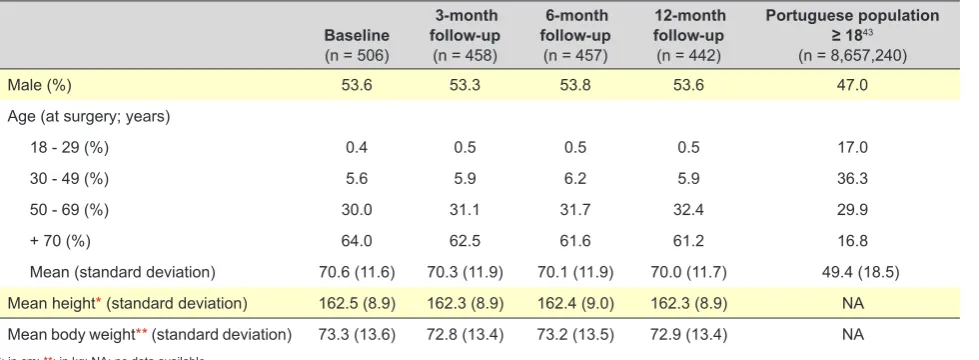
The major characteristics of our group of patients are shown in Table 1, at baseline and follow-up; in addition, the same information regarding the Portuguese population aged 18 or over is also shown.43 A total of 506 patients were
initially included in our group, mostly male and aged over 50, mean age 70.6. A 73 kg mean body weight and 162.5 cm height have been found. A total of 458, 457 and 442 pa-tients were assessed at 3, 6 and 12 months postoperatively, respectively, meaning that one year later around 87% of the initially included patients were followed (some patients had since died and others were lost to follow-up or were
Table 1 – Characteristics of the initial group of patients, at follow-up and of the Portuguese population
Baseline
(n = 506)
3-month follow-up
(n = 458)
6-month follow-up
(n = 457)
12-month follow-up
(n = 442)
Portuguese population
≥ 1843 (n = 8,657,240)
Male (%) 53.6 53.3 53.8 53.6 47.0
Age (at surgery; years)
18 - 29 (%) 0.4 0.5 0.5 0.5 17.0
30 - 49 (%) 5.6 5.9 6.2 5.9 36.3
50 - 69 (%) 30.0 31.1 31.7 32.4 29.9
+ 70 (%) 64.0 62.5 61.6 61.2 16.8
ARTIGO ORIGINAL not provided with the questionnaire for completion). Some patients have completed the questionnaire by phone, even
though some phone calls were not established on time for the study. Similar characteristics to baseline were found, as it would be expected (Table 1).
The major characteristics of the group of patients un-dergoing surgery are shown in Table 2, considering their comorbidities, type of replacement, length of stay in ICU, length of in-hospital stay, postoperative complications and 30-day and 1-year mortality rate. In terms of comorbidity, a high percentage of patients presented with high blood pres-sure, hypercholesterolaemia and diabetes mellitus. Mostly Canadian Cardiovascular Society (CCS) angina class I and II patients and New York Heart Association (NYHA) heart failure class II and III patients were found. This distribution was explained by the higher frequency of heart failure with this type of pathology. Mostly biological prostheses were
used, explained by the fact that most patients were over 65. The incidence of postoperative complications fell within the expected range. A EUROSCORE I risk stratification has been carried out and a lower than expected 30-day mor-tality rate was found. A total of 41 deceased patients were found (30-day and 1-year mortality), corresponding to 64% of the patients who became lost to follow-up.
The evolution of health-related quality of life and com-parison with the population norms
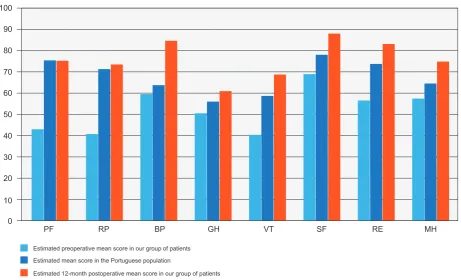
A comparison between estimated preoperative and 1-year postoperative SF-36 mean scores in patients and in the Portuguese population is shown in Fig. 1. An improve-ment in patient’s health status has been found regarding all the dimensions. Similar postoperative scores regarding physical dimensions (physical functioning and role physical) were found in our group of patients, when compared to the
Table 2 – Level of comorbidity in patients who underwent surgery (n = 506), type of aortic valve prosthesis, length of in-hospital stay,
postoperative complications and mortality
Number / mean (standard deviation) %
Body mass index 28.3 (8.0)
-Angina CCS 0 104 20.6
CCS I 259 51.2
CCS II 111 21.9
CCS III 30 5.9
CCS IV 2 0.4
New York Heart Association class NYHA I 15 29.6
NYHA II 207 40.9
NYHA III 275 54.3
NYHA IV 9 1.8
High blood pressure 435 86
Hypercholesterolaemia 368 72.8
Diabetes mellitus 347 68.6
Chronic obstructive pulmonary disease 49 9.7
Preoperative serum creatinine 1.0 (0.5)
-Ejection fraction ˂ 30% 10 2
30% - 49% 91 18
˃ 49% 405 80
EUROSCORE I 6.8 (5.1)
-Type of aortic valve prosthesis Biological 404 79.8
Mechanical 102 20.2
Length of stay in ICU 2.7 (2.2)
-Stroke 8 1.6
Prolonged ventilation (> 24 hours) 17 3.4
Prolonged inotropic support (> 24 hours) 140 27.7
Atrial fibrillation 92 18.2
Blood transfusion 345 68.2
Length of in-hospital stay 9.6 (7.1)
-30-day mortality rate 6 1.2
12-month mortality rate 35 6.9
ARTIGO ORIGINAL
Figure 1 – Comparison between estimated preoperative and 12-month postoperative mean score in SF-36 dimensions in our group of
patients and in the Portuguese population29
PF: physical functioning; RP: role physical; BP: bodily pain; GH: general health; VT: vitality; SF: social functioning; RE: role emotional; MH: mental health 0
Estimated preoperative mean score in our group of patients
Estimated 12-month postoperative mean score in our group of patients Estimated mean score in the Portuguese population
PF RP BP GH VT SF RE MH
10 20 30 40 50 60 70 80 90 100
Portuguese population. Instead, even though an improve-ment has been found, patient scores regarding bodily pain and mental health were still quite below those found in the Portuguese population.
Comparisons between estimated SF-36v2 PHS mean scores in patients and the Portuguese population are shown in Fig. 2.Postoperative scores in patients were simi-lar to those found in the Portuguese population, as it would be expected. A slightly higher estimated postoperative PHS score when compared to the Portuguese population has been found in male patients and estimated postoperative SF-36v2 PHS mean score has always been higher in pa-tients aged over 30 when compared to those found in the Portuguese population, except in younger patients, in whom mean PHS scores were slightly lower than those found in the Portuguese population.
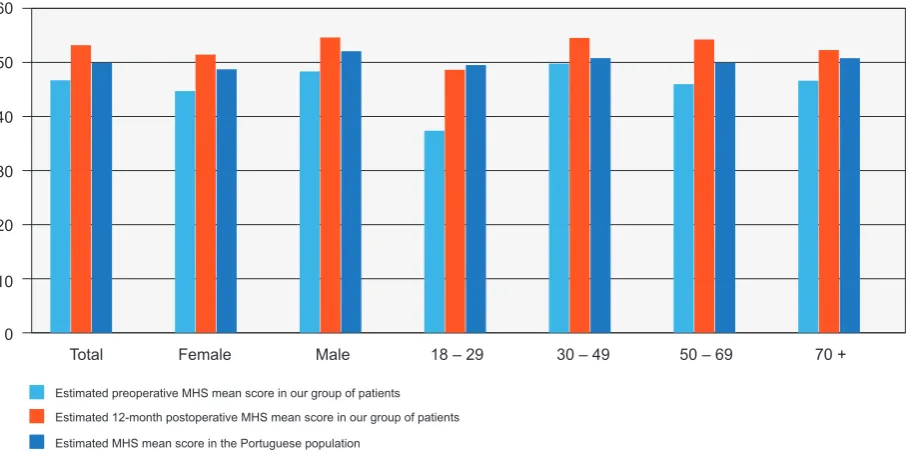
Higher 1-year postoperative vs. preoperative mean scores were found, as it happened with PHS score, either globally and by gender and age group, with statistically significant differences, as shown in Fig. 3. It is worth men-tioning that higher postoperative scores have been globally found in patients vs. the Portuguese population, in both genders and all age groups, except in people aged 30 or under.
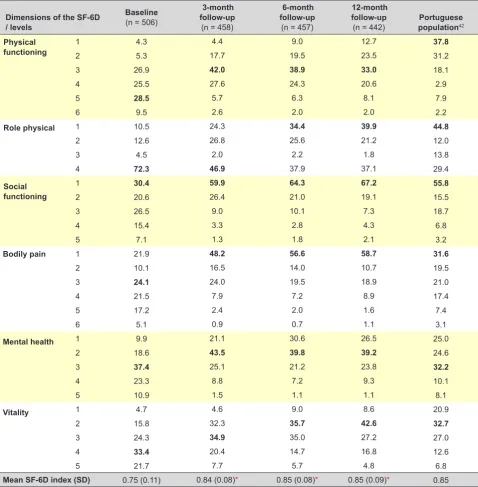
As regards HRQoL (Table 3), the SF-6D descriptive system showed that, for each level and dimension, more severe problems when compared to the Portuguese popu-lation have been found in patients in need for aortic valve replacement,42 with statistically significant differences.
Se-vere issues were described in all the dimensions and less
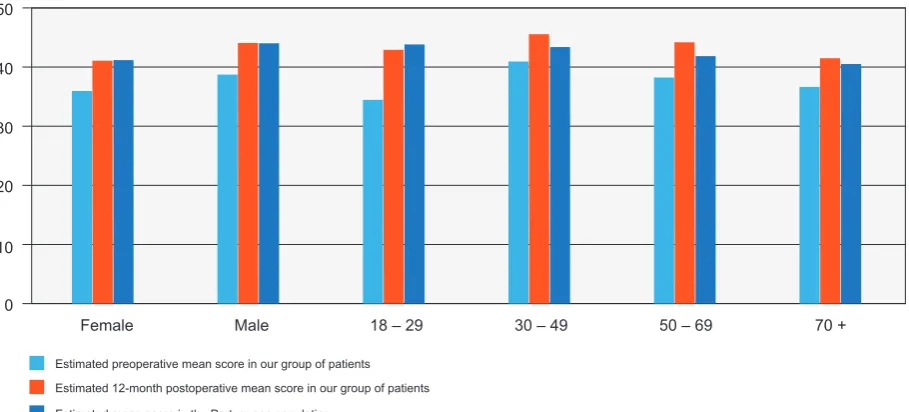
severe issues regarding social functioning dimension were described. Clear improvements have been found in all the dimensions. The SF-6D index has ranged between 0.38 and 1.00, with a 0.75 mean value, below what has been found in the Portuguese population. With surgery, patient’s HRQoL has improved and similar mean SF-6D index scores to the Portuguese population have been found. Statistical-ly significant differences have been found when 3, 6 and 12-month SF-6D indexes were compared to baseline and throughout time (6 vs. 3 months and 12 vs. 3 months). The evolution of the SF-6D index by gender and age group and compared to the Portuguese population is shown in Fig. 4. As expected, a higher HRQoL was found in male patients and postoperative scores were higher in both gen-ders, coming closer to what was found in the Portuguese population. A decline in HRQoL has been found with pa-tient’s increasing age beyond 30, despite a higher postop-erative HRQoL found in all age groups, as expected, even higher than those found in the Portuguese population. The youngest age group was the exception, as a very low pre-operative HRQoL score has been found in patients aged 18 to 29, probably due to the fact that the issue is perceived by these patients as a great limitation to normal activity. A great increase in HRQoL has been found at 12 months postoper-atively in these patients, coming closer to the scores found in the Portuguese population.
DISCUSSION
ARTIGO ORIGINAL
SF-36 v2 which was applied preoperatively and 3, 6 and 12 months postoperatively. Postoperative results have shown a statistically significant improvement when compared to preoperatively in all the 8 dimensions of the SF-36 v2. Worse preoperative results were found when compared to the Portuguese population. Similar scores to the general population regarding physical functioning and role physical were found at 12 months, while worse scores were found regarding bodily pain and mental health.
Mean physical health summary scores came closer to what was found in general population and was even higher in male patients. This may be explained by the fact that el-derly patients with a low level of comorbidity were included
in this group of patients, as opposed to the general popu-lation with the same age. In patients under the age of 30, a lower mean score has been found, when compared to general population, while a higher score has been found beyond this age. However, these results should be care-fully considered due to the small number of patients aged 30 or younger in our group. Higher mental health summary postoperative vs. preoperative scores were found and were even higher when compared to the general population in both genders and all age groups except in patients aged 30 or younger. This may be due to the fact that significant physical limitations are usually related to the disease and therefore any improvement has a great impact on mental
Figure 3 – Comparison between estimated preoperative and 12-month postoperative mean score in SF-36v2 mental health summary
(MHS) in our group of patients and in the Portuguese population29 by gender and age group
0
Estimated preoperative MHS mean score in our group of patients
Estimated MHS mean score in the Portuguese population
Estimated 12-month postoperative MHS mean score in our group of patients
Total Female Male 18 – 29 30 – 49 50 – 69 70 +
10 20 30 40 50 60
Figure 2 – Comparison between estimated preoperative and 12-month postoperative mean score in SF-36v2 physical health summary
(PHS) in our group of patients and in the Portuguese population29 by gender and age group
0
Estimated preoperative PHS mean score in our group of patients
Estimated PHS mean score in the Portuguese population
Estimated 12-month postoperative PHS mean score in our group of patients
Total Female Male 18 – 29 30 – 49 50 – 69 70 +
ARTIGO ORIGINAL
health at an initial stage upon surgery.
For each level or dimension of the SF-6D, enhanced preoperative issues were described by patients when com-pared to general population and similar issues were found at one year postoperatively. Better scores were found in male patients.
A postoperative improvement in all the dimensions of the SF-36 has been found, which is not consistently the case with other studies on this type of procedure.10,13
How-ever, an improvement in patient’s quality of life with an aortic valve replacement surgery can be safely considered, in line with our results and those by other authors.12,14
Surgery-re-lated quality of life has also been a subject in different stud-ies. A similar improvement to aortic valve replacement has
been found with coronary revascularisation surgery,44 even
though better patient recovery had been found.45 The fact
that better results have been found in male patients may be explained by lower preoperative scores in most of the di-mensions, in line with other studies.46,47 Similar or even
bet-ter postoperative quality of life was found in patients when compared to general population, as found in this study and confirmed by others.14 Higher postoperative bodily pain was
higher in patients than in general population and remains a major issue. A high incidence of bodily pain has been found (around 10% of the patients), in line with Gjeilo et al.11
Two studies aimed at the assessment of the quality of life in the Portuguese population who underwent aortic prosthesis implantation have been carried out, even though
Table 3 – Population estimates regarding the dimensions of the SF-6D (%)
Dimensions of the SF-6D / levels
Baseline
(n = 506)
3-month follow-up
(n = 458)
6-month follow-up
(n = 457)
12-month follow-up
(n = 442) populationPortuguese 42
Physical
functioning 12 4.35.3 17.74.4 19.59.0 12.723.5 37.831.2
3 26.9 42.0 38.9 33.0 18.1
4 25.5 27.6 24.3 20.6 2.9
5 28.5 5.7 6.3 8.1 7.9
6 9.5 2.6 2.0 2.0 2.2
Role physical 1 10.5 24.3 34.4 39.9 44.8
2 12.6 26.8 25.6 21.2 12.0
3 4.5 2.0 2.2 1.8 13.8
4 72.3 46.9 37.9 37.1 29.4
Social functioning
1 30.4 59.9 64.3 67.2 55.8
2 20.6 26.4 21.0 19.1 15.5
3 26.5 9.0 10.1 7.3 18.7
4 15.4 3.3 2.8 4.3 6.8
5 7.1 1.3 1.8 2.1 3.2
Bodily pain 1 21.9 48.2 56.6 58.7 31.6
2 10.1 16.5 14.0 10.7 19.5
3 24.1 24.0 19.5 18.9 21.0
4 21.5 7.9 7.2 8.9 17.4
5 17.2 2.4 2.0 1.6 7.4
6 5.1 0.9 0.7 1.1 3.1
Mental health 1 9.9 21.1 30.6 26.5 25.0
2 18.6 43.5 39.8 39.2 24.6
3 37.4 25.1 21.2 23.8 32.2
4 23.3 8.8 7.2 9.3 10.1
5 10.9 1.5 1.1 1.1 8.1
Vitality 1 4.7 4.6 9.0 8.6 20.9
2 15.8 32.3 35.7 42.6 32.7
3 24.3 34.9 35.0 27.2 27.0
4 33.4 20.4 14.7 16.8 12.6
5 21.7 7.7 5.7 4.8 6.8
Mean SF-6D index (SD) 0.75 (0.11) 0.84 (0.08)* 0.85 (0.08)* 0.85 (0.09)* 0.85
ARTIGO ORIGINAL
Figure 4 – Comparison between estimated preoperative and 12-month postoperative mean SF-6D index score in our group of patients and
in the Portuguese population42 by gender and age group
0
Estimated preoperative mean score in our group of patients
Estimated mean score in the Portuguese population
Estimated 12-month postoperative mean score in our group of patients
Female Male 18 – 29 30 – 49 50 – 69 70 +
10 20 30 40 50
their results could not be directly compared to this study. A self-awareness instrument rather than any validated in-strument for the assessment of the quality of life has been used in one of these studies16 while the SF-36 has been
used by the other study in a postoperative and preoperative comparison between two independent groups of patients.15
Therefore, this is the first Portuguese study using a vali-dated scale and comparing pre and postoperative HRQoL in aortic valve replacement surgery.
A clear and statistically significant improvement in the quality of life of this group of patients has been found in this study, showing similar scores to the general population with the same age. There is still some resistance towards considering surgery in elderly patients as patient’s life ex-pectation will not be increased. However, considering that an improvement in the quality of life assumes a crucial rel-evance for an ageing population, we consider that this study may contribute to the discussion on whether surgery will become an option for an increasing number of patients. In the future, these conclusions should be taken into consid-eration regarding the therapeutic decision in this group of patients and may be used as an argument in the discussion with patients on their therapeutic options and what would be expected upon surgery.
Limitations
It is worth mentioning that, as in every other study of this kind, there are some limitations that should be taken into consideration. One relates to the fact that the study is aimed at the evaluation of a procedure carried out in a single sur-gical department with its specific criteria for the admission of patients for surgery and therefore differences may arise when compared to other surgical centres. Sampling is an-other limitation. On one hand, even though a significant sample has been considered, a small number of patients under the age of 50 have been found upon the application
of the questionnaires. Nevertheless, our group of patients was actually a population census, as all the patients having complied with the inclusion criteria previously defined over that period of time and having consented to participate in the study were included. Finally, it is worth mentioning that 48 patients were lost to follow-up at 3 months (9.5%), 49 at 6 (9.6%) and 64 patients at 1 year (12.6%). Around 64% of these patients died. All the efforts have been made in order to follow all the living patients from the initial group; how-ever, 23 patients were lost to follow-up and a final group of 442 patients was considered. This is a relevant limitation, although the characteristics of the patients that were lost to follow-up were similar to the remaining patients. The num-ber of patients lost to follow-up has been low when com-pared to similar studies in other areas, even though con-sidering that some patients are expected to become lost to follow-up in such studies.
CONCLUSION
This study has shown the relevance of the assessment of HRQoL in patients submitted to aortic valve replacement surgery. The results have confirmed an improvement in pa-tient’s HRQoL with the implantation of an aortic prosthesis, allowing for a HRQoL score coming closer to general popu-lation.
post-ARTIGO ORIGINAL
operative outcomes in terms of HRQoL aimed at improving patient counselling.
HUMAN AND ANIMAL PROTECTION
The authors declare that the followed procedures were according to regulations established by the Ethics and Clini-cal Research Committee and according to the Helsinki Dec-laration of the World Medical Association.
DATA CONFIDENTIALITY
The authors declare that they have followed the proto-cols of their work centre on the publication of patient data.
Patients consent have been obtained.
CONFLICTS OF INTEREST
The authors declare that there were no conflicts of inter-est in writing this manuscript.
FINANCIAL SUPPORT
The authors declare that there was no financial support in writing this manuscript.
The Centro de Estudos e Investigação em Saúde of the University of Coimbra is funded by the Fundação para a Ciência e a Tecnologia (UID/Multi/04066/2013).
REFERENCES
1. Thaden JJ, Nkomo VT, Enriquez-Sarano M. The global burden of aortic stenosis. Prog Cardiovasc Dis. 2014;56:565-71.
2. Bonow RO, Carabello B, de Leon AC Jr. Guidelines for the management of patients with valvular heart disease: executive summary. A report of the American College of Cardiology/ American Heart Association Task Force on Practice Guidelines (Committee on Management of Patients with Valvular Heart Disease). Circulation. 1998;98:1949–84.
3. Ross J, Braumwald E. Aortic stenosis. Circulation. 1968;38:S61–7. 4. Nishimura RA, Otto CM, Bonow RO, Carabello BA, Erwin JP 3rd, Guyton
RA, et al. American College of Cardiology;2014 AHA/ACC guideline for the management of patients with valvular heart disease: a report of the American College of Cardiology/American Heart Association Task Force on Practice Guidelines. J Thorac Cardiovasc Surg. 2014;21;64:1763. 5. Abelha FJ, Botelho M, Fernandes V, Barros H. Avaliação da qualidade
de vida e mortalidade em pacientes com eventos cardíacos graves no pós-operatório. Rev Bras Anestesiol. 2010;60:268-84.
6. Christmann M, Costa C, Moussalle L. Avaliação da qualidade de vida de pacientes cardiopatas internados em um hospital público. Rev AMRIGS. 2011;55:239-43.
7. Dempster M, Donnelly M. Measuring the health related quality of life of people with ischaemic heart disease. Heart. 2000;83:641–4.
8. Gierlaszyńska K, Pudlo R, Jaworska I, Byrczek-Godulak K, Gąsior M. Tools for assessing quality of life in cardiology and cardiac surgery. Kardiochir Torakochirurgia Pol. 2016;13:78-82.
9. Guyatt G. Measurement of health-related quality of life in heart failure. JACC Clin Electrophysiol. 1993;II:185A-91.
10. Gelsomino S, Lorusso R, Livi U, Masullo G, Lucà F, Maessen J, et al. Cost and cost-effectiveness of cardiac surgery in elderly patients J Thorac Cardiovasc Surg. 2011;142:1062-73.
11. Gjeilo KH, Klepstad P, Wahba A, Lydersen S, Stenseth R. Chronic pain after cardiac surgery: a prospective study. Acta Anaesthesiol Scand. 2010;54:70-8.
12. Gjeilo KH, Wahba A, Klepstad P, Lydersen S, Stenseth R. Survival and quality of life in an elderly cardiac surgery population: 5-year follow-up. Eur J Cardiothorac Surg. 2013;44:e182-8.
13. Goldsmith IR, Lip GY, Patel RL A prospective study of changes in patients’ quality of life after aortic valve replacement. J Heart Valve Dis. 2001;10:346-53.
14. Shan L, Saxena A, McMahon R, Wilson A, Newcomb A. A systematic review on the quality of life benefits after aortic valve replacement in the elderly. J Thorac Cardiovasc Surg. 2013;145:1173-89.
15. Ferreira A, Nunes A, Rodrigues E, Camarneiro A. Qualidade de vida em doentes submetidos a cirurgia valvular cardíaca. Psicol Saúde Doenças. 2008;9:155-64.
16. Oliveira SM, Correia AS, Paiva M, Gonçalves A, Pereira M, Alves E, et al. Long-term survival, autonomy, and quality of life of elderly patients undergoing aortic valvereplacement. J Card Surg. 2012;27:20-3. 17. Ware J, Sherbourne C. The MOS 36-item Short-Form Health Survey
(SF-36). Conceptual framework and item selection. Med Care. 1992;30:473-83.
18. Ware J, Snow K, Kosinski M, Gandek B. SF-36 Health survey manual and interpretation guide. Boston: The Health Institute; 1993.
19. Ferreira PL, Ferreira LN, Pereira LN. Medidas sumário física e mental
de estado de saúde para a população portuguesa. Rev Port Saúde Pública. 2012;30:163-71.
20. Ware JE, Kosinski M, Keller SD. SF-36 physical and mental health summary scales: a user’s manual. Boston: Health Institute; 1994. 21. Hawthorne G, Osborne R, Taylor A, Sansoni J. The SF36 Version
2: critical analyses of population weights, scoring algorithms and population norms. Qual Life Res. 2007;16:661-73.
22. Hopman WM, Towheed T, Anastassiades T, Tenenhouse A, Poliquin S, Berger C, et al. Canadian Normative data for the SF-36 health survey. CMAJ. 2000;168:265-71.
23. Bartsch LJ, Butterworth P, Byles JE, Mitchell P, Shaw J, Anstey KJ. Examining the SF-36 in an older population: analysis of data and presentation of Australian adult reference scores from the Dynamic Analyses to Optimise Ageing (DYNOPTA) project. Qual Life Res. 2011;20:1227-36.
24. Juniper E, Norman G, Cox F, Roberts J. Comparison of the standard gamble, rating scale, AQLQ and SF-36 for measuring quality of life in asthma. Eur Respir J. 2001;18:38-44.
25. Soto Torres M, Márquez Calderón S, Ramos Díaz I, Barba Chacón A, López Fernández F, Failde Martínez I. Health-related quality of life in coronary heart disease compared to norms in Spanish population. Qual Life Res. 2004;13:1401-07.
26. Ferreira PL. Criação da versão portuguesa do MOS SF-36. Parte I – Adaptação cultural e linguística. Acta Med Port. 2000;13:55-66. 27. Ferreira PL. Criação da versão portuguesa do MOS SF-36. Parte II –
Testes de validação. Acta Med Port. 2000;13:119-27.
28. Ware J, Kosinski M, Dewey J. How to score Version Two of the SF-36 Health Survey. Rhode Island: QualityMetric, Incorporated; 2000. 29. Ferreira PL, Santana P. Percepção de estado de saúde e de qualidade
de vida da população activa: contributo para a definição de normas portuguesas. Rev Port Saúde Pública. 2003;21:15-30.
30. Norman R, Church J, van den Berg J, Goodall S. Australian health-related quality of life population norms derived from the SF-6D. Aust N Z J Public Health. 2013;37:17-23.
31. Kosinki M, Kujawki S, Martin R, Wanke L, Buatti M, Ware J, et al. Health-related quality of life in early rheumatoid arthritis: pmpact of disease and treatment response. Am J Manag Care. 2002;8:231-40.
32. Oppe M, Charro F. Population norms and their uses. In: Szende A, Williams A, editors. Measuring self-reported population health: an international perspective based on EQ-5D. Budapest: SpringMed Publishing; 2004.
33. Brazier J, Robert J, Deverill M. The estimation of a preference-based measure of health from the SF-36. J Health Econ. 2002;21:271-92. 34. Lam C, Brazier J, McGhee S. Valuation of the SF-6D Health States Is
Feasible, Acceptable, Reliable, and Valid in a Chinese Population. Value Health. 2008;11:295–303.
35. Brazier J, Fukahara S, Roberts J, Kharroubi S, Yamamoto Y, Ikeda S, et al. Estimating a preference-based index from the Japanese SF-36. J Clin Epidemiol. 2009;62:1323-31.
36. Cruz L, Camey S, Hoffmann J, Rowen D, Brazier J, Fleck M, et al. Estimating the SF-6D value set for a population-based sample of Brazilians. Value Health. 2011;14:S108-14.
ARTIGO ORIGINAL
I. Lowering the “floor” of the SF-6D scoring algorithm using a lottery equivalent method. Health Econ. 2012;21;1271-85.
38. Norman R, Viney R, Brazier J, Burgess L, Cronin P, King M, et al. Valuing SF-6D health states using a discrete choice experiment. Med Decis Making. 2014;34:773-86.
39. Ferreira PL, Ferreira LN. A medição de preferências em saúde na população portuguesa. Rev Port Saúde Pública. 2006;24:5-14. 40. Ferreira L, Ferreira P, Pereira L, Brazier J, Rowen D. A Portuguese value
set for the SF-6D. Value Health. 2010;13:624-30.
41. van den Berg J. SF-6D population norms. Health Econ. 2012;21:1508-12.
42. Ferreira PL, Ferreira LN, Pereira LN. SF-6D portuguese population norms. Eur J Health Econ. 2015;16:235-41.
43. INE. Census 2011 Resultados definitivos - Portugal. Lisboa: INE; 2012.
44. Chocron S, Etievent JP, Viel JF, Dussaucy A, Clement F, Alwan K, et al. Prospective study of quality of life before and after open heart operations. Ann Thorac Surg. 1996;61:153-7.
45. Falcoz PE, Chocron S, Stoica L, Kaili D, Puyraveau M, Mercier M, et al. Open heart surgery: one-year self-assessment of quality of life and functional outcome. Ann Thorac Surg. 2003;76:1598-604.
46. Falcoz PE, Chocron S, Laluc F, Puyraveau M, Kaili D Mercier M, et al. Gender analysis after elective open heart surgery: a two-year comparative study of quality of life. Ann Thorac Surg. 2006;81:1637-43. 47. Gjeilo KH, Wahba A, Klepstad P, Lydersen S, Stenseth R. The role of
sex in health quality of life after cardiac surgery: a prospective study. Eur J Cardiovascular Prev Rehabil. 2008;15:448-52.