Power Quality Enhancement of Grid interconnected wind energy
system with 4-Leg Inverter
P,Balaji1, B.Venkateswarlu2,V.Haribabu3
1PG Scholar,2Asst. Prof.;3Assoc. Prof. ;Dept. Of EEE, Prakasam Engineering College, JNTUK,India,
[email protected]; [email protected] [email protected]
Abstract
At present the Renewable energy resources (RES) are being increasingly connected in distribution systems utilizing power electronic converters. This paper presents a novel control strategy for achieving maximum benefits from these grid-interfacing inverters when installed in 3-phase 4-wire distribution systems. The inverter is controlled to perform as a multi-function device by incorporating active power filter functionality. The inverter can thus be utilized as power converter to inject power generated from RES to the grid and shunt APF to compensate current unbalance, load
current harmonics, load reactive power demand and load neutral current. All of these functions may be accomplished either individually or simultaneously. With such a control, the combination of grid-interfacing inverter and the 3-phase 4-wire linear/non-linear unbalanced load at point of common coupling appears as balanced linear load to the grid. This new control concept is demonstrated with extensive MATLAB/Simulink simulation studies and validated through digital signal processor-based laboratory experimental results. Key Words- Active power filters (APF), distributed generation (DG), distribution system, grid interconnection, power quality (PQ), and renewable energy.
I.INTRODUCTION
Electric utilities and end users of electric power are becoming increasingly concerned about meeting the growing energy demand. Seventy five percent of total global energy demand is supplied by the burning of fossil fuels. But increasing air pollution, global warming concerns, diminishing fossil fuels and their increasing cost have made it necessary to look towards renewable sources as a future energy solution. Since the past decade, there has been an enormous interest in many countries on renewable energy for power generation. The market liberalization and government’s incentives have
further accelerated the renewable energy sector growth. Renewable energy source (RES) integrated at distribution level is termed as distributed generation (DG). The utility is concerned due to the high penetration level of intermittent RES in distribution systems as it may pose a threat to network in terms of stability, voltage regulation and power-quality (PQ) issues. Therefore, the DG systems are required to comply with strict technical and regulatory frameworks to ensure safe, reliable and efficient operation of overall network. With the advancement in power electronics and digital control technology, the DG systems can now be actively controlled to
in this paper authors have incorporated the features of APF in the, conventional inverter interfacing renewable with the grid, without any additional hardware cost. Here, the main idea is the maximum utilization of inverter rating which is most of the time underutilized due to intermittent nature of RES. It is shown in this paper that the grid-interfacing inverter can effectively be utilized to perform following important functions: 1) transfer of active power harvested from the renewable resources (wind, solar, etc.); 2) load reactive power demand support; 3) current harmonics compensation at PCC; and 4) current unbalance and neutral current compensation in case of 3-phase 4- wire system. Moreover, with adequate control of grid-interfacing inverter, all the four objectives can be accomplished either individually or simultaneously. The PQ constraints at the PCC can therefore be strictly maintained within the utility standards without additional hardware cost.
II. SYSTEM DESCRIPTION
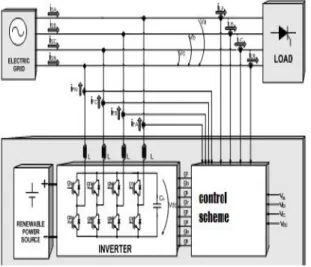
The proposed system consists of RES connected to the dc-link of a grid-interfacing inverter as shown in Fig.1. The voltage source inverter is a key element of a DG system as it interfaces the renewable energy source to the grid and delivers the generated power.
Fig. 1. Schematic of proposed system.
The RES may be a DC source or an AC source with rectifier coupled to dc-link. Usually, the fuel cell and photovoltaic energy sources generate power at variable low dc voltage, while the variable speed wind turbines generate power at variable ac voltage. Thus, the power generated from these renewable sources needs power conditioning (i.e., dc/dc or ac/dc) before connecting on link. The dc-capacitor decouples the RES from grid and also
allows independent control of converters on either side of dc-link.
A. DC-Link Voltage and Power Control Operation
Due to the intermittent nature of RES, the generated power is of variable nature. The dc-link plays an important role in transferring this variable power from renewable energy source to the grid. RES are represented as current sources connected to the dc-link of a grid-interfacing inverter. Fig. 2 shows the systematic representation of power transfer from the renewable energy resources to the grid via the dc-link. The current injected by renewable into dc-link at voltage level (vdc) can be given as
where is the power generated from RES.
Fig. 2. DC-Link equivalent diagram.
The current flow on the other side of dc-link can be represented as,
=
Where , and are total power available at grid-interfacing inverter side, active power supplied to the grid and inverter losses, respectively. If inverter losses are negligible then .
B. Control of Grid Interfacing Inverter
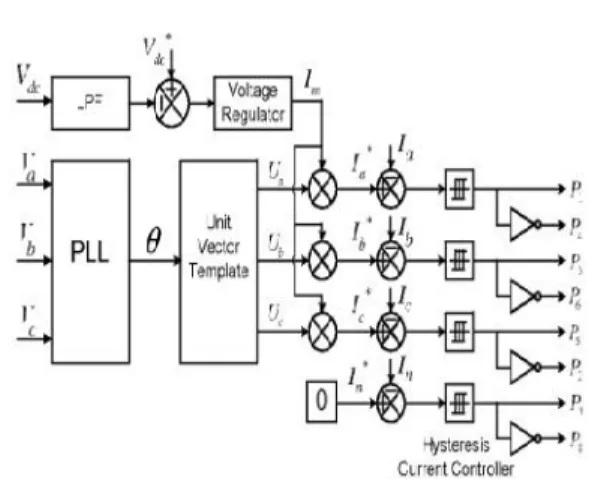
The control diagram of grid- interfacing inverter for a 3-phase 4-wire system is shown in Fig.3. The fourth leg of inverter is used to compensate the neutral current of load. The main aim of proposed approach is to regulate the power at PCC during:
1) ;
While performing the power management operation, the inverter is actively controlled in such a way that it always draws/ supplies fundamental active power from/ to the grid. If the load connected to the PCC is non-linear or unbalanced or the combination of both, the given control approach also compensates the harmonics, unbalance, and neutral current. The duty ratio of inverter switches are varied in a power cycle such that the combination of load and inverter injected power appears as balanced resistive load to the grid. The regulation of dc-link voltage carries the information regarding the exchange of active power in between renewable source and grid. Thus the output of dc-link voltage regulator results in an active current ( ).
The multiplication of active current component ( ) with unity grid voltage vector templates ( , and ) generates the reference grid currents
( , and ).
Fig. 3. Block diagram representation of grid-interfacing inverter control.
The reference grid neutral current ( ) is set to zero, being the instantaneous sum of balanced grid currents. The grid synchronizing angle (Ɵ)obtained from phase locked loop (PLL) is used to generate unity vector template.
= =
=
The actual dc-link voltage ( ) is sensed and passed through a first-order low pass filter (LPF) to eliminate the presence of switching ripples on the dc-link voltage and in the generated reference current signals. The difference of this filtered dc-link voltage and reference dc-link voltage ( ) is given to a discrete- PI regulator to maintain a constant dc-link voltage under varying generation and load conditions. The dc-link voltage error at nthsampling
instant is given as:
-The output of discrete-PI regulator at th sampling instant is expressed as
=
Where and are
proportional and integral gains of dc-voltage regulator. The instantaneous values of reference three phase grid currents are computed as
= . .
= . .
= . .
The neutral current, present if any, due to the loads connected to the neutral conductor should be compensated by forth leg of grid-interfacing inverter and thus should not be drawn from the grid. In other words, the reference current for the grid neutral current is considered as zero and can be expressed as
= 0.
The reference grid currents ( , , and ) are compared with actual grid currents ( , , and
= =
=
These current errors are given to hysteresis current controller. The hysteresis controller then generates the switching pulses( to ) for the gate drives of grid-interfacing inverter. The average model of 4-leg inverter can be obtained by the following state space equations
=
=
=
=
=
where , , and are
the three-phase ac switching voltages generated on the output terminal of inverter. These inverter output voltages can be modeled in terms of instantaneous dc bus voltage and switching pulses of the inverter as
.
Similarly the charging currents
, , and on dc bus due to the
each leg of inverter can be expressed as
= )
= )
= )
= )
The switching pattern of each IGBT inside inverter can be formulated on the basis of error between actual and reference current of inverter, which can be explained as:
If ( - , then upper
switch will be OFF ( and lower switch will be ON ( in the phase “a” leg of
inverter.
If ( - , then upper
switch will be ON ( and lower switch will be OFF ( in the phase “a” leg of
inverter.
Where , is the width of hysteresis band. On the same principle, the switching pulses for the other remaining three legs can be derived.
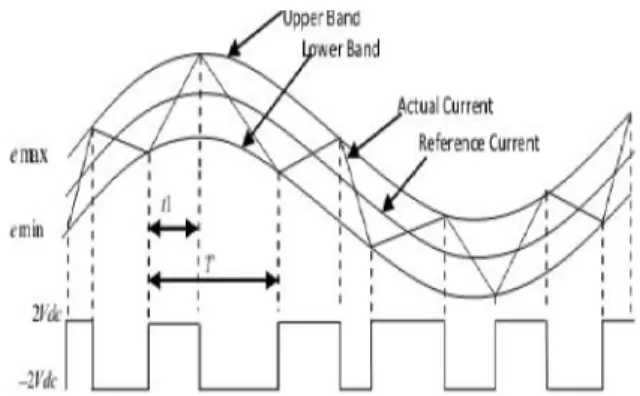
Fig. 4. Waveform of Hysteresis current controller
If the error crosses the lower limit of the hysteresis band, the lower switch of the inverter arm is turned off and the upper switch is turned on. As a result, the current gets back into the hysteresis band. The minimum and maximum values of the error signal are eminand emax respectively. The range of the error signal emax-emindirectly controls the amount of ripple in the output current from the VSI.
IV. MATLAB MODELEING AND SIMULATION RESULTS
.
Fig.5.(a) Matlab/Simulink Model of Proposed System
Fig.5(b). Matlab/Simulink Model of Proposed System with DC-motor load
Fig.6.Dc load voltage and current
Fig.7. PCC voltage and current
Fig .7 shows the Voltage and Currents at PCC in phase due to 4-Leg Inverter
Fig.9. DC link voltage
Fig.10.a)Voltage b)Speed c)Rectifier output voltage d)Torque
Fig.11.THD of Load Current without APF
Fig.12.THD of Load Current with APF
In Fig 11 & 12 the THD of Load current with and without 4-Leg Inverter are Presented.
V. CONCLUSION
quality of power at PCC for a 3-phase 4-wireDGsystem. It has been shown that the grid-interfacing inverter can be effectively utilized for power conditioning without affecting its normal operation of real power transfer. The grid-interfacing inverter with the proposed approach can be utilized to:
i) inject reactive power required to the grid, ii) operate as a shunt Active Power Filter (APF). This approach thus eliminates the need for additional power conditioning equipment to improve the quality of power at PCC. The proposed system is also verified for dc motor load.Finally Matlab/Simulink based model is developed and simulation results are presented.
REFERENCES
[1] J. M. Guerrero, L. G. de Vicuna, J. Matas, M.
Castilla, and J. Miret, “A wireless controller to
enhance dynamic performance of parallel inverters in
distributed generation systems,” IEEE Trans. Power
Electron., vol. 19, no. 5, pp.1205–1213, Sep. 2004.
[2] J. H. R. Enslin and P. J. M. Heskes, “Harmonic
interaction between a large number of distributed
powerinverters and the distribution network,”IEEE
Trans. Power Electron. vol. 19, no. 6, pp. 1586–1593, Nov. 2004.
[3] U. Borup, F. Blaabjerg, and P. N. Enjeti, “Sharing
of nonlinear load in parallel-connected three-phase
converters,” IEEE Trans. Ind. Appl., vol. 37, no. 6,
pp. 1817–1823, Nov./Dec. 2001.
[4] P. Jintakosonwit, H. Fujita, H. Akagi, and
S.Ogasawara, “Implementation and performance of cooperative control of shunt active filters for harmonic damping throughout a power distribution
system,” IEEE Trans. Ind. Appl., vol. 39, no. 2, pp. 556–564, Mar./Apr.2003.
[5] G.Satyanarayana., K.N.V Prasad, G.Ranjith Kumar, K.Lakshmi Ganesh, "Improvement of power quality by using hybrid fuzzy controlled based IPQC at various load conditions," Energy Efficient Technologies for Sustainability (ICEETS), 2013 International Conferenceon , vol., no., pp.1243,1250, 10-12 April 2013.
[6] F. Blaabjerg, R. Teodorescu, M. Liserre, and A.
V.Timbus, “Overview of control and grid
synchronization for distributed power generation
systems,” IEEE Trans. Ind.Electron., vol. 53, no. 5,