118
CLIMATIC CONDITIONS AND EVOLUTION OF SOIL
PROFILES IN ROMANIA
ILIE L., MIHALACHE M., MARIN D.I., SCĂEȚEANU GINA
University of Agronomic Sciences and Veterinary Medicine of Bucharest, Blv. Mărăşti, no. 59, Bucharest, 011464, Romania
Key words: climate, soil profiles, agricultural ecosystem
ABSTRACT
For over a century has been recognized the climate role in genesis and evolution of soil profiles and initial area classification indicated the types of soil after their climate zones.
Climate was characterized by an annual average temperature of the coldest month (January) and the most warm month (July). For expressed the moisture has been used average annual rainfall (mm).
To investigate the influence of climatic conditions on the evolution of soil profiles were selected a group of samples belonging to agricultural, pastoral and forestry ecosystems. For each profile was analyzed the first two horizons where the climate is more intense.
Climate data shows that they determine the intensity of decomposition processes of plants, the accumulation and mineralisation of organic matter.
INTRODUCTION
To investigate the influence of climatic conditions on the evolution of soil profiles were selected a group of samples belonging to agricultural, pastoral and forestry ecosystems. Each profile was analyzed the upper horizons where the climate is more intense.
Climate data shows that they determine the intensity of decomposition processes of plants, the accumulation and mineralisation of organic matter.
Thus, the average annual temperatures, the coldest and warmest month increase, cause increased organic material mineralisation and decreased the organic material, total nitrogen and total phosphorus accumulation, in surface horizons of soils.
On the other hand, increasing annual precipitation and aridity index, increased accumulation of organic material and increased eluviation of release ions and clay-humus colloids.
Nitrogen is mostly bound to organic matter and phosphorus inherited from the parent material is retained by bioaccumulation on the surface horizons.
MATERIAL AND METHODS
Climate was characterized by a mean annual temperature of the coldest month (January) and the warmest month (July) expressed in Celsius degrees (0C). For moisture regime was used average annual rainfall (mm). It has also been used aridity index, by Koppen, expressed as ratio of average precipitation / average annual temperature + 10, which has been used for the past eight decades for delimitation steppe, temperate and boreal climate. At each profile were assessed climate data after the nearest weather station.
119
RESULTS AND DISCUSSION
Climatic regions of Romania are determined by its geographic position in Central and South-Eastern Europe, crossed by 45th parallel north latitude, relief and vegetation. Carpathian mountain chain in the country has a boreal climate (DFK), with rainfall throughout the year, cold winter, the average annual temperature below 8 0C, the temperature of the warmest month below 18 0C and general aridity indices greater than 45 (Florea N. et al, 1968). Soils in this climate area are dystric cambisols, podzols and humic leptosol. They have short profiles, skeletal character because hard parental rocks.
Natural vegetation placed parallel climatic zones with a succession from alpine meadows to coniferous forests in the boreal province, to deciduous forests in the temperate province to steppe with grasses. This requires research into agricultural, pastoral and forestry ecosystems to estimate the influence of vegetation and agricultural technologies on the development of soil profiles.
Parallelism but not identity between climatic conditions and soil types shows the determining influence of climate in the formation of soil profiles. Indeed, the processes of soil formation (pedogenesis), soil horizons are formed by the accumulation of organic material and nutrients at the soil surface by humification and mineralisation plant residues and ions eluviation to depth, possibly accompanied by translocation of soil colloids.
Average temperatures decline in the following order: agricultural ecosystems, forestry and pastoral and annual rainfall and aridity indices increased in the same sequence.
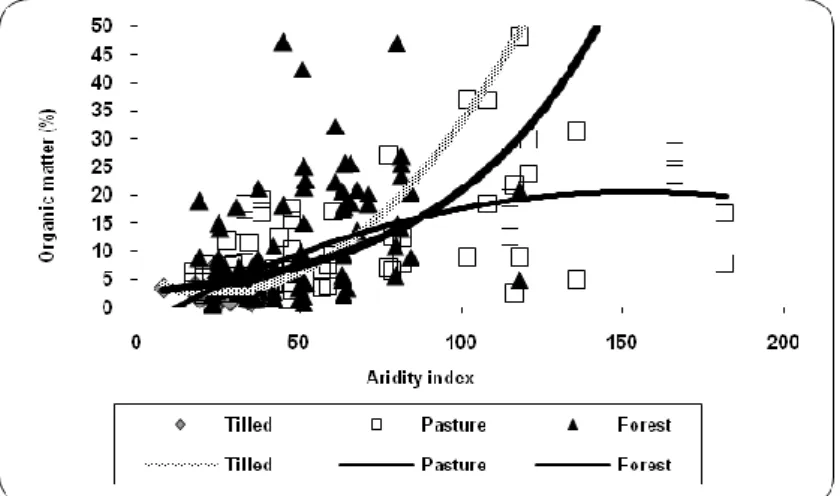
Distribution of the three ecosystems samples like a organic material - aridity index graphic (Fig. 1) shows that the points corresponding agricultural ecosystems are grouped in a small area at relatively low values of variables while those of natural ecosystems are spread throughout space diagram. Points of pastoral ecosystem occupies a large space especially for big values of aridity index while key points of forestry ecosystems covering an extended area, especially to higher content of organic material. This shows that tree vegetation increase humification and minimizes mineralisation of organic material, in pastoral ecosystems, especially those from alpine to low temperatures and high rainfall, increase more mineralisation.
Fig. 1 Relationship between organic matter content and aridity index
120
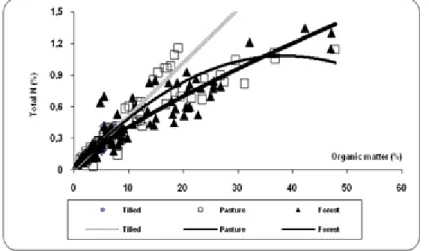
Total nitrogen is very closely linked to organic material (n=276, Rpow=0.933***, Rlin=0.907***, F=1271) and suggests that it is a constituent of his. Nitrogen increases with the organic material content (Fig. 2) in all ecosystems: agricultural (n=102, Rpow=0.910***, Rlin=0.906***, F=38.4), pastoral (n=82, Rpoly=0.937***, Rlin=0.891***, F=309) and forestry (n=92, Rpow=0.940***, Rlin=0.911***, F=440).
Fig. 2 Relationship between total nitrogen and organic matter
As climate conditions and human activity (agricultural technology) change ratio of intensities processes of humification and mineralisation of dead plant debris on the soil surface and its upper horizons (zoogene debris, roots and microorganisms). Thus, the increase of temperature produces an increase of biological activity and mineralisation accompanied by a decrease of organic matter content (Fig. 3) as shown for example relationship between organic material and temperature of the warmest month, July (n=276, R=0.634***, Rlin=0.611***, F=163). This decrease is pronounced for natural grassland ecosystems (n=82, Rexp=0.630***, Rlin=0.621***, F=50.2) and forestry (n=92, Rpow=0.497***, Rlin=0.452***, F=23.1) and low for agricultural ecosystems (n=102, Rpoly=0.177, Rlin=0.169, F=2.93) where the two variables are not correlated each with other and representative points are grouped into a small space under 4.6% organic material and temperature over 17 0C.
Fig. 3 Organic matter content versus July mean temperature
121
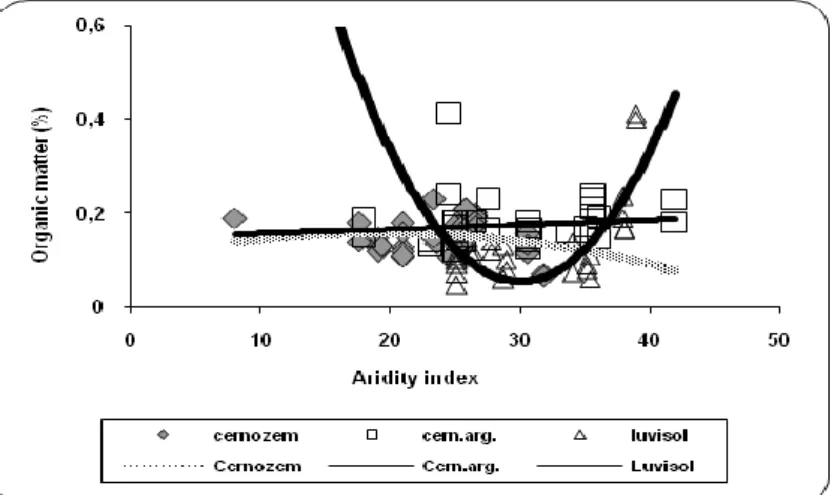
so the group of agricultural ecosystems was investigated in detail, dividing its samples into three categories: chernozems, luvic phaeozems and luvisols.
At chernozem (n=42, Rpoly=0.196, Rlin=0.121, F=0.98) and luvic phaeozems (n=34, Rexp=0.147, Rlin=0.079, F=0.97), organic material did not correlate with aridity index, only to luvisols (n=26, Rpoly=0.772***, Rlin=0.574***, F=8.01), because agricultural technologies, including irrigation, changed the upper horizon of soils with a relatively low eluviation.
Besides, all three types of tilled soils have different representing curves (Fig. 4).
Fig. 4 Organic matter content of agricultural ecosystems as a function of aridity index
Accumulation of organic material in the horizons surface of soils produce a high porosity, allows oxygen diffusion from the air in soil pores, increases mineralisation, alteration of minerals and increases eluviation of ions released into soil solution. Therefore, organic matter content correlates closely with bulk density (n=276, Rexp=0.762***, Rlin=0.690***, F=249) and the amount of organic material decreases with bulk density and consequently with porosity (Fig. 5).
Fig. 5 Correlation between organic matter content and bulk density
122
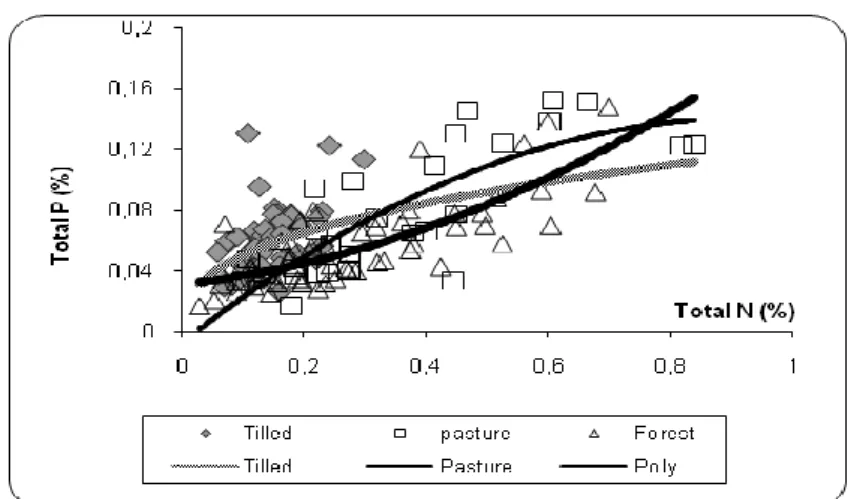
Fig. 6 Total P content as a function of the total N content
CONCLUSIONS
Statistical calculations are useful to investigate the influence of climatic conditions on the evolution of soil profiles. Overall, annual average temperatures correlate closely with average temperatures of the warmest month (July) and coldest (January) and increases the mineralisation of organic material, total nitrogen and total phosphorus content. But, increasing annual precipitation and aridity index increased accumulation of organic material, reducing its mineralisation and increased eluviation of release ions and clay-humus colloids.
Accumulation of organic material, especially like moder, causes a lower bulk density and therefore a higher porosity horizons that emphasizes eluviation ions formed by mineralisation process and clay-humus plasma.
Total nitrogen is mostly bound to organic matter and total phosphorus inherited from the parent material is retained by plants and microorganisms and coordinative related by organic material from surface horizons of soils.
BIBLIOGRAPHY
Crăciun C. Analize mineralogice de fracţiuni argiloase. Publ. SNRSS, nr. 20 (1983),
nr. 22 (1985), nr. 25 (1988), nr. 27 (1994), nr. 29 (1997), nr. 30 (2000), nr. 35B (2006). Florea N., Munteanu I., Rapaport C., Chiţu C., Opriş M. Geografia solurilor României. Ed. Ştiinţifică, 1968.
Florea N., Munteanu I. Sistemul Român de Taxonomie a Solurilor (SRTS). Ed.
Estfalia, Bucureşti, 2003.
Gâţă Gh., Mihalache M., Udrescu S., Ilie L. Agricultura durabilă şi procese ireversibile în soluri. Lucr. Şt., USAMV Bucureşti, Seria A, Vol. XLIX, 2006.
Gâţă Gh., Udrescu S., Mihalache M., Ilie L., Muşat M. Procese fizico-chimice la
solul brun argiloiluvial de la Sânandrei (Timiş). Publ. SNRSS, nr. 34B, Timişoara, Vol. 2, 2005.
Gâţă Gh., Udrescu S., Mihalache M., Ilie L. Proprietăţi ale solului care
influenţează formarea talpei brazdei. Lucr. Șt., USAMV București, Seria A, Vol. L, 2007. Ilie L., Dumitru M., Mihalache M. Influenţa agriculturii organice asupra potenţialului productiv al solurilor. Lucr. Şt., USAMV Bucureşti, Seria A, Vol. XLIX, 2006.
123
Ilie L., Mihalache M., Marin D.I., Gâţă Gh. Accumulation and mineralisation of organic matter in Romanian soils. Scientific Papers, USAMV Bucharest, Series A, Vol. LII, 2009.
Mihalache M., Ilie L. Influence of soil's organic matter upon microelements mobility.
Bulletin USAMV-CN, 66(1), 2009.
Mihalache M., Gâţă Gh., Ilie L., Marin D.I., Puicea Brândușa. Oxidation of clay minerals with oxygenated water. Scientific Papers, USAMV Bucharest, Series A, Vol. LII, 2009.
Mihalache M., Ilie L., Marin D.I. Research concerning the evolution of physical and