THE EULER NUMBER FROM THE DISTANCE FUNCTION
XIMO
GUAL-A
RNAUInstitute of New Imaging Technologies, Campus Riu Sec, Universitat Jaume I, 12071 Castell´o, Spain e-mail: [email protected]
(Received April 11, 2013; revised November 11, 2013; accepted November 12, 2013)
ABSTRACT
We present a new method to obtain the Euler number of a domain based on the tangent counts of concentric spheres inR3(or circles inR2), with respect to the centerO, that sweeps the domain. This method is derived from the Poincar´e-Hopf Theorem, when the index of critical points of the square of the distance function with respect to the originOis considered.
Keywords: critical points, distance function, Euler number, stereology, tangent counts.
INTRODUCTION
The Euler number describes the topology of the surfaces of a structure of interest and its practical value of obtaining, for example, the number of trabeculae in bone, the number of glomerular capillaries in kidney, or the alveolar number in lung-architecture, has been demonstrated.
Hadwiger (1957) gave an inductive definition of the Euler characteristic which has suggested several methods for deriving the Euler number from close parallel flat sections; see for instance De Hoff (1987), Gundersenet al. (1993), Ohseret al. (1996) or Rataj (2004). In this case, the principle used to obtain the Euler number of ann-dimensional domain inRn(n= 2 or 3) is based on what happens in an (n−1) -dimensional plane that sweeps through the domain. Some of the methods obtained from this principle and derived from the Hadwiger definition, can also be proved from the classical Poincar´e-Hopf Theorem, when the index of critical points of a family of height functions are considered (Gual-Arnauet al., 2001).
It follows that, for any vectoruinRn (n=2 or 3), the Euler number of a domain is obtained from the tangent counts of the domain and a perpendicular plane to u (or line in R2), that sweeps the domain. This method is isotropic in the sense that, although the tangent events depend on the direction u, the final result (Euler number) does not depend onu.
In this paper we present an alternative method to obtain the Euler number of a domain based on the tangent counts of concentric spheres inR3 (or circles inR2) that sweep the domain. The tangent counts will depend on the position of the centerOof the spheres (or circles) but the final result will be the Euler number for a general position of the center O. This method is then based on what happens in a sphere inR3 (or
circle inR2) that sweeps through the domain and it is obtained from the Poincar´e-Hopf Theorem, when the index of critical points of the square of the distance function with respect to an origin Ois considered. In fact, Chapter 6 of Milnor (1969) is deserved to show that the square distance from a chosen point, restricted to a smooth submanifold in Rn, is indeed a function with no degenerate critical points (Morse function), for almost all chosen points for the originO. For instance, if the domain is bounded by a sphere, the square distance restricted to the sphere is a Morse function for all reference points, except when the reference pointO
is the center of the sphere.
This method may be of interest in images with a prominent reference point:e.g., the nucleolus of a cell or the planet earth when counting celestial objects like stars; and in images which include anisotropic particles that have approximately parallel sides (plant fibers, fibrous minerals,...).
In the first part of the paper we give the stereological versions of the principle for 3-dimensional domains in R3, 2-dimensional domains in R2 and domains with boundary in a surface
S ⊂ R3. In the second part we give the detailed mathematical justifications and we relate the Euler-Poincar´e characteristic with curvatures of the domain and the concentric spheres inR3(or circles inR2).
STEREOLOGICAL FORMULAE
In this section we give an elementary version of the Euler-Poincar´e characteristic of closed orientable smooth surfaces S=∂Din R3, of bounded domains
The Euler-Poincar´e characteristic for domains in R2 and R3 has been studied in several stereological applications (see, for instance, Gundersenet al., 1993). The principle used to obtain the Euler number of an
n-dimensional domain in Rn (n =2 or 3), is based on what happens in an(n−1)-dimensional plane that sweeps through the domain. Here we consider a new principle based on what happens in a sphereS2(λ)(or circle S1(λ) in R2) that sweeps through the domain when the radiusλ varies.
Both principles can be derived from a result of Morse (1929) that we simplify for surfaces inR3 and domains in R2. In the next section we give a more detailed mathematical justification.
CLOSED SURFACES INR3
Let f :S−→R be a smooth function defined on a closed orientable smooth surface. We say thatx∈S
is a critical point if∇fx:TxS−→Rvanishes for every
v∈TxS. A critical point x∈S is non degenerated if the Hessian of f at x, (∇2f)x :TxS×TxS −→R, is a non degenerated bilinear form, i.e., for every non zero vectorv∈TxS, there exists a vectorw∈TxSsuch that(∇2f)x(v,w)6=0. A function f is called a Morse function if all its critical points are non-degenerated (Bruceet al., 1984).
Theorem 1. (Morse) Let f : S → R be a differentiable Morse function on a closed orientable two-dimensional surface, then
χ(S) =
∑
x∈Σ(f)Indx(f), (1)
whereΣ(f)denotes the set of singular points of f and
the index, Indx(f), is given by +1 when x is a local extreme of f, or−1 whenxis a saddle point (Morse, 1929).
That is,
χ(S) =M−s+m, (2)
where M,m and s denote the number of maximum, minimum and saddle, respectively, of f.
Now, we apply the above results to a particular function: the square of the distance function.
We define the square of the distance function to a generic coordinate originO∈R3as
d :R3−→R
x−→d(x) =hx,xi=||x||2. (3)
For almost all O∈R3 (all but a set of measure 0), the restriction of d to S, d|S, is a Morse function
(Milnor, 1969). Now we will apply Theorem 1 to the square of the distance function.
The level sets are πλ2 = d−1(λ2) = {x ∈
R3/||x||2=λ2}=S2(λ).
When we restrict d to S, the critical points x ∈
Σ(d|S) are those where the tangent plane to S at x coincides with the tangent plane toπλ2 atx;i.e.,TxS= TxS2(λ); then we give a ’stereological’ interpretation of the local extreme (maximum and minimum) and saddle points ofd.
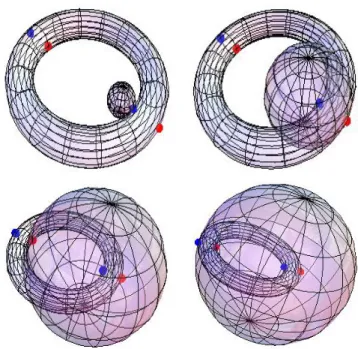
LetDbe a domain in R3 such that∂D=S; then, the critical points ofd|S,(x∈Σ(d|S)), can be classified as follows: x∈Σ(d|S)) is a point of type ”Island” if d−1(d(x)) =S2(λ)is locally contained inR3rD, (x is a local extreme (maximum) ofd|S);x∈Σ(d|S))is a point of type ”Hole” ifd−1(d(x))is locally contained in D (x is a local extreme (minimum) of d|S); and x∈Σ(d|S)) is a point of type ”Bridge” if there exist points ofSin the interior and in the exterior ofS2(λ) whereS2(λ) =d−1(d(x)), (xis a saddle point ofd|S), (see Fig. 1).
Fig. 1. Images that we see in the sweeping spheres
S2(λ)∩S, where S is a fixed torus and the growing
spheresS2(λ)have a fixed center O. Depending on the
type of critical point we have Islands or Holes (blue points) and Bridges (red points). The Euler number of the torus is 0. Note that, although S is fixed, as the radius ofS2(λ) increases, a change of scale and
LetS=∂D⊂R3be an orientable smooth surface inR3and letO∈R3such thatd|Sis a Morse function. Whenλ varies onR, the different spheresπλ2 can be
considered as a “sweeping” sphereS2(λ)(centered at
O) inR3. Then, Theorem 1, with the interpretation of local extrema and saddle points ofd|Sas Islands, Holes and Bridges, can be expressed as:
χ(S) =2χ(D) =I2+H2−B2, (4)
where I2,H2,B2 denote the number of islands, holes and bridges observed in the “sweeping” sphereS2(λ), which contribute to the sum∑x∈Σ(d|S)Indx(d|S).
Moreover, whenO∈S,Ois a minimum ofd, and
χ(S) =2χ(D) =1+I2+H2−B2. (5)
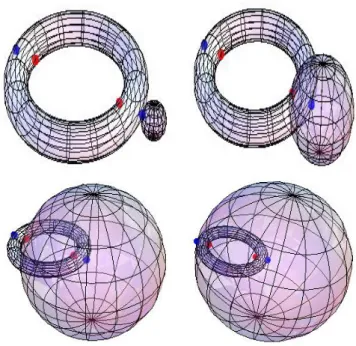
Note that the tangent countsI2,H2,B2may depend on the position of the centerO; however the final result of(I2+H2−B2)is always 2χ(D)(see Fig. 2). In fact, whenOis far from the domain Dthe tangent counts
I2,H2,B2 are similar to that obtained when sweeping planes are considered.
Fig. 2. The surface S is the same as in Fig. 1 and the growing spheresS2(λ)have a fixed origin O different
to that considered in Fig. 1. Therefore, we obtain different values of the critical points, because they depend on the position of the center of the spheres, O. Blue points are Islands and red points are Bridges. The Euler number of the torus is 0.
DOMAINS INR2
LetD⊂R2 be a domain inR2whose boundary is a curve∂D. In this case, we can not apply Theorem 1 becauseDis a surface with a boundary. As explained in the Mathematical foundations section, the generalized result of Theorem 1 for domains inR2is as follows:
Theorem 2. Let D ⊂ R2 be a domain with boundary and let f :D→Rbe a Morse function such that f has no critical points on∂Dand the restriction
f|∂D:∂D→Ris also a Morse function. Then,
χ(D) =
∑
x∈Σ(f)Indx(f) + 1 2y∈
∑
Σ(f|∂D)
Indy(f), (6)
where the index Indx(f) is defined as in Eq. 1 and the index Indx(f|∂D)is defined as follows: if the level set f−1(f(y)) is locally contained in R2rD then Indy(f|∂D) = +1 and if the level set f−1(f(y)) is locally contained inDthen Indy(f|∂D) =−1.
The square of the distance function to a generic coordinate originO∈R2is
d :R2−→R
x−→d(x) =hx,xi=||x||2. (7)
The level curves πλ2 are in this case circles S1(λ) centered atO∈R2.
To satisfy Theorem 2 we suppose that O∈R2r ∂D; then, the square of the distance function d|Dhas only a critical point O∈D; and we also suppose that the restriction of the square of the distance function
d|∂Dis a Morse function; then, from Eq. 6,
χ(D) =δ0(D) +1 2y∈
∑
Σ(d|∂D)
Indy(d|∂D), (8)
where
δ0(D) =
(
1,ifO∈D,
0,ifO∈/D, (9)
and a critical point y ∈Σ(d|∂D) is a point of type ”Island” if d−1(d(y)) =S1(λ)is locally contained in R2rD; andy∈Σ(d|∂D))is a point of type ”Bridge” if d−1(d(y))is locally contained inD(see Fig. 3).
Therefore, whenλvaries onR, the different circles S1(λ)can be considered as “sweeping” circles inR2, and Eq. 6 can be expressed as:
χ(D) =δ0(D) +1
2(I1−B1), (10)
a)O∈/D. b)O∈D.
Fig. 3. Different values of the critical points, depending on the position of the center of the growing circles, O. Blue points are Islands and red points are Bridges. The Euler number of the domain D is 0.
Note that when the point O∈/ D, Eq. 10 can be expressed as:
χ(D) =1
2(I1−B1), (11)
which, when O is far from D, is similar to that obtained in Gundersenet al. (1993), whereI1 andB1
denote the number of islands and bridges observed in a ”sweeping” line.
SURFACES WITH BOUNDARY INR3
LetD⊂S⊂R3be a domain with boundary in an orientable smooth surfaceSinR3and letO∈R3such that Eq. 14 is satisfied in this case. Whenλ varies on R+, the different spheresS2(λ)can be considered as a sweeping sphere inR3, and
χ(D) = (I2−B2) + 1
2(I1−B1), (12)
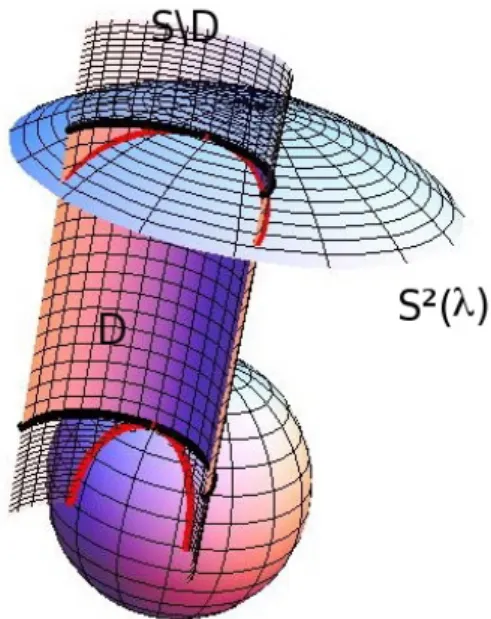
where I2, B2 are defined as in Eq. 4 and I1, B1 denote the number of islands and bridges, respectively, observed in the level curves S2(λ)∩S. In Fig. 4 we consider a domain D in a cylinder, whose boundary is given by two circles (black curves), and we show two critical points: an Island where the level curve
S∩S2(λ) (red curve) is locally contained in SrD, and a Bridge point, where the level curve is locally contained inD.
MATHEMATICAL FOUNDATIONS
The classical Poincar´e-Hopf Theorem states that if S is a closed orientable smooth surface and v is a smooth vector field onSwith isolated zeros, then
χ(S) =
∑
v(x)=0Indx(v),
Fig. 4.Partial view of the domain D. The boundary∂D
is given by the black curves (circles). The red curves correspond to S∩S2(λ).
where χ(S) is the Euler-Poincar´e characteristic of S and the index, Indx(v), is just the local degree ofv at x; that is, the degree of the mapu:S−→S2 given by
u(z) =v(z)/|v(z)|. As an immediate consequence, we see that if f :S →R is a Morse function (that is, a function with non-degenerate critical points), then
χ(S) =
∑
x∈Σ(f)Indx(f), (13)
whereΣ(f)denotes the set of singular points of f and the index, Indx(f), is given by +1 when x is a local extreme of f, or−1 whenx is a saddle point (Morse, 1929).
Now, we consider a generalization of the classical Poincar´e-Hopf Theorem which can be applied domains with boundary in an orientable smooth surface in R3 and, in particular, to closed domains in R2(Gual-Arnauet al., 2001).
Let D ⊂ R3 be a compact orientable smooth surface with boundary and let f :D→R be a Morse function such that f has no critical points on ∂D and the restriction f|∂D :∂D → R is also a Morse function. Then, the Poincar´e-Hopf Theorem (Morse, 1929), states
χ(D) =
∑
x∈Σ(f)Indx(f) + 1 2y∈
∑
Σ(f|∂D)
Indy(f), (14)
Indy(f|∂D) = +1 and if the level set f−1(f(y)) is locally contained inDthen Indy(f|∂D) =−1.
In the next section we will consider a particular function f, the square of the distance function, and we will interpret Eq. 1 in terms of critical points of this function.
CLOSED SURFACES INR3
LetSbe a closed orientable smooth surface inR3. Givenx∈S, we denote byN(x)andK(x)the normal vector and the Gauss curvature ofS, respectively.
Theorem 3. Let S ⊂ R3 be a closed orientable smooth surface inR3.
1. Letx∈S. It is a critical point ofd|S if and only if x=±λN(x) if and only ifTxS=TxS2(λ)(where
d(x) =λ2).
2. Letx∈Sbe a critical point ofd|S.
(a) Suppose that x = −λN(x); then x is non-degenerate if and only if κ1 6= λ1 and κ26= λ1 ( 1
λ2 is the Gauss curvature ofS 2(
λ)). Moreover, it is a local extreme or a saddle point of d|S depending on weather (λ1 −κ1)(λ1 −κ2) is positive or negative, respectively.
(b) Suppose that x = λN(x); then x is non-degenerate if and only if κ1 6=−λ1 and κ2 6=
−λ1. Moreover, it is a local extreme or a saddle point of d|S depending on weather (λ1 +κ1)(λ1 +κ2) is positive or negative, respectively.
Proof.To prove part 1 we consider
(∇d)x(v) = d
dt|t=0||α(t)||
2
=2hα0(0),α(0)i=2hv,xi,
(15)
whereα:(−ε,ε)−→Sis a differentiable curve with α(0) =x and α0(0) =v. Then, (∇d)x(v) =0 if and only if v⊥x if and only ifx=±λN(x) if and only if N(x) ⊥TxS2(λ) (||x|| =λ) if and only if TxS = TxS2(λ). An alternative proof using local coordinates can be found in Milnor (1969).
To prove part 2a we consider the Hessian ofdatx,
(∇2d)x(v) = d2
dt2|t=0||α(t)|| 2=2d
dt|t=0hα
0
(t),α(t)i
=2(hα00(0),α(0)i+hα0(0),α0(0)i)
=2(hα00(0),−λN(x)i+hv,vi).
(16)
Now, if we take derivatives att=0 of the identity
hα0(t),−λN(α(t))i=0 we obtain
hα00(0),−λN(x)i=−hv,−λdN(x)(v)i.
Since the second fundamental form ofSatxis defined as IIx(v,v) =−hdN(x)(v),vi and it is symmetric, we obtain
(∇2d)x(v) =2(||v||2−λIIx(v,v)). (17)
Let{e1,e2}be a principal orthonormal frame atx; then, in matrix form we have
(∇2d)x(v) =v
1−λ κ1 0
0 1−λ κ2
vT. (18)
So,xis non-degenerate if(1−λ κ1)(1−λ κ2)6=0; that is, κ1 6= λ1 and κ2 6= λ1. The rest of part 2a is derived from the classification of local extrema and the proof of part 2b is similar.
Corollary 1. Let S⊂R3 be a closed orientable smooth surface inR3. Then
χ(S) =
∑
x∈S/x=−λN(x)sign(1−λ κ1)(1−λ κ2)
+
∑
x∈S/x=λN(x)
sign(1+λ κ1)(1+λ κ2)
=
∑
x∈S/x=−λN(x)
sign(1−2λH(x) +λ2K(x))
+
∑
x∈S/x=λN(x)
sign(1+2λH(x) +λ2K(x)).
(19) whereH(x)denotes the mean curvature ofSatx.
Proof. This formula is a direct consequence of Eq. 1 and Theorem 3.
Remark. In Milnor (1969) it is proved that for almost allO∈R3the functiond|Sis a Morse function; i.e., in general, all the critical points of d|S are non-degenerate (these points are characterized in Theorem 3). When O∈S, from Eqs. 15 and 16, we have that
d|S has a non-degenerate critical point (minimum) at x=O. In this case IndO(d|S) = +1.
DOMAINS INR2
LetD⊂R2 be a domain with boundary. As in the preceding section, we consider now the square of the distance functiond:R2→R, instead of the square of the distance function ofR3. The level curvesπλ2 are
in this case circlesS1(λ).
O= (0,0)∈D). Moreover, in general, the restriction of the square of the distance functiond|∂D is a Morse function; then, from Eq. 14,
χ(D) =δ0(D) +1 2y∈
∑
Σ(d|∂D)
Indy(d|∂D), (20)
where
δ0(D) =
(
1,ifO∈D,
0,ifO∈/D. (21)
Lemma 1.LetD⊂R2be a domain with boundary; then,
χ(D) =δ0(D) + 1
2 y∈
∑
∂D/y=−λn(y)
sign
κ− 1 λ
+
∑
y∈∂D/y=λn(y)
sign
κ+1 λ
! ,
(22) where n(y) and κ(y) are the normal vector and the curvature of the plane curve∂D, respectively.
Proof. Suppose that α is a parameterization by arc length of ∂D. Given a point y ∈Σ(d|∂D), with α(s0) = y, we have Dd(s0) = hα0(s0),α(s0)i = 0, then α0(s0) is tangent to S1(λ) at y. Moreover,
D2hu(s0) = hα00(s0),α(s0)i + hα0(s0),α0(s0)i =
hκ(y)n(y),±λn(y)i+1=1±λ κ(y) so y is a local extreme. Finally, from the way we have chosen the orientation on ∂D and the definition of Indy(hu|∂D) given in Eq. 14, we have the result.
SURFACES WITH BOUNDARY INR3 LetD⊂S⊂R3be a domain with boundary in an orientable smooth surfaceSinR3 (Gual-Arnauet al., 2001). Parts 1 and 2 of Theorem 3 are valid here when we restrictd|Dandx∈D.
We will give a geometrical interpretation of the critical points of d|∂D. The level sets S∩S2(λ) and D∩S2(λ)are now curves inS. Giveny∈∂D, letn(y)
andκg(y) denote the normal vector and the geodesic curvature of∂DinDaty, respectively. We consider the orientation in ∂Dsuch thatn(y)points to the interior of D. Let κg0(y) denote the geodesic curvature of the level curveD∩S2(λ)at a regular pointyofd|D. If the curvesS∩S2(λ)and∂Dare tangent atywe choose in
S∩S2(λ)the same orientation.
Theorem 4.LetDbe a domain with boundary in an orientable smooth surfaceSinR3.
1. Lety∈∂Dbe a regular point ofd|D.yis a critical point ofd|∂D if and only if the curves D∩S2(λ) and∂Dare tangent aty.
2. Lety∈∂Dbe a regular point ofd|Dand a critical point of d|∂D. y is non-degenerate if and only if κg(y)6=κg0(y). Moreover, it is an island when
κg(y)iκg0(y)and it is a bridge whenκg(y)hκg0(y).
Proof.Suppose that β(s) is a parameterization of
S∩S2(λ)by arc length with α(s0) =y. The vector y can be expressed as
y=hy,N(y)iN(y) +hy,β0(s0)iβ0(s0)
+hy,N(y)∧β0(s0)iN(y)∧β0(s0).
(23)
Sincehβ(s),β(s)i=λ2we have thathβ0(s0),yi= 0.
Suppose now thatα(s)is a parameterization of∂D
by arc length withβ(s0) =y. Then,
y=hy,N(y)iN(y) +hy,α0(s0)iα0(s0)
+hy,N(y)∧α0(s0)iN(y)∧α0(s0),
(24)
whereN(y)∧α0(s0) =n(y).
yis a critical point ofd|∂Difhy,α0(s0)i=0. Since
y is a regular point of d|D, from Theorem 3 we have that y 6=λN(y); then, from Eqs. 23 and 24, y is a critical point ofd|∂Dif and only if the normal vectors toα andβ inTy∂Dcoincide, and therefore the curves D∩S2(λ)and∂Dare tangent aty.
To prove the second part of the theorem we suppose thaty=α(s0)is a critical point ofd|∂D,i.e.,
hα0(s0),α(s0)i=0.
ywill be a degenerate critical point ofd|∂Dif
hα00(s0),α(s0)i+hα0(s0),α0(s0)i=0,
that is,hα00(s0),α(s0)i=−1.
Since hβ(s),β(s)i = λ2 we have that
hβ00(s0),β(s0)i=−1.
On the other hand,
hα00(s0),yi=κn(y)hy,N(y)i+κg(y)hy,n(y)i, (25)
hβ00(s0),yi=κn(y)hy,N(y)i+κg0(y)hy,n(y)i, (26)
where the normal curvatureκn(y)ofα atycoincides, from the Meusnier’s theorem, with the normal curvature ofβ aty. Then, subtracting Eq. 26 to Eq. 25, we obtain
hα00(s0),yi+1= (κg(y)−κg0(y))hy,n(y)i. (27)
ACKNOWLEDGEMENTS
This research was supported by the Spanish Ministry of Education and Science I+D Project MTM2009-14500-C02-02, the UJI project P11B2012-24 and the PROMETEO/2010/028 project.
REFERENCES
Bruce JW, Giblin PJ (1984). Curves and singularities. Cambridge: Cambridge University Press.
De Hoff RT (1987). Use of the disector to estimate the Euler characteristics of three-dimensional micro structures. Acta Stereol 6:133–40.
Gual-Arnau X, Nu˜no-Ballesteros JJ (2001). A stereological version of the Gauss-Bonnet formula. Geometriae Dedicata 84:253–60.
Gundersen HJG, Boyce RW, Nyengaard JR, Odgaard A (1993). The conneulor: unbiased estimation of
connectivity using physical disectors under projection. Bone 14:217–22.
Hadwiger H (1957). Vorlesungen ¨uber Inhalt, Oberfl¨ache und Isoperimetrie. Berlin: Springer Verlag.
Milnor JW (1969). Morse theory. Princeton University Press.
Morse M (1929). Singular points of vector fields under general boundary conditions. Amer J Math 51:165-78. Ohser J, Nagel W (1996). The estimation of the
Euler-Poincar´e characteristic from observations on parallel sections. J Microsc 184:117–26.
Rataj J (2004). On estimation of the Euler number by projections on thin slabs. Adv Appl Prob (SGSA) 36:715–24.
Santal´o LA (1976). Integral geometry and geometric probability. London: Addison-Wesley.