Journal of Global Pharma Technology
Available Online at:
www.jgpt.co.in
RESEARCH ARTICLE
Correlation between Selective and Non-selective α-Blocker Drugs
with Age, Prostate Volume and Different Benign Prostate
Hyperplasia (BPH) Indicators
Islam Abdul Rasool Hashim
1*,Majid Kadhim Abbas
1,Mohammed Ridha Joodi
21. Iraq/University of Babylon/College of Medicine/Department of Pharmacology.
2. Iraq/University of Babylon/College of Medicine/Department of Uorology.
*Corresponding Author: Islam Abdul Rasool Hashim
Abstract
Objective: This study aimed to evaluating the correlation between(age, prostate size) and different BPH indicators such as ( PSA , IPSS , testosterone , estrogen ,Testosterone/Estrogen {T/E} ratio ) among two groups (one treated with selective and another treated with non-selective α-blocker drugs) and untreated group. Methods: The study is a randomized control clinical trial carried out in Urology department during the period from September /2018 to May /2019.The study was based on 60 cases of symptomatic Benign Prostatic Hyperplasia, 30 patients treated with selective α-blocker drug (tamsulosin) and 30patients treated with non-selective α-blocker drug (alfuzosin) and 30 cases of newly diagnosed patients with BPH but did not take treatment for BPH disease, the range of their age was between (50-90). The variables age, prostate size, PSA, IPSS, testosterone, estrogen, T/E ratio were examined and appropriate statistical tests were employed for data analysis. Results: The results showed that there was a significant difference in correlation between age with IPSS and between age with testosterone (p≤0.05)among treated and untreated groups and also showed a significant difference in linear correlation between PSA ,Testosterone, Estrogen indicators levels and the prostate size (p≤0.05) among treated and untreated groups Conclusion: In men with biopsy-proven BPH , both International Prostate Symptom Score IPSS and testosterone increased and altering with ageing. Prostate size demonstrated significant positive correlations with Prostate Specific Antigen PSA, Testosterone, Estrogen among treated and untreated groups in this study.
Keywords: BPH, Testosterone, Estrogen, PSA, IPSS, Tamsulosin, Alfuzosin.
Introduction
Benign Prostatic Hyperplasia (BPH) is a pathological change that occurs in the prostate, leading to enlargement. It’s a condition that greatly affects the quality of life of middle-aged and elderly men, causing Bladder Outlet Obstruction (BOO) and
resulting in Lower Urinary Tract
Symptoms(LUTS) [1].The precise molecular etiology of BPE/BPH is complicated and poorly understood, although several risk factors for the development of BPE/BPH and LUTS conditions have been identified.
These include age, genetics, hormones, growth factors, inflammation, and lifestyle factors [2]. Benign Prostatic Hyperplasia listed together with sign and symptoms range from nocturnal polyuria, overactive
bladder, underactive bladder, bladder
tumours,urinary stones, urinary tract
3-Dihydrotestosterone(DHT), the most potent androgen in men, is metabolized from testosterone through the activity of 5α -reductase enzyme.
DHT plays a crucial role in the differentiation and growth of the prostate gland during fetal development as well as in the development of male external genitalia and secondary sexual characteristics [7]. Inhibition of the production or actions of DHT can result in the inhibition of the growth of the prostate gland. There is substantial clinical evidence that androgen and DHT play a key role in the development of BPH [8].
4-Estrogen plays an important role during prostate development and studies have shown that excessive estrogenization during prostatic development may contribute to the high incidence of BPH cur-rently observed in the aging male population [9].A more profound knowledge of the pathogenesis.
The natural history, and the risk of the Progression enabled more differentiated therapy of elderly men with BPH.the specific approach used to treat BPH depends upon a number of factors like age, prostate size, weight, prostate-specific antigen level, and severity of the symptoms [10]. Treatment options for BPH include: Watchful waiting is the monitoring of a patient without medical
or surgical intervention, generally
recommended for men with mild-to-moderate symptoms whose quality of life is not impaired and who have no disease complications [11]. Medical therapy for clinical benign prostatic hyperplasia (BPH) has advanced significantly in the last 2 decades.
Many new α1 antagonists (selective α1 receptor blocker (tamsulosin) and non- selective α1- blocker receptor (alfuzosin) drugs and 5α -Reductase inhibitors (5α-Ri) are now commercially available. The practicing urologist must decide on the most appropriate medication for his patients, taking into consideration various factors like efficacy, dosing regime, adverse effects, cost,
patient’s socioeconomic background,
expectations, drug availability and his own clinical experience [12]. Surgical treatment of BPH is necessary, and referral to an urologist is warranted if medical treatments fail, or if benign prostatic obstruction causes renal insufficiency, urinary retention, recurrent
urinary tract infections, and bladder calculi [13]. The aim of this study is to evaluate the outcomes and effectiveness of selective therapy with alpha one blocker and non-selective alpha blocker drugs in patients with Benign Prostate Hyperplasia.
Materials and Methods
Study DesignThe present study is a randomized control clinical trial carried out in Urology
department during the period from
September /2018 to May /2019. In this study
we have three
patients groups
:New Diagnosis (untreated)
Patients
group with Benign Prostate Hyperplasia {did not take medication for BPH disease}.They were 30male new diagnosis with BPH depending on specificparameters examination(prostate size,
International Prostate Symptom Score (IPSS), Prostate Specific Antigen (PSA) ,testosterone, estrogen, T/E ratio) range of their ages was (50-90) years old.
Treated Groups
Treated with Selective α1 Receptor Blocker Drug
They were 30male diagnoses with BPH and give to them selective α1 receptor blocker Tamsulosin oral tab once daily for one month. After this month measuring to them the following parameters (prostate size, IPSS, PSA, testosterone, estrogen, T/E ratio) range of their ages was (50-90) years old.
Treated with Non-selective α-receptor Blocker Drug
They were 30 male diagnosis with BPH and give to them non-selective α1 receptor blocker Alfuzosin oral tab once daily for one month .after this month measuring to them the following parameters(prostate size, IPSS, PSA, testosterone, estrogen ,T/E ratio ) range
of their ages was( 50-90)years old.
After
weget the result of all groups we make the comparison between them depending on statistical analysis.
Methods
Measurement of Prostate Size
modality for evaluation of the prostate. Plays a central role in the detection, localization and staging of patients who have BPH and this made by special urologist [14].
Measuring of International Prostate Symptom Score (IPSS)
The International Prostate Symptom Score (IPSS) is a scoring system used to screen for and diagnose Benign Prostatic Hyperplasia (BPH) as well as to monitor symptoms and
guide decisions about how
to manage
thedisease. The IPSS is based on the answers to eight questions, seven regarding disease symptoms and one question related to the patient’s quality of life [5].
Blood Sample Collection
Five ml
of blood was drown in situ using adisposable 5ml syringe.
A
tourniquet wasapplied directly on the skin around the arm. The skin over the vein sterilized with 70%ethyl alcohol, and then collected blood poured on the walls of the plain tube. Then the blood is centrifuged for 10 min. at 3000 rpm to to get a clear solution of blood plasma (blood serum) in the upper phase which is labeled by the patients name serum ,then collected for measuring the following parameters:(Prostate Specific Antigen (PSA), testosterone, estrogen, T/E ratio) calculate
the level of them for all three
groups.
The
procedure made by using Roche CobasE411 auto
analyzer instrument
. All assaysteps and assay temperature are controlled
by this
instrument, the
total duration assayis 1hr and the level of Estrogen parameter
calculate, also
and The procedureis made
by using The VIDAS® Estradiol II (E2 II) assay is intended for use on the instruments
of the VIDAS family (VITEK
Immunodiagnostic Assay System) as an
automated quantitative Enzyme-Linked
Fluorescent immunoassay (ELFA) for the determination of total estradiol concentration in human serum. All assay steps and assay
temperature are controlled by this
instrument.
Ethical Approval
Ethical approval for this study was obtained from research ethical committee in college of medicine, University of Babylon-Iraq.
Statistics Analysis
All data were collected and analyzed by using SPSS (statistical package for social sciences) version 23,Variable were presented as mean ± SD. Student T-test was used to assess significant difference among the means of the data .P value was set <0.05 as significant where the P value less than 0.05 was considered to be statistically significant.
Results
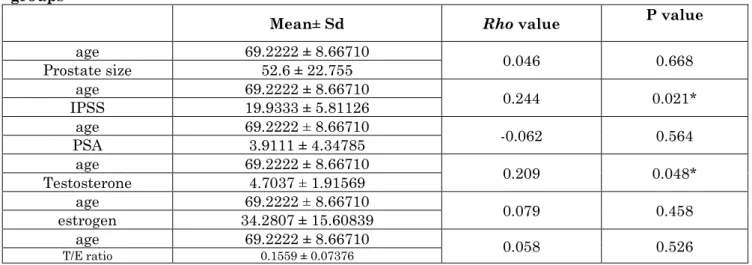
Correlation between Age and Different BPH Indicators among Treated and UN Treated Groups
The results showed that there was a significant difference in correlation between age with IPSS and between age with testosterone (p≤0.05) among treated and
untreated groups. While showed no
significant difference in correlation between age with (Prostate size, PSA, Estrogen, and T/E ratio) (p>0.05) among treated and untreated groups as shown in Table (1).
Table 1: Correlation between age and different BPH indicators among treated and untreated groups
Mean± Sd Rho value P value
age 69.2222 ± 8.66710 0.046 0.668
Prostate size 52.6 ± 22.755
age 69.2222 ± 8.66710
0.244 0.021*
IPSS 19.9333 ± 5.81126
age 69.2222 ± 8.66710 -0.062 0.564
PSA 3.9111 ± 4.34785
age 69.2222 ± 8.66710
0.209 0.048*
Testosterone 4.7037 ± 1.91569
age 69.2222 ± 8.66710 0.079 0.458
estrogen 34.2807 ± 15.60839
age 69.2222 ± 8.66710 0.058 0.526
©2009-2019, JGPT. All Rights Reserved 274 Linear Correlation Figures between
Both PSA, IPSS, Testosterone, Estrogen, T/E Ratio Indicators Levels and the Prostate Size among Treated and Untreated Groups
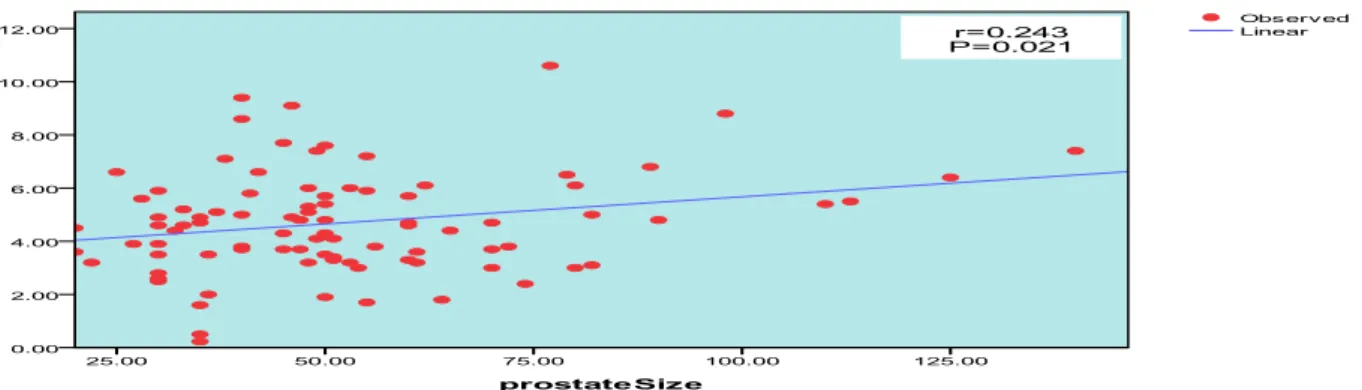
The results showed that there was a significant difference in linear correlation
between PSA, Testosterone, Estrogen
indicators levels and the prostate size (p≤0.05) among treated and untreated groups. While Showed no significant difference in linear correlation between IPSS indicator level and the prostate size between treated and untreated groups As show in Figures (1), (2), (3) and (4).
Figure 1: The linear correlation (significant difference) between PSA level and the prostate size between treated and untreated groups
Figure 2: The linear correlation (no significant difference) between IPSS level and the prostate size between treated and untreated groups
Figure4: The linear correlation (significant difference) between Estrogen level and the prostate size between treated and untreated groups
Discussion
The results of this study demonstrated that the administration of non- selective α- receptor blocker drug (Alfuzosin) and
selective α1-receptor blocker drug
(Tamsulosin) for one month as single daily dose have a positive effects on the enhancement of patients responsiveness in the treatment of BPH, with good tolerability, acceptability, and minimum hemodynamic adverse effects. alfuzosin and tamsulosin are comparable in their efficacy in the symptomatic management of BPH which found in this study by difference in BPH indicators between the three studied groups. BPH is age-related, and the prevalence increases with increasing age [15].
Among many factors that contribute to prostate enlargement in BPH, the two most well-known etiologic factors were aging and androgen [16]. In this study the Correlation between Age and different BPH indicators among treated and un treated groups, The results showed that there was a significant difference between age and IPSS (p≤0.05) among treated and untreated groups as shown in Table 1 and this result agree with (Suzuki ,2003) who reported that the results of IPSS were increased with age as BPH is a major cause of morbidity in the aging men and lead to disturbed voiding in men, which symptoms are collectively referred to as LUTS that was collected by IPSS question.
The results also showed a significant difference between age and testosterone (p≤0.05) between the two groups and this agree with (Qin-Song, 2012) who mentioned that the two etiologic factors that are largely
accepted to play a role in the pathogenesis of the disease are aging and alterations in androgen levels. This study showed no significant difference (p>0.05) between age and (Prostate size, PSA, Estrogen, and T/E ratio) among treated and untreated groups
[16]. Linear Correlation between both(PSA,
IPSS, Testosterone, Estrogen indicators levels) and the prostate size among treated and untreated groups: The results showed that there was a significant difference in linear correlation between PSA level and prostate size (p≤0.05) among treated and untreated groups. This result agree with (Putra ET al. 2016) and (Jozo Coric et al. 2015).
Who confirmed that there is positive correlation between PSA and the increase in prostate size, this is supported by the fact that prostate epithelial cells are responsible for circulating PSA, since PSA is an organ-specific biomarker of the prostate [17, 18].In this present study, the result ,also showed significant difference between testosterone level and prostate size (p≤0.05)and this
agree with (Vincenzo,2010), (Joseph et. al.)
who mentioned that in the prostate, testosterone is converted into the more potent androgen Dihydrotestosterone (DHT) by 5α-reductase type, And so DHT has a central role in BPH development and maintenance [19, 20].
and prostatic volume [21]. The results Showed no significant difference (p>0.05) between IPSS indicator level and the prostate size and this compatible with (Gnyawali, 2014) who mentioned that no
correlation between prostate size and IPSS, so the management of BPH patients should be considered on the bother symptom and not
on the size of prostate[22].
References
1. Foo KT (2017) From evidence-based
medicine to evidence-balanced medicine for medicine for individualized and personalized care: as applied to benign prostatic hyperplasia/male lower urinary tract symptoms. Int. J. Urol., 24: 94-105.
2. Cheng-Ling Lee, Hann-Chorng Kuo
(2017)" Pathophysiology of benign prostate enlargement and lower urinary tract symptoms: Current concepts)".Medical Journal, 29(2):79-83.
3. Gravas S, Bach T, Bachmann A, Drake M,
Gacci M, Gratzke C (2015) "Guidelines on the management of non-neurogenic male Lower Urinary Tract Symptoms LUTS) incl". Benign Prostatic Obstruction (BPO).
European Associations of Urology,
67(6):1099-1109.
4. Sausville J, Naslund M (2010)"Benign
prostatic hyperplasia and prostate cancer: an overview for primary care physicians". Int. J. Clin. Pract., 64(13):1740-1745.
5. Kapoor A (2012)"Benign Prostatic
Hyperplasia (BPH) management in the primary care setting". Can J. Urol., 19(1):10-17.
6. Levitt J, Slawin K (2007)"Prostate-specific
antigen and prostate-specific antigen derivatives as predictors of benign prostatic hyperplasia progression". Curr. Urol. Rep., 8: 269-274.
7. Andriole G, Bruchovsky N, Chung LW,
Matsumoto AM, Ritmaster R, Roehrborn C (2004)" Dihydotesterone and prostate: the scientific rationale for 5-alpha-reductase inhibitors in the treatment of benign prostatichyperplasia". J. Urol., 174(4 pt1):1399-1403.
8. Agrawal M, Nahata A, Dixit V (2012)"
Protective effects of Echinops echi-natus
on testosterone-induced prostatic
hyperplasia in rats". Eur. J. Integr. Med., 4: 177-185.
9. Vermeulen A, Kaufman JM, Goemaere S,
Van Pottelberg I (2002)" Estradiol in elderly men". Ageing Male, 2(5):98-102.
10.Bullock T, Andriole G (2006)"Emerging
drug therapies for benign prostatic hyperplasia ".Expert Opin. Emerg. Drugs, 11: 111-123.
11.Jacobsen S, Jacobson D, Girman C
(1999)"Treatment for benign prostatic hyperplasia among community dwelling men: the Olmsted County study of urinary symptoms and health status". J. Urol., 162:1301-1306.
12.Cheuk Fan, Shum Weida, Lau Chang,
Peng Colin Teo (2017)" Medical therapy for clinical benign prostatic hyperplasia: a1 Antagonists, 5α- reductase inhibitors and their combination". Asian Journal of Urology, 4:185-190.
13.Levy A, Samraj G (2007)" Benign prostatic
hyperplasia: when to ‘watch and wait,’ when and how to treat". Cleve Clin J. Med., 74(3):S15-20.
14.Pallwein L, Mitterberge M, Pelzer A
(2008)" Ultrasound of prostate cancer: recent advances". Eur. Radiol., 18: 707-15.
15.Bushman W (2009) Etiology, epidemiology,
and natural history of benign prostatic hyperplasia. Urol. Clin North Am., 36: 403-415.
16.Qin-Song, Z Chuan-Liang, X Zhi-Yong, L
Hui-Qing, W Bo Yang, Wei-Dong X, Tai-Le J, Cheng-Yao W, Gang H, Zheng L, Bo Wang, Ying-Hao Sun (2012)" Relationship between serum sex hormones levels and degree of benign prostate hyperplasia in Chinese aging men. Asian Journal of Andrology, 14: 773-777.
17. Jalissa L, Wynder M, Nicholson B
DeFranco, William A Ricke corresponding author (2015).' Estrogens and Male Lower Urinary Tract Dysfunction". Urology J., 16(9): 61.
18.Putra I Hamid, AR Mochtar, CA Umbas R
19.Joseph F Steine (2012)" Clinical Pharmacokinetics and Pharmacodynamics of Finasteride'. Clin Phrma., 30: 16-27.
20.Vincenzo F, Sebastiano C, Tommaso C,
Massimo M, Wang MC, Papsidero LD, Kuriyama M, Valenzuela LA, Murphy GP, Chu TM (1981)" Prostate antigen: a new potential marker for prostatic cancer" 2(1): 89-96.
21.Schatzl G, Brössner C, Schmid S, Kugler
W, Roehrich M, Treu T, Schulman CC,
Asplund R, Desgrandchamps F, Jonas U (2005)" The impact of nocturia on health status and quality of life in patients with lower urinary tract symptoms suggestive
of benign prostatic hyperplasia
(LUTS/BPH)". Eur. Urol. Supp., 4:1-8.
22.Gnyawali D, Sharma U (2014)"