Epiphany: Vol. 7, No. 1, 2014 ISSN 1840-3719
How is Culture used as a Tool for Dissuasion of
Conflict and Consensus: A Case of Sarajevo
(1992-1995)
Jelena Hadžiosmanovi
ć
∗∗∗∗Abstract
Within cities, culture and creativity have often been used as successful tools for dissuasion of conflict and consensus. Using the case study of the cultural scene in the city of Sarajevo – chiefly focusing on the period of the 1992-95 siege of the city – this paper argues that culture is an arena for creativity and resistance, but generally not an effective tool to end the conflict. I suggest that the role of arts in peace building and reaching consensus within Bosnia and Herzegovina is rather modest and its primary role is simply the artists’ need to confront Beckettian “nothing to be done” while, in a truly Lafebvreian manner they, as citizens, are thus expressing their right to the city. To illustrate this, I will start with a short explanation of the history and the complexity of ethnic and cultural structure of Sarajevo. The main part of this paper will explore various examples of art forms produced in the besieged city – all examples of socially engaged art created in candlelit basements and cold, heavily damaged buildings, followed by its more peace-building role in the period after the end of the war. After providing several examples of art during the siege, I explain what might have been the reasons for such a rich cultural production during the war, using some of the theories about identity, loss of common memories and urbicide. Finally, I discuss the purpose of culture during the war and that only in a less complex conflict arts and culture could be used as tools for dissuasion of conflict and consensus. In general, the paper argues for the affirmative power of cultural production and consumption for a community, which cannot always change the reality of a situation, but provides mental relief and a symbolic performance of unity and togetherness.
Keywords: Identity; Culture; Memory; History; Urbicide.
Each place has a potential to develop creativity and one can argue that
the more complex a place is, the higher creative potential emerges.
Florida (2005) claims that cities “have long been the vehicles for
mobilizing, concentrating, and channelling human creative energy”
(p. 1). Moreover, within cities, culture and creativity have often been
used as successful tools for dissuasion of conflict and consensus.
Nonetheless, Yudice (2003) raises a question, prompted by the
September 11 attacks upon the United States: “does culture have the
power to remake community when the world is thrown into crisis?”
(p. 8).
Using the case study of cultural scene in the city of Sarajevo –
chiefly focusing on the period of the 1992-1995 siege of the city –
this paper argues that culture is an arena for creativity and resistance,
but generally not an effective tool to end the conflict, as some – quite
naively – believe. Defining art and culture is diverse depending on
concepts used in different social sciences – sociology, anthropology,
etc. Having in mind the difficulty of daily struggles for survival, for
people in Sarajevo the closest one is probably the anthropological
definition of “culture as a whole way of life” (Mayo, 2000, p. 13), but
in this paper I will mostly analyse art forms created during the war.
I suggest that the role of arts in peace building and reaching
the consensus within Bosnia and Herzegovina is rather modest and its
primary role is simply the artists’ need to confront Beckettian
“nothing to be done.” They needed to achieve a catharsis in order to
reduce psychological stress as well as offer their stance against
violence and absurdity of war. Similar to what Hayden explains in her
deals with bitter memories […] but shows how citizens survived and
persevered to make an urban life for themselves, their families, and
communities” (Hayden, 1995, p. xiv). For Sarajevo artists, creating
art was the only way to gain freedom from oppression and confirm
their connection and affiliation with the city. Their art, at the same
time, provided a strong message to the rest of the world: “don’t let
them kill us”, as was written on a banner held by contestants of the
1992 Miss of the Besieged Sarajevo beauty contest (Figure 1).
To illustrate this, I will start with a short explanation of the
history and the complexity of ethnic and cultural structure of
Sarajevo. The main part of this paper will explore various examples
of art forms produced in the besieged city – the establishment of a
film festival, numerous exhibitions, musical concerts, theatre plays –
all examples of socially engaged art created in candlelit basements
and heavily damaged cold buildings. The artists’ collective memory
still does not allow them to deviate from conflict-related topics, which
is seen in films they direct, plays they write and other activities they
take part in after the end of the war – when arts and culture take on a
peace building role.
Each city and its people are famous for something. War
Sarajevo stands as a symbol of immense and stubborn human
resistance and its people wanted to prove that the city belonged to
them. As if, while creating more, the artists agreed with the theory
that “the city is everywhere and in everything” (Amin & Thrift, 2002,
p. 1) and more art would create more of a city to defy and proudly
stand against the enemy. Therefore, I argue for the affirmative power
cannot always change the reality of a situation, but provides mental
relief and a symbolic performance of unity and togetherness.
As a non-sociologist, I must emphasize that this is solely an
attempt to rationalize why things happened they way they did, while
drawing parallels with theories about the city, identity and memories.
At the same time, this is an intimate experience of living through the
events from more than a decade ago. For me, a citizen of Sarajevo, it
is my own cathartic journey.
Figure 1: Miss Besieged Sarajevo
“Great cities have always been melting pots of races and
cultures” (Park, 1925 cited in Florida, 2005, p. 27), and before the fall
of Tito’s Yugoslavia, Sarajevo was for many one of such great cities
famous for its ethnic, cultural and religious diversity. The urban
landscape of Sarajevo has always been extremely complex: the
groups were firstly differentiated by different religious backgrounds,
but “in the previous century the differences were created among main
national groups” (Donia, 2006, p. 2): Bosniaks, Croats and Serbs,
Muslims, Roman Catholics and Eastern Orthodox, respectively.
Although some people considered Sarajevo to be “an ideal of
pluralism” (Sontag, 2003, p. 316), and often called it “Jerusalem of
the Balkans,” its once lauded multi-ethnicity and interculturalism
developed into a burden to be borne by its war-troubled citizens.
The siege started in April 1992, with nationalist Serb forces
bombing the city ordered not to stop “until [people] are on the edge of
madness” (Bell in introduction to Edge of Madness, 1997). Suffering
the longest siege of a capital city in modern history, lasting 1,395
days, the city’s destiny was a perfect example of a modern war and
dreadful ethnic cleansing. The number of civilians who lost their lives
reached around 10,000, and the once great city became a synonym for
a wasteland spreading on two sides of the Miljacka River.
And yet, those who were surviving and those who succeeded
to survive until the end of the war showed unmeasured spiritual
resistance and “a determination to preserve trappings of normal urban
life” (Donia, 2006, p. 317). Among them, as a special community
determined not to give up were Sarajevo artists. It is known that in
times of political crises “[c]onflicts, as in Belfast, Beirut or Sarajevo,
can sometimes create incidental innovations” (Landry, 2000, p. 148).
What happened in Sarajevo certainly was not anything similar to a
carefully planned rich urban solution for a project within an urban
environment. It was a spontaneous and unplanned acting and rise of
creativity during a crisis.
First such example is definitely the creation of the Sarajevo
Film Festival. Today, it is the biggest Balkan film festival, and,
screenings, 17 programs and over 100,000 visitors last year
(information collected from Sarajevo Film Festival website). Kevin
Spacey, Steve Buscemi, Michael Moore, Mickey Rourke, Morgan
Freeman, Wim Wenders, Angelina Jolie and Brad Pitt are just few
names from an enviably successful list of Festival’s guests over the
years. However, it certainly was not always like this and the
Festival’s founders have not thought that it could become such a huge
event primarily because they were not sure if they would still be alive
by the end of the first screening.
When the war broke out, electricity supply was cut, and,
furthermore, it was too risky to gather in larger numbers and
consequently become a better target for shelling. These were the main
reasons for all movie theatres to close when the siege started. Susan
Sontag (2003) described: “Outside a boarded-up movie theatre next to
the Chamber Theatre is a sun-bleached poster for The Silence of the
Lambs with a diagonal strip across it that says DANAS (today),
which was April 6, 1992, the day moviegoing stopped” (p. 302).
However, as Dani Magazine reports (Seksan and Hadzovic,
2002), after the first shock, people started organizing various cultural
events and two cinemas opened: Apollo in 1993 and Radnik in 1994.
They played what they had, usually films from private collections,
later retrospections or even newer films brought by foreign
journalists. “Obala” Open Stage continued with activities during the
war in cooperation with Sarajevo’s Academy of Performing Arts, and
Dani Magazine, and organized screenings in Apollo. Screenings were
operated through a generator; ticket – one German mark or one
the most popular films, as “everyone wondered if you could really see
it” (Seksan & Hadzovic, 2002). A visitor to this film explains: “I was
scared to death, running all the way with my cousin. It was very
dangerous, but we did it” (Turan, 2002, p. 90).
The first Sarajevo Film Festival opened as a logical sequel of
the previously organized screenings, on 25 October 1995 – near the
end of the war – with today’s jailed Iranian film director Jafar
Panahi’s film White Balloon. Film directors Milcho Manchevski
(Macedonia) and Leos Carax (France) were Festival’s guests and
dragged 40 kg of film rolls over the Mount Igman – the only way they
could access Sarajevo. The foundation of the festival was only a
continuation of all other efforts filmmakers and filmgoers did prior to
it, and festival director Mirsad Purivatra recalls it was done “under
extremely difficult conditions but with incredible enthusiasm and a
dream of freedom" (Purivatra cited in Zuvela, 2011). The creation of
a film festival during the war “could have seemed more like a bizarre
act of resistance than a real film festival” (People Building Peace
website). Nevertheless, it was real. Thirty-seven films were shown,
some on VHS, some on film, and every day the screenings were
packed with cineastes – 15,000 in total. One of the main organizers
Haris Pasovic explains:
there are many things you can live without, food, etc., but you need film or arts for the magic. In the war it was particularly powerful to be watching films and be able to be transported to another world and also release emotions through the film (as many kept them bottled up during the war) (Zelizer, 2003, p. 69).
Musicians ceaselessly appeared in public. Sarajevo String
Quartet never stopped performing or rehearsing. Concerts were
electricity. During the siege the members kept changing because some
left the city and some lost their lives. The quartet’s leader Dzevad
Sabanagic admits he never thought about leaving the city: “It’s
unthinkable for me. It would be like leaving a sick parent or child. I
never even think about it [...] My country is crying now. It carries a
heavy burden. Can you imagine abandoning a sick child?” (CNN
World, 1995) he explains.
The rehearsals were held wherever they had a chance to meet
– usually at someone’s apartment and later, from 1993, when they
started the official cooperation with the Chamber Theatre and were
then called “Chamber Theatre 55 String Quartet”, they could practice
at the theatre’s premises (information collected from Sarajevo String
Quartet website). During the siege, they held over 250 concerts,
always playing, avoiding shells and pieces of shrapnel; never giving
up.
I still remember well a concert we held in a church in New Sarajevo
Municipality in 1993. Outside it was around -170C and inside of the
church -200C. After the service we held a concert; people sat in furs,
coats, and no one moved – they asked from us to play encore several times (Seksan & Hadzovic, 2002).
Even when people got scared during heavy shelling and would start
leaving, the quartet never stopped playing. UN’s Peacekeeper Anne
Marie du Preez Bezdrob, recalls in her book Sarajevo Roses: War
Memoir of a Peacekeeper a visit to a concert by the quartet in 1993.
She was impressed by these intrepid people, both performers and the
audience, and felt somewhat guilty for shaking under her flak vest
(which no one else had). She writes:
Serb shells were ripping apart their city and their lives, but their souls were their own […] As an intensity of the bombing increased, small groups started leaving. The quartet kept playing as though nothing was amiss; their faces calm and composed, their practiced hands unwavering (du Preez Bezdrob, 2004, pp. 162-63).
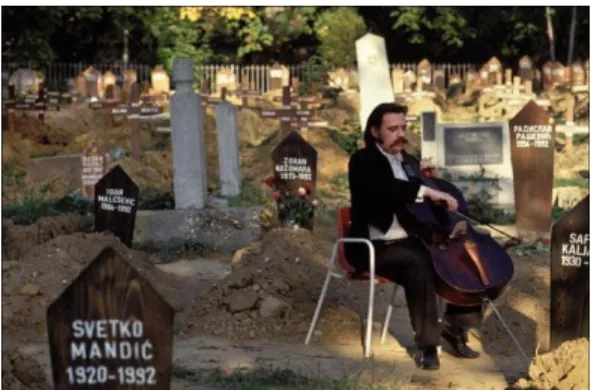
Figure 3: Vedran Smajlovic performing at a Sarajevo cemetery
Another musician Vedran Smajlovic (who played for Sarajevo
String Quartet as well as for the National Theatre, Sarajevo Opera, the
Sarajevo Philharmonic Orchestra and the Symphony Orchestra of
RTV Sarajevo), also known as “The Cellist of Sarajevo,” became a
symbol of moral undefeatedness all over the world. When a mortar hit
a breadline in May 1992, it killed 22 civilians, the cellist’s close
neighbours and friends. Smajlovic, wearing his concert dress, decided
to mourn and honour the innocent by playing for 22 consecutive days
of Sarajevo (Figures 2 and 3). “Smajlovic’s quixotic requiem became
an irresistible symbol of European civilization under siege” (The
Daily Beast, 1993), and his performance of Albinoni’s Adagio in G
Minor filled the air in the midst of the battle and made a stand against
war and violence.
Two smaller theatres remained open throughout the war:
Youth Theatre and Chamber Theatre 55, and during the war SARTR
or Sarajevo War Theatre (Sarajevski ratni teatar) was founded in
1992. Actors and associates of the existing professional theatres in
Sarajevo gathered around SARTR and gave around 2000
performances during the siege (information collected form SARTR
website). Among many other titles, Youth Theatre produced a
premiere of Samuel Beckett’s Waiting for Godot, directed by Susan
Sontag, who visited Sarajevo on several occasions during the war, and
staged the play in 1993.
When asked why she had chosen that particular play Sontag
replied: “Beckett’s play, written over forty years ago, seems written
for, and about, Sarajevo” (Sontag, 2003, p. 300). Classical tragedies
usually have a social purpose. This play might not have as strong
anti-war message of the Theatre of the Oppressed where authors like
“Brecht aimed to provoke precisely such reflections – as the prelude
to action for social change, rather than simply wanting to inspire
empathy with his characters” (Mayo, 2000, p. 104). Sontag
unassumingly wanted to do a small contribution and make the actors
and the audience feel normal, at least for the duration of the
Figure 5: The cast of Susan Sontag’s production
of Waiting for Godot, 1993
Sontag describes how the entire group was struggling during
rehearsals without heating and light, they lacked appropriate props,
the actors were malnourished and could not memorise the lines easily
and would get tired quickly. Nevertheless, the play premiered with
twelve candles on the stage, and actors of all ethnic and religious
groups delivered the lines without problem. They acted as friends,
fellow citizens.
“In Sarajevo, as anywhere else, there are more than a few
people who feel strengthened and consoled by having their sense of
reality affirmed and transfigured by art” (Sontag, 2003, pp. 301-302).
To list all artistic creations would be impossible, and the above
mentioned examples serve here just as an illustration of a vast
quantity of events during the siege: poetry days, Eurovision song
contest, documentaries and feature films made by SAGA production
house, International Festival ‘Sarajevo Winter’, chess competitions,
football matches between B&H and UNPROFOR forces, children
plays and costume parties, etc.
And that was not all. Each and every citizen contributed to the
city’s spirit never to be defeated. Sarajevans kept their humour –
many jokes from the war are still told, most of them in the famous Figure 4: Pasovic, Sontag and Grebo during
black humour style (for example, they were joking that Americans did
not send the air raid but at least they could have sent a pigeon since it
could be cooked and eaten). A group of people contributed to
FAMA’s publication of Sarajevo Survival Guide – with inventive
solutions for survival in a besieged city, including a list of recipes
mostly explaining how to make something out of nothing (with a
warning to use the cookbook at your own peril). Even the members
of the Bosnian army showed their ingenuity when “borrowing” four
tanks from the Sarajevo museum and returning them at the end of the
war with a note they were very useful and they had no complains
while using them (Donia, 2006, p. 311). Such are Sarajevans, never
losing their high spirits, even during the hardest times.
After becoming acquainted with the quantity of cultural
production during the siege of Sarajevo, one cannot but wonder: what
makes you want to go to a film screening or a performance of a
theatre play when your basic human needs are cut: you live without
water, food, electricity, medical supplies or connection with the rest
of the world? Moreover, what makes you create culture, when the
whole cityscape around you seems to be falling to pieces?
“Social scientists and psychologists have noted that preserving
a sense of normalcy is a common response to violence” (Maček,
2000, cited in Donia, 2006, p. 318). Artists’ primary role within a
society is to create art, which was, according to this theory, the most
“normal” reaction to the war around them. Additionally, Hayden
believes that “when the urban landscape is battered, important
collective memories are obliterated” (Hayden, 1995, p. 9), so in order
to protect their memories and the memories of their city from
disappearance and destruction, the artists simply decided to create
more than ever – in order for their works to outlive them, and
memories to be preserved. “A cityscape is not made of flesh” (Sontag,
2004, p. 8) but destroyed buildings could almost be added to the
number of casualties in Sarajevo (Figure 6). The people of Sarajevo
made it clear that the enemy could crumble the entire cityscape, but
not its people – the core of the city. After all, city is “a living
organism, not a machine” (Landry, 2000, p. 8).
Significantly, it seems the enemy was thinking similarly in
terms of the importance of collective memories and identity. As
Donia (2006) explains in his book on Sarajevo, during several first
months, The Army of the Bosnian Serb Republic did not target most
populated places, or places which were strategically and artillery-wise
significant for Sarajevan inhabitants. They turned their focus on all
most visible manifestations of culture and religion and thus the first
major victims of the heavy shelling from the surrounding hills were
places like the National and University Library of Bosnia and
Herzegovina situated in the old City Hall building Vijećnica (which
co-existence of the peoples in Bosnia and Herzegovina), the Olympic
Museum, the Oriental Institute, the main daily newspapers
(Oslobodjenje) building as well as churches, mosques and the old
synagogue. Landry (2000) explains how “[c]ultural heritage is the
sum of our past creativities and the results of creativity is what keeps
society going and moving forward” (p. 6). All these buildings, burned
to ashes, were cultural symbols of the city and by destroying these
symbolic values a part of the city’s significant history of co-existence
and common memories would be deleted, which would prevent it to
advance and prosper. In a way, as historian Robert Donia explains, it
was a true “memoricide” (Donia, 2006, p. 314).
Besides it being a “memoricide”, Martin Coward ‘revives’ the
term “urbicide” relating it to the 1992-1995 War in Bosnia, and
describes it as the “widespread and deliberate destruction of the urban
environment” (Coward, 2008, p. xii). He focuses primarily on the city
of Mostar and the destruction of the Old Bridge (Stari most), built
during the Ottoman time and heavily shelled until it collapsed into the
river of Neretva. Coward argues that from an anthropocentric
perspective it is difficult to give such importance to destruction of
buildings, but one has to understand that it was the integral part of the
destruction of cultural property to perform the ethnic cleansing
process. The attachment to and importance of the space and place is
clear from a Croatian writer Slavenka Drakulic’s ‘obituary’ she
dedicated to the Old Bridge in Mostar, when describing her reaction
to photographs of a Bosnian woman with a cut throat and the image
of the destroyed bridge. The answer reads:
mortality in the collapse of the bridge, not in the death of the woman […] A dead woman is one of us – but the bridge is all of us. (Drakulic, 1993, cited in Coward, 2008, p. 11)
Similarly, Michael A. Sells describes in his book The Bridge
Betrayed: Religion and Genocide in Bosnia a comparable reaction by
a Sarajevan woman who lived there during the war and saw the
cityscape destruction as well as numerous casualties in a hospital.
Sells notices that
the burning of the library struck her with special horror. In the fire of the National Library, she realized that what she was experiencing was not only war but also something else. The centuries of culture that fell back in ash onto the besieged city revealed a secret. (Sell, 1996, cited in Coward, 2008, p. 1)
Figure 7: The City Hall (Vijećnica) burning after heavy shelling in 1992
One of the highest achievements of Bosnian and Herzegovinian
culture was disappearing in fire and together with it shared history
and memories of co-existence. That hurt some people more than the
injuries on their bodies – which could eventually heal. So, to come
back to the artistic creation during the war – it must be that,
stimulated by the destruction of the collective memories of the city,
the citizens answered with a creative endeavour taking them to
creation of new memories.
protect? Which identity, and whose city was it? A nation has been
defined as a society that “occupies a particular territory and includes a
common identity, history and destiny (Johnson, 1995, p. 188). In that
sense, due to the complex ethnic structure, the articulation of national
or ethnic identity was quite difficult and problematic for people in
Bosnia and Herzegovina, especially for those coming from mixed
marriages – many of whom lived in the capital. Some of them simply
declared only their Yugoslav identity (and, absurdly, some still do).
Just as in the case of Cieszyn Lutherans in Poland described in
Marian Kempny’s study about their locality, in war Sarajevo
“national identification ceased to be a decisive factor in the process of
identity construction” (Kempny, 2002, p. 66). Communities based on
ethnicity, religion, age or social statuses were not the primary ones.
Of course, there were “connections arising out of shared experiences,
relationships, histories, territories and practices” (Ibid., p. 15).
Nevertheless, the people of Sarajevo created a new community based
on shared locality, i.e. the city, but at the same time they shared same
interests and experience. As Popple (2003) nicely explains,
“communities of interest can be based upon people sharing a common
condition or problem” (p. 39). Community was never precisely
defined, but here it is worth noting Anthony P. Cohen’s (2002)
observation that “[it] has become a way of designating that something
is shared among a group of people at a time when no longer assume
that anything is necessarily shared” (p. 169, original italics). The
sameness of the people of Sarajevo was the war oppression. Thus, no
matter how much the issue of identity was problematic for Sarajevans
belonged to it, regardless of them being Bosniaks, Croats or Serbs,
since there were surely members of all three major ethnic groups
defending it – on the front lines, or, as previously mentioned artists,
by creating new city culture and memories. Their primary important
aspect of identity was that they were citizens of Sarajevo – the city as
it used to be before the destruction. Sarajevo as a place became
extremely important for all those people who remained there and
created strong social bonds between themselves and the city.
We can see this in the example of The Cellist of Sarajevo. In
an interview for New York Times Smajlovic said: “My mother is a
Muslim and my father is a Muslim, but I don’t care. I am a Sarajevan,
I am a cosmopolitan, I am a pacifist. I am nothing special, I am a
musician, I am a part of the town. Like everyone else, I do what I
can” (People Building Peace website).
Of course, here one has to clarify that “citizen” as a term used
in the text above relates to an inhabitant of a city and not member of a
state, and professor Painter affirms “that there is no simple
correspondence between citizenship and national identity” (Painter,
2005, p. 6). He furthermore explains how “[g]eographies of
citizenship have become increasingly dislocated from those of
national belonging” (ibid), which coincides with the priority given to
this particular definition of “citizen” in this case, due to the
complexity of national identity. It might be that the people of
Sarajevo linked citizenship with the city specifically because that
Another link among the people was their cultural identity.
There are different ways to define cultural identity according to Hall,
and the
first position defines ‘cultural identity’ in terms of one, shared culture, a sort of collective ‘one true self’, hiding inside the many other, more superficial or artificial imposed ‘selves’, which people with a shared history and ancestry hold in common. (Hall, 1994, p. 393)
The second one
recognises that, as well as the many points of similarity, there are
also critical points of deep and significant difference which
constitute ‘what we really are’; or rather – since history has intervened – ‘what we have become’ […] Cultural identity, in this second sense, is a matter of ‘becoming’ as well as ‘being’. (Ibid., p. 394, original italics)
One can say that, during the war, Sarajevans who kept many
different identities within themselves developed the ‘collective self’
beyond the differences among them and transformed their identity to
a common one. One way or another, they were all extremely shaped
by the cultural legacy of their ancestors and found the “common
language” to unite them in their difference. “For some, culture
represents a protective ‘shield’ to guard them against unwelcome
change, for others it represents a ‘backbone’ with which to face the
future” (Landry, 2000, p. 39). In Sarajevo’s case, it might have been
both – culture guarded the citizens from the horrors around them as
well as gave them some hope that one day – hopefully soon – this will
all be in the past. In the end, what mattered most to them was not so
much what they were, but what they were not – enemies, “them”,
“others”.
Another forced identity to which Sarajevo citizens were
“the bloody Balkans”, when organizing events like, for example,
Sarajevo Film Festival during the siege, the citizens of Sarajevo saw it
as “a way of reminding the world that this city fought a war because it
believed it had earned a place in that cosmopolitan artistic cosmos”
(Turan, 2002, p. 107). Feeling abandoned by the rest of the (mostly
Western) world, they wanted to revive their European identity, or,
even broader, be part of the bigger world again.
Finally, after explaining various reasons which triggered
heightened culture productivity during the war in Sarajevo, we come
back to the question from the beginning of this essay: “What is the
role of culture in times of ongoing crisis, as has been the case in
Bosnia and Colombia?” (Yudice, 2003, p. 338). Can culture ease the
conflict? Does it have the power to stop the war?
The Oxford English Dictionary, among other definitions,
describes war as “any kind of active hostility or contention between
living beings, or of conflict between opposing forces or principles”
(The Oxford English Dictionary – Vol. XII, 1933, p. 80), and warfare
as “the act or state of conflict” (Ibid., p. 97) which defines ‘war’ and
‘warfare’ as a type of conflict. Looking back at history and knowing
what happened in the case of Sarajevo, one knows that, no matter how
strong it was, cultural activity did not stop the conflict, it did not stop
the war. Why did it fail, and should we call it a failure?
I believe it did not fail, because its purpose was not to
accomplish any bigger impact than it was. Arts are often used as a
tool for conflict resolution and reconciliation. However, once the
conflict is brought to an extreme, as in the case of Sarajevo war, we
resistance and serve as a confirmation of people’s city identity. Once
the escalated violence and conflict is kept under control, arts take on
another role and help peacekeeping and reconciliation. Of course, the
example of Sarajevo is not sui generis. Any severe catastrophe – war,
or a natural disaster, would have similar results. It might be that the
case of Sarajevo is simply extremely complex, as filmmaker Srdjan
Karanovic puts in plain words: “Here history is very complicated,
there is conflict and remembrance from every period” (Karanovic
cited in Turan, 2002, p. 91). Nevertheless, it used to be something
extremely positive in past, and Sarajevo-born theatre director Haris
Pasovic tried to explain to Susan Sontag while they worked on
Waiting for Godot together: “You can’t imagine what it used to be
like here. It was paradise” (Pasovic cited in Sontag, 2003, p. 316).
Even foreigners understood the city’s uniqueness and, to use the
words of film director Paul Alden Robinson “[b]efore the war it was
the one place where people got along, a combination of small town
openness and warmth and big city sophistication; it was the best
vision we have of ourselves” (Turan, 2002, p. 93). Remembering this
almost idealised picture of the city possibly motivated artists even
more in their struggle to keep the city’s former spirit alive.
Many journalists and war photographers hope that showing
the rest of the world the horrors of war would make a significant
change. But the photograph “The Napalm Girl” by Nick Ut did not
end the Vietnam War. Susan Sontag’ play did not help end the war in
Sarajevo, as well as all the activities of Jews during the WW2 did not
have any conflict resolution aim. Jean Baudrillard wrote:
do the right thing. They harbour no illusion about the outcome and do not indulge in self-pity. This is what it means to be really existing, to exist within reality […] This is why they are alive, while we are dead. (Baudrillard, 1994)
All creative solutions within arts and culture section during
the war were not there to solve problems and were not catalysts for
change. But later, they did and still do play a significant role in
peacekeeping and reconciliation processes.
Since the war ended, Sarajevo Film Festival is dedicating a
special part of their program to children, “which started when director
Purivatra realized that the four-year siege meant that a generation of
children hadn’t had the opportunity to see the movies on the big
screen” (Turan, 2002, p. 108). Buses bring children from all over
Bosnia and Herzegovina – both entities – to children matinee
program, similar to the later constructed idea of Kids’ Festival
organized every year since 2004. Sarajevo Film Festival brings some
of its program outside of the capital too, to areas where people might
not even have a cinema to visit – all having “a special role to play in
binding the wounds of wars, advancing regional cooperation and
reconciliation, and promoting peace and human rights” (People
Building Peace website).
Some projects exist so that the horrors of war do not fall into
oblivion. Young actress Zana Marjanovic leads a project in the last
couple of years, where actors and ordinary citizens take part in a
performance where they count the number of victims of the
Srebrenica massacre. Artists still carry memories which need to be
told. This might be the main reason why they mostly reflect the war in
consequences of war. An example could be the recent film by
contemporary artist Sejla Kameric 1395 Days without Red, in which
the main character, played by Spanish actress Maribel Verdú, is
reliving the experience of the trauma of the siege. It is her individual
journey through the collective memory of the city.
“Cities have always been, and will always be, places of
heterogeneity” (Bridge & Watson, 2000, p. 255). In this paper, I tried
to illustrate the complexity of Sarajevo’s heterogeneity and the search
of its war troubled citizens for identity within the city. In a truly
Lafebvreian manner, the citizens expressed their right to the city and I
argue that exactly because of the strength of the urbicidal affects,
Sarajevo’s citizens, and especially artists, were fighting against this
war with strong cultural production in the besieged city.
After providing several examples of art during the siege, I
explained what might have been the reasons for such a rich cultural
production during the war, using some of the theories about identity,
loss of common memories and urbicide. Finally, I discussed the
purpose of culture during the war and that only in a less complex
conflicts arts and culture could be used as tools for dissuasion of
conflict and consensus.
Sometimes it seems culture in Sarajevo is struggling more
today than it did during the siege – due to the lack of budget, many
institutions might close their doors to public, many artists left the city,
and those who are still there, in these times of social poverty and
more global problems, are hoping for affectionate audience as was in
the time of the city’s siege. On one occasion, actor and director of
paraplegic as an early victim of the war, declared that he missed the
war because then we were all better people (Seksan and Hadzovic,
2002). Anyhow, it is certain that “[c]ulture helps us to adapt to change
by anchoring our sense of being; it shows that we come from
somewhere and have a story to tell; it can provide us with confidence
and security to face the future” (Landry, 2000, p. 39), which was
exactly the role of culture during the siege in Sarajevo. Thus, Wilde’s
belief that “all art is quite useless” does not hold ground. As described
in People Building Piece II,
It is doubtful whether Vedran Smailovic managed to save a single life, shorten the Bosnian war, or speed the end of the siege of Sarajevo by even one day. Almost certainly, his brave actions made little impression on the Serb gunners who continued their merciless shelling of Sarajevo from the hilltops surrounding the city; if they were aware of his existence at all. He did not see himself as a peacebuilder. Yet his story has been often repeated and his actions have been held up to the world as a symbol of inspiring courage and nonviolent resistance in the face of horrible violence and human suffering (People Building Peace website).
The time to grasp the entirety of purposes and consequences
of artistic production during the war in Sarajevo has not yet ended and
as long as there are such inspiring people as those described in this
essay it gives hope in the brighter future of this “crazy but charismatic
town” (Purivatra cited in Turan, 2002, p. 93).
References
Amin A. and Thrift N. 2002. Cities: Reimagining the urban. Cambridge: Polity
Press.
Andreas, P. 2008. Blue helmets and black markets: the business of survival in the siege of Sarajevo. Ithaca: Cornell University Press.
Baudrillard, J. (2004). ‘No Reprieve For Sarajevo’ Liberation, 8 January. Retrieved from:
http://www.uta.edu/english/apt/collab/texts/reprieve.html (Accessed: 22 December 2011)
Bridge G. and Watson S. 2003. ‘City Differences’ in Bridge G. and Watson S.
(Eds.) A companion to the city. Oxford: Blackwell Publishers Ltd.
Cohen, A. 2002. Epilogue. In: Amit, V. (ed.) 2002. Realizing community: concepts,
social relationships and sentiments. London: Routledge. Ch.9.
Coward M. 2009. Urbicide – the politics of urban destruction. New York: Taylor
and Francis Group, Routledge, retrieved from URL
http://www.ewidgetsonline.com/dxreader/Reader.aspx?token=v+PpHsyYi WdiGCmc2vu0Vw%3d%3d&rand=1838137898&buyNowLink=&page= &chapter=
Donia, Robert J. 2006. Sarajevo, a biography. London: Hurst & Company.
du Preez Bezdrob, A. M. 2006. Sarajevo roses: war memoir of a peacekeeper.
Johannesburg: Struik Publishers.
Florida, R. 2004. The rise of the creative class and how it's transforming work, leisure, community and everyday life. New York: Basic Books.
Florida, R. 2005. Cities and the creative class. New York: Routledge.
Hall, S. 1994. ‘Cultural Identity and Diaspora’ in Williams P. and Chrisman L.
(Eds.) Colonial discourse and post-colonial theory, a reader. London:
Pearson Education Limited.
Hayden, D. 1995. The power of place: urban landscapes as public history.
Cambridge: MIT Press.
Jenks, C. 1993. Culture. London: Routledge.
Johnson, A. 1995. The Blackwell dictionary of sociology. Oxford: Blackwell.
Kempny, M. 2002. Cultural islands in the globalising world: community-cum-locality of the cieszyn silesian lutherans. In: Amit, V. (ed.) (2002).
Landry, C. 2000. The creative city: a toolkit for urban innovators. London: Earthscan.
Malcolm, N. 1994. Bosnia, a short history. London: Pan Books.
Mayo, M. 2000. Cultures, communities, identities: cultural strategies for
participation and empowerment. New York: Plagrave
Murray, J. et al. (Eds.) 1933. The Oxford English dictionary Vol. 12: V-Z. Oxford:
Clarendon Press.
Seksan V. and Hadzovic S. 2002. ‘Trijumf volje’ Dani Magazine (no. 251), 5 April. Retrieved from:
http://www.bhdani.com/arhiva/251/t25124.shtml (Accessed: 21 December 2011).
Sells, Michael A. 1996. The bridge betrayed: religion and genocide in Bosnia. London: University of California Press.
Sontag, S. 2003. Where the stress falls. London: Vintage.
Sontag, S. 2004. Regarding the pain of others. New York: Picador.
Stoddart, T. 1997. Edge of madness: Sarajevo, a city and its people under siege / photographs by Tom Stoddart and Alastair Thain. London: South Bank Centre
Turan, K. 2002. Sundance to Sarajevo: film festivals and the world they made.
London: University of California Press, Ltd.
Yudice, G. 2003. The expediency of culture: uses of culture in the global era.
London: Duke University Press.
Zelizer, C. 2003. The role of artistic processes in peace-building in
Bosnia-Herzegovina. In: Peace and conflict studies, volume 10, 2. Fall 2003 (pp.
62-75). Retrieved from: http://shss.nova.edu/pcs/journalsPDF/V10N2.pdf (Accessed: 22 December 2011)
Zuvela, M. 2011. ‘Sarajevo Film Festival awards jailed Iranian director’ Reuters,
U.S Edition, 22 July. Retrieved from: