BUSINESS DEVELOPMENT OF NEW ASSISTED COMPANIES BY
INTELLIGENT AGENTS ON THE ENTIRE PATH
PRODUCTION-COMPETITIVE MARKET
RADU O.1)
1)INMA Bucharest / Romania
E-mail: [email protected]
Keywords: company, business, production, actions, competition
ABSTRACT
The paper presents some concepts and solutions that can be used by economic agents to become more efficient, in a very competitive market.
INTRODUCTION
Profitability processes for renewal of economico-engineering companies can use the following types of technico-economic intelligent agents:
1. AIMA's agent of Russell and Norvig is described as "anything that can perceive its environment through sensors and act upon that environment through effectors." The definition depends largely on what is meant by environment, perception and action. Thus, if the environment asures inputs for agents and receives outputs, any program can be considered an agent in general sens.
2. Maes agent: “ Autonomous agents are computational systems that populate some complex dynamic environment and act autonomously in this environment, performing a set of tasks for which they were designed”.
This definition adds a very important element: agents autonomy, but limits the environment types, to the complex and dynamic ones.
3. It can therefore be considered an agent is “ a computational system located in an exceptional environment and capable of autonomous action in this environment to meet scheduled targets”.
The set of all possible actions of an agent called effector capacity, ie the ability to modify the execution environment. Not all actions can be performed in a certain situation; they have some associated pre conditions, defining the state of the environment in which they can be met. For example, an agent- buyer in order to buy an electronic system will not be able to carry out the transaction if the user account does not contain enough money for it.
4. Hayes-Roth agent: “Intelligent agents continuously perform three functions : perception of dynamic conditions from average, action for influencing environmental conditions and reasoning in interpreting perceptions including solving problems, inference deduction and determine actions”.
5. IBM agent: “ Intelligent agents are software entities that meet certain operations in the user's name, with some degree of independence or autonomy, " using such knowledge and representations of the user desires”.
Most appropriate definition for intelligent agents belonging to creators Wooldridge and Jennings. They believe that an intelligent agent is an hardware or (especially) software system, which enjoys the following properties.
- “autonomy” when the agent operates as a stand alone process, without direct human
intervention and detaining control over actions and its internal state;
- “reactivity” when the agent perceives its environment and responds promptly to
changes occurring in the concerned environment;
but is able to manifest an oriente behavior toward the purpose by taking initiative;
- “social skill” when the agent interacts with other agents in a certain communication
language and cooperate on the basis of what we mentioned and appreciates intelligence as a capacity of autonomous flexible action, where flexibility requires reactivity, proactivity and social skill.
• Reactivity is a property required when the agent acts in unsafe environments, which are always changing. The agent reacts continuously in order to adapt to changes.
• Proactivity refers to goal oriented behavior. This concept can be exemplified by a simple written program in an imperative language. Effects of execution proceedings is the purpose, what they intend to achieve the program's author. The model is suitable for static environments, where pre-conditions changes during the execution procedure, the result will be unpredictable and usually wrong.
• Social skill, the third attribute of a flexible behavior, it covers cooperation between the agents, sharing goals. A simple exchange of information can not be regarded as social behavior, which proves more complex. There are cases where they achieve their goals with conflict of interests with other agents. In such cases they recourse to negotiation, choosing alternative actions, etc.
Analysis model of intelligent agents is based on four dimensions: environmental properties, property actions of agents, property goals of agents and property shares of agents. The environment can be accessible or inaccessible, determined or probabilistically, static or dynamic, discrete or continuous.
• Infallibility: an infallible action will certainly produce the desired effects if the environment meets his preconditions and executes them correctly. Infallibility mainly refers to the intention to perform an action and not the success probability.
• Utilityaction is given by the state necessity when is reached by the respectiv action.
MATERIAL AND METHOD
Different actions may require different resources to be fulfilled such as electricity consumption, spending an amount of money, etc. Costs can be calculated on the spot, prior to perform an action, or can be determine at a later point in time. In a non deterministic environment, the cost of an action can not be known in advance. An action is optimal if is fair and there is no other correct action with a lower cost.
In terms of information exchange with the environment, actions can be:
“ofperceptions”: refers to agent capacity to perceive the execution environment;
“of movement”: if no possible action can not determine changing the agent perspective on its environment of execution;
“of comunication”: communication between agents refers to interactions (information exchange) in a certain inter- agent communication language. In an environment where there are several types of agents, it may impose more communication languages.
RESULTS AND DISSCUSSIONS
Goals of intelligent agents is achive by:
“ autonomous generation”: ability to generate your own actions falling between the defining characteristics of an intelligent agent. In general, the establishment of new approaches depends on the agent and the environment current state;
“ achievement or maintenance purposes” a certain state in the environment. Maintenance tries storing and preserving a certain state;
singular purpose;
“ commitment to the actions triggered”: appears when an agent abandons his pursued interest. If this is achieved, it says that the agent is strongly committed to the purpose. If the agent will abandon its purpose in other circumstances, such as when it is demonstrated that the goal can not be reached or requires too much consumption of resources, it is said that the agent is weakly committed to the purpose;
“ utility purposes”: is determined to reward actions fulfillment.
Intelligent agents convictions refer to the following specifications:
Convictions of an agent means internal representation of its execution environment. In other words, convictions means what agent "believe" about the environment, and not necessarily what is in reality of the environment. And for agent convictions we can remember a few properties:
“consistency”: an agent convictions are consistent if for every p proposition, it does not believe p simultaneously and non-p;
“safety”: agent convictions are safe if convictions representation does not admit an uncertainty degree;
“propositional attitudes well nested”: agent convictions contains well nested propositional attitudes if it can represent both their own goals and beliefs, and those of other agents.
Agents features in simulating complex systems refers to:
“ aggregation”: agents groups similar objects and ignores differences (thus organizational patterns appear at a collective level);
“labeling”: agents should be individualized, they possess an identity;
“ nonlinearity” It shows that: global behavior of a complex system can not be lineary decomposed in individual agents behavior;
“ fluency”:agents are interconnected, interact and transfer information;
“diversitatea”: heterogeneous multi-agent systems shows that agents have different roles and behaviors;
“internal models” have the role to designe rules that produce agents' behavior, so they can anticipate environmental influences;
“construction components”are comprised of simple components, and by combining it can result agents with different roles and behaviors.
Agents can be classified in terms of minimum characteristics that must manifest and namely: autonomy, learning and cooperation. As recalled, autonomy refers to the ability of operating without human intervention, in order to meet its own goals and those of users.Cooperation is why we choose and use more agents in multi-agent systems, in situations where a single agent could not function effectively. Also, to be considered intelligent, agent must be able to learnfrom interactions with external environment which results in an increase in performance over time. The combination of these attributes, can deduct the following types of agents: collaborative instructed, of interface and intelligent agents.
Desktop agents work on a PC or a workstation and are software agents that runn in the local operating system of a personal computer, such as Windows or Unix. Depending on tasks, desktop agents can be classified as:
"Operating system agents": perform tasks that typically require user interaction with the operating system through the graphical user interface (GUI). For example, such agents can monitor events from the operating system and execute various tasks when the user no longer work for a period. Also, agents may initiate or complete tasks related to graphical interface in user's behalf;
♦ application agents:automate some tasks whitin an application.
Internet agents arose from the need of processing a growing amount of information. Within this type of agents, can be found:
♦ search agents: regular search engines have so-called robots, which explores all the links from a base address and catalogs information on each accessed page;
♦ agents of information filtration: unlike search agents, that returns the user's address, they gather information based on content, from different sources, filters them through the personal preferences of the user and suggest the result as an updated Web page or an e-mail mesage;
♦ notification agents: announces user that some changes acured, such as updating a Web page, receive a reminder e-mail or data of particular significance.
Intranet term it refers to an internal network of a specific organization, based on Internet technology. Usually, the network can be accessed by the organization's employees, customers and suppliers, based on a password.
Intranet agents are software agents located on a corporate server, which oversees and administers conduct of the affairs on behalf of users, In such an environment, the model is easy to apply for agents because the business process itself can be seen as a collection of autonomous agents that interact within interdependent tasks. Each category of Intranet agents finds its applicability on the Internet. Intranet agents include some additional categories:
♦ collaborative agents: is integrated on collaborative programs, managing information sharing by a group of users;
♦ agents of automation process: automates the flow of operations in commercial applications, such as systems processing of data requested by customers;
♦ database agents: acts as a front end for corporate databases, as background data centralization, for the preparation of periodic reports;
♦ mobile agents: these agents are effectively carrying on a client machine on different servers in the network to perform some tasks on behalf of the user. In contrast to the remote procedure calls, limited to transmitting data to a procedure on the server, mobile agents carrying both data and program on which it acts.
Modeling based on agents is adequate for analysing a complex dynamic processes because it allows a rich representation of the characteristics and actions of agents, which could not be supported by the formality and rigor of computational algorithms.
Semiotics agents, generates emerging unplanned behavier, yet complex enough to have an adequate representation of knowledge and ability to share this knowledge with the idea to simulate a common symbolic "culture".
A step forward in terms of "humanizing" social agents is adding features to psychological agents. Would prove their usefulness in building hybrid systems in which agents and people socially interact, because now agents are not flexible enough to work effectively in human society. Psychological agents should be able to decipher in an heuristic way human intentional states and can communicate using natural language. Emotional agent, called MINDERI, is constructed using SIM AGENT development environment. The emotional features are simulated by so-calleddisturbancesin the normal action process, partial or total loss of attention control.
Simulation based on agents is applied in the study of various economic activities. Energy holdings are in fund economic entities with stimuli and reaction.
Economic agents they are suitable for analytical study of trade because they make possible modeling of complex interconnections that characterize markets. Build operational decisions producers must consider the following restrictions:
provision to be neglected, the agent is free to explore a number of offer strategies until utilization rate became a specific objective of the central.
2) If the agent can achieve utilization rates increases the central offered price with the lowest profit achieved over the portfolio or during the market period at the central offered price that has achieved the next highest profit in the same period. This is applicable for the same cycle central, centrals with higher marginal costs offering prices are always higher than those offered by central with lower marginal cost.
3) Agent compares the profit made during the day on the market (D-1) at made the day before (D-2); if that is at an increas then the agent will offer the same prices on the market mechanism as those offered during the day (D-1).
4) Where appropriate the profits decreased or remained constant, then the agent will try one of two possible alternatives: It will increase or decrease the offered price for each central during the next day on the market (D), by adding or subtracting a random percentage. This policy forces the agent to explore alternative ways to maximize their daily profit both by increasing its participation on the market or by raising prices. Agent decides whether to decrease or increase the proportion of random market price based on previous experience.
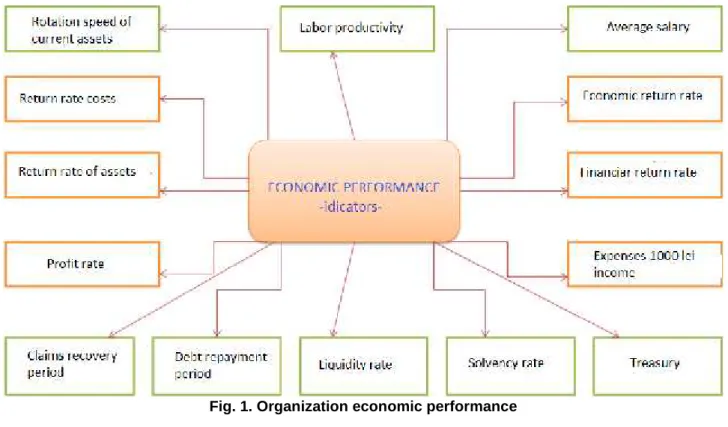
It was mentioned that both agents will pursue the policy of increased and low price as part of their marketing strategy. This implies that there must be a minimum and maximum price limit offered by an agent. The economic performance of companies subject innovation can be traced in Figure 1.
Fig. 1. Organization economic performance
CONCLUSIONS
Novel approaches of optimal innovation under economico- managerial aspects of applicable research frame for profitable companies subject for innovation are mainly the following:
- Addressing the integration of new modernized companies into digital economy structure;
- Develop decision models compared on ensuring success of innovation product and service including boosting human factor growth;
- Ensure anticipatory pilotage of integrated companies (market-production) to diminish holistic vulnerabilities;
- Innovative presentation of profitableness models of renewed companies based on the content of performance project management;
- Completing the current structure of economico-financiar and technologico-managerial indicators with new complex relationship dictated by increasing the value of products for competitive market;
BIBLIOGRAPHY
1. Carabulea A., 1986 - The Theory of Engineering Management Applied to the Design, Assembly and Operation of Power Project in a Archemic Approach E.M.T.A., Anglia; 2. Merrian I., 1964 - Optimization Theory and the Design of Feedback Control Systems,
McGraw-Hill Book Company;
3. Lgrant E. & Grabt W., 1970 - Principles of Engineering Economy. The Rowald Press Company;
4. Hicks T., 1969 -Successful Engineering Economy. McGraw-Hill Book Company; 5. McCornick E., 1970 -Human Factors Engineering. McGraw-Hill Book Company;
6. Mullineux G. CAD, 1986 - Computaţional Concepte and Methodes, Mac MHIan Publishing Company New York;
7. Timmons J., 1990 -New Venture Creation Entrepreneuschip in the 1990's Homewood, II 60430 SUA;
8. Jelen F.C., 1970 - Cost and Optimization Engineering, McGraw-HilI Book Company, New York;
9. Baker W.E., 1998 - Networking Smart. How to Build Relationships for Success, Executive Book Summaries;