THERMAL REQUIREMENTS FOR WHITE GRAPEVINE VARIETIES
GROWN IN THE REGION OF SREMSKI KARLOVCI, SERBIA
RUML, M.1A, KORAĆ, N.2, VUJADINOVIC, M.1, VUKOVIC, A.1
1Faculty of Agriculture, University of Belgrade, Serbia 2Faculty of Agriculture, University of Novi Sad, Serbia Acorresponding author e-mail:[email protected]
Keywords: Vitis vinifera, GDD, Serbia
ABSTRACT
Thermal requirements to reachbudburst, flowering, veraison and harvest for thirteenwhite grapevine varieties grown in the Sremski Karlovci region were determined using a growing degree-days (GDD) method and base temperature of 10°C. The accumulated GDD for the beginning of budburst ranged from 60 (‘Petra’) to 79 (‘Bagrina’). The thermal requirements for the beginning flowering varied between 334 GDD in ‘Chardonnay’ to 404 GDD in ‘Bagrina’. The smallest accumulated GDD to reach the beginning of veraison was observed in ‘Bouvier’ (869) and the greatest in‘Riesling Italian’ (1106). The GDD for harvest spanned the range from 1530 in ‘Muscat Ottonel’ to 1717 in ‘Riesling Italian’. Greater variation in GDD was displayed between years for a single variety than among varieties within individual years. Considering phenological stages, the greatest year-to-year variability was found for the beginning of budburst and the least for harvest.
INTRODUCTION
Climate, in particular temperature, is the key factor for grapevine(VitisviniferaL.) yield and quality (van Leeuwen et al.,2004) and its geographical distribution (Jones, 2006).Traditionally, grapevines are cultivated in areas where mean growing season temperatures is within the 12–22 °C range(Jones, 2006). Prolonged temperatures above 10°C initiate vegetative growth in the spring (Mullins et al.,1992).Temperature determines the beginning and duration of the phenologicalphases. Grapevine is a phenologically distinct crop with the main stages being bud break, flowering, veraison and harvest (Jones and Davis 2000). Every grapevine variety has its own climatic requirement for well-balanced ripeningand high quality wine production. The varietal thermal requirementsare most often expressed in growing degree-days (GDD) for a base temperature of 10°C (Winkler et al., 1974). This study is aimed to determine thermal requirements to reach major phenological stages for thirteenwhite varieties grown in the region of SremskiKarlovci,one of the oldest wine-producing European regions,where grapevine cultivation goes back to Roman times.Information on thermal requirements for different varieties are very important for selecting varieties that may reach maturity under conditions favorable for terroirexpression, particularly having in mind the present (Ruml et al., 2016a) and future climatic change (Ruml et al., 2012) in this region.
MATERIALS AND METHODS
established in 1979. Each variety was represented by 20 vines planted with a spacing of 3 x 1 m and trained using the single Guyot system.
Thirteen white wine varieties, both Serbian and internationally recognized ones, were selected from the ampelographic collection for this study. Following phenological events of grapevine were examined: the beginning of budburst – the date when green shoot tips became just visible, stage 7 on the BBCH scale (Lorenz et al.1995); the beginning of flowering – the date when first flower hoods were detached from the receptacle (stage 60 on the BBCH scale); the beginning of veraison – the date when berries begin to develop variety-specific colour (stage 81 on the BBCH scale); and harvest (stage 89 on the BBCH scale). Harvest cannot be considered a true phenological stage, because it is mostly subjective and depends upon winery requests, weather conditions, disease occurrence, etc.
Temperature data were obtained from the Republic Hydrometeorological Service of Serbia, which performed technical and critical controls of the measurements. Daily maximum (Tx) and minimum (Tn) air temperature were observed at a meteorological station near the ampelographic collection.
Daily GDD was calculated as a difference between daily mean air temperatures (Td= (Tn+Tx)/2) and base temperature (Tb= 10°C). If daily GDD was negative, it was set equal to zero. Total GDD was obtained by summing up daily values:
∑ max 0, (1)
where GDDi is GDD for ith year, and ni the number of days from 1 January to the
beginning of phenological event in the ith year.
RESULTS AND DISCUSSION
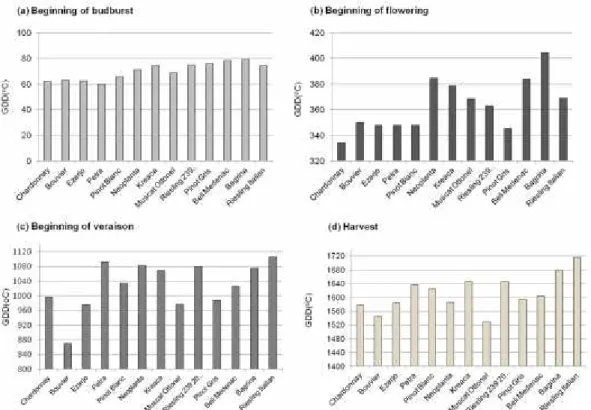
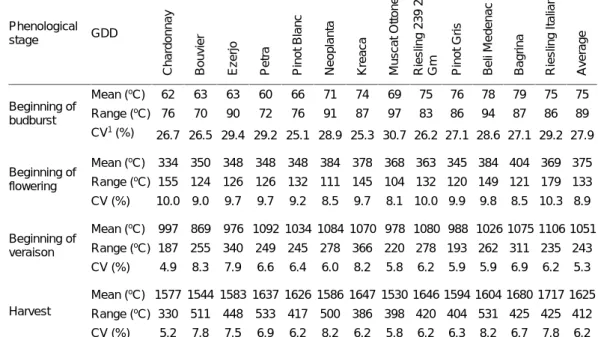
Average GDD over the period for studied phenological events are shown in Figure 1, while relevant descriptive statistics are displayed in Table 1.
The least thermal requirements for the beginning of budburst was observed in ‘Petra’ (60 GDD) and the greatest in ’Bagrina’(79 GDD). ’Pinot Blanc’ displayed the least inter-annual variation, while the smallest range in GDDswas exhibited for‘Bouvier’. ‘Muscat Ottonel’shown the highest inter-annual variation and the greatest range in GDDs for the beginning of budburst.
The variety with the smallest average temperature sum for the beginning of flowering was ‘Chardonnay’ (334 GDD), while the variety with the greatest average temperature sum was ‘Bouvier’(404 GDD). In contrast to the beginning of budburst, ‘Muscat Ottonel’ exhibited the lowest year-to-year variability and the least range in GDDs for the beginning of flowering. ‘Riesling Italian’ was the variety with the highest inter-annual variability and the greatest GDD range.
The thermal accumulation for the beginning veraison ranged from 869 GDD in ‘Bouvier’to 1106 GDD in‘Riesling Italian’. ‘Chardonnay’had the lowest year-to-year variationand the smallest range, while ’Kreaca’ had the highest year-to-year variation and the greatest range in GDDs for the beginning of veraison.
The smallest thermal requirements for harvest was observed in ‘Muscat Ottonel’(1530 GDD) and the greatest in ‘Riesling Italian’(1717 GDD). ‘Chardonnay’ exhibited the lowest inter-annual variation and the smallest rangein GDDs.‘Neoplanta’and ‘Beli medenac’ had the highest inter-annual variation, while‘Petra’ had the greatest range in GDDs for harvest.
Similar analysis of thermal requirementswas done for eight red grapevine varieties grown in the same region over the same period (Ruml et al., 2016b). Obtained results from these two sutudies were very similar considering average thermal requirements of examined varieties as well as inter-annual variaton in GDDs.
Table 1 Descriptive statistics of thermal requirements for white varieties
in the region of Sremski Karlovci (1986–2007)
Phenological stage GDD C h a rd o n n a y B o u v ie r E z e rj o P e tr a P in o t B la n c N e o p la n ta K re a c a M u s c a t O tt o n e l R ie s lin g 2 3 9 2 0 G m P in o t G ri s B e li M e d e n a c B a g ri n a R ie s lin g I ta lia n A v e ra g e Beginning of budburst
Mean (oC) 62 63 63 60 66 71 74 69 75 76 78 79 75 75
Range (oC) 76 70 90 72 76 91 87 97 83 86 94 87 86 89
CV1(%)
26.7 26.5 29.4 29.2 25.1 28.9 25.3 30.7 26.2 27.1 28.6 27.1 29.2 27.9 Beginning of
flowering
Mean (oC) 334 350 348 348 348 384 378 368 363 345 384 404 369 375
Range (oC) 155 124 126 126 132 111 145 104 132 120 149 121 179 133
CV (%) 10.0 9.0 9.7 9.7 9.2 8.5 9.7 8.1 10.0 9.9 9.8 8.5 10.3 8.9 Beginning of
veraison
Mean (oC) 997 869 976 1092 1034 1084 1070 978 1080 988 1026 1075 1106 1051
Range (oC) 187 255 340 249 245 278 366 220 278 193 262 311 235 243
CV (%) 4.9 8.3 7.9 6.6 6.4 6.0 8.2 5.8 6.2 5.9 5.9 6.9 6.2 5.3
Harvest
Mean (oC) 1577 1544 1583 1637 1626 1586 1647 1530 1646 1594 1604 1680 1717 1625
Range (oC) 330 511 448 533 417 500 386 398 420 404 531 425 425 412
CV (%) 5.2 7.8 7.5 6.9 6.2 8.2 6.2 5.8 6.2 6.3 8.2 6.7 7.8 6.2
1CV: Coefficient of variation
Sauvignon’ in the region of SremskiKarlovci(Ruml et al., 2016b) than those reported by van Leeuwen et al. (2008).
Temperature sums for the beginning of budburstshowed the greatest inter-annul variation in terms of coefficient of variation (CV) for both white (Table 1) and red (Ruml et al., 2016b) varieties. Among examined phenological stages,the least inter-annul GDD variation was exhibited for varaison for white varieties (Table 1) and for harvest for red varieties (Ruml et al., 2016b).
Absolute difference in the average temperature sums among white varieties was the smallest for thebeginning budburst (19 GGD) and the greatest for the beginning of verasion (237 GGD). The same results were gotten for red varieties with absolute difference of 23 GGD for the beginningbudburst and 180 GGD for the beginning of verasion.
A variation in GDD among white grapewine varieties within individual years was also investigated and results are summarized in Table 2. In terms of CV, the greatest variation in GDD among varieties was for the beginning of budburst and the smallest for harvest. The phenological event with the greatest GDD range between varieties within individual years was harvest. The same results were obtained for red grapewine varieties (Ruml et al., 2016b), except for the greatest GDD range between varieties. For the red varieties, the phenological event with the greatest GDD range was veraison.
Table 2 Descriptive statistics of GDD variation among white grapevine varieties within
individual years in the region of Sremski Karlovci (1986–2007)
Phenological stage Range (
oC) CV1(%)
Mean Max Min Mean Max Min
Beginning of budburst 20 48 6 9.8 22.6 2.4
Beginning of flowering 67 148 20 6.1 13.6 2.0
Beginning of veraison 173 248 59 5.8 8.4 2.3
Harvest 195 364 51 4.2 7.7 1.5
1CV: Coefficient of variation
A greater variation in GDD was found between years for a single variety (Table 1) than between varieties within individual years (Table 2) for all phenological stages, except for the beginning of veraison when the CV is considered. The same results were obtained for red grapevine varieties (Ruml et al., 2016b). This findingimplies that climatic factors generally had a stronger impact on thermal accumulations than genetic characteristics of varieties. Nevertheless, in some climatologically extreme years, the difference in accumulated GDD between varieties was quite large or small (Table 2), pointing to the fact that a wide diversity exists among grapevine varieties in response to critical meteorological variables, whichmay offer adaptation options to climate change.
CONCLUSIONS
ACKNOWLEDGEMENTSThe paper was part of the project ‘Studying climate change and its influence on the environment: impacts, adaptation and mitigation’ (III 43007) financed by the Ministry of Education and Science of the Republic of Serbia.
BIBLIOGRAPHY
Jones, G.V., 2006 -Climate and terroir: impacts of climate variability and change on wine. In: Macqueen RW, Meinert LD (eds) Fine wine and terroir. The geoscience perspective. Geosci Can Repr Ser 9. Geological Association of Canada, St. John’s Newfoundland.
Jones, G.V., Davis, R.E., 2000 - Climate influences on grapevine phenology, grape composition, and wine production and quality for Bordeaux, France. Am. J. Enol. Vitic. 51, 249–261.
Lorenz, D.H., Eichhorn, K.W., Bleiholder, H., Klose, R., Meier, U., Weber, E., 1995 -Phenological growth stages of the grapevine (Vitis vinifera L. ssp. vinifera) – Codes and descriptions according to the extended BBCH scale. Aust. J. Grape Wine Res. 1, 100– 103.
Mullins MG, Bouquet A, Williams L.E., 1992 -Biology of the grapevine. Cambridge University Press, Great Britain.
Ruml, M., Vuković, A., Vujadinović, M., Djurdjević, V., Rankovic-Vasić, Z., Atanacković, Z.,Sivčev, B., Marković, N., Matijašević S., Petrović, N., 2012 - On the use of regional climate models: Implications of climate change for viticulture in Serbia.Agr.Forest Meteorol. 158, 53–62.
Ruml, M., Korać, N.,Vujadinović, M.,Vuković, A.,Ivanišević D., 2016a -Response of grapevine phenology to recent temperature change and variability in the wine-producing area of SremskiKarlovci, Serbia. The Journal of Agricultural Science, 154, 186–206.
Ruml, M., Korać, N., Ćirković, D., Vujadinović, M. Vuković, A., 2016b - Heat requirements for red grapevine varietys in the wine-producing region of SremskiKarlovci, Serbia.ActaHortic. 1139, 409-412.
van Leeuwen, C., Friant, P., Choné, X., Tregoat, O., Koundouras, S., Dubordieu, D., 2004 -Influence of climate, soil, and variety on terroir. Am. J. Enol. Vitic. 55(3):207–217.
van Leeuwen, C., Garnier, C., Agut, C., Baculat, B., Barbeau, G., Besnard, E., Bois, B., Boursiquot, J.M., Chuine, I., Dessup, T., Dufourcq, T., Garcia-Cortazar, I., Marguerit, E., Monamy, C., Koundouras, S., Payan, J.C., Parker, A., Renouf, V., Rodriguez-Lovelle, B., Roby, J.P., Tonietto, J., Trambouze, W., 2008 - Heat requirements for grapevine varieties are essential information to adapt plant material in a changing climate.Proc. 7th International Terroir Congress, 14-18 June 2008, Changins, Switzerland.p.222–227.