330
HETEROGENEITY OF RURAL AREA IN ROMANIA
CĂLINA JENICA, CĂLINA A.,CROITORU A.,
University of Craiova, Faculty of Agronomy
Keywords: rural area, heterogeneity,villages, agriculture, demography.
ABSTRACT
In this paper, we will examine the heterogeneity of rural area viewed from three aspects: morphological, structural and functional. In Romania the rural area holds an important place from the point of view of the heterogeneity of the administrative territory (with small and very small, average, big and very big villages), the agricultural potential (by the contribution of agriculture in realizing the Gross Domestic Product, and demographic (share population in rural area).At the momentover 46% of Romanian population live in the 12957 thousand of rural habitation where the great part of manpower is concentrated in agriculture, sylviculture, fishing, providing a specific and viable life style of inhabitants and through the policies for modernization, the rural feature will be kept in perspective.
INTRODUCTION
Traditionally, the rural space refers to places located outside the urban areas with natural landscapes and low population (Braga et al., 2015). By definition, the rural adjectivecomprises everything that relates to the life in the countryside (Alecu andGeamasu, 2014).
The diversity of the European rural space is oneof the World’s greatest resources. According to the Organisation for Economic Co-operation and Development(OECD) urban-rural typology, Europe’s rural areas cover 91 % of the territory. Moreover, 56%of EU’s population lives in predominantly rural areas/ significantly rural regions (OECD, 2006).
Reincorporating agriculture into the countryside is the main issue that the European agricultural policy and farmers alike now face, in order to retrieve it to the rural economy and environment from which it was missing, starting with the ‘productivist’ phase of agricultural development. (Marsden,1999,2001; Van der Ploeg, 2000, 2004).
Among European countries, Romania is one of the countries where the rural environment is still preponderant from all points of view.In the period after the Second World War the industrialisation process determined a long running trend of population transfer from rural to urban areas.The communist regime maintained a somewhat traditional socio-economic structure, as the government prioritised “top-down” central planning and introduced a new farming system charaterised by large co-operatives and state farms. Ceauşescu's systematization plan in the 1980s became a subject of controversy, aiming to create stronger district units based on coordinating “rural towns”, by completely eliminating up to 8000 villages. The project was nipped in the bud due to the fall of the regime. (Ioro and Corsale, 2010).
331
rural community represent the basis of agriculture and agritourism in Romania (Călina and Călina, 2015b, 2016).
MATERIALS AND METHODS
The paper is based on a thorough study of the elements offered by the rural area in Romania, its original personality and on the experiences of the authors in the field. The work was realised by collecting, processing and analysing a rich database from the year 2005 until present. The data was obtained using the TEMPO-Online platform of the National Institute of Statistics (NIS). Elements regarding the grouping of rural localities, the contribution of Romanian agriculture in the Gross Domestic Product, the used agricultural surface structurally correlated with the number and type of agricultural exploitations and demographical density have been analyzed.
RESULTS AND DISCUSSION
1. Heterogeneity of administrative territory and rural localities
From an administrative point of view, the Romanian territory is organized in 320 localities (of which 103 municipalities – the most important towns) that form the urban area, and 2861 communes, constituting the rural area. The commune, delimited as basic administrative-territorial unit, comprises the rural population gathered by the community of interests and traditions and comprises one or more villages, depending on the economic, social-cultural, geographical and demographic conditions. The villages where the head office of the public authorities of the commune is locatedare designated as residence villages.
In Romania, at present, there are 12957 rural localities, where the great part of manpower is concentrated in agriculture, sylviculture, fishing, providing a specific and viable life style of inhabitants and through the policies for modernization, the rural feature will be kept in perspective.
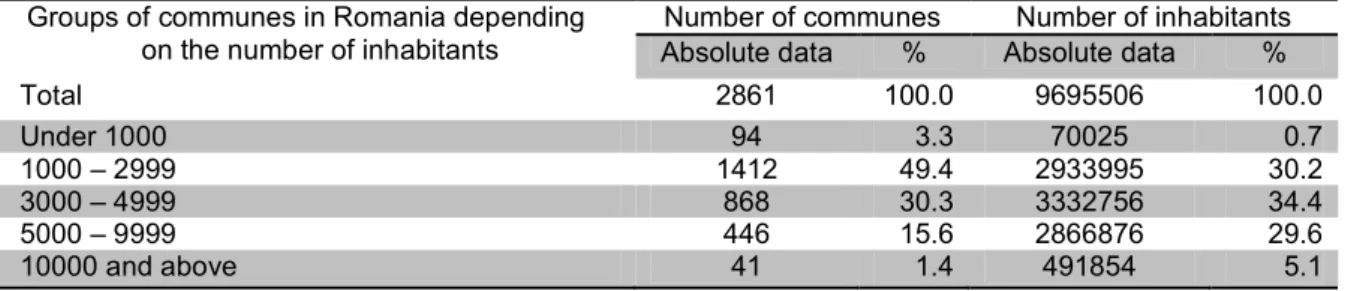
For Romania, grouping of rural localities is differentiated, and there is a structure of groups of commune, depending on the number of inhabitants. In table 1 such structures (at the level of year 2015) are presented, where the ranking of 2861 communes is below 1000 inhabitantsto over 10000 inhabitants. The most significant group of communes is the group with 3000-4999 inhabitants comprising 30.3% of the number of communes and 34.4% of the number of inhabitants.
Table 1 Group of communes in Romania depending on the number of inhabitants
Groups of communes in Romania depending on the number of inhabitants
Number of communes Number of inhabitants Absolute data % Absolute data %
Total 2861 100.0 9695506 100.0
Under 1000 94 3.3 70025 0.7
1000 – 2999 1412 49.4 2933995 30.2
3000 – 4999 868 30.3 3332756 34.4
5000 – 9999 446 15.6 2866876 29.6
10000 and above 41 1.4 491854 5.1
Source: National Institute of Statistics
2. Heterogeneity of agricultural potential in rural area
332
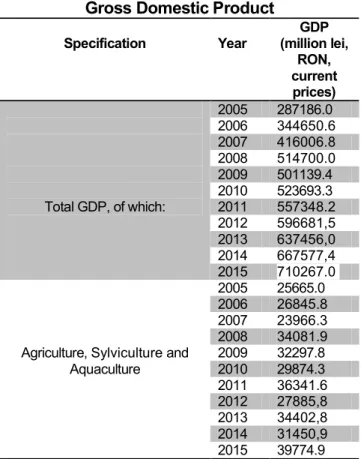
Out of the data presented in table 2 it is noticeable that, for agriculture, sylviculture and fish farming sector, the weight in the year 2005 as compared to the national total was of 8.9 % and 5.6% in the year 2015, increases being registered, but also decreases as compared to the previous year.
All these oscillations occurred depending on the activity carried out, on the meteorological conditions, but also on the elements of the structural situation of agricultural exploitations in the aggregate of rural sector. It can also become evident that the rural area does not constitute a homogenous assembly(aspect also pointed out byCălina et al, 2009), but it is not an abstract area either.
Table 2 Gross Domestic Product
Specification Year
GDP (million lei,
RON, current prices)
Total GDP, of which:
2005 287186.0 2006 344650.6 2007 416006.8 2008 514700.0 2009 501139.4 2010 523693.3 2011 557348.2 2012 596681,5 2013 637456,0 2014 667577,4 2015 710267.0
Agriculture, Sylviculture and Aquaculture
2005 25665.0 2006 26845.8 2007 23966.3 2008 34081.9 2009 32297.8 2010 29874.3 2011 36341.6 2012 27885,8 2013 34402,8 2014 31450,9 2015 39774.9 Source:National Institute of Statistics
Regarding the used agricultural surface (in year 2012), but structurally correlated with the number and type of agricultural exploitations, according to the data in table 3, the following can be deduced:
a significantly large number of individual agricultural exploitations is still noticeable, the weight of this type of exploitations being 99.2 % as compared to the total of exploitations in Romania;
with regard to the used agricultural surface, it can be determined that these individual exploitations use agricultural land, but not at the percentage level held as number of the total.
333
level, these levels, which for individual agricultural exploitations are only 55.8 %, for units with legal personality the pace of growth is 5.55 times higher (5555.8%).
Table 3 Agricultural exploitations and agricultural land used in Romania
Indicators Total agricultural exploitations
Individual agricultural exploitations
Agricultural exploitations of legal
personality
Agricultural exploitation No.(thousand) % No.(thousand) % No.(thousand) %
3859 100 3828 99.2 31 0.8
Agriculture surface: Thousand ha % Thousand ha % Thousand ha %
Total 15694 100 8307 52.9 7387 47.1
Used 13305 100 7449 56,0 5856 44.0
Agriculture surface on average:
ha % ha % ha %
on an agricultural exploitation that utilises agriculture surface
3.4 100 1.9 55.8 188.9 5555.8
Source: National Institute of Statistics
It may be inferred that the Romanian agricultural landscape has suffered a fundamental change by pulverization of land ownership, occurrence of millions of small farms, with insufficient dimensions in order to be sustainable, lacking of means of production, decapitalising etc., and all these factors having determined the practice of subsistence agriculture.
3. Demographic heterogeneity
The Romanian population has a more pronounced rurality level, many of these rural communities contributing, to a small extent, to the economic growth, but at the same time keeping their social structure and the traditional way of life. The rural area in Romania holds a surface of 212.700 km² (about 89% of the total surface of the country) and a population, in the year 2016, of 9126396 inhabitants (46% of the total population). Demographically, over 46% of Romanian population live in the 12957 thousand of rural habitation.
In table 4 the structure of population on averages is expressed, from which results a decrease of the total population existent in the rural area. Thus, if in the year 1960 in Romania 67.9% of the population was living in rural environment, in the year 2016 the level is 46.2%.
Table 4 Structure of population by averages in Romania
Period
Number of inhabitants % of total: Total Urban Rural Urban Rural 1 July 1960 18403414 5912011 12491403 32.1 67.9 1 July 1989 23151564 12311803 10839761 53.2 46.8 1 July 2016 19759968 10633572 9126396 53.8 46.2 Source: National Institute of Statistics
334
CONCLUSIONS
For Romania, grouping of rural localities is differentiated, and there is a structure of groups of commune, depending on the number of inhabitants. The most significant group of communes is the group with 3000-4999 inhabitants comprising 30.3% of the number of communes and 34.4% of the number of inhabitants. Agricultural landscape has suffered a fundamental change by pulverization of land ownership, occurrence of millions of small farms, with insufficient dimensions in order to be sustainable, lacking of means of production, decapitalising etc., and all these factors having determined the practice of subsistence agriculture.Population has a more pronounced rurality level, many of these rural communities contributing, to a small extent, to the economic growth, but at the same time keeping their social structure and the traditional way of life.
BIBLIOGRAPHY
1.Alecu N. I., Geamasu T., 2014 - Conceptual approaches of the rural space, Agrarian Economy and Rural Development – Realities and Perspectives for Romania, 5, 8-12pp.
2. Braga B. G., Remoaldo C. P., Carvalho Fiúza L.A.,2015 -A methodology for definition
of rural spaces: an implementation in Brazil, Ciência Rural, 46(2), 375-380 pp.
3. Călina A., Călina J., Romulus I., Croitoru A.,2009-Researches on the potential and impact of agrotourism upon the economic and social-cultural development of rural areas in the South-West of Romania, 44th Croatian & 4th International Symposium on Agriculture, Proceedings, University of Zagreb, Faculty of Agriculture, Croatia, 139-143 pp.
4. Călina A., Călina J.,2011-Study Regarding the Determination of the Agro Tourism
Resources in Cozia National Park and the Impact of This Activity Development on the Contiguous Rural Space, Bulletin UASVM Cluj, Agriculture, 68 (2), 103-109 pp.
5. Călina A., Călina J.,2015a - Research on the Production of Forage for the
Agro-touristic Farms in Romania by Cultivating Perennial Leguminous Plants. Environmental Engineering and Management Journal, 14(3), 657-663 pp.
6.Călina J., Călina A.,2015b - The evolution of agritourism demand in Romania, 2nd
International Multidisciplinary Scientific Conference on Social Sciences and Arts SGEM, Proceedings, Book 2, Vol. 3, 839 – 846 pp.
7. Călina J., Călina A., Olaru L. A.,2016 - Correlative Forms between Arrivals and
Overnight stays in Romanian agritourism, 3nd International Multidisciplinary Scientific Conference on Social Sciences and Arts SGEM, Proceedings, Book 2, Vol. 4, 199-206 pp.
8.Iorio M., Corsale A., 2010 -Rural tourism and livelihood strategies in Romania,Journal of Rural Studies, 26 (2), 152–162 pp.
9. Marsden T.,1999 -Rural futures: the consumption countryside and its regulation,
Sociologia Ruralis, 39(4), 501–520 pp.
10. Marsden T., Banks,J., Renting H. & van der Ploeg J. D.,2001- The road towards sustainable rural development: issues of theory, policy and research practice, Journal of Environmental Policy and Planning, 2(2), 75–83 pp.
11. National Institute of Statistics, 2016 -Online database of National Institute for Statistics: Bucharest, accessed between 20th August – 23thSeptember of 2016, https://statistici.insee.ro.
12. OECD, 2006 - OECD Territorial Reviews: France, OECD Publishing, Paris.
13. Van Der Ploeg J. D., Renting H., Brunori G., Knickel K., Mannion J., Marsden T.,
De Roest K., Sevilla-Guzmán E., and Ventura F.,2000-Rural Development: From
Practices and Policies towards Theory. Sociologia Ruralis, 40(4), 391–408 pp.