202
THE ENVIRONMENTAL REHABILITATION AND PRESERVATION
MEASURES IN THE LESPEZI QUARRY (DAMBOVITA COUNTY)
MARIANA NICULESCU1, ALEXANDRU SĂRARU1, VILOETA BORUZ2, ILIE SILVESTRU NUȚĂ3, BERCEA IULIAN1
1
University of Craiova, Faculty of Agronomy, Departament of Botany, 19 Libertatii Street, 200583, Craiova, [email protected], Romania
2
University of Craiova, “Al. Buia” Botanical Garden, [email protected] 3Dolj Forestry Division, [email protected], Romania
Key words: biodiversity, Lespezi quarry, preservation measures, rehabilitation
ABSTRACT
The conservation of biodiversity from a mine’s quarry is required, regardless of where it is. For a good rehabilitation in a mine’s quarry is necessary first to know the biodiversity from that area, with all the complexity, including also the substrate on which it is developing. We have to know: the vegetation’s type, the ecologic conditions, the pressures, the threats, the conservation mode, rehabilitation possibilities. To successed, the ecologic rehabilitation from the Lespezi Quarry have to follow the best methods to remake the vegetal communities and also for the animals, and to restore the landscape, major events with a big importance in preserving biodiversity. This fact can’t be made if there is no good collaboaration with the company, which owns the mine. During this studies, I followed the achviements of the proposed objectives and also the enrichment and multiplying of this, the objects presented above. Taking into account the scientific, landscape, economic and social significance of this area, we believe its rehabilitation, conservation is imperative. In order to have chances of success, the ecological rehabilitation in Lespezi Quarry must follow the best restoration methods for the vegetal communities and, implicitly, the animal communities, as well as landscape reintegration, highly significant phenomena in biodiversity conservation. All these actions must be carried out at the level of herbaceous as well as forest habitats. The natural habitats here must under no circumstance be fragmented, even though their restoration takes time. We must not forget one important thing, which is keeping the uncovered soil nearby the respective area, so as to be restored and repopulated after the end of the exploitation. This is the best soil, and the natural vegetation will be much quicker reinstalled.
INTRODUCTION
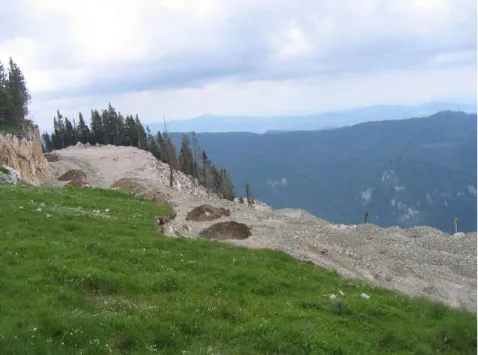
Ecological reconstruction requires the restoration of phytocenoses and, implicitly zoocenoses, but not in the last place pedogenesis. Ecological reconstruction following mining exploitations is achieved through technical and biological methods which can ensure ecogenesis. In addition to the climate, geomorphological, biotic and anthropic factors, the edaphic conditions and place type are key points for the reinstallation of vegetal species in the area of Lespezi Quarry (fig. 1).
MATERIAL AND METHODS
203
The second stage will target the phytocenosis reconstruction, by colonization, seeding or cultivation of the species (as the case may be) and stabilization of the interspecific relations favorable to the productivity and biocenotic balance of the new ecosystem. After the installation of the plant communities, the focus will be placed on monitoring the species dynamics, combating the pests and invasive species, controlling erosion and the action of climate factors.
Fig. 1 – The restoration of the forest of spruce in the Lespezi Quarry
RESULTS AND DISCUSSIONS
The ecological rehabilitation in Lespezi Quarry must be achieved at the level of the forest vegetation and at the level of grasslands and screes. In Lespezi Quarry (where the exploitation is made in benches) the focus is placed on the ecological rehabilitation of the higher bench, where the exploitation ended, but on smaller portions also in other quarry areas, where possible. In order to achieve a proper rehabilitation at the level of the higher bench, it must be achieved on three levels or terraces.
Ecological rehabilitation at the grassland level is achieved with native species from the quarry or its surroundings, without disturbing or fragmenting the existing habitats here. Thus, the grassland vegetation recommended for ecological rehabilitation in Lespezi Quarry falls under 5 associations (as mentioned under habitat description): Seslerio
haynaldianae-Caricetum sempervirentis Puşcaru et al.1956, Potentillo
chrysocraspedae-Festucetum airoidis Boşcaiu 1971, Scorzonero roseae-chrysocraspedae-Festucetum nigricantis (Puşcaru et al. 1956) Coldea 1978 and Violo declinatae-Nardetum Simon 1966.
At the higher limit of the bench where the exploitation ended, namely on terrace III, rehabilitation is recommended with species falling under the first two grassland plant
communities Seslerio haynaldianae-Caricetum sempervirentis Puşcaru et al.1956 and
Potentillo chrysocraspedae-Festucetum airoidis Boşcaiu 1971 (Syn. Festucetum supinae
204
shallow, very acid or little acid with pH=4.1-4.5) rich in humus, and can be brought from the immediate vicinity, not elsewhere, thus favoring the development of the species which are to be installed. It is recommended for grassed lands to be brought with the soil, thus favoring proper installment and natural development of this type of grassland. Plots (of
50-100 m2) will be naturally seeded using mowed grass that reached maturity (not green)
from this type of grassland in the neighboring areas of Lespezi Quarry. However, in order to speed up the phytocenosis process and have spectacular results as regards the installation of this grassland, we can also use a smaller or higher quantity of seed belonging to the edifying species, from which the seed can be reaped to a certain extent. No fertilizations are necessary, but if they are made nonetheless, they should be made with farmyard manure from the neighboring stables.
The next terrace (recommended to be larger than the previous terrace) is meant to be rehabilitated with the other two grassland associations: Scorzonero roseae-Festucetum nigricantis (Puşcaru et al. 1956) Coldea 1978 and Violo declinatae-Nardetum Simon 1966. The same methods will be applied, only the floristic compositions will be different. However, we can mention that for Scorzonero roseae-Festucetum nigricantis (Puşcaru et al. 1956) Coldea 1978 association, the soil must be districambosoils, with short profile and saturated in alkalis (20-25%) and pH=4-4.5 and can also be brought from such grasslands in the immediate vicinity together with grassed lands which will facilitate the installation of this type of vegetation. Mowed grass that reached full maturity can be used also in this
case, as well as a minimum quantity of the seed of the edifying species Festuca
nigrescens and Scorzonera rosea and of the fundamental species belonging to
Potentillo-Nardion association and Nardetalia order: Viola declinata, Poa media, Geum montanum,
Phleum alpinum coming especially from mowed and dried grass, which is subsequently disseminated over the area subject to rehabilitation.
In the case of Nardus planting (which are widely spread in the surrounding areas, on spodosols with short profile, poor in alkalis (510%), poorly aerated and acid, pH = 3.6 -4.5) together with grassed lands and mature mowed grass, the seed to be used as
rehabilitation aid, will also consist of the two edifying species Nardus stricta and Viola
declinata and the fundamental species of the vegetal community: Ligusticum mutellina,
Geum montanum, Phleum alpinum, Centaurea nervosa, Antennaria dioica, Pseudorchis
albida, Carex ovalis, Campanula serrata, Hypochoeris uniflora, resulting from mowed and dried grass, which can be disseminated in the respective areas. From our point of view Nardus are not particularly significant from an economic point of view (poorly productive grasslands), although they are scientifically important, we propose that the ecological
rehabilitation is made on small areas and give priority to Festuca nigrescens and
Scorzonera rosea grasslands, which are of inestimable value. In conclusion, we believe
the best method for grassland rehabilitation is to use grassed lands, in addition to mowed grass and seed.
If we want quick rehabilitation of the grasslands, we can use another type of grassland (practically used at wide scale at the level of our country and not only) but in this case the natural vegetation cannot be restored, and the habitats are fragmented. It’s about
Festucetum rubrae-Agrostietum capillaris Csürös-Káptalan 1964 (Syn. Festucetum
rubrae-Agrostietum capillaris Horv. 1951) grasslands. Thus, the leveled land will be divided into plots subject to re-cultivation by seeding a mix of 8 plants used in the following
percentage shares: Festuca rubra 30, Agrostis capillaris 20, Anthoxanthum
odoratum 15, Phleum pratense 15, Trifolium pratense 15, Lotus corniculatus 3 and Achillea millefolium 2. Although it is extremely easy to install such grassland, and the seed can be very easily acquired, I personally do not recommend this.
205
vegetation, is to avoid their fragmentation and take into account the reconstruction of the natural fundamental type of vegetation.
Brush regeneration on anthropic-modified lands is achieved in this case artificially, through plantations, as well as naturally. As part of the ecological management measures for Lespezi Quarry, we will aim at achieving ecological rehabilitation first of all by
promoting natural regeneration with native species, which will also be used as regards
the rehabilitation of the forest vegetation, avoiding the substitution of native species with “quickly growing” species.
Taking into account the stationary conditions in this area, natural regeneration is toilsome. Hence, we will try to artificially rehabilitate the forest vegetation (brushes), taking into account their particular protection role, but the native species will be maintained, i.e. the species from natural regenerations, including pioneer species. There are two rehabilitation possibilities: through plantations or direct seeding. Of course, the second method by direct seeding is much easier to apply, less costly and very similar to natural regeneration. However, taking into account the stationary conditions in Lespezi Quarry, as well as the importance of brush restoration in an area as important from the point of view of biodiversity, I recommend the first method.
Thus, taking into account the type of vegetation and forest habitats existing in the area, as well as the type of fundamental vegetation, the fundamental species should preferably be the spruce– Picea abies (L.) Karsten (Syn. P. excelsa Link).
Starting from the fundamental species – Picea abies (L.) Karsten (Syn. P. excelsa Link) we propose the following two formulations:
1.Ecological rehabilitation of the forest vegetation through pure spruce cultures – Picea abies (L.) Karsten (Syn. P. excelsa Link) (Annex 7).
We chose the spruce as fundamental species for the rehabilitation of the forest vegetation because, despite its rootedness, it has anti-eroding qualities, can be relatively easily planted in Lespezi area where, in its natural habitat, its vegetal biomass will contribute to the balance of the discharge, to the stopping of surface erosion, it can also fulfill (secondarily) the hydrological function and can contribute to air purification from dust. Forestation will be achieved at the level of the higher bench of the quarry, especially on its sides. The soil will be brought from the neighboring spruce forests together with moss layer lands and characteristic species. The culture density is 5000 -6000 saplings/ha, and the planting distance will be 1.5 x 1 m. In order to have good results, I believe the spruce saplings should be grown in polyethylene bags, be aged 4, non-transplant and healthy. They will be planted in floors of 40/60 cm.
2. Ecological rehabilitation of the forest vegetation through mixed plantations of
Picea abies (Mo) şi Larix decidua ssp. carpatica (Domin) Šiman (Syn. Larix decidua var.
polonica (Recid.) Ostfen et Syrach-Larsen) (La);
Together with spruces, in order to have an even better result, Larix deciduas can
also be introduced in this area. This species is found in its natural habitat, with favorable stationary conditions for installation (even though we did not find it in the quarry but its surroundings) and grows rapidly. Moreover, it has strong rootedness, which confers it great stability, being recommended to be installed with spruces, so as to prevent blow-downs.
In this case the forestation composition and planting scheme is as follows:
60Mo and 40La – forestation is made in pure alternate bands, of 10-15 m wide, perpendicular on the direction of damaging winds (as per the Romanian Technical Regulation). Planting will be made in the spring. The culture density is 5000 saplings/ha, of
which 3500 saplings of Picea abies (Mo) and 1500 saplings of Larix decidua (La). For
206
As mentioned above, spruce and larch installation can also be achieved by direct seeding, on very well prepared soil, but in this case more and careful attendance works will be necessary, even though this method is very similar to natural regeneration. It can, however, be achieved on limited areas, but lands with a
slope of over 200 must be avoided or at the base of the slope, where scree
accumulation usually occurs.
CONCLUSIONS
Biodiversity conservation in Lespezi Quarry is indispensable, taking into account it is an integral part of Bucegi Mountains and the National Park of the same name. The ecological rehabilitation of Lespezi Quarry presents also a major social and economic impact. The reinstalled vegetation, herbaceous as well as forest vegetation, can be an inestimable source of berries, macromycetes, medicinal plants, honey and, not in the last place, wood. Moreover, the vegetation reinstalled on the lands exposed to the mining exploitations has a significant role in improving and protecting the environment, as well as from an aesthetic, sanitary and touristic viewpoint. In order to have chances of success, the ecological rehabilitation in Lespezi Quarry must follow the best restoration methods for the vegetal communities and, implicitly, the animal communities, as well as landscape reintegration, highly significant phenomena in biodiversity conservation. All these actions must be carried out at the level of herbaceous as well as forest habitats. The natural habitats here must under no circumstance be fragmented, even though their restoration takes time (Niculescu, M., 2008).
BIBLIOGRAPHY
1. ANDRE, B., 2002 - Bioremedierea solurilor si apelor. In Managementul deşeurilor, Cap.V, V. Oros, Camelia Draghici, Ed. Univ, Transilvania Braşov, p.129-133
2. ANGHEL, G., RĂVĂRUŢ, M., TURCU, G., 1971 – Geobotanica, Ed. Ceres Bucureşti 3. BEJENARU L.E., BEJENARU C., MOGOŞANU G.D., OANCEA C.N., Histo-anatomical investigation on Lysimachia punctata L. (Primulaceae) species. Analele Universităţii din Craiova. Seria Agricultură – Montanologie – Cadastru (Annals of the University of Craiova – Agriculture, Montanology, Cadastre Series), XLIII (1): 31–39.
4. DAMIAN, I., 1978 - Împăduriri, Ed. Did. şi Ped. Bucureşti, 374 p.
5. MALSCHI, D., 2010 - Planificarea şi reconstrucţia mediului -tehnologii de bioremediere şi reconstrucţie ecologică a terenurilor degradate şi poluate antropic -Note de curs, Universitatea „Babeş-Bolyai” Cluj-Napoca, Facultatea de Ştiinţa Mediului
6. MARCU, G. coord., 1974 - Cercetări privind extinderea culturii de molid în România, Ed. Ceres, Bucureşti, 524 p.
7. NICULESCU, M., 2012 - The scientific study assessment of Natura 2000 habitats and
species to substantiation ecological reconstruction in the Lespezi Quarry – Research
Project, Quarry life Competicion, HeidelbergCement.
8. RODWELL, J.S., J.H.J. SCHAMINÉE, J.H.J., MUCINA, L., S. PIGNATTI, S., DRING, MOSS, J. D., 2002 - The Diversity of European Vegetation, Raport EC-LNV nr. 2002/054 9. ROŞCULETE, C. A., ROŞCULETE ELENA, 2009 - Pedologie si staţiuni forestiere – Lucrări practice, 2009. Roşculete Catalin Aurelian, Editura Sitech, ISBN 978-606-530-620-2
10. TRACI, C., COSTIN, E., 1966 - Terenurile degradate şi valorificarea lor pe cale forestieră, Ed. Agro-Silvică Bucureşti, 275 p.