413
RESEARCH ON THE DETERMINATION OF THE NOISE LEVEL
PRODUCED BY AN ATOMIZER IN DIFFERENT FUNCTIONING
CONDITIONS
SORICĂ E., VLĂDUŢ V., SORICĂ C., RADU O., VLĂDUŢOIU L., MIRCEA C., DUMITRU D. M.
1)INMA Bucharest
E-mail: [email protected]
Keywords: atomizer, acoustic power, acoustic pressure, noise
ABSTRACT
Noise is one of the priority issues of environment, especially in crowded urban zones. The user is more and more informed and prefers to choose some reliable products with low noise level. A low level of acoustic pollution leads to the environmental and consumer health protection satisfaction level and thus increases the quality of marketed products. 2000/14/E Directive it requires manufacturers to apply to each equipment introduced on market the guaranteed value of the acoustic power.
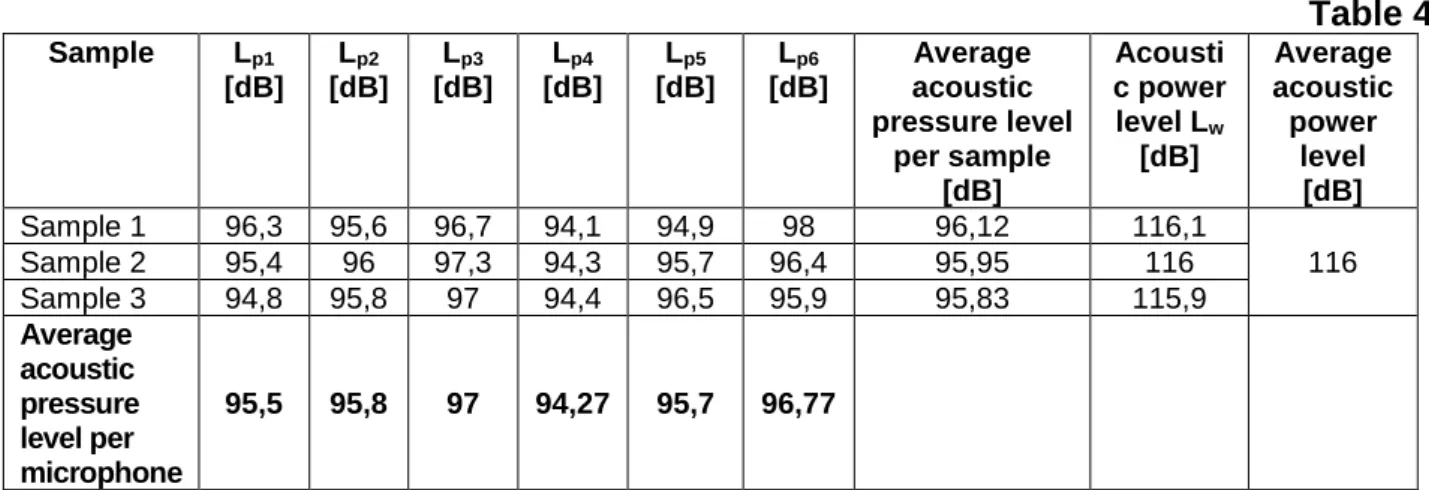
In this regard, the paper consists both in measuring the acoustic power level of the atomizer at maximum speed and idling. Also, in the paper will be specified choosing the method, number and place of the used microphones, calculating the average of the acustic pressure, functioning conditions, and incertitude measuring.
INTRODUCTION
Noises can have a dangerous action on human body, action that depends of more factors, namely: noise intensity level, its spectral component, duration and distribution of noise exposure during a working day, the total lifetime exposure.
The achieved researches have showed that a continuous noise that repeats at closed intervals noise is more annoying than a fleeting noise of short duration, which repeated at long intervals. Noises consisting mainly in high frequency components are more harmful than those of low frequency. Also, machines noises produced by some technological processes are more annoying than natural ones, having equal intensities.
2000/14/EC directive belongs to improving air quality category and is part of the chapter- Air quality, targeting emissions management outside buildings. Air quality is an environment priority issue and any kind of is recorded in regulations. [1], [10]
EN ISO 3744:2011 establishes the method for measuring acoustic pressure levels on a measuring surface that includes a noise source, under conditions close to those of a free field, near one or more reflecting planes, in order to calculate the acoustic power level produced by the noise source. The standard contains conditions for test environment and equipment, as well as procedures for obtaining the level of acoustic pressure on the surface, from which the acoustic power level of the source is calculated. [6], [9]
It is clear that markings of the produces which indicate a guranteed level of the acoustic power, will allow uses to choose the product after an appropriate information.
MATERIAL AND METHOD
414
Sound pressure level (Lp) is ten times the logarithm to the base 10 of the ratio between the square of the measured sound pressure and the square of the reference sound pressure (20 μPa). Sound pressure level is expressed in dB.
Sound pressure level averaged over the measurement surface is given by: [6], [10]
N
i
L p
pi
N L
1 ' 1 , 0 10 1 lg 10
' , [dB] (1)
where N is the number of measuring points;
pi L' - sound pressure level measured in the i position of the microphone
Sound pressure level averaged over the measurement surface and corrected is:
2 1
' k k
L
Lpf p (2)
where k1 - is the correction for background noise;
k2 - the correction for the reflected sound (it applies to enclosed spaces). The sound power level is given by:
0
lg 10
S S L
Lw pf , [dB] (3)
where S is the measurement surface area; S0 = 1 m2.
In view of determining the acoustic power level is used modern equipment that in fact measures the immediately acoustic pressure on measuring surface, makes the necessary corrections and then calculates the acoustic power level by the above formula.
The measurements have been achieved on a atomizer (fig. 1), at INMA place. A 203 atomizer is intended for spraying in order to apply plant protection treatments to crops in rows (vines, tomatoes, melons) or trees. The A203 atomizer can also be used (without filling with product) to remove leaves, grass, papers, dust or snow from parks, stadiums, gardens, etc. [2].
Fig. 1 Atomizer [2]
Main components of the product:
✓ two-stroke engine;
✓ fuel tank;
415
✓ spraying pipe;
✓ wearing straps.
The main technical characteristics of the product are presented in table 1:
Table 1
Crt.
No. Characteristic UM Values
1. Engine type - 2 stroke
2. Ignition system - electronic
3. fuel mixture ml of oil / liter of petrol 25/1
4. Engine power CP 3,5
5. Cilindric capacity cm3 70
6. Fuel tank capacity l 1,4
7. Product spraying tank capacity l 20
8. Nominal volume l 15
9. Maximum air speed m/s 100
According to the provisions of the procedures in force within DI - INMA, metrologically verified equipment was used and also within the verification validity term, the measuring accuracy being within the limits imposed by the metrological norms in force.
In table no. 2 are presented the measuring devices used:
Table 2
No. Name of instrument or
device Measuring range
Measurement uncertainty/ Permissible error
1. Measuring tape 08 m 0,5+10 -4mm
2. Integrating Sound Level
Meter type 2237 2020000 Hz 0,3 dB
3. Anemometer Testovent 4000
type 0,440m/s
measurement uncertainty 0,35m/s
4. Thermohygrometer DH 50 humidity: 595% temperature: - 2080C
0,1 %
measurement uncertainty 0,5oC
The equipment used to determine the sound power level is a measurement and analysis system based on PC - "System Type 3569 C PULSE multi-analysis" produced by Bruel & Kjaer, which consists in 12 microphones with preamp, amplifier and signal conditioning module with 12 measuring channels, assisted by a notebook computer and software required for the acquisition, processing, interpretation and presentation of data in tabular form. [7] Also, includes a calibration module type 4231 which generates on the frequency of 1 kHz, a noise level of 94 dB or 114 dB. The calibration value of 114 dB is used when measurements are made in a noisy environment (noise level> 50 dB). [3], [4], [8], [9].
Calibration of measuring channels is performed at the beginning of each set of measurements required to measure a noise source.
In order to determine the sound power level, the following operations were performed, necessary for preparing the product for tests:
• noise source dimensions were measured;
• measuring the surface area was calculated [3]
RESULTS AND DISCUSSIONS
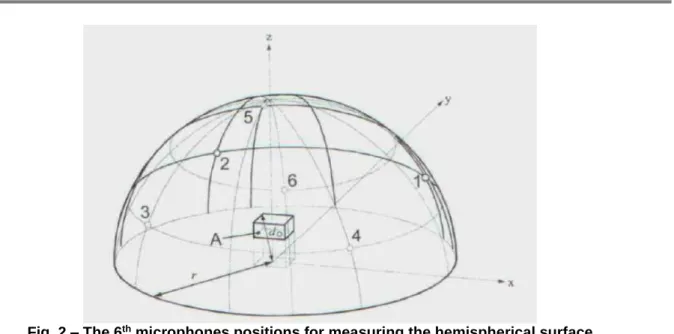
In figure 2 is presented the positioning of the 6th microphones on measuring surface
416
Fig. 2 – The 6th microphones positions for measuring the hemispherical surface
Weather conditions:
▪ temperature: 16,7C;
▪ humidity: 52.6%;
▪ wind speed: 0.8 m/s
In table 3 is presented acoustic power level, idle determined, for atomizer, acoustic pressure level for every microphone and calculating the average acoustic pressure level values:
Table 3
Sample Lp1
[dB]
Lp2
[dB]
Lp3
[dB] Lp4
[dB] Lp5
[dB]
Lp6
[dB]
Average acoustic pressure level
per sample [dB]
Acousti c power
level Lw
[dB]
Average acoustic power
level [dB]
Sample 1 81,8 84,5 86,2 81,6 83,2 80,4 83,4 103,4
103,2
Sample 2 82 83,7 85,3 81,4 84,2 79,7 83,1 103,1
Sample 3 82,1 83,4 85,1 81,1 84 80,4 82,99 103
Average acoustic pressure level per microphone
81,97 83,87 85,53 81,37 83,8 80,17
Lp1, Lp2, Lp3, Lp4, Lp5 si Lp6 - represent the determined sound pressure level in each of the 6 measurement
points in Fig. 2.
Lw – represents the sound power level that is calculated by the PULSE system using the formula (Eq. 3)
The uncertainty of the acoustic power level (to idle) for the atomizer is 0.33 dB, designated interval with a probability of about 95%.
The measuring uncertainty of the acoustic power was estimated in accordance with SR GHID ISO/CEI 98-3:2010.
417
Table 4
Sample Lp1
[dB] Lp2
[dB] Lp3
[dB] Lp4
[dB] Lp5
[dB]
Lp6
[dB]
Average acoustic pressure level
per sample [dB]
Acousti c power level Lw
[dB]
Average acoustic power
level [dB]
Sample 1 96,3 95,6 96,7 94,1 94,9 98 96,12 116,1
116 Sample 2 95,4 96 97,3 94,3 95,7 96,4 95,95 116
Sample 3 94,8 95,8 97 94,4 96,5 95,9 95,83 115,9
Average acoustic pressure level per microphone
95,5 95,8 97 94,27 95,7 96,77
The uncertainty of the acoustic power level (to maximum speed) for the atomizer is 0.31 dB, the designated range with a probability of approximately 95% [7].
The measuring uncertainty of the acoustic power was estimated in accordance with SR GHID ISO/CEI 98-3:2010.
In figure 3 is presented the averange sound pressure level per microphone, at idle and maximum speed:
Fig. 3 –Averange sound pressure level per microphone, at idle and maximum speed
CONCLUSIONS
As can be seen in Tables 3 and 4, the acoustic power level, determined inactive for the atomizer above, was 103 dB and at a maximum speed of 116 dB.
Although this equipment is not subject to noise limitation according to D 2000/14 / EC, however, in order to avoid hearing injuries, it is recommended that workers working with such equipment wear protective equipment against noise (ear protectors, capsules, waxed wool plugs etc.). Markings indicating the guaranteed acoustic power level of the products will enable consumers and users to choose the product knowingly.
REFERENCES
418
[2] Postelnicu E., Matache M., Cujbescu D., Grigore I. – Atomizor A 203, Testing
Bulletin, Bucharest, 2012;
[3] Postelnicu E., Vladut V., Sorica C., Cardei P. and Grigore I. - Analysis of the sound power level emitted by portable electric generators (outdoor powered equipment) depending on location and measuring surface, Applied Mechanics and Materials, Vol. 430 (2013), pp 266-275, ISBN 978-3-03785-877-6;
[4] PULSE Multi-analyzer System Type 3560 – technical documentation;
[5] SR EN ISO 22868:2011 – Forestry and gardening machines. Acoustic testing code for
portable machines, equipped with an internal combustion engine. Expertise method (accuracy class 2);
[6] SR EN ISO 3744:2011 - Acoustics. Determination of the acoustic power and energy levels for noise sources, using acoustic pressure. Technical methods of closed conditions of those of an empty field above a reflecting plane;
[7] SR GUIDE ISO/CEI 98-3:2010 - The measuring uncertainty. Part 3: Guide for expression of uncertainty in measurement (GUM: 1995);
[8]. *** Sound Level Calibrator type 4231 – technical documentation;
[9]. Sorică C., Sorică E, Bolintineanu Gh., Brăcăcescu C., Mircea C., Radu O., Neagoe
M., Leşeanu A., Grigore A. I. - Research on open-air noise emissions level of a universal hammer mill, Proceedings of International Symposium ISB-INMA TEH’2017, Print ISSN 2344-4118, CD-ROM ISSN 2344-4126, ISSN-L 2344-4118;
![Fig. 1 Atomizer [2]](https://thumb-us.123doks.com/thumbv2/123dok_us/8068497.2137107/2.892.278.597.760.1041/fig-atomizer.webp)