RESEARCH ON THE DEVELOPMENT OF A CONSERVATIVE
TECHNOLOGY, USING OPTIMIZED ACTIVE BODIES FOR SOIL TILLAGE
VLĂDUŢ D.I.1), DAVID L.1), MARIN E.2), BIRIŞ S.ŞT.1), VOICULESCU I.1), MAICAN E.1), VLĂDUŢ V.2),
UNGUREANU N.1), VLĂDUŢOIU L.2), FECHETE L.3), CROITORU ŞT.4), BORUZ S.4), VOICEA I.2),
MATACHE M.2),BUNGESCU S.T.5) 1)University "POLITEHNICA" Bucharest;2)INMA Bucharest;3)T.U. Cluj Napoca; 4)University of Craiova;5)USAMVB Timişoara
E-mail: [email protected]
Keywords: soil, tillage, tractor, conservative, precision
ABSTRACT
Conservative agriculture has grown particularly in developed countries over the past 20 years, due to intensive use of soils to obtain higher yields, by means of the processing works, maintenance, herbicides, etc. (even several times during a year), which in time led to the degradation and destruction of the structure and properties of soils. In this context, this paper presents the research conducted in order to develop a conservative technology based on optimized active bodies for soil tillage, to be mounted on a complex aggregate, in order to reduce wear, deformation and increase its lifetime.
INTRODUCTION
Precision agriculture is the way of management that ensures the strategy of sustainable agricultural development, involving geospatial and information technologies, with the aim of using specific data of a given site, for decisions making related to agricultural production. [1]
Individual producers in Romania practice extensive agriculture with low inputs – of subsistence, with less competitive production, which may affect to some extent the environment, including biomass quality, especially through nutrition imbalances. Mineral fertilizers and other agrochemicals (herbicides, insecticides and fungicides, mineral amendments), etc., are not practically used or applied only in very small amounts (except in the vegetable sector) and hybrids and performing varieties are not widespread. [2]
The concept of soil conservation covers a range of activities, measures and technologies that contribute to maintaining soil fertility status without significant decrease in yields or without high costs. This system covers a wide range of agricultural methods aiming mainly at keeping plant residues on the surface of arable soil to reduce erosion. [3]
Soil conservation technologies are characterized by the fact that they leave on soil surface over 30% of plant residues of previous crop. Plant residues protect the surface of soil from water erosion by absorption of raindrops energy, thus reducing the possibility of detachment of soil particles. The layer of plant residues also reduces soil compaction by raindrops and the possibility of crust formation, thus increasing the capacity of water infiltration into the soil. By creating small dams and obstructions along the riverbed for water drainage, plant residues decrease water flow rate, reduce the amount of transported soil and the amount of additional particles detached by water. Thus, by reducing the speed of water flow, some soil particles and aggregates transported by the water will redeposit. During the period of plant development, plant residues protects the soil from sun and wind, reducing water loss by evaporation and in winter they determine the increase of soil moisture by retaining the snow on soil surface. [4]
reduce the detachment of soil particles (the first step in the process of erosion), slowing water flow on the surface of sloppy soils and they reduce the transportation of soil particles (the second step in the process of erosion). [5]
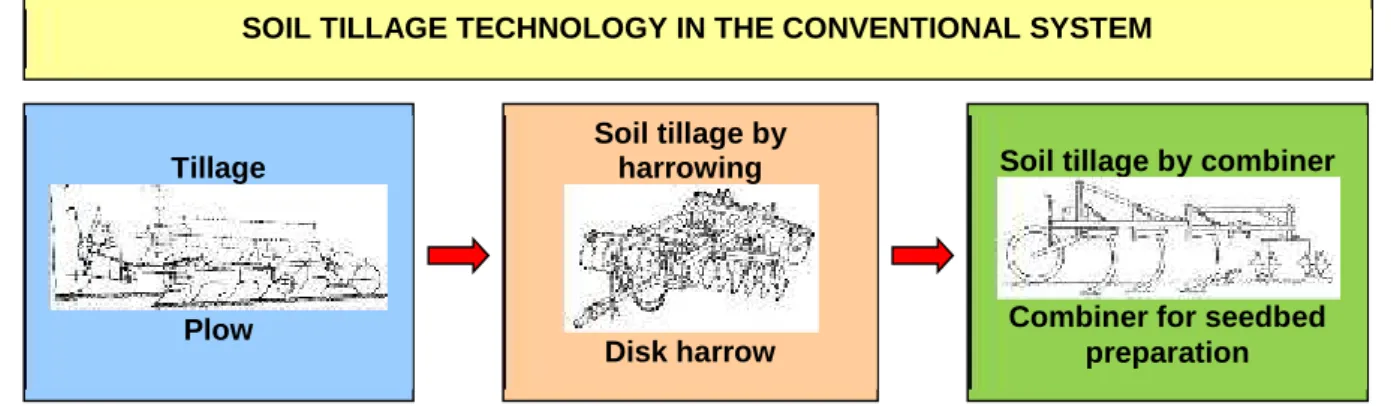
In figure 1 is presented the diagram of the technological flow for soil tillage in the conventional system.
Fig. 1.Diagram of the technological flow for soil tillage in the conventional system
Plowing.Is the basic soil tillage work, using the plow and consists in furrow turning,
loosening and leveling of the soil. To achieve this operation, the plow has a knife that cuts off the furrow laterally separating it from the rest of the soil, a ploughshare that separates the furrow at its lower part and a mouldboard that raises and turns the furrow by dividing it into smaller parts. The quality of plowing depends on several factors, namely: plow construction, type of soil and the period of plowing, the degree of soil coverage with vegetation, topography of the land, tensile force and the speed of movement of the plowing aggregate.
Soil tillage by harrowing. The harrow is an agricultural tool Harrow is an
agricultural tool which loosens soil surface, crushes the lumps, levels the soil and destroys the weeds under emergence. It is generally used to prepare the seedbed under various conditions. Disk harrows are used for harrowing of autumn and spring plowing and less in summer in order to prepare the seedbed.
Soil tillage by combiner. The combiner is an combined agricultural tool consisting
of a cultivator with blades (vibrocultivator), a harrow with rigid teeth and a helix harrow. This tool performs soil loosening up to 10...12 cm, cutting the weeds, shredding and leveling the soil. It is used in spring for seedbed preparation, when soil moisture is optimal. By tillage, the layer of soil is separated from its natural environment and changes its conditions of stability, aeration, wetting, and the biological processes are in total confusion. By performing several works, the soil becomes an artificial body, having another regime of infiltration and superficial leakage of rainfalls, with direct consequences over the washing of the superior horizons and erosion production, with great possibilities for water loss through evaporation. It results that the tilled soils are less fertile and this is mainly the consequence of irrational soil tillage. [6, 7, 8, 9, 10, 11]
Taking into account all of the above, the proposed technology of soil tillage in conservative system involves:
a) Performing minimum works with a technical equipment for conservative tillage of soil that in a single pass performs multiple operations;
b) Soil works will be perfoemed at optimal moisture (physical maturity), which varies depending on soil texture. On heavy, clayey soils, the optimal moisture range is short, between 19 % and 21 %, and on light, sandy soils, this range is longer, between 7 % and 21 % or even 28 %.
c) Loosening of compacted layers of soil with specific working bodies;
Tillage
Plow
Soil tillage by harrowing
Disk harrow
Soil tillage by combiner
d) A better recovery of plant residues by incorporating them at a depth of 12…15 cm in order to decompose under aerobic conditions, with the furrow turned at 45° instead of being introduced to the bottom of the furrow, where it takes place the anaerobic decomposition with release of toxic substances for seed germination.
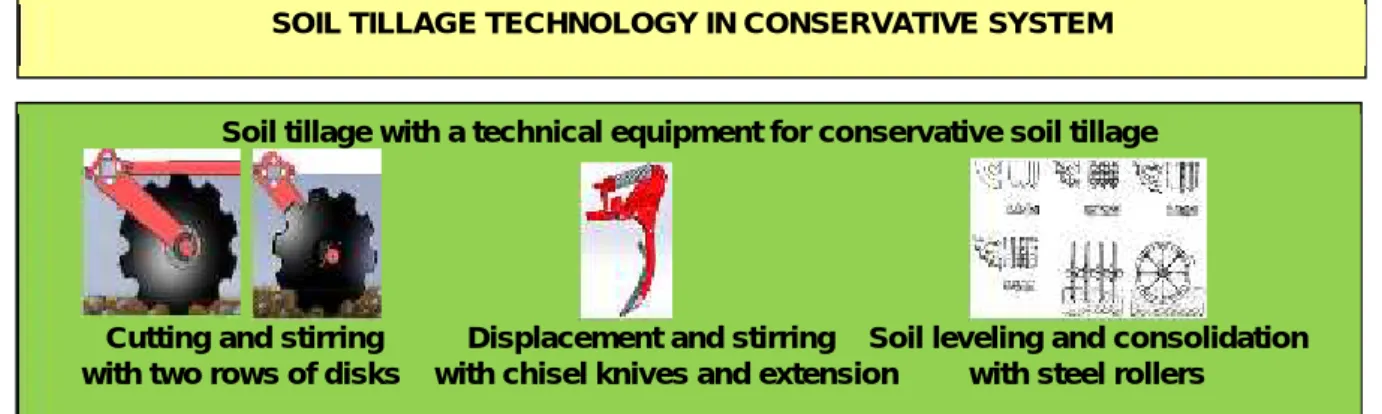
In figure 2 is presented the diagram of the technological flow for soil tillage in conservative system.
Fig. 2.Diagram of the technological flow for soil tillage in the conservative system
MATERIAL AND METHOD
Operations performed within the proposed conservative technology:
a. Cutting and stirring with two rows of disks (once the harvest residues are stirred, the biological processes are set to work and to increase the rate of decomposition);
b. Displacment and stirring with chisel knives and extension (soil loosening without bringing the raw soil to the surface, increases drainage capacity and improves soil structure by turning of plant residues);
c. Soil leveling and consolidation (the degree of compression can be adjusted depending on the weight of the roller. The steel rings have an aggressive profile, crushing clods and straws in the surface layer of the soil in order to ensure optimum decomposition rate).
RESULTS AND DISCUSSIONS
Optimized active soil tillage bodies, components of a technical equipment for conservative soil tillage
Soil tillage body (figure 3, drawing attached), which aims to deploy the soil to a depth
of up to 25 cm, to elevate, stir and turn plant residues, it is mounted on the frame of the technical equipment for conservative soil tillage.
Soil tillage with a technical equipment for conservative soil tillage
Cutting and stirring Displacement and stirring Soil leveling and consolidation
with two rows of disks with chisel knives and extension with steel rollers
SOIL TILLAGE TECHNOLOGY IN CONSERVATIVE SYSTEM
1
2
9 7
8
3
6 5
Soil tillage body consists of a support (pos. 1) on which are mounted two support plates (pos. 2) on the one hand, for assembling of a rigid support (pos. 3) provided with a chisel (pos. 4 , drawing attached) with the role of soil decompaction, an extension (pos. 5) with the role of slight twisting of plant residues and a cutting knife (pos. 6, drawing attached) to the bottom of the furrow and on the other hand, for assembly of a preloaded spring (pos. 7) at 600 kg, which allows absorbing most of the tensile load and some plates (pos. 8) with the role of limiting the stroke of the spring.
The solution with pre-tensioned spring is suitable for stony and hard soils. Also, the active body for soil tillage is equipped with an emergency shear bolt (pos. 9), which makes that when the maximum permissible load is exceeded, it breaks and the body for soil tillage is turned backwards, to prevent any damage to the frame or the tractor.
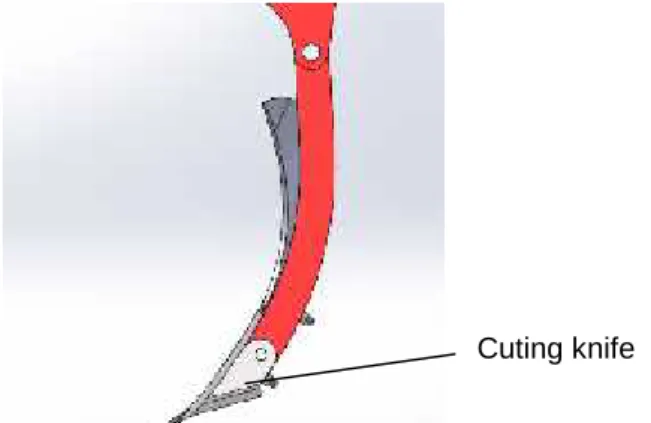
Cutting knife (figure 4), which is a simple active body, easy and inexpensive, through the solutions adopted in its design, increases the stability during working of the technical equipment and, in the same time, decreases the tensile force due to the fact that, in the work process, the soil does not gather between the chisel and the rigid support (figure 5).
Fig. 4.Cutting knife to increase the stability and reduce the tensile force
Fig. 5.Soil tillage body without cutting knife
Main technical characteristics of the soil tillage body in conservative system:
- Working depth, cm 25
- Working width, cm 8
- Distance between two bodies, cm 45
Problems and constructive solutions
Active parts of the chisel were subjected to hard loading with experimental filling materials, obtained from alloys with high entropy, ensuring increased durability, high reliability and lower maintenance costs, compared with materials and heat treatments applied with conventional technologies.
Rigid base
Chisel
Cuting knife
Proposed solutions:
Loading by welding of the active areas subjected to intensive wear following the abrasive and corosive action of the working environment (tilled soil)
Option I– Loading by manual welding with experimental electrodes type rod with
composite core that contains tungsten carbide and chemical elements for making
metal matrix with resistance to abrasion. It will be chosen for the recipe best suited for the tillage of Romanian soils, based on an analysis of the types of soils in different geographic areas (clayey, sandy, dry, wet etc.).
Option II – Loading by MIG/MAG welding procedureusing wires that allow deposits
with high hardness and wear resistance. Possibilities of hard loading:
- Plating by welding in the frontal area of the „chisel” elements, highly loaded, with a filler material having increased wear resistance (SK ABRA MAX O tubular wire) and using as filling material for the loading of other areas, less loaded, of the Postalloy 2832-SPL wire;
- Deposit of a buffer layer with high alloy steel electrode E307 (18/8/6) before the loading of two layers with Postalloy 2832-SPL wire of the „chisel” component and achieving of deposits with different orientation, in order to reduce wear effects.
SK ABRA-MAX O/G tubular wire (in compliance with DIN: 8555: MF 6-GF-65-GT) allows to obtain a deposit with thickness between 6 and 8 mm in maximum 2 passes, with very high hardness, increased abrasion resistance with reduced impact and solid erosion, with an estimated hardness of 60 HRC and wear index with SiO2 of 0,7 %. Its processing can only be made by grinding, without being cut with oxyacetylene flame.
Postalloy 2832 SPL tubular wire allows to obtain welded deposits with a high amount of dispersed chromium carbides, being reccomended for applications of intensive wear at low or moderate impact. It is also recommended for deposits loaded at temperatures of up to 530oC, on carbon steel backing. It can weld with or without gas protection. The hardness estimated by the manufacturer ranges between 58–62 HRC, for deposits with maximum 2 layers.
In table 1 is given the chemical composition of tubular wires for rigid load of the active elements subjected to intensive wear, in weight percents (%).
Table 1.
Type of wire C Mn Si Cr Mo Nb W V B Fe
SK 255-O 4,2 0,7 1,0 26,5 - - - - 0,5 rest
SK ABRA-MAX O/G 2 0,5 0,9 8,5 4,5 5,5 5 2 3,4 rest
Option III – Loading by WIG welding with experimental alloys with high entropy
(FeCrAlxCoNi).
CONCLUSIONS
Conservative soil tillage system virtually replaces the conventional tillage, using active working bodies that process the soil without furrow turning.
These bodies are subjected to high wear in contact with the soil, which leads to their replacement several times during a campaign.
Optimizing of the active working bodies and applying of some layers of material, increases their resistance to wear.
Hardening of the working bodies will determine the increase of their wear resistance and hence their lifetime, by:
loading by manual welding with experimental electrodes type rod with composite core;
loading by WIG welding,
respectively by eliminating the aggresive edges that come into contact with the soil and the achievement of optimized surfaces of minimum resistance for the soil.
ACKNOWLEDGMENT
The work has been funded by the Sectoral Operational Programme Human Resources Development 2007-2013 of the Ministry of European Funds through the Financial Agreement POSDRU/187/1.5/S/155420, within the project entitled „Promoting
quality and science in research through doctoral scholarships”(PROSCIENCE).
BIBLIOGRAPHY
1. Boussinesq J., 1885, Application des Potentiels à l’étude de l’équilibre et du Mouvement des Solides Élastiques, Gauthier-Villars, Paris, 30 pp.;
2. Britto A.M. & Gunn M.J.,1987, Critical State Soil Mechanics via Finite Elements, Ellis Horwood, Chichester, 488 pp.;
3. Cârdei P., Muraru V., Sfîru R., 2007,Quick estimation of the moisture and compaction of the agricultural fields, Scientific Papers (INMATEH), vol. 13, no. 5/2007, pag. 43-50; 4. Cook R.D., Malkus D.S., Plesha M.E., 2002, Concepts and Applications of Finite
Element Analysis, 4thEdition, John Wiley;
5. Dexter A.R., 2002, Soil mechanical notes. Course in agricultural soil mechanics, Swedish University of Soil Sciences, Uppsala, Sweden;
6. Cojocaru I., Constantin N., Pirna I., Marin E., Cociu A., 2009, Mechanization technology for deep decompaction and aeration of defective soils, concomitantly with the administration of nutritive elements, Scientific Papers (INMATEH), vol. 27, nr. 1/2009, pg. 19-23;
7. Constantin N., Cojocaru I., Pirnă I., Ganea C., Andrei L., 2008, Levelling system of transport height to ripper and subsoil, Patent Application no. A/00945/28.11.2008, OSIM Romania;
8. Constantin N., Cojocaru I., Marin E., Niţescu V. Cociu A., 2008,Copy elastic system of land for rollers battery, Patent Application no. A/01010/19.12.2008, OSIM Romania; 9. David A., Voicu Gh., Persu C., Gheorghe G., 2014, Studies and researches for
unifying the resistance expression of machines designed to soil tillage with applications in their working regime optimization, INMATEH – AGRICULTURAL ENGINEERING, vol. 43, nr. 2/2014, pag. 21-28;
10.Marin E., Pirnă I., Sorică C., Manea D., Cârdei P., 2012, Studies on structural analysis of resistance structure as a component of equipment with active working parts driven to deeply loosen the soil, INMATEH – AGRICULTURAL ENGINEERING, vol. 36, nr. 1/2012, pg. 13-20;