A Flux Splitting Method for the SHTC Model for
High-performance Simulations of Two-phase Flows
Nadezhda S. Smirnova1, Michael Dumbser1,2, Mikhail N. Petrov1,
Alexander V. Chikitkin1, Evgeniy I. Romenski3
c
The Authors 2018. This paper is published with open access at SuperFri.org
In this paper we propose a new flux splitting approach for the symmetric hyperbolic thermo-dynamically compatible (SHTC) equations of compressible two-phase flow which can be used in finite-volume methods. The approach is based on splitting the entire model into acoustic and pseudo-convective submodels. The associated acoustic system is numerically solved applying HLLC-type Riemann solver for its Lagrangian form. The convective part of the pseudo-convective submodel is solved by a standart upwind scheme. For other parts of the pseudo-convective sub-model we apply the FORCE method. A comparison is carried out with unsplit methods. Numerical results are obtained on several test problems. Results show good agreement with exact solutions and reference calculations.
Keywords: flux splitting, two-phase compressible flow, complete Riemann solver, finite-volume method, hyperbolic equations, supercomputer computations.
Introduction
Modeling of two-phase compressible flows finds many applications in various engineering spheres. However, the research of two-phase models is still a challenging area of computational fluid dynamics. The numerical investigation of these problems requires powerful computing resources and therefore parallel calculations. Nowadays mathematical models of this class of problems and their computational methods are actively developed. The most widely used two-phase models are the Baer-Nunziato model [1], the Kapila model [3] and the SHTC model [4]. The main advantage of these models is the hyperbolicity of the governing equations that allows to apply well-known methods for this type of equations. The key disadvantage of the Baer-Nunziato and the Kapila models is that they are of non-conservative form, while the SHTC equations can be written in the conservation-law form. This shortcoming of first two models leads to difficulties in the definition of the discontinuous solutions and in the development of high order numerical methods. In this paper we introduce a new method for solving the SHTC equations of compressible two-phase flow with one common entropy. The present method is based on the original method for the Kapila equations [2]. The aim of the present work is to develop a method which allows efficient parallelization and provides reliable numerical solutions.
1. Numerical Method
In this paper we consider the governing partial differential SHTC equations of compressible two-phase flow in one-dimensional case [4]. The approach with one common entropy S for two phases is applied for the description of thermal effects. We study flows of water-gas and gas-gas mixtures, for which the equations of states are presented in [4].
We apply a splitting-based method for the considered system. First, we identify the corre-sponding acoustic system, which includes the same equations for mixture mass, mixture
mo-1Moscow Institute of Physics and Technology, Moscow, Russia 2University of Trento, Trento, Italy
mentum, mixture energy as presented in the acoustic system in [2] with adding two equations:
∂t(α1) = 0 and ∂t(c1) = 0, and the pseudo-convective system
∂tρ+u∂xρ= 0, ∂t(ρu) +∂x(ρwEw) +u∂x(ρu) = 0,
∂t(ρE) +∂x(ρEw(uw+Ec1)) +u∂x(ρE) = 0,
∂t(ρα1) +u∂x(ρα1) =−λ(p2−p1),
∂t(ρc1) +∂x(ρEw) +u∂x(ρc1) = 0,
∂tw+∂x(Ec1) +u∂xw=−χw.
(1)
The intermediate time (n+1−) update formulae of the acoustic system in Eulerian variables is the following
Rjρnj+1− =ρnj, Rj(ρu)nj+1−= (ρu)nj − ∆t
∆x(p
∗
j+1/2−p∗j−1/2),
Rj(ρE)nj+1−= (ρE)nj − ∆t
∆x(p
∗
j+1/2u∗j+1/2−pj∗−1/2u∗j−1/2), (α1)nj+1− = (α1)nj, (c1)nj+1−= (c1)nj, wjn+1−=wnj −wjn∆t
∆x(u
∗
j+1/2−u∗j−1/2),
(2)
whereRj = 1 +∆∆xt(u∗j+1/2−u∗j−1/2), p∗ u∗ – pressure and velocity in the Star Region [6], which were constructed using HLLC-type Riemann solver [7] for the acoustic system in Lagrangian coordinates. More detailed description of solving similar system is given in [2].
The resulting conservative vector of the next time level (φnj+1)T = (ρ, ρu, ρE, ρα
1, ρc1, w)nj+1 is obtained from the discretization of the pseudo-convective system using finite-volume method:
φnj+1 =φnj+1−− ∆t
∆x(u
∗
j+1/2φnj+1+1/−2−uj∗−1/2φnj−+11/−2)+ +∆t
∆xφ n+1−
j (u∗j+1/2−u∗j−1/2)− ∆t
∆x(Fj+1/2−Fj−1/2),
(3)
where the numerical intercell flux Fi+1/2 is obtained applying the FORCE method [6] and the convective terms of the equations (1) are approximated with the upwind rule using corresponding velocity u∗ to find the direction of the convective flux.
2. Numerical Results
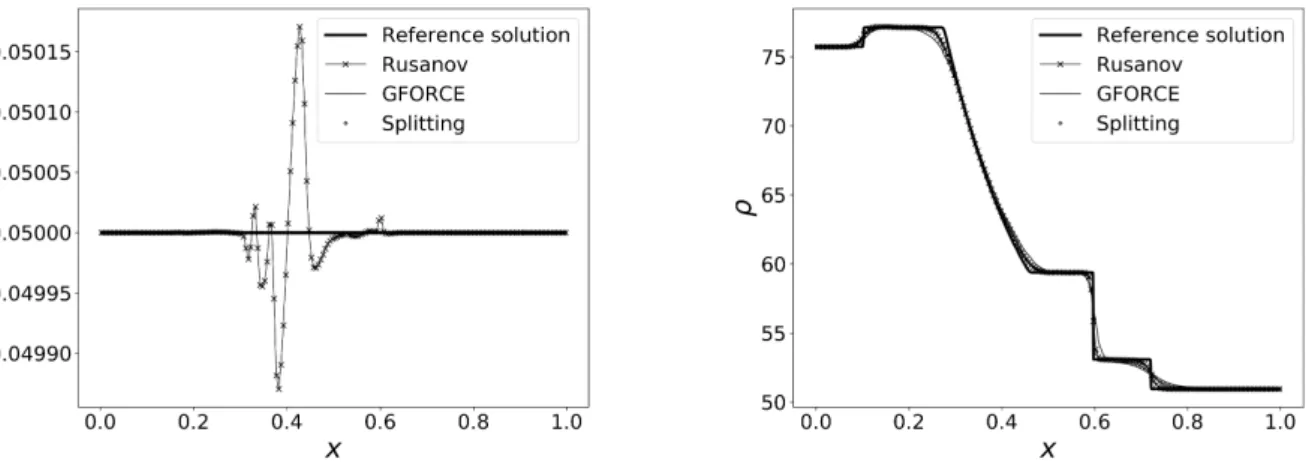
In this section we test the performance of the presented flux splitting method in order to verify accuracy and correctness on several Riemann problems. The flux splitting method is compared with direct methods (Rusanov [6] in tests 1−3 and GFORCE [8] in test 3). The numerical results for first phase volume fraction for tests 1−2 are shown in Fig. 1, and for both first phase volume fraction and mixture density for test 3 are presented in Fig. 2. The numerical solutions are computed in the spatial domain 0 ≤ x ≤ 1 using the mesh of M = 200 cells. Transmissive boundary conditions are applied. The calculations have been run on Lomonosov-2 system of Moscow State University using up to 72 CPU cores.
In the first test [6] we consider two perfect gases with the same properties. The initial data is set to the left and to the right of the discontinuity position x0 as (α1, ρ1, ρ2, u1, u2, S)LT = (0.8,1.0,1.0,−2.0,−2.0,−654.23158) and (α1, ρ1, ρ2, u1, u2, S)TR = (0.5,1.0,1.0,2.0,2.0,−654.23158).The phase parameters are taken as follows: ρ01 =ρ02= 1.0,
symmetric rarefaction waves and trivial stationary contact wave. The Star Region between two rarefaction waves is close to vacuum, hence this problem is appropriate for accessing relevant nu-merical method for low-density flows. The flux splitting scheme allows to resolve volume fraction significantly better than the Rusanov scheme.
Figure 1. Test1 (left) and test2 (right). Comparison of numerical solutions computed by the Rusanov and the present flux splitting method with the exact solution at time t = 0.15 and
x0= 0.5 for test1, and with the reference solution at time t= 229·10−4 and x0 = 0.7 for test2 In the second test we study water-air flow. The formulation of this test is close to diffuse interface problems, which have one of phases volume fraction nearly to unity and the another to zero. The initial data are: (α1, ρ1, ρ2, u1, u2, S)TL = (0.995,1000.0,50.0,0.0,0.0,932.76862) and (α1, ρ1, ρ2, u1, u2, S)TR= (0.005,1000.0,50.0,0.0,0.0,4309.77059).The phase parameters are given by ρ01 = 1000, ρ02 = 1.0, γ1 = 4.4, γ2 = 1.4, C1 = 1624.80768, C2 = 1.18322, cv1 = 951,
cv2 = 714, p01= 0.The reference solution is obtained by using the Rusanov solver on 1000 mesh cells. The flux splitting scheme shows sharper resolution of shock wave structure than Rusanov scheme.
Figure 2. Test3. Comparison of numerical solutions computed by the Rusanov, the GFORCE
and the present splitting with the reference solution at timet= 2·10−4 and x0 = 0.5
ρ01 = 1000, ρ02 = 1.0, γ1 = 2.8, γ2 = 1.4, C1 = 1543, C2 = 374, p01 = 0. We ignore source terms in the considered system [4] in order to compare results obtained by the flux splitting, the Rusanov and the GFORCE methods with the reference solution, which corresponds to the GFORCE flux computed for 4000 mesh cells in the article [4]. Here we use second-order flux splitting and Rusanov methods by applying second order reconstruction of variables with the slope limiter function minmod [6]. All schemes give physically correct solution of density. The Rusanov and the flux splitting methods perform density distribution a little better than the GFORCE method. The Rusanov method provides more accurate resolution of right shock struc-ture in density distribution, but produces small oscillations of volume fraction.
Conclusion
We have shown that the proposed flux splitting method for the one-dimensional SHTC equations provides good agreement with reference and exact solutions. Future work will concern the extension of the method to solid-water and solid-gas flows, as well as for multi-dimensional problems. We are going to improve the method for solving diffusive interface problems.
Acknowledgments
The research was made possible by the Government of the Russian Federation (Agreement 074-02-2018-286). The research is carried out using the equipment of the shared research facilities of HPC computing resources at Lomonosov Moscow State University [5] supported by the project RFMEFI62117X0011. We thank Dr. V.A. Titarev for helping to run calculations on Lomonosov-2 supercomputer.
This paper is distributed under the terms of the Creative Commons Attribution-Non Com-mercial 3.0 License which permits non-comCom-mercial use, reproduction and distribution of the work without further permission provided the original work is properly cited.
References
1. Baer, M., Nunziato, J.: A Two-phase mixture theory for the deflagration-to-detonation tran-sition (DDT) in reactive granular materials. International Journal of Multiphase Flow 12(6), 861–889 (1986), DOI: 10.1016/0301-9322(86)90033-9
2. ten Eikelder, M.F.P., Daude, F., Koren, B., Tijsseling, A.S.: An acoustic-convective splitting-based approach for the Kapila two-phase flow model. Journal of Computational Physics 331, 188–208 (2017), DOI: 10.1016/j.jcp.2016.11.031
3. Kapila, A., Menikoff, R., Bdzil, J., Son, S., Stewart, D.S.: Two-phase modeling of deflagration-to-detonation transition in granular materials: Reduced equations. Physics of Fluids 13(10), 3002–3024 (2001), DOI: 10.1063/1.1398042
4. Romenski, E., Drikakis, D., Toro, E.F.: Conservative models and numerical methods for compressible two-phase flow. Journal of Scientific Computing 42(1), 68–95 (2010), DOI: 10.1007/s10915-009-9316-y
Petascale toward Exascale. pp. 283–307. Chapman & Hall/CRC Computational Science, CRC Press, Boca Raton, United States, (2013)
6. Toro, E.F.: Riemann Solvers and Numerical Methods for Fluid Dynamics. Springer (2009), DOI: 10.1007/b79761
7. Toro, E.F., Spruce, M., Speares, W.: Restoration of the contact surface in the HLL-Riemann solver. Shock Waves 4(1), 25–34 (1994), DOI: 10.1007/bf01414629