Parallel algorithm for 3D modeling of monochromatic acoustic
field using integral equations
Mikhail S. Malovichko1, Nikolay I. Khokhlov1, Nikolay B. Yavich1,
Michael S. Zhdanov 2
c
The Authors 2016. This paper is published with open access at SuperFri.org
We present a parallel algorithm for solution of the three-dimensional Helmholtz equation in the frequency domain using volume-integral equations. The algorithm is applied to seismic forward modeling. The method of integral equations reduces the size of the problem by dividing the geologic model into the anomalous and background parts, but leads to a dense system matrix. Tolerable memory consumption and numerical complexity were achieved by applying an iterative solver, accompanied by an effective matrix-vector multiplication operation, based on the fast Fourier transform. We used OpenMP to speed up the matrix-vector multiplication, while MPI was used to speed up the equation system solver, and also for parallelizing across multiple sources. Practical examples and efficiency tests are presented.
Keywords: integral equations, acoustics, seismics, MPI, OpenMP.
Introduction
The integral equations method (IE) is a well-known wavefield modeling technique [2, 9]. It has a number of attractive properties. It requires discretization for the anomalous volume only. It drastically reduces the size of a problem in many applications. The IE formulation does not require boundary conditions. It also can be naturally used to compute the Fr´echet derivatives and for this reason it is very attractive for inverse problems.
The IE method is based on the discretization of the original integral equation and results in a complex-valued dense matrix. In a straightforward implementation, the computational burden becomes prohibitive for large three-dimensional problems, encountered in seismology. Yet some studies, many of them for the two-dimensional solution, have been reported [4–6, 8, 11]. Recently, the full IE method, accompanied by an iterative solver, was applied to the visco-acoustic three-dimensional modeling [1]. The authors of [1] have implemented Green’s integral operator for the free space background model via the Fourier transform (this idea itself is quite old). An effective matrix-free implementation allowed them to apply the BiCGStab method [10] to the resulting system of linear equations with the cost per iteration of O(N logN), whereN is the number of model cells. They showed that a realistically large acoustic model can be simulated almost as effectively with the IE method, as it is for finite-different schemes.
In this study, we design a parallel version of the solver for the half-space host medium, and study the efficiency of parallelization.
1. Problem formulation
We consider a 3D model consisting of a half-space host medium and an anomalous volume D, confined within the lower half-space. The host medium has piece-wise constant density and acoustic velocity: ρ0 and c0 for the upper half-space; ρb and cb for the lower half space. The
anomalous volume has the same background density ρb, and arbitrary distribution of velocity
c = c(r), where r is the position vector. Let ω be the circular frequency. Assuming a lossless
medium, we define the anomalous velocity as ca=c−cb, wavenumber as k=ω/c, background
wavenumber as kb =ω/cb and parameter χ = 1/c2−1/c2b. The pressure responsep to a point
source at a given frequency ω satisfies to the Helmholtz equation, which can be transformed to the following integral equation:
p− G[ω2χp] =pb, (1)
where pb is the background field, G is the integral operator, defined for any scalar fieldf,
G[f] =
Z
D
g(r|r0)f(r0)dV0, (2)
where gis the background Green’s function.
Let the anomalous volume be covered by N =NxNyNz cubical cells. After discretization
we receive the following matrix equation:
Au=b, (3)
where u = (p1..pN) is the vector of N unknown values approximating p in the center of each
cell, b = (pb,1..pb,N) are known values of the background field in each cell, A is the scattering
matrix,
A= (I−GX), (4)
where I is the identity matrix, X =diag(χ1..χN) is a diagonal matrix formed by contrasts for
each cell, Gcontains integrals of Green’s function over cells,
Gmn=
Z
Dn
g(rm|r0)dV0, m, n= 1..N. (5)
Matrix A is a dense complex-valued non-hermitian matrix with real-valued spectrum. Its condition number substantially improves at lower frequencies since in this case matrix spectrum has a weak dependence on the grid step size and velocity model. These properties make the IE equation system more attractive for iterative solution than that of the finite-difference method. To solve system (3) we use the unpreconditioned BiCGStab iterative solver. An effective implementation of the matrix-vector multiplication is critical for iterative solutions.
In case of a layered background medium Green’s function g has lateral symmetry, i.e.
g(r|r0) =g(x−x0, y−y0, z, z0). (6)
Thus, for interior points (r∈D),
Inml= Nz
X
k=1
Ny
X
j=1
Nx
X
i=1
G(xn−xi, ym−yj, zl, zk)f(xi, yj, zk),
(7)
where Inml is the value ofG[f] for a cell located at (xn, ym, zl). The expression inside the outer
parenthesis is essentially a 2D convolution for givenk and l. Being implemented with 2D FFT, it takes O(NxNylog(NxNy)). This should be performed Nz2 times (for every k-l combination).
Finally, the total complexity for matrix-vector multiplication in the case of a layered host model isO(N Nzlog(NxNy)). The memory requirements isO(N Nz), though this amount can be reduced
2. Parallelization
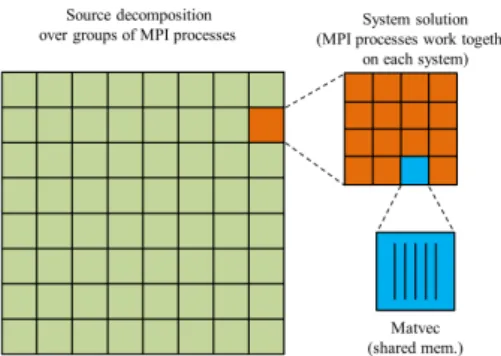
Our code exploits three levels of parallelism: parallel execution of the matrix-vector product, parallel system solution, and data decomposition across multiple acoustic sources (Figure 1).
Figure 1. Layers of parallelism on a hybrid cluster
The BiCGStab solver requires four inner products and two matrix-vector products per iteration. The inner products are easily parallelized, though in distributed-memory systems some collective communication is required. In this study we have used the standard MPI collective communication routines. This overhead is negligible for our typical tasks.
The matrix-vector multiplications are easily parallelized within a single computational node with OpenMP. On a distributed-memory system, this operation becomes the most problematic part, because each model cell is connected with all other cells through the integral operator. No matter what distribution scheme is selected (splitting the matrix into strips across MPI processes with subsequent assembling the resulting vector on a single MPI process, or splitting the matrix into vertical strips and subsequent reduction of resulting vectors on a single MPI process), when the matrix-vector product is computed, it must be sent to all other MPI processes to update their copies. It can be expected that this level scales to O(logP) whereP is the number of processes that communicate during the system solutions [7]. This may create huge network traffic for large
P.
The highest level of parallelism is the distribution of different seismic sources across several MPI groups. In our tasks a forward problem typically has to be solved for many sources (several thousand) for the same model. Naturally, the available pool of MPI processes is divided into several groups. All processes in a group have their copies of model parameters and simultaneously work on a subset of sources, processing them one by one.
3. Numerical tests
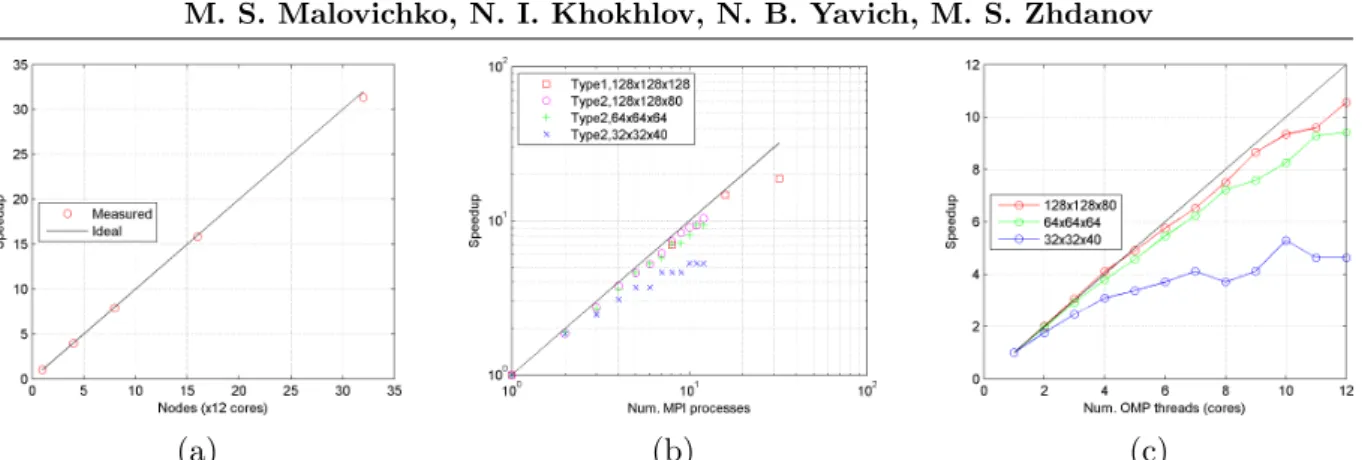
In this section we present the results of numerical experiments. We used two types of hard-ware. All tests, involving several computing nodes, such as those shown in Figure 2a and Fig-ure 2b (labels ”Type 1”), have been performed on a hybrid cluster. Each node consisted of twelve-core Intel Xeon (Westmere X5660) processors running at 2.8GHz and was equipped with 24Gb RAM and QDR Infiniband interconnect. All tests on a shared-memory system (Figure 2b, labels ”Type 2”, and Figure 2c) have been performed on a workstation with a single twelve-core Intel Xeon E5-2620 processor running at 2.10GHz.
(a) (b) (c)
Figure 2.Scalability tests. (a) - distribution of sources across MPI groups, (b) - system solution with several MPI processes, (c) - matrix-vector parallelization with OpenMP threads
the first test we selected a model with 2;097;152 cells (128 cells in each direction). There were 32 seismic sources, located at the surface. The size of a single MPI group was constant and set to 1. We ran computations with 1, 4, 8, 16, and 32 nodes, i.e. each node had to solve 32, 8, 4, 2, and 1 forward problems, respectively. The resulting speedup (Figure 2a) confirmed, that the task decomposition has produced a good acceleration.
In the next test, only one forward problem (a single source) was solved. The iterative solver ran in parallel on varying number of MPI processes. The curve labeled ”Type 1” (Figure 2b) was obtained on a cluster, on which one MPI process was running on a single node with 12 cores. The curves named ”Type 2” have been obtained on a single 12-core node, where each core was running one MPI process. For this test we used four different models, in which the number of cells varied from 40;960 cells to 2;097;152 cells (see the plot legend). The speedup rapidly deteriorates as the number of processes per system grows. For the largest model, the computational time dominates the communication time until 16 process per system. For smaller models the speedup began to deteriorate at lower K.
In the third test, we studied the performance of the matrix-vector multiplication leveraged with the shared-memory parallelization. There were three runs with three models of different sizes (Figure 2c). The resulting speedup curves revealed fairly good scaling versus the number of cores. The speedup for the smallest model suffered from the fact that the background field
pb was computed on the master thread. However, for the larger models where the matrix-vector
operations dominated, the efficiency was above 86%.
Conclusion
We have designed a parallel solver for 3D frequency-domain modeling of an acoustic field. The equation system is solved iteratively; the matrix-vector product is performed via FFT. It makes the computational complexity and memory requirements tolerable for realistically large problems. We have extended this approach by parallelizing the code at three levels: the dis-tribution of seismic sources across different groups of MPI processes, solution of the equation system with several MPI processes, and parallelization of the matrix-vector multiplication over OpenMP threads.
integral equations would have similar problems. On the other hand, coarse-grained (distribu-tion of sources) and fine-grained parallelism (matrix-vector product) have good scalability. We expect, that the presented approach might be quite effective on CPU-GPU clusters, especially in case of multi-frequency and multi-source simulation, which are often encountered in seismic applications.
The presented results confirm that the integral-equation modeling can be applied to realistic problems, and is quite promising for seismic applications involving multiple sources/frequencies.
This research was supported by the Russian Science Foundation, project No. 16-11-10188.
This paper is distributed under the terms of the Creative Commons Attribution-Non Com-mercial 3.0 License which permits non-comCom-mercial use, reproduction and distribution of the work without further permission provided the original work is properly cited.
References
1. Abubakar, A., T.M. Habashy. Three-dimensional visco-acoustic modeling using a renormal-ized integral equation iterative solver. //Journal of computational physics, vol. 249, pp.1-12, 2013.
2. Aki, K. and P. G. Richards. Quantitative seismology. 1980. W. R. Freeman and Co.
3. Aminzadeh, F., Brac, J., Kunz, T. 3-D Salt and Overthrust Models. SEG/EAGE 3-D Mod-eling Series No.1., Soc. Explor. Geophysicists, Tulsa, 1997.
4. Freter, H. An Integral Equation Method for Seismic Modelling// in Inversion Theory and Practice of Geophysical Data Inversion, vol. 5, 1992. Vieweg+Teubner Verlag.
5. Fu, Li-Yun. Numerical study of generalized Lippmann-Schwinger integral equation including surface topography. //Geophysics, vol. 68, no. 2, pp.665-671, 2003.
6. Fu, Li-Yun, Yong-Guang Mu, Huey-Ju Yang. Forward problem of nonlinear Fredholm integral equation in reference medium via velocity-weighted wavefield function. //Geophysics, vol. 62, no. 2, pp.650-656, 1997.
7. Grama, A., A. Gupta, G. Karypis, V. Kumar Introduction to parallel computing, 2nd ed. Addison Wesley, 2003.
8. Johnson, S.A., Y. Zhou, M.J. Berggren, M.L. Tracy. Acoustic Inverse Scattering Solutions by Moment Methods and Back Propagation // Conference on inverse scattering: theory and applications. 1983. SIAM.
9. Morse, P. M. and Feshbach, H. Methods in theoretical physics. 1953, McGraw-Hill Book Company, inc.
10. Saad, Y. Iterative methods for sparse linear systems, 2nd ed., SIAM, Philadelphia, PA, USA. 2003.