Macedonian Journal of Chemistry and Chemical Engineering, Vol. 26, No. 2, pp. 125–134 (2007)
GHTMDD – 508 ISSN 1857 – 5552
Received: August 9, 2007 UDC: 549.67
Accepted: October 19, 2007
Original scientific paper
REMOVAL OF Zn
2+, Cd
2+AND Pb
2+FROM BINARY AQUEOUS SOLUTION
BY NATURAL ZEOLITE AND GRANULATED ACTIVATED CARBON
Mirjana Minceva, Liljana Markovska, Vera Meshko
Department of Chemical and Control Engineering, Faculty of Technology and Metallurgy, SS. Cyril and Methodius University,
P.O.Box 580, MKD-1001 Skopje, Republic of Macedonia [email protected]
The adsorptive removal of Zn2+, Cd2+ and Pb2+ from single and binary metal ion aqueous solution using natural
clinoptilolitic zeolite tuff, a regional low-cost naturally available adsorbent, and granulated activated carbon, an ad-sorbent conventionally applied in wastewater treatment, was studied. The competitive adsorption equilibrium of three binary mixtures (Cd2+/Zn2+, Zn2+/Pb2+ and Pb2+/Cd2+) with different ratios of initial metal ion concentrations, on both
adsorbents, was determined in batch mode at 25oC.
Langmuir and Freundlich isotherms were used to interpret the adsorption data of the investigated systems. The results indicate that the Langmuir isotherm fits the data better in both single and binary component systems. Natural zeolite and granulated activated carbon showed similar adsorption capacity for Pb2+, although granulated activated
carbon had higher adsorption capacity for Zn2+ and Cd2+ than natural zeolite. The order of metal ion selectivity on
both adsorbents is Pb2+> Cd2+> Zn2+..
The binary equilibrium of adsorption showed competitive nature. For all studied metal ions (Zn2+, Cd2+ and
Pb2+) the natural zeolite and granulated activated carbon metal ion adsorption capacity in the case of binary systems
(adsorption) are lower than those obtained for a single metal systems (adsorption), and are significantly influenced by the ratios of initial metal ion concentrations in the binary water solutions.
Key words: heavy metals; adsorption; binary mixture equilibrium; granular activated carbon; natural zeolite
IZVLEKUVAWE NA Zn2+, Cd2+ I Pb2+ OD BINAREN VODEN RASTVOR
SO PRIRODEN ZEOLIT I GRANULIRAN AKTIVEN JAGLEN
Istra`uvano e izvlekuvaweto na jonite Zn2+, Cd2+ i Pb2+ od edini~en i binaren voden rastvor so koristewe na priroden klinoptiloliten zeoliten tuf, regionalen evtin atsorbent, kako i so koristewe na granuliran aktiven jaglen {to se koristi kako konvencionalen atsorbent pri tret-man na otpadni vodi. Opredeleni se kompetitivnite atsorpcioni ramnote`i na tri binarni smesi (Cd2+/Zn2+, Zn2+/Pb2+ i Pb2+/Cd2+) so razli~ni odnosi na po~etni koncentracii na metalnite joni vrz dvata atsorbenta vo {ar`ni uslovi pri 25 oS.
Za interpretirawe na rezultatite na ispituvanite sistemi se koristeni izotermite na Lang-muir i Freundlich. Rezultatite poka`uvaat deka izotermata na Langmuir podobro gi fituva podatocite i za edini~nite i za binarnite sistemi. Prirodniot zeolit i granuliraniot aktiven jaglen poka-`uvaat sli~en atsorpcionen kapacitet za Pb2+, iako granuliraniot aktiven jaglen ima pogolem atsorpcionen kapacitet za Zn2+ i Cd2+odo{to prirodniot zeolit. Redot na selektivnosta na metal-nite joni za dvata atsorbenta e Pb2+> Cd2+> Zn2+.
Studijata za binarnata atsorpcija poka`a kompetitivna priroda. Za site ispituvani metalni joni (Zn2+, Cd2+ i Pb2+) atsorpcioniot kapacitet na jonite vrz dvata atsorbenta za binarnite sistemi e pomal od onoj dobien za edini~nite sistemi, pri {to golemo vlijanie ima po~etnata koncentra-cija na metalnite joni vo binarnite vodni rastvori.
INTRODUCTION
Heavy metal containing wastes are consid-ered to be hazardous to both human life and the environment due to their acute toxicity and non-biodegradability, even when the heavy metals are present at trace concentrations. Several methods for removal of metal ions from wastewaters have been developed, but most have disadvantages, such as continuous input of chemicals, high cost and even incomplete metal removal [1].
Adsorption is a very effective process for a variety of applications, and now it is considered an economical and efficient method for metal ions removal from wastewaters [2]. The most generally used solid adsorbent is activated carbon which is used as a very efficient solid adsorbent in many different applications [3]. However, activated ca-rbon is expensive and for effluents containing metal ions activated carbon requires chelating agents to enhance its performance, thus increasing treatment cost. Therefore, the need of alternative low-cost adsorbents has prompted the search for new and cheap sorption processes for aqueous effluent treatment, as these materials could reduce signifi-cantly the wastewater-treatment cost [4–6].
Recently, there has been a great interest in R&D of low cost alternative adsorbents for treat-ment of heavy metal wastewaters. These investiga-tions include: removal of Cr(VI) [7], Cu(II) [8, 9], Cd(II) [10,11], Ni(II) [12], Pb (II) [13], Zn(II) [14], Co(II) [15], As(V) [16] and Hg(II) [17] with dif-ferent low-cost adsorbents such as clinoptiolite [5], coals [8, 11], montmorilonite [10], agricultural waste [14], sepiolite [15], and clay [16].
Because of their low cost and local availabili-ty, natural materials such as chitosan, zeolites, clay, or certain waste products from industrial op-erations such as fly ash, coal, and oxides, are clas-sified as low-cost adsorbents. Natural zeolites also gained a significant interest among scientist, mainly due to their unique properties such as ion exchan-ge capability. Larexchan-ge deposits of natural zeolites in many countries provide local industries some pro-mising benefits, such as cost efficiency, since they are able to treat wastewater contaminated with heavy metal at low cost. For an excellent review regarding the use of this low cost adsorbent, the reader is referred to the articles by Pollard et al. [17] and Sandhya Babel and Tonni Agustiono Kurniawan [18].
In general, contaminated water contains more than one heavy metal. From the point of view of
environmental protection, adsorption studies of multi-metal systems are imperative. Although the number of references in related literature concern-ing sconcern-ingle component systems is rather larger, there are only few studies of multi-component sys-tems. Because of system complexity, a simplifica-tion should be introduced in order to make the problem more tractable. Mohan and Sing [14], and Mohan and Chander [19] used Langmuir and Freundlich models to examine the competitive ad-sorption of metals on activated carbon and agricul-tural waste in multi-solute systems. Machida et al. [20] used Langmuir equation to predict simultane-ous adsorption of Cu(II) and Pb(II) onto activated carbon.
The efficient application of natural zeolites for heavy metal remediation is dependent on the understanding of their capacity and affinity. In this paper, the adsorption ability of local natural zeolite was investigated for removal of Zn,(II), Cd(II) and Pb(II) from single (non-competitive) and binary (competitive) aqueous systems. This paper also presents the results of comparative equilibrium studies performed using activated carbon and natu-ral zeolite.
EXPERIMENTAL
Materials and methods
Chemicals
Pb2+, Zn2+ and Cd2+ single and binary ion
wa-ter solutions were prepared by dissolving respecti-ve amount of the metal nitric salts, Pb(NO3)2
(Merck-Germany), Zn(NO3)2.6H2O (Fluka,
Germa-ny) and Cd(NO3)2.4H2O (Fluka, Germany), in
dis-tilled water. The initial total metal ion concentration used in the adsorption equilibrium experiments was in the range between 10 mg/l and 500 mg/l.
Sorbent materials
The adsorbents were characterized by X-ray diffraction (XRD) using Philips X'pert X-ray dif-fractometer, and scanning electron microscopy (SEM) and energy-dispersive X-ray spectroscopy (EDX) using Philips XL 30 CP Scanning Electron Microscope. The ZEO specific surface area, total pore volume, and real density were measured using the multi-point-N2-BET method, on the Quanta-chrome NovaWin2 system. The particle density was determined using Hg picnometry analysis.
According to the data from the supplier, the ZEO consists mainly of clinoptilolite (more than 80%), heulandite, and mordenite, with quartz, sa-nidine, and biotite present in trace quantities. The XRD diffraction pattern of natural zeolite, pre-sented in Figure 1, is in good agreement with the diffraction patterns of clinoptilolite, although some extra peaks corresponding to heulandite and non-zeolitica phase (quartz and calcite) were also de-tected. On the SEM image of ZEO, presented in Figure 2a, typical crystals of clinoptilolite–heulan-dite family of zeolite were observed. The chemical composition of natural zeolite (ZEO) is presented in Table 1. According to the chemical analysis, the total (or maximum) exchange capacity of ZEO is 2.19 meq/g, calculated as the sum of Mg, Ca, K and Na cations. The Si(mol)/Al(mol) ratio is 4.23. The physical properties of natural zeolite are summarized in Table 2.
The granulated activated carbon (GAC) X-ray diffraction pattern did not show any peak, thereby indicating the amorphous nature of the material. The GAC element composition, calculated from the EDX spectra, in wt% is: 87.67 C, 11.31 O, 0.25 Si, 0.09 S, 0.41 K and 0.28 Ca. The GAC SEM image and physical properties are presented in Figure 2b and Table 2, respectively.
2Theta (degree)
In
te
n
s
it
y (
c
o
unt
s
/s)
Fig. 1. XRD spectrum of natural zeolite
a)
b)
Fig. 2. SEM images of (a) natural zeolite (clinoptilolite) and (b) granulated activated carbon
T a b l e 1
Chemical composition of natural zeolite (ZEO)
Oxide wt%
SiO2 64.88
Al2O3 12.99
Fe2O3 2.00
TiO2 0.37
CaO 3.26
MgO 1.07
Na2O 0.95
K2O 0.89
T a b l e 2
Physical properties of natural zeolite (ZEO) and granulated activated carbon (GAC)
Property Natural
zeolite activated carbonGranulated Particle size (mm) 1–2 0.5–1.6
Particle density (g/cm3) 1.425
Real density (g/cm3) 2.246
Bulk density (g/cm3) 0.70–0.75 0.44–0.48
BET area m2/g 17.83 1200
Pore volume (cm3/g) 0.01597* 0.8–1.0
Micropore volume (cm3/g) 0.45–0.50
CEC (meq/g) 2.19
Hardness (Moss scale) 3–3.5 Ballpan hardness 96–9%
Iodine number AWWA (mg/g) 1150–1250
Ash content (%) 3–5
*Pores smaller than 269.8 Å
Prior to the experiments, the ZEO was washed with distilled water in order to remove the surface dust and possible impurities, and dried at 350oC for 48 hours. GAC was repeatedly washed
with distilled water to remove any leachable impu-rities and adherent powder, and then dried to con-stant weight at 120 oC for 24 hours. After the
treatment, both materials were stored in well closed glass bottles.
Equilibrium of adsorption
The single and binary equilibrium of adsorp-tion of Zn2+, Cd2+ and Pb2+ on ZEO and GAC was
determined at 25oC in batch mode. The competitive
adsorption equilibrium of three binary mixtures (Cd2+/Zn2+, Zn2+/Pb2+ and Pb2+/Cd2+), with
differ-ent ratios of initial metal ion concdiffer-entrations, were studied. Three different metal ion initial concentra-tion ratios were used in the determinaconcentra-tion of the binary adsorption equilibrium: Cd2+: Zn2+ = 2.5:1, 1:1, 0.45:1; Zn2+: Pb2+ = 2:1, 1:1, 0.5:1 and Pb2+:
Cd2+ = 7.4:1, 2.2:1, 0.43:1.The purpose of the use
of different ratios of initial metal ion concentra-tions is to determine the effect of the second metal ions on the adsorption of Zn2+, Cd2+ and Pb2+ on
ZEO and GAC.
A 100 ml of solution with selected metal ion/s concentration (10–500 mg/l) and mass of adsorbent (1–4 g) were placed in 250 ml Erlen-meyer flask and shaken for a predefined time pe-riod needed for reaching an equilibrium (3 days for GAC and 4 days for ZEO) in vertical rotary shaker
(150 turns/min), at constant temperature. The pH of the solution was not adjusted. After an equilib-rium has been established, the mixture was sepa-rated by filtration, the filtrate was acidified with HNO3, and the concentration of the filtrate was
measured on ARL 3520 atomic absorption spec-trophotometer (ARL, Ecublens, Switzerland).
RESULTS AND DISCUSSION
Single adsorption isotherms
The equilibrium of adsorption of Zn2+, Cd2+
and Pb2+ on natural zeolite (ZEO) and granulated
activated carbon (GAC) was determined at 25oC.
The adsorption equilibrium isotherms of Zn2+,
Cd2+ and Pb2+ on ZEO and GAC are presented in
Figure 3a and Figure 3b, respectively. The GAC has higher adsorption capacity for Zn2+ and Cd2+
than ZEO. Both adsorbents showed similar adsorp-tion capacity for Pb2+.
The experimental adsorption equilibrium data were described by the Langmuir and Freundlich equations.
ZEO
0 5 10 15 20 25 30
0 50 100 150 200 250
c* (mg/dm3)
q
* (m
g/
g)
a)
GAC
0 5 10 15 20 25 30
0 50 100 150 200
c* (mg/dm3)
q*
(
m
g/
g
)
b)
Fig. 3. Equilibrium of adsorption of Zn2+, Cd2+ and Pb2+ at 25oC on (a) natural zeolite (clinoptilolite) and (b) granulated
Langmuir isotherm
* * 0 *
1 bc bc Q q
+
= (1)
linear form
0 *
0 *
* 1
Q c b Q q
c = +
(2)
where c (mg/dm3) is the equilibrium concentration, q (mg/g) is the amount adsorbed at equilibrium, b (dm3/mg) is the “affinity” parameter or the Lang-muir constant, and Q0 (mg/g) is the maximum
ad-sorption capacities.
Freundlich isotherm
( )
n Fc
K
q
*=
*1 (3)linear form
( )
* log( )
1log( )
*log c
n K
q = F + (4)
where c and q have the same definitions presented for the Langmuir isotherm. KF and n are the
con-stants that can be related to the adsorption capacity and the adsorption intensity,respectively.
The Langmuir and Freundlich isotherm parame-ters for Zn2+, Cd2+ and Pb2+ adsorption on ZEO and
GAC are presented in Table 3 and Table 4, respec-tively. The Langmuir isotherm gives better fitting of the experimental adsorption isotherms for all metal ions on both adsorbents. The Zn2+, Cd2+ and
Pb2+ maximum (monolayer) adsorption capacities
on ZEO are: 3.93 mg/g, 5.18 mg/g and 27.17 mg/g, respectively, and on GAC are: 10.70 mg/g, 17.15 mg/g and 24.27 mg/g, respectively. Oren and Kaya [21], Zamzow and Murphy [22], Alvarez-Ayuso et al, [23] and Athanasiadis and Helmreich [24] obtained similar adsorption capacity of Zn2+
on clinoptilolite form of natural zeolite. The Cd2+
adsorption capacity obtained in our study is similar to those determined by Sprynskyy et al. [25] and Alvarez-Ayuso et al. [23]. The ZEO adsorption capacity for Pb2+ is similar to that obtained by
Sprynskyy et al. [25], in the other studies the ob-tained values are much lower or much higher than 27.17 mg/g. There are several possible reasons for the difference in clinoptilolite metal ion adsorption capacity presented in the literature: the minera-logical composition of natural zeolite from differ-ent deposits, the initial metal ion concdiffer-entration range, pH and mass of adsorbent used in the ad-sorption equilibrium experiments, etc.
T a b l e 3
Comparison of adsorption capacities in single and binary systems for natural zeolite (ZEO)
Q0 K R Q0 /Q0bin KF n R KF / KF0
(mg/g) (dm3/mg) (–) (–) (mg/g(dm3/mg)1/n) (–) (–) (–)
Zn alone 3.926 0.041 0.996 – 0.546 2.78 0.975 –
Zn:Cd (2.2:1) 3.667 0.011 0.828 0.93 0.125 1.74 0.949 0.23
Zn:Cd (1:1) 2.02 0.015 0.974 0.51 0.118 2.06 0.988 0.22
Zn:Cd (0.4:1) 1.109 0.035 0.773 0.28 0.103 2.09 0.817 0.19
Zn:Pb (2:1) 1.201 0.073 0.992 0.31 0.416 5.33 0.898 0.76
Zn:Pb (1:1) 0.881 0.112 0.988 0.22 0.188 3.21 0.687 0.34
Zn:Pb (0.5:1) 0.604 0.091 0.977 0.15 0.227 3.21 0.869 0.42
Cd alone 5.157 0.05 0.997 – 0.962 3.38 0.669 –
Cd:Zn (2.5:1) 4.64 0.007 0.812 0.9 0.128 1.78 0.96 0.13
Cd:Zn (1:1) 3.804 0.009 0.818 0.74 0.149 1.94 0.966 0.15
Cd:Zn (0.45:1) 2.037 0.02 0.634 0.39 0.093 1.67 0.91 0.1
Cd:Pb (2.3:1) 2.601 0.133 0.978 0.5 0.411 2.06 0.897 0.43
Cd:Pb (0.5:1) 2.314 0.1 0.967 0.45 0.248 1.62 0.897 0.26
Cd:Pb (0.14:1) 1.326 0.172 0.906 0.26 0.216 1.81 0.937 0.22
Pb alone 27.174 0.644 0.998 – 11.752 5.56 0.887 –
Pb:Cd (7.4:1) 21.739 0.498 0.937 0.80 5.951 1.68 0.832 0.51 Pb:Cd (2.2:1) 18.622 0.349 0.723 0.69 4.448 1.36 0.857 0.38
Pb:Cd (0.43:1) 12.3 0.246 0.77 0.45 2.127 1.3 0.872 0.18
Pb:Zn (2:1) 26.316 0.125 0.994 0.97 3.38 1.9 0.827 0.29
Pb:Zn (1:1) 24.51 0.168 0.987 0.90 3.718 1.93 0.926 0.32
T a b l e 4
Comparison of adsorption capacities in single and binary systems for granulated activated carbon (GAC)
Q0 K R Q0 /Q0bin KF n R KF /KF0
(mg/g) (dm3/mg) (–) (–) (mg/g(dm3/mg)1/n) (–) (–) (–)
Zn alone 10.695 0.15 0.999 – 3.047 3.88 0.947 –
Zn:Cd (2.2:1) 6.911 0.4 0.988 0.65 2.437 4.03 0.907 0.8
Zn:Cd (1:1) 6.502 0.169 0.979 0.61 2.055 4.28 0.955 0.67
Zn:Cd (0.4:1) 3.052 0.337 0.987 0.29 1.15 4.35 0.934 0.38
Zn:Pb (2:1) 3.358 0.111 0.989 0.31 1.477 7.02 0.966 0.48
Zn:Pb (1:1) 2.061 0.752 0.998 0.19 1.383 9.65 0.8 0.45
Zn:Pb (0.5:1) 1.208 1.36 0.999 0.11 0.852 10.18 0.93 0.28
Cd alone 17.153 0.203 0.999 – 4.065 3.52 0.861 –
Cd:Zn (2.5:1) 6.09 0.668 0.999 0.36 2.358 4.83 0.903 0.58
Cd:Zn (1:1) 3.324 13.611 0.999 0.19 2.075 9.42 0.777 0.51
Cd:Zn (0.45:1) 2.023 2.85 0.999 0.12 1.112 5.38 0.835 0.27
Cd:Pb (2.3:1) 6.878 1.634 0.997 0.4 1.894 3.43 0.807 0.71
Cd:Pb (0.5:1) 5.066 2.924 0.999 0.3 2.486 4.67 0.537 0.61
Cd:Pb (0.14:1) 1.708 17.268 0.999 0.1 1.029 4.13 0.651 0.25
Pb alone 24.272 3.646 0.997 – 17.964 3 0.803 –
Pb:Cd (7.4:1) 23.148 1.778 0.947 0.95 14.898 1.5 0.846 0.83
Pb:Cd (2.2:1) 22.779 0.876 0.978 0.94 8.25 1.72 0.747 0.46
Pb:Cd (0.43:1) 11.148 4.172 0.873 0.46 11.701 1.5 0.923 0.65
Pb:Zn (2:1) 22.371 0.878 0.992 0.92 7.986 2.08 0.934 0.44
Pb:Zn (1:1) 21.739 1.162 0.995 0.90 8.198 2.35 0.93 0.46
Pb:Zn (0.5:1) 16.464 1.457 0.947 0.68 6.859 2.49 0.996 0.38
The order of metal ion selectivity on both ad-sorbents is Pb2+> Cd2+> Zn2+. The same order of
ZEO selectivity was determined by Zamzow and Murphy [22] and Kesraoui-Ouki et al. [26]. In the following section the relation between adsorbents metal ion selectivity series (Pb2+> Cd2+> Zn2+) and
Zn2+, Cd2+ and Pb2+ characteristic properties
(Ta-ble 5) are discussed.
T a b l e 5
Metal ion characteristic parameters
Metal radius Ionic (pm)
Hydrated radius,
(pm)
Electron-gativity (Pauling)
Hydratation entalpy (KJ/mol) Zn2+ 88a 430b 1.65a –2044a
Cd2+ 109a 426b 1.69a –1806a
Pb2+ 133a 401b 2.33a –1480a
aWulfsberg, 1987; bNightingale Jr., 1959
The metal ions with larger ionic radius have lower charge density and lower electrostatic attrac-tion that limits the interacattrac-tion of the metal ions with the adsorption sites. Thus metals with higher electronegativity adsorb more readily. The ob-tained selectivity series is in agreement with the metal ions electronegativity, namely Pb2+(2.33) > Cd2+(1.69) > Zn2+(1.65). Also, with an increase of
the ionic size, the absolute value of enthalpy of hydration decreases. The enthalpy of hydration of an ion is the amount of energy released when a mole of the ion dissolves in a large amount of wa-ter forming an infinite dilute solution. According to the values of enthalpy of hydration (Table 3), the Pb2+
aq ions will have a greater accessibility to
the adsorbent surface, followed by Cd2+
aq and
Zn2+
aq, which would lead to the following order
Pb2+> Cd2+> Zn2+ in the extent to the adsorption
Binary adsorption equilibrium
The competitive adsorption equilibrium of three binary mixtures, Cd2+/Zn2+, Zn2+/Pb2+ and
Pb2+/Cd2+ were studied at 25oC. For each binary
system three different ratios of the initial metal ion concentration were used in order to determine the effect of the second metal ions on the adsorption of Zn2+, Cd2+ and Pb2+ on ZEO and GAC. The
fol-lowing metal ion initial concentration ratios were used: Cd2+: Zn2+ = 2.5:1, 1:1, 0.45:1;Zn2+: Pb2+ =
2:1, 1:1, 0.5:1 and Pb2+: Cd2+ = 7.4:1, 2.2:1, 0.43:1.
The total metal ion concentration in all studied binary systems was between 10 and 500 mg/l, and the pH of the metal ions aqueous solutions was not adjusted.
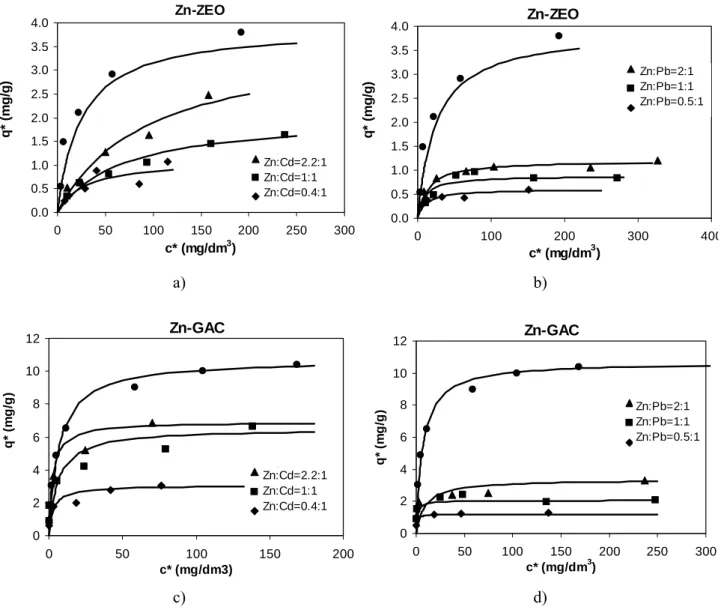
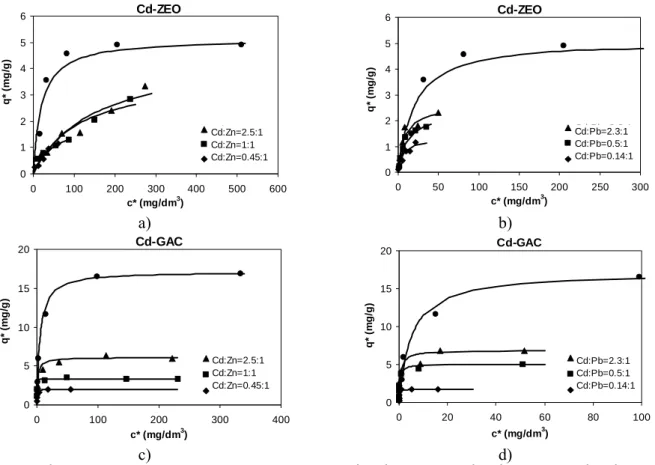
The binary adsorption isotherms were fitted with the Langmuir (Eq. 2) and Freundlich isotherm (Eq. 4). The Langmuir and Freundlich parameters for binary adsorption isotherms on ZEO and GAC are presented in Tables 3 and 4, respectively. Once again, the Langmuir isotherm fits better the ex-perimentally obtained binary adsorption isotherms. The calculated Langmuir adsorption isotherms and experimental data of Zn2+, Cd2+ and Pb2+ single
and binary adsorption on ZEO and GAC are pre-sented in Figures 4, 5 and 6, respectively. It was observed that the Pb2+ adsorption on both natural
zeolite and activated granulated carbon (Fig. 6) is less affected by the presence of second metal ion (Zn2+or Cd2+).
Zn-ZEO
0.0 0.5 1.0 1.5 2.0 2.5 3.0 3.5 4.0
0 50 100 150 200 250 300
c* (mg/dm3)
q*
(
m
g/g
)
Cd:Zn=1:2.2 Cd:Zn=1:1 Cd:Zn=2.5:1
Zn:Cd=2.2:1 Zn:Cd=1:1 Zn:Cd=0.4:1
Zn-ZEO
0.0 0.5 1.0 1.5 2.0 2.5 3.0 3.5 4.0
0 100 200 300 400
c* (mg/dm3)
q*
(
m
g/
g)
Zn:Pb=2:1 Zn:Pb=1:1 Zn:Pb=1:2
Zn:Pb=2:1 Zn:Pb=1:1 Zn:Pb=0.5:1
a) b)
Zn-GAC
0 2 4 6 8 10 12
0 50 100 150 200
c* (mg/dm3)
q*
(
m
g/
g
)
Cd:Zn=1:2.2 Cd:Zn=1:1 Cd:Zn=2.5:1
Zn:Cd=2.2:1 Zn:Cd=1:1 Zn:Cd=0.4:1
Zn-GAC
0 2 4 6 8 10 12
0 50 100 150 200 250 300
c* (mg/dm3)
q*
(
m
g/
g)
Zn:Pb=2:1 Zn:Pb=1:1 Zn:Pb=1:2
Zn:Pb=2:1 Zn:Pb=1:1 Zn:Pb=0.5:1
c) d)
Cd-ZEO 0 1 2 3 4 5 6
0 100 200 300 400 500 600
c* (mg/dm3)
q* ( m g/ g) Cd:Zn=2.5:1 Cd:Zn=1:1 Cd:Zn=1:2.2 Cd:Zn=2.5:1 Cd:Zn=1:1 Cd:Zn=0.45:1 Cd-ZEO 0 1 2 3 4 5 6
0 50 100 150 200 250 300
c* (mg/dm3)
q* ( m g /g) Cd:Pb=2.3:1 Cd:Pb=1:2.2 Cd:Pb=1:7.4 Cd:Pb=2.3:1 Cd:Pb=0.5:1 Cd:Pb=0.14:1 a) b) Cd-GAC 0 5 10 15 20
0 100 200 300 400
c* (mg/dm3)
q* ( m g/ g) Cd:Zn=2.5:1 Cd:Zn=1:1 Cd:Zn=1:2.2 Cd:Zn=2.5:1 Cd:Zn=1:1 Cd:Zn=0.45:1 Cd-GAC 0 5 10 15 20
0 20 40 60 80 100
c* (mg/dm3)
q* (m g/g) Cd:Pb=2.3:1 Cd:Pb=1:2.2 Cd:Pb=1:7.4 Cd:Pb=2.3:1 Cd:Pb=0.5:1 Cd:Pb=0.14:1 c) d) Fig. 5. Cd2+ single and binary equilibrium isotherms at 25oC. a) Cd2+/Zn2+ – ZEO; b) Cd2+/Pb2+ – ZEO; c) Cd2+/Zn2+ – GAC;
d) Zn2+/Pb2+ – GAC. ● (Cd2+) – single adsorption isotherm (the solid lines represent the fitting of data by Langmuir isotherms) Pb-ZEO 0 5 10 15 20 25 30
0 10 20 30 40 50
c* (mg/dm3)
q* (m g/ g) Cd:Pb=1:7.4 Cd:Pb=1:2.2 Cd:Pb=2.3:1 Pb:Cd=7.4:1 Pb:Cd=2.2:1 Pb:Cd=0.43:1 Pb-ZEO 0 5 10 15 20 25 30
0 20 40 60 80 100
c* (mg/dm3)
q* ( m g/ g ) Zn:Pb=1:2 Zn:Pb=1:1 Zn:Pb=2:1 Pb:Zn=2:1 Pb:Zn=1:1 Pb:Zn=0.5:1 a) b) Pb-GAC 0 5 10 15 20 25 30
0 2 4 6 8 10 12
c* (mg/dm3)
q* ( m g/ g) Cd:Pb=1:7.4 Cd:Pb=1:2.2 Cd:Pb=2.3:1 Pb:Cd=7.4:1 Pb:Cd=2.2:1 Pb:Cd=0.43:1 Pb-GAC 0 5 10 15 20 25 30
0 10 20 30 40
c* (mg/dm3)
q* ( m g /g) Zn:Pb=1:2 Pb:Zn=1:1 Zn:Pb=2:1 Pb:Zn=2:1 Pb:Zn=1:1 Pb:Zn=0.5:1 c) d) Fig. 6. Pb2+ single and binary equilibrium isotherms at 25oC. a) Pb2+/Cd2+ – ZEO; b) Pb2+/Zn2+ – ZEO; c) Pb2+/Cd2+ – GAC;
Adsorption in multi-component systems is complicated because of the fact that solute–surface interactions are involved. The second metal ion present in the water solution competes with the single metal (Zn2+, Cd2+ and Pb2+) ions adsorption.
The influence of the ionic interaction of the second metal ion present in the binary metal ion mixture can also be evaluated by the ratio of the sorption capacity for the particular metal ion in the presence and ab-sence of the second metal ion in the solution:
0 0
Q
Q
bin,
where
Q
0bin is the metal ion adsorption capacity in presence of second metal ion in the aqueous solution, andQ
0is the sorption capacity for the same metal ion when it is present alone in the aqueous solution. They are three possible cases of metal ions interaction, namely:1
0 0
>
Q
Q
binwhich indicates that the presence of the second metal ion in the solution promotes the sorption, i.e. increases the metal ion adsorption capacity.
When
1
0
0
=
Q
Q
binthere is no interaction of the metal ions during the adsorption process.
And the last case:
1
0 0
<
Q
Q
binwhich suggest that the metal ions interact during the adsorption and compete for the same adsorp-tion sites. In this case the sorpadsorp-tion is suppressed by the presence of the second metal ion, leading to lower adsorption capacity as compared to the case when the particular ion was the only ion present in the aqueous solution.
The values of
0 0
Q
Q
binfor Zn2+, Cd2+ and Pb2+
on natural zeolite (ZEO) and granulated activated carbon for all studied binary mixtures are pre-sented in Table 3 and Table 4, respectively. The
0 0
Q Q bin
are higher than 1 for all binary adsorption
isotherms obtained on both adsorbents. The
0 0
Q
Q
binshould be used only as an indicator of the
nature of the metal ion interaction during their bi-nary (competitive) adsorption, since some of the single and binary isotherms do not cover the same concentration range, as is the case of the Cd2+/Zn2+
and Cd2+/Pb2+ adsorption on natural zeolite (Figs.
5a and 5b).
The influence of the second metal ion in the mixtures on the single metal ion adsorption capac-ity increases as its concentration in the binary mix-tures increases. For example, in the case of the system Zn2+/Pb2+ – ZEO, the Zn2+ adsorption ca-pacity obtained for the single component (Zn2+
only) decreases as the quantity of the Pb2+ in the
initial binary mixture increases (Table 3). Namely, in the case when the zinc concentration in the mix-ture is two times higher than the lead
concentra-tion (Zn2+: Pb2+ = 2:1) the
0 0
Q
Q
binis 0.31 and drops
to 0.15 when the zinc concentration is two times lower than the lead concentration in the mixture (Zn2+: Pb2+ = 0.5:1).
Generally, it can be also concluded that the single component metal ion adsorption capacity is more affected by the presence of metal ions with higher single component adsorption capacity than by the metal ions with lower single component adsorption capacity. Namely, the Zn2+(or Cd2+)
single component adsorption capacity is much more affected by the presence of Pb2+ than by the
presence of Cd2+ (or Zn2+) in the binary solution.
CONCLUSIONS
The equilibrium of adsorption of Zn2+, Cd2+
and Pb2+ on regional low-cost natural clinoptilolite
containing zeolite tuff (ZEO) and commercial granulated activated carbon (GAC) was studied for single and binary systems (Cd2+/Zn2+, Zn2+/Pb2+
and Pb2+/Cd2+). The adsorption equilibrium was
determined in batch mode at 25oC, without
adjust-ment of metal ion water solution pH. Langmuir and Freundlich isotherm were used to interpret the adsorption data of the investigated single and bi-nary systems. The following general conclusions may be deduced from this study:
• The GAC has around three time higher adsorp-tion capacity for Cd2+ and Zn2+, then ZEO; and
almost the same adsorption capacity for Pb2+ as ZEO.
• The same metal ion selectivity series, Pb2+ >
Cd2+ > Zn2+, was obtained for both adsorbents.
The metal ion selectivity series is in agreement with the metals ionic radius, electronegativity, and hydratation enthalpy.
• The binary adsorption isotherms show competi-tive nature of the adsorption process. The ad-sorption capacity of natural zeolite and granu-lated activated carbon for given metal ion ob-tained from single adsorption isotherms de-crease when the second metal ion is present in the solution.
• The adsorption of a metal ions in binary sys-tems is affected by the concentration of the sec-ond ion present in the solution.
• The lead, as the most selectively adsorbed com-ponent, is less affected by the presence of zinc and cadmium in the binary solutions.
Acknowledgements: Mirjana Minčeva gratefully ac-knowledges the financial support of NATO Security through Sci-ence Programme – Reintegration grant (EAP.RIG.981814).
REFERENCES
[1] P. A. Brown, S. A. Gill, S. J. Allen. Metal removal from wastewater using peat, Water Res. 34 (16), 3907–3916 (2000).
[2] G. McKay, Use of Adsorbents for the Removal of Pollu-tants from Wastewaters, CRC Press, Boca Raton, 1996. [3] D. O. Cooney, Adsorption Design for Wastewater
Treat-ment, Lewis Publishers, Boca Raton, 1998.
[4] V. Meshko, Lj.Markovska, M. Marinkovski, Experimen-tal study and modelling of zinc adsorption by granular ac-tivated carbon and natural zeolite, Int. J. Environ. Pollut., 27 (4), 285–299 (2006).
[5] O. Yavuz, Y. Altunkaynak, F. Guzel, Removal of copper, nickel, cobalt and manganese from aqueous solution by kaolinite, Water Res., 36, 948–952 (2003).
[6] E. Erdem, N. Karapinar, R. Donat, The removal of heavy metal cations by natural zeolites, J. Colloid. Interface. Sci., 280, 309–314 (2004).
[7] D. Chen, A. K. Ray, Removal of toxic metal ions from wastewater by semiconductor photocatalysis, Chem. Eng. Sci., 56,1561–1570 (2001).
[8] S. Karabult, A. Karabahan, A. Denizli, Y. Yurum, Batch removal of copper(II) and zinc(II) from aqueous solution with low-rank Turkish coals, Separ. Purif. Tech., 18, 177–184 (2000).
[9] C. Faur-Brasquet, Z. Reddad, K. Kadirvelu, P. Le Cloirec, Modeling the adsorption of metal ions (Cu2+, Ni2+, Pb2+)
onto ACCs using surface complexation models, Appl. Surf. Sci. 196 (1–4), 356–365 (2002).
[10] F. Barbier, G. Due, M. Petit-Ramel, Adsorption of lead and cadmium ions from aqueous solution to the montmo-rilonite/water interface, Colloid Surface Physicochem Eng Aspect, 166, 153–159 (2000).
[11] C. A. Burns, P. J. Class, I. H. Harding, R. J. Crawford, Adsorption of aqueous heavy metals onto carbonaceous substrate, Colloid Surface Physicochem Eng Aspect, 155, 63–68 (1999).
[12] O. Yavuz, Y. Altunkaynak, F. Guzel, Removal of copper, nickel, cobalt and manganese from aqueous solution by kaolinite, Water Res., 37, 948–952 (2003).
[13] J. R. Evans, W. G. Davids, J. D. MacRae, A. Amirbah-man, Kinetic of cadmium uptake by chitosan-based crab shells, Water Res,. 36, 3219–3226 (2002).
[14] D. Mohan, K. P Singh, Single- and multi-component adsorption of cadmium and zinc using activated carbon derived from bagasse – an agricultural waste, Water Res., 36, 2304–2318 (2002).
[15] M. F. Brigatti, C. Lugli, L. Poppi, Kinetics of heavy metal removal and recovery in sepiolite, Appl. Clay. Sci., 16, 45–57 (2000).
[16] S. A. Garsia, A. Alastuey, X. Querol, Heavy metal ad-sorption by different minerals: application to the remedia-tion of polluted soils, Sci. Total. Environ., 242, 179–188 (1999).
[17] S. J. T. Pollard, G. D. Fowler, C. J. Sollars, R. Perry, Low cost adsorbents for waste and wastewater treatment: A review, Sci. Total. Environ.,116, 31–52 (1992). [18] S. Babel, T. A. Kurn, Low-cost adsorbents for heavy
metals uptake from contaminated water: A review, J. Hazard. Mater., B97, 219–243 (2003).
[19] D. Mohan, S. Chander, Single component and multi-component adsorption of metal ions by activated carbons, Colloid Surface Physicochem Eng Aspect, 177, 183–196 (2001).
[20] M. Machida, M. Aikawa, H. Tatsumato, Prediction of simultaneous adsorption of Cu(II) and Pb(II) onto acti-vated carbon by conventional Langmuir type equations, J. Hazard. Mater., B120, 271–275 (2005).
[21] A. H. Oren, A. Kaya, Factors affecting adsorption charac-teristics of Zn2+ on two natural zeolites, J. Hazard. Mater, 131 (1–3), 59–65 (2006).
[22] M. J. Zamzow, J. E. Murphy, Removal of Metal Cations from Water Using Zeolites. Separ. Sci. Tech., 27 (14), 1969–1984 (1992).
[23] E. Alvarez-Ayuso, A. Garcia-Sanchez, X. Querol, Purifi-cation of metal electroplating waste waters using zeolites. Water Res. 37 (20), 4855–4862 (2003).
[24] K. Athanasiadis, B. Helmreich, Influence of chemical conditioning on the ion exchange capacity and on kinetic of zinc uptake by clinoptilolite. Water Res., 39 (8), 1527– 1532 (2005).
[25] M. Sprynskyy, B. Buszewski, A. P. Terzyk, J. Namiesnik, Study of the selection mechanism of heavy metal (Pb2+,
Cu2+, Ni2+, and Cd2+) adsorption on clinoptilolite. J
Col-loid Interface Sci., 304 (1), 21–28 (2006).