How shall we know them? Trainee teachers’ perceptions of their learners’ abilities
Ian Rushton
University of Huddersfield
HUDCETTAbstract
This article, being the final one in a series of three for this journal, is concerned with trainee teachers’ changing perceptions of their learners and focuses on two areas: trainees’ perceptions of their learners’ abilities and how they are formed by their own experiences as learners; and the changes in trainees’ perceptions over the duration of their two year Initial Teacher Education (ITE) course in the Lifelong Learning Sector (LLS). Working within a multi-method approach to action research, this small-scale study found that trainees’ perceptions were influenced not so much by their own identities and habitus, although social capital was a prominent feature, but by a problematic mix of competing cultures and the impact of casualisation in the sector.
Key words
Teacher Biography and Identity; Learner Ability; Teacher Education and Training; Social Capital.
Introduction
The study emerged from previous works where, in Rushton (2010a), trainees’ anxiety and confidence levels at the start of their teacher training were analysed and, in Rushton (2010b), the dimension of individual biography was found to be crucial in mentoring a trainee from grade 4 (unsatisfactory) to grade 1 (outstanding). The findings called for further research to make sense of the various dispositions and perceptions of trainees, how they were influenced by their subject specialisms, the particular nuances that exist between both male and female trainees and between contextual areas, and the part played by individual trainees’ agencies. Together, the twin foci of this study considered how trainees’ cultural, biographical and pedagogical capital, in the collective form of developing professional identity and habitus, informed their changing perceptions of their learners’ abilities by the end of their In-Service Certificate of Education/Professional Graduate Certificate of Education (Cert Ed/PGCE) training programme in an LLS college in the North of England which culminated in July 2008.
This author suggests that the ITE community has a vested interest in better understanding the process of trainee teacher development and mentoring whilst rising to the exhortations of Maxwell (2004), Butcher (2005), Challon (2005) and Gutherson and Pickard (2005) et al to better prepare new teachers for life in the LLS.
Throughout this article, this and other authors use five key concepts relating to individuals’ identities and it is appropriate to make clear the subtle differences between them at this point where:
Agency is taken to mean the various values and dispositions, formed from many factors, that individuals embody (Avis and Bathmaker, 2006).
Value systems, a deeply problematic and contentious concept (Halliday, 2002) which can be said to represent the way in which one measures a present situation against previous learned experiences (Bathmaker et al, 2002).
Cultural capital is considered to be the manners, modes of bearing, interaction and expression that an individual develops during their formative years, often in the home (Bathmaker and Avis, 2005).
Social capital is deemed to be an individual’s cultural capital after it has been further modified by, for example, a community of practice or vocational culture (Bathmaker and Avis, 2005) and is a central concept in the study.
Habitus (after Colley et al, 2003) is taken to be a wider, more complex version of the self including, for example, dispositions relating to one’s race and gender.
Background literature
worker, consistent with the Dreyfus and Dreyfus (1986) ‘expert stage’, is generally recognisable only in those with many years’ experience and, whilst this has not been quantified by age, carries with it the implication that some older trainees possess a valuable asset in mature years and may mirror Avis and Bathmaker’s (2006) generational perspective.
In identifying the problematic transition of the vocational specialist into the trainee lecturer, Avis and Bathmaker (2006: p. 183) draw on the work of Bloomer and Hodkinson (2001) to locate both lived experience and vocational habitus in the change process:
‘Learning careers constitute both continuity and change, although the balance between them may differ markedly from case to case, from time to time and from situation to situation. For this reason we have adopted the term transformation, to describe the development of learning careers, although transformations…are often neither sudden nor dramatic, and may take many forms. They are not predetermined, although they are orientated by the habitus and the former life.’
(Bloomer and Hodkinson, 2001: p. 132)
In identifying the emerging and diverse professional identities of trainees Avis and Bathmaker (2006) make clear the contrasts between those whose dispositions were grounded in experiences as learners and those who firmly related to previous workplace experiences. Whilst such experiences were found to be significantly influential, their study found clear evidence that many trainees’ preconceptions of their learners’ abilities had, for some, been misguided and amounted to over-estimating the degree of learner autonomy, independence, motivation and possibly cultural dispositions, for example attitude and lack of respect. Although the distribution of these perceptions among the sample was unspecified, the study gave a strong flavour of trainees drawing on their own experiences as learners, which the authors construed as ‘the old days’ and ‘better times’ (p. 59), to gauge their learners’ lack of abilities.
Paradoxically, the same literature gives a sense of trainees’ value systems being subsequently influenced, often in unwelcome ways, by institutional culture as they sought to become enculturated in the sector through joining communities of practice which changed as a result of what trainees brought to the LLS sector.
Significantly, the same literature also identified a dimension where the inadequacies of the competency-based re-professionalisation of ITE (Rice, 2004) and the government’s apparently fragile grasp of teacher professionalism (Coffield, 2007) are portrayed as central tensions between individual agency and organisational structures in the sector.
Methodology
Given, therefore, that trainees’ identities are understandably highly individualised and different, a qualitatively ethnographic approach to collecting and analysing primary data from the sector was called for which was appropriate when trying to understand what they expect the abilities of their own learners to be and how those expectations change over two years. Here, Getz’s (2009, Ab.) caution of, ‘learning how to engage one’s internal experience while maintaining an ongoing reflective stance’ suggests the appropriateness of narrative-based enquiry.
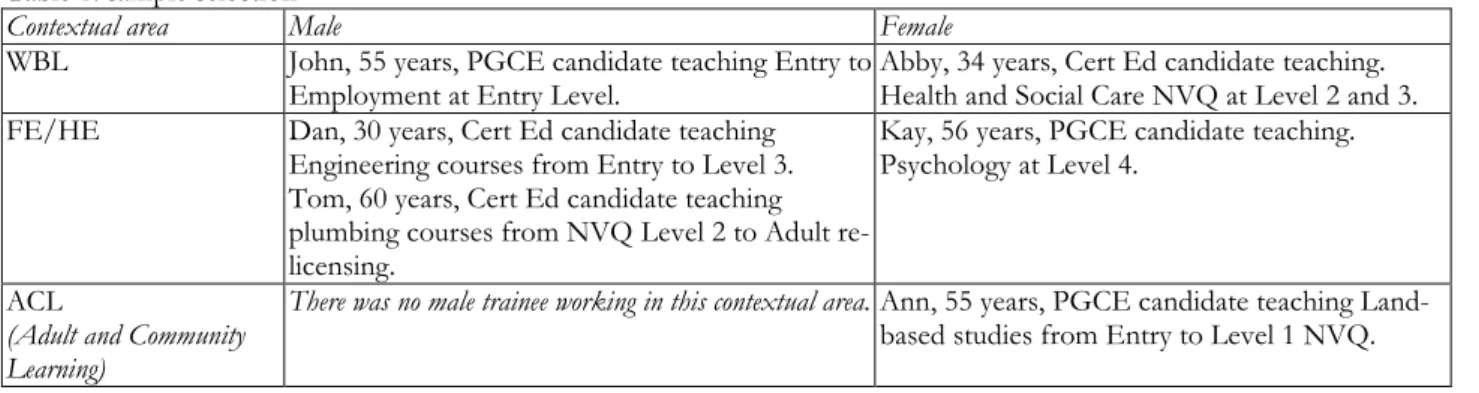
A small purposive sample of six trainees from the second year group was chosen, purposive in that all three LLS contextual areas (Further Education/Higher Education [FE/HE], Work Based Learning [WBL] and Adult and Community Learning [ACL]) were represented by both male and female trainees on both Cert Ed and PGCE routes. The data included biographical and vocational data previously captured as Personal Development Plan (PDP) and Curriculum Vitae evidence at the start of the first year, a short biographical questionnaire to develop a fuller picture of individual identities, followed by individual semi-structured interviews using a grounded theory approach (Glaser and Strauss, 1967); the appropriateness of which was justified by Wallace (2002) as, ‘It can be argued that qualitative research is, to some extent, always grounded in biography (Campbell, 1988) in that research seeks to understand the lived experience of its participants (Sherman and Webb, 1988)’ (Wallace, 2002: p. 81). Respondents in the sample gave written permission for their PDPs and CVs to be used as data for their entry point into ITE and for the questionnaire and interview being used as data for the exit point two years later on a written consent form where they suggested their own pseudonyms (below).
Table 1: sample selection
Contextual area Male Female
WBL John, 55 years, PGCE candidate teaching Entry to
Employment at Entry Level.
Abby, 34 years, Cert Ed candidate teaching. Health and Social Care NVQ at Level 2 and 3.
FE/HE Dan, 30 years, Cert Ed candidate teaching
Engineering courses from Entry to Level 3. Tom, 60 years, Cert Ed candidate teaching plumbing courses from NVQ Level 2 to Adult re-licensing.
Kay, 56 years, PGCE candidate teaching. Psychology at Level 4.
ACL
(Adult and Community Learning)
Individual biographies
Periods of vocational training ranged from two years (Abby – care work) to five years (Tom – plumbing) and in all cases had been a longer period for the older trainees. Four of the five trainees in this category had remained in the same vocational area until entering the teaching profession whilst Abby had changed her career at 18. The sixth trainee, Ann, had changed her career at the age of 50, qualified with a HND (Higher National Diploma) and has followed her new career in horticulture for the last seven years, entering teaching 18 months ago.
The CVs gave an indication of trainees with diverse school and vocational backgrounds and qualifications yet with an almost common trend in vocational stability. Whilst Ann had changed her career in mid-life, the other five had progressed steadily throughout their careers into various positions of responsibility, the highest being John who had risen to being International Sales Director before entering teaching. During interviews, five of the trainees felt that they had reached a peak in their specialist knowledge at that time although Tom’s decision to enter teaching coincided with personal health issues whereas Ann “Just happened into it”.
As a data source, the PDP 3, with two exceptions, was almost barren ground regarding their initial perceptions of their learners’ abilities as they entered the teaching profession. Firstly, John had entered “Written work from students” as a personal development point which he later explained was based on his experiences in a voluntary capacity with BTEC (Business and Technician Education Council) learners in the six months prior to joining the PGCE course. Secondly, Kay had entered “Lasting images of teaching and learning strategies that did not fulfil their objectives” as part of her pedagogic knowledge, a point she explained well during interview as:
“School failed me completely because we had one teacher who just stood in front of the board and wrote for the entire lesson, without speaking – he just wrote and I found that very difficult because I’ve always had poor sight, even at that time, so I missed out and I have a strong memory of that teacher failing me.”
Data from the questionnaires highlighted distinct boundaries between Cert Ed and PGCE routes in a number of ways. On one hand, the Cert Ed trainees were all teaching vocational subjects at Level 3 (both Tom and Don were teaching at the level of their own highest qualifications whilst Abby was qualified at Level 4), were all employed full-time on permanent contracts and had been established in FE staffrooms for three years. On the other hand, the three PGCE trainees were all agency-employed on temporary contracts; none had access to a base room in their different institutions and, whilst all were qualified at Level 6, two were teaching at Entry Level whilst Kay had the highest level of learners on a Level 4 Foundation degree. These provided useful points of reference for the individual interviews, were used to check the validity of interview responses and to develop the questioning as themes emerged.
Relationships between habitus and perception
In identifying the relationship between trainees’ habitus and their perceptions of their learners’ abilities, the interviews revealed a strong sense of trainees’ lived experiences heavily influencing their preconceptions of their learners and stood in contrast to the tenuous link revealed in the literature. Whilst the respondents tended to interpret ability as motivation, both Abby and John believed that the two were related and, interestingly, were the two who most appeared to have realised their own intrinsic motivation at the age of 18 upon entering the vocation of their choice having coasted through school. Their home upbringing had been poles apart, for example John “Had never been pushed” whilst Abby had endured numerous traumas, for example her parents had her sacked from her first job at age 16 as a punishment for becoming pregnant.
In a slightly different vein Tom drew on his school experiences for a value system to ally his expectations of apprentice plumbers with his school peers in a deprived area and whom he described as “Rough diamonds”. Like Abby and John, Tom believed in a link between ability and motivation where most learners, rough diamonds included, would have been as motivated as he had been throughout childhood to shrug off social disadvantage, as Maxwell found in 2004, and aspire beyond their lot.
In contrast, Kay’s comfortable upbringing and cultural capital collided with what she interpreted as class distinction upon choosing a vocation in a scenario which resonates powerfully with Hall and Raffo’s (2003) notion of a “certain kind of trainee”:
“Erm, I mean I did toy with the idea of being a vet but was told that, as a woman, you had to be extra clever because the men got the jobs. […] Well, having been dampened down from being a vet I thought that, well, with everyone applying to university I’d apply to a London teaching hospital. So that was all very interesting in terms of class because I applied to Guys, Hammersmith, the Royal Free and St. Bartholomew’s. St. Bart’s sent me back a questionnaire about my careers within my family – had anyone been a doctor, a lawyer or a HE teacher and I said, “No” to that, so they wrote back and said I wouldn’t be considered. […] And then I got a distinction from Hammersmith. I think that was the first realisation that I had that not everyone was the same in terms of how they were viewed and that they were, I mean, that and the comment about being a vet made me realise that people are judged differently.”
(Kay)
experiences of working with young people affirmed Gutherson and Pickard’s (2005) assertion that such experience was of no use when teaching:
“I mean, all my three sons have done GCSEs, A Levels and gone on to different universities and I’ve gone through the whole process with them so it’s not like I’m way out of date with it. I can remember the project work that they had to do at GCSE and they got reasonable grades, nearly always A to C with an occasional D, but in all cases the level of English were (sic) good enough. But coming here I found a whole different level that was nothing like I’d expected. […] I mean they were awful, absolutely awful. They used to use text-speak in coursework.”
(John)
Here, echoing the assured beliefs of the youngest Cert Ed trainee, John shared identical concerns with the other two graduates regarding the literacy skills of learners being lower than they had anticipated and were largely the remit of the ex-grammar school trainees. Whilst all three had only taught on courses at least two levels below their own highest qualification (John and Ann were both teaching Entry Level this year) they felt able to equate learner ability to their own school experiences. However, given that none of the three could recall ever having been Entry Level learners themselves, the graduate trainees may have had unrealistic perceptions of ability that were grounded in grammar school experiences that were out of kilter with those of their learners.
The two mid-life graduates, both with extensive nursing experience, were the only ones who thought that their vocational experience was of no influence in their perceptions. Such beliefs upheld Richardson’s (1990) claim that vocational identity was of little use in the transformation to trainee teacher although why this was the sole stance of the nurses in the sample was not clarified during interviews. In contrast John, with significant experience in sales force training, anticipated that learners would have been able to demonstrate a modicum of “[…] background knowledge – I just expected them to have a bit more understanding than they actually had”, an initial perception that was common throughout the literature.
Tom and Dan, despite being both the eldest and youngest respectively and with a 27 year age gap, were in many ways the most similar and their evidence seems to challenge Avis and Bathmaker’s (2006) notion of a generational divide. The two were clearly the most influenced by their different vocational cultures and were the only two in the sample to have served apprenticeships. Here, both trainees seemed to draw heavily on their vocational identities as they expressed solid preconceptions which were axiomatic of the abilities of novice apprentices they had mentored during their working lives in industry. In addition, they drew on their vocational identities and habitus with ease to identify learner abilities which both believed they could accurately predict and which Tom typically summarised as “not much idea”.
In terms of cultural capital, in addition to Kay’s awakening to class distinctions, only Abby expressed any meaningful biographical influence, albeit extreme on occasion. Throughout her interview she frequently returned to a position of low self-esteem which she related to her perceptions of her learners’ abilities. For example, she strongly believed that learners older than her would know more than her whilst the younger ones would be more motivated than she, a perspective she maintains after teaching for six years.
Dan, being the youngest and with the most recent memories of lived experiences of what Avis et al (2002) called “educative spaces” at school, college and in industry, was noticeably the most affected by his school identity. Throughout the interview he constantly related his learners’ abilities to his own cultural capital and core values, formed at both primary and secondary school, and his development of vocational habitus. Interestingly, Dan’s recurring focus on his learners’ basic skills deficiencies rests uneasily with the generational divide suggested in the literature although the problem was imponderable to him. Likewise, it is unclear why the youngest trainee was clearly the most prominent in echoing Avis and Bathmaker’s (2006, p. 59) construction of the “old days” and “better times” given that his cultural capital suggested nothing particularly unique.
In contrast to the three Cert Ed candidates, the PGCE trainees bemoaned a decidedly peripheral and marginalised existence, identified throughout the literature (passim) as being atypical of pre-service trainees, within their organisations and which John typically described as:
“I don’t trust any of them down there to give valuable advice – and I was right not to. […] In the end, I gave up trying to get information out of them. Useless, really.”
(John)
Whilst Ann claimed that the only time she ever saw any of her colleagues was, “When passing in car parks”, she also held the notion of predicting learner abilities in some disdain:
“I didn’t have any opinion because I didn’t get any information and never do. I mean, do people really go around thinking, ‘Hum, I wonder what this lot will be like? I wonder if they’ll be like my Burnley lot?’”
Some people do.
Why not?
“Because if you think they’ll be better than your last lot they may aspire to that” (sic).
Whilst Ann hinted at frustrations with her position, Kay gave a distinctly peripheral positioning of her place within the team in a lengthy section of her interview and which concurred strongly with the frustrations found by Norman and Hyland (2003) in her unsuccessful and abandoned attempts to achieve a sense of becoming:
“Well, to be quite honest, discussing with my colleagues is not something I get much chance to do […] which is why I feel a bit out on a limb, really. I just find it particularly hard so I work from home. There’s a sense of de-satisfaction about not having a base which I do find difficult – it tires me out to be honest. What with working shifts for six days and teaching a full day here, I never get a day off. […] I did have one student who did have issues which caused problems within the session, I mean it was manageable, but I did have a sense that I need to tell someone about this so I did speak to K. about my concerns – I did manage to catch her on the ‘phone, but I didn’t get anywhere. […] I mean, I’m the only one from the agency even though I wrote all three modules for this year, and then there’s a 2nd year module to write, and I just sit at home creating all the materials and marking. Everything.”
(Kay)
Here, the PGCE trainees gave a clear sense of employment-related issues relegating their perceptions of learner ability to one of lesser importance. In contrast, the Cert Ed trainees enjoy the privileged position of being a long way on the road to “becoming” with the two time-served trainees, possibly drawing on cultural dispositions they experienced in industry and undergoing yet another apprentice-like enculturation or transformation into their respective teams, have an affinity with their colleagues, share views on learner abilities and, in one case, are clearly influenced by colleagues’ perceptions.
In analysing interviewees’ responses to questions designed to identify any changes in their perceptions of their learners’ abilities over the duration of their training, only Ann, with the shortest teaching practice and the only trainee teaching a flexible or process-driven curriculum, maintained her steady humanist resolve with, “No, people are always surprisingly wonderful”, and refused to be drawn further.
Cert Ed/PGCE distinctions melted at this point in the interviews with the other trainees, having expressed shock at learner abilities at the start of their training as suggested throughout the literature, seemed resigned to more of the same but with slightly different perspectives. For example, Abby, at one moment claiming to no longer predict ability since, “There’s no point – you just get a class list now – no interviews or anything”, appeared to accept a target or product-driven existence axiomatic of that at the national level. Yet shortly afterwards she described at length and with several examples her intuitive grasp of recognising ability in group dynamics, especially in mixed-gender groups when women invariably became more competitive. Here, she was able to encourage and nurture emerging ability through both what Bathmaker and Avis (2004) saw as an emotional component of care and through replicating best practice she had occasionally experienced at school, much like the isolated nuggets of inspirational teaching identified variously in the literature, for example, Avis and Bathmaker (2006) et al. Likewise, John had also succumbed in a different contextual area and in the manner described by Wallace (2002) as “playing the game” and had ceased to predict abilities since:
“Well, to be honest, you can’t have great expectations when the onus is on you to get them passed. And I just fell into it because I didn’t want to be seen as a failure. But really, they’re still disappointing – lazy but bright with the odd surprises.”
(John)
Here, John gives a clear sense of deflated resignation, akin to that exhibited by Richard in Avis and Bathmaker’s (2006) study, and which reinforced his feelings of isolation from the rest of his team.
In a different vein, Tom felt that age 25 was a watershed where the relationship between ability and motivation were allied to fee payment where the older learners were motivated and their ability surfaced because they had to pay their own fees, whereas the reverse was true for those aged below 25 years who had their fees paid. However, he believed that whilst low ability gave way to learner frustration which manifested itself in behavioural issues (and only the two tradesmen mentioned learner behaviour), learner ability had nonetheless remained a constant during his teacher training.
Only Dan and Kay, teaching NVQ (National Vocational Qualification) 1 and 3 and Foundation Degree (FD) respectively, shared an unshakeable belief that learner abilities had fallen during their ITE course and were a result of entry criteria having been lowered during that time and that basic literacy skills deficiencies were the most prominent feature. Whereas Dan believed that schools and the wider education system held the key to remedying the situation, although he did what he could to develop his learners’ basic skills, Kay had scant knowledge of the current school system and believed that she alone held the key to unlocking potential:
“I think my expectations and theirs need some marrying up – how we’re going to get there – I think that differentiation comes into it significantly and we can negotiate that. I think the level of ability does follow the normal distribution and the couple of strugglers at one end will do ok, if they let me help them.”
Kay echoes the emotional care and pastoral duty revealed in the literature although her fragile position in the teaching team paradoxically questions Colley et al’s (2003) belief that emotional care is a central tenet in the act of “becoming” since, although she is becoming a teacher, she appears firmly locked out of her community of practice. However, when probed, the interviewees seemed to momentarily rise above their positions of conformity and tended to share Kay’s commitment to emotional care for emancipatory reasons, although whether this was due to being interviewed by their ITE tutor was unclear. Similarly unknown is the part played by generational processes in trainees’ perceptions of learner abilities, either initially or developing, since the interviews did not reveal any tangible data.
Overall, trainees on both courses drew heavily from their lived experiences as trainee teachers where two were resigned to accepting a teaching role where learner ability is of no consequence and peripheral to their organisations’ exam-driven demands for achievement; another trainee allied the perceived ability-motivation paradigm to funding regimes; whilst two others expressed mixed feelings as they witnessed the decline of abilities that fail to equip learners for post-16 work and study.
Conclusion
Given the small sample, only tentative conclusions can be drawn from the study although the data expresses many interesting nuances of individual habitus.
Trainees tended to draw heavily on their core values, formed more through lived educational experiences and social rather than cultural capital, to predict a relationship between ability and motivation. Likewise, they embraced vocational habitus and lived occupational experiences to inform their preconceptions of their learners’ abilities but found these to be of little use in practice as evidenced in the literature.
Most trainees’ perceptions of their learners’ abilities tended not to change significantly during their ITE training since the focus of their attention switched to conforming to the strategic compliance of their placement organisations. This seemed especially true for trainees on temporary contracts in the wider LLS and made clear a possible divide between and within general FE and wider communities. Notwithstanding this, trainees developed a distinct ethos of emotional care towards their learners despite a resignation to anticipating low abilities in learners which they felt they were compelled to accommodate in order to achieve organisational targets; again, mirrored in parts of the literature.
Absent from the literature, yet found here, were a number of possible distinctive divides: a distinct Cert Ed/PGCE divide where the majority of the former expressed a sense of belonging, acceptance and enculturation into their communities of practice giving them time to reflect on learner ability which they worked with in developmental ways as part of their individual agency. In contrast, the agency-employed graduates expressed a strong sense of marginalisation and tended to channel their thoughts and efforts towards strategically meeting targets as a means to acceptance. Here, trainees gave a flavour of what one of the reviewers of this piece likened to being “a stranger in a strange land” where trainees’ value systems and social capital were compromised in the pursuit of renewed contracts. The study failed to make clear whether such a dichotomy was a graduate/non-graduate divide, a full-time/part-time distinction, a set of permanency/agency conditions or whether the difference relates to teaching at or below one’s own level of qualification or the extent of the vocational/non-vocational divide.
The emerging, tentative findings are worthy of further and larger exploration, particularly through a theoretical framework that seeks to focus on the dynamics of social capital as it develops in casualised teaching communities in the sector.
References
Avis, J., Bathmaker, A–M., Parsons, J. (2002) ‘Communities Of Practice And The Construction Of Learners In Post-Compulsory Education And Training’,
Journal of Vocational Education and Training Vol. 54, No. 1, pp. 27 – 50. http://dx.doi.org/10.1080/13636820200200186
Avis, J., Kendall, A., Bathmaker, A-M. (2003) ‘The Politics Of Care – Emotional Labour And Trainee FE Lecturers.’ Paper presented at the British Educational Research Association Annual Conference at Heriot-Watt University, Edinburgh, 11 - 13 September 2003.
Avis, J., Bathmaker, A-M. (2006) ‘From Trainee To FE Lecturer: Trials And Tribulations’, Journal of Vocational Education and Training Vol. 58, No. 2, pp. 171 – 189. http://dx.doi.org/10.1080/13636820600799619
Bathmaker, A-M., Avis, J., Kendall, A., Parsons, J. (2002) ‘Biographies, Values And Practice: Trainee Lecturers’ Constructions Of Teaching In Further Education.’ Paper presented at the British Educational Research Association Annual Conference, University of Exeter, 12 - 14 September 2002.
Bathmaker, A-M., Avis, J. (2004) ‘“How Do I Cope With That?” The Development Of ‘Schooling Identities’ Amongst Trainee FE Lecturers.’ Paper presented at the British Educational Research Association Annual Conference, University of Manchester, 16 - 18 September 2004.
Bathmaker, A-M., Avis, J. (2005) ‘Is That Tingling Feeling Enough? Constructions Of Teaching And Learning In Further Education’ Educational Review Vol. 57, No. 1, pp. 3 - 20. http://dx.doi.org/10.1080/0013191042000274150
Bloomer, P., Hodkinson, P. (2001) ‘Learning Careers And Cultural Capital: Adding A Social And Longitudinal Dimension Into Our Understanding Of Learning’, in Nata, R. (Ed.) Progress in Education, Volume 5, New York: Nova Science Publishers.
Butcher, J. (2005) Developing Effective 16 – 19 Teaching Skills. Abingdon: Routledge Falmer.
Challon, D. (2005) ‘To Teach Or Not To Teach: Trainees’ Responses To The Challenges Found During Initial Teacher Training: A Summary.’ Paper presented at the British Educational Research Association Annual Conference, University of Glamorgan, 14 – 17 September 2005.
Coffield, F. (2007) ‘Running Ever Faster Down The Wrong Road: An Alternative Future For Education And Skills.’ Keynote lecture at the 6th Annual
Colley, H., James, D., Tedder, M., Diment, K., (2003) ‘Learning As Becoming In Vocational Education And Training: Class, Gender And The Role Of Vocational Habitus’, Journal of Vocational Education and Training Vol. 55, No. 4, pp. 471 – 498. http://dx.doi.org/10.1080/13636820300200240
Colley, H. (2006) ‘Learning To Labour With Feeling: Class, Gender And Emotion In Childcare Education And Training’, Contemporary Issues in Early Childhood Vol. 7, No. 1, pp. 15 – 29. http://dx.doi.org/10.2304/ciec.2006.7.1.15
Dreyfus, H.L., Dreyfus, S.E. (1986) Mind Over Machine: The Power Of Human Intuition And Expertise In The Era Of The Computer. Oxford: Basil Blackwell. Getz, C. (2009) ‘Teaching Leadership As Exploring Sacred Space’, Educational Action Research Vol. 17, No. 3, pp. 447 – 461. http://dx.doi.org/10.1080/09650790903093318
Glaser, B., Strauss, L. (1967) The Discovery Of Grounded Theory. New York: Aldine.
Gutherson, P., Pickard, L. (2005) ‘Behaviour Management And Pastoral Skills Training For Initial Teacher Trainers: Initial Findings On Trainees’ Confidence And Anxiety Levels.’ October 2005. TAC, part of CfBT. http://www.leeds.ac.uk/educol/documents [Accessed 1 February 2007].
Halliday, J. (2002) ‘Researching Values In Education’, British Educational Research Journal Vol. 28, No. 1, pp. 49 – 62. http://dx.doi.org/10.1080/01411920120109748
Hall, D., Raffo, C. (2003) ‘Cultural Capital And The Emerging Professional Identities Of Trainee Teachers.’ Paper presented at the British Educational Research Association Annual Conference at Heriot-Watt University, Edinburgh, 11 - 13 September 2003.
Maxwell, B. (2004) ‘Becoming A Teacher In The Learning And Skills Sector: Using A Knowledge Resource Perspective To Inform The Development Of Initial Teacher Education.’ Paper presented at the Scottish Educational Research Association Annual Conference, Perth, 25 – 27 November 2004. Norman, M. & Hyland, T. (2003) The role of confidence in lifelong learning, Educational Studies 29 (2/3), pp. 261 – 272. http://dx.doi.org/10.1080/03055690303275
Rice, R. (2004) ‘The Student Teachers’ Perspective On Challenge Within Teaching Practice.’ Paper presented at the British Educational Research Association, University of Manchester, 16 - 18 September 2004.
Richardson, (1990) (unreferenced), in: Pickering, A. (2003) ‘Factors Influencing The Pedagogic Development Of Novice University Lecturers: Findings From Research.’ Paper presented at the British Educational Research Association Annual Conference, Heriot-Watt University, Edinburgh, 11 - 13 September 2003.
Rushton, I. (2010a) ‘Managing Meat One: Perceptions And Anxieties Of Trainee Teachers As They Enter The Learning And Skills Sector For The First Time’, Teaching in Lifelong Learning Vol. 2, No. 1, pp. 15 – 22. http://dx.doi.org/10.5920/till.2010.2115
Rushton, I. (2010b) ‘Mentoring In The Lifelong Learning Sector: A Critical Heuristic Account’, Teaching in Lifelong Learning Vol. 2, No. 2, pp. 15 – 23. http://dx.doi.org/10.5920/till.2010.2215
Wallace, S. (2002) ‘No Good Surprises: Intending Lecturers’ Preconceptions And Initial Experiences Of Further Education’, British Educational Research Journal Vol. 28, No. 1, pp. 79 – 93. http://dx.doi.org/10.1080/01411920120109766