ENHANCED HOPFIELD NEURAL NETWORKS
WITH ARTIFICIAL IMMUNE SYSTEM
ALGORITHM FOR SATISFIABILITY LOGIC
PROGRAMMING
MOHD. ASYRAF MANSOR
UNIVERSITI SAINS MALAYSIA
2017
ENHANCED HOPFIELD NEURAL NETWORKS
WITH ARTIFICIAL IMMUNE SYSTEM
ALGORITHM FOR SATISFIABILITY LOGIC
PROGRAMMING
by
MOHD. ASYRAF MANSOR
Thesis submitted in fulfilment of the requirements for the degree of
Doctor of Philosophy
ACKNOWLEDGEMENT
In the first place, all the praises and thanks to Allah S.W.T, the Almighty for the infinite blessings and giving me strength throughout my research journey.
I would like to record my sincere appreciation to my supervisor, Associate Profes-sor Saratha Sathasivam for her incessant encouragement and professional guidance as well as providing us with mountains of insights for the research. I am very grateful for her patience in answering all my queries so promptly and always being supportive and constructive. I could not have completed this thesis without the immense knowledge and continuous support I have been given.
Also, I would like to thank my parents, Mansor Majin and Jelihah Taha including my siblings for their constant support and comfort during the ups and downs of my research. I am extremely grateful to my parents for their prayers and sacrifices for educating and preparing me for a better future. Indeed, my family members have been my genuine inspiration and motivation to improve my knowledge and soar higher for my future career. In addition, I dedicated this thesis to my family including those in Taha’s and Majin’s clan.
I am fervently indebted to my research colleague, Mohd Shareduwan Mohd Kasih-muddin who has assisted in the fundamental concept of neural networks and provid-ing millions information about publications. Hence, I am predominantly indebted for his thought-provoking insight throughout this research, but trying to express the enor-mity of my gratitude would be like trying to divide by zero. Completing this work would have been even more difficult were it not for the support and friendship pro-vided by the other comrades from USM, some of which include Mohamad Asyraf
Mohamad Adnan, Ardiana Amirsom, Faisal Basir, Ainina Redwan, Yushalify Misro, Soffiah Sahubar Ali and Syafiah.
I would like to thank the academic and administrative staffs of the School of Mathe-matical Sciences (PPSM), USM and IPS, USM for generous provision of facilities and support to complete this research. I am momentously indebted for the excellent and conducive academic atmosphere that is captivating. Special credit to Professor Hailiza Kamrulhaili, Dean of PPSM, USM and Associate Professor Ong Hong Choon, Deputy Dean of PPSM, USM for organizing the seminar and endless academic programs that boost my research horizon.
Finally, I would like to express a token of appreciation to Ministry of Higher Edu-cation, Malaysia for the generous financial support I received. The funding was in the form of a scholarship for tertiary education under MyBrain15 and without this funding, the research would not have been possible.
Mohd. Asyraf Mansor 2017
TABLE OF CONTENTS
Acknowledgement . . . ii Table of Contents . . . iv List of Tables . . . ix List of Figures . . . xi List of Abbreviations . . . xxList of Symbols . . . xxiv
Abstrak . . . xxvii
Abstract . . . xxix
CHAPTER 1 – INTRODUCTION 1.1 Introduction to Artificial Neural Network . . . 1
1.2 Data Mining in Neural Network . . . 4
1.3 Problem Statement . . . 5
1.4 Research Objectives . . . 7
1.5 Methodology . . . 8
1.6 Scope and Limitations of Research . . . 11
1.7 Organization of Thesis . . . 12
CHAPTER 2 – LITERATURE REVIEW 2.1 Hopfield Neural Network . . . 14
2.2 Logic Programming . . . 17
2.3 Hyperbolic Tangent Activation Function . . . 20
2.5 General Concept of Maximum 3-Satisfiability . . . 24
2.6 Artificial Immune System Algorithm. . . 26
2.7 Exhaustive Search . . . 28
2.8 Genetic Algorithm . . . 29
2.9 Circuit Satisfiability . . . 31
2.10 Data Mining in Hopfield Neural Network . . . 32
2.11 Summary . . . 33
CHAPTER 3 – LOGIC PROGRAMMING IN HOPFIELD NEURAL NETWORK 3.1 The Architecture of Hopfield Neural Network . . . 34
3.2 The Implementation of Discrete Hopfield Neural Network . . . 38
3.3 The Implementation of Hyperbolic Tangent Activation Function. . . 40
3.4 Network Relaxation Approach . . . 41
3.5 Hopfield Content Adressable Memory . . . 42
3.6 Convergence and Dynamics of Hopfield Neural Network. . . 45
3.7 Propositional Logic Programming . . . 47
3.8 Horn Logic Programming in Hopfield Neural Network . . . 48
3.9 Summary . . . 50
CHAPTER 4 – PROPOSED HYBRID HNN MODELS FOR SATISFIABILITY LOGIC PROGRAMMING 4.1 3-Satisfiability Programming in Hopfield Neural Network. . . 51
4.1.1 3-Satisfiability Logical Rule . . . 51
4.1.2 3-Satisfiability Logic Programming Training Phase . . . 53
4.2 Hybrid Hopfield Neural Network with Enhanced Artficial Immune
System Algorithm (HNN-3SATAIS) . . . 62
4.2.1 Standard Model of Artificial Immune System Algorithm . . . 62
4.2.2 Enhanced Artificial Immune System in HNN-3SATAIS . . . 64
4.2.3 Convergence Analysis of Artificial Immune System Algorithm . . . . 69
4.3 Hybrid Hopfield Neural Network with Exhaustive Search (HNN-3SATES) 69 4.3.1 Exhaustive search in HNN-3SATES . . . 69
4.3.2 Limitation of Exhaustive Search . . . 71
4.4 Hybrid Hopfield Neural Network with Genetic Algorithm (HNN-3SATGA). . . 72
4.4.1 Standard Genetic Algorithm . . . 72
4.4.2 Enhanced Genetic Algorithm in HNN-3SATGA . . . 74
4.4.3 Convergence Analysis of Genetic Algorithm . . . 77
4.5 3-Satisfiability Enhanced Reverse Analysis Paradigm (3-SATERAP) . . . 77
4.6 Implementation of HNN-C3SATGA and HNN-C3SATAIS in Circuit Verification . . . 79
4.7 Maximum 3-Satisfiability Logic Programming in Hopfield Neural Network . . . 83
4.7.1 Maximum 3-Satisfiability Logical Rule. . . 83
4.7.2 Implementation of Maximum 3-Satisfiability Logic Programming in Hopfield Neural Network . . . 84
4.8 Summary . . . 88
CHAPTER 5 – SIMULATED RESULTS OF HYBRID HNN MODELS 5.1 Introduction . . . 89
5.2 Performance Evaluation Metrics . . . 89
5.2.2 Mean Absolute Error (MAE) . . . 91
5.2.3 Sum of Squared Error (SSE) . . . 92
5.2.4 Symmetric Mean Absolute Percentage Error (SMAPE) . . . 93
5.2.5 Global Minima Ratio and Ratio of Satisfied Clauses. . . 94
5.2.6 Schwarz Bayesian Criterion (SBC) . . . 95
5.2.7 CPU Time . . . 96
5.2.8 Accuracy. . . 96
5.3 Simulated Results and Discussions for HNN Models in 3-SAT. . . 97
5.4 Simulated Results and Discussions for HNN models in MAX-3SAT . . . 107
5.5 Simulated Results and Discussions for Circuit Verification . . . 115
5.6 Summary . . . 119
CHAPTER 6 – PERFORMANCE EVALUATIONS OF HYBRID HNN MODELS IN DATA MINING 6.1 Introduction . . . 120
6.2 Real Data Set . . . 121
6.3 Analysis of Hybrid HNN in Training the Real Data Sets . . . 124
6.3.1 Bach choral harmony data set . . . 125
6.3.2 Census Income data set . . . 128
6.3.3 Diabetic Retinopathy Debrecen data set . . . 131
6.3.4 Statlog data set . . . 134
6.3.5 Heart disease data set . . . 137
6.3.6 Indian Liver Patient data set . . . 139
6.3.7 Ionosphere data set . . . 142
6.3.9 MAGIC Gamma Telescope data set . . . 146
6.3.10 PIMA Indians diabetes data set. . . 148
6.3.11 Skillcraft1 master table data set . . . 150
6.3.12 Seismic-bumps data set . . . 152
6.3.13 Spambase data set . . . 155
6.3.14 Steel plates faults data set. . . 158
6.3.15 Thoracic Surgery data set . . . 160
6.4 Analysis of Hybrid HNN Model in Testing the Real Data Sets . . . 162
6.5 Summary . . . 164
CHAPTER 7 – CONCLUSION 7.1 Conclusion and Summary of the Research . . . 165
7.2 Suggestions for Future Research. . . 167
REFERENCES. . . 170
APPENDICES. . . 184
LIST OF TABLES
Page
Table 2.1 Related Literature on Hopfield Neural Network 16 Table 2.2 Related Literature on Logic Programming 19 Table 2.3 Related Literature on Hyperbolic Tangent Activation
Func-tion
21
Table 2.4 Related Literature on 3-Satisfiability 23 Table 2.5 Related Literature on Maximum 3-Satisfiability 25 Table 2.6 Related Literature on Artificial Immune System Algorithm 27 Table 2.7 Related Literature on Exhaustive Search 28 Table 2.8 Related Literature on Genetic Algorithm 30 Table 2.9 Related Literature on Circuit Satisfiability 31 Table 2.10 Related Literature on Data Mining in Hopfield Neural
Net-work
32
Table 4.1 The Truth Table for 3-SAT formula,φ 55
Table 4.2 The Clauses and Corresponding Synaptic Weights (Wan Ab-dullah Method)
57
Table 4.3 The Truth Table for MAX-3SAT formula,ω and the
corre-spondingEω
85
Table 5.1 Performance Evaluations for C3SATGA and HNN-C3SATAIS in Circuit Verification
118
Table 6.1 The Description of Real Data Sets 122 Table 6.2 Performance Evaluations for Hybrid Models in Training
Bach Choral Hramony Data Set
127
Table 6.3 Performance Evaluations for Hybrid Models in Training Census Income Data Set
Table 6.4 Performance Evaluations for Hybrid Models in Training Di-abetic Retinophaty Debrecen Data Set
133
Table 6.5 Performance evaluations for Hybrid Models in Training Stat-log Data Set
136
Table 6.6 Performance Evaluations for Hybrid Models in Training Heart Disease Data Set
138
Table 6.7 Performance Evaluations for Hybrid Models in Training In-dian Liver Patient Data Set
141
Table 6.8 Performance Evaluations for Hybrid Models in Training Ionosphere Data Set
143
Table 6.9 Performance Evaluations for Hybrid Models in Training Japanese Credit Screening Data Set
145
Table 6.10 Performance Evaluations for Hybrid Models in Training MAGIC Gamma Telescope Data Set
147
Table 6.11 Performance Evaluations for Hybrid Models in Training PIMA Indians diabetes Data Set
149
Table 6.12 Performance Evaluations for Hybrid Models in Training Skillcraft1 Master Table Data Set
151
Table 6.13 Performance Evaluations for Hybrid Models in Training Seismic-bumps Data Set
154
Table 6.14 Performance Evaluations for Hybrid Models in Training Spambase Data Set
157
Table 6.15 Performance Evaluations for Hybrid Models in Steel Plates Faults Data Set
159
Table 6.16 Performance Evaluations for Hybrid Models in Training Thoracic Surgery Data Set
161
Table 6.17 Performance Evaluations for Hybrid Models in Testing the Data Sets
163
LIST OF FIGURES
Page
Figure 1.1 Biological Neural Network Model (Takefuji, 2012) 2 Figure 1.2 The Advancement of ANN in Face Recognition (Levy,
2016)
3
Figure 1.3 The Methodology of Hybrid HNN Networks in 3-SAT, MAX-3SAT, and C3-SAT Logic Programming
9
Figure 1.4 The Methodology of Hybrid HNN models in Logic Mining 10 Figure 3.1 Recurrent Hopfield Neural Network (Swarup and Simi,
2006).
35
Figure 3.2 Simple Topology of Hopfield Neural Network (Sathasivam et al., 2011).
36
Figure 4.1 The Implementation of 3-SAT Logic Programming in Hop-field Neural Network
61
Figure 4.2 Clonal Selection Principle in AIS (Shangce et al., 2007). 63 Figure 4.3 Important Stages in Standard Genetic Algorithm (Gen and
Cheng, 2000).
73
Figure 4.4 The Configuration of Circuit Satisfiability (Hamadneh, 2013).
81
Figure 5.1 RMSE Evaluation for HNN-3SATAIS, HNN-3SATGA and HNN-3SATES
98
Figure 5.2 MAE Evaluation for HNN-3SATAIS, HNN-3SATGA and HNN-3SATES
98
Figure 5.3 SSE Evaluation for HNN-3SATAIS, HNN-3SATGA and HNN-3SATES
100
Figure 5.4 SMAPE Evaluation for HNN-3SATAIS, HNN-3SATGA and HNN-3SATES
101
Figure 5.5 Global Minima Ratio Evaluation for 3SATAIS, HNN-3SATGA and HNN-3SATES
Figure 5.6 SBC Evaluation for HNN-3SATAIS, HNN-3SATGA and HNN-3SATES
104
Figure 5.7 CPU Time Evaluation for HNN-3SATAIS, HNN-3SATGA and HNN-3SATES
105
Figure 5.8 RMSE Evaluation of MAX3SATGA and HNN-MAX3SATAIS
107
Figure 5.9 MAE Evaluation of MAX3SATGA and HNN-MAX3SATAIS
108
Figure 5.10 SSE Evaluation of MAX3SATGA and HNN-MAX3SATAIS
109
Figure 5.11 SMAPE Evaluation of MAX3SATGA and HNN-MAX3SATAIS
110
Figure 5.12 SBC Evaluation of MAX3SATGA and HNN-MAX3SATAIS
111
Figure 5.13 Global Minima Ratio Evaluation of HNN-MAX3SATGA and HNN-MAX3SATAIS
112
Figure 5.14 Ratio of Satisfied Clauses Evaluation of HNN-MAX3SATGA and HNN-MAX3SATAIS
113
Figure 5.15 CPU Time Evaluation of MAX3SATGA and HNN-MAX3SATAIS
114
Figure A.1 Performance Evaluations of HNN-3SAT Models in Training Bach Choral Data Set
185
Figure A.1(a) RMSE Evaluation of HNN-3SAT Models in Training Bach Choral Data Set
185
Figure A.1(b) MAE Evaluation of HNN-3SAT Models in Training Bach Choral Data Set
185
Figure A.1(c) SSE Evaluation of HNN-3SAT Models in Training Bach Choral Data Set
185
Figure A.1(d) SMAPE Evaluation of HNN-3SAT Models in Training Bach Choral Data Set
185
Figure A.1(e) SBC Evaluation of HNN-3SAT Models in Training Bach Choral Data Set
Figure A.1(f) CPU Time Obtained by HNN-3SAT Models in Training Bach Choral Data Set
185
Figure A.2 Performance Evaluations of HNN-3SAT Models in Training Census Income Data Set
186
Figure A.2(a) RMSE Evaluation of HNN-3SAT Models in Training Census Income Data Set
186
Figure A.2(b) MAE Evaluation of HNN-3SAT Models in Training Census Income Data Set
186
Figure A.2(c) SSE Evaluation of HNN-3SAT Models in Training Census Income Data Set
186
Figure A.2(d) SMAPE Evaluation of HNN-3SAT Models in Training Cen-sus Income Data Set
186
Figure A.2(e) SBC Evaluation of HNN-3SAT Models in Training Census Income Data Set
186
Figure A.2(f) CPU Time Obtained by HNN-3SAT Models in Training Census Income Data Set
186
Figure A.3 Performance Evaluations of HNN-3SAT Models in Training Diabetic Retinopathy Debrecen Data Set
187
Figure A.3(a) RMSE Evaluation of HNN-3SAT Models in Training Dia-betic Retinopathy Debrecen Data Set
187
Figure A.3(b) MAE Evaluation of HNN-3SAT Models in Training Diabetic Retinopathy Debrecen Data Set
187
Figure A.3(c) SSE Evaluation of HNN-3SAT Models in Training Diabetic Retinopathy Debrecen Data Set
187
Figure A.3(d) SMAPE Evaluation of HNN-3SAT Models in Training Dia-betic Retinopathy Debrecen Data Set
187
Figure A.3(e) SBC Evaluation of HNN-3SAT Models in Training Diabetic Retinopathy Debrecen Data Set
187
Figure A.3(f) CPU Time Obtained by HNN-3SAT Models in Training Di-abetic Retinopathy Debrecen Data Set
187
Figure A.4 Performance Evaluations of HNN-3SAT Models in Training Statlog Data Set
Figure A.4(a) RMSE Evaluation of HNN-3SAT Models in Training Statlog Data Set
188
Figure A.4(b) MAE Evaluation of HNN-3SAT Models in Training Statlog Data Set
188
Figure A.4(c) SSE Evaluation of HNN-3SAT Models in Training Statlog Data Set
188
Figure A.4(d) SMAPE Evaluation of HNN-3SAT Models in Training Stat-log Data Set
188
Figure A.4(e) SBC Evaluation of HNN-3SAT Models in Training Statlog Data Set
188
Figure A.4(f) CPU Time Obtained by HNN-3SAT Models in Training Stat-log Data Set
188
Figure A.5 Performance Evaluations of HNN-3SAT Models in Training Heart Disease Data Set
189
Figure A.5(a) RMSE Evaluation of HNN-3SAT Models in Training Heart Disease Data Set
189
Figure A.5(b) MAE Evaluation of HNN-3SAT Models in Training Heart Disease Data Set
189
Figure A.5(c) SSE Evaluation of HNN-3SAT Models in Training Heart Disease Data Set
189
Figure A.5(d) SMAPE Evaluation of HNN-3SAT Models in Training Heart Disease Data Set
189
Figure A.5(e) SBC Evaluation of HNN-3SAT Models in Training Heart Disease Data Set
189
Figure A.5(f) CPU Time Obtained by HNN-3SAT Models in Training Heart Disease Data Set
189
Figure A.6 Performance Evaluations of HNN-3SAT Models in Training Indian Liver Patient Data Set
190
Figure A.6(a) RMSE Evaluation of HNN-3SAT Models in Training Indian Liver Patient Data Set
190
Figure A.6(b) MAE Evaluation of HNN-3SAT Models in Training Indian Liver Patient Data Set
Figure A.6(c) SSE Evaluation of HNN-3SAT Models in Training Indian Liver Patient Data Set
190
Figure A.6(d) SMAPE Evaluation of HNN-3SAT Models in Training In-dian Liver Patient Data Set
190
Figure A.6(e) SBC Evaluation of HNN-3SAT Models in Training Indian Liver Patient Data Set
190
Figure A.6(f) CPU Time Obtained by HNN-3SAT Models in Training In-dian Liver Patient Data Set
190
Figure A.7 Performance Evaluations of HNN-3SAT Models in Training Ionosphere Data Set
191
Figure A.7(a) RMSE Evaluation of HNN-3SAT Models in Training Iono-sphere Data Set
191
Figure A.7(b) MAE Evaluation of HNN-3SAT Models in Training Iono-sphere Data Set
191
Figure A.7(c) SSE Evaluation of HNN-3SAT Models in Training Iono-sphere Data Set
191
Figure A.7(d) SMAPE Evaluation of HNN-3SAT Models in Training Iono-sphere Data Set
191
Figure A.7(e) SBC Evaluation of HNN-3SAT Models in Training Iono-sphere Data Set
191
Figure A.7(f) CPU Time Obtained by HNN-3SAT Models in Training Ionosphere Data Set
191
Figure A.8 Performance Evaluations of HNN-3SAT Models in Training Japan Credit Screening Data Set
192
Figure A.8(a) RMSE Evaluation of HNN-3SAT Models in Training Japan Credit Screening Data Set
192
Figure A.8(b) MAE Evaluation of HNN-3SAT Models in Training Japan Credit Screening Data Set
192
Figure A.8(c) SSE Evaluation of HNN-3SAT Models in Training Japan Credit Screening Data Set
192
Figure A.8(d) SMAPE Evaluation of HNN-3SAT Models in Training Japan Credit Screening Data Set
Figure A.8(e) SBC Evaluation of HNN-3SAT Models in Training Japan Credit Screening Data Set
192
Figure A.8(f) CPU Time Obtained by HNN-3SAT Models in Training Japan Credit Screening Data Set
192
Figure A.9 Performance Evaluations of HNN-3SAT Models in Training MAGIC Gamma Telescope Data Set
193
Figure A.9(a) RMSE Evaluation of HNN-3SAT Models in Training MAGIC Gamma Telescope Data Set
193
Figure A.9(b) MAE Evaluation of HNN-3SAT Models in Training MAGIC Gamma Telescope Data Set
193
Figure A.9(c) SSE Evaluation of HNN-3SAT Models in Training MAGIC Gamma Telescope Data Set
193
Figure A.9(d) SMAPE Evaluation of HNN-3SAT Models in Training MAGIC Gamma Telescope Data Set
193
Figure A.9(e) SBC Evaluation of HNN-3SAT Models in Training MAGIC Gamma Telescope Data Set
193
Figure A.9(f) CPU Time Obtained by HNN-3SAT Models in Training MAGIC Gamma Telescope Data Set
193
Figure A.10 Performance Evaluations of HNN-3SAT Models in Training PIMA Indians Diabetes Data Set
194
Figure A.10(a) RMSE Evaluation of HNN-3SAT Models in Training PIMA Indians Diabetes Data Set
194
Figure A.10(b) MAE Evaluation of HNN-3SAT Models in Training PIMA Indians Diabetes Data Set
194
Figure A.10(c) SSE Evaluation of HNN-3SAT Models in Training PIMA Indians Diabetes Data Set
194
Figure A.10(d) SMAPE Evaluation of HNN-3SAT Models in Training PIMA Indians Diabetes Data Set
194
Figure A.10(e) SBC Evaluation of HNN-3SAT Models in Training PIMA Indians Diabetes Data Set
194
Figure A.10(f) CPU Time Obtained by HNN-3SAT Models in Training PIMA Indians Diabetes Data Set
Figure A.11 Performance Evaluations of HNN-3SAT Models in Training Skillcraft1 Master Table Data Set
195
Figure A.11(a) RMSE Evaluation of HNN-3SAT Models in Training Skill-craft1 Master Table Data Set
195
Figure A.11(b) MAE Evaluation of HNN-3SAT Models in Training Skill-craft1 Master Table Data Set
195
Figure A.11(c) SSE Evaluation of HNN-3SAT Models in Training Skill-craft1 Master Table Data Set
195
Figure A.11(d) SMAPE Evaluation of HNN-3SAT Models in Training Skill-craft1 Master Table Data Set
195
Figure A.11(e) SBC Evaluation of HNN-3SAT Models in Training Skill-craft1 Master Table Data Set
195
Figure A.11(f) CPU Time Obtained by HNN-3SAT Models in Training Skillcraft1 Master Table Data Set
195
Figure A.12 Performance Evaluations of HNN-3SAT Models in Training Seismic-bumps Data Set
196
Figure A.12(a) RMSE Evaluation of HNN-3SAT Models in Training Seismic-bumps Data Set
196
Figure A.12(b) MAE Evaluation of HNN-3SAT Models in Training Seismic-bumps Data Set
196
Figure A.12(c) SSE Evaluation of HNN-3SAT Models in Training Seismic-bumps Data Set
196
Figure A.12(d) SMAPE Evaluation of HNN-3SAT Models in Training Seismic-bumps Data Set
196
Figure A.12(e) SBC Evaluation of HNN-3SAT Models in Training Seismic-bumps Data Set
196
Figure A.12(f) CPU Time Obtained by HNN-3SAT Models in Training Seismic-bumps Data Set
196
Figure A.13 Performance Evaluations of HNN-3SAT Models in Training Spambase Data Set
197
Figure A.13(a) RMSE Evaluation of HNN-3SAT Models in Training Spam-base Data Set
Figure A.13(b) MAE Evaluation of HNN-3SAT Models in Training Spam-base Data Set
197
Figure A.13(c) SSE Evaluation of HNN-3SAT Models in Training Spam-base Data Set
197
Figure A.13(d) SMAPE Evaluation of HNN-3SAT Models in Training Spambase Data Set
197
Figure A.13(e) SBC Evaluation of HNN-3SAT Models in Training Spam-base Data Set
197
Figure A.13(f) CPU Time Obtained by HNN-3SAT Models in Training Spambase Data Set
197
Figure A.14 Performance Evaluations of HNN-3SAT Models in Training Steel Plates Faults Data Set
198
Figure A.14(a) RMSE Evaluation of HNN-3SAT Models in Training Steel Plates Faults Data Set
198
Figure A.14(b) MAE Evaluation of HNN-3SAT Models in Training Steel Plates Faults Data Set
198
Figure A.14(c) SSE Evaluation of HNN-3SAT Models in Training Steel Plates Faults Data Set
198
Figure A.14(d) SMAPE Evaluation of HNN-3SAT Models in Training Steel Plates Faults Data Set
198
Figure A.14(e) SBC Evaluation of HNN-3SAT Models in Training Steel Plates Faults Data Set
198
Figure A.14(f) CPU Time Obtained by HNN-3SAT Models in Training Steel Plates Faults Data Set
198
Figure A.15 Performance Evaluations of HNN-3SAT Models in Training Thoracic Surgery Data Set
199
Figure A.15(a) RMSE Evaluation of HNN-3SAT Models in Training Tho-racic Surgery Data Set
199
Figure A.15(b) MAE Evaluation of HNN-3SAT Models in Training Tho-racic Surgery Data Set
199
Figure A.15(c) SSE Evaluation of HNN-3SAT Models in Training Thoracic Surgery Data Set
Figure A.15(d) SMAPE Evaluation of HNN-3SAT Models in Training Tho-racic Surgery Data Set
199
Figure A.15(e) SBC Evaluation of HNN-3SAT Models in Training Thoracic Surgery Data Set
199
Figure A.15(f) CPU Time Obtained by HNN-3SAT Models in Training Thoracic Surgery Data Set
LIST OF ABBREVIATIONS
3-SAT 3-Satisfiability
3-SATERAP 3-Satisfiability Reverse Analysis Paradigm
ABM Agent Based Modelling
ANN Artificial Neural Network
AI Artificial Intelligence
AIS Artificial Immune System
C-3SAT Circuit 3-Satisfiability
CAM Content Adressable Memory
CIRCUIT-SAT Circuit Satisfiability
CNF Conjunctive Normal Form
COMBMAX Combination of Neuron
CPU Central Processing Unit
CSP Constrained Satisfaction Problem
DNA Deoxyribonucleic acid
DNF Disjunctive Normal Form
DPP David-Putnam Procedure
ES Exhaustive Search
FCM Fuzzy C-Means Algorithm
GASAT Genetic Algorithm for Satisfiability problem
G-SAT Greedy Satisfiability
GNN Graph Neural Network
GS Greedy Search
HNN Hopfield Neural Network
HNN-3SATAIS Hopfield Neural Network with Artificial Immune System Algorithm for 3-Satisfiability
HNN-3SATES Hopfield Neural Network with Exhaustive Search Algorithm for 3-Satisfiability
HNN-3SATGA Hopfield Neural Network with Genetic Algorithm for 3-Satisfiability
HNN-C3SATGA Hopfield Neural Network with Genetic Algorithm for Maximum 3-Satisfiability
HNN-C3SATAIS Hopfield Neural Network with Artificial Immune System Algorithm for Circuit 3-Satisfiability
HNN-MAX3SATAIS Hopfield Neural Network with Artificial Immune System Algorithm for Maximum 3-Satisfiability
HNN-MAX3SATGA Hopfield Neural Network with Genetic Algorithm for Maximum 3-Satisfiability
HTAF Hyperbolic Tangent Activation Function
IC Integrated Circuit
KM K-Means Algorithm
LNS Large Neighborhood Search
LS Local Search
MAE Mean Absolute Error
MASE Mean Absolute Scaled Error
MeAE Median Absolute Error
MAX-3SAT Maximum 3-Satisfiability
MAX-kSAT Maximum k-Satisfiability
MLP Multi Layer Perceptron
MSE Mean Square Error
NC Noise Clause
NN Number of Neurons
NP Non-deterministic polynomial
NT Number of Transistors
PPSM Pusat Pengajian Sains Matematik
Q-MAXSAT Quantified Maximum Satisfiability
Q-SAT Quantified Satisfiability
RAM Reverse Analysis
RAM Random Access Memory
RBE Rank Based Error
RMSE Root Mean Square Error
SBC Schwarz Bayesian Criterion
SMAPE Symmetric Mean Absolute Percentage Error
SSE Sum of Squared Error
UCI University of California Irvine
USM Universiti Sains Malaysia
LIST OF SYMBOLS
∨ OR ∧ AND ← Implication ¬ Negation > True ⊥ False ∃ There Exists ∀ For All ε Termination Criterion ψ Relaxation RateWi j Synaptic weight from unitito j
hi Local Field of neuron connection
sgn Signum function
Sj State of unit j
Si State of uniti
ξi Threshold of uniti
Elyapnov Lyapunov Energy Function
E Generalized Lyapunov Energy Function
E(S∗) Generalized Lyapunov Energy Function for the Update in Neuron Activation
Emin Optimized Global Minimum Energy
4E Change in Energy
φ 3-SAT formulaφ
Eφ Cost function ofEφ
NT Number of Transistor
ρk Total Neuron Excitation
NEmin Global Minimum Solutions
Pi Targeted values
Oi Observed values
fGA Fitness function for genetic algorithm
fES Fitness function for exhaustive search
fa f f inity Affinity function for artificial immune system
Doptimum The Optimum Logical Rule
Dinduced The Induced Logical Rule
Dtest The Testing Logical Rule
Dtrain The Training Logical Rule
β Number of population clone
a f f inityi Initial affinity
Ci Clause to the uniti
NV Number of variables in 3-SAT formula
a f f inity Ni Normalized affinity
ω MAX-3SAT formula
fmax Maximum Fitness
fi Measured Fitness
tanh(x) Hyperbolic tangent activation function
R Relaxation Rate of neuron
hnewi New induced local field
hi Induced local field
AN ClauseA
BN ClauseB
r Number of satisfied clauses
PC3−SAT Circuit 3-Satisfiability formula
In Parallel Output Channel
Vn Parallel Input Channel
U Interconnectivity between Neurons
NTr No of Trial
NEmin Global Minimum Solutions
COMBMAX Global Minimum Solutions
RANGKAIAN NEURAL HOPFIELD YANG DIPERTINGKATKAN DENGAN ALGORITMA SISTEM IMUN BUATAN UNTUK PENGATURCARAAN
LOGIK SATISFIABILITI
ABSTRAK
Kepesatan dalam masalah 3-Satisfiabiliti (3-SAT) telah menghasilkan banyak kaji-an ykaji-ang berpaksikkaji-an kepada bidkaji-ang logik dkaji-an perlombongkaji-an data. Dalam kajikaji-an ini, kaedah hibrid baharu dalam pengaturcaraan logik iaitu peraturan logik 3-SAT seba-gai alat pengiraan akan dibentangkan. Oleh itu, sistem kepintaran yang tuntas de-ngan mengintegrasikan rangkaian neural Hopfield dan teknik metaheuristik akan di-bangunkan bagi mengekstrak maklumat tersembunyi bagi set data dalam bentuk per-aturan logik 3-Satisfiabiliti. Rangkaian hibrid dipanggil HNN-3SATAIS telah dica-dangkan dengan mengasimilasikan rangkaian neural Hopfield dengan algoritma sis-tem imun buatan (AIS) sebagai medium latihan dalam melakukan pengaturcaraan lo-gik 3-Satisfiabiliti. Prestasi rangkaian yang telah dicadangkan, HNN-3SATAIS telah dibandingkan dengan rangkaian neural Hopfield dengan algoritma genetik yang diu-bahsuai (HNN-3SATGA) dan algoritma carian lengkap dengan rangkaian neural Ho-pfield (HNN-3SATES) sebagai satu rangkaian tunggal. Secara teorinya, teknik hibrid HNN-3SATAIS dijangka akan mengurangkan kerumitan rangkaian kerana terdapat-nya mekanisme pencarian yang lebih sistematik. Tambahan pula, HNN-3SATAIS ada-lah satu kaedah lebih mantap di mana algoritma metaheuristik akan membantu proses pencarian dan mendorong kepada penyelesaian global yang lebih layak. Kemampu-an teknik-teknik hibrid ini telah diuji dengKemampu-an menggunakKemampu-an set data simulasi dKemampu-an set data sebenar. Perisian Dev-C ++ Versi 5.11 untuk Windows 10 telah digunakan se-bagai platform untuk latihan, simulasi dan pengesahan prestasi rangkaian yang telah
dicadangkan. Oleh itu, penilaian model pengkomputeran hibrid telah dijalankan seca-ra eksperimen dengan menggunakan data 3-SAT seca-rawak dan 15 set data sebenar yang diarkibkan dari laman sesawang pembelajaran mesin UCI. 15 set data sebenar dengan saiz yang berbeza dipilih daripada bidang yang berbeza seperti bidang kewangan, as-tronomi dan data set penyakit kronik. Dalam kajian ini, paradigma analisis berbalik berasaskan 3-Satisfiabiliti (3-SATERAP) telah diperkenalkan bagi mengekstrak pera-turan logik terbaik daripada set data yang tertentu. Kemantapan 3SATES, HNN-3SATGA dan HNN-3SATAIS yang diintegrasikan dengan kaedah 3-SATERAP dalam menghasilkan peraturan logik yang terbaik daripada 15 set data UCI telah dinilai da-ri RMSE, MAE, SSE, SMAPE, SBC dan tempoh CPU. Menurut hasil ekspeda-rimen, HNN-3SATAIS mempunyai prestasi yang lebih baik berbanding HNN-3SATES dan HNN-3SATGA dalam pengaturcaraan logik 3-SAT. Selain itu, masalah pengesanan li-tar satisfiabiliti (Circuit-SAT) dengan menggunakan kaedah yang dicadangkan, HNN-C3SATAIS dan HNN-C3SATGA telah juga dibincangkan dengan lengkap. Seterus-nya, teknik hibrid telah diuji bagi menyelesaikan kes satisfiabiliti yang sukar seperti masalah maksimum 3-Satisfiabiliti (MAX-3SAT). Maka, HNN-MAX3SATAIS mem-punyai prestasi yang lebih baik daripada HNN-MAX3SATGA dari segi indikator pe-nilaian prestasi. Kesimpulannya, kajian yang dibentangkan di dalam tesis ini mampu menyelesaikan pelbagai masalah satisfiabiliti. Oleh itu, rangkaian hibrid yang telah di-cadangkan boleh digunakan sebagai alat perlombongan data dalam bidang-bidang lain seperti transformasi ekonomi, masalah dalam sains sosial, pengurusan pelancongan, sains komputer dan sebagainya.
ENHANCED HOPFIELD NEURAL NETWORKS WITH ARTIFICIAL IMMUNE SYSTEM ALGORITHM FOR SATISFIABILITY LOGIC
PROGRAMMING
ABSTRACT
The emergence of 3-Satisfiability (3-SAT) problem has produced a prolific number of works devoted to the field of logic and data mining. In this study, a new hybrid method in doing logic programming by incorporating 3-SAT logical rules as a com-putational tool will be presented. Hence, a robust intelligence system that integrates the Hopfield neural network and metaheuristic paradigm is constructed to extract the data set hidden knowledge in the form of 3-Satisfiability logical rule. A hybrid net-work called HNN-3SATAIS is proposed by assimilating the Hopfield neural netnet-work with the enhanced artificial immune system (AIS) algorithm as a training tool in do-ing 3-Satisfiability logic programmdo-ing. The performance of the proposed network, HNN-3SATAIS is compared with a modified genetic algorithm with Hopfield neu-ral network (HNN-3SATGA) and the exhaustive search with Hopfield neuneu-ral network (HNN-3SATES). Theoretically, the proposed HNN-3SATAIS technique is expected to reduce the complexity of the network due to the systematic searching mechanism. In addition, HNN-3SATAIS is a robust method since the metaheuristic algorithm will boost the searching process that will drive to more feasible global solutions. The per-formances of the hybrid techniques were tested by using simulated and real data set. Dev-C++ Version 5.11 for Windows 10 was used as a platform for training, simulat-ing and validatsimulat-ing the performances of the proposed network. Hence, the appraisal of hybrid computational models was conducted experimentally by using the random-ized 3-SAT instances and 15 real data sets archived from the UCI machine learning
repository. 15 real data sets of different sizes are selected from different fields, rang-ing from the finances, astronomy to the vigilant diseases data sets. In this research, 3-Satisfiability enhanced reverse analysis paradigm (3-SATERAP) is introduced as a tool to extract the logical rule from the real life data sets. The robustness of the HNN-3SATES, HNN-3SATGA and HNN-3SATAIS integrated with 3-SATERAP in extracting the best logical rule of 15 UCI data sets were evaluated in terms of RMSE, MAE, SSE, SMAPE, SBC and CPU Time. It can be observed from the experimen-tal results, HNN-3SATAIS outperforms the other counterparts, HNN-3SATES and HNN-3SATGA in doing 3-SAT logic programming. In addition, verification of the cir-cuit satisfiability (Circir-cuit-SAT) by using the proposed methods, HNN-C3SATAIS and HNN-C3SATGA are discussed in detail. Then, the proposed techniques were tested to withstand the vilest case satisfiability such as maximum 3-satisfiability (MAX-3SAT). In this case, the HNN-MAX3SATAIS outclasses HNN-MAX3SATGA in terms of the performance evaluation metrics. To sum up, the work presented in this thesis is able to counter the variety of the satisfiability problem. Hence, the hybrid network can be applied as a data mining tool in other fields such as economic transformation, social sciences problems, tourism management, computer sciences and so forth.
CHAPTER 1
INTRODUCTION
1.1 Introduction to Artificial Neural Network
Artificial neural network is a staple computational field that produces a prolific amount of research. It is a staple mathematical model, inspired by the way of the bi-ological nervous system such as the brain process information (Hopfield, 1982; Park et al., 1993; Zhu and Yan, 1997). One of the goals of the neural network or specif-ically called as artificial neural network (ANN) was to comprehend and outline the functional characteristics and computational power of the brain when it performs cog-nitive processes such as concept cognition, sensorial perception, concept association, and learning. Hence, the artificial neural network can be defined as an intelligent sys-tem that impersonates the mechanism of human intelligence (Strong, 2016). In fact, neural networks have been popularized as a computational tool. Historically, the work on the ANN basically focused on the work of trying to model the neuron as a computa-tional model. The earliest model of a neuron was crafted by physiologists McCulloch and Walter Pitts (McCulloch and Pitts, 1943). The model they created had two inputs and a single output. McCulloch and Pitts (1943) proposed that a neuron would not be activated if only one of the inputs was active. The weights for each input were sym-metric, and the output was binary. Until the inputs summed up to a certain threshold level, the output was stable. The McCulloch and Pitts neuron has become the pioneer in the development of the other variants of ANN. Strictly speaking, most of the ANN model is inspired by the biological neurons (Basheer and Hajmeer, 2000; Wasserman,
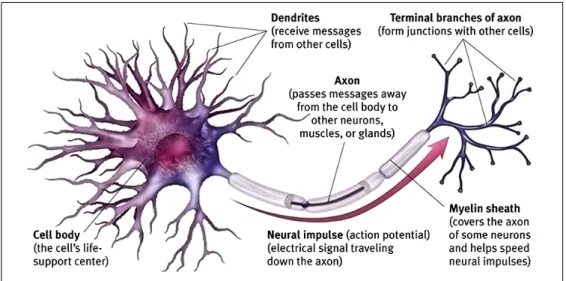
1989). Theoretically, the ANNs consist a set of interconnected entities called nodes or units that usually operates in parallel (Takefuji, 2012). Figure 1.1 depicts the bi-ological neural network that became the building block of numerous artificial neural network up to today. There are many types of neural networks such as the Hopfield
Figure 1.1: Biological Neural Network Model (Takefuji, 2012)
neural network (HNN) presented by Hopfield and Tank (1985). The state-of-the-art neural network model is the HNN. According to Hopfield (1982), HNN is a recurrent and synaptic connection pattern, whereby there is a Lyapunov function for the activity dynamics. The process of association and information retrieval is simulated by the dynamical behavior of a highly interconnected system of non-linear circuit elements with collective computational abilities. Park et al. (1993) asserted that the HNN can be applied to tackle the electric power system problem. Pursuing that, Cheng et al. (1996) implemented the HNN in medical image segmentation. By the same token, Sathasivam (2009) introduced the implementation of HNN in the logic programming. Additionally, Velavan et al. (2016) proposed the HNN incorporated with mean field theory to solve higher-order logic programming. Thus, the developments in HNN are
still mushrooming due to the flexibility of the HNN to be assimilated with other ANN and machine learning techniques. The rapid development of ANN has produced an array of neural network models that can be applied in numerous real life problems. One of the recent development in the artificial neural network is a deep convolutional neural network that deploys the deep learning algorithms. The development of this artificial neural network is still new in the artificial intelligence field. Guo et al. (2016) proposed the implementation of deep learning in image classification and human pose estimation. Basically, the implementation of deep neural network revolves around the computer vision (Bengio, 2009), automatic age estimation (Dong et al., 2016) and so forth. The advancement of ANN can be seen in the development of the features in the smartphone. Figure 1.2 demonstrates the example of neural network embedded in the system for the face recognition in iPhone 6 Plus. Basically, the network will detect the
Figure 1.2: The Advancement of ANN in Face Recognition (Levy, 2016)
correct face or pattern by looking at the databases entrenched to the system. Thus, the data mining in neural network plays an important role to many real life applications.
1.2 Data Mining in Neural Network
Recent studies on data mining have been mushrooming especially with the emer-gence of ANN and machine learning that can foster the process. Hence, the data min-ing practitioners are assimilatmin-ing the multidisciplinary knowledge such as mathemat-ics, artificial intelligence, machine learning and statistics in order to establish an ideal data mining technique. The competencies of the data mining have benefited numerous fields such as improving the disease diagnosis based on the medical record, predicting the finance trend, propelling the tourism industries, weather prediction and so on. In theory, data mining is defined as the extraction of some significant information from any databases. In layman terms, data mining can be defined as finding the underlying information according to the behavior of databases or data sets. Similarly, the core impetus of data mining is to extract some information that will provide insight about a particular database. Kamruzzaman and Sarkar (2011) asserted that knowledge dis-covery in databases refers to the process of automated extraction of hidden, previously unknown and potentially useful information from large databases. Equally important, Sawale and Gupta (2013) proposed the data mining system for climatology forecast-ing by implementforecast-ing the ANN with backpropagation rule. Henceforth, Wan Abdullah and Sathasivam (2005) inaugurated the logic mining in HNN by extracting the logical rule of a particular database via reverse analysis method. Pursuing that, Sathasivam and Wan Abdullah (2011) has addressed the implementation of Conjunctive Normal Form (CNF) clause as the logical rule in knowledge extraction from real life data set. Sathasivam et al. (2014) introduced the reverse analysis for higher order HNN in de-termining the optimum Horn logical rule entrenched in a particular data entry. Hence, data mining in neural network can be improved to cater different problems.
1.3 Problem Statement
The main drawback of a simple propositional logic is the limitation in representing the attributes in a particular data set. Furthermore, a better logical rule is needed to extract the hidden information in the data sets. Hence, the 3-SAT logic is proposed to induce the real life data sets in a more precise way. The 3-SAT form was chosen due to the flexibility of the logical problem to be entrenched in the logic programming. Thus, the 3-SAT problem which is considered as non-horn clauses is embedded into our logic programming. Additionally, 3-SAT programming will be encoded into the hybrid HNN as a single computational model. Moreover, the 3-SAT programming is expected to provide our network with sufficient symbolic instructions in order to fos-ter the training and retrieval phase in the hybrid HNN. The drawback of the standard reverse analysis method is the difficulties to unearth the relationship of the real data sets. As a result, 3-Satisfiability enhanced reverse analysis paradigm (3-SATERAP) is formulated in order to extract a solid logical rule from the attributes of real life data sets. The attributes of the real data sets can be represented as the neurons in the 3-SAT formula in a systematic manner. The proposed knowledge extraction method has the flexibility to create many possibilities of 3-SAT logical rules according to the behavior of the real data sets. Therefore, the proposed data extraction method can be applied to tackle the problem with high complexity such as data sets with a huge number of in-stances. The Hopfield neural network is not symbolic and requires another computing system to assist the process. Henceforth, 3-SAT logic programming is incorporated in Hopfield neural network to give the symbolic form to the existing network. In this the-sis, the enhanced AIS algorithm is proposed to improve the performance of HNN. The proposed hybrid HNN will overcome the circumstances associated with standalone
non-symbolic HNN. However, there is still a problem in checking clause satisfaction during the training phase. The network tends to deteriorate the solutions and requires more iterations to achieve the convergence. In order to address the problem, the meta-heuristics are proposed to foster the training process in doing logic programming. The metaheuristic algorithm is usually robust because only focusing on selected searching space in generating the correct interpretations. In fact, the optimization operator will accelerate the process of generating the optimal output. In this case, HNN-3SATAIS, HNN-3SATGA, and HNN-3SATES are formulated to address the problem in training the network. Another problem with the standard HNN is when the complexity of the system increases exponentially with the instances. Moreover, the computation bur-den for the network will become higher. Some enhanced metaheuristic methods are introduced to search for feasible solutions in more systematic search spaces. Hence, HNN-3SATAIS and HNN-3SATGA are formulated based on a modification of the previous metaheuristic. In order to develop a computational model, the model should be able to counter the worst case problem. In this study, HNN-MAX3SATGA and HNN-MAX3SATAIS are expected to be able to do MAX-3SAT programming. So, the proposed hybrid model must be able to be the tool to solve various real life satisfiability problem. One of the notable problems is the circuit verification problem.
1.4 Research Objectives
The thesis is centered on the performance analysis of the hybrid HNN model in 3-SAT programming. The objectives of the thesis are:
1. To derive a brand new non-horn logic programming paradigm based on 3-SAT logic programming embedded in the Hopfield neural network (HNN).
2. To compare the performance of hybrid Hopfield neural network with enhanced artificial immune system algorithm (HNN-3SATAIS), modified genetic algo-rithm (HNN-3SATGA) and exhaustive search (HNN-3SATES) in doing 3-SAT logic programming.
3. To develop a knowledge extraction technique called 3-Satisfiability enhanced reverse analysis paradigm (3-SATERAP) to explain and unearth the behaviour real data sets. The performance analysis of 3-SATERAP with HNN-3SATAIS, HNN-3SATGA, and HNN-3SATES will be validated by using real data sets.
4. To compare the performance of HNN-MAX3SATAIS and HNN-MAX3SATGA in doing MAX-3SAT logic programming.
5. To compare the capability of HNN-C3SATGA and HNN-C3SATAIS in doing circuit verification.
1.5 Methodology
In this thesis, a hybrid Hopfield neural network in 3-SAT logic programming is established with the metaheuristic technique such as exhaustive search (ES), modi-fied genetic algorithm (GA), and enhanced artificial immune system (AIS) algorithm. Since the previous data mining technique revolves around the Horn logical rule, the ad-vantages of the 3-SAT form are used to map the real data sets. In this research, a data extraction paradigm, namely 3-Satisfiability enhanced reverse analysis (3-SATERAP) method is developed to address the weakness of the previous techniques. The pro-posed knowledge extraction technique will unearth the relationship entrenched be-tween the attributes by taking into account the 3-SAT logical rule. Hence, the solid logical rule extracted by 3-SATERAP will be used to explain the hidden behavior of the real data sets. In this research, the effectiveness of our hybrid computing paradigm, namely HNN-3SATAIS, HNN-3SATGA, and HNN-3SATES to do 3-SAT logic pro-gramming will be compared. The proposed algorithms are expected to withstand vig-orous training and the complexity. The computing paradigms will be tested by using simulated data set and real data set. The Dev-C++ Version 5.11 for Windows 10 is used as the platform of training, simulating and validating for our hybrid network. For the simulated data sets, the HNN-3SATAIS, HNN-3SATGA and HNN-3SATES will train the randomized 3-SAT logical rule. Then, a knowledge extraction method, 3-SATERAP is proposed in order to extract the optimum logical rule from 15 data sets obtained from UCI machine learning repository. In addition, the ability of hybrid HNN models in MAX-3SAT logic programming and C-3SAT in circuit verification will also investigated by using simulated data set. In this research, the HNN-3SATAIS, 3SATGA, 3SATES, MAX3SATAIS, MAX3SATGA,
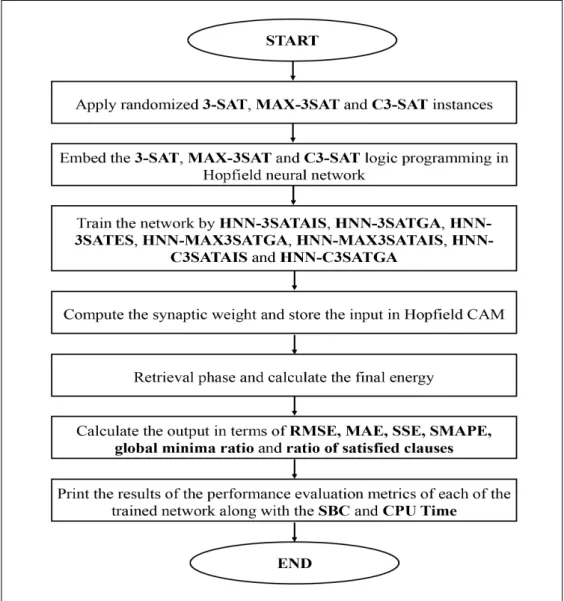
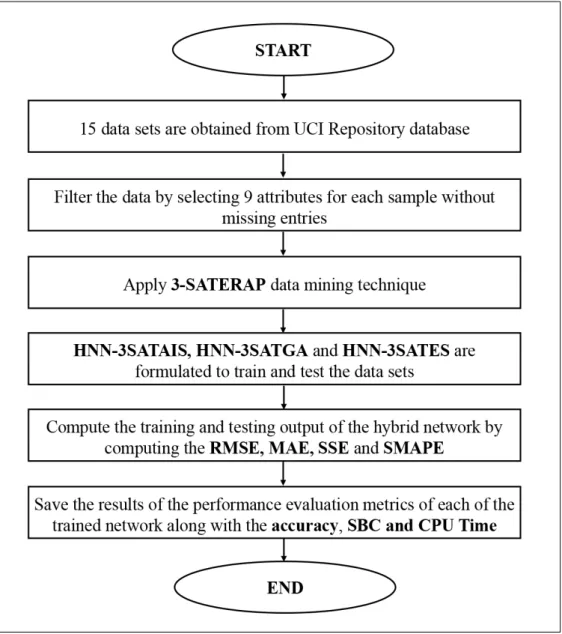
HNN-C3SATGA, and HNN-C3SATAIS will be appraised in term of performance evaluation metrics. The goodness of fit or error evaluations involved are root mean square er-ror (RMSE), mean absolute erer-ror (MAE), sum of squared erer-ror (SSE) and symmet-ric mean absolute percentage error (SMAPE). The performance evaluations such as Schwarz Bayesian Criterion (SBC), global minima ratio, ratio of satisfied clauses, ac-curacy and CPU time are vital in determining the robustness and effectiveness of the hybrid model. The methodologies for this research are summarized in Figure 1.3 and Figure 1.4.
Figure 1.3: The Methodology of Hybrid HNN Networks in 3-SAT, MAX-3SAT, and C3-SAT Logic Programming
1.6 Scope and Limitations of Research
The logical semantics in our research only revolves around propositional logic such as 3-SAT and MAX-3SAT problem to be entrenched into our non-symbolic hybrid Hopfield systems. Other variants of logic such as predicate logic cannot be deployed in the proposed models because it only complies with propositional logic. Hence, more modifications are necessary to do the predicate logic programming due to more com-plex operators. On the other hand, logic programming with complicated constraints will require a massive change in the method developed by Wan Abdullah (1991) and Sathasivam and Wan Abdullah (2011). The data mining technique is deployed in this research, namely 3-Satisfiability enhanced reverse analysis method (3-SATERAP) has only capability to classify the bipolar data sets. Hence, the model deals with 3-dimensional decision problems with only bipolar decisions. However, the ternary de-cision cannot be done by the proposed method. On the other hand, the technique cannot cope with the data set containing missing values. The logical rule will become convo-luted when the missing data being replaced with random values. In the simulated data set, we limit the investigation untilNN=180 during the simulation of HNN-3SATAIS, HNN-3SATGA and HNN-3SATES for simplicity. The networks require more compu-tation time if we increase the complexity of the problem. On the other hand, the real data set deployed is limited into 15 data sets obtained from UCI data set repository. Hence, the 15 data sets will provide the network with the different levels of training and testing that is crucial in assessing the performance of the hybrid networks. The selection complies with the work of Hamadneh (2013) and Pwasong and Sathasivam (2016). Although the capacity of discrete HNN is still satisfactory for our research, the problem will arise when dealing with a more complex datum. The discrete HNN
is sufficient in the research due to the ability of the network to blend with the other training algorithms. This is because the HNN can be considered the building block for the elegant neural network available in the market nowadays. Moreover, the circuit design (C-3SAT) simulation is limited until 90 transistor for simplicity.
1.7 Organization of Thesis
The remaining parts of the thesis are organized as follows. Chapter 2 presents the notable literature that became the building blocks of our research. The related liter-ature involved are the fundamental concept of HNN, logic programming, activation function, 3-SAT, MAX-3SAT, ES algorithm, GA, AIS algorithm, circuit verification, and data mining in HNN. Then, Chapter 3 emphasizes on the existing model of Horn logic programming in HNN. The chapter begins with a comprehensive overview and architecture of the HNN, followed by the concept of Hyperbolic tangent activation function that accelerates the HNN. The Hopfield content addressable memory and con-vergence dynamic are also highlighted. In addition, the logic programming techniques are discussed in this chapter. The proposed algorithms and contributions set the tone for Chapter 4. This chapter starts with the implementation of 3-SAT logic program-ming in HNN. Specifically, the algorithm for the implementation of ES, enhanced GA and enhanced AIS are discussed in details. In this chapter, HNN-3SATGA and 3SATAIS are introduced to be compared with the state of the art model, HNN-3SATES. Besides, the other counterpart of 3-SAT problems that involved is the MAX-3SAT. In this section, HNN-MAX3SATAIS and HNN-MAX3SATGA are discussed. The implementation of HNN-C3SATAIS and HNN-C3SATGA in circuit verification is also highlighted. In order to extract the logical rule to be applied in data mining, the
3-Satisfiability enhanced reverse analysis paradigm (3-SATERAP) method is also in-troduced. Chapter 5 reveals the simulated results for HNN-3SATAIS, HNN-3SATGA and HNN-3SATES based on the performance evaluation metrics such as RMSE, MAE, SSE, SMAPE, SBC, global minima ratio, and CPU Time. In addition, the simulated results of MAX3SATAIS, MAX3SATGA, C3SATAIS, and HNN-C3SATGA are also discussed. Chapter 6 validates the effectiveness and robustness of HNN-3SATES, HNN-3SATGA, and HNN-3SATAIS in training and testing 15 real data sets from UCI repository. The training and testing errors can be used to signify the performances of our model. To sum up, Chapter 7 concludes the thesis by summa-rizing the findings in relations to the motivations and objectives fulfilled in this work and outlining some suggestions for the future direction of our work. Lastly, additional details are deferred to the appendices.
CHAPTER 2
LITERATURE REVIEW
This chapter provides the fundamental overview of the HNN, logic programming, 3-SAT, MAX-3SAT, AIS algorithm, ES, GA, circuit satisfiability and data mining in HNN. These domains are the building blocks of this research. Thus, the important works of literature of these domains are discussed in detail.
2.1 Hopfield Neural Network
The emergence of HNN has produced a prolific amount of research since four decades ago. Firstly, HNN was proposed by John Hopfield, a scientist from the Uni-versity of California, Berkeley in 1982. Hopfield (1982) proposed an associative com-putational model that made a tremendous breakthrough in the AI field. Pursuing that, the HNN was implemented to the optimization and constraint satisfaction problems (Gao and Liu, 2009; Hopfield and Tank, 1985; Liang, 1996; Ma´ndziuk, 2000). Since then, tremendous modification and improvements have been applied to the HNN ar-chitecture to solve any optimization problems. In theory, the HNN comprises of a simple recurrent network that has an efficient associative memory and resembled the biological brain. For instance, Wen et al. (2009) proposed that the HNN is one major neural network specialized and crafted for solving constraint optimization or mathe-matical programming problems. The main benefit of HNN is that its structure can be realized on an electronic circuit, possibly on a very large-scale integration circuit, for an on-line solver with a parallel-distributed process. The structure of HNN utilizes
three common methods, penalty functions, Lagrange multipliers, and primal and dual methods to construct an energy function (Pinkas, 1991). Moreover, the HNN mini-mizes Lyapunov energy by utilizing the physical Ising spin of the neuron states. On top of that, the network produced global output by minimizing the network energy. Pinkas (1991) and Wan Abdullah (1992) described a bi-directional mapping between logic and energy function of symmetric neural network. Besides, both methods are the building blocks for a corresponding logic program. Due to the effectiveness of energy changes in HNN, several researchers have combined the idea of logic programming with HNN. Several standard models were developed by Sathasivam and Wan Abdullah (2011) and Kasihmuddin and Sathasivam (2016). The work by Velavan et al. (2016) portrays the flexibility of HNN to amalgamate with the accelerating algorithm such as Mean Field theory. On the other hand, recent work by Zhang et al. (2017) emphasizes on the classification by using Hopfield associative memories. The work reported the welding quality of Chernoff face image had been successfully classified even though under abnormal welding conditions.
In this research, the HNN is hybridized with robust metaheuristic paradigms such as ES, GA, and AIS algorithm as a network respectively. The newly hybrid HNN networks called HNN-3SATAIS, HNN-3SATGA, and HNN-3SATAIS will serve as computing network in logic programming. The selection of HNN is not only due to the capability to blend with other networks but more primarily due to the power of CAM that resembles the biological intelligence system. Furthermore, the related works on HNN are shown in Table 2.1.
Table 2.1: Related Literature on Hopfield Neural Network
Author Method Summary and Findings
Hopfield (1984) The computational network based on a stochastic model of McCulloch-Pitts neurons.
Thus, the computational power of HNN was inaugurated by taking into account the content addressable memories and the stochastic properties of the primitive McCulloch-Pitts neuron.
Pinkas (1991) Energy function of HNN.
The work described a bi-directional mapping between propositional logic and energy function of a symmetric neural network.
Wan Abdullah (1993)
Higher order HNN for Horn logic program.
The HNN has minimized the logical in-consistencies in the interpretation of the logic program. Logical contents were obtained by the synaptic strength com-puted of the network.
Joya et al. (2002)
The dynamic of dis-crete HNN for opti-mization.
The proposed discrete HNN was proven in the avoidance of tremendous lo-cal minima solutions obtained after the computation. Wen et al. (2009) HNN in mathemat-ical programming problem.
The work pinpointed the computational ability of HNN in doing mathematical programming such as VLSI simulation. Sathasivam
and Wan Ab-dullah (2011)
Logic mining by using discrete HNN.
The logic mining can be done by ex-tracting the information entrenched in the Horn clauses.
Sathasivam and Fen (2013) Logic programming in the HNN by agent based modelling.
The values of global minima ratio and Hamming distance provide solid evi-dence of the effectiveness of logic pro-gramming in HNN by using agent based modelling. Zhou et al. (2015) Bipolar auto-associative memory model in discrete HNN.
The external input patterns were mem-orized accurately, stable, robust and more generalized by learning through a discrete recurrent neural network com-pared to the existing methods.
Velavan et al. (2016)
Discrete HNN with mean field theory paradigm.
The results have been proven in accel-erating the computational ability of the existing mean field theory. The mean field theory with HNN outperforms the standalone mean field network when be-ing simulated by Agent Based Mod-elling (ABM).
Bansal and Dixit (2016)
The pattern recalling as content addressable memories by HNN and genetic algorithm.
This work proves that the HNN can be blended with the other metaheuristic al-gorithms to accelerate the computation and memory.
2.2 Logic Programming
Generally, logic program is an important concept in HNN. In general, logic pro-gramming has emerged as an essential field to model some real life problem. Accord-ing to Kowalski (1979), the logic program provides a genuine and flexible way for problem-solving. Hence, logic program is easier to understand and verify compared with neural network which is a black-box model. Thus, logic program will provide neural network with symbolic instructions. As was mentioned, logic programming can be seen as a problem in combinatorial optimization and thus it can be carried out on a neural network. The HNN model proposed by Hopfield (1982) is a standard model for associative memory and widely incorporated with logic programming. In addition, logic program can be applied in HNN. Pinkas (1991) and Wan Abdullah (1992) defined a bi-directional mapping between propositional logic formulas and energy functions of symmetric neural networks. Both methods are concerned in finding whether the solu-tions complying with the logic program. Hence, both researchers are interested with Hopfield network. The findings are crucial in applying logic program in HNN. The activation function and McCulloch-Pitts function usually applied in logic program-ming. Besides that, both approaches can handle non-monotonicity of logic. Pinkas (1991) introduced preferred interpretation concept than Wan Abdullah (1992) in han-dling non-monotonicity. Kowalski and Sergot (1984) describe the motivation behind logic programming is the idea suits for both logic and computation. Basically, the idea of logic and computing has been emerging since the yesteryears inspired by the Turing machine (Petzold, 2008). Computing involves some computational modes such as programming, databases, and artificial intelligence. Specifically, Lloyd (2012) as-serts the logic programming as an array of axioms, clauses or rules that blend together
to form literals. Inevitably, the logic programming has emerged as a platform for knowledge extraction and data mining. In fact, the earliest was the propositional logic programming that being done by using Horn clauses. The most direct case of logic programming is when information is disclosed by means of Horn clauses and deduc-tion is carried out by backward reasoning embedded in soludeduc-tion (Robinson, 1965). But logic programming can also be understood more generally such as, to include negation failure (Clark, 1978) or set construction (Miller and Nadathur, 1986). A logic program consists of Horn clauses and is activated by an initial statement. The propositional logic programming emphasizes on the propositional logic formula used to describe the relations. Since, the logical knowledge is symbolic, the logic act as the programming instructions. Hence, a propositional logic program consists of a set of logic clauses. Recent work by Riguzzi et al. (2017) proposes probablistic logic programming under distribution semantics. In this thesis, a brand new logic programming called 3-SAT logic programming is proposed as a core knowledge instructions to be embedded to the hybrid HNN. Thus, 3-SAT logic programming is different from the previous works due to the capability to solve the constraint optimization problem and the power of logic knowledge to be used in data mining. Hence, the 3-SAT logic programming will serve as a building block for the newly proposed 3-SATERAP to be used as a classi-fication approach. Additionally. the 3-SAT logic program will be utilized to map and unearth the relationship between the attributes in the real data set. Moreover, Table 2.2 summarizes the related literatures and developments on logic programming.
Table 2.2: Related Literature on Logic Programming
Author Method Summary and Findings
Pinkas (1991) Propositional logic programming in sym-metric connectionist model.
The propositional logic was trans-formed into the energy equation for op-timization deployed by the symmetric connectionist model. HNN is a sym-metric connectionist model due to the symmetric weights. Wan Abdullah (1992) Logic programming implemented on a neural network.
The work had developed a state-of-the-art model of logic programming on the HNN. Hence, the method of comput-ing the connections strength has been outlined from the logic program. This work provides a better insight of synap-tic strengths computation for the dis-crete HNN. Hölldobler et al. (1999) Logic program by recurrent neural network.
The recurrent neural network was proven to work effectively with the logic program. Hence, the logic pro-gram has provided the semantics or in-structions to the non-symbolic recurrent neural network.
Sathasivam (2010)
Enhanced logic pro-gramming in HNN.
The performance of the logic program-ming in HNN was consistently good in term of the global minima ratio, Ham-ming distance, fitness energy landscape and computational time even though the number of neurons increases.
Hamadneh et al. (2014)
Satisfiability logic programming.
The satisfiability logic programming was carried out in radial basis function neural network (RBFNN). The find-ings showed a good agreement with the HNN. However, the implementation of RBFNN requires a single operator prob-lem.
Sathasivam (2015)
The logic program-ming in HNN by us-ing acceleration tech-nique.
The robustness of logic programming in HNN was accelerated by using the modified Hyperbolic tangent activation function (HTAF). Hence, the mecha-nism could benefit the computation of more complex problems.
Velavan et al. (2016)
The Horn logic pro-gramming using mean field theory with HNN.
The hybrid mean field theory with HNN has proven to work with the higher or-der horn logic programming in terms of global convergence.
2.3 Hyperbolic Tangent Activation Function
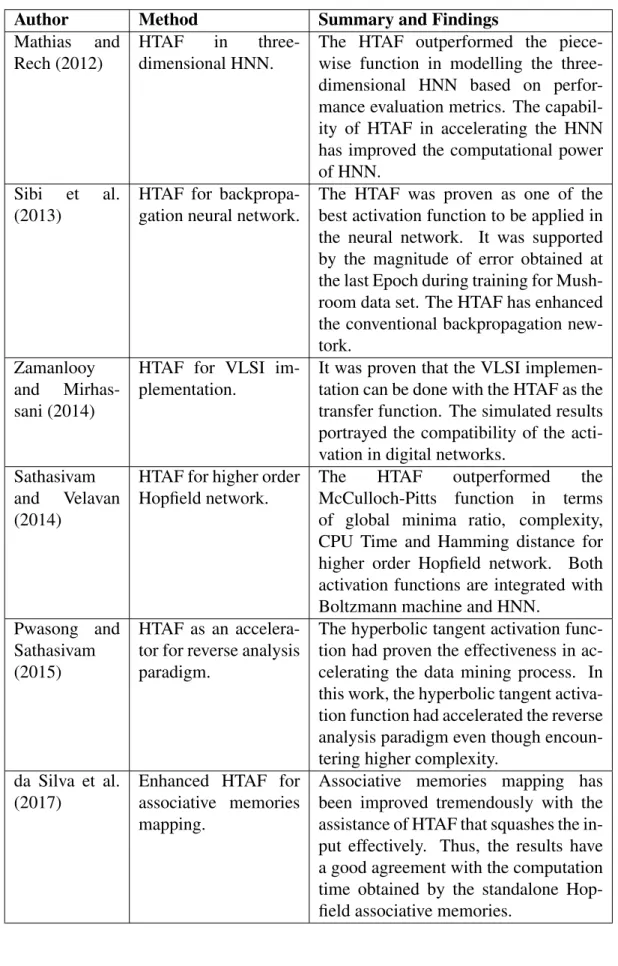
Generally, the activation functions are widely utilized to transform the activation level of a unit (neuron) into an output signal in a particular neural network (Karlik and Olgac, 2011). In layman’s term, it is also known as the transfer function or squashing function due to the capability to squash the permissible amplitude range of output sig-nal to some finite value. In this research, the Hyperbolic tangent activation function (HTAF) is applied to the system due to the effectiveness in accelerating logic program-ming in HNN for the Horn clauses (Sathasivam, 2015). Hence, the HTAF is expected to work well with 3-SAT logic programming. The process of training and getting the global solutions for 3-SAT will become tedious and more expensive due to the com-plexity. Hence, a post optimization paradigm is proposed to counter the circumstances due to the complexity of the network during the process of doing logic programming in Hopfield network. Obviously, the default activation function incorporated as the ac-celerator of 3-SAT logic programming will set the tone of the research. Therefore, the desired output can be generated systematically when doing the logic programming in Hopfield network. Theoretically, it will lead to produce global solutions. In addition, it will assist the Hopfield’s content addressable memories to recall the correct global states. In essence, the HTAF is explained in the work of (Karlik and Olgac, 2011) as the ratio between the Hyperbolic sine and Hyperbolic cosine functions expanded as the ratio of half-difference and half-sum of two exponential functions. Next, the HTAF is essential to optimize the output of the network. In theory, the HTAF is a differentiable function and produced a bounded output (Mathias and Rech, 2012). These properties are essential to maintain non-linearity in neuron’s state classification. The important literatures on the HTAF are highlighted in Table 2.3.
Table 2.3: Related Literature on Hyperbolic Tangent Activation Function
Author Method Summary and Findings
Mathias and Rech (2012)
HTAF in three-dimensional HNN.
The HTAF outperformed the piece-wise function in modelling the three-dimensional HNN based on perfor-mance evaluation metrics. The capabil-ity of HTAF in accelerating the HNN has improved the computational power of HNN.
Sibi et al. (2013)
HTAF for backpropa-gation neural network.
The HTAF was proven as one of the best activation function to be applied in the neural network. It was supported by the magnitude of error obtained at the last Epoch during training for Mush-room data set. The HTAF has enhanced the conventional backpropagation new-tork.
Zamanlooy and Mirhas-sani (2014)
HTAF for VLSI im-plementation.
It was proven that the VLSI implemen-tation can be done with the HTAF as the transfer function. The simulated results portrayed the compatibility of the acti-vation in digital networks.
Sathasivam and Velavan (2014)
HTAF for higher order Hopfield network.
The HTAF outperformed the McCulloch-Pitts function in terms of global minima ratio, complexity, CPU Time and Hamming distance for higher order Hopfield network. Both activation functions are integrated with Boltzmann machine and HNN.
Pwasong and Sathasivam (2015)
HTAF as an accelera-tor for reverse analysis paradigm.
The hyperbolic tangent activation func-tion had proven the effectiveness in ac-celerating the data mining process. In this work, the hyperbolic tangent activa-tion funcactiva-tion had accelerated the reverse analysis paradigm even though encoun-tering higher complexity.
da Silva et al. (2017)
Enhanced HTAF for associative memories mapping.
Associative memories mapping has been improved tremendously with the assistance of HTAF that squashes the in-put effectively. Thus, the results have a good agreement with the computation time obtained by the standalone Hop-field associative memories.
2.4 General Concept of 3-Satisfiability
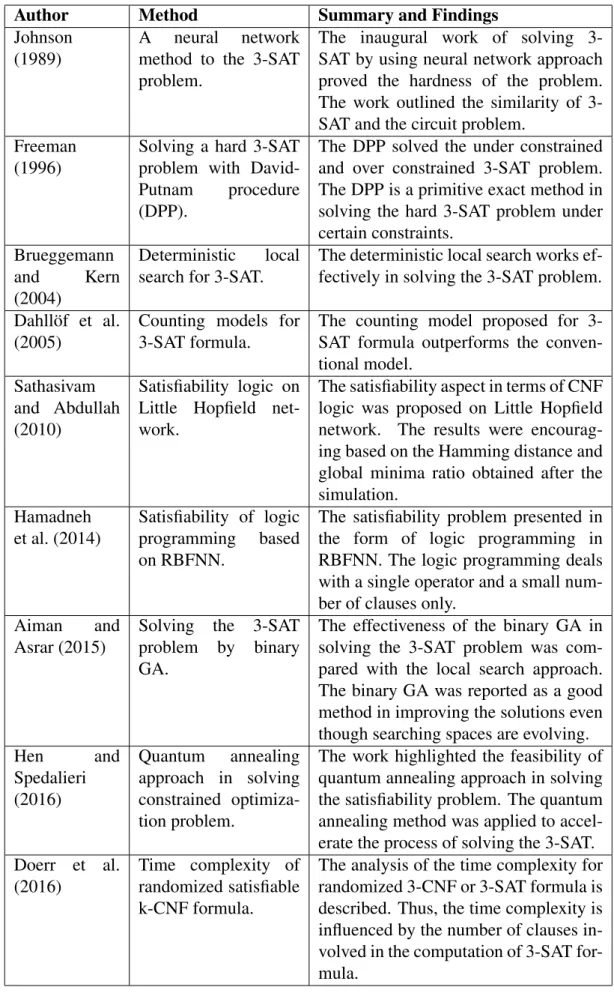
The work on 3-SAT is still mushrooming even though it can be classified as a clas-sical NP hard problem (Johnson, 1989). Baclas-sically, 3-Satisfiability (3-SAT) problem is a mapping problem from a logic programming in 3-CNF to truth values. In theory, 3-SAT can be defined as a formula in a conjunctive normal form with a collection of clauses where each comprises strictly 3 literals per clause (Kutzkov, 2007). Therefore, a 3-SAT paradigm can allow two choices for the value of each variable, which are 1 or -1. In addition, the 3-SAT problem is an example of a non-deterministic problem and constraint satisfaction problem (CSP). Therefore, solving the CSP problem such as 3-SAT is a notoriously expensive due to the complexity.There are limitless of ways to solve 3-SAT problem ranging from exact to the approximation algorithm. Bünz and Lamm (2017) studied the implementation of Graph neural network (GNN) in 3-SAT as a classifier in 3 randomized data sets. However, the result obtained was encouraging with the accuracy in a range of 65% to 71% in terms of training error. In this the-sis, the idea of incorporating 3-SAT logic programming is inspired by the Horn logic programming proposed by Sathasivam (2010). The 3-SAT logic will be encoded to the non-symbolic HNN as the main language of knowledge to the system. Apart from that, 3-SAT serves as a constraint optimization problem that requires some approximation algorithm such as metahueristic paradigms as the training method. Overall, 3-SAT log-ical rule is utilized as a loglog-ical representation to study the behaviour of the data sets and serve as a classification method in data mining. The HNN-3SATAIS, HNN-3SATGA, and HNN-3SATES will train the 3-SAT problem before being retrived by the CAM in HNN. The other notable works on 3-SAT are dicussed in Table 2.4.