Assessing blockchain
technology for Transport Data
Logger
Master’s Thesis
By
Björn Johansson
Department of Electrical and Information Technology
Faculty of Engineering, LTH, Lund University
SE-221 00 Lund, Sweden
i
Abstract
A proof of concept permissioned blockchain system that holds data from the Transport Data Logger, TDL, was developed. Transport chain actors who hand off TDL-equipped goods between one another use the TDL app to upload a digital handoff containing their identities and log data from and signed by the TDL to a Hyperledger Fabric blockchain network.
The current Transport Data Logger system consists of a sensor-equipped device that interacts with a companion smartphone app using Bluetooth. The device is fastened to goods and will log temperature, humidity and more during transport. Upon delivery the recipient can connect to the TDL device with the smartphone app and retrieve the log data. The TDL system lacks cryptographic data protection and attribution of data points to specific transport chain actors other than in the form of comparing timestamps. The promise of blockchain is network-distributed, decentralized and immutable data storage and transaction conduction. Many very differing implementations of the blockchain concept exist, with their common factor being the sorting of data into an append-only list of blocks chronologically and cryptographically linked to one another in linear sequence. The greatest divisor of blockchain technology is between permissioned and permissionless blockchains. A permissioned blockchain system limits participation to known and approved entities, allowing much better performance at the cost of increased centralization. Full trust between participants is still not required, which is the great advantage of blockchain technology.
There is potential for a gap in historical truth, what happened, and documental truth, what is documented as having happened. A blockchain is fully capable of protecting its data, or the documental truth, from tampering but closing the gap between the documental and historical truths requires more than just using blockchain technology.
Blockchain technology is still nascent, and mainstream use beyond cryptocurrencies is years off. There is a large reliance on hype and signaling with blockchain technology, which means that much research and development of standards is needed before it can be properly treated as the cryptosystem it should be interpreted as. The thesis recommendation on blockchain adoption is two-fold: start now if getting in on the ground floor and helping to develop the underlying systems and standards is important, otherwise there is everything to gain from waiting until that work has been done, as the blockchain technology sector will be very volatile until then.
iii
Acknowledgements
I would like to thank my friends and family whose emotional support helped make this thesis possible. Special mention to my beloved companion Lisa the Golden Retriever.
v
Contents
Abstract ... i Acknowledgements ... iii Contents ... v List of acronyms ... ixPopular Science Summary: Storing and attributing log data using blockchain technology ... xi 1. Introduction ... 1 Background ... 1 Problem Statements ... 2 Method ... 2 Related Work ... 4 Thesis Outline... 5 Part I. Theory ... 7 2. Cryptography... 9 Kerckhoffs’ principle ... 10 Hashing ... 10 Symmetric cryptography ... 11
2.3.1. Exchanging secret keys ... 12
Asymmetric cryptography ... 13
2.4.1. Key pair ... 13
2.4.2. Asymmetric encryption and decryption ... 13
Signing ... 14
Tying public keys to entities ... 15
3. Blockchain technology ... 19
Concept ... 19
vi
3.2.1. Byzantine nodes ... 23
3.2.2. Sybil attacks ... 24
Chaincode and smart contracts ... 24
State of blockchain security ... 25
Permissionless blockchains ... 26
3.5.1. Proof-of-work ... 27
3.5.2. Proof-of-stake ... 29
Permissioned blockchains ... 29
3.6.1. The Hyperledger project ... 29
3.6.2. Proof of elapsed time ... 30
3.6.3. Byzantine fault tolerant consensus ... 31
Hyperledger Fabric ... 33
3.7.1. Consensus and node responsibilities ... 33
3.7.2. Transaction process ... 34
3.7.3. Participation and permissions ... 35
Summary ... 36
4. Transport Data Logger ... 37
Tracking conditions during shipping ... 37
Baseline version ... 38
Security solution ... 38
4.3.1. Assumptions ... 39
4.3.2. PIN protection ... 39
4.3.3. Data protection ... 40
Part II. Evaluation ... 41
5. TDL blockchain system ... 43
Reasons for using blockchain ... 43
vii
5.1.2. Data reliability ... 44
5.1.3. Assumptions ... 44
Choosing blockchain type and system ... 45
5.2.1. Important criteria ... 46 5.2.2. Decision tree ... 46 Proof-of-concept implementation ... 48 5.3.1. Versions used ... 48 5.3.2. Use case ... 49 5.3.3. Technical overview ... 54 5.3.4. Cryptographic materials ... 58 5.3.5. TDL data summary ... 58
5.3.6. Semi-automatic PIN handling ... 58
Summary ... 59
Part III. Conclusions ... 61
6. Discussion ... 63
Blockchain technology ... 63
6.1.1. Maturity, hype and signaling ... 63
6.1.2. Permissionless vs permissioned blockchains ... 64
The TDL blockchain system and its proof of concept... 65
6.2.1. Historical vs documental truth ... 66
6.2.2. Other blockchain system solutions ... 67
7. Future work ... 69
8. Summary ... 71
8.1.1. Question 1 – Permissioned vs permissionless blockchains . 71 8.1.2. Question 2 – Data reliability... 71
8.1.3. Question 3 – Data attribution ... 72
viii
ix
List of acronyms
API Application Programming Interface
BFT Byzantine Fault Tolerance (alt. Byzantine Fault Tolerant)
CA Certificate Authority
CPU Central Processing Unit
HTTPS Hypertext Transfer Protocol Secure
MSP Membership Service Provider
PBFT Practical Byzantine Fault Tolerance
PKI Public Key Infrastructure
PoET Proof of Elapsed Time
REST Representational State Transfer
SDK Software Development Kit
SGX Software Guard Extensions
SHA Secure Hash Algorithm
SSH Secure Shell
TDL Transport Data Logger
xi
Popular Science Summary:
Storing and attributing log data using blockchain
technology
Blockchain technology is incredibly young, even the most mature of the blockchain technologies are either functionally complete but very simple or lack important features. The thesis has assessed blockchain technology for implementation with the Bosch Transport Data Logger, TDL.
The TDL is a sensor-equipped logging device with a companion smartphone app. The device is fastened to packages during transportation and logs how the packages have been handled while in the care of post and transport companies. For example, unacceptable temperatures, humidity and manhandling are logged.
The two main types of blockchain technology, permissionless and permissioned, are found to have inherent trade-offs between open/closed participation and poor/good performance. Hyperledger Fabric, most mature of the permissioned blockchain systems, was used to build a TDL Blockchain System proof of concept. Log data and other information from and about the TDL devices, transferred by the transport company employees using the companion app, are stored on the blockchain.
Generally, just saving sensor values is not enough to accomplish anything. To give credence to the logged data and to be able confidently to act upon it, the data must be made trustworthy. In an environment where data is generated while the sensor device is in the hands of different organizations, trustworthy connections between each data point and the organization responsible must be made. This to prevent blame-shifting of the type “it was like that when I got it”. To bring historical and documental truth closer to one another, further links between the real world and the data must be made, provided in part by devices needing to digitally sign the data logged by them.
The thesis can be used by Bosch to learn about blockchain technology and its applicability for the TDL. If they or others want to extrapolate they could use the thesis results to draw conclusions for other similar devices and systems. The general thesis recommendation is two-fold. If an organization simply wants to implement blockchain technology applications and not help develop the underlying technology the blockchain technology sector is not yet ready for them, otherwise now is a good time to jump in.
1
1.
Introduction
As the steps in a transport chain increases the more distrust between transport chain actors (companies) can be expected as those who commit errors while handling sensitive goods would most likely want to shift the blame to another actor in the transport chain. The Bosch Transport Data Logger, TDL, was created to determine what conditions a package equipped with a TDL device is exposed to during transport.
This thesis will look at how blockchain technology can be used to make the data generated by the TDL more reliable and how it can be used to pinpoint what transport chain actor had responsibility for the package when any sort of unacceptable conditions were logged.
Background
The Transport Data Logger system consists of a sensor-equipped device that interacts with a companion smartphone app. The device is fastened to goods during transport and set up using the app to tolerate certain threshold sensor values including temperature, impacts and humidity (and more), with readings exceeding those values being logged as violations. The recipient can then connect to the TDL device with the smartphone app upon delivery of the goods and then view (and share) the log data.
The problem of “it was like this when I got it” can potentially be solved by logging if and when conditions damaging to the goods occur at any time during transportation, recording every handoff between actors in the transport chain and protecting the recorded data from manipulation.
In its current form the TDL system lacks cryptographic protection or attribution of violation data to specific transport chain actors, other than in the form of manually comparing timestamps.
Data verification today relies heavily on having a common trusted third party that vouches for the dependability, source and integrity of that data.
Blockchain technology promises to provide network-distributed, decentralized and immutable data storage and transaction conduction. This would eliminate the need to completely trust a single third party to verify the integrity or existence of some data. Instead trust is put in the collective that is made up of entities collaborating in a blockchain network.
Some form of consensus building methodology is needed to make sure that the blockchains at all entities nodes are identical, making the figurative
2
collective blockchain stable. All good consensus building methods are tamper resistant in that for tampering to occur, many different actors on the blockchain network must collaborate. With a traditional single centralized database only direct changes to the database would be needed for tampering to succeed.
The brute-force nature of creating new blocks for proof-of-work consensus blockchains has led to that form of block creation being called “mining”.
Problem Statements
These three questions are good to keep in the reader’s mind as they are the guiding lights of the thesis report.
Question 1. What are the different strengths and weaknesses of permissioned and permissionless blockchains?
To decide what type of blockchain system should be used for the TDL Blockchain System, the defining characteristics of the two main types of blockchain technology must be determined. Identifying how blockchain technology works is also important in being able to answer the other questions in the problem statement.
Question 2. How can blockchain technology be used to increase the reliability of the Transport Data Logger data?
Question 3. How can blockchain technology be used to attribute specific data points from the Transport Data Logger to specific transport chain actors? To be able to use the data generated by the TDL to make well-informed decisions that data must be determined to be reliable, meaning accurate and unmanipulated. It must also be possible to directly attribute specific data to transport chain actors, preventing them from shifting blame away from themselves.
Method
This thesis is exploratory in nature, at the beginning a vague approximation of what would later become Question 2 and Question 3 as well as the intent to develop a proof of concept was used to create a schedule and method outline (a project plan).
As the author could not for several very important reasons commit any more time to the thesis than the standard one semester this thesis was from the start conducted to fit inside of those 20 weeks (5 months). Other thesis
3
projects known to the author had exhibited a tendency to expand time to fit the scope and to prevent that from happening care was taken from the start to create and stick to a reasonable schedule, method and scope. The schedule outline looked roughly like the following: development finished by end of month 3, complete draft of thesis report before end of month 4, presentation done before end of month 5. As time progressed this schedule outline was filled in with considerably more details. The phases of the thesis project are illustrated in Fig. 1.
Month 1 Month 2 Month 3 Month 4 Month 5
Research Development Development Writing Writing
Presenting Finishing up Fig. 1. The method outline showing the 5 months of the project and the
phases they contained. This is a simplified version of reality as for example outline drafts of the thesis were created during the research phase and research in one form or another was conducted during almost all project phases.
The method outline was to spend the first month exploring the blockchain technology field and doing much of the necessary research for the thesis. This included Lund University Libraries1 and Swedish thesis report2 searches for
terms like, or related to, “blockchain”. It also included looking at interesting references and technologies from the results of those searches. The initial research phase also included looking through Bosch internal development documentation for the TDL, exploring the TDL’s capabilities, and setting up all the practicalities required for development of the proof of concept. Initial decisions around the design of the TDL Blockchain System and its proof of concept based on the research findings were made by the end of this phase.
The next phase was the development phase that consisted of two months of software development of the TDL Blockchain system proof of concept. As everything in a blockchain system is dependent on the chaincode development started with that and then moved on to the network, and then client. Development progress and planning was strongly influenced by
1 The LUBSearch service at website lubsearch.lub.lu.se was used.
2 The National Library of Sweden Libris service for finding student papers called
4
difficulties encountered during the process. Decisions were always made with the knowledge that time was a limited resource.
Once the main use case for the TDL Blockchain System was supported the development phase was over. It was followed by a month-long thesis report writing phase. Writing the thesis was mostly done chapter by chapter. An outline of the thesis chapters and their contents had been worked on during the research phase and writing continued from that as well as the lessons learned during development. While focus was kept on one chapter at a time the outline of the entire thesis was still worked on all throughout the writing process. Research complemented the actual writing work all throughout this phase.
The final month of the project was spent finishing and polishing the thesis report based on feedback, preparing and performing presentations and working to complete all other requirements associated with the final phase of a thesis project. Opposition could unfortunately not be arranged before the end of the five months and as such spilled into the subsequent semester. This was unfortunate but ultimately acceptable.
All throughout the thesis project a daily diary was kept and weekly status reports to the supervisors were made. This, along with the rigorous use and iterative development of the project plan containing the schedule and decisions around method and scope, was crucial in keeping the project on track and on time.
Related Work
Jeppsson and Olsson did a Master’s thesis on the usage of blockchains for tracking goods during transportation [1]. Their thesis focuses on the impact to the transport chain actors, offering an excellent complement to this thesis which focuses more on the security and technical aspects of such a blockchain system. Their thesis is highly recommended reading.
In another related Master’s thesis Jansson and Petersen developed a framework for evaluating blockchain as a supply chain traceability system [2]. While their framework is not used in this thesis important topics brought up by them are addressed such as the difference between documental and historical accuracy.
Yli-Huumo et al mapped out existing areas of blockchain research up until 2015 [3]. They concluded that 80% of research focused on Bitcoin specifically instead of the general field of blockchain technology. They also
5
summarize many areas of concern for blockchain technology such as throughput, latency, resource use, attack vectors and privacy.
Important aspects of performance and scaling in blockchain systems is addressed by Scherer [4]. Many of his results, as supported by other sources, are important for highlighting the differences between permissioned and permissionless blockchain technology in this thesis.
There is quite a bit of research and development going into blockchain applicability for supply chains as the area is considered “promising” [5]. Most of that work is primarily focused on moving the physical paperwork surrounding transportation to a digital system based on blockchain technology, and to then be able to trace a product through the entire supply chain with that blockchain data. As examples, [1] and [2] are already mentioned. See also [5, p. 23], [5] itself, and from industry see for example [6] and [7]. It is notable that much of this work is less than a year old, speaking to the emergent nature of blockchain technology.
Thesis Outline
This thesis is divided into three main parts. 0 deals with cryptography, blockchain technology and explains the current TDL security solution. Part II deals with the TDL Blockchain System and its proof-of-concept implementation. Part III contains a discussion of blockchain technology and the TDL Blockchain System as well as potential future work and the thesis summary.
7
9
2.
Cryptography
An understanding of the basic concepts of modern cryptography is required understanding for many important aspects of blockchain technology. The field of modern cryptography is highly mathematics-based but those specifics are not required understanding for blockchain technology.
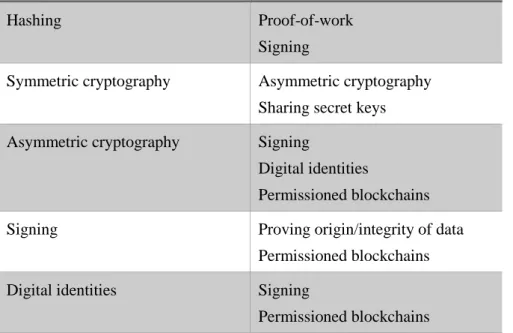
To see roughly what section of cryptography aids understanding of what section of other cryptography and blockchain technology see Fig. 2.
It helps to know this To understand the following
Hashing Proof-of-work
Signing
Symmetric cryptography Asymmetric cryptography
Sharing secret keys
Asymmetric cryptography Signing
Digital identities
Permissioned blockchains
Signing Proving origin/integrity of data
Permissioned blockchains
Digital identities Signing
Permissioned blockchains
Fig. 2. The cryptography areas on the left help in understand the areas of cryptography and blockchain technology on the right.
Because of the basic nature of this section on cryptography the information is largely sourced from the lecture notes for EIT060 Computer Security held in 2017 at Lund University, Faculty of Engineering [8].
In cryptographic scenarios, it is common to use “Alice” and “Bob” to denote trusted parties wishing to communicate in some way, and “Eve” as someone wishing to eavesdrop or otherwise compromise the scenario.
10
Kerckhoffs’ principle
Cryptographic algorithms use keys to protect data, and Kerckhoffs’ principle states that a cryptosystem should remain secure even if everything about it, excluding its key, is public knowledge [9].
Related to Kerckhoffs’ principle is the general principle of only using cryptographic primitives that have been thoroughly tested using extensive research, also known as “don’t roll your own crypto” [10] [11].
Hashing
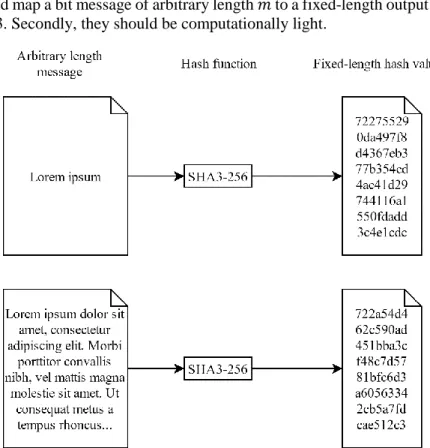
Hash functions, hash(𝑚) = ℎ, have two defining properties. Firstly, they should map a bit message of arbitrary length 𝑚 to a fixed-length output ℎ, see Fig. 3. Secondly, they should be computationally light.
Fig. 3. Messages of varying length are run through the cryptographic hash function SHA3-256 generating hash values of the fixed length 256 bits.
11
To make hash functions suitable for use in cryptography, three additional properties are needed.
• Pre-image resistance: given a hash value ℎ, it is infeasible to find
𝑚 such that hash(𝑚) = ℎ.
• Second pre-image resistance: given a message 𝑚, it is infeasible to find 𝑚’ such that hash(𝑚) = hash(𝑚’).
• Collision resistance: it is infeasible to find 𝑚 and 𝑚’ such that
hash(𝑚) = hash(𝑚’).
Cryptographic hash functions provide small representations of potentially much larger data. This is very valuable when signing data as without representing the data with its hash value the signature would have to be just as large as the data itself. Section 2.5 deals with signing data using asymmetric cryptography.
Symmetric cryptography
Cryptography has historically only consisted of what we today call symmetric cryptography. It is used to send encrypted messages back and forth between trusted parties sharing a common secret key. This key is, as its name suggests, kept secret from everyone else.
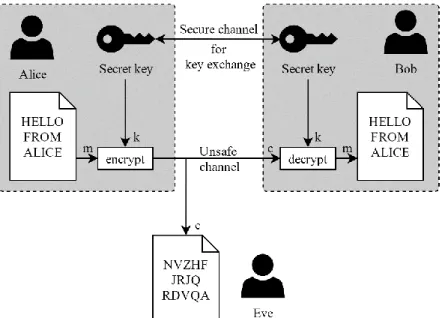
Alice and Bob trust each other and share a secret key 𝑘. Alice encrypts a plaintext message 𝑚 using the symmetric encryption function encrypt(𝑚, 𝑘)
and sends the resulting ciphertext 𝑐 to Bob over some communication channel. After receiving the ciphertext Bob uses the corresponding decryption function decrypt(𝑐, 𝑘) providing it the same secret key that Alice encrypted the message with. The result, the original message 𝑚, can now be read by Bob. This is illustrated in Fig. 4.
12
Fig. 4. Alice encrypts the message “HELLO FROM ALICE” using a secret key and sends it to Bob who uses that same key to decrypt the ciphertext “NVZHF JRJQ RDVQA” into the original message. Eve, who only has access to the ciphertext and not the key, is unable to access the message.
The main advantage of symmetric encryption is speed and resource use. It is, in general, computationally lighter to encrypt and decrypt data with symmetric encryption than it is to use asymmetric cryptography, described in Section 2.4.
2.3.1.
Exchanging secret keys
A problem is the need to share the secret key outside of the cryptosystem, which creates an attack vector. When describing a symmetric encryption system, it is generally assumed that the key is already shared between the trusted parties, leading to the alternate name “pre-shared key”. When describing symmetric encryption schemes, keys are assumed to be distributed in a safe manner outside the cryptosystem.
It is common to use the slower asymmetric cryptography to exchange a secret key and then switch to symmetric cryptography for the rest of the session.
13
Asymmetric cryptography
Instead of being based on sharing a common secret key, asymmetric cryptography is based on the concept of having a pair of mathematically linked keys. Every participant holds one of these key pairs, keeping their “private key” secret while actively sharing their “public key”.
One of the most famous asymmetric encryption schemes is RSA, named after its three creators Rivest, Shamir, and Adleman. RSA uses a form of trapdoor function, taking advantage of the computational difficulty of finding the factors of large numbers. It is easy to multiply two large prime numbers to generate a very large number, but to find the two prime factors only knowing the large number is very difficult.
Asymmetric cryptography can, in addition to its use in encryption, also be used to create digital signatures that ties data to a specific source. Signatures can also be used to validate that the data has not been changed since it was signed.
2.4.1.
Key pair
The public and private keys are cryptographically linked in such a way that if you encrypt a message with the public key only someone who holds the private key can decrypt it. It is also important that it is infeasible to find the private key if you’re given the public key. These properties make it easy to verify that someone has access to a certain private key, you simply need to encrypt some random data with a public key and if they can decrypt it then you know that they have the associated private key.
Note that the names “public” and “private” refer to how the keys are used.
2.4.2.
Asymmetric encryption and decryption
A message encrypted with the public key can only be decrypted with the private key.
Alice has generated her key pair consisting of her public key 𝑝𝑢𝑏𝐴 and
private key 𝑝𝑟𝑖𝑣𝐴. Bob has, in turn, generated his own key pair 𝑝𝑢𝑏𝐵 and 𝑝𝑟𝑖𝑣𝐵. Alice and Bob have both shared their public keys 𝑝𝑢𝑏𝐴 and 𝑝𝑢𝑏𝐵 with
one another in such a way that they both know that the respective key belongs to the other.
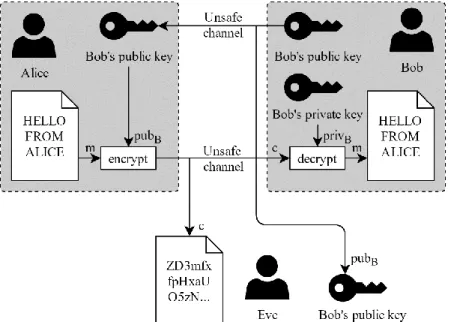
Alice wants to send a plaintext message 𝑚 to Bob so she uses Bob’s public key 𝑝𝑢𝑏𝐵 to encrypt the message into ciphertext 𝑐 using 𝑐 = encrypt(𝑚, 𝑝𝑢𝑏𝐵). She then sends 𝑐 to Bob who decrypts the message using 𝑚 = decrypt(𝑐, 𝑝𝑟𝑖𝑣𝐵). This is illustrated in Fig. 5.
14
Fig. 5. Alice encrypts a message “HELLO FROM ALICE” using Bob’s public key. She sends the resulting ciphertext to Bob who decrypts it using his private key. Eve who knows both the ciphertext and Bob’s public key is unable to decrypt the message as she does not know Bob’s private key.
It should be noted that the message is in practice not encrypted/decrypted immediately, some sort of pre- and post-processing should be implemented to prevent the identical messages from being encrypted to the same ciphertext, a fact that can otherwise be used by Eve to gain information about the messages sent [12].
Signing
To prove the origin of a message it is common to send a digital signature along with the message itself.
The signing process begins with Alice in possession of her own key pair,
𝑝𝑢𝑏𝐴 and 𝑝𝑟𝑖𝑣𝐴, and her having shared her public key in such a way that
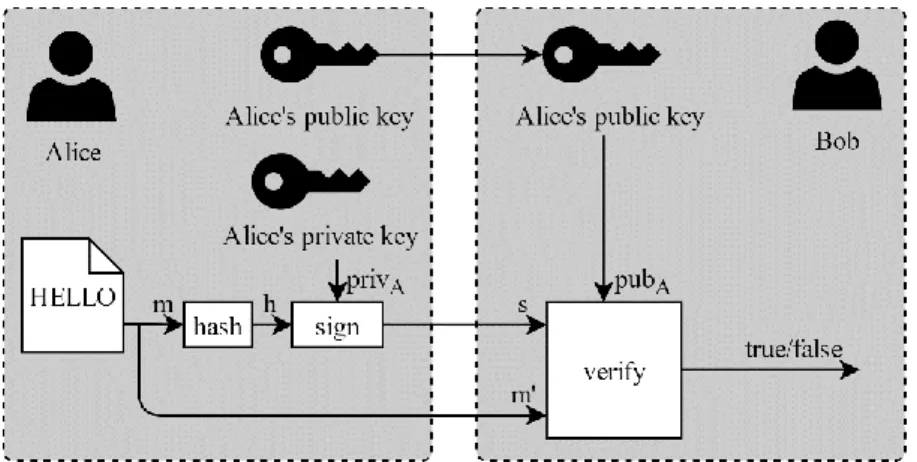
everyone knows that she is really the owner of it. Alice wants to send a message 𝑚 to Bob so that Bob can verify that it came from her.
Alice produces a hash value ℎ = hash(𝑚) of the message 𝑚 and generates a signature 𝑠 = sign(ℎ, 𝑝𝑟𝑖𝑣𝐴) by signing ℎ using her private key 𝑝𝑟𝑖𝑣𝐴.
15
Alice now sends not only the message 𝑚 to Bob but also the signature 𝑠. Bob now verifies the signature, verify(𝑚, 𝑠, 𝑝𝑢𝑏𝐴), using Alice’s public key.
He can then conclude whether the message he received was sent by Alice or not. This is illustrated in Fig. 6.
Fig. 6. Alice sends the message “HELLO” to Bob. She also encrypts the hash of that message using her private key. Bob can then verify that the message he receives is the one Alice signed by decrypting the signature with Alice’s public key and comparing the hash value from it with his independently computed hash value of the message he received.
Note that signing does not provide encryption of the message sent, that must be done separately. See [12] to learn more about the differences between signing and encryption with RSA.
A final note on replay attacks, in which the same data and signature is provided multiple times. Consider a situation where you send status reports every five minutes. If you have data and signature for when ‘everything is fine’ you could send that same data and signature multiple times to avoid exposing that everything is not fine. To prevent you from doing that including a “number used once”, nonce, with the data would mean that the data and signature would not be accepted other than the first time it is sent.
Tying public keys to entities
Being able to verify the connection between a public key and a private key is not same as verifying who the physical (or legal) entity behind that key pair is. A separate trusted third-party certificate authority is often used to attest that a specific key pair belongs to a specific entity. The certificate authority, CA, verifies that Alice is the entity associated with Alice’s public
16
key and creates a certificate asserting that to be true. The CA signs this certificate using its own private key. This is illustrated in Fig. 7.
Instead of independently doing so, Alice, Bob and any other entities networking with each other place their trust in the certificate authority to verify that 𝑝𝑢𝑏𝐴 belongs to Alice, 𝑝𝑢𝑏𝐵 belongs to Bob, and so on. The
certificate provides a link between a physical identity and a digital identity (public key).
For Alice to prove her physical identity in a digital system she can provide the certificate along with proof that she is in possession of the private key 𝑝𝑟𝑖𝑣𝐴.
Fig. 7. A certificate authority verifies the link between Alice, the physical person, and Alice’s public key. The CA then creates a certificate stating that fact, signing it using the CA’s own private key.
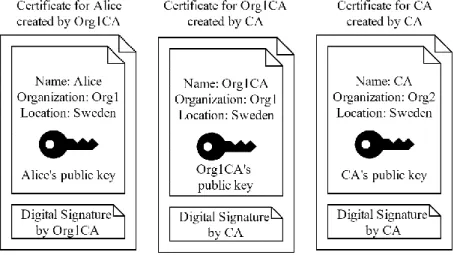
The certificate authority does not have to independently verify the identity of and create certificates for every single entity. Instead the certificate authority can, for example, create a certificate for an entire organization and then that organization can in turn create their own certificates for individuals within the organization. The way these certificates are linked together is illustrated in Fig. 8. This chain of certificates can then be accepted as identity verification.
When verifying those individuals’ certificates, the verifier checks the chain of certificates all the way back to the original certificate authority, see Fig. 8. As a CA is considered the root of trust they sign their own certificate, thus forming the final link of the chain.
17
Fig. 8. Alice has a digital certificate of her physical identity and public key created by Org1CA. A separate certificate tying together Org1CA’s public key and physical identity is signed by CA. Finally, CA has a self-signed certificate.
The importance of the role of certificate authorities as the root of trust in public key infrastructures, PKI, cannot be understated. Much of web security, such as HTTPS and TLS, depend on CAs. Additionally, many Swedes are likely familiar with BankID which is a digital identification service used by individuals to identify themselves to banks and authorities. This service is also dependent on certificate authorities.
19
3.
Blockchain technology
A centralized database is hosted by a single entity and trust is put in that entity to maintain the security and integrity of that database. A distributed database provides redundancy, but full trust between all participants is still needed. Where blockchain technology comes into play is in areas where full trust of that kind is considered unachievable or undesirable.
The basis of blockchain technology comes from two things. First is the data structure consisting of a sequence of data blocks tied cryptographically to one another in chronological order. The second is consensus-driven blockchain network distribution, with the data being replicated across mutually distrustful nodes.
Concept
Blockchain technology promises network-distributed, decentralized and immutable data storage and transaction conduction. The information contained within the blocks make up a database where adding or changing information in that database comes in the form of appending new blocks to the blockchain. A block consists of a header, containing mostly metadata, and transactions that hold the actual blockchain information making up the database.
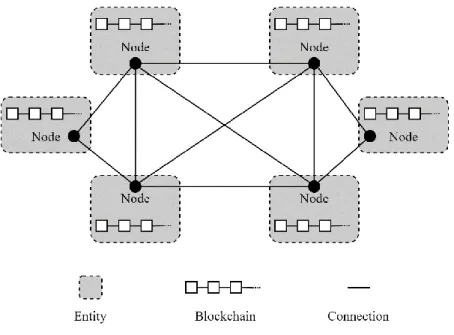
Because of the append-only nature of blockchain technology any previous state of the database can be extracted by looking at the blocks up to a certain point. While a current value in the database can change, a history of all database operations is intrinsic to the append-only design of blockchains. Many very differing implementations of the blockchain concept exist, with their common factor being the sorting of data into an append-only list of blocks, chronologically and cryptographically linked to one another in linear sequence. Entities participating in a blockchain network, see Fig. 9, are all collectively responsible for maintaining the blockchain.
Some form of consensus building methodology is needed to make sure that the blockchains at the network nodes are identical to one another, making the figurative collective blockchain stable. All good consensus methods are tamper resistant, meaning many separate malicious entities would have to collaborate for tampering to succeed.
20
Fig. 9. A simplified blockchain network layout. Each entity controls a network node. These communicate with one another in some way, with all of them holding their own blockchain. Any one network node’s blockchain should match that of the rest of the correct nodes, making a stable collective blockchain.
Every block in the chain, except for the first “genesis block”, contains a cryptographic hash of the preceding block in the chain, illustrated in Fig. 10 [3] [13] [14]. Depending on the specific blockchain system, certain demands can be put on these hashes. For example, in proof-of-work as implemented by Bitcoin the hash must contain a certain number of leading zeroes [15].
Fig. 10. The blockchain is examined at height 𝑛. The block at height 𝑛 + 1
contains the hash of, or references, the previous block at height 𝑛. Similarly, the block at height 𝑛 references the block at height 𝑛 − 1. Note that no block references a subsequent block, all references are to preceding blocks. This means that while the block at 𝑛 only
21
references the block at 𝑛 − 1, any number of blocks could contain a reference to 𝑛.
These cryptographic hashes are what tie blocks together and make the blockchain immutable. Depending on what specific blockchain technology is used this is a statement with some definite asterisks. The consensus finality property says that if a node appends a block to its blockchain no other node will append any other block before that one to their blockchain [14]. Without consensus finality, the blocks that make up the blockchain can change even though the blocks themselves are unchanged. The only difference is what blocks are considered part of the blockchain. For example, in the proof-of-work system Bitcoin the series of blocks that are collectively accepted as constituting the blockchain can change if a longer sequence of blocks is found, even if it excludes blocks currently seen as part of the blockchain [14] [15]. This is known as the “longest chain” rule, illustrated in Fig. 11. Other scenarios exist where blockchains become similarly split and the question of which branch counts as “the one” is raised. If a blockchain has consensus finality, then once a block has been added to the blockchain it cannot be removed or replaced (by the consensus process).
Fig. 11. Alice and Bob are participants in a blockchain network that uses the longest chain rule. At 𝑡 = 1 they both have matching blockchains up to the last block height, 7. There they separately created new valid
22
blocks at around the same time meaning either of their blockchains could be considered “the” blockchain. This constitutes a “fork” in the collective blockchain. The different blocks are considered different “branches”. At 𝑡 = 2 Bob happens to be the first of the two to mine a new height 8 block making his branch longer. Alice, who becomes aware of Bob’s new block at 𝑡 = 3, will now use the blocks from Bob as per the longest chain rule, abandoning the block 7A that she previously considered part of the blockchain.
Consensus
The term consensus in the context of blockchains is the process of making sure all “correct”, or alternatively “honest”, nodes have a shared and consistent blockchain [16]. This requires two abstracted elements [17]. The first is a state machine containing some form of logic, illustrated in Fig. 12. A state machine consists of state variables and commands [18]. The state is encoded using the state variables, and the commands are the state transitions from one valid state to another. In the case of blockchain technology, the state is the blockchain itself and the state changes are the additions of new blocks to that blockchain.
Fig. 12. A simple state transition diagram. The diagram contains three states, A, B and C. The state transition arrows indicate possible changes of the current state. Using the terminology of state variables and commands there is one variable that has the possible values of “A”, “B” and “C”. Commands can change that variable value from A to B, B to A, B to C and C to A.
23
The second element is a replication management, or consensus, protocol that coordinates node interactions with the state machine. Consensus needs to be achieved and then maintained. First some common state must be shared between all state machines. Second, an agreement must be met on any new state change to make sure that all nodes reach the same new state. Important for the decentralized nature of blockchain technology is that this is done without trusting any one entity fully.
This description of consensus is abstract for a reason. The area of blockchain technology is sprawling and very disparate forms of consensus building exist. This makes it hard to describe them collectively without referring to some abstracted common ground.
It is also a good idea to assume that not all nodes behave correctly but that they can also be “Byzantine”. The term, explained in Section 3.2.1, in short means that a node can fail or misbehave in a way that threatens the integrity of a network-system not protected against Byzantine behavior.
A fundamental threat is if some sufficiently large number of malign blockchain network participants collaborate to subvert the integrity of the blockchain system [13] [14]. Participants holding some large enough network power would in extension obtain power over the blockchain itself. Power that would, depending on the specifics of the system, include the ability to replace parts of the blockchain and to censor any new transactions for any reason [13] [19]. Having some large enough majority of non-Byzantine nodes is critical to both proof-of-work and Byzantine Fault Tolerant consensus [14].
A single entity could potentially connect a disproportionate number of nodes to the blockchain network. Section 3.2.2 contains information on attacks where multiple identities are used by the same entity.
The two main types of blockchains, permissionless and permissioned, are explored in Sections 3.5 and 3.6. Their specific consensus methods are explained in Sections 3.5.1, 3.5.2, 3.6.2 and 3.6.3.
3.2.1.
Byzantine nodes
Using Byzantine as a shorthand for misbehaving nodes is terminology originating in the Byzantine Generals Problem. The problem deals with agreeing on some common data in a distrustful environment.
The problem is summarized in [20] as “a group of generals of the Byzantine army camped with their troops around an enemy city. Communicating only by messenger, the generals must agree upon a common battle plan. However, one or more of them may be traitors who will try to
24
confuse the others. The problem is to find an algorithm to ensure that the loyal generals will reach agreement.”
Protection against byzantine nodes is always in relationship to the total number of nodes in the network. See Sections 3.5 and 3.6.3 for specific thresholds for tolerance of Byzantine nodes.
3.2.2.
Sybil attacks
A single entity has the potential to present several different and seemingly unrelated identities to gain some unproportionate amount of power in a peer-to-peer system, something that is known as a Sybil attack [21].
Because the resilience of blockchain technology lies in the data structure and distribution network in combination, one being subjectively useless without the other, a blockchain system using distribution susceptible to Sybil attacks would eliminate any trust for that blockchain system.
The distribution of blockchain network power could, using a Sybil attack, be shifted so a single entity gains control over the collective blockchain. Two current solutions to this problem exist, one being that network participation is limited to verified identities, and the other that blockchain network power is proportional to the resources being contributed to the consensus process, see Section 3.6 and 3.5.
Chaincode and smart contracts
Some form of logic is needed to decide what constitutes a transaction on the blockchain. Many cryptocurrency blockchain systems have this logic built-in as it only needs to support a small set of features such as transferring cryptocurrency tokens from one owner to another. To support more general use cases, the concept of “chaincode” running on the blockchain network was introduced.
The related term “smart contract” comes with some baggage, see [22], and to avoid the implications that come with that name the Hyperledger Fabric term chaincode will be used unless specifically referring to a smart contract.
Chaincode is described in [23] as “software, running on a ledger [blockchain], to encode assets and the transaction instructions (business logic) for modifying the assets”. This is a pretty concise description and for a programmer chaincode doesn’t look all that different from any other software implementing some form of business logic.
25
With the risk of introducing confusion by making two similar analogies chaincode can also be described using state machines. The assets of chaincode constitute the state machine variables and the changes made to those assets are the state transitions.
In a permissionless blockchain system executing chaincode is associated with payment in the form of cryptocurrency but no such payment is required in a permissioned system [5].
State of blockchain security
There has been an explosion in research of blockchain technology in the past few years although a large majority of that research has been centered on Bitcoin as opposed to the technology in general [3].
It is argued that while blockchain technology should be developed and evaluated like a cryptographic system, many of the blockchain systems currently in existence have been created in ignorance of such development processes [17].
Neha Narula, who is one of the discoverers of a rather obvious but very severe security vulnerability in the blockchain system IOTA, argues the following [11]:
“Though the [blockchain] technology is exciting, the due diligence required to make sound investments in the technology isn’t keeping up with the pace of the hype. Aside from the financial risk, I don’t think developers and investors are thoroughly evaluating these systems technically, either. Many investors are relying on signaling — if enough well-known institutions like universities or large companies sign on as investors or advisors, it indicates approval of the project and its software. The problem is that some of these technologies have serious issues, and the large companies and well-known individuals either aren’t doing due diligence and investing the resources and time needed to evaluate the projects with which they are partnering, or aren’t sharing their findings with everyone else. The cryptocurrency space still doesn’t have a good way to assess these projects.” The security vulnerability in question was a result of IOTA developers breaking the mantra against rolling one’s own crypto, see Section 2.1, as they had created their own hash function that could not withstand differential cryptanalysis [24]. Narula puts her finger on a subjectively large issue with blockchain technology today. There is a lot of work being done in the field but little of that work is dedicated to making sure the blockchain systems are secure and trustworthy.
26
Not only attacks to the blockchain systems themselves need to be considered. Attacks on chaincode could lead to results just as devastating as if the target had been the blockchain system itself.
As part of a larger survey of attacks on smart contracts for the blockchain system Ethereum the somewhat infamous “DAO attack” is investigated in [25]. The DAO was a form of decentralized investment system where investors of the DAO could vote to choose where their collective investments should go. They raised 10.7 million in Ethereum cryptocurrency Ether, valued at USD 120 million [26]. A large portion of that investment was later stolen using vulnerabilities present in the DAO smart contract [25]. The attack led to a schism in the Ethereum community as a hard fork was made to reverse the transfers that constituted the theft [27]. Ethereum Classic, a version of Ethereum “free from censorship, fraud or third party [sic] interference”, was created as a reaction to the perceived wrongdoings of this hard-fork solution to the DAO attack [28].
Beyond the implications to chaincode security considerations, this sequence of events is a great illustration that the immutability associated with blockchain technology is not some absolute property but a result of consensus among network participants. This is not limited to just the participating network nodes but extends to the actual people in charge of those nodes.
Permissionless blockchains
The primary identifier of a permissionless blockchain system is its open participation model where anyone can join or leave the blockchain network at any time [14]. The largest problem associated with such anonymous networks, Sybil attacks, is solved by linking participation to real-world resource use [14]. Bitcoin and Ethereum are the two prominent systems used to exemplify permissionless blockchain systems in this thesis.
An adversary hoping to gain blockchain network control must control most of the total CPU-cycles being spent “mining” blocks for the blockchain to be successful, something known as a “51%” or “majority” attack [19]. This means that the more decentralized the network the less likely a majority attack is to succeed. It was however shown in 2014 that it is possible to achieve a successful “Selfish Mining strategy” attack on the Bitcoin system with a 25% minority [13].
Because the reliance of a permissionless system is based on the network being decentralized the organization of “miners” (nodes) into “mining pools” for sharing block creation awards effectively increases centralization and thus decreases the resilience of the system [13] [14].
27
As all blockchain data is shared to the network and network participation is completely open any data stored on a permissionless blockchain should be considered public. See [5, p. 25] for a short discussion on blockchain data privacy. The authors of [5] advocate storing sensitive data “off-chain” with only the hash “on-chain”. This allows for verification but not direct protection as the off-chain stored data is most likely more vulnerable to, for example, deletion. Finding what hash is linked to what data could also be a source of additional system complexity.
3.5.1.
Proof-of-work
Pseudonym Satoshi Nakamoto introduced proof-of-work consensus with the original Bitcoin whitepaper [15]. The generation of blocks depends on solving a hard cryptographical puzzle where any solution is easy to verify [29].
As previously mentioned each block in a blockchain contains the hash of the previous block. The specific data included in that hash varies with the specific protocol used but in general a summary of the block data along with some block metadata is used. Each block’s hash must match a certain pattern, in Bitcoin this pattern is a certain amount of leading zero bits [15]. Finding a match to the pattern is the cryptographical puzzle.
As hashing the same data always leads to the same hash value a nonce is included as part of the block. Using different nonce values changes the hash of the block. This is illustrated in Fig. 13.The pattern rule is enforced by the network nodes as they only accept blocks generated by other nodes if, in addition to the other verifications, the hash of that block matches the pattern.
Attempt Block data Nonce value
Hash value Matches pattern? 1478998384 3b96bb7e… 869292030 43862b5ec7… No 1478998385 3b96bb7e… 169950584 ee084c2518… No 1478998386 3b96bb7e… 208296255 0000000027… Yes
Fig. 13. A few attempts at finding a hash value that matches the pattern required by proof-of-work, in this example case the pattern is 8 leading zero bytes. The block data remains the same for each attempt but the nonce value changes leading to the hash value of them both combined changing between each attempt. On the bottom attempt in the figure the hash value contains 8 leading zeroes and as such
28
matches the pattern. The nonce value and the other block data will now be propagated to the network as a complete block.
Every bitcoin block mined awards the miner with a bitcoin currency reward and this is what incentivizes entities to engage in the mining process [15]. As the number of bitcoins awarded for every block decreases, the long-term mining incentive is expected to be transaction fees [15]. Currently, Ethereum has a fixed reward but this may change in the future considering the planned move to proof-of-stake [30] [31].
Proof-of-work systems can scale to thousands of mining nodes and clients [4] [14]. This goes well with the goal of decentralization as supporting thousands of nodes also means that thousands of separate entities can participate in the blockchain network. The pooling of resources into mining pools does go against this decentralization principle.
Despite supporting thousands of network nodes and clients, performance and scalability of another kind becomes a large issue in proof-of-work systems [4].
The closer a transaction’s block is to the end of the blockchain the less mining work is protecting it from being replaced using another longer sequence of blocks [15]. This lack of consensus finality, see Section 3.1 for a definition, has given rise to the recommendation that for Bitcoin one should wait for 6 blocks to be appended to the one with the transaction in it, taking roughly 60 minutes, for the transaction to be considered properly committed [14]. This results in transactions having a very high latency. This is in addition to the already low transaction bandwidth that with Bitcoin has a theoretical high of 7 transactions per second [14].
The mining process uses a large amount of CPU-cycles3 and, in
extension, electricity. This massive resource use is comparable to that of entire countries such as Denmark and Ireland [32] [33]. This can arguably be considered a massive waste.
The proof-of-work derivation used in Ethereum is called Ethash [34]. It mitigates some issues associated with Bitcoins proof-of-work consensus [4] [34]. Ultimately, the proof-of-work performance limitations, including high latencies and low bandwidth, are inherent to the method itself [14].
3 CPU-cycles is used generally in this context. Currently much of Bitcoin mining is
29
3.5.2.
Proof-of-stake
In contrast to proof-of-work there is no “mining” in a proof-of-stake system. Block confirmation is based on in-system investment using the assumption that anyone with enough investment into the system would want to see it continue functioning. One example of a cryptocurrency that uses proof-of-stake consensus is BlackCoin [35].
Most proof-of-stake protocols currently proposed are susceptible to several attacks and proof-of-stake only accounts for less than 2% of cryptocurrency market capitalization [36]. Because of this assessing the usability of proof-of-stake in blockchain systems is, can, and will be the subject of entire theses.
Ethereum is likely to adopt a proof-of-stake system called Casper in their future Serenity milestone [37]. The basic idea behind Casper is that consensus will be reached by the participants (validators) placing bets on which block is going to become the next to be included in the blockchain. After enough validators have placed large enough bets on a single block it is considered finalized and every bet on any other block will be distributed as winnings to the validators who bet on the ‘winning’ block. The aim with Casper is to encourage betting on blocks that are likely to be accepted by the majority and to punish those who bet against the majority [38].
Permissioned blockchains
In contrast to permissionless blockchains where anyone can set up a node and connect to the blockchain network a permissioned blockchain network limits participation to known and approved entities. This is in practice achieved by a collaborating group of organizations. The main advantage compared to permissionless blockchains is increased transaction bandwidth and lower latency [4].
Permissioned blockchains will, in this thesis, be exemplified using mostly Hyperledger Fabric. The term “ledger” is often used in Hyperledger documentation and terminology to refer to the blockchain-based data storage but this thesis will continue to use the term “blockchain”.
3.6.1.
The Hyperledger project
There are several different blockchain projects in varying levels of development, from incubation to production, all organized under the Hyperledger project from the Linux Foundation. Several high-profile
30
companies have chosen to gather their permissioned blockchain efforts under the Hyperledger banner [39] [40].
The Hyperledger project is envisioned as being decades long and the goal is to gather all viable permissioned blockchain solutions, allowing them to grow and to see which technologies emerge as the eventual “winners” [41]. Fabric and Sawtooth are the two projects furthest along in development, with a few production-level Fabric-based projects and some Sawtooth “late-stage pilots” [41].
Hyperledger Fabric is originally contributed by IBM and is the only project to have a 1.0 release at the time of writing [42]. It will be explained in more detail in Section 3.7.
Hyperledger Sawtooth uses a consensus algorithm based on “Proof of Elapsed Time”, see Section 3.6.2. It uses a trusted execution technology to provide this proof and the network node responsible to provide the proof is chosen through a lottery system [17] [43].
Hyperledger Iroha has the goal of providing reusable components (code libraries, consensus, chaincode/smart contracts) to the other Hyperledger projects.
Hyperledger Burrow is contributed by Monax and it features an Ethereum Virtual Engine using a proof-of-stake Tendermint consensus engine. See [17] for more information about this specific consensus method.
Hyperledger Indy “provides tools, libraries, and reusable components for providing digital identities rooted on blockchains” [39].
Fabric, Sawtooth and Iroha are currently in active development while Burrow and Indy are in incubation status [44]. Considering the goals and development status of the Hyperledger projects, only Fabric and Sawtooth will be discussed further.
3.6.2.
Proof of elapsed time
Proof of elapsed time, PoET, was created as a response to the knowledge of proof-of-work serving as a resource hungry distributed timestamping machine. PoET was developed to achieve the same result but with massively decreased resource use. The result in question is trust in that a certain amount of time has passed between each block. It leverages Intel Software Guard Extensions, SGX, to provide attestation that a certain amount of time has passed, with the assumption that the trusted execution technology cannot be subverted. This is potentially problematic as during the writing of this thesis security flaws subverting Intel’s trusted computing technologies were
31
identified [45]. This is in addition to previous research on attacks against SGX [46] [47].
Because of proof-of-work similarities, PoET has the potential to be used in permissionless blockchains as well as permissioned ones [17]. Where proof-of-work uses CPU-cycles as the ticket of entry, PoET uses the availability of hardware supporting Intel SGX [17] [48]. As CPU-cycles are a far more ubiquitous resource this puts a lot of trust and some measure of centralization with Intel. The centralization comes from the fact that the distribution of Intel SGX compatible hardware will in practice form a barrier of entry not present in proof-of-work [17].
Finding a valid block hash in proof-of-work can be compared to simply waiting an amount of time and then propagating a block to the network with the proof of that time having elapsed, namely the block hash matching a certain pattern [17] [48]. Proof of elapsed time takes this literally and uses SGX to wait for some time and once that time has passed a node can use that SGX-generated proof as part of the block data and propagate that block to the rest of the network [17] [48]. Like with proof-of-work, PoET does not provide consensus finality as forks are created when new blocks are generated in close time proximity to one another [17].
PoET eliminates the massive resource use associated with proof-of-work at the cost of putting trust and power in the hands of a single hardware vendor [17] [48].
3.6.3.
Byzantine fault tolerant consensus
Requiring nodes to have known identities allows the use of Byzantine fault-tolerant, BFT, consensus protocols [14]. These types of database replication protocols have a several decades long history and much research exists in the area [14] [49] [50]. BFT protocols have several important advantages over proof-of-work protocols, most importantly performance and resource use.
According to both [4] and [14] there is an apparent inherent tradeoff between transaction performance and node scalability. BFT protocols have great performance, tens of thousands of transactions per second [50] and low latency overhead of less than 100ms [51], but is only tested up to twenty nodes [14].
When one becomes aware of the 𝑂(𝑛2) inter-node communication involved, see Fig. 14, the reason behind the limited node scaling of BFT protocols becomes apparent.
32
Fig. 14. Visualization of communication between nodes (P0-P3) performing
BFT consensus. Adapted from [50, p. 148. Figure 2] and [52, p. 87. Figure 9].
Historically the protocol Practical Byzantine Fault Tolerance, PBFT, has been the earliest and almost only real-world usable BFT protocol [50]. More recently BFT-SMaRT has, with several improvements over PBFT, taken over as a more current implementation of Byzantine fault tolerance and it is used by several blockchain systems [17] [50].
BFT protocols protect against Byzantine nodes, but only if they do not make up more than a third of the total number of nodes [14].
33
Hyperledger Fabric
Hyperledger Fabric can currently be considered the flagship Hyperledger project as it is the longest-running and is the furthest along the development process.
3.7.1.
Consensus and node responsibilities
Consensus in Fabric is a bit more involved than ‘just’ nodes propagating valid blocks to the rest of the network as with, for example, Bitcoin [53]. In earlier stages of development Fabric used native PBFT but architecture changes mean that the current 1.0 release does not include BFT consensus [17]. As adding BFT-SMaRT is part of current development, it should be noted that the current lack of protection against node subversion is a product of release scheduling and not inherent to Fabric [17]. This thesis will assess Fabric as if it uses BFT consensus.
The architecture changes for the 1.0 release were to separate some node responsibilities into different types of nodes [17]. The current division is into three types of nodes: clients, peers and orderers [54].
Before the node responsibilities are specified further, note that transactions in Hyperledger Fabric come in the form of “invoking” chaincode and then having the result of that invocation committed to the blockchain [54]. The network can contain several different chaincode stored on different subsets of peers [54].
A client node is the active driver of the transaction process, explained in Section 3.7.2. The client invokes a certain chaincode at some peer, requesting the peers’ endorsement of the transaction [54]. The client then sends the endorsed transaction to the ordering service that performs a total-order broadcast to the network [54].
A peer holds their copy of the blockchain with new blocks being provided to them by the ordering service [54]. Peers can serve as “endorsers”, where they endorse transactions before they can be committed. An endorser ‘emulates’ the execution of chaincode invocations and the result is either endorsed or rejected [54]. Chaincode has individual endorsement policies, requiring the endorsement from peers from a certain specified set of participating organizations for the network to consider a transaction involving that chaincode valid [53].
The orderers form the ordering service and can, if the system is configured to do it, keep their own copies of the blockchain [54]. The name
34
quite simply comes from the service performing the total-order broadcast of all transactions to the rest of the network [54].
Even invalid transactions are stored on the nodes’ blockchains, although without affecting the actual blockchain database, to preserve the history of all transactions [54]. The blockchain database in Fabric is known as the state, modeled as a key-value store [54].
Once BFT-SMaRT is implemented, Fabric will be able to withstand up to a third of participating ordering nodes being subverted [17]. Remember that chaincode still needs to be properly designed, maintained and updated, read Section 3.3 for more. In addition, providing a chaincode endorsement policy that matches the stakes of the network is important. If an endorsement policy only requires a single organization to endorse transactions for that chaincode, nothing will prevent them from performing arbitrary changes to the key-value store associated with that chaincode.
3.7.2.
Transaction process
Clients are the drivers of the transaction process. For the purposes of this explanation assume that the network is already up and running with all necessary steps taken to enable some type of example transaction. For an illustration of the transaction process, see Fig. 15.
The transaction process starts with a client sending a transaction proposal to the network peers, specifying what chaincode should be invoked, and any input parameters required by the specific invocation [55].
The peers run a simulation of the chaincode invocation and make sure that the result is valid as defined by the chaincode [55]. The result in question is a set of read/write instructions for the key-value state [55]. After performing all the necessary verifications, the peers send a proposal response back to the client, including their result and endorsement [55].
The client gathers the proposals into a transaction after verifying that the results are all the same [55]. This transaction is then sent to the ordering service, the orderer nodes, who collect it with any other transactions, checks for conflicting read/write sets, and forms them into a block [55]. The ordering service then propagates the block to the peers and they all commit the block to their copies of the blockchain. Not until the block is committed are the read/write sets of the chaincode invocations used to update the state of the key-value store.
The transaction process is concluded by the client receiving an event message broadcast by the network peers acknowledging the committal of the transaction.
35
Fig. 15. A simple overview of the transaction process. A client submits a transaction proposal to the peers who respond with proposal responses. These responses are sent together as a transaction to the orderers who gather multiple transactions into a block. The block is sent to the peers who notify the client that its transaction has been committed to the blockchain.
Note that identities, results, signatures, endorsements etc. are checked by the involved peers and orderers at each step of the transaction process, even when not mentioned explicitly above [53] [55].
3.7.3.
Participation and permissions
In the general case organizations are responsible for maintaining their own public key infrastructure, PKI. The participating organizations’ public key infrastructures are connected to the larger Fabric network and serve as the providers and verifiers of digital identities and signatures used therein [53]. The connection between the Fabric network and the PKIs is done with Membership Service Providers, MSPs [56]. The connection between the MSPs and the actual blockchain is configuration blocks, including the genesis block [56]. Configuration blocks also contain other information needed to set up a network or channel [23].
A single network can contain one or more channels, a feature introduced with the 1.0 architecture change that aims to allow separation of more or less private data and/or logic from the rest of the network [53]. For this purpose, Fabric blockchains exist on a per-channel basis instead of a per-network basis [53].
36
The network and channels can be configured to allow for specific organizations to have different levels of permissions. Some organizations could, for example, only be permitted to run clients and some could be allowed to install/update chaincode [57] [56].
Unfortunately, a very crucial feature that has yet to be implemented is chaincode-level access control [58] [59]. This is a planned feature that would allow chaincode to react differently to a specific chaincode invocator (client) belonging to a specific organization or holding some specific title/role at that organization. The current lack of such a feature is problematic for many use cases, including the one in this thesis’ proof of concept. Lu and Xu put it mildly when they say that “unauthorized users could accidentally trigger a permissionless function” [5].
Summary
Blockchain technology achieves consensus for, and immutably stores, some sort of data in an environment where entities in separate, mutually distrustful, trust domains want to achieve just that. This functionality is dependent on careful considerations and practices in developing and maintaining the blockchain system, network, the participating actor power balance, and the chaincode.