Online Learning of Personalised
Human Activity Recognition
Models from User-Provided
Annotations
Tudor-Alin Miu
Submitted for the degree of Doctor of
Philosophy in the School of Computing
Science, Newcastle University
January 2017
c
In Human Activity Recognition (HAR), supervised and semi-supervised training are important tools for devising parametric activity models. For the best modelling per-formance, large amounts of annotated personalised sample data are typically required. Annotating often represents the bottleneck in the overall modelling process as it usually involves retrospective analysis of experimental ground truth, like video footage. These approaches typically neglect that prospective users of HAR systems are themselves key sources of ground truth for their own activities.
This research therefore involves the users of HAR monitors in the annotation process. The process relies solely on users’ short term memory and engages with them to parsimoniously provide annotations for their own activities as they unfold. Effects of user input are optimised by using Online Active Learning (OAL) to identify the most critical annotations which are expected to lead to highly optimal HAR model performance gains.
Personalised HAR models are trained from user-provided annotations as part of the evaluation, focusing mainly on objective model accuracy. The OAL approach is con-trasted with Random Selection (RS) – a naive method which makes uninformed an-notation requests. A range of simulation-based anan-notation scenarios demonstrate that using OAL brings benefits in terms of HAR model performance over RS. Additionally, a mobile application is implemented and deployed in a naturalistic context to collect annotations from a panel of human participants. The deployment is proof that the method can truly run in online mode and it also shows that considerable HAR model performance gains can be registered even under realistic conditions.
The findings from this research point to the conclusion that online learning from user-provided annotations is a valid solution to the problem of constructing personalised HAR models.
Portions of the work within this thesis have been documented in the following publi-cations:
Miu et al. [1]: T. Miu, T. Pl¨otz, P. Missier, and D. Roggen, ”On strategies for budget-based online annotation in human activity recognition” in Proceedings of the 2014 ACM International Joint Conference on Pervasive and Ubiquitous Computing: Ad-junct Publication, UbiComp ’14 Adjunct, (New York, NY, USA), 2014.
Miu et al. [2]: T.Miu, P. Missier and T. Pl¨otz, ”Bootstrapping Personalised Human Activity Recognition Models Using Online Active Learning” inProceedings of the 14th IEEE International Conference on Ubiquitous Computing and Communications, IUCC 2015, (Liverpool, UK), 2015
First and foremost, I am grateful to Paolo Missier, my main PhD supervisor, not only for giving me the opportunity to pursue the PhD, but also for supporting me throughout this journey. Paolo has been nothing short of an inspiration and I learned tremendously from him. I can’t believe it’s been four years!
I would like to thank Paul Watson for his general guidance and for always ensuring all the key resources were in place. I have worked extensively with Thomas Pl¨otz and I grateful for his collaboration and valuable advice. I would also like to thank Daniel Roggen for working with me during his stay at Newcastle University. Casim Ladha has provided me with technical support for the sensors and that was essential, so thank you!
I had fascinating discussions (not always technical!) with my office mates Rawaa Qasha, Zhenyu Wen, Hugo Firth and Faris Llwah. They were terrific to have around and their feedback on my work proved to be very useful.
I was extremely fortunate to meet Anya Batalina, Ciprian Sp˘atar and Adil Ibadula here in Newcastle. They are wonderful friends and I am grateful for their relentless positivity and encouragement which made it indirectly in this thesis.
The list could go on and on, so, in general, I would like to thank the crowd in the School of Computing Science for being so welcoming and engaging.
1 Introduction 1
1.1 Introduction . . . 2
1.2 Health – A Case for Physical Activity Recognition . . . 2
1.2.1 Interventions . . . 3
1.3 Personalising Wearable Devices . . . 5
1.3.1 HAR System Usage . . . 7
1.4 Contributions . . . 13
1.5 Thesis Organisation . . . 15
2 Foundations 17 2.1 Introduction . . . 18
2.1.1 Definition of an Annotation . . . 18
2.1.2 Our Contributions in Context . . . 18
2.1.3 Chapter Outline. . . 20
2.2 Obtaining Annotations . . . 21
2.2.1 Retrospective Annotations . . . 21
2.2.2 User-Generated Annotations . . . 22
2.2.3 Relation to our Work . . . 27
2.3 The User’s Perspective . . . 27
2.3.1 Interrupting the User . . . 28
2.3.2 Budget of Annotations . . . 29
2.3.3 Relation to our Work . . . 30
2.4 Machine Learning . . . 30
2.4.1 Sensor Data Acquisition . . . 31
2.4.2 Preprocessing and Feature Extraction . . . 32
2.4.3 Activity Segmentation . . . 33
2.4.4 Model Building and Classification . . . 34
2.4.5 Relation to our Work . . . 34
2.5 Learning Methodologies for Model Building . . . 35
2.5.4 Relation to our Work . . . 43
2.6 Machine Learning in HAR Applications . . . 44
2.6.1 Using Active Learning . . . 44
2.6.2 Mobile and Continuous Monitoring . . . 45
2.6.3 Relation to our Work . . . 46
2.7 Conclusions . . . 46
3 Online Learning with a Budget 50 3.1 Introduction . . . 51
3.2 A Budget-based Online Annotation Framework . . . 53
3.2.1 Overview . . . 53
3.2.2 Budget-Based Interactive Annotation Framework . . . 54
3.3 Experiments and Key Results . . . 57
3.3.1 Segmentation and Budgeting. . . 57
3.3.2 Evaluation Methodology . . . 60
3.3.3 Dataset . . . 61
3.3.4 Classification Backend . . . 62
3.3.5 Results . . . 64
3.3.6 Conclusions for Key Results . . . 66
3.4 Extended Results . . . 66
3.4.1 Segmentation Procedure . . . 68
3.4.2 Conclusions for Extended Results . . . 74
3.5 Summary and Discussion . . . 74
3.5.1 Summary of Contributions . . . 75
3.5.2 Moving Forward: From Simulation to Field Studies . . . 75
4 Online Active Learning in the Lab 78 4.1 Introduction . . . 79
4.1.1 Contributions . . . 80
4.2 Annotation Decision Framework . . . 82
4.2.1 Online Active Learning Heuristic . . . 82
4.2.2 General Simulation Procedure . . . 85
4.3.3 Results . . . 90
4.4 Periodic Activities . . . 96
4.4.1 Preprocessing . . . 96
4.4.2 Recognition Performance Evaluation . . . 96
4.4.3 Learning Machinery . . . 98
4.4.4 Results . . . 98
4.5 Conclusions . . . 110
5 Online Active Learning in the Wild 112 5.1 Introduction . . . 113
5.1.1 Contributions . . . 113
5.1.2 Overview of Field Study . . . 114
5.2 Experimental Design . . . 116
5.2.1 Activities . . . 117
5.2.2 Experiment Protocol . . . 117
5.3 Learning Machinery. . . 120
5.3.1 NAD: Novel Activity Detector . . . 121
5.3.2 Updateable Bootstrap Aggregation . . . 125
5.3.3 Effect of the Segmentation Procedure . . . 127
5.4 Mobile App Architecture . . . 127
5.4.1 App User Interface . . . 131
5.4.2 Online Learning from Annotations . . . 132
5.5 Performance Results . . . 134 5.6 User Feedback . . . 138 5.6.1 Annotation Requests . . . 138 5.6.2 Annotation Delay . . . 141 5.6.3 Activities . . . 142 5.7 Conclusions . . . 145
6.1.1 Contributions . . . 151
6.2 Method . . . 152
6.2.1 Mathematical Considerations . . . 153
6.2.2 Step 1: Setting a Target Budget . . . 154
6.2.3 Step 2: Attaining a Target Budget . . . 155
6.2.4 Preliminary Conclusions . . . 159
6.2.5 Uniform Random Budget Spending Strategy . . . 159
6.2.6 Exponential Budget Spending Strategy . . . 161
6.3 Simulations . . . 162
6.3.1 Results for Non-periodic Activities . . . 163
6.3.2 Results for Periodic Activities . . . 168
6.4 Additional Constraint . . . 168
6.4.1 Step 3: Coercing the Budget . . . 172
6.5 Results . . . 175
6.5.1 Results for Non-Periodic Activities . . . 176
6.5.2 Results for Periodic Activities . . . 186
6.5.3 Discussion . . . 194
6.6 Conclusions . . . 195
7 Conclusions 197 7.1 Motivation and Context . . . 198
7.2 Results and Significance . . . 199
7.2.1 Chapter 3 – Online Learning with a Budget . . . 199
7.2.2 Chapter 4 – Online Active Learning in the Lab . . . 201
7.2.3 Chapter 5 – Online Active Learning in the Wild . . . 203
7.2.4 Chapter 6 – Online Active Learning with Budget Constraints . 204 7.3 Our Contributions in the Wider Research Context . . . 205
7.3.1 Obtaining Annotations . . . 205
7.3.2 The User’s Perspective . . . 207
7.3.3 Machine Learning . . . 209
7.3.4 Learning Methodologies . . . 210
B Structure of questionnaires 216
C Questionnaire Answers 219
D Code and Data 263
1.1 Typical HAR Monitoring. . . 11
1.2 HAR Monitoring with Model Personalisation. . . 11
1.3 HAR Monitoring with User-Provided Annotations for Model Personalisation. . . 12
1.4 Personalisation Loop. . . 12
1.5 Roadmap of Contributions.. . . 14
1.6 Parameter Space of the Annotation Method. . . 16
2.1 Machine Learning Classification and Model Building Pipelines. . . 31
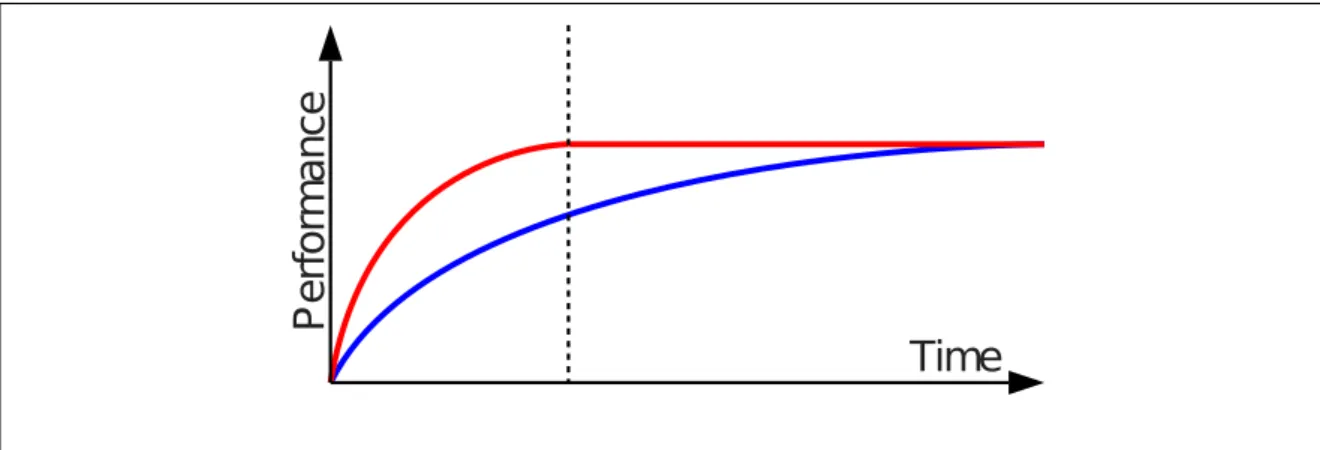
3.1 Influence of annotation strategies on online activity recognition systems (schematic): Accelerated (red) vs. slower learning (blue). . . . 52
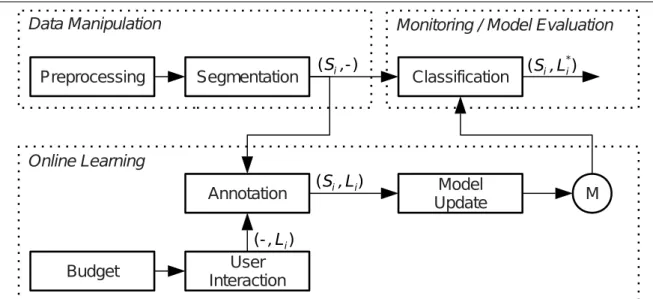
3.2 Budget-Based Interactive Annotation Framework . . . 55
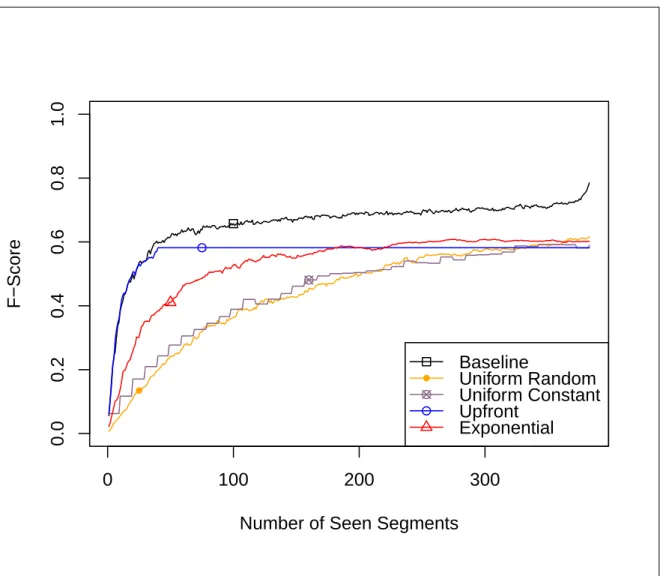
3.3 Influence of budget strategy over model bootstrapping speed. . . 66
3.4 Obtaining performance estimates from baseline graph.. . . 67
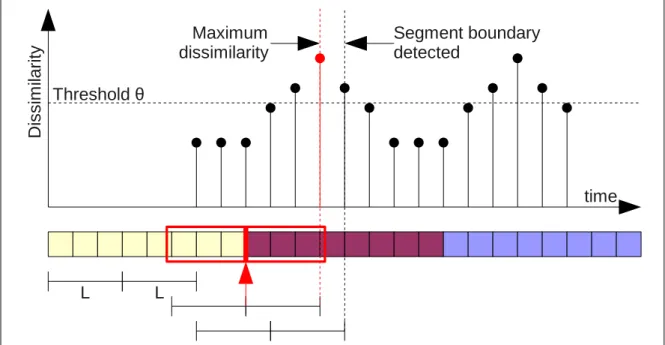
3.5 Automatic Segmentation Strategy (Schematic) . . . 68
3.6 Budget strategies with best-effort segmentation. . . 71
3.7 Baseline performance with different segmentation configurations. . . 73
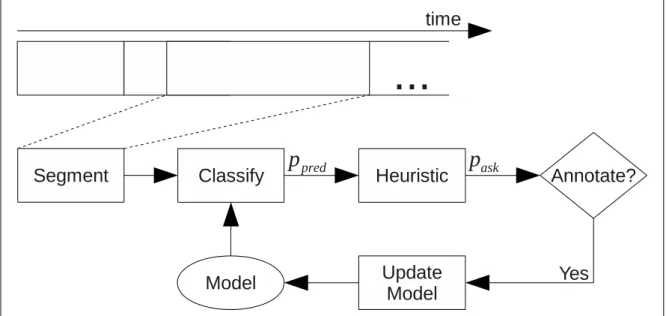
4.1 Overview of the annotation method. . . 83
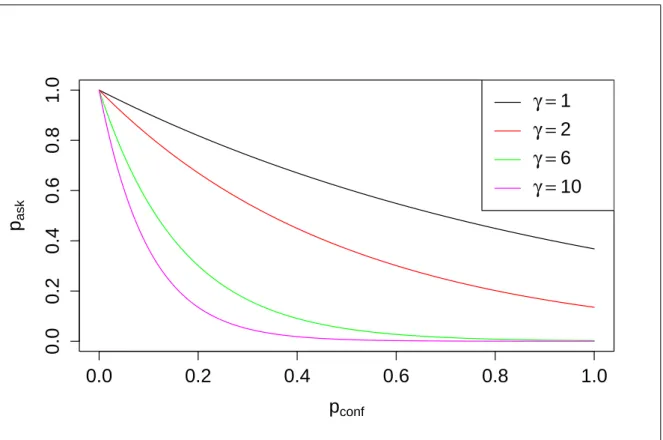
4.2 The probability of asking as a function of classification confidence. . . . 84
4.3 Interactive Annotation Pipeline. . . 86
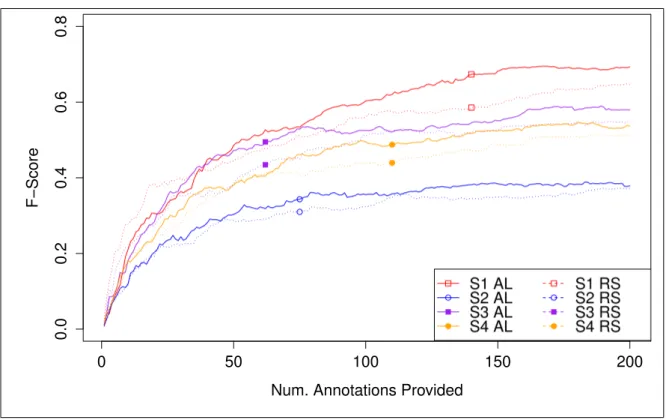
4.4 Learning Curve for Opportunity; Legend: S1 – Subject 1, AL – Online Active Learning, RS – Random Selection.. . . 90
4.5 Active Learning versus Random Sampling on Opportunity. Average performances. . . 91
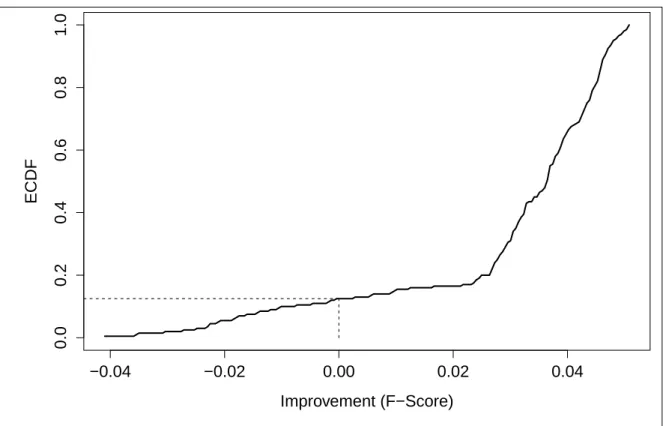
4.6 Performance gain on Opportunity due to Active Learning. Empirical Cumulative Distribution Function. . . 92
4.7 Comparison of annotation effort; Opportunity Subject 1. . . 93
4.8 Comparison of annotation effort; Opportunity Subject 2. . . 93
4.9 Comparison of annotation effort; Opportunity Subject 3. . . 94
4.10 Comparison of annotation effort; Opportunity Subject 4. . . 94
4.13 Active Learning versus Random Sampling on USC-HAD. Performance
ECDF comparison between γ = 2 andγ = 6. . . 100
4.14 Active Learning versus Random Sampling on PAMAP. Average performance for 1-frame segments.. . . 101
4.15 Active Learning versus Random Sampling on PAMAP. Performance ECDF comparison between γ = 2 andγ = 6. . . 102
4.16 Active Learning versus Random Sampling on USC-HAD. Average performance for automatically delineated segments. . . 104
4.17 Active Learning versus Random Sampling on USC-HAD. Performance contrast between 1-frame segments and imperfect segments. . . 104
4.18 Active Learning versus Random Sampling on PAMAP. Average performance for automatically delineated segments. . . 105
4.19 Active Learning versus Random Sampling on PAMAP. Performance contrast between 1-frame segments and imperfect segments. . . 105
4.20 Active Learning versus Random Sampling on PAMAP. Average performance for balanced activity classes (initial class distribution). . . 107
4.21 Active Learning versus Random Sampling on PAMAP. Training set class label entropy for balanced activity classes (initial class distribution).107 4.22 Active Learning versus Random Sampling on PAMAP. Average performance for imbalanced activity classes (artificially imbalanced class distribution). . . 108
4.23 Active Learning versus Random Sampling on PAMAP. Training set class label entropy for imbalanced activity classes (artificially imbalanced class distribution). . . 109
5.1 The Ignorant Classifier Problem. . . 121
5.2 NAD Probabilities of Generating Annotation Requests (Logarithmic Scale) . . . 124
5.3 NAD Usage Throughout the Experiment. . . 125
5.4 Training with boostrap aggregation. . . 126
5.5 Updating with modified boostrap aggregation. . . 126
5.6 App data flow diagram. . . 128
5.7 App Screens . . . 131
5.8 Average Learning Curves . . . 135
5.9 Distribution of Annotation Requests (Averaged Across Participants) . . 136
6.3 Online Learning under Budget Constraints - Exponential Distribution . 162 6.4 Budget-Based OAL; Opportunity Dataset; Uniform Strategy; 200
Budget Units; (S1 – Subject 1; AL – Online Active Learning; RS – Random Selection); Frequency: Theoretical (blue), Actual (grey) and ARMA (red); Cumulative Distribution: Theoretical (blue dotted) and Actual (black solid). . . 165 6.5 Budget-Based OAL; Opportunity Dataset; Exponential Strategy
(λ= 2); 200 Budget Units; (S1 – Subject 1; AL – Online Active Learning; RS – Random Selection); Frequency: Theoretical (blue), Actual (grey) and ARMA (red); Cumulative Distribution: Theoretical (blue dotted) and Actual (black solid). . . 166 6.6 Budget-Based OAL; Opportunity Dataset; Exponential Strategy
(λ= 3); 200 Budget Units; (S1 – Subject 1; AL – Online Active Learning; RS – Random Selection); Frequency: Theoretical (blue), Actual (grey) and ARMA (red); Cumulative Distribution: Theoretical (blue dotted) and Actual (black solid). . . 167 6.7 Budget-Based OAL; PAMAP Dataset; Uniform Strategy; 200 Budget
Units; Frequency: Theoretical (blue), Actual (grey) and ARMA (red); Cumulative Distribution: Theoretical (blue dotted) and Actual (black solid). . . 169 6.8 Budget-Based OAL; PAMAP Dataset; Exponential Strategy (λ = 2);
200 Budget Units; Frequency: Theoretical (blue), Actual (grey) and ARMA (red); Cumulative Distribution: Theoretical (blue dotted) and Actual (black solid). . . 170 6.9 Budget-Based OAL; PAMAP Dataset; Exponential Strategy (λ = 3);
200 Budget Units; Frequency: Theoretical (blue), Actual (grey) and ARMA (red); Cumulative Distribution: Theoretical (blue dotted) and Actual (black solid). . . 171 6.10 The effect of the β parameter on pbudgetask . . . 175 6.11 Budget-Based OAL with Additional Constraint (β = 0.1);
Opportunity Dataset; Uniform Strategy; 200 Budget Units; (S1 – Subject 1; AL – Online Active Learning; RS – Random Selection); Cumulative Distribution: Theoretical (blue dotted) and Actual (black solid). . . 177 6.12 Uniform Strategy; Opportunity Dataset; Distribution of Annotations
(Zoom-In). . . 178 6.13 The Fractional Under-spending Phenomenon . . . 179
Subject 1; AL – Online Active Learning; RS – Random Selection); Cumulative Distribution: Theoretical (blue dotted) and Actual (black solid). . . 180 6.15 Budget-Based OAL with Additional Constraint (β = 1); Opportunity
Dataset; Uniform Strategy; 200 Budget Units; (S1 – Subject 1; AL – Online Active Learning; RS – Random Selection); Cumulative
Distribution: Theoretical (blue dotted) and Actual (black solid). . . 181 6.16 Budget-Based OAL with Additional Constraint (β = 0.1);
Opportunity Dataset; Exponential Strategy; 200 Budget Units; (S1 – Subject 1; AL – Online Active Learning; RS – Random Selection); Cumulative Distribution: Theoretical (blue dotted) and Actual (black solid). . . 182 6.17 Exponential Strategy; Opportunity Dataset; Distribution of
Annotations (Zoom-In). . . 183 6.18 Budget-Based OAL with Additional Constraint (β = 0.5);
Opportunity Dataset; Exponential Strategy; 200 Budget Units; (S1 -Subject 1; AL - Online Active Learning; RS - Random Selection); Cumulative Distribution: Theoretical (blue dotted) and Actual (black solid). . . 184 6.19 Budget-Based OAL with Additional Constraint (β = 1); Opportunity
Dataset; Exponential Strategy; 200 Budget Units; (S1 - Subject 1; AL - Online Active Learning; RS - Random Selection); Cumulative
Distribution: Theoretical (blue dotted) and Actual (black solid). . . 185 6.20 Budget-Based OAL with Additional Constraint (β = 0.1); PAMAP
Dataset; Uniform Strategy; 200 Budget Units; Frequency: Theoretical (blue), Actual (grey) and ARMA (red); Cumulative Distribution:
Theoretical (blue dotted) and Actual (black solid). . . 186 6.21 Budget-Based OAL with Additional Constraint (β = 0.5); PAMAP
Dataset; Uniform Strategy; 200 Budget Units; Frequency: Theoretical (blue), Actual (grey) and ARMA (red); Cumulative Distribution:
Theoretical (blue dotted) and Actual (black solid). . . 187 6.22 Budget-Based OAL with Additional Constraint (β = 1); PAMAP
Dataset; Uniform Strategy; 200 Budget Units; Frequency: Theoretical (blue), Actual (grey) and ARMA (red); Cumulative Distribution:
Theoretical (blue dotted) and Actual (black solid). . . 188 6.23 Uniform Strategy; PAMAP Dataset; Distribution of Annotations
(Zoom-In). . . 189 6.24 Budget-Based OAL with Additional Constraint (β = 0.1); PAMAP
Dataset; Exponential Strategy; 200 Budget Units; Frequency: Theoretical (blue), Actual (grey) and ARMA (red); Cumulative
Theoretical (blue), Actual (grey) and ARMA (red); Cumulative
Distribution: Theoretical (blue dotted) and Actual (black solid). . . 191 6.26 Budget-Based OAL with Additional Constraint (β = 1); PAMAP
Dataset; Exponential Strategy; 200 Budget Units; Frequency: Theoretical (blue), Actual (grey) and ARMA (red); Cumulative
Distribution: Theoretical (blue dotted) and Actual (black solid). . . 192 6.27 Exponential Strategy; PAMAP Dataset; Distribution of Annotations
(Zoom-In). . . 193 7.1 Complementing Online Active Learning (OAL) with Other
3.1 Final recognition accuracies (F-scores; Opportunity challenge test set) for different budget configurations under ideal segmentation. . . 64 3.2 Recognition performance as a function of budget configuration. Real
segmentation. . . 70 4.1 Summary of Opportunity Equi-Performance Lines . . . 95 5.1 Volume of annotations as a percentage of total number of detected
1
Introduction
Contents
1.1 Introduction . . . 2
1.2 Health – A Case for Physical Activity Recognition . . . 2
1.2.1 Interventions . . . 3
1.3 Personalising Wearable Devices . . . 5
1.3.1 HAR System Usage . . . 7
1.4 Contributions . . . 13
Introduction
One of the key promises of Weiser’s vision of pervasive computing has been the prospect of disappearing technologies that “weave themselves into the fabric of everyday life un-til they are indistinguishable from it” [3]. Tremendous progress has already been made towards making this vision a reality where smart environments, living labs, and espe-cially mobile computing now constitute the central paradigm of this third generation of computing [4]. As an enabling technology, automatic inference of the context and es-pecially of the activities humans are engaged in (Human Activity Recognition – HAR) plays a central role in a large plurality of pervasive and mobile computing applications.
Health – A Case for Physical Activity Recognition
HAR is primarily an observational tool suitable for monitoring lifestyle. By identify-ing certain patterns, such as damagidentify-ing behaviours, one has the possibility of changidentify-ing them by prioritising certain lifestyle decisions. A common damaging behaviour is gen-eral physical inactivity which has been linked with serious health conditions including cardiovascular disease [5,6], diabetes [7–9], colon cancer [10], obesity [11] or depression [12]. According to the World Health Organization, the incidence of such cases could be reduced if physical inactivity was less pervasive [13].The prevalence of these medical conditions has far-reaching consequences on how soci-ety functions and sustains itself. For example, according to Hex et al. [14], in 2010/2011 the economic cost incurred by the UK’s National Health Service (NHS) for treating diabetes stood at £9.8bn for direct treatment and an additional £13.9bn for treating complications. The cost is projected to rise by 2035/2036 to £16.9bn for direct treat-ment and £22.9bn for treating complications. In fact, diabetes accounts for approxi-mately 10% of the total health expenditure for 2010/2011 and the share is expected to rise to 17% in 2035/2036, according to the same source.
Astronomical health care costs are not singular to diabetes. In the UK, the healthcare costs for major conditions partly caused by physical inactivity are still in the order of billions of pounds: cardiovascular disease cost £8.6bn in in 2009 [15], while cancer
cost£5.81bn in 2010/20111. It is estimated that between 1.5% to 3% of the healthcare costs in developed countries is directly accounted for physical inactivity [16]. Physical inactivity is also correlated with obesity [17], smoking [18, 19] or hazardous alcohol consumption [20], each of which adds costs of the order of billions of pounds to NHS expenditure [21]. With the UK GDP at£1800bn2, the cost of addressing diabetes and other serious illnesses rises to single-figure percentages of the GDP.
According to Lee et al. [22], at a worldwide level, physical inactivity is estimated to cause 6% of the cases of coronary heart disease, 7% type 2 diabetes, 10% breast cancer and 10% colon cancer. In the UK, according to the same source, the effects are more pronounced: 10.5% for coronary heart disease, 13% for type 2 diabetes, 17.9% for breast cancer and 18.7% for colon cancer. With physical inactivity being linked to serious medical conditions in double-figure percentages of all cases, it is clear that society should strive to combat physical inactivity.
Interventions
People who are sedentary for long periods of time, such as office workers, face addi-tional health risks. Sitting down for extended periods of time has been identified as a health risk promoter, even for people who are otherwise physically active [23, 24]. Prolonged sitting can affect not only by causing physical discomfort, such as, for ex-ample, muscoskeletal pain [25], but can also have serious health repercussions, such as increased cardiovascular risk [26] or coronary heart disease [27].
As a whole, the negative societal impact of these medical conditions, which is partly caused by physical inactivity, is set to increase and cannot be ignored. Therefore, at this point in time, it is justified to allocate research resources to combat these medical conditions, not only directly through treatment, but also indirectly, by addressing the causes, such as reducing physical inactivity.
1
https://www.gov.uk/government/publications/2003-04-to-2010-11-programme-budgeting-data - Accessed 06.05.2015
2http://www.imf.org/external/pubs/ft/weo/2015/01/weodata/weorept.aspx?pr.x=83&pr.
y=16&sy=2015&ey=2015&scsm=1&ssd=1&sort=country&ds=.&br=1&c=193%2C273%2C223%2C156% 2C924%2C922%2C132%2C184%2C134%2C534%2C536%2C136%2C158%2C112%2C111%2C542&s=NGDPD% 2CPPPGDP&grp=0&a=- IMF estimates; Accessed 27.05.2015
Research efforts include interventionary actions at the workplace to interrupt long sitting times and promote other less sedentary behaviour such as standing. These interventions were shown to be effective not only in changing behaviour in the short term [28, 29], but also in reducing muscoskeletal pain symptoms [30–32]. It has been suggested by Dunstan et al. [33] that short and regular interventions which break sitting times with walking may reduce cardiovascular risk.
Office workers are sedentary a great deal of time, so the office is an ideal environment to suppress physical inactivity and to promote healthier behaviours. Therefore, short breaks from sitting, either by standing or by performing some form of physical exer-cise, can have substantial effects in increasing physical comfort and maintaining good health. However, these interventions are naturally disruptive. While it is beneficial for office workers, for example, to regularly break their sitting times, this is not in their short-term interest and, in addition, the benefits are not immediate. Without instant gratification, it is questionable that office workers would voluntarily remember to comply with the intervention protocol.
Consequently, in order to ensure greater compliance, these interventions can be sup-ported by appropriate technological means. We argue therefore that technology can be part of the solution. An enormous body of research, which has been dedicated to the general problem of inferring context, has shown that HAR technology and techniques can meet the needs for self-monitoring. For instance, it is now possible to measure one’s expended energy [34–37] or register individual activities [37, 38]. In fact, multi-ple dimensions of wellbeing can be monitored in parallel, such as sleep patterns, social interaction and physical activity [39]. The user’s tracked behaviour can be summarised in order to monitor progress and improve the intervention compliance. HAR can also help with tracking behaviours which are symptomatic to serious underlying conditions, such as, diabetes [40] or Alzheimer’s Disease [41].
Insight into what is worth monitoring and how to do so can be gained from the adher-ents of the Quantified Self [42] community. These are individuals who track different aspects of their life including sleep, dieting or time management and some of whom are also inspired by the prospects of tracking physical activities. Choe et al. [43] show that physical exertion is one of the top tracked objectives for quantified selfers. The
reasons may lie with the desire to self-improve in different physically demanding ac-tivities, such as sports or athletics, but they may also lie with maintaining an active and healthy lifestyle and the benefits it brings.
HAR applications do not necessarily have to be strict monitors, but they can encourage certain behaviours. This was demonstrated by Consolvo et al. [44] who have deployed a system that displayed pleasant video feedback when the user attained certain physical exertion goals. The authors report that most of their user study participants thought the system would motivate physical exertion.
Once compliance is ensured and time is allocated to physical activity, then our goal is to use HAR and to maximise its effects. Performing certain physical activities, such as fitness ones, is a skill that can be improved with correct technique. Instead of personal trainers, which may be a limited and expensive resource, HAR can be used to automatically assess and provide feedback for such activities [45].
An important factor that led to the adoption and study of HAR by the research community is the large scale adoption of consumer-grade wearable technology. The wearables industry is developing to serve a considerable market of consumers. Ac-cording to uk.businessinsider.com[46], 33 million units are going to be shipped by the end of 2015. The size of the wearables market is on an upward trend with sales expected to grow yearly by 35% until 2019, when a predicted 148 million units are going to be shipped annually.
Personalising Wearable Devices
Given our societal need to reduce physical inactivity and the increasingly widespread use of wearable devices, HAR is becoming an enabling technological driver for personal interventions that can prevent or correct damaging behaviours. Activity recognition may be further improved if the wearable devices are personalised, i.e. adapted to the user’s lifestyle or movement idiosyncrasies. This is explained in greater detail in Chapter 2.
The overarching concept we investigate in this thesis is user feedback as a form of knowledge that can be used to personalise HAR models. We make the hypothesis that
it is possible to construct fully personalised HAR models from gradual user feedback, by starting from either zero or relatively little prior knowledge.
A HAR model is a description of a set of a user’s physical activities. The types of models we are concerned with in this thesis aremachine learning models, as discussed in Chapter 2.4. Specifically, we focus on the user’s HAR model which monitors the user’s stream of physical activities. In this context, a user’s model is an operational description of the user’s physical activities which is used within a HAR monitoring system to estimate what activities are exerted by the user. The type of model of we investigate throughout this thesis are classification models – models that output estimates over a discrete set of labels. We use terms model, classification model and
classifier interchangeably to designate the user’s HAR model. In this respect, and as discussed in Section 2.2, a personalised model is a model which is constructed or adapted in such a way so as to better monitor the target user, without regard to a larger pool of separate users. When it comes to training personalised models, we apply (1) semi-supervised machine learning techniques (introduced in Chapter 2 and investigated in Chapters3-6) to collect personalised training sets and (2) standard su-pervised techniques to infer the parameters of standard classification models (outlined in Chapter 2).
If this hypothesis is correct, then the user of the HAR system is in control of person-alising her model. Continuous personalisation leads to improved activity monitoring relative to previous versions of the model. Because this technical improvement even-tually translates into improved wellbeing to the user, the user might be motivated to participate in personalising her own HAR model. Additionally, as we demonstrate in this thesis, the user can personalise her own model without external assistance, such as a researcher or video footage of her activities. This not only frees researchers from the costly process of labelling another person’s data, but also potentially allows user-led labelling at a much larger scale than would be possible with external supervision. Also, as we show in this thesis and also by means of existing research, in many situations, personalised models are more accurate than non-personalised models.
Personalising HAR models is a challenging research problem because user feedback is a valuable, but, at the same time, scarce resource. Exploiting it presents a problematic
trade-off because, on the one hand, the more user input is requested, the greater the personalisation, but, on the other hand, asking for feedback from a user is disruptive, so the user should not be interrupted excessively. The difficulty, therefore, lies in identifying the most critical inputs to request from the user and this creates two-fold complications: Firstly, the requests for feedback should be simple and timely enough for the user to answer, but, at the same time, critical enough to warrant interrupting the user. As shown in Chapter 2, we rely on the user’s short-term memory to obtain personalising feedback and this entails severe time restrictions over what the user can reliably provide. Secondly, the frequency and volume of input requests, even if all are highly critical, should not cross user interruption boundaries.
In this thesis we demonstrate different solutions of obtaining feedback from a user and personalising her model in the context of several case studies. Encouraged by our positive results, we argue that our methods may be applicable to a wider range of HAR classes of applications.
HAR System Usage
Previously we have argued about the benefits of personalising HAR models and pro-posed that personalisation could be achieved through user feedback. In this section we go into more detail. We first illustrate how general HAR systems work without per-sonalisation. Afterwards, we propose a mechanism of personalisation and look at the consequences of our proposed mechanism of personalisation. To this end, we illustrate how we envisage the process of HAR model personalisation from user feedback and we exemplify it through a hypothetical scenario involving a fictitious character. We draw parallels between and contrast a generic non-personalisable HAR system and a personalisable one. We consider how personalisation affects the system usage and user interaction.
System Usage – without Personalisation
Consider Anya – a typical office worker who is conscious about her health. Because her work involves long periods of physical inactivity, she uses a generic wearable physical activity tracker to monitor her levels of physical activity throughout the day. She relies
on accurate reports so that she can break long sitting times or compensate physical inactivity at the office with physical exercise after work. The monitor’s functioning is completely passive. Fig. 1.1, which illustrates a schematic of its mechanics, shows that the user does not supply input – Anya merely benefits from passive monitoring. The device uses a “one size fits all” model which gives good results for a limited set of activities and when averaged across a large population. However, the model may not be very accurate for Anya in particular because some of her favourite physical activities and her general movement idiosyncrasies are not taken into account.
Therefore, without personalisation, the model does not account for user-specific char-acteristics, such as idiosyncrasies or lifestyle specifics. A generic system that supports personalisation is illustrated in Fig. 1.2. Key user aspects can be captured via model personalisation and this is expected to improve the recognition accuracy.
System Usage – with Personalisation
In this thesis we propose that HAR model personalisation is achieved through active user participation. Specifically, we envisage a HAR monitor that parsimoniously in-teracts with the user by requesting feedback which is then used to further personalise the user’s model. The type of personalising feedback we choose to obtain from the user areannotations. This format, discussed in detail in Chapter2, assigns an activity label to recorded signal data and can be used directly to personalise HAR models. We use annotations throughout the rest of the thesis to train personalised models under different scenarios and to evaluate their recognition performance.
Because the only types of HAR models investigated here are classification models, intuitively, we use recognition success rate as a measure of HAR monitoring perfor-mance. We use other similar terms, such as model performance, model improvement classification accuracy, interchangeably. The objective measure behind recognition success rate is F-Score and it is formally defined in Section 3.3.23, i.e. what insight
can an expert gain from examining the parameters of such a model.
3Models are therefore distinguished between themselves on a prediction-based criterion (i.e. how
successful the recognition of activities is). An alternative method of comparing models, albeit more
Such a personalising system, shown in Fig. 1.3, can automatically diagnose when feedback is most needed, but can also take into account the user’s propensity towards interruption so that the provision of annotations is not overly taxing on the user. Now that the system supports personalisation, this brings about a new pattern of usage of the system, as illustrated in Fig. 1.4. With the addition of the annotation step, we reroute the natural data flow of a generic HAR application to form a closed circuit so that it can support progressive model personalisation.
Continuing our example, Anya decides she is willing to respond only to a very limited number of annotation requests and, for instance, preferably evenly spread out through-out the day. We discuss in Chapter 2the user’s propensity to provide annotations on demand. We accept that the user’s tolerance towards annotation interruptions is a finite resource, so annotation strategies should account for limited compliance. There-fore, we introduce the concept of a budget of annotations that models the sparsity of input which the user could provide. The effects of budget-constrained annotation methods are evaluated in Chapters 3 and 6.
We further propose that annotations are produced online, i.e. while the system is being used and the activities are being monitored. This is a crucial distinction to other proposals which focus on offline annotations, i.e. the annotations are attributed upon retrospective inspection of the data and other sources of information such as video footage. We argue against offline approaches in Chapter 2 because they require extensive supporting infrastructures and support from other researchers or expert an-notators. Instead, by focusing on online annotations, users can easily resort to their short-term memory to parsimoniously annotate their most recent activities. As ex-plained in Chapter 2, offline approaches are not compatible with a very short term user memory.
In our example, suppose that Anya is on a break from working at her desk and she starts performing a series of regular torso movements. This is a new exercise that has been recently suggested to her and she hasn’t done it before, or has done it only a few times, and this would be insufficient for accurate monitoring. The system runs a fully automated procedure (one that does not require user feedback) to diagnose its performance at classifying the activity. Because the system has no or limited data
on this activity, it performs relatively poorly at recognising the activity, so it decides that an annotation for this activity is important for improving Anya’s HAR model. As soon as the system detects the end of this problematic activity, it issues an annotation request to Anya for that activity. Anya does not have to recall into the distant past and does not have to fall back to memory aids such as video footage. Instead, she can easily remember what she was doing just seconds before the annotation request. Going further with the example, after Anya is done with her torso exercise and provides an annotation, she heads down to the common room to make herself some tea. The system now detects she is walking and, because it already has several annotations for this more common activity, it recognises the activity with very little uncertainty. Consequently, the system decides not to ask Anya to annotate the activity, so she proceeds uninterrupted.
Anya turns on the kettle and, while the water comes to boil, she performs again the torso exercises. However, she had previously set up her HAR monitor to issue annotation requests only very infrequently while she is at work. The HAR model still diagnoses itself as not very adequate at classifying this exercise, but it suppresses its current annotation request so that Anya does not become annoyed.
Considering the mechanics of the system, because it is now interactive, the pattern of usage changes partially. In this case, the user is expected to engage occasionally to provide annotations. Anya still relies on fully automated, passive and, for the most part, non-intrusive activity recognition, but now the system occasionally asks her to provide feedback which aids model personalisation. The mechanics of how an annota-tion is deemed useful by the system – using active learning – is introduced in Chapter 2 and is a core concept which is evaluated in Chapters 4, 5 and 6. However, as we discuss in Chapter 2, previously studied offline active learning methods are inappli-cable to our scenario because, effectively, they are at odds with our assumption of limited user memory recall. Instead, we apply an online method, called Online Active Learning (investigated by Sculley [48]), which is able to identify critical annotations even when operating over an extremely limited horizon of choices. In our case, the horizon is limited to a single potential annotation at any one time which is the most recently finished activity.
Physical
Exertion
Monitoring
Model
Figure 1.1: Typical HAR Monitoring.Physical
Exertion
Personalization
Monitoring
Model
Physical
Exertion
Interruption
Annotation
Monitoring
Model
Personalization
Figure 1.3: HAR Monitoring with User-Provided Annotations for Model Personalisa-tion.
Personalization
User Data
+
Annotation
Performance
HAR Application
drives
justifies
generates
improves
Contributions
We claim that HAR models can be personalised from user-provided online annotations and throughout this thesis we use experiment-based approaches to support our claim. As underlined previously, online annotations can be more easily supported than offline annotations because online annotations can be provided by the users themselves while resorting only to their short-term memory.
In our scenarios we start either from zero knowledge, i.e. the system does not know anything about the user and it does not have any of the user’s annotations, or from a relatively small corpus of annotations. With each annotation the user provides, we
bootstrap the model – we update or reconstruct the model so that it accounts for the newly updated corpus of annotations.
We use a core concept, Learning from Online Annotations, to designate the process of model induction from the annotations the user parsimoniously provides while using the system. We introduce several methods and a complete system implementation and we assess different aspects of our core concept, as illustrated in Fig. 1.5.
The principal assumption of our work is a technological evolution of physical activity trackers. Even though, currently, activity trackers are usually passive sensing devices, we propose to augment them with user interaction capabilities, so that the they can engage with the user to learn from personalising feedback.
The contributions in this thesis are as follows:
Firstly, we model a user’s limited and varying propensity of providing annotations by introducing the concept of a Budget of Annotations. We issue annotation requests strictly according to the user’s predisposition towards interruptions, but without ac-counting for the importance of each potential annotation towards model improvement. We evaluate the impacts of the user’s predisposition on the recognition performance of the user’s personal HAR model in Chapter 3.
Secondly, in Chapter 4 we exploit the observation that not all annotations increase model accuracy by equal amounts. Here we shift focus from the user’s predisposi-tion entirely to the importance potential annotapredisposi-tions have for model improvement.
Online Learning from User-Provided Annotations
Online Active Learning
- simulation-based experiment - learning performance evaluation
Chapter 4 Budget-based Online Learning
- simulation-based experiment - learning performance evaluation
Chapter 3
Online Active Learning - field study deployment
- learning performance evaluation - user feedback assessment
Chapter 5 Budget-based Online Active Learning
- simulation-based experiment - learning performance evaluation
Chapter 6
Figure 1.5: Roadmap of Contributions.
Because some annotations are more beneficial towards model accuracy improvement, we propose to use Online Active Learning, a method of identifying highly promising annotations (from a model improvement point of view) from a stream of activities. We obtain online annotations which clearly distinguishes our work from other Active Learning methods which typically identify offline annotations, as explained in Chapter 2. Our results demonstrate that performance gains on recognition performance can be obtained by using our Online Active Learning approach to accumulating annotations. Encouraged by these results, in Chapter 5, we provide a complete system implemen-tation of our Online Active Learning method for HAR and we deploy the system within the setting of a naturalistic user study. We propose a HAR framework that incorporates a suite of methods supporting Online Active Learning and implement a mobile application for online activity recognition using body-worn wireless sensors. The results are threefold:
1. the deployment of our system in a user-centred field study shows that modern mobile platforms could support our concept implementation and, so, it serves as
proof of concept for our Online Active Learning method;
2. post-experiment analysis shows that models improve their recognition accuracy as they are increasingly personalised. Therefore Online Active Learning method is robust enough to operate under realistic conditions, not only under simulated conditions as in Chapter 4;
3. the compilation of subjective user feedback on interacting with the system reveals that Online Active Learning is disruptive and taxing on user tolerance, but not necessarily excessively, so it can arguably be adopted in moderation to drive model personalisation.
Finally, in Chapter 6, we propose a hybrid criterion of requesting input that combines the Online Active Learning method from Chapters 4 and 5 with the Budget-based online learning method from Chapter3. Our results show that the seemingly compet-ing Online Active Learncompet-ing and Budget-based online learncompet-ing methods can actually be blended to yield, on the one hand, active learning-specific performance gains while, on the other hand, still closely adhering to the limitations of an imposed budget of annotations.
Overall, as we show in Fig. 1.6, we are, roughly speaking, exploring a two-dimensional space of parameters for our annotation method of obtaining online annotations and evaluating the effects on HAR model performance.
Thesis Organisation
The rest of the thesis is structured as follows. In Chapter 2we provide an overview of the state of the art in HAR model personalisation and related directions of research. In Chapter 3we present an exploration of the effects of a budget-based online learning strategy that models a user’s tolerance towards interruption. After that, we temporar-ily depart from budget constraints and instead focus on Online Active Learning as a method to identify important annotations for model improvement. In Chapter 4 we provide simulation-based experiments to evaluate Online Active Learning, while in Chapter 5we test the feasibility of the method on a live user study. In Chapter 6 we
Model Performance Interruptions Importance of Annotations
Ch. 6
Ch. 4 & 5Ch. 3
Figure 1.6: Parameter Space of the Annotation Method.
unify the budget idea from Chapter 3 and the Online Active Learning from Chapters 4and 5. Finally, in Chapter7we reflect upon our contributions and place them in the context of future exploration.
2
Foundations
Contents
2.1 Introduction . . . 18
2.1.1 Definition of an Annotation . . . 18
2.1.2 Our Contributions in Context . . . 18
2.1.3 Chapter Outline . . . 20
2.2 Obtaining Annotations . . . 21
2.2.1 Retrospective Annotations. . . 21
2.2.2 User-Generated Annotations . . . 22
2.2.3 Relation to our Work . . . 27
2.3 The User’s Perspective . . . 27
2.3.1 Interrupting the User . . . 28
2.3.2 Budget of Annotations . . . 29
2.3.3 Relation to our Work . . . 30
2.4 Machine Learning . . . 30
2.4.1 Sensor Data Acquisition . . . 31
2.4.2 Preprocessing and Feature Extraction . . . 32
2.4.3 Activity Segmentation . . . 33
2.4.4 Model Building and Classification . . . 34
2.4.5 Relation to our Work . . . 34
2.5 Learning Methodologies for Model Building . . . 35
2.5.1 Unsupervised Learning . . . 36
2.5.2 Semi-Supervised Learning . . . 36
2.5.3 Active Learning. . . 39
2.5.4 Relation to our Work . . . 43
2.6 Machine Learning in HAR Applications . . . 44
2.6.1 Using Active Learning . . . 44
2.6.2 Mobile and Continuous Monitoring . . . 45
2.6.3 Relation to our Work . . . 46
Introduction
In the previous chapter we presented the motivation behind our research and a general overview of the significance of the contributions in this thesis. In this chapter we provide the research background for the rest of the thesis.
Because constructing personalised HAR models through user input only and without external supervision is a complex multi-stage problem, a series of inter-related design choices have to be made. In this chapter, for all design decisions we make in future chapters, we consider relevant related and background research.
Definition of an Annotation
For a continuous timeseries of sensor readings which capture movement about physical activities, we define anannotation as a labelled contiguous subsequence of sensor data which is representative for the underlying activity. An annotation therefore consists, in part, of a start timestamp and an end timestamp which designate the first and, respectively, the last readings of a segment – the contiguous sub-timeseries that cor-responds to the underlying activity. In addition, an annotation carries a segment label
– a name of the respective activity class.
The annotations are collected into a training set which is then used to construct a HAR model. Further details concerning how this is achieved are presented in Section 2.4.4.
Our Contributions in Context
Supervised learning is a dominant approach for HAR applications. However, obtaining reliable and sufficient ground truth annotations for training data is challenging, largely due to practical as well as ethical reasons, especially in mobile ubiquitous computing settings.
We involve the user in the annotation process and, like Intille et al. [49], we propose that users parsimoniously provide annotations for their own activities. We therefore remove expert annotators and other external sources of ground truth, such as video
footage, from the annotation process and, pass the responsibility of annotation to the prospective users of the HAR system themselves. The annotations are then used to construct fully personalised HAR models for each user in turn. This style of anno-tation provision and others are explicated in Section 2.2. As discussed in Chapter 1, even though user engagement entails disruption, users would arguably be moti-vated to interact with the system and provide annotations because this would lead to improved monitoring accuracy. User disruptions, their effects and mechanisms to alleviate annoyance are discussed in Section 2.3.
In this thesis we are concerned only with wearable HAR systems. By definition, these are attached and in close proximity to the user and, so, they can be carried across different environments. Not only do they have to provide effective monitoring by design, but the mechanism for collecting annotations should also function regardless of where the user may be. Since not all contexts will be instrumented, external sources of ground truth such as video footage are not always available and so they cannot be relied upon.
A key source of ground truth for annotations, therefore, is the user’s short-term mem-ory. We propose an interactive HAR system which makes use of this recent human memory in order to obtain annotations for the user’s own activities. The activities at which annotation requests are aimed need to have occurred very recently; otherwise, as Eisen et al. [50] show, human memory recall deteriorates with the passage of time. In order to simplify the annotation process and to increase the robustness in user feedback, we only target the last activity the user performed. In Section 2.2.2 we use existing research to show that such timely feedback can accurately represent reality. In fact, with the benefit of hindsight, according to the results in Chapter 5, the event is so recent, that users have no problems remembering.
In Section 2.5.3 we use supporting literature to show that not all annotations are equally beneficial in terms of accuracy. Before prompting the user to provide an annotation, it is possible to estimate its potential performance gains using a learning methodology called Active Learning [51]. Learning methodologies in general, including active learning, are discussed in 2.5.
Active Learning, one needs to compromise on a technical level. For example, a widely used class of active learning techniques are pool-based oroffline. These require, at any one time, a relatively large corpus of potential annotations from which to choose the one which is expected to maximise the gain in model accuracy. However, any sizeable sequence of activities would not be robustly recalled by the user because it would be beyond the user’s limited short-term memory. To circumvent this problem, we adopt a stream-based oronline active learning technique developed by Sculley [48]. Instead of operating over a large corpus of potential annotations, this Online Active Learning approach considers only one activity at a time – the most recent one – and decides for each activity in turn whether to annotate it or not.
An interactive HAR monitor that supports collecting user-provided annotations and constructing personalised models is an entire ecosystem of automated procedures and algorithms that ultimately support its core machine learning-related functionality. Consideration to the characteristics of auxiliary functions and the technological impli-cations of HAR systems is given in Section 2.6.
Chapter Outline
Having established our contributions and the necessary context for them in Section 2.1.2, we proceed to outline the rest of the chapter:
• Section 2.2 Obtaining Annotationsdiscusses different types of annotations in human activity recognition. We focus on how the acquisition mechanism of an-notations affects not only the quality of the anan-notations, but also the interaction mechanism with the user
• In Section 2.3 The User’s Perspective we outline key ideas in how users perceive interruptions. Additionally, in order to exploit the user’s emotional variations towards interruptions, we draw inspiration from existing research on the notion of abudget of annotation – treating interruptions as a finite resource.
• In Section 2.4 Machine Learning we discuss general mechanisms of creating HAR models from annotated data. We review a pipeline of data processing and
model building which is routinely used in HAR research and which we also use in this thesis.
• Section 2.5Learning Methodologies for Model Learningdeals with more advanced Machine Learning concepts. While the previous section (2.4) deals with supervised model building methods, we now investigate unsupervised and semi-supervised methods. A semi-semi-supervised method of particular importance to our thesis is Active Learning. In this section we describe the model accuracy benefits that Active Learning can bring and we also discuss how to adapt Active Learning to our proposed annotation mechanism.
• Finally,Section 2.6 Machine Learning in HAR Applicationsgives a prac-tical perspective of applying machine learning for HAR and techniques used in this thesis.
Obtaining Annotations
Personalising activity models, i.e. fine-tuning a model to the user being monitored, has been shown to lead to improved recognition accuracy over non-personalised models, for example by Lane et al. [52]. Personalisation, and therefore model improvement, can be obtained directly from gradually accumulating personalised annotations about a user, as Rebetez et al. [53] show, or by leveraging existing corpora of non-personalised data that can supplement the personalised annotations, like, for example, Cook et al. [54] or Stikic et al. [55]. Obtaining annotations is a critical step towards model improvement and different methodologies of collecting annotations exist.
Retrospective Annotations
In HAR research, typically, while movement data is readily collected through sensors, the participants are observed by a researcher who annotates the data as the user’s activities are performed, like Lester et al. [56] or Morris et al. [57], or by examining retrospective video footage of the participants, like Chavarriaga et al. [38] or Pham and Olivier [58].
An example tool for annotating used in HAR is ELAN [59]. It allows expert annotators to synchronise the video ground truth with sensor data and then to annotate the sensor data: they inspect the ground truth, establish temporal segment boundaries and declare the label for identified segments.
Retrospectively annotating activity data is suitable for one-off research investigations, such as collecting a dataset of annotations for offline analysis. However, in more realistic settings, this approach presents several limitations:
• Because of the involvement of an expert annotator, retrospective annotation does not scale well to increasing user bases because this requires increasing the team of annotators proportionally. Bagaveyev and Cook [60] and Lasecki et al. [61] have suggested crowdsourcing the annotation task. While this approach removes the bottleneck in human annotation, extensive ground truth in the form of video footage still needs to be collected, which can still limit the context of the anno-tations.
• The possibility to annotate is limited to the environment where the ground truth collection infrastructure is present. This greatly reduces what can be annotated and annotations may not be representative of a user’s entire lifestyle. Portable cameras are a possibility (for instance, Maekawa et al. [62] suggest computer vision techniques to assist automated activity recognition), but, examining video footage is arguably tedious and time consuming, so users may not participate in the annotation process as much.
• If examined by a human annotator, the collection of video footage may be a source ground truth for annotations, but it may also be revealing in unexpected ways and so video footage can raise serious privacy concerns.
User-Generated Annotations
Retrospective methods typically do not involve the users in the annotation process and instead require external assistance from expert annotators. The ubiquitous computing research community has recognised the importance of leveraging user-generated an-notations. Similarly to Intille et al. [49], we also propose that users, not researchers,
occasionally provide annotations for their own activities as they happen. Engaging di-rectly with the users (1) relieves the annotation bottleneck by expert annotators and (2) ensures that the annotations are collected in a more naturalistic context where users do not feel excessively monitored (i.e. by video footage or in the constant presence of a human annotator).
A central issue with user-provided annotation is their timeliness. A self-reporting method, Ecological Momentary Assessment (EMA), described by Smyth and Stone [63], which is also known as Experience Sampling Method (ESM) according to Intille et al. [49, 64], is successfully used in medical research to allow patients to report rele-vant symptoms, conditions or circumstances as and when they occur. Data integrity levels in EMA/ESM are high and Smyth and Stone [63] argue this may be due to the timeliness with which input is given. We too take advantage of this timeliness and we propose that the user takes ownership of annotating some of her own activities as they happen. In addition, we continually monitor user context and identify which activities should be annotated so that the user’s participation translates in optimal model improvement.
Obtaining annotations straight from the users creates opportunities to reinforce or adapt known contexts and to augment the set of contexts. For instance, Nguyen et al. [65] propose to adapt a crowdsourced acoustic model from annotations generated (with-out expert supervision) by the users themselves in the environments they visit. In terms of context augmentation, SoundSense (Lu et al. [66]), uses the microphone on a smartphone to monitor not only predefined categories of sound (speech and music), but also a variable category of ambient sound. The authors use unsupervised learning to automatically discover frequent novel patterns in the user’s monitored data. When such a pattern is identified and if it is dissimilar to previously discovered ones, the user is asked to provide an annotation for it. This approach allows the user to increase the vocabulary of contexts or activities, in similar fashion to Hossmann et al. [67].
Given the typical limited amount of annotations that can be collected through typical observational studies, Kawaguchi et al. [68] proposed collecting physical annotations on a large scale, directly from users. Aided by a smartphone app, users could opt in to generate annotations for their activities with the consent that their data would
be uploaded to a centralised HAR database. Similarly to the authors of ActiServ
Berchtold et al. [69] or Hossmann et al. [67], the user must be conscious about her intention to execute a physical activity. Therefore, the user must first signal on the app that she is about to exert an activity and when the user is done, she must again inform the app as soon as the activity ended. While the interactions with the annotation device are very granular, the advantage of obtaining annotations in this way is that the user is ultimately in control of when annotations are provided – she is not interrupted with potentially intrusive annotations requests.
Some authors recognised that this kind of repetitive input on a smartphone can be te-dious, so voice commands have been proposed instead of tactile input by Harada et al. [70] (VoiceLabel), Hoque et al. [71] (Vocal-Diary) and van Kasteren et al. [72]. van Kasteren et al. [72] report near errorless voice recognition, but Hoque et al. [71] have shown that, in a different context, the precision for some labels can drop to 80%. The added layer of voice recognition may result in additional errors in the activity model. We want to avoid such errors and we suggest that annotations be collected using an unambiguous interface, such as a tap-only interface on a mobile device.
However, using interruptions on a smartphone to require (as opposed to the previ-ous paragraph, where annotations were merely provided by a purely benevolent user) physical activity annotations from users has been also tried before, for example, by Cleland et al. [73], Abdallah et al. [74, 75] and by Miluzzo et al. [76] in the CenceMe
application. As discussed later, in our approach, we apply a heuristic to reduce the number of user interruptions and this distinguishes our work from Cleland et al. [73] or Miluzzo et al. [76] who do not apply heuristics to identify potential annotations which might not make the most of the users’ annotation effort. The differences between our work and Abdallah et al. [74, 75] are more technical (they revolve around the timing of annotations) and they are discussed in detail in Section 2.5.3.
Reducing the number of interactions is known to be an important factor and has been researched (in Section 2.3we discuss some key papers for our work). For example, the authors of YouSense Linnap and Rice [77] define a trade-off between the importance of an annotation and the cost of interrupting the user. Their work, however, is aimed at geo-contexts, so their heuristic function which values geographical coverage is not
applicable to our scenario.
Proactive Annotations
Users may be asked to proactively initiate the annotation process by declaring in advance that they are going to perform an activity and provide a label when the activity will have finished. This may be done for model personalisation, as suggested by Berchtold et al. [69], or simply as part of the experimental protocol for collecting user-provided annotations, as done by van Kasteren et al. [72].
However, by essentially providing an annotation before the usefulness of obtaining that annotation can be estimated, one denies the possibility of directing annotation effort only towards the most promising annotations.
Reactive Annotations
Not all annotations bring equal improvement to the model. This has been shown, for example, by Longstaff et al. [78] and it is a concept we leverage in Chapters 4, 5 and 6 where we seek to find the annotations that overall bring greater performance gains than randomly provided annotations. Annotations are reactive in the sense that the annotation process is initiated after the activity has finished.
Because reactive annotations are, by definition, aimed at activities which occurred in the past, user-driven retrospective annotation techniques (as explicated in Section 2.2.1) could potentially be used with the user performing the role of the annotator. However, either the user benefits from the same ground truth collection infrastructure (since memory recall deteriorates with time [50]) or steps have to be taken to simplify the annotation task.
If the user has the same access to the same collection of ground truth as an expert annotation, she may inspect the video footage and identify segment boundaries and assign activity labels. Nonetheless, the annotation process can be simplified if in addition the segment boundaries can be automatically estimated. This shields the user from the relatively complex task of delineating her own activities and, instead, has to provide only a label for the activity. As we discuss later, activity segmentation
is a difficult problem, and especially so in the absence of prior annotations. In this case, the following reactive annotation scenario is applicable:
1. The system would identify what segments are most useful for annotation (i.e. are expected to bring a relatively large gain in terms of activity monitoring accuracy).
2. The user would then be prompted with ground truth video footage for that segment and would be asked to provide a label.
The techniques that quantify how a segment is deemed “useful” are discussed at length in Section 2.5.3.
Nonetheless, if segment boundaries are detected automatically in real-time or online
and the usefulness of annotating the most recent segment can also be estimated in real-time, as Abdallah et al. [74,75] propose, then the user does not need an infrastructure for ground truth – she may simply use her short-term memory.
In this thesis we present several case studies where we either employ a fully automated online segmentation procedure or assume a perfect online segmentation procedure that produces segments which are suitable for online annotation by the user.
Proactive versus Reactive Annotations
Proactive and reactive annotations differ essentially in the moment in time when an annotation is provided. Proactive annotations are provided before an activity starts, whereas reactive annotations are provided after an activity starts. The timing has important implications on the entire annotation process. Using a proactive approach, segments cannot be assessed in terms of their usefulness because the decision to an-notate precedes the segment. Therefore, in the proactive case, the user needs to guide the annotation process, but this robs the system of the opportunity of annotating the most critical segments, which are the focus of reactive annotation.
However, the two annotation schemes are not exclusive of each other and could be used in tandem. Reactive annotations can be more efficient in terms of accuracy gains
(when compared to proactive annotations), but, as we discuss in Section 2.5, this is true only if there is already enough class diversity in the collected annotations. This initial class diversity can be expanded through proactive annotation, because proactive annotations for completely new activities can help increase the training set diversity which in turn boosts the effectiveness of the reactive annotations. Nonetheless, as we show, reactive annotations can bring classification accuracy improvements over proactive annotations.
Relation to our Work
In Section 2.1.2, we described the outline of our proposed annotation process. As we pointed out, in our approach, the responsibility of providing annotations rests with the user who is involved in the annotation process – the user provides the activity labels for annotations of her own activities. Since we focus on a mobile scenario, we cannot rely on a heavy infrastructure for collecting ground truth which is typical of smart homes [79] and which benefits from video footage. Instead, in a mobile setting, users find themselves in uninstrumented environments and the only definitive source of ground truth is their memory. This annotation scenario, in order to be compatible with the user’s memory limited power of recall, must be compatible with online processing. Data must be processed in a timely fashion so that all annotation requests reference ac-tivities which have finished in the near past. Therefore, the EMA/ESM-style of ground truth provisioning is suitable for our scenario. Moreover, we support EMA/ESM with necessary technological means which support online activity data processing, which include the detection of activity boundaries or the construction of personalised activ-ity models. As soon as a boundary is detected, we propose to ask the user to provide an annotation for this activity if the annotation is expected to substantially improve the HAR model.
The User’s Perspective
Tolerance to interruption while performing an activity is naturally idiosyncratic, as personal patience and inclination to collaborate come into play. Clearly explaining to
the users the purpose of the interruptions and the benefits that can be expected is one way to try and increase their tolerance. Key acceptance factors include the nature of the task, and user awareness that a device is gathering information about the task itself.
In this context, the notion of intelligibility, introduced by Lim and Dey [80], has been adopted by the ubiquitous computing community to measure and improve upon the capabilities of interactive systems. Intelligibility emphasises the need to explain to the user the decisions of a context-aware application. However, this works only if the user perceives the application to perform high-confidence actions, i.e. actions which the user can rely on. Therefore, the user should be made aware that her annotation effort leads to the improvement of the HAR model and that the improvement should be observable.
Meschtscherjakov [81] has shown that users become emotionally attached on different levels to their devices, so this can be leveraged to attract the user to interact with the device more often. The user’s emotional involvement can be further exploited by
nudging [82], i.e. instilling subtle desired bias in one’s actions, so that users can be influenced to act in a desired way, namely to provide annotations for their own actions. For example, Consolvo et al. [44] have shown that an attractive design with seemingly pleasing and rewarding animations can change users’ behaviour – in this case, even causing them to be more physically active.
Interrupting the User
There exists a significant corpus of prior art that explores how appropriate it is to interrupt users. The effects of interruptions on task performance were explored by Bailey and Konstan [83], who showed that user interruption not only reduces effec-tiveness in performing and completing tasks, but it may also increase user annoyance. Interruptions, however, are not fundamentally or entirely negative. For example, Sa-hami Shirazi et al. [84] point out that, while notifications are disruptive by nature, the users do value notifications if they are about their own context. Consequently, if a user is motivated by improving her activity recogniser, then it is arguable that the user will put some effort into annotating her activities.